

The effect of multiple adverse childhood experiences on health: a systematic review and meta-analysis.
Open accessThe DOI matches its Crossref record; 66 of the 70 references it cites were found in a registry or an index; 23 of the 40 sources its claims cite were checked for support.
Abstract
BACKGROUND: A growing body of research identifies the harmful effects that adverse childhood experiences (ACEs; occurring during childhood or adolescence; eg, child maltreatment or exposure to domestic violence) have on health throughout life. Studies have quantified such effects for individual ACEs. However, ACEs frequently co-occur and no synthesis of findings from studies measuring the effect of multiple ACE types has been done. METHODS: In this systematic review and meta-analysis, we searched five electronic databases for cross-sectional, case-control, or cohort studies published up to May 6, 2016, reporting risks of health outcomes, consisting of substance use, sexual health, mental health, weight and physical exercise, violence, and physical health status and conditions, associated with multiple ACEs. We selected articles that presented risk estimates for individuals with at least four ACEs compared with those with none for outcomes with sufficient data for meta-analysis (at least four populations). Included studies also focused on adults aged at least 18 years with a sample size of at least 100. We excluded studies based on high-risk or clinical populations. We extracted data from published reports. We calculated pooled odds ratios (ORs) using a random-effects model. FINDINGS: of >75%) between estimates for almost half of the outcomes. INTERPRETATION: To have multiple ACEs is a major risk factor for many health conditions. The outcomes most strongly associated with multiple ACEs represent ACE risks for the next generation (eg, violence, mental illness, and substance use). To sustain improvements in public health requires a shift in focus to include prevention of ACEs, resilience building, and ACE-informed service provision. The Sustainable Development Goals provide a global platform to reduce ACEs and their life-course effect on health. FUNDING: Public Health Wales.
Overview
CoChat Summary
TL;DR
This systematic review and meta-analysis of 37 studies and 253,719 participants found that adults with at least four adverse childhood experiences (ACEs) had increased odds of all 23 health outcomes compared with those with no ACEs. The strongest associations were for problematic drug use and interpersonal and self-directed violence, while physical inactivity, overweight or obesity, and diabetes showed weaker associations.
Key findings
- Across 37 included studies providing risk estimates for 23 outcomes, 57% of 252,467 participants reported at least one ACE and 13% of 244,979 reported at least four.
- Pooled odds ratios (ORs) were weak or modest for physical inactivity (1·25, 95% CI 1·03–1·52), overweight or obesity (1·39, 1·13–1·71), and diabetes (1·52, 1·23–1·89); moderate for smoking (2·82, 2·38–3·34), heavy alcohol use (2·20, 1·74–2·78), poor self-rated health (2·24, 1·97–2·54), cancer (2·31, 1·82–2·95), cardiovascular disease (2·07, 1·66–2·59), and respiratory disease (3·05, 2·47–3·77).
- Stronger associations included multiple sexual partners (3·64, 3·02–4·40), anxiety (3·70, 2·62–5·22), early sexual initiation (3·72, 2·88–4·80), teenage pregnancy (4·20, 2·98–5·92), low life satisfaction (4·36, 3·72–5·10), depression (4·40, 3·54–5·46), illicit drug use (5·62, 4·46–7·07), problematic alcohol use (5·84, 3·99–8·56), and sexually transmitted infections (5·92, 3·21–10·92).
- The strongest pooled ORs were for violence victimisation (7·51, 5·60–10·08), violence perpetration (8·10, 5·87–11·18), problematic drug use (10·22, 7·62–13·71), and suicide attempt (30·14, 14·73–61·67); considerable heterogeneity (I² >75%) was identified for almost half of outcomes.
Methods
- Systematic review and meta-analysis searching five electronic databases for cross-sectional, case-control, or cohort studies published up to May 6, 2016, reporting health outcomes associated with multiple ACEs; included studies focused predominantly on adults aged at least 18 years, had sample sizes of at least 100, used a cumulative measure of at least four ACEs spanning direct and indirect types, and reported risk estimates for at least four ACEs versus none.
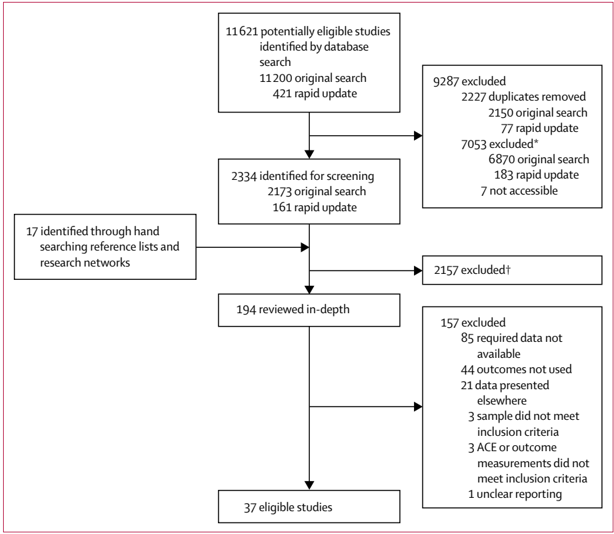
- From 11,621 references, 37 studies were included, providing risk estimates for 23 outcomes and 253,719 participants; most studies were from high-income countries, with nine samples from middle-income countries and none from low-income countries; 26 articles used cross-sectional data and 11 used cohort data, and all used retrospective, self-reported ACEs.
- Pooled ORs with 95% CIs were calculated using a random-effects model in StatsDirect; heterogeneity was assessed with I², publication bias with Begg-Mazumdar and Egger tests and funnel plots where at least ten samples were available, and sensitivity analyses and meta-regression were done in Stata.
Limitations
- The paper states that all included studies used retrospective ACE reports, which could be affected by recall or reporting bias; the number and types of ACEs varied, and summing ACEs does not account for different combinations or for variation in age at or length of exposure; confounding factors varied and some studies included no adjustments; genetic and environmental risks were largely unmeasured.
- The paper states that focusing on community settings likely excluded those with the most complex health problems (eg, homeless populations) and those who had already had ACE-related premature mortality; outcome measurement varied, rarer outcomes were less well covered by population surveys, and the study could only measure associations rather than establish causality.
- Evident from the text: most included samples came from high-income countries, with nine middle-income samples and none from low-income countries; heterogeneity was high for many outcomes; and visual funnel-plot assessment suggested possible missing small studies for smoking and early sexual initiation, although statistical tests for smoking were nonsignificant.
Model-written summary. Check it against the paper before relying on it.
Integrity signals
Registry
Cites
Statistics
Figures
Verification
Claims the paper makes
18 Valid · 0 Not valid · 4 Not checked · 126 Own results and interpretations
The sources with a verdict support this claim; the rest weren’t checked yet, have no full text we could read, or their verdicts aren’t rated yet.
In the paper
“However, five of the seven samples comprised students aged 18-25; 13 pooling of the remaining two samples 8,18 resulted in an OR of 12·53 (6·71-23·37; appendix).”
What the sources say
- Not checked — no full text of the sourcecites [8] 8 Ramiro LS, Madrid BJ, Brown DW. Adverse childhood experiences (ACE) and health-risk behaviors among adults in a developing country setting. Child Abuse Negl 2010; 34: 842-55. source
- Supportedcites [18] 18 Dube SR, Felitti VJ, Dong M, Giles WH, Anda RF. The impact of adverse childhood experiences on health problems: evidence from four birth cohorts dating back to 1900. Prev Med 2003; 37: 268-77 . source
The citation follows “the remaining two samples,” identifying studies used in the citing authors’ pooling rather than attributing the pooled estimate to either study. The cited paper’s Abstract describes a study of 17,337 adult HMO members that examined suicide attempts; its Methods identify the population as adult Kaiser Health Plan members. The OR of 12.53 is presented as the citing authors’ pooled result, not a result attributed to this source. (LLM, conf=0.85)
plainstates an associationn = 2- Asserted: passes — The authors put it forward as true.
- Checkable: passes — It can be checked against evidence.
- Load-bearing: unclear — It is unclear whether the paper’s conclusions depend on it.
- Based: passes — The paper gives a reason why it holds.
Every source the paper cites for this claim was checked and supports it.
In the paper
“However, five of the seven samples comprised students aged 18-25; 13 pooling of the remaining two samples 8,18 resulted in an OR of 12·53 (6·71-23·37; appendix).”
What the sources say
- Supportedcites [13] 13 Bellis MA, Hughes K, Leckenby N, et al. Adverse childhood experiences and associations with health-harming behaviours in young adults: surveys in eight eastern European countries. Bull World Health Organ 2014; 92: 641-55. source
The Attempted suicide section says respondents in seven of the eight countries were asked about suicide attempts. The Methods describe classroom surveys of students and state that the multi-study analyses were limited to respondents aged 18–25, supporting this paper's inclusion among the student samples described in the citing sentence. (LLM, conf=0.90)
plainn = 5- Asserted: passes — The authors put it forward as true.
- Checkable: passes — It can be checked against evidence.
- Load-bearing: unclear — It is unclear whether the paper’s conclusions depend on it.
- Based: passes — The paper gives a reason why it holds.
- Supported
The sources with a verdict support this claim; the rest weren’t checked yet, have no full text we could read, or their verdicts aren’t rated yet.
In the paper
“Supported by international work to standardise measurement of ACEs and their effects on health, these findings have since been replicated in studies from low-income and middle-income 7,8 and high-income 2,9 countries.”
What the sources say
- Not checked — no full text of the sourcecites [7] 7 Almuneef M, Qayad M, Aleissa M, Albuhairan F. Adverse childhood experiences, chronic diseases, and risky health behaviors in Saudi Arabian adults: a pilot study. Child Abuse Negl 2014; 38: 1787-93. source
- Not checked — no full text of the sourcecites [8] 8 Ramiro LS, Madrid BJ, Brown DW. Adverse childhood experiences (ACE) and health-risk behaviors among adults in a developing country setting. Child Abuse Negl 2010; 34: 842-55. source
- Supportedcites [2] 2 Bellis MA, Hughes K, Leckenby N, Hardcastle KA, Perkins C, Lowey H. Measuring mortality and the burden of adult disease associated with adverse childhood experiences in England: a national survey. J Public Health 2015; 37: 445-54. source
The citation to this paper supports the high-income-country part of the sentence: its English national survey found a strong association between ACEs and adult morbidity and premature mortality. The low- and middle-income-country studies are attributed to other citations. The decisive passage is in “What this study adds”; no page number is supplied in our copy. (LLM, conf=0.90)
- Supportedcites [9] 9 Bellis MA, Hughes K, Leckenby N, Perkins C, Lowey H. National household survey of adverse childhood experiences and their relationship with resilience to health-harming behaviors in England. BMC Med 2014; 12: 72. source
Citation 9 is attached to the high-income-country portion of the sentence. The Methods describe a national household survey in England, and the Results report that adverse childhood experiences were associated with multiple health-harming behaviors after adjustment for deprivation and other demographics. The indexed copy does not provide page numbers. (LLM, conf=0.91)
plainstates an association- Asserted: passes — The authors put it forward as true.
- Checkable: passes — It can be checked against evidence.
- Load-bearing: unclear — It is unclear whether the paper’s conclusions depend on it.
- Based: passes — The paper gives a reason why it holds.
The cited sources support only part of this claim — read each source’s verdict below.
In the paper
“For teenage pregnancy, four studies 9,33-35 had measured unintended teenage pregnancy and these studies reported higher estimates than did those measuring any teenage pregnancy 8,14,21 (appendix).”
What the sources say
- Supportedcites [9] 9 Bellis MA, Hughes K, Leckenby N, Perkins C, Lowey H. National household survey of adverse childhood experiences and their relationship with resilience to health-harming behaviors in England. BMC Med 2014; 12: 72. source
The paper is one of the studies identified in the citing sentence as measuring unintended teenage pregnancy. Its Results report an adjusted odds ratio of 5.86 for that outcome among respondents with four or more ACEs versus none. The comparison with studies measuring any teenage pregnancy is the citing authors’ cross-study synthesis, not a comparison attributed to this individual paper. (LLM, conf=0.88)
- Not checked — no full text of the sourcecites [33] 33 Bellis MA, Lowey H, Leckenby N, Hughes K, Harrison D. Adverse childhood experiences: retrospective study to determine their impact on adult health behaviours and health outcomes in a UK population. J Public Health 2014; 36: 81-91. source
- Partly supportedcites [34] 34 Bellis MA, Ashton K, Hughes K, Ford K, Bishop J, Paranjothy S. Adverse childhood experiences and their impact on health-harming behaviours in the Welsh adult population. Cardiff: Public Health Wales, 2015. sourceExperimental — accuracy not yet measured
The section ‘ACEs and their association with unintended teenage pregnancy’ reports an estimate for unintended teenage pregnancy, so this paper supports its identification as a study measuring that outcome. It does not compare its estimate with studies measuring any teenage pregnancy or establish that four studies reported higher estimates. (LLM, conf=0.83)
- Not matchedcites [35] 35 Ford K, Butler N, Hughes K, Quigg Z, Bellis MA. Adverse childhood experiences (ACEs) in Hertfordshire, Luton and Northamptonshire. Liverpool: Liverpool John Moores University, 2016.
Its entry has no title and year that we can search by.
- Not checked — no full text of the sourcecites [8] 8 Ramiro LS, Madrid BJ, Brown DW. Adverse childhood experiences (ACE) and health-risk behaviors among adults in a developing country setting. Child Abuse Negl 2010; 34: 842-55. source
- Not checked yetcites [14] 14 Anda RF, Chapman DP, Felitti VJ, et al. Adverse childhood experiences and risk of paternity in teen pregnancy. Obstet Gynecol 2002; 100: 37-45. source
Checked before — its earlier verdict is held back until a new check runs.
- Not checked — no full text of the sourcecites [21] 21 Hillis SD, Anda RF, Dube SR, Felitti VJ, Marchbanks PA, Marks JS. The association between adverse childhood experiences and adolescent pregnancy, long-term psychosocial consequences, and fetal death. Pediatrics 2004; 113: 320-27 . source
plainstates an association- Asserted: passes — The authors put it forward as true.
- Checkable: passes — It can be checked against evidence.
- Load-bearing: unclear — It is unclear whether the paper’s conclusions depend on it.
- Based: passes — The paper gives a reason why it holds.
- Supported
Every source the paper cites for this claim was checked and supports it.
In the paper
“However, our criteria also meant that studies were excluded because of alternative data analysis methods (eg, analysis of the World Mental Health Surveys 51 ).”
What the sources say
- Supportedcites [51] 51 Kessler RC, McLaughlin KA, Green JG, et al. Childhood adversities and adult psychopathology in the WHO World Mental Health Surveys. Br J Psychiatry 2010; 97: 378-85. source
The Analysis methods section identifies this paper as an analysis of the World Mental Health Surveys and describes its discrete-time survival analysis using person-years. The statement that the citing review excluded it under its own criteria is the citing authors’ decision, not a claim the source needs to make. (LLM, conf=0.88)
plainstates a cause- Asserted: passes — The authors put it forward as true.
- Checkable: passes — It can be checked against evidence.
- Load-bearing: unclear — It is unclear whether the paper’s conclusions depend on it.
- Based: passes — The paper gives a reason why it holds.
- Supported
53 more claims · 2 with their cited sources checked
Create a free account to see all 148 claims and to verify the 1 reference still open.
- It may state two separate claims as one. 44
- Probably not a substantial claim. 27
- The quote only partly states this claim. 31
Claims other papers make about this one
Each is checked against this paper’s own text: does it say what the citing paper says it does?
The source backs part of the claim, not all of it — or backs it for a different population, condition or comparison.
In the citing paper
“Early adverse life experiences, negative affectivity, neuroticism, depression, and anxiety have been identified as psycho logical predisposing conditions for persistent physical symptoms”
From Persistent physical symptoms: definition, genesis, and management (2024) · cites this paper as [64]
Experimental — accuracy not yet measuredThe source backs part of the claim, not all of it — or backs it for a different population, condition or comparison.
In the citing paper
“The impact of childhood abuse, neglect, and violence exposure on adult physical and emotional health and behaviors is significant and well documented”
From Intergenerational effects of childhood maltreatment: A systematic review of the parenting practices of adult survivors of childhood abuse, neglect, and violence. (2020) · cites this paper as Hughes et al., 2017
Experimental — accuracy not yet measuredThe source backs part of the claim, not all of it — or backs it for a different population, condition or comparison.
In the citing paper
“Early institutional rearing is associated with adverse biological and health outcomes in later life, including accelerated cellular aging as measured by telomere length.”
From Telomere trajectories from early adolescence to adulthood following early institutionalization: Protective effects of foster care in the Bucharest Early Intervention Project (2026) · cites this paper as Hughes et al., 2017
Experimental — accuracy not yet measuredThe source backs part of the claim, not all of it — or backs it for a different population, condition or comparison.
In the citing paper
“Individuals exposed to early life adversity are at increased risk of developing a broad spectrum of age-related illnesses at a young age, resulting in shorter health span, referring to the period of life free from chronic disease (Chandan et al., 2020; Hughes et al., 2017).”
From Telomere trajectories from early adolescence to adulthood following early institutionalization: Protective effects of foster care in the Bucharest Early Intervention Project (2026) · cites this paper as Hughes et al., 2017
Experimental — accuracy not yet measuredThe source backs part of the claim, not all of it — or backs it for a different population, condition or comparison.
In the citing paper
“This aligns with findings that ACEs are linked not only with SUD onset, but also with broader emotional and interpersonal dysregulation [4, 6].”
From The link of adverse childhood experiences and attachment to maladaptive personality traits in adults diagnosed with substance use disorder (2025) · cites this paper as [4]
Experimental — accuracy not yet measured
7 more claims about this paper
Create a free account to see every claim other papers make about this one.
Self-check
Percentages, sums and reported differences re-computed from the paper’s own numbers.
Each contradiction between two passages listed here was confirmed by an independent check.
Rated minor: it would not touch a result — a value no result rests on, a p-value that stays on the same side of the significance level, or a conflict that is clerical, resolved elsewhere in the paper, or outside its own findings.
In the paper
§ Summary
“respiratory disease (ORs of two to three)”
§ Discussion
“| Respiratory disease | 3·05 (2·47-3·77)”
Citations
Cites
Felitti, V. J., Anda, R. F., Nordenberg, D., Williamson, D. F., Spitz, A. M., Edwards, V., Koss, M. P., & Marks, J. S. (1998) · American Journal of Preventive Medicine · doi:10.1016/s0749-3797(98)00017-8 · Cited by 18,943
Global status report on noncommunicable diseases 2010.
Alwan, A. (2011) · Cited by 8,494
Forouzanfar, M. H., Afshin, A., Alexander, L. T., Anderson, H. R., Bhutta, Z. A., Biryukov, S., Brauer, M., Burnett, R., Cercy, K., Charlson, F. J., et al. (2016) · The Lancet · doi:10.1016/s0140-6736(16)31679-8 · Cited by 7,698
Wang, H., Naghavi, M., Allen, C., Barber, R. M., Bhutta, Z. A., Carter, A., Casey, D. C., Charlson, F. J., Chen, A. Z., Coates, M. M., et al. (2016) · The Lancet · doi:10.1016/s0140-6736(16)31012-1 · Cited by 6,596
Anda, R. F., Felitti, V. J., Bremner, J. D., Walker, J. D., Whitfield, C., Perry, B. D., Dube, S. R., & Giles, W. H. (2006) · European archives of psychiatry and clinical neuroscience · doi:10.1007/s00406-005-0624-4 · Cited by 4,292
Norman, R. E., Byambaa, M., De, R., Butchart, A., Scott, J., & Vos, T. (2012) · PLoS Medicine · doi:10.1371/journal.pmed.1001349 · Cited by 3,387
Self-citationValidity of adult retrospective reports of adverse childhood experiences: review of the evidence
Hardt, J., & Rutter, M. (2004) · Journal of Child Psychology and Psychiatry · doi:10.1111/j.1469-7610.2004.00218.x · Cited by 2,827
Childhood adversities and adult psychopathology in the WHO World Mental Health Surveys
Kessler, R. C., McLaughlin, K. A., Green, J. G., Gruber, M. J., Sampson, N. A., Zaslavsky, A. M., Aguilar-Gaxiola, S., Alhamzawi, A. O., Alonso, J., Angermeyer, M., et al. (2010) · British Journal of Psychiatry · doi:10.1192/bjp.bp.110.080499 · Cited by 2,640
Impact of child sexual abuse: A review of the research.
Browne, A., & Finkelhor, D. (1986) · Psychological Bulletin · doi:10.1037/0033-2909.99.1.66 · Cited by 2,590
Adverse childhood experiences, allostasis, allostatic load and age-related disease
Danese, A., & McEwen, B. S. (2012) · Physiology & Behavior · doi:10.1016/j.physbeh.2011.08.019 · Cited by 2,140
Cited by
Items 1,501–1,600 of 5,221
Eid, K., Bjørk, M., Gilhus, N. E., & Torkildsen, Ø. (2024) · International Journal of Molecular Sciences · doi:10.3390/ijms25031520 · Cited by 18
“ACEs are associated with a range of behavioral and lifestyle factors that are also associated with increased MS risk, such as smoking, high body mass index, adverse socioeconomic status, and physical inactivity [4,25,73–75].”
BackgroundBelisle, L. A., Pinchevsky, G. M., & Ortega, G. (2024) · Child Abuse & Neglect · doi:10.1016/j.chiabu.2023.106514 · Cited by 15
Bauer, A., Martins, R. C., Hammerton, G., Hoffmann, M. S., Cardoso, A. S., Colvara, C. C., Hartmann, C. F., Calegaro, G., Perrone, L. R., Aurélio, N. H. S., et al. (2024) · Psychiatry Research · doi:10.1016/j.psychres.2024.115809 · Cited by 18
“In line with previous research (Hughes et al., 2017), our findings provide further support for an important cumulative effect of ACEs on crime — there was a roughly stepwise progression in risk, with exposure to 2 + , 3 + , and 4 + ACEs being associated with up to 3-fold increased odds for violent…”
BackgroundResultInfluentialAdverse childhood experiences, sarcopenia, and social participation in older adults: a cohort study
Huang, R., Li, Y., Ma, C., Ren, R. C., Yuan, X., Peng, Y., & Wang, D. (2024) · BMC Public Health · doi:10.1186/s12889-024-18138-0 · Cited by 14
“ACEs are defined as exposure to a series of traumatic events or potentially stressful events during childhood, typically including direct or indirect emotional and physical neglect, abuse, family challenges, and other stress events [4].”
BackgroundInfluentialCooper, H., Simpson, J., Dale, M., & Eccles, F. J. R. (2024) · Journal of Genetic Counseling · doi:10.1002/jgc4.1886 · Cited by 14
“Adverse childhood experiences (ACEs) have been associated with psychological distress and poor physical health outcomes in non-HD populations (e.g., Hughes et al., 2017).”
Panagou, C., & MacBeth, A. M. (2024) · Child Abuse & Neglect · doi:10.1016/j.chiabu.2024.106811 · Cited by 22
Zeng, Q., Ding, J., Tu, R., He, H., Wang, S., Huang, Y., Wang, Z., Chen, Q., Lu, G., & Li, Y. (2024) · Journal of Affective Disorders · doi:10.1016/j.jad.2024.05.087 · Cited by 14
“Third, poor CF may increase the likelihood of engaging in risky behaviour in adolescence and adulthood such as smoking; and drinking, which are also possibly associated with impaired physical function [27].”
BackgroundResultMolero-Zafra, M., Fernández‐García, O., Mitjans-Lafont, M. T., Pérez‐Marín, M., & Hernández-Jiménez, M. J. (2024) · Frontiers in Psychiatry · doi:10.3389/fpsyt.2024.1360388 · Cited by 32
Stress and Trauma Among Nurses in Development (STAND): A Descriptive Study
Gilroy, H., Anderson, K. S., Berry, D. M., Hirsch, S. A., Makiya, D. J., & Ratcliff, C. G. (2024) · Issues in Mental Health Nursing · doi:10.1080/01612840.2024.2352588 · Cited by 14
“In the general population, 2%–13% of adults report four or more ACEs (Hughes et al., 2017; Kessler et al., 2010).”
Fadeeva, A., Hashemi, L., Cooper, C., Stewart, R. J., & McManus, S. (2024) · Journal of Affective Disorders · doi:10.1016/j.jad.2024.07.073 · Cited by 17
Allen, K., Meléndez‐Torres, G. J., Ford, T. J., Bonell, C. P., & Berry, V. (2024) · BMC Public Health · doi:10.1186/s12889-024-19694-1 · Cited by 18
“Furthermore, evidence suggests these ACEs tend to be inter-generational, with those who experience parental DVA, MH, and SU during childhood being at increased risk of developing problems with violence, MH, and SU themselves, later on in life [13].”
BackgroundYang, P., Kuo, J., Hart, C. A., Zia, S., & Grigsby, T. J. (2024) · Trauma Violence & Abuse · doi:10.1177/15248380241275972 · Cited by 16
Xu, P., Liu, Z., Xu, Y., Li, T., Xu, G., Xu, X., Wang, L., Yan, Y., Xiao, S., Li, L., et al. (2024) · The Lancet Regional Health - Western Pacific · doi:10.1016/j.lanwpc.2024.101253 · Cited by 25
Kreshpaj, B., Elsenburg, L. K., Andersen, S. H., de Vries, T. R., Thielen, K., & Rod, N. H. (2024) · The Lancet Public Health · doi:10.1016/s2468-2667(24)00242-1 · Cited by 13
Wilson, C., Butler, N., Quigg, Z., Moore, D., & Bellis, M. A. (2024) · BMC Medicine · doi:10.1186/s12916-024-03821-1 · Cited by 19
“…experiencing ACEs and adulthood health outcomes showed that those who suffered four or more ACEs were more likely to experience mental health difficulties, engage in health risk behaviours, and be involved in violence as a victim or perpetrator, compared to those who experienced no ACEs [17].”
Self-citationProfiles of adversity and resilience resources: A latent class analysis of two samples
Lines, R. L. J., Crane, M. F., Ducker, K. J., Ntoumanis, N., Thøgersen‐Ntoumani, C., Fletcher, D., & Gucciardi, D. F. (2019) · British Journal of Psychology · doi:10.1111/bjop.12397 · Cited by 20
“Doi: 10.1161/circoutcomes.115.002184 Hughes, K., Bellis, M. A., Hardcastle, K. A., Sethi, D., Butchart, A., Mikton, C., ... & Dunne, M. P. (2017).”
InfluentialCumulative Risk of Substance Use in Community College Students
García, F. I. S., Bursac, Z., & Derefinko, K. J. (2020) · American Journal on Addictions · doi:10.1111/ajad.12983 · Cited by 18
Bager, L., Agerbo, E., Skipper, N., Thøgersen, M. H., & Laursen, T. M. (2020) · Acta Psychiatrica Scandinavica · doi:10.1111/acps.13203 · Cited by 16
Pearson, R. J., Jay, M. A., Wijlaars, L. P. M. M., Stavola, B. L. D., Syed, S., Bedston, S., & Gilbert, R. E. (2020) · BMJ Open · doi:10.1136/bmjopen-2019-036564 · Cited by 12
Mo, X., Gai, R. T., Tachibana, Y., Bolt, T., Takahashi, Y., & Nakayama, T. (2020) · BMC Public Health · doi:10.1186/s12889-020-09397-8 · Cited by 15
“As adverse childhood experiences (ACEs) often intertwine with child maltreatment, cluster in children’s lives and cumulatively lead to poor health outcomes, we pooled the ORs from a recent systematic review and meta-analysis for the effect of multiple ACEs on health [5], rather than that for each category of child mal…”
BackgroundMethodResultInfluentialVoisin, D. R., & Takahashi, L. M. (2021) · Journal of Adolescent Health · doi:10.1016/j.jadohealth.2020.11.015 · Cited by 14
Zur Komorbidität von Posttraumatischer Belastungsstörung und Sucht in biopsychosozialer Perspektive
Kapfhammer, H. (2021) · Neuropsychiatrie · doi:10.1007/s40211-020-00384-4 · Cited by 12
Batty, G. D., & Kivimäki, M. (2021) · Journal of Epidemiology & Community Health · doi:10.1136/jech-2020-215870 · Cited by 12
Abuso sexual temprano y su impacto en el bienestar actual del adulto
Murillo, J. A., Mendiburo‐Seguel, A., Santelices, M. P., Araya, P., Narváez, S., Piraino, C., Martínez, J., & Hamilton, J. (2021) · Psicoperspectivas Individuo y Sociedad · doi:10.5027/psicoperspectivas-vol20-issue1-fulltext-2043 · Cited by 15
Coid, J. W., Zhang, Y., Bebbington, P., Ullrich, S., Stavola, B. L. D., Bhui, K. S., & Tsai, A. C. (2021) · SSM - Population Health · doi:10.1016/j.ssmph.2021.100858 · Cited by 16
Kisely, S. R., Strathearn, L., & Najman, J. M. (2021) · Psychosomatic Medicine · doi:10.1097/psy.0000000000001029 · Cited by 15
Demakakos, P., Steptoe, A., & Mishra, G. D. (2022) · BJOG An International Journal of Obstetrics & Gynaecology · doi:10.1111/1471-0528.17088 · Cited by 12
Adverse childhood experiences and diurnal cortisol patterns in older people in England
Demakakos, P., & Steptoe, A. (2022) · Psychoneuroendocrinology · doi:10.1016/j.psyneuen.2022.105798 · Cited by 16
“They are associated with multiple chronic conditions in adulthood (Hughes et al., 2017; Norman et al., 2012; Suglia et al., 2018) and are important to better understand population health.”
BackgroundPatterns of adverse childhood experiences and cardiovascular risk factors in U.S. adults
Wooldridge, J. S., Tynan, M. E., Rossi, F. S., Gasperi, M., McLean, C. L., Bosch, J. O., TRIVEDI, R. B., Herbert, M. S., & Afari, N. (2022) · Stress and Health · doi:10.1002/smi.3167 · Cited by 16
Sosnowski, D. W., Rojo‐Wissar, D. M., Smail, E. J., Musci, R. J., Wilcox, H. C., & Johnson, S. B. (2022) · Emerging Adulthood · doi:10.1177/21676968221114260 · Cited by 14
“Adverse childhood experiences have been associated with negative mental and behavioral health outcomes ranging from anxiety and depression to obesity, risky sexual behavior, substance abuse, and premature mortality (Grummitt, Kreski, et al., 2021; Hughes et al., 2017; Kalmakis & Chandler, 2015).”
BackgroundNichter, B., Koller, D., Angelis, F. D., Wang, J., Girgenti, M. J., Na, P. J., Hill, M. L., Norman, S. B., Krystal, J. H., Gelernter, J. E., et al. (2022) · Psychological Medicine · doi:10.1017/s0033291722003646 · Cited by 11
Zara, S., Brähler, E., Sachser, C., Fegert, J. M., Häuser, W., Krakau, L., Kampling, H., & Kruse, J. (2022) · Annals of Epidemiology · doi:10.1016/j.annepidem.2022.12.004 · Cited by 12
Payne-Sturges, D., Ballard, E., Cory‐Slechta, D. A., Thomas, S. B., & Hovmand, P. S. (2023) · Environmental Research · doi:10.1016/j.envres.2023.115295 · Cited by 16
On the road to resilience: Epigenetic effects of meditation
Verdone, L., Caserta, M., Ben‐Soussan, T. D., & Venditti, S. (2023) · Vitamins and hormones · doi:10.1016/bs.vh.2022.12.009 · Cited by 12
Mental Health and Violence in Children and Adolescents
Kemal, S., Nwabuo, A., & Hoffmann, J. A. (2023) · Pediatric Clinics of North America · doi:10.1016/j.pcl.2023.06.011 · Cited by 22
Békés, V., Szabó, D., Lévay, E., Salgó, E., & Unoka, Z. (2023) · Journal of Personality Disorders · doi:10.1521/pedi.2023.37.4.406 · Cited by 20
Effects of Psychosocial Adversity on School Maladjustment: A Follow-up of Primary School Students
Vargas, B., Leiva, L., Andrade, R. M. R., & Squicciarini, A. M. (2019) · Psicología Educativa · doi:10.5093/psed2019a10 · Cited by 23
“God Spoke to Me”: Subjective Paranormal Experience and the Homeostatic Response to Early Trauma
Marks, D. F. (2020) · Imagination Cognition and Personality · doi:10.1177/0276236620934003 · Cited by 14
“A systematic review found that individuals with at least four abusive childhood experiences (ACEs) are at increased risk of multiple health outcomes compared with individuals with no ACEs (Hughes et al., 2017).”
BackgroundMotor problems in children with severe emotional and behavioural difficulties
Taylor, B., Hanna, D., & McPhillips, M. (2019) · British Journal of Educational Psychology · doi:10.1111/bjep.12327 · Cited by 18
Segeren, M. W., Fassaert, T. J. L., de Wit, M. A. S., Grimbergen, C., & Popma, A. (2020) · Child Abuse & Neglect · doi:10.1016/j.chiabu.2019.104354 · Cited by 16
Shaikh, K., Premji, S., Lalani, S. B., Forcheh, N., Dosani, A., Yim, I. S., Samia, P., Naugler, C. T., & Letourneau, N. L. (2020) · Journal of Affective Disorders · doi:10.1016/j.jad.2020.01.180 · Cited by 14
Batty, G. D., & Hamer, M. (2020) · American Journal of Epidemiology · doi:10.1093/aje/kwaa079 · Cited by 12
Hege, A., Bouldin, E. D., Roy, M., Bennett, M., Attaway, P. R., & Reed-Ashcraft, K. B. (2020) · International Journal of Environmental Research and Public Health · doi:10.3390/ijerph17228548 · Cited by 17
“Previous studies have found that ACEs or maltreatment in childhood are associated with poorer self-rated health or lower health-related quality of life in adulthood [7,46].”
BackgroundInfluentialSmall, E., Kim, Y. K., & Yu, M. (2021) · Sexuality & Culture · doi:10.1007/s12119-020-09799-1 · Cited by 15
Moon, D.-S., Bong, S.-J., Kim, B.-N., & Kang, N. R. (2021) · Journal of korean Academy of Child and Adolescent Psychiatry · doi:10.5765/jkacap.200041 · Cited by 14
Wigham, S., Hatton, C., & Taylor, J. L. (2021) · Research in Developmental Disabilities · doi:10.1016/j.ridd.2021.103914 · Cited by 12
Helton, J. J., Vaughn, M. G., & Schiff, M. (2021) · Child Abuse & Neglect · doi:10.1016/j.chiabu.2021.105447 · Cited by 13
Bornscheuer, L., Lundin, A., Forsell, Y., Lavebratt, C., & Melas, P. A. (2022) · Scientific Reports · doi:10.1038/s41598-022-08980-w · Cited by 13
The Association Between Discrimination and Falling. A National Sample of Older Adults
Ortiz, C. A. R., Campo‐Arias, A., Ocampo-Chaparro, J. M., Moncayo-Hernández, B. A., Lee, T., & Luque, J. S. (2022) · Journal of Aging and Health · doi:10.1177/08982643211052364 · Cited by 12
“Both recent and early life exposure to discrimination reflects psychological trauma that may have late health consequences in older adults (Hughes et al., 2017; Wong & Waite, 2017), where any or recurrent falling is a likely possibility as we showed in our study.”
ResultBuilding Resilience in Childhood and Adolescence
(2019) · Journal of Pediatric Health Care · doi:10.1016/j.pedhc.2019.06.008 · Cited by 14
“ACEs include but are not limited to childhood physical, emotional, psychological, or verbal abuse; sexual abuse; household substance abuse; household mental illness; exposure to domestic violence; parental separation or divorce; household criminality; neglect; family financial problems or conflict; bullying; death of…”
BackgroundInfluentialGao, R., Liang, L., Yue, J., Song, Q., Zhao, X., Fei, J., Hu, Y., Lv, J., Yuan, T., Guo, X., et al. (2022) · Journal of Affective Disorders · doi:10.1016/j.jad.2022.09.115 · Cited by 14
Núñez, D., Gaete, J., Guajardo, V., Libuy, N., Araneda, A. M., Contreras, L., Donoso, P., Ibáñez, C. F., & Mundt, A. P. (2022) · Archives of Suicide Research · doi:10.1080/13811118.2022.2134067 · Cited by 14
Delivering national public mental health – experience from England
Walker, I., Stansfield, J., Makurah, L., Garnham, H., Robson, C., Lugton, C., Hey, N., & Henderson, G. (2019) · Journal of Public Mental Health · doi:10.1108/jpmh-06-2018-0032 · Cited by 15
Tobón, A. L., Condon, E. M., Sadler, L. S., Holland, M. L., Mayes, L. C., & Slade, A. (2021) · Development and Psychopathology · doi:10.1017/s0954579420001923 · Cited by 12
Developmental pathways from preschool temper tantrums to later psychopathology
Hoyniak, C. P., Donohue, M. R., Quiñones-Camacho, L. E., Vogel, A. C., Perino, M. T., Hennefield, L., Tillman, R., Barch, D. M., & Luby, J. L. (2023) · Development and Psychopathology · doi:10.1017/s0954579422000359 · Cited by 12
“Three plausible covariates, (1) child sex, (2) child race, and (3) preschool adverse childhood experiences (ACEs), were examined based on prior associations with temper tantrums and psychopathology (Hughes et al., 2017; Roberts et al., 2018; Wakschlag et al., 2012).”
Kascakova, N., Petrikova, M., Furstova, J., Hasto, J., Geckova, A. M., & Tavel, P. (2022) · BMC Public Health · doi:10.1186/s12889-022-14160-2 · Cited by 14
“[9] found 11,621 studies concerning the effects of childhood trauma on later health and ultimately revealed from 37 studies comprising 253,719 participants that 4 or more adverse childhood experiences increase the risk of overweight, obesity and diabetes (odds ratio (OR) = 2); moderately increase health-risk behaviour…”
BackgroundMadigan, S. L., Plamondon, A., & Jenkins, J. M. (2025) · Journal of Child Psychology and Psychiatry · doi:10.1111/jcpp.14118 · Cited by 14
Troy, D. M., Russell, A. E., Kidger, J., & Wright, C. (2021) · Journal of Child Psychology and Psychiatry · doi:10.1111/jcpp.13379 · Cited by 13
“…types of adversity (e.g. Bryant & Range, 1995; McCauley et al., 1997), but also on the cumulative impacts of multiple types of adversity, with studies showing a gradient of increasingly poor health associated with exposure to more types of adversity (Bellis et al., 2019; Hughes et al., 2017).”
BackgroundResultInfluentialIshikawa, K., Azuma, N., & Ohka, M. (2022) · Frontiers in Psychology · doi:10.3389/fpsyg.2022.852467 · Cited by 11
Nicklas, L., Albiston, M., Dunbar, M., Gillies, A. C., Hislop, J., Moffat, H., & Thomson, J. (2022) · BMC Health Services Research · doi:10.1186/s12913-022-08158-0 · Cited by 18
Najman, J. M., Clavarino, A. M., McGee, T. R., Middeldorp, C. M., Williams, G. M., & Scott, J. G. (2022) · Journal of Psychiatric Research · doi:10.1016/j.jpsychires.2022.09.020 · Cited by 12
Roth, A., Meigen, C., Hiemisch, A., Kieß, W., & Poulain, T. (2023) · International Journal of Environmental Research and Public Health · doi:10.3390/ijerph20021050 · Cited by 16
“Examples of potential negative effects include obesity and overweight [11], early-onset depression [12], and increased suicidality [10].”
BackgroundBradford, K. L. (2023) · Religions · doi:10.3390/rel14010125 · Cited by 21
Prevalence of Childhood Trauma in a Community-Based Mental Health Clinic
Sucich, J. T., Breitbart, V., Williams, S. Z., Sanichar, N., Candelaria-Arce, E., Frankle, W. G., & Davison-Duffy, S. (2023) · Community Mental Health Journal · doi:10.1007/s10597-023-01094-1 · Cited by 18
“A systematic review and meta-analysis by Hughes et al. found moderate associations between ACEs and heavy alcohol use and smoking and strong associations with poor mental health, problematic alcohol use and sexual risk taking behaviors (Hughes et al., 2017).”
BackgroundMethodInfluentialLetourneau, N. L., Anis, L., Novick, J., Pohl, C., Ntanda, H. N., & Hart, M. J. (2023) · International Journal of Environmental Research and Public Health · doi:10.3390/ijerph20043078 · Cited by 15
Vahedi, L., Orjuela‐Grimm, M., Bhatt-Carreño, S., & Meyer, S. R. (2023) · PLoS ONE · doi:10.1371/journal.pone.0281961 · Cited by 16
“stress-inducing form of trauma which engenders nutrition-related consequences in childhood and adolescence (as seen in this review), and into adulthood [15].”
BackgroundMira, R. S., Newton, T., & Sabbah, W. (2023) · Journal of the American Medical Directors Association · doi:10.1016/j.jamda.2023.01.009 · Cited by 12
Cruz, T. H., Ross‐Reed, D. E., FitzGerald, C. A., Overton, K., Landrau-Cribbs, E., & Schiff, M. A. (2023) · Journal of School Health · doi:10.1111/josh.13297 · Cited by 20
Wiss, D. A., Prelip, M. L., Upchurch, D. M., Ehrenstein, O. S. V., Tomiyama, A. J., Gorbach, P. M., & SHOPTAW, S. J. (2023) · Journal of Urban Health · doi:10.1007/s11524-023-00719-w · Cited by 14
“Estimated odds ratios between multiple ACEs and depressive and anxiety symptoms from the current study are approximately half of those reported in meta-analytic findings comparing those with 4 or more ACEs to those with none [3].”
BackgroundDollberg, D. G., & Hanetz‐Gamliel, K. (2023) · Frontiers in Child and Adolescent Psychiatry · doi:10.3389/frcha.2023.1094206 · Cited by 23
Short review on adverse childhood experiences, pelvic pain and endometriosis
Moussaoui, D., Joseph, K. E., & Grover, S. R. (2023) · Journal of Gynecology Obstetrics and Human Reproduction · doi:10.1016/j.jogoh.2023.102603 · Cited by 13
Loveday, S., Balgovind, M., Hall, T., Goldfeld, S. R., Sanci, L. A., & Hiscock, H. (2023) · Archives of Disease in Childhood · doi:10.1136/archdischild-2023-325473 · Cited by 13
The effect of childhood adversity on mental health in young adults: a longitudinal study
Villanueva, L., Adrián, J., & Pomares, A. G. (2023) · Current Psychology · doi:10.1007/s12144-023-04831-7 · Cited by 18
Amos, R., Cresswell, K., Hughes, K. E., & Bellis, M. A. (2023) · International Journal of Environmental Research and Public Health · doi:10.3390/ijerph20176633 · Cited by 16
Self-citationTelfar, S., McLeod, G. F. H., Dhakal, B., Henderson, J. M. T., Tanveer, S., Broad, H. E. T., Woolhouse, W., Macfarlane, S., & Boden, J. M. (2023) · Child Abuse & Neglect · doi:10.1016/j.chiabu.2023.106444 · Cited by 18
Bränn, E., Vaina, A., Daníelsdóttir, H. B., Thordardottir, E. B., Yang, Q., Jakobsdóttir, J., Aspelund, T., Hauksdóttir, A., Valdimarsdóttir, U. A., & Lu, D. (2023) · Archives of Women s Mental Health · doi:10.1007/s00737-023-01369-2 · Cited by 17
“…events that occur in childhood (e.g., emotional and physical abuse or neglect and growing up in dysfunctional home environments) and can harm the child’s development and health through changes in the development of the nervous, endocrine, and immune systems under distress (Hughes et al. 2017).”
BackgroundAngeles, W. W. L.-D. L. (2023) · Academic Pediatrics · doi:10.1016/j.acap.2023.09.014 · Cited by 16
Alvarado, G., McBain, R. K., Chen, P. G., Estrada-Darley, I., Engel, C. C., Malika, N. M., Machtinger, E. L., McCaw, B. R., Thyne, S. M., Thompson, N., et al. (2023) · The Annals of Family Medicine · doi:10.1370/afm.3014 · Cited by 13
Mediating pathways that link adverse childhood experiences with cardiovascular disease
Carr, A. L., Massou, E., Kelly, M. P., & Ford, J. A. (2023) · Public Health · doi:10.1016/j.puhe.2023.11.027 · Cited by 13
Hunt, C., Vinograd, M., Glynn, L. M., Davis, E. P., Baram, T. Z., Stern, H. S., Nievergelt, C. M., Cuccurazzu, B., Napan, C., Delmar, D., et al. (2023) · Journal of Mood and Anxiety Disorders · doi:10.1016/j.xjmad.2023.100045 · Cited by 14
“There is clear evidence that early-life adversity impacts neuro-development and subsequent risk for mood and anxiety disorders [31, 47].”
de Jongh, A., Hafkemeijer, L., Hofman, S., Slotema, K., & Hornsveld, H. K. (2024) · Frontiers in Psychiatry · doi:10.3389/fpsyt.2024.1331876 · Cited by 49
Adverse childhood experiences and unhealthy dietary behaviours in adulthood
Testa, A. M., Zhang, L., Jackson, D. B., Ganson, K. T., Raney, J. H., & Nagata, J. M. (2024) · Public Health Nutrition · doi:10.1017/s1368980024000144 · Cited by 17
“Having experienced four or more ACE is a critical threshold associated with a significantly elevated risk of poor health outcomes, as it amplifies the cumulative and synergistic impact of early-life adversities on physical and mental well-being (8) .”
BackgroundResultTaylor, K., & Demakakos, P. (2024) · Child Abuse & Neglect · doi:10.1016/j.chiabu.2024.106653 · Cited by 13
The Influence of Childhood Trauma on Multiple Unhealthy Lifestyle Behaviors in Adulthood
Tong, L., Kuzminskaite, E., Hovens, J. G. F. M., Jeuring, H. W., Krause-Utz, A., Vinkers, C. H., & Penninx, B. W. J. H. (2024) · Journal of Aggression Maltreatment & Trauma · doi:10.1080/10926771.2024.2307380 · Cited by 14
“…has a modest impact on weight management (Danese & Tan, 2014; Hughes et al., 2017; Lang et al., 2020), high impact on smoking and illicit drug use (Hughes et al., 2017; Ramiro et al., 2010), negative impact on sleep duration (Schonning et al., 2022; Sullivan et al., 2019), and non-significant…”
BackgroundResultInfluentialBriere, J., Runtz, M., & Rodd, K. (2024) · Journal of Interpersonal Violence · doi:10.1177/08862605231225524 · Cited by 17
“ACE items and the total scale have been used in numerous studies (e.g., Hughes et al., 2017; Sahle et al., 2022) and have been shown to be valid measures of childhood adversities.”
MethodTrauma-Informed Care Training in Forensic Mental Health Services: A Scoping Review
Simjouw, A., de Vogel, V., & de Ruiter, C. (2024) · International Journal of Forensic Mental Health · doi:10.1080/14999013.2024.2323934 · Cited by 17
“Experiencing ACEs is also strongly associated with risk of interpersonal and self-directed violence (Hughes et al., 2017).”
Baiden, P., Graaf, G., Okine, L., & LaBrenz, C. A. (2024) · Social Work in Public Health · doi:10.1080/19371918.2024.2323137 · Cited by 13
“%) children had at least one ACE is also consistent with prior studies (Crouch, Radcliff, Hung, & Bennett, 2019; Hughes et al., 2017; Jackson, Chilton, Johnson, & Vaughn, 2019) and underscores the prevalent nature of ACEs (Butchart, Mikton, Dahlberg, & Krug, 2015).”
ResultLageborn, C. T., Zhou, M., Boman, M., Sjölander, A., Larsson, H., D'Onofrio, B. M., Pettersson, E., Lichtenstein, P., & Landén, M. (2024) · Journal of Child Psychology and Psychiatry · doi:10.1111/jcpp.13982 · Cited by 16
Blangis, F., Drouin, J., Launay, E., Miranda, S., Zureik, M., Cohen, J. F., Weill, A., Dray‐Spira, R., & Chalumeau, M. (2024) · The Lancet Regional Health - Europe · doi:10.1016/j.lanepe.2024.100921 · Cited by 17
“14 In this context, early CPA is a target of various primary preventive interventions based on universal campaigns promoting parental education on the harmful effects of violence on children or home visits for at-risk populations.”
BackgroundYuan, M., He, Y., Wang, F., Wen, X., Tong, Y., Zhu, D., Wang, G., & Su, P. (2024) · Child Abuse & Neglect · doi:10.1016/j.chiabu.2024.106861 · Cited by 13
Wang, Y., & Meng, W. (2024) · Frontiers in Psychology · doi:10.3389/fpsyg.2024.1374932 · Cited by 13
Mitani, H., Kondo, N., Amemiya, A., & Tabuchi, T. (2024) · BMJ Open · doi:10.1136/bmjopen-2023-082134 · Cited by 20
Psychosocial Determinants Conferring Resilience after TBI: Current Understanding
Semanision, K., Williams, R., Moran, E. E., & Rabinowitz, A. R. (2024) · Current Physical Medicine and Rehabilitation Reports · doi:10.1007/s40141-024-00461-7 · Cited by 15
“Although more research is needed, a history of ACEs is linked to negative mental health outcomes in numbers studies [31].”
Health Care Needs and Costs for Children Exposed to Prenatal Substance Use to Adulthood
Lee, E., SCHOFIELD, D. J., Dronavalli, M., Lawler, K., Uebel, H., Burns, L., Bajuk, B., Page, A., Gu, Y., Eastwood, J. G., et al. (2024) · Archives of Pediatrics and Adolescent Medicine · doi:10.1001/jamapediatrics.2024.2281 · Cited by 13
Fang, Z., Martin, M., Copeland, L., Evans, R., & Shenderovich, Y. (2024) · Trauma Violence & Abuse · doi:10.1177/15248380241266183 · Cited by 15
Sexual identity is associated with adverse childhood experiences (ACEs) in US early adolescents
Raney, J. H., Weinstein, S., Testa, A. M., Ganson, K., Memon, Z., Glidden, D. V., Baker, F. C., Brindis, C. D., & Nagata, J. M. (2024) · Academic pediatrics · doi:10.1016/j.acap.2024.07.022 · Cited by 12
Fasolato, R., Felice, M. D., Barbui, C., Bertani, M., Bonora, F., Castellazzi, M., Castelli, S., Cristofalo, D., Dall’Agnola, R. B., Ruggeri, M., et al. (2024) · Journal of Eating Disorders · doi:10.1186/s40337-024-01103-y · Cited by 17
“Research on psychological trauma has widely emphasized the dose–response effect between adverse childhood experiences and outcomes, recognizing the impact of the cumulative trauma (i.e., exposure to multiple types of adversities) on mental health [21, 22].”
BackgroundBlackwell, C. K., Cella, D. F., & Mansolf, M. A. (2024) · Child Abuse & Neglect · doi:10.1016/j.chiabu.2024.107050 · Cited by 17
White, B. M., Prasad, R., Ammar, N., Yaun, J. A., & Shaban‐Nejad, A. (2024) · JMIR Pediatrics and Parenting · doi:10.2196/58403 · Cited by 18
“Overwhelmingly, suicide rates are 30 times higher among adults with more than 4 ACEs, highlighting an urgent need for innovative solutions [31].”
BackgroundZhang, X., Merrin, G. J., & Slavich, G. M. (2024) · Child Abuse & Neglect · doi:10.1016/j.chiabu.2024.107129 · Cited by 14
Metadata
- Authors
- Hughes, K., Bellis, M. A., Hardcastle, K. A., Sethi, D., Butchart, A., Mikton, C., Jones, L., & Dunne, M. P.
- Affiliations
- Bangor University (GB)
- Public Health Wales (GB)
- World Health Organization Regional Office for Europe (DK)
- World Health Organization (CH)
- University of the West of England (GB)
- Liverpool John Moores University (GB)
- Queensland University of Technology (AU)
- Corresponding author
- Bellis, Mark A
- Venue
- The Lancet Public Health
- Publisher
- Elsevier BV
- Published
- 2017-08
- Volume
- 2
- Issue
- 8
- Pages
- e356-e366
- ISSN
- 2468-2667 (ISSN-L)
- OpenAlex
- W2740726397
- Semantic Scholar
- cdd633b48c3e902b5a7a012711d868cf5745c677
- Cited by
- 5,255
- References
- 70
- Citations by year
- 2026: 750 · 2025: 849 · 2024: 817 · 2023: 711 · 2022: 698 · 2021: 626 · 2020: 464 · 2019: 232 · 2018: 97 · 2017: 7
- FWCI
- 33.48
- Type
- journal article
- Language
- en
- Open access
- gold
- doi.org
- Licence
- cc-by-nc-nd
- www.elsevier.com/tdm/userlicense/1.0/ (tdm)
- creativecommons.org/licenses/by-nc-nd/4.0/ (vor)
- Locations
- The Lancet Public Health (publishedVersion, cc-by-nc-nd)
- PubMed (publishedVersion)
- Liverpool John Moores University (acceptedVersion)
- QUT ePrints (Queensland University of Technology) (submittedVersion, cc-by-nc-nd)
- UWE Research Repository (UWE Bristol) (submittedVersion, cc-by-nc-nd)
- DOAJ (DOAJ: Directory of Open Access Journals) (submittedVersion, cc-by-sa)
- Funders
- World Health Organization
- Public Health Wales
- Topics
- Social Sciences › Psychology › Clinical Psychology › Child Abuse and Trauma
- Social Sciences › Sociology and Political Science › Child Welfare and Adoption
- Social Sciences › Health › Intimate Partner and Family Violence
- Keywords
- adverse childhood experiences, child abuse, domestic violence exposure, substance use, sexual health, mental health, violence, physical health, physical activity, weight, resilience
- MeSH terms
- Health Status, Humans, Life Change Events
About these checks
Registry, retraction, Cites and statistics results are computed, not judged, with one exception: a printed reference that no index lists is read once by a model before it counts as a citation error. Claims are extracted by a model and kept only when their quote appears verbatim in the text; each cited source is then checked, with a model’s help, for whether it says what the claim relies on. Those verdicts can be wrong — read the claim’s quote and the cited source before relying on one.
The claim verdicts this report counts are experimental: their accuracy is not yet measured.
A language model drew the claims from the paper on 2026-09-28, under version 3 of the claim definition (prompt extract-v3).
A second model labelled each claim on 2026-09-28 (model jev-1.13-20260917, definition revision gold-guideline-v0.2).
Cited sources are checked with a language model’s help (gpt-6-sol).
Statistics and arithmetic are recomputed, not judged.
Confidence bands are shown only for fields calibrated on our annotated test set. None is calibrated yet, so no band is shown.
What counts as a claim ›How we measure confidence ›How we check this ›
Are you an author, or do you see a problem with this page? Request a review
Data sources
Bibliographic data: Semantic Scholar, OpenAlex, Crossref.
Contains information from the Semantic Scholar Academic Graph Datasets, made available under the ODC Attribution License (ODC-BY 1.0).
Semantic Scholar’s data is described in: Kinney, R., et al. (2023). The Semantic Scholar Open Data Platform. arXiv:2301.10140.
