

The DOI matches its Crossref record; 30 of the 31 references it cites were found in a registry or an index.
A mindfulness-based intervention to increase resilience to stress in university students (the Mindful Student Study): a pragmatic randomised controlled trial
Open accessAbstract
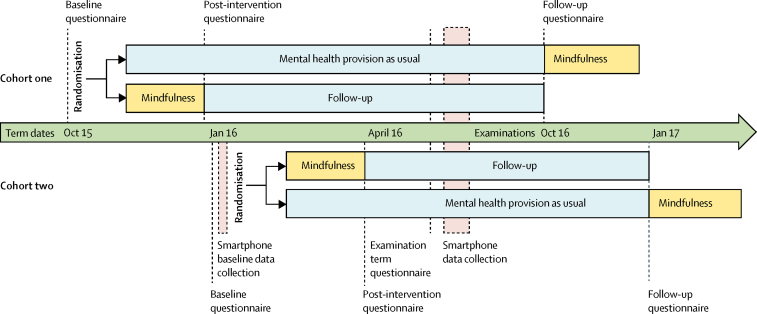
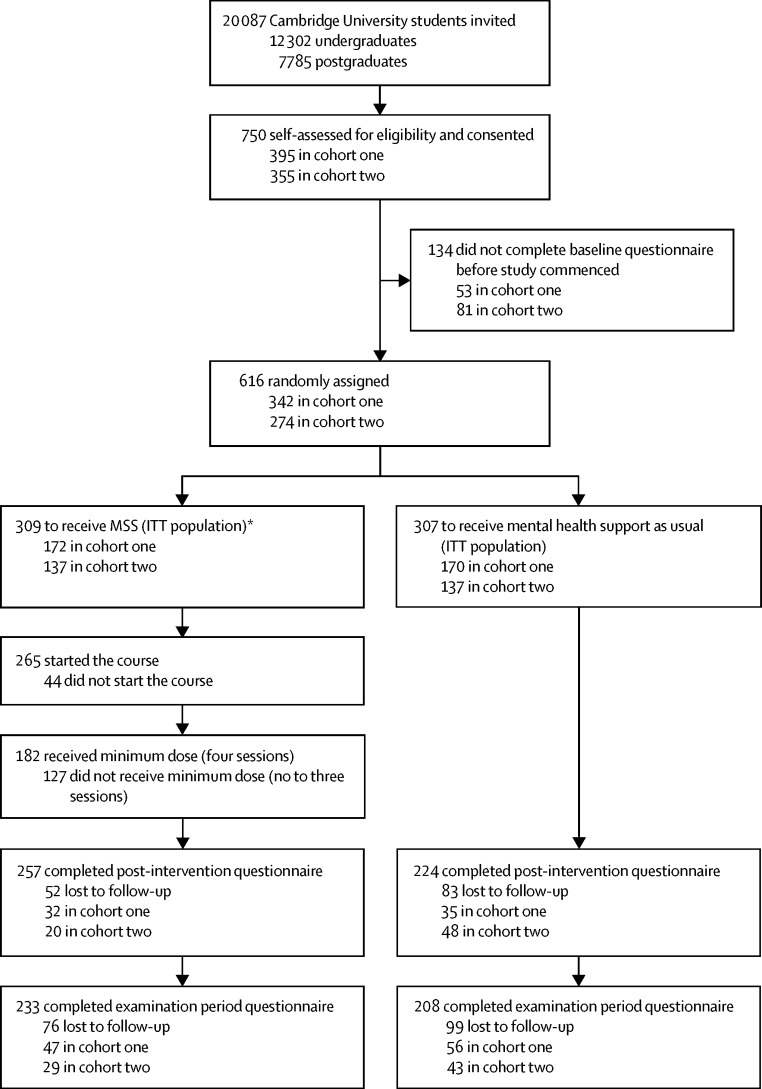
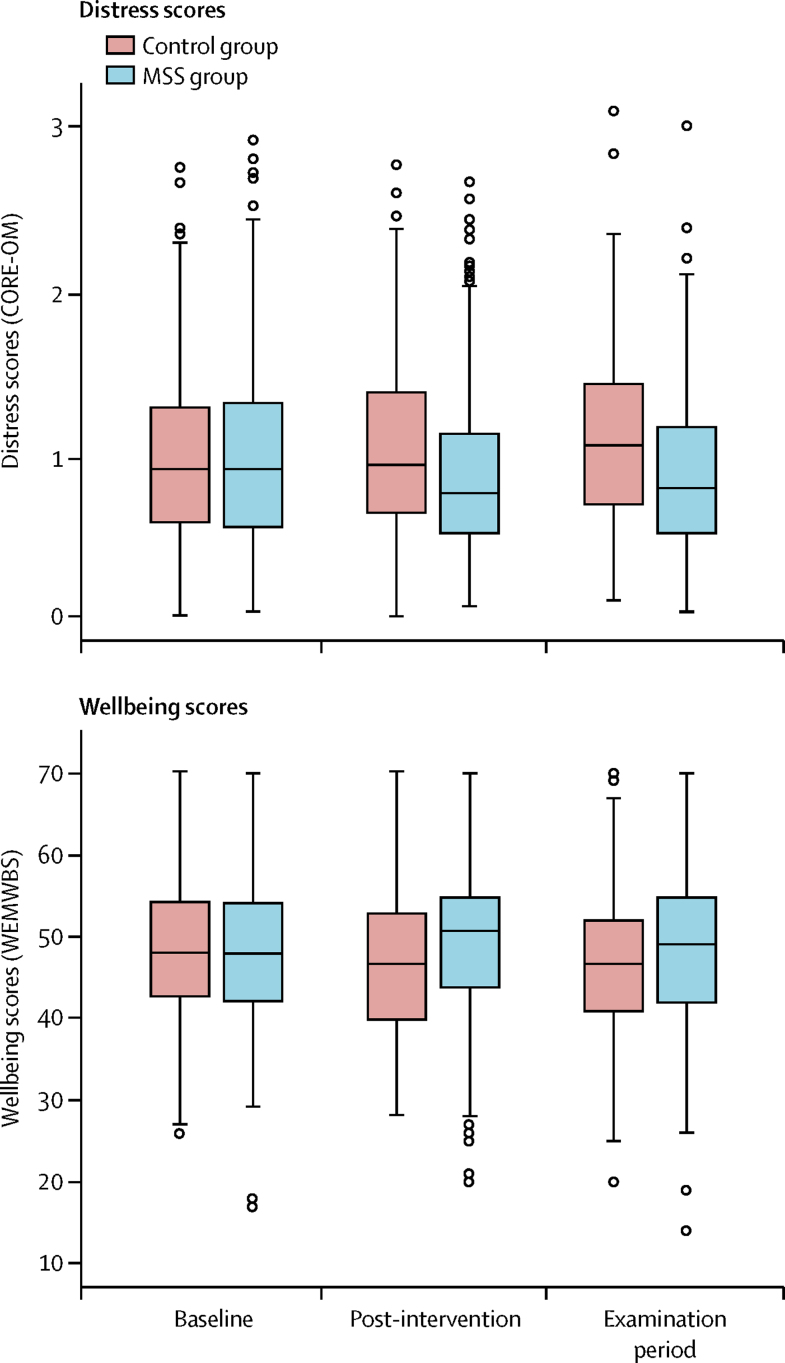
BACKGROUND: The rising number of young people going to university has led to concerns about an increasing demand for student mental health services. We aimed to assess whether provision of mindfulness courses to university students would improve their resilience to stress. METHODS: We did this pragmatic randomised controlled trial at the University of Cambridge, UK. Students aged 18 years or older with no severe mental illness or crisis (self-assessed) were randomly assigned (1:1), via remote survey software using computer-generated random numbers, to receive either an 8 week mindfulness course adapted for university students (Mindfulness Skills for Students [MSS]) plus mental health support as usual, or mental health support as usual alone. Participants and the study management team were aware of group allocation, but allocation was concealed from the researchers, outcome assessors, and study statistician. The primary outcome was self-reported psychological distress during the examination period, as measured with the Clinical Outcomes in Routine Evaluation Outcome Measure (CORE-OM), with higher scores indicating more distress. The primary analysis was by intention to treat. This trial is registered with the Australia and New Zealand Clinical Trials Registry, number ACTRN12615001160527. FINDINGS: Between Sept 28, 2015, and Jan 15, 2016, we randomly assigned 616 students to the MSS group (n=309) or the support as usual group (n=307). 453 (74%) participants completed the CORE-OM during the examination period and 182 (59%) MSS participants completed at least half of the course. MSS reduced distress scores during the examination period compared with support as usual, with mean CORE-OM scores of 0·87 (SD 0·50) in 237 MSS participants versus 1·11 (0·57) in 216 support as usual participants (adjusted mean difference -0·14, 95% CI -0·22 to -0·06; p=0·001), showing a moderate effect size (β -0·44, 95% CI -0·60 to -0·29; p<0·0001). 123 (57%) of 214 participants in the support as usual group had distress scores above an accepted clinical threshold compared with 88 (37%) of 235 participants in the MSS group. On average, six students (95% CI four to ten) needed to be offered the MSS course to prevent one from experiencing clinical levels of distress. No participants had adverse reactions related to self-harm, suicidality, or harm to others. INTERPRETATION: Our findings show that provision of mindfulness training could be an effective component of a wider student mental health strategy. Further comparative effectiveness research with inclusion of controls for non-specific effects is needed to define a range of additional, effective interventions to increase resilience to stress in university students. FUNDING: University of Cambridge and National Institute for Health Research Collaboration for Leadership in Applied Health Research and Care East of England.
Overview
The claims and statistics of this paper haven’t been checked yet.
Run the check — free, no account needed. It reads the open-access text and checks the sources it cites.
Integrity signals
Registry
Cites
Statistics
Figures
Verification
Claims the paper makes
The claims and statistics of this paper haven’t been checked yet.
Run the check — free, no account needed. It reads the open-access text and checks the sources it cites.
Claims other papers make about this one
Each is checked against this paper’s own text: does it say what the citing paper says it does?
The source backs part of the claim, not all of it — or backs it for a different population, condition or comparison.
In the citing paper
“As both a skill and a therapy, mindfulness has been shown to improve symptoms of anxiety, depression, stress, and other mental states (Galante et al. 2018; Ji et al. 2021; Johannsen et al. 2022; Zhu et al. 2021).”
From Changes in Mental Health and EEG Biomarkers of Undergraduates Under Different Patterns of Mindfulness (2024) · cites this paper as Galante et al. 2018
Experimental — accuracy not yet measuredThe source backs part of the claim, not all of it — or backs it for a different population, condition or comparison.
In the citing paper
“Systematic reviews conducted on the effectiveness of meditation programs and mindfulness-based intervention programs led to improvements in resilience to stress, anxiety and depression among university students and other populations, whether delivered offline [9] or online [10–14].”
From Effectiveness of online mindfulness interventions on medical students’ mental health: a systematic review (2021) · cites this paper as [9]
Experimental — accuracy not yet measuredThe check wasn’t confident either way, so it gives no verdict — never disputed.
In the citing paper
“However, none of neuroscientific studies have explored whether and how brief mindfulness training influences certain psychological features especially social support in college students during the COVID-19 pandemic.”
From Changes in Mental Health and EEG Biomarkers of Undergraduates Under Different Patterns of Mindfulness (2024) · cites this paper as Galante et al. 2018
Experimental — accuracy not yet measuredThe check wasn’t confident either way, so it gives no verdict — never disputed.
In the citing paper
“Although personality traits are relatively stable through time they are not cast in stone and can be enhanced, as research has shown, through specific interventions (for reviews and metanalyses see Galante et al., 2018; Gilmartin et al., 2017; Jayawardene et al., 2017; McConville et al., 2017; Quaglia et al., 2016; Spinelli et al., 2018).”
From Specific mindfulness traits protect against negative effects of trait anxiety on medical student wellbeing during high-pressure periods (2021) · cites this paper as Galante et al., 2018
Experimental — accuracy not yet measuredIn the citing paper
“We know from trials in older students that the key skills taught during MT can protect against deterioration in mental health during periods of stress, even if there are no apparent MT-related mental health benefits prior to the onset of stress.11”
In the citing paper
“Four studies set up independent data monitoring and ethics committees [52,85,92,171].”
In the citing paper
“The direction of this bias could favour the effects of MBPs because participants who feel unwell may be less likely to attend assessment sessions or complete self–reported outcomes [52].”
In the citing paper
“Two studies reported a participant abandoning the MBP because s/he felt it was being counterproductive [52,186].”
In the citing paper
“One study actively monitored clinically meaningful adverse events with no significant differences between trial arms [52].”
Self-check
Percentages, sums and reported differences re-computed from the paper’s own numbers.
The self-check needs the paper’s full text.
Citations
Cites
Cohen, J. (1992) · Psychological Bulletin · doi:10.1037//0033-2909.112.1.155 · Cited by 8,771
Our future: a Lancet commission on adolescent health and wellbeing
Patton, G. C., Sawyer, S. M., Santelli, J. S., Ross, D. A., Afifi, R., Allen, N. B., Arora, M., Azzopardi, P., Baldwin, W., Bonell, C., et al. (2016) · The Lancet · doi:10.1016/s0140-6736(16)00579-1 · Cited by 3,785
Meditation Programs for Psychological Stress and Well-being: A Systematic Review and Meta-analysis
Goyal, M., Singh, S., Sibinga, E. M. S., Gould, N. F., Rowland-Seymour, A., Sharma, R., Berger, Z., Sleicher, D., Maron, D. D., Shihab, H. M., et al. (2014) · JAMA Internal Medicine · doi:10.1001/jamainternmed.2013.13018 · Cited by 2,380
Mrazek, M. D., Franklin, M. S., Phillips, D. T., Baird, B., & Schooler, J. W. (2013) · Psychological Science · doi:10.1177/0956797612459659 · Cited by 1,063
Interventions to reduce stress in university students: A review and meta-analysis
Regehr, C., Glancy, D., & Pitts, A. (2013) · Journal of Affective Disorders · doi:10.1016/j.jad.2012.11.026 · Cited by 956
de Vibe, M., Solhaug, I., Tyssen, R., Friborg, O., Rosenvinge, J. H., Sørlie, T., & Bjørndal, A. (2013) · BMC Medical Education · doi:10.1186/1472-6920-13-107 · Cited by 398
Effect of kindness-based meditation on health and well-being: A systematic review and meta-analysis.
Galante, J., Galante, I., Bekkers, M.-J., & Gallacher, J. (2014) · Journal of Consulting and Clinical Psychology · doi:10.1037/a0037249 · Cited by 380
Self-citationMcConville, J., McAleer, R., & Hahne, A. (2017) · EXPLORE · doi:10.1016/j.explore.2016.10.002 · Cited by 336
The mental health of university students in the United Kingdom
Macaskill, A. (2013) · British Journal of Guidance and Counselling · doi:10.1080/03069885.2012.743110 · Cited by 335
Greeson, J. M., Juberg, M. K., Maytan, M., James, K. M., & Rogers, H. (2014) · Journal of American College Health · doi:10.1080/07448481.2014.887571 · Cited by 251
Cited by
Sorted by citations
Items 201–300 of 517
Stice, E. M., Rohde, P., Gau, J. M., Bearman, S. K., & Shaw, H. E. (2023) · Journal of Consulting and Clinical Psychology · doi:10.1037/ccp0000806 · Cited by 12
Mantzios, M., Egan, H. H., Cook, A., Jutley-Neilson, J., & O’Hara, M. (2019) · Journal of Further and Higher Education · doi:10.1080/0309877x.2018.1541970 · Cited by 13
Mastering team crises: a play-oriented approach to foster resilience capabilities in student teams
Duchek, S., Geithner, S., & Roth, T. (2021) · Teaching in Higher Education · doi:10.1080/13562517.2021.1943652 · Cited by 13
Allan, J. F., & McKenna, J. (2022) · Psychiatry International · doi:10.3390/psychiatryint3010007 · Cited by 11
Chyi, T., Lu, F. J. H., Hsieh, Y.-C., Hsu, Y.-W., Gill, D. L., & Fang, B.-B. (2023) · Perceptual and Motor Skills · doi:10.1177/00315125231216329 · Cited by 13
Zhao, K. (2024) · Studies in Psychological Science · doi:10.56397/sps.2024.03.06 · Cited by 13
Sifat, M. S., Tasnim, N., Stoebenau, K., & Green, K. M. (2022) · International Journal of Qualitative Studies on Health and Well-Being · doi:10.1080/17482631.2022.2113015 · Cited by 14
Felton, A., & Lambert, M. (2019) · The Journal of Mental Health Training Education and Practice · doi:10.1108/jmhtep-03-2019-0015 · Cited by 10
Manjula, M., & Srivastava, A. (2022) · Springer eBooks · doi:10.1007/978-981-16-8263-6_26 · Cited by 16
Mindful Lawyering: A Pilot Study on Mindfulness Training for Law Students
Rosky, C. J., Roberts, R. L., Hanley, A. W., & Garland, E. L. (2022) · Mindfulness · doi:10.1007/s12671-022-01965-w · Cited by 10
Soimah, H., Baqi, S. A., & Daryono, R. W. (2024) · IMPROVEMENT Jurnal Ilmiah untuk peningkatan mutu manajemen pendidikan · doi:10.21009/improvement.v11i1.44304 · Cited by 9
Gardner, P., & Kerridge, K. (2019) · Canadian Journal of Community Mental Health · doi:10.7870/cjcmh-2018-022 · Cited by 14
Siripongpan, A., Phattaramarut, K., Namvichaisirikul, N., Poochaya, S., & Horkaew, P. (2022) · Health Psychology Research · doi:10.52965/001c.35464 · Cited by 9
Dijk, S. W., Steijlen, O. F. M., Kranenburg, L. W., Rouwet, E. V., Luik, A. I., Bierbooms, A. E., Kouwenhoven-Pasmooij, T. A., Rizopoulos, D., Swanson, S., Hoogendijk, W. J. G., et al. (2022) · Contemporary Clinical Trials · doi:10.1016/j.cct.2022.106928 · Cited by 9
Delivering Resilience: Embedding a Resilience Building Module into First-Year Curriculum
Goodchild, T., Heath, G., & Richardson, A. (2023) · Student Success · doi:10.5204/ssj.2883 · Cited by 9
Baeza‐Velasco, C., Genty, C., Jaussent, I., Benramdane, M., Courtet, P., & Olié, É. (2020) · BMC Psychiatry · doi:10.1186/s12888-020-02529-9 · Cited by 9
Creating a Robot Coach for Mindfulness and Wellbeing: A Longitudinal StudyPreprint
Bodala, I. P., Churamani, N., & Güneş, H. (2020) · arXiv (Cornell University) · doi:10.48550/arxiv.2006.05289 · Cited by 9
Shahraki, S. K., Adelian, H., Miri, S., & Farokhzadian, J. (2022) · Psychology Health & Medicine · doi:10.1080/13548506.2022.2055771 · Cited by 8
Ismail, S. M., & Nikpoo, I. (2023) · Asian-Pacific Journal of Second and Foreign Language Education · doi:10.1186/s40862-023-00217-1 · Cited by 8
Hu, Q., Yang, N., Huang, Q. L., Cheng, C., Xiao, L., Gao, X., & Zhang, F. (2024) · Psychology Research and Behavior Management · doi:10.2147/prbm.s466422 · Cited by 8
Mansuroğlu, S. (2025) · Applied Psychology Health and Well-Being · doi:10.1111/aphw.70014 · Cited by 18
Wang, S., & Jin, C. (2025) · Acta Psychologica · doi:10.1016/j.actpsy.2025.105300 · Cited by 8
Consiglio, M. D., Merola, S., Satta, C., Pascucci, T., Violani, C., & Couyoumdjian, A. (2022) · Frontiers in Psychology · doi:10.3389/fpsyg.2022.877340 · Cited by 10
Ang, W. H. D., Shorey, S., Zheng, Z. J., Ng, W. H. D., Chen, E. C., Shah, L., Chew, H. S. J., & Lau, Y. (2024) · Stress and Health · doi:10.1002/smi.3367 · Cited by 14
James, R., Moore, A. L., Carpenter Dick, M., Miller, T. M., & Ledbetter, C. R. (2019) · OBM Integrative and Complementary Medicine · doi:10.21926/obm.icm.1903054 · Cited by 8
The relationship between alexithymia and self-harm: The mediating role of mindfulness
Norman, H., Marzano, L., Oskis, A., & Coulson, M. (2021) · Current Psychology · doi:10.1007/s12144-021-01553-6 · Cited by 12
Effect of Data mindfulness training on accounting students: results from a randomized control trial
Shinde, J. S., Shinde, U. S., Hill, A., Adams, C., & Harden, J. (2021) · Accounting Education · doi:10.1080/09639284.2021.1888136 · Cited by 8
Burger, J. W., Bantjes, J. R., Derman, W. E., Whitesman, S., & Gomez‐Ezeiza, J. (2021) · Journal of American College Health · doi:10.1080/07448481.2021.1920601 · Cited by 8
Witt, T., Klumpp, M., & Beyer, B. (2021) · Education Sciences · doi:10.3390/educsci11110728 · Cited by 8
Galante, J., Friedrich, C., Dalgleish, T., White, I. R., & Jones, P. B. (2022) · BMJ Open · doi:10.1136/bmjopen-2021-058976 · Cited by 8
Self-citationFactors affecting university image among graduate alumni: A case study of Qatar university
Hazaa, K. A., Abdel‐Salam, A. G., Mollazehi, M., Mohamed, R. I., Hasan, M. A., Al-Tameemi, R. A. N., Said, A. B., Johnson, C., & Romanowski, M. H. (2022) · Heliyon · doi:10.1016/j.heliyon.2022.e09668 · Cited by 8
Wang, X., & Wang, Y. (2022) · Journal of Sex & Marital Therapy · doi:10.1080/0092623x.2022.2109542 · Cited by 8
Vo, D. X., Tabi, K., Bhullar, M., Johnson, A., Locke, J. J., Wang, S., Stewart, S. E., & Marshall, S. K. (2024) · International Journal of Adolescent Medicine and Health · doi:10.1515/ijamh-2023-0112 · Cited by 11
Baluku, M. M. (2024) · Journal of Enterprising Communities People and Places in the Global Economy · doi:10.1108/jec-01-2024-0008 · Cited by 7
Mindfulness as a Path to Freedom from Internet Addiction in Adolescents: A Narrative Review
Samanta, P., Mohapatra, I., Mitra, R., Mishra, J., Mahapatra, P., Mohakud, N. K., Pattnaik, J. I., Behera, M. R., & Nanda, P. (2024) · Cureus · doi:10.7759/cureus.72544 · Cited by 14
University students’ resilience in post-pandemic period: a socio-ecological perspective
Sheng, J., Ng, D. T. K., Tian, P., & Zheng, Z. (2025) · Frontiers in Psychology · doi:10.3389/fpsyg.2025.1574153 · Cited by 14
Wen, L.-Y., Zhang, L., Zhu, L.-J., Song, J., Wang, A., Feng, Y., Tao, Y.-J., Zhu, Y., Jin, Y., & Chang, W. (2025) · Journal of Affective Disorders · doi:10.1016/j.jad.2025.119593 · Cited by 7
Khatami, M., Çelık, F., Calafato, R., & Sharmin, S. (2025) · International Journal of Applied Linguistics · doi:10.1111/ijal.12785 · Cited by 8
Hayes, M., & Cejnar, L. (2020) · Journal of University Teaching and Learning Practice · doi:10.53761/1.17.4.7 · Cited by 7
Junus, A., & YIP, P. S. F. (2023) · Journal of Affective Disorders · doi:10.1016/j.jad.2023.11.060 · Cited by 8
Juozelskyte, G., & Catling, J. C. (2024) · Health Psychology and Behavioral Medicine · doi:10.1080/21642850.2024.2305723 · Cited by 7
O’Doherty, M., Cunningham, C., Neill, R. D., & Tully, M. A. (2024) · Journal of Public Health · doi:10.1007/s10389-024-02274-3 · Cited by 7
Deroche, M.-H., Kuyken, W., Uwatoko, T., Imoto, Y., & Kusumoto, R. (2025) · Mindfulness · doi:10.1007/s12671-025-02528-5 · Cited by 10
Gherardi‐Donato, E. C. D. S., Quinhoneiro, D. C. G., Gimenez, L. B. H., Siqueira, L. H., Díaz‐Serrano, K. V., & Zanetti, A. C. G. (2020) · SMAD Revista Eletrônica Saúde Mental Álcool e Drogas (Edição em Português) · doi:10.11606/issn.1806-6976.smad.2020.152589 · Cited by 7
Carpi, M., Milanese, A., Cattaruzza, M. S., Ferrara, C., Liuccio, M., & Vestri, A. (2021) · Trends in Psychology · doi:10.1007/s43076-021-00114-x · Cited by 9
Wagner, A. P., Galante, J., Dufour, G., Barton, G., Stochl, J., Vainre, M., & Jones, P. B. (2023) · BMJ Open · doi:10.1136/bmjopen-2023-071724 · Cited by 7
Self-citationHeshmati, S., Muth, C., Li, Y., Roeser, R. W., Smyth, J. M., Vandekerckhove, J., Chow, S., & Oravecz, Z. (2025) · Applied Psychology Health and Well-Being · doi:10.1111/aphw.70037 · Cited by 7
Examining Working Memory Training for Healthy Adults—A Second-Order Meta-Analysis
Syed, M., Lum, J. A. G., Byrne, L. K., & Skvarc, D. (2024) · Journal of Intelligence · doi:10.3390/jintelligence12110114 · Cited by 6
“…management (Veehof et al. 2011), enhanced sleep quality (Black et al. 2015), decreased burnout (MacKenzie et al. 2006), increased resilience to stress (Galante et al. 2018; Shapiro et al. 2005), less distractive behaviors (Jain et al. 2007), and improved cognitive functions (C á sedas et al. 2020).”
Juberg, M., Spencer, S. D., Martin, T. J., Vibell, J., da Costa Ferro, A., Kam, B., & Masuda, A. (2019) · Clinical Case Studies · doi:10.1177/1534650119836166 · Cited by 5
Halimi, S. N., Rowett, D. S., & Luetsch, K. (2024) · Research in Social and Administrative Pharmacy · doi:10.1016/j.sapharm.2024.10.006 · Cited by 9
Wang, R., & Zhang, H. (2025) · Acta Psychologica · doi:10.1016/j.actpsy.2025.104834 · Cited by 19
Guo, J., Guo, B., Ren, J., Wu, M., & Liu, J. (2025) · Acta Psychologica · doi:10.1016/j.actpsy.2025.104954 · Cited by 7
Family structure and depression in Chinese adolescents: the mediating role of resilience
Du, Y., Cao, Y., Duan, X., Zheng, W., Chen, J., & Qu, M. (2025) · Journal of Affective Disorders · doi:10.1016/j.jad.2025.120982 · Cited by 6
Mindful path to psychological wellbeing: a comprehensive review
Attrey, S., Joshi, S., & Bhatt, V. (2025) · Journal of Behavioral and Cognitive Therapy · doi:10.1016/j.jbct.2025.100537 · Cited by 11
Meditation for stress and anxiety relief in undergraduate students: a randomized clinical trial
Malheiros, P. C., Vanderlei, A. D., & de Brum, E. H. M. (2023) · Revista Brasileira de Educação Médica · doi:10.1590/1981-5271v47.1-20220021.ing · Cited by 7
Student support services: Perceptions and recommendations for the next generation
Perez, H. L., & Sabato, E. H. (2023) · Journal of Dental Education · doi:10.1002/jdd.13305 · Cited by 6
Boland, S. T., Mayhew, S., & Balabanova, D. (2023) · BMJ Public Health · doi:10.1136/bmjph-2023-000236 · Cited by 6
The integration of meditation into higher education: a systematic literature review
Haberlin, S., & Bradshaw, T. (2025) · Journal of American College Health · doi:10.1080/07448481.2025.2451974 · Cited by 6
Enhancing social functioning using multi-user, immersive virtual reality
Holt, D. J., DeTore, N. R., Aideyan, B., Utter, L., Vinke, L. N., Johnson, D. S., Zimmerman, J., Dokholyan, K. N., & Burke, A. (2025) · Scientific Reports · doi:10.1038/s41598-024-84954-4 · Cited by 6
Yan-ping, R., Zhang, Y. C., & Jin, H. (2025) · BMC Psychology · doi:10.1186/s40359-025-02827-5 · Cited by 10
Fathi, J., Rezaei, N., & Hosseini, H. M. (2025) · Perceptual and Motor Skills · doi:10.1177/00315125251340564 · Cited by 9
Relación entre sesiones de atención plena y el nivel de estrés en estudiantes universitarios
Villarroel, K., & Cruz-Riveros, C. (2021) · Enfermería Global · doi:10.6018/eglobal.442391 · Cited by 6
Buttazzoni, A. N. (2022) · Compass Journal of Learning and Teaching · doi:10.21100/compass.v15i1.1285 · Cited by 6
de Souza, R. C., & Scott, C. F. (2022) · Religions · doi:10.3390/rel13080681 · Cited by 6
Chen, X., Shi, X., Liu, X., Zhou, Y., & Fan, F. (2022) · Applied Research in Quality of Life · doi:10.1007/s11482-022-10088-2 · Cited by 6
Marenus, M. W., Cahuas, A., Hammoud, D., Murray, A., Friedman, K., Ottensoser, H., Sanowski, J., Kumavarel, V., & Chen, W. (2023) · International Journal of Environmental Research and Public Health · doi:10.3390/ijerph20085463 · Cited by 6
Kassie, S. A. (2023) · Frontiers in Education · doi:10.3389/feduc.2023.1281949 · Cited by 9
Mind the Echo Chamber: Mindfulness as a Contemplative Practice That can Contribute to Public Health
Galante, J., & Dam, N. T. V. (2024) · Mindfulness · doi:10.1007/s12671-024-02343-4 · Cited by 9
Self-citationMindfulness and academic performance among nursing students in Saudi Arabia: a cross-sectional study
Mathkor, D. M. (2025) · Scientific Reports · doi:10.1038/s41598-025-11911-0 · Cited by 5
Liu, C., Pi, X.-X., Liu, B., Zhang, L., Luo, M.-Y., Zhang, Y.-J., Zhang, X.-F., & Nie, S.-C. (2025) · Frontiers in Psychiatry · doi:10.3389/fpsyt.2025.1651506 · Cited by 8
Akiki, Z., Karam, V. Y., Salame, W. O., & Asmar, N. (2025) · BMC Medical Education · doi:10.1186/s12909-025-07942-w · Cited by 12
Torquati, J., Lombardi, C. M., Cohen, R. C., Matthews, A., & Brophy‐Herb, H. E. (2023) · Journal of American College Health · doi:10.1080/07448481.2023.2277184 · Cited by 5
Mohammadi, Y., Niri, V. S., & Shayanfar, S. (2023) · Quarterly Journal of Child Mental Health · doi:10.61186/jcmh.10.2.5 · Cited by 5
Coholic, D. A., Hardy, A. O., Patricia, G., & Stephanie, M. (2021) · Diversity of Research in Health Journal · doi:10.28984/drhj.v4i2.323 · Cited by 5
Meditation for stress and anxiety relief in undergraduate students: a randomized clinical trial
Malheiros, P. C., Vanderlei, A. D., & de Brum, E. H. M. (2023) · Revista Brasileira de Educação Médica · doi:10.1590/1981-5271v47.1-20220021 · Cited by 15
Bilić, A., Burns, R. D., Bai, Y., Brusseau, T. A., Lucero, J. E., & Jensen, J. K. (2023) · Cyberpsychology Behavior and Social Networking · doi:10.1089/cyber.2022.0365 · Cited by 4
Ennion, L., & Hess, D. (2020) · South African Journal of Physiotherapy · doi:10.4102/sajp.v76i1.1392 · Cited by 5
Dufour, G. (2020) · Counselling and Psychotherapy Research · doi:10.1002/capr.12310 · Cited by 8
Self-citationThe Dark Triad of personality and momentary affective states: an experience sampling study
Pilch, I., Lathia, N., & Wiesebach, K. (2020) · Current Issues in Personality Psychology · doi:10.5114/cipp.2020.95146 · Cited by 5
Self-citationMindfulness no contexto dos transtornos mentais: uma revisão integrativa
Pinho, P. H., Carnevalli, L. M., Santos, R. O., & Lacerda, L. C. S. D. (2020) · SMAD Revista Eletrônica Saúde Mental Álcool e Drogas (Edição em Português) · doi:10.11606/issn.1806-6976.smad.2020.166027 · Cited by 5
Bennion, M. R., Baker, F. R. L., & Burrell, J. (2022) · Journal of Technology in Behavioral Science · doi:10.1007/s41347-021-00225-3 · Cited by 4
Kogias, N., Geurts, D. E. M., Krause, F., Speckens, A. E. M., & Hermans, E. J. (2023) · BMC Psychology · doi:10.1186/s40359-023-01220-4 · Cited by 7
Chiodelli, R., de Mello, L. T. N., de Jesús, S. N., & Andretta, I. (2020) · Trends in Psychology · doi:10.1007/s43076-020-00034-2 · Cited by 5
Researcher cautions against initiatives to reduce student suicide that lack evidence
Nunez-Mulder, L. (2018) · BMJ · doi:10.1136/bmj.k3969 · Cited by 5
Hirshberg, M. J., Frye, C. J., Dahl, C. J., Riordan, K. M., Vack, N., Sachs, J., Goldman, R. I., Davidson, R. J., & Goldberg, S. B. (2021) · doi:10.31234/osf.io/hrvmu · Cited by 5
Mindfulness and Academic Performance of College and University Students: A Systematic Review
Tzelepi, I., Bacopoulou, F., Chrousos, G. P., Sotiropoulou, L., Vlachakis, D., & Darviri, C. (2023) · Advances in Experimental Medicine and Biology · doi:10.1007/978-3-031-31986-0_20 · Cited by 5
Tukhareli, N. (2024) · Journal of Chiropractic Humanities · doi:10.1016/j.echu.2024.08.001 · Cited by 4
The relative importance of dispositional optimism and resilience in predicting stress
Huynh, H. P., Reiss, J., & Sánchez, R. F. (2024) · Current Psychology · doi:10.1007/s12144-024-07046-6 · Cited by 5
García-Pérez, L., Ruz, R. P., Cepero-González, M., & Ubago-Jiménez, J. L. (2025) · Behavioral Sciences · doi:10.3390/bs15040549 · Cited by 5
Sezgin, E. (2025) · Frontiers in Psychology · doi:10.3389/fpsyg.2025.1528159 · Cited by 4
Jing, S., Xin, Y., Dai, Z., Wang, Y., Yang, T., Lin, Q., Shan, T., Zhu, L., Hu, H., & Su, X. (2025) · International Journal of Women s Health · doi:10.2147/ijwh.s549509 · Cited by 4
Ünlü, S., Uzun, K., & Arslan, G. (2025) · Children · doi:10.3390/children12070826 · Cited by 15
Schutte, N. S., & Meynadier, J. (2024) · Trends in Psychology · doi:10.1007/s43076-024-00371-6 · Cited by 4
An Integrated Health and Wellness Model in a College Setting: A Path Analysis Pilot Investigation
Liu, Y., Beauparlant, E. T., Gao, S., & Yu, Q. (2024) · Journal of College Student Mental Health · doi:10.1080/28367138.2024.2338940 · Cited by 4
Colangelo, R., & Audet, K. N. (2020) · Behavioural Sciences Undergraduate Journal · doi:10.29173/bsuj500 · Cited by 4
The role of mind-body bridging-based university psychology course for students’ well-being
Siira, V., Petäjäniemi, M., Lutovac, S., & Kaasila, R. (2022) · Nordic Psychology · doi:10.1080/19012276.2022.2159867 · Cited by 4
Mehrabian, N., Salehi, H., Tabatabaei, O., & Dastjerdi, H. V. (2022) · Iranian Evolutionary Educational Psychology Journal · doi:10.52547/ieepj.4.2.228 · Cited by 4
Pal, R., Gao, K., Li, X., Guragai, B., Li, T., Xie, Q., & Li, G. (2023) · Brain Behavior and Immunity Integrative · doi:10.1016/j.bbii.2023.100029 · Cited by 5
Effectiveness of Mindfulness Group Training on Hope and Resilience of People with Gender Dysphoria
Amini, F., Ramezani, K., & Maredpour, A. (2022) · Caspian Journal of Health Research · doi:10.32598/cjhr.7.1.395.1 · Cited by 4
Fox, T. (2019) · Research Exchange (Washington State University) · Cited by 4
Metadata
- Authors
- Galante, J., Dufour, G., Vainre, M., Wagner, A. P., Stochl, J., Benton, A., Lathia, N., Howarth, E., & Jones, P. B.
- Affiliations
- University of Cambridge (GB)
- National Institute for Health and Care Research (GB)
- University of East Anglia (GB)
- University College London (GB)
- Corresponding author
- Galante, Julieta
- ORCID
- Venue
- The Lancet Public Health
- Publisher
- Elsevier BV
- Published
- 2018-02
- Volume
- 3
- Issue
- 2
- Pages
- e72-e81
- ISSN
- 2468-2667 (ISSN-L)
- PMC
- PMC5813792
- OpenAlex
- W2778288638
- Cited by
- 516
- References
- 31
- Citations by year
- 2026: 42 · 2025: 69 · 2024: 67 · 2023: 68 · 2022: 71 · 2021: 86 · 2020: 56 · 2019: 46 · 2018: 9
- FWCI
- 37.99
- Type
- journal article
- Language
- en
- Open access
- gold
- doi.org
- Licence
- Locations
- The Lancet Public Health (publishedVersion, cc-by)
- Europe PMC (PubMed Central) (publishedVersion, cc-by)
- PubMed Central (publishedVersion, cc-by)
- PubMed (publishedVersion)
- UEA Digital Repository (University of East Anglia) (submittedVersion)
- DOAJ (DOAJ: Directory of Open Access Journals) (submittedVersion, cc-by-sa)
- Apollo (University of Cambridge) (submittedVersion, cc-by)
- Apollo (cc-by)
- Funders
- National Institute for Health Research
- University of Cambridge
- Topics
- Social Sciences › Psychology › Clinical Psychology › Mindfulness and Compassion Interventions
- Social Sciences › Psychology › Developmental and Educational Psychology › Student Stress and Coping
- Social Sciences › Psychology › Applied Psychology › Digital Mental Health Interventions
- Keywords
- mindfulness-based interventions, stress resilience, university students, student mental health, psychological distress, exam period, mental health support, CORE-OM, student well-being, academic stress, student satisfaction, student engagement, student attendance
- MeSH terms
- Adolescent, Adult, Female, United Kingdom, Health Promotion, Humans, Male, Mental Health Services, Stress, Psychological, Student Health Services, Students, Universities, Program Evaluation, Resilience, Psychological, Young Adult, Mindfulness
About these checks
Registry, retraction, Cites and statistics results are computed, not judged, with one exception: a printed reference that no index lists is read once by a model before it counts as a citation error. Claims are extracted by a model and kept only when their quote appears verbatim in the text; each cited source is then checked, with a model’s help, for whether it says what the claim relies on. Those verdicts can be wrong — read the claim’s quote and the cited source before relying on one.
Statistics and arithmetic are recomputed, not judged.
Confidence bands are shown only for fields calibrated on our annotated test set. None is calibrated yet, so no band is shown.
What counts as a claim ›How we measure confidence ›How we check this ›
Are you an author, or do you see a problem with this page? Request a review
