

The DOI matches its Crossref record; 30 of the 31 references it cites were found in a registry or an index.
A mindfulness-based intervention to increase resilience to stress in university students (the Mindful Student Study): a pragmatic randomised controlled trial
Open accessAbstract
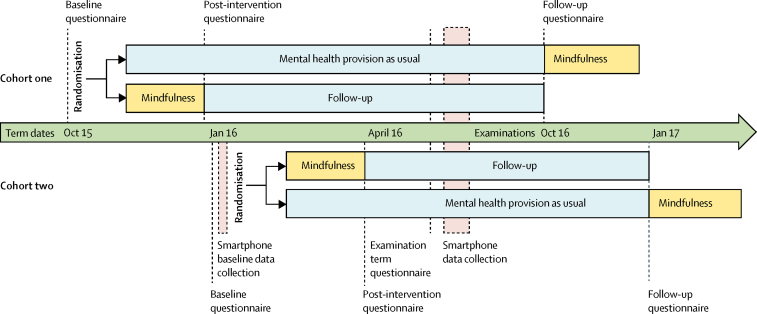
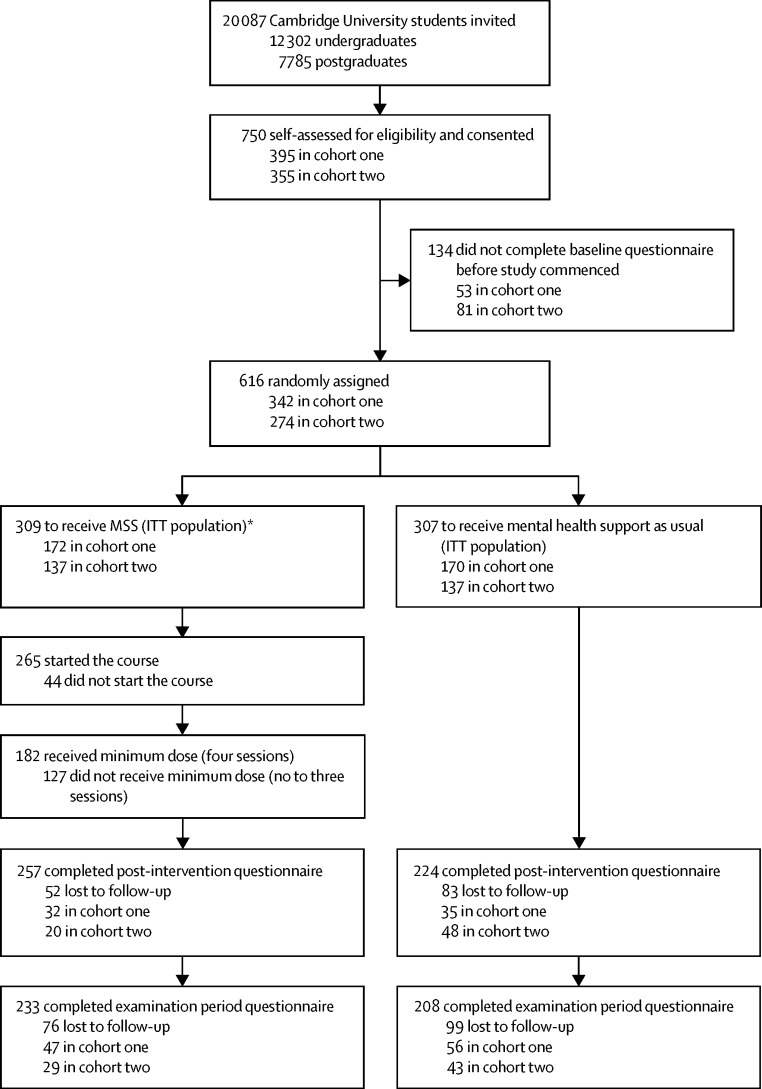
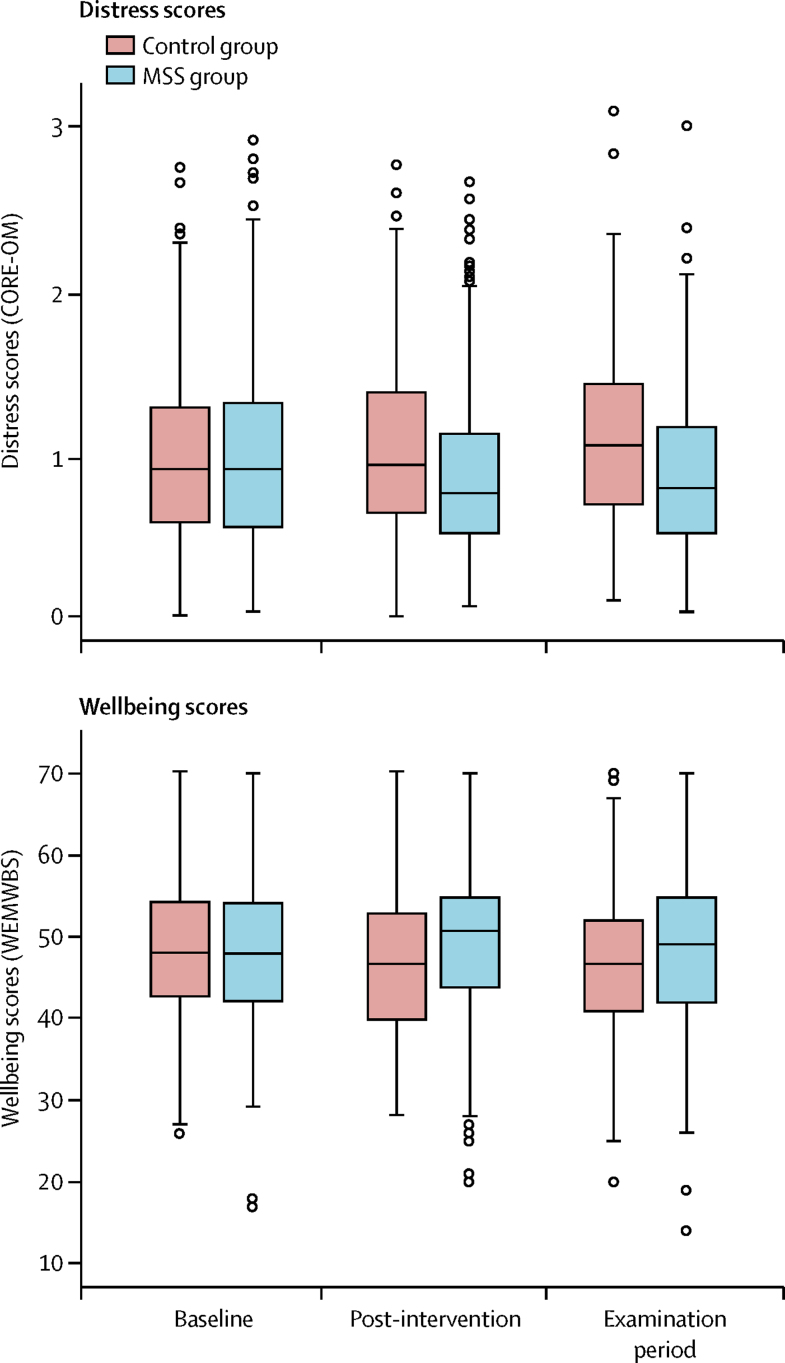
BACKGROUND: The rising number of young people going to university has led to concerns about an increasing demand for student mental health services. We aimed to assess whether provision of mindfulness courses to university students would improve their resilience to stress. METHODS: We did this pragmatic randomised controlled trial at the University of Cambridge, UK. Students aged 18 years or older with no severe mental illness or crisis (self-assessed) were randomly assigned (1:1), via remote survey software using computer-generated random numbers, to receive either an 8 week mindfulness course adapted for university students (Mindfulness Skills for Students [MSS]) plus mental health support as usual, or mental health support as usual alone. Participants and the study management team were aware of group allocation, but allocation was concealed from the researchers, outcome assessors, and study statistician. The primary outcome was self-reported psychological distress during the examination period, as measured with the Clinical Outcomes in Routine Evaluation Outcome Measure (CORE-OM), with higher scores indicating more distress. The primary analysis was by intention to treat. This trial is registered with the Australia and New Zealand Clinical Trials Registry, number ACTRN12615001160527. FINDINGS: Between Sept 28, 2015, and Jan 15, 2016, we randomly assigned 616 students to the MSS group (n=309) or the support as usual group (n=307). 453 (74%) participants completed the CORE-OM during the examination period and 182 (59%) MSS participants completed at least half of the course. MSS reduced distress scores during the examination period compared with support as usual, with mean CORE-OM scores of 0·87 (SD 0·50) in 237 MSS participants versus 1·11 (0·57) in 216 support as usual participants (adjusted mean difference -0·14, 95% CI -0·22 to -0·06; p=0·001), showing a moderate effect size (β -0·44, 95% CI -0·60 to -0·29; p<0·0001). 123 (57%) of 214 participants in the support as usual group had distress scores above an accepted clinical threshold compared with 88 (37%) of 235 participants in the MSS group. On average, six students (95% CI four to ten) needed to be offered the MSS course to prevent one from experiencing clinical levels of distress. No participants had adverse reactions related to self-harm, suicidality, or harm to others. INTERPRETATION: Our findings show that provision of mindfulness training could be an effective component of a wider student mental health strategy. Further comparative effectiveness research with inclusion of controls for non-specific effects is needed to define a range of additional, effective interventions to increase resilience to stress in university students. FUNDING: University of Cambridge and National Institute for Health Research Collaboration for Leadership in Applied Health Research and Care East of England.
Overview
The claims and statistics of this paper haven’t been checked yet.
Run the check — free, no account needed. It reads the open-access text and checks the sources it cites.
Integrity signals
Registry
Cites
Statistics
Figures
Verification
Claims the paper makes
The claims and statistics of this paper haven’t been checked yet.
Run the check — free, no account needed. It reads the open-access text and checks the sources it cites.
Claims other papers make about this one
Each is checked against this paper’s own text: does it say what the citing paper says it does?
The source backs part of the claim, not all of it — or backs it for a different population, condition or comparison.
In the citing paper
“As both a skill and a therapy, mindfulness has been shown to improve symptoms of anxiety, depression, stress, and other mental states (Galante et al. 2018; Ji et al. 2021; Johannsen et al. 2022; Zhu et al. 2021).”
From Changes in Mental Health and EEG Biomarkers of Undergraduates Under Different Patterns of Mindfulness (2024) · cites this paper as Galante et al. 2018
Experimental — accuracy not yet measuredThe source backs part of the claim, not all of it — or backs it for a different population, condition or comparison.
In the citing paper
“Systematic reviews conducted on the effectiveness of meditation programs and mindfulness-based intervention programs led to improvements in resilience to stress, anxiety and depression among university students and other populations, whether delivered offline [9] or online [10–14].”
From Effectiveness of online mindfulness interventions on medical students’ mental health: a systematic review (2021) · cites this paper as [9]
Experimental — accuracy not yet measuredThe check wasn’t confident either way, so it gives no verdict — never disputed.
In the citing paper
“However, none of neuroscientific studies have explored whether and how brief mindfulness training influences certain psychological features especially social support in college students during the COVID-19 pandemic.”
From Changes in Mental Health and EEG Biomarkers of Undergraduates Under Different Patterns of Mindfulness (2024) · cites this paper as Galante et al. 2018
Experimental — accuracy not yet measuredThe check wasn’t confident either way, so it gives no verdict — never disputed.
In the citing paper
“Although personality traits are relatively stable through time they are not cast in stone and can be enhanced, as research has shown, through specific interventions (for reviews and metanalyses see Galante et al., 2018; Gilmartin et al., 2017; Jayawardene et al., 2017; McConville et al., 2017; Quaglia et al., 2016; Spinelli et al., 2018).”
From Specific mindfulness traits protect against negative effects of trait anxiety on medical student wellbeing during high-pressure periods (2021) · cites this paper as Galante et al., 2018
Experimental — accuracy not yet measuredIn the citing paper
“We know from trials in older students that the key skills taught during MT can protect against deterioration in mental health during periods of stress, even if there are no apparent MT-related mental health benefits prior to the onset of stress.11”
In the citing paper
“Four studies set up independent data monitoring and ethics committees [52,85,92,171].”
In the citing paper
“The direction of this bias could favour the effects of MBPs because participants who feel unwell may be less likely to attend assessment sessions or complete self–reported outcomes [52].”
In the citing paper
“Two studies reported a participant abandoning the MBP because s/he felt it was being counterproductive [52,186].”
In the citing paper
“One study actively monitored clinically meaningful adverse events with no significant differences between trial arms [52].”
Self-check
Percentages, sums and reported differences re-computed from the paper’s own numbers.
The self-check needs the paper’s full text.
Citations
Cites
Cohen, J. (1992) · Psychological Bulletin · doi:10.1037//0033-2909.112.1.155 · Cited by 8,771
Our future: a Lancet commission on adolescent health and wellbeing
Patton, G. C., Sawyer, S. M., Santelli, J. S., Ross, D. A., Afifi, R., Allen, N. B., Arora, M., Azzopardi, P., Baldwin, W., Bonell, C., et al. (2016) · The Lancet · doi:10.1016/s0140-6736(16)00579-1 · Cited by 3,785
Meditation Programs for Psychological Stress and Well-being: A Systematic Review and Meta-analysis
Goyal, M., Singh, S., Sibinga, E. M. S., Gould, N. F., Rowland-Seymour, A., Sharma, R., Berger, Z., Sleicher, D., Maron, D. D., Shihab, H. M., et al. (2014) · JAMA Internal Medicine · doi:10.1001/jamainternmed.2013.13018 · Cited by 2,380
Mrazek, M. D., Franklin, M. S., Phillips, D. T., Baird, B., & Schooler, J. W. (2013) · Psychological Science · doi:10.1177/0956797612459659 · Cited by 1,063
Interventions to reduce stress in university students: A review and meta-analysis
Regehr, C., Glancy, D., & Pitts, A. (2013) · Journal of Affective Disorders · doi:10.1016/j.jad.2012.11.026 · Cited by 956
de Vibe, M., Solhaug, I., Tyssen, R., Friborg, O., Rosenvinge, J. H., Sørlie, T., & Bjørndal, A. (2013) · BMC Medical Education · doi:10.1186/1472-6920-13-107 · Cited by 398
Effect of kindness-based meditation on health and well-being: A systematic review and meta-analysis.
Galante, J., Galante, I., Bekkers, M.-J., & Gallacher, J. (2014) · Journal of Consulting and Clinical Psychology · doi:10.1037/a0037249 · Cited by 380
Self-citationMcConville, J., McAleer, R., & Hahne, A. (2017) · EXPLORE · doi:10.1016/j.explore.2016.10.002 · Cited by 336
The mental health of university students in the United Kingdom
Macaskill, A. (2013) · British Journal of Guidance and Counselling · doi:10.1080/03069885.2012.743110 · Cited by 335
Greeson, J. M., Juberg, M. K., Maytan, M., James, K. M., & Rogers, H. (2014) · Journal of American College Health · doi:10.1080/07448481.2014.887571 · Cited by 251
Cited by
Sorted by citations
Items 301–400 of 517
Morgan, W. J. (2019) · ProQuest LLC eBooks · Cited by 5
Cassar, L., Fischer, M., & Valero, V. (2023) · SSRN Electronic Journal · doi:10.2139/ssrn.4291733 · Cited by 3
Luo, M., Gan, Q., Huang, Z., Jiang, Y., Li, K., Wu, M., Yang, D., Shao, H., Chen, Y., Fu, Y., et al. (2024) · Brain Topography · doi:10.1007/s10548-023-01026-y · Cited by 3
“Previous studies have described the impact of mindfulness on psychological or EEG-related outcomes in students (Galante et al. 2018; Kuyken et al. 2013; Morais et al. 2021; Ren et al. 2011; Sanger et al. 2018).”
Jalene, S., Pharr, J. R., Sharma, M., & Poston, B. (2021) · Journal of Education and Health Promotion · doi:10.4103/jehp.jehp_1421_20 · Cited by 3
Liu, J., Wei, W., & Liu, J. (2025) · Current Psychology · doi:10.1007/s12144-025-08196-x · Cited by 3
Baluku, M. M. (2025) · The Journal of Entrepreneurship · doi:10.1177/09713557251361699 · Cited by 3
Economic evaluation of resilience training for medical students: A cohort state-transition model
Dijk, S. W., Krijkamp, E., & Hunink, M. G. M. (2025) · Medical Teacher · doi:10.1080/0142159x.2025.2459371 · Cited by 3
Mediating role of resilience in the relationship between mindfulness and mental health
Sinha, N. K. (2025) · Frontiers in Psychology · doi:10.3389/fpsyg.2025.1570016 · Cited by 4
Song, Z., Liang, S., Liu, S., Song, L., Zhang, Y., & Yu, Y. (2025) · Journal of Affective Disorders · doi:10.1016/j.jad.2025.120545 · Cited by 4
Mindfulness as an intervention after multisystem trauma
Clement, E., Murphy, P., Lee, A. S. Y., Ericson, A. D., Gratton, C., Clements, T. W., Ryan, J. F., Kim, M. J., Ball, C. G., & Widder, S. L. (2020) · Trauma · doi:10.1177/1460408620961014 · Cited by 3
Coping strategies and chiropractic student perceived stress
Zhang, N., & Henderson, C. N. R. (2021) · Journal of Chiropractic Education · doi:10.7899/jce-20-28 · Cited by 3
Building Workforce Resilience at the Individual and Organizational Levels
Wood, S. C. J., & Phillips, R. A. (2022) · NEJM Catalyst · doi:10.1056/cat.22.0107 · Cited by 3
Qualitative Pilot Interventions for the Enhancement of Mental Health Support in Doctoral Students
Casey, C., Trenoweth, S., Harvey, O., Helstrip, J., Knight, F., Taylor, J., & Polkinghorne, M. (2024) · Psych · doi:10.3390/psych6010025 · Cited by 3
Factors and Manifestations of Resilience in Graduate Students: A Multidimensional Perspective
Moreira-Chóez, J. S., de Rodríguez, T. M. L., Coronel-Flores, M. L., Campuzano-Rodríguez, M. A., Saltos, R. K. B., Pacheco-Gómez, J. C., Molero, D. A. L., & Cedeño, A. R. M. (2024) · Journal of Educational and Social Research · doi:10.36941/jesr-2024-0066 · Cited by 4
Diplock, B. D., Selchen, S., Rawana, J. S., Craig, S. G., & Pepler, D. J. (2024) · Advances in Mental Health · doi:10.1080/18387357.2024.2367408 · Cited by 3
Resilienz und Krisenvorsorge eines Stadtteils: Ergebnisse einer Photovoice-Studie
Heinzelmann, A., Igler, F., Jahl, L., Karl, L., Pappe, V., Rapp, K., Rosenkranz, A.-C., Scherrenbacher, J., Schmidt, V., Seick, R., et al. (2024) · Prävention und Gesundheitsförderung · doi:10.1007/s11553-024-01142-y · Cited by 3
Lin, P., Chang, Y., & Chang, Y.-H. (2024) · Nurse Educator · doi:10.1097/nne.0000000000001768 · Cited by 3
Smith, L., Tanner, M. W., & McMurry, B. L. (2024) · Canadian Modern Language Review/ La Revue canadienne des langues vivantes · doi:10.3138/cmlr-2023-0053 · Cited by 4
Enhancing Cognitive, Emotional, and Social Outcomes
Tsarkos, A. (2024) · Advances in educational technologies and instructional design book series · doi:10.4018/979-8-3693-3613-7.ch006 · Cited by 3
Wax On, Wax Off: Maintaining Confidence and Overcoming Anxiety
de Caux, B. C. (2019) · Springer eBooks · doi:10.1007/978-981-13-9302-0_11 · Cited by 3
How can educators improve the perception of happiness for pre-clinical medical students?
Ghani, S. A., Salam, M. A. U., Oyekwe, G. C., & Choudhury, S. R. (2020) · BMC Medical Education · doi:10.1186/s12909-020-02216-z · Cited by 3
Sarfraz, A., & Siddiqui, S. (2023) · Pakistan Journal of Social Research · doi:10.52567/pjsr.v5i02.1107 · Cited by 4
Harrison, L. (2019) · MedEdPublish · doi:10.15694/mep.2019.000084.1 · Cited by 4
Weare, K., & Huppert, F. A. (2019) · Oxford University Press eBooks · doi:10.1093/obo/9780199828340-0236 · Cited by 5
Terzioğlu, Z. A., & Çakır, S. G. (2025) · Journal of Clinical Psychology · doi:10.1002/jclp.70034 · Cited by 2
Catling, J. C., Williams, S. E., Zanten, J. V., & Crisp, A. (2025) · Mental Illness · doi:10.1155/mij/6166781 · Cited by 2
Chen, J., Lei, X., Lazhen, W., Xie, S., Qian, S., Tan, H., Li, Y., Ren, Q., Deng, Q., & Zhou, Y. M. (2026) · BMC Women s Health · doi:10.1186/s12905-026-04284-7 · Cited by 2
The effect of meditation on depression, anxiety, and stress in university students
Doğan, M. D., Polat, T., & Yilmaz, M. M. (2021) · Advances in Health and Behavior · doi:10.25082/ahb.2021.01.006 · Cited by 4
Koso-Drljević, M., Čelenka, E., & Omerović-Ihtijarević, N. (2022) · Društvene i humanističke studije · doi:10.51558/2490-3647.2022.7.1.535 · Cited by 2
Mindfulness-Based Interventions for Anxiety and Stress in College Students: An Integrative Review
Cicuto, K. M., & Demarzo, M. (2022) · Springer eBooks · doi:10.1007/978-3-031-12737-3_21 · Cited by 3
Nursalim, M., Saroinsong, W. P., Boonroungrut, C., WAGINO, W., & da COSTA, A. (2023) · Psychology in the Schools · doi:10.1002/pits.22920 · Cited by 2
Hirschberger, S., Wittner, B., & Kauffeld, S. (2023) · Swiss Psychology Open · doi:10.5334/spo.48 · Cited by 3
Lohner, M. S., & Aprea, C. (2023) · Discover Psychology · doi:10.1007/s44202-023-00106-1 · Cited by 3
Horvath, L. M., Burns, R. D., Brusseau, T. A., Bai, Y., Lucero, J. E., & Jensen, J. K. (2024) · American Journal of Health Education · doi:10.1080/19325037.2024.2338067 · Cited by 2
Athanasiadou, V., Lekka, E., & Pilafas, G. (2024) · Galore International Journal of Applied Sciences and Humanities · doi:10.52403/gijash.20240201 · Cited by 2
A Scoping Review of 20 Years of College Fitness/Wellness Courses
Woodall, R., Ransdell, L. B., Lencioni, A., Mursolova, S., Martin, E., & Gao, Y. (2024) · Quest · doi:10.1080/00336297.2024.2407145 · Cited by 2
Más allá de las notas: Salud mental y suicidio en el ámbito universitario
Ordóñez, S. L. R. (2025) · Revista Realidad Educativa · doi:10.38123/rre.v5i1.474 · Cited by 2
LEVEL OF MENTAL WELL-BEING OF EDUCATORS DURING DISTANCE LEARNING
Novik, H. M., & V, M. (2021) · Scientific Bulletin of Kherson State University Series Psychological Sciences · doi:10.32999/ksu2312-3206/2021-3-8 · Cited by 2
Učenje in poučevanje v visokem šolstvu: Spoznanja in izzivi
Perše, T. V. (2021) · doi:10.18690/978-961-286-466-8 · Cited by 8
The Effect of Mindfulness-Based Stress Reduction Among Various Subject Groups: A Literature Review
Anh, A. H. M., Trung, N. N., Hoai, N. T., Thu, D. K. T., & Ha, H. (2021) · World Congress on Medical Physics and Biomedical Engineering, September 7 - 12, 2009, Munich, Germany · doi:10.1007/978-3-030-75506-5_71 · Cited by 4
Vallim, J. R. D. S., Mello, E. C. C. R., Fagundes, H. G., Lima, G. S., Tsuji, H. M. S., Xylaras, B. D. P., Rosa, A. D. S., Demarzo, M., & D’Almeida, V. (2022) · European Journal of Integrative Medicine · doi:10.1016/j.eujim.2022.102127 · Cited by 3
Analysis of the Relationship between Mindfulness, Personality, and Academic Performance
Wu, B. (2022) · BCP Education & Psychology · doi:10.54691/bcpep.v7i.2698 · Cited by 4
Suzuki, K., Bublitz, M. H., Park, J. J., Arimitsu, T., & Proulx, J. A. (2024) · Mindfulness · doi:10.1007/s12671-024-02460-0 · Cited by 2
Developing the mindful nurse practitioner
Baverstock, S., & Hulatt, I. (2021) · Mental Health Practice · doi:10.7748/mhp.2020.e1406 · Cited by 2
Psychological and Cardiovascular Effects of Meditation and Yoga
Bigliassi, M. (2020) · Springer eBooks · doi:10.1007/978-3-319-90305-7_57-1 · Cited by 2
Galante, J., Friedrich, C., Dalgleish, T., White, I. R., & Jones, P. B. (2021) · doi:10.31234/osf.io/3gsv9 · Cited by 2
Self-citationLai, A. Y. K., Sit, S. M.-M., Lai, T. T.-K., Wang, M. P., Kong, C., Cheuk, J., Feng, Y., Ip, M., & Lam, T. (2021) · doi:10.2196/preprints.27647 · Cited by 2
Adelian, H., Shahraki, S. K., Miri, S., & Farokhzadian, J. (2021) · Research Square · doi:10.21203/rs.3.rs-321448/v1 · Cited by 2
Examining Risk and Protective Factors for Psychological Health during the COVID-19 PandemicPreprint
Racine, S. E., Miller, A. E., Mehak, A., & Trolio, V. (2020) · doi:10.31234/osf.io/ys8fn · Cited by 2
Aizik-Reebs, A., Yuval, K., Hadash, Y., Gebremariam, S. G., & Bernstein, A. (2020) · doi:10.31231/osf.io/jyhwa · Cited by 3
Vainre, M., Dalgleish, T., Bendriss‐Otiko, T., Butler, M., Kirkpatrick, A., Kosugiyama, N., Martinez‐Sosa, C., Mariscotti, F., Sideri, A., Soenksen, S., et al. (2022) · PsyArXiv (OSF Preprints) · doi:10.31234/osf.io/2vkru · Cited by 2
Self-citationXiong, Y., Prasath, P. R., Zhang, Q., Jeon, L., & Pillay, Y. (2023) · The Journal for Specialists in Group Work · doi:10.1080/01933922.2022.2158971 · Cited by 1
Kishi, M., Osoba, E., & Phillips, J. (2023) · Journal of Pedagogical Sociology and Psychology · doi:10.33902/jpsp.202317514 · Cited by 1
Kyvelou, A., & Tsitsas, G. (2023) · Creative Education · doi:10.4236/ce.2023.1412160 · Cited by 4
Hao, S. (2024) · Current Psychology · doi:10.1007/s12144-024-06234-8 · Cited by 2
NECSTCamp: a Novel Approach to Education and Physical Well-Being
Bardini, S., Ginestretti, L., Lazzari, J., & Santambrogio, M. D. (2024) · IEEE International Workshop on Sport, Technology and Research (STAR) · doi:10.1109/star62027.2024.10635923 · Cited by 1
Hickey, G., & Stynes, H. (2024) · Irish Educational Studies · doi:10.1080/03323315.2024.2399563 · Cited by 1
Mirabito, G., Koganti, L. S., & Verhaeghen, P. (2024) · Journal of American College Health · doi:10.1080/07448481.2024.2409694 · Cited by 1
Kulandaiammal, R., & Neelakantan, M. S. (2024) · British Journal of Guidance and Counselling · doi:10.1080/03069885.2024.2429396 · Cited by 5
Zhang, L. (2025) · Applied Mathematics and Nonlinear Sciences · doi:10.2478/amns-2025-0549 · Cited by 1
Mohanram, K. M., & Cecily, H. S. J. (2025) · Journal of Datta Meghe Institute of Medical Sciences University · doi:10.4103/jdmimsu.jdmimsu_664_24 · Cited by 1
Wei, Z., Sha, M., Bu, Z., Liu, Y., Gao, Y., Dong, F., Jiang, S., & Huang, D. (2025) · Frontiers in Psychology · doi:10.3389/fpsyg.2025.1590573 · Cited by 1
Feng, Y. H., Wang, X., Di, B., Wan, F., Guo, Z., Zhang, H., & CHENG, L. (2025) · Journal of Posthumanism · doi:10.63332/joph.v5i6.2711 · Cited by 1
Luctkar‐Flude, M., Lawrynuik, A., Wall, E., & Tyerman, J. J. (2025) · Teaching and learning in nursing · doi:10.1016/j.teln.2025.07.016 · Cited by 1
Ramdani, C., & Kotsou, I. (2025) · Journal of Workplace Behavioral Health · doi:10.1080/15555240.2025.2541014 · Cited by 3
Experiences of suicidality in PhD students: A mixed methods study
Cox, J. A., Driver, C., Hutchinson, B. T., Bragg, J. E., & Read, G. J. M. (2025) · Counselling Psychology Quarterly · doi:10.1080/09515070.2025.2572565 · Cited by 1
Alrashdi, D. H., Meyer, C., & Gould, R. L. (2025) · JMIR Formative Research · doi:10.2196/78532 · Cited by 1
Turan, M. E., Usta, F., Alkhulayfi, A. M. A., & Yıldırım, M. (2026) · Asia Pacific Journal of Counselling and Psychotherapy · doi:10.1080/21507686.2026.2620740 · Cited by 3
Hoang, T. H., Ngo, Q. D., Phạm, K. M. L., Le, T. Q. A., Hoang, K. L., Truong, Q. D., & Bach, L. A. (2026) · Health Education · doi:10.1108/he-10-2024-0122 · Cited by 2
Queirolo, L., Boscolo, A., Tommaso, C., Otello, M., Facco, E., Zanette, G., Stellini, E., & Navalesi, P. (2026) · Scientific Reports · doi:10.1038/s41598-026-40770-6 · Cited by 1
Kök, M., & Kantar, A. (2026) · Journal of Human Behavior in the Social Environment · doi:10.1080/10911359.2026.2629328 · Cited by 3
Wong, R. C. P., & Bates, G. W. (2026) · Mindfulness · doi:10.1007/s12671-026-02909-4 · Cited by 1
Manju, C., Alexander, R., & Divakaran, B. (2019) · International Journal of Medical Research and Review · doi:10.17511/ijmrr.2019.i04.04 · Cited by 1
Boonlue, T., & Sillence, E. (2021) · Journal of Social Sciences and Humanities Kasetsart University · Cited by 1
Liss, M., Erchull, M. J., Hirshberg, D. A., Pitts, A. L., & Ambuel, D. (2020) · Scholarship & Creative Works - Digital UNC a service of University Libraries (University of Northern Colorado) · Cited by 1
Fenomenološko učenje in poučevanje – didaktična strategija za sodobno izobraževanje
Licardo, M. (2021) · doi:10.18690/978-961-286-466-8.4 · Cited by 1
Immunotherapies for Depression
Kappelmann, N., Bullmore, E. T., & Khandaker, G. M. (2021) · Cambridge University Press eBooks · doi:10.1017/9781108539623.009 · Cited by 1
Rahimi, F. C., Pouresmaeil, M., Rafiei, F., Hazrati‐Meimaneh, Z., Sabeti, F., Amini, N., & Borjalilu, S. (2022) · Caspian Journal of Health Research · doi:10.32598/cjhr.7.1.393.1 · Cited by 1
Rodrigues, T. C. M. M., Barbosa, G. C., & Tonete, V. L. P. (2022) · Revista Família Ciclos de Vida e Saúde no Contexto Social · doi:10.18554/refacs.v10i3.5718 · Cited by 1
Dealing with the issue of student stress: Is mindfulness a solution?
Isham, A. E. (2019) · PsyPag Quarterly · doi:10.53841/bpspag.2019.1.112.19 · Cited by 1
A study of Irish secondary school student’s views on mental health supports in school
Kenneally, A., Begley, T., & Donohue, G. (2023) · Irish Journal of Psychological Medicine · doi:10.1017/ipm.2023.34 · Cited by 1
Estresse universitário e vivências acadêmicas: uma revisão sistemática
Magalhães, T. D. S., & Marra, A. V. (2023) · Educação · doi:10.18675/1981-8106.v34.n.67.s17145 · Cited by 1
Vakilian, K., Najafabadi, S. H., Ghaemmaghami, M., Zmanian, M., & Beigi, M. (2024) · Current Women s Health Reviews · doi:10.2174/0115734048275867231226093528 · Cited by 1
Laeequddin, M., Abdul, W. K., & Sahay, V. S. (2024) · Mental Health and Social Inclusion · doi:10.1108/mhsi-12-2023-0136 · Cited by 3
Cahyani, L., Wahyuni, E., & Marjo, H. K. (2024) · BICC Proceedings · doi:10.30983/bicc.v1i1.96 · Cited by 1
Building Adolescents’ Resilience: Evaluating the Impact of a 20-Week Inner-City Program
Hu, Y., der Hallen, R. V., Godor, B. P., Nederhand, M. L., & Smeets, G. (2024) · The Journal of Experimental Education · doi:10.1080/00220973.2024.2366346 · Cited by 5
Revisiting The Contemplative Life in The Contemporary Era
Simarmata, P. S., Pinem, M. L., & Pinem, F. L. (2024) · Jurnal Filsafat Indonesia · doi:10.23887/jfi.v7i1.67079 · Cited by 1
Munjal, P., Khurana, N., Saggar, M., & Kumar, L. (2025) · Frontiers in Psychiatry · doi:10.3389/fpsyt.2025.1573407 · Cited by 1
Psychological and Cardiovascular Effects of Meditation and Yoga
Bigliassi, M. (2020) · Springer eBooks · doi:10.1007/978-3-030-28008-6_57 · Cited by 1
Salameh, A. M. K. B., & Ghaith, S. M. (2020) · doi:10.7176/jep/11-18-14 · Cited by 1
Evaluation of Stressors in Undergraduate Students in a Medical College in North India
Pathak, J., Chenicherry, M., & Singla, K. (2019) · Journal of Medical Academics · doi:10.5005/jp-journals-10070-0035 · Cited by 1
Management of Procedural Pain in Children
Páramo-Cano, T., Ortiz, M. I., Gómez-Busto, F. J., & Espinoza-Ramírez, A. L. (2021) · Current Pediatric Reviews · doi:10.2174/1573396317666210405150526 · Cited by 2
Spoznanja in izzivi sodobnih pogledov na učenje in poučevanje v visokem šolstvu
Perše, T. V. (2021) · doi:10.18690/978-961-286-466-8.1 · Cited by 1
Melnyk, B. M., Tan, A., Hsieh, A. P., Amaya, M., Regan, E. P., & Stanley, L. M. (2021) · Building Healthy Academic Communities Journal · doi:10.18061/bhac.v5i2.8474 · Cited by 1
Mindfulness no manejo do estresse para estudantes universitários
Castro, Y. D. C. C., Kestenberg, C. C. F., & de Andrade, P. C. D. S. T. (2020) · Research Society and Development · doi:10.33448/rsd-v9i10.9192 · Cited by 1
Raziskovanje v vzgoji in izobraževanju: medsebojni vpliv raziskovanja in prakse
(2021) · Pedagoški inštitut eBooks · doi:10.32320/978-961-270-339-4 · Cited by 1
Mindfulness Community Education for High School Students and Guidance and Counseling Teachers
Suryanto, Y. I., & Nugraha, L. N. (2022) · Journal of Innovation and Community Engagement · doi:10.28932/ice.v3i4.4785 · Cited by 3
Yosep, I., Hikmat, R., Mardhiyah, A., Wati, N. L., & Lukman, M. (2023) · KnE Social Sciences · doi:10.18502/kss.v8i14.13811
Metadata
- Authors
- Galante, J., Dufour, G., Vainre, M., Wagner, A. P., Stochl, J., Benton, A., Lathia, N., Howarth, E., & Jones, P. B.
- Affiliations
- University of Cambridge (GB)
- National Institute for Health and Care Research (GB)
- University of East Anglia (GB)
- University College London (GB)
- Corresponding author
- Galante, Julieta
- ORCID
- Venue
- The Lancet Public Health
- Publisher
- Elsevier BV
- Published
- 2018-02
- Volume
- 3
- Issue
- 2
- Pages
- e72-e81
- ISSN
- 2468-2667 (ISSN-L)
- PMC
- PMC5813792
- OpenAlex
- W2778288638
- Cited by
- 516
- References
- 31
- Citations by year
- 2026: 42 · 2025: 69 · 2024: 67 · 2023: 68 · 2022: 71 · 2021: 86 · 2020: 56 · 2019: 46 · 2018: 9
- FWCI
- 37.99
- Type
- journal article
- Language
- en
- Open access
- gold
- doi.org
- Licence
- Locations
- The Lancet Public Health (publishedVersion, cc-by)
- Europe PMC (PubMed Central) (publishedVersion, cc-by)
- PubMed Central (publishedVersion, cc-by)
- PubMed (publishedVersion)
- UEA Digital Repository (University of East Anglia) (submittedVersion)
- DOAJ (DOAJ: Directory of Open Access Journals) (submittedVersion, cc-by-sa)
- Apollo (University of Cambridge) (submittedVersion, cc-by)
- Apollo (cc-by)
- Funders
- National Institute for Health Research
- University of Cambridge
- Topics
- Social Sciences › Psychology › Clinical Psychology › Mindfulness and Compassion Interventions
- Social Sciences › Psychology › Developmental and Educational Psychology › Student Stress and Coping
- Social Sciences › Psychology › Applied Psychology › Digital Mental Health Interventions
- Keywords
- mindfulness-based interventions, stress resilience, university students, student mental health, psychological distress, exam period, mental health support, CORE-OM, student well-being, academic stress, student satisfaction, student engagement, student attendance
- MeSH terms
- Adolescent, Adult, Female, United Kingdom, Health Promotion, Humans, Male, Mental Health Services, Stress, Psychological, Student Health Services, Students, Universities, Program Evaluation, Resilience, Psychological, Young Adult, Mindfulness
About these checks
Registry, retraction, Cites and statistics results are computed, not judged, with one exception: a printed reference that no index lists is read once by a model before it counts as a citation error. Claims are extracted by a model and kept only when their quote appears verbatim in the text; each cited source is then checked, with a model’s help, for whether it says what the claim relies on. Those verdicts can be wrong — read the claim’s quote and the cited source before relying on one.
Statistics and arithmetic are recomputed, not judged.
Confidence bands are shown only for fields calibrated on our annotated test set. None is calibrated yet, so no band is shown.
What counts as a claim ›How we measure confidence ›How we check this ›
Are you an author, or do you see a problem with this page? Request a review
