

The DOI matches its Crossref record; 30 of the 31 references it cites were found in a registry or an index.
A mindfulness-based intervention to increase resilience to stress in university students (the Mindful Student Study): a pragmatic randomised controlled trial
Open accessAbstract
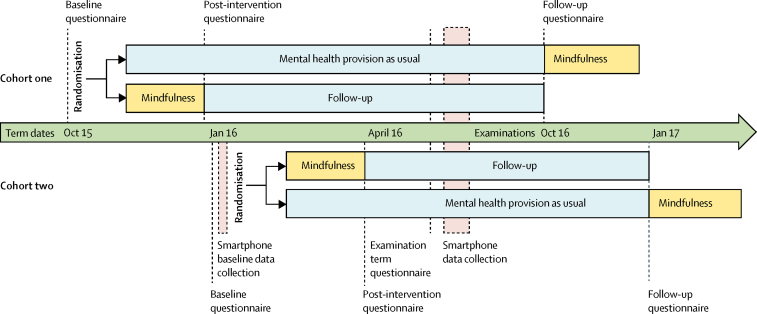
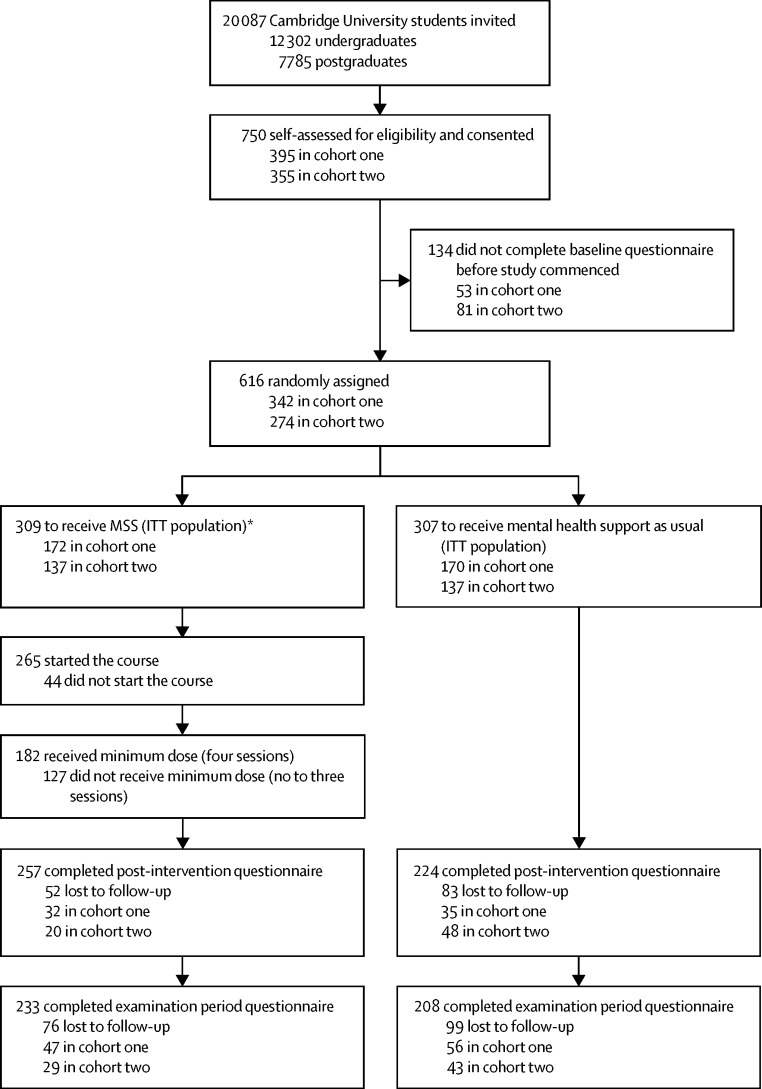
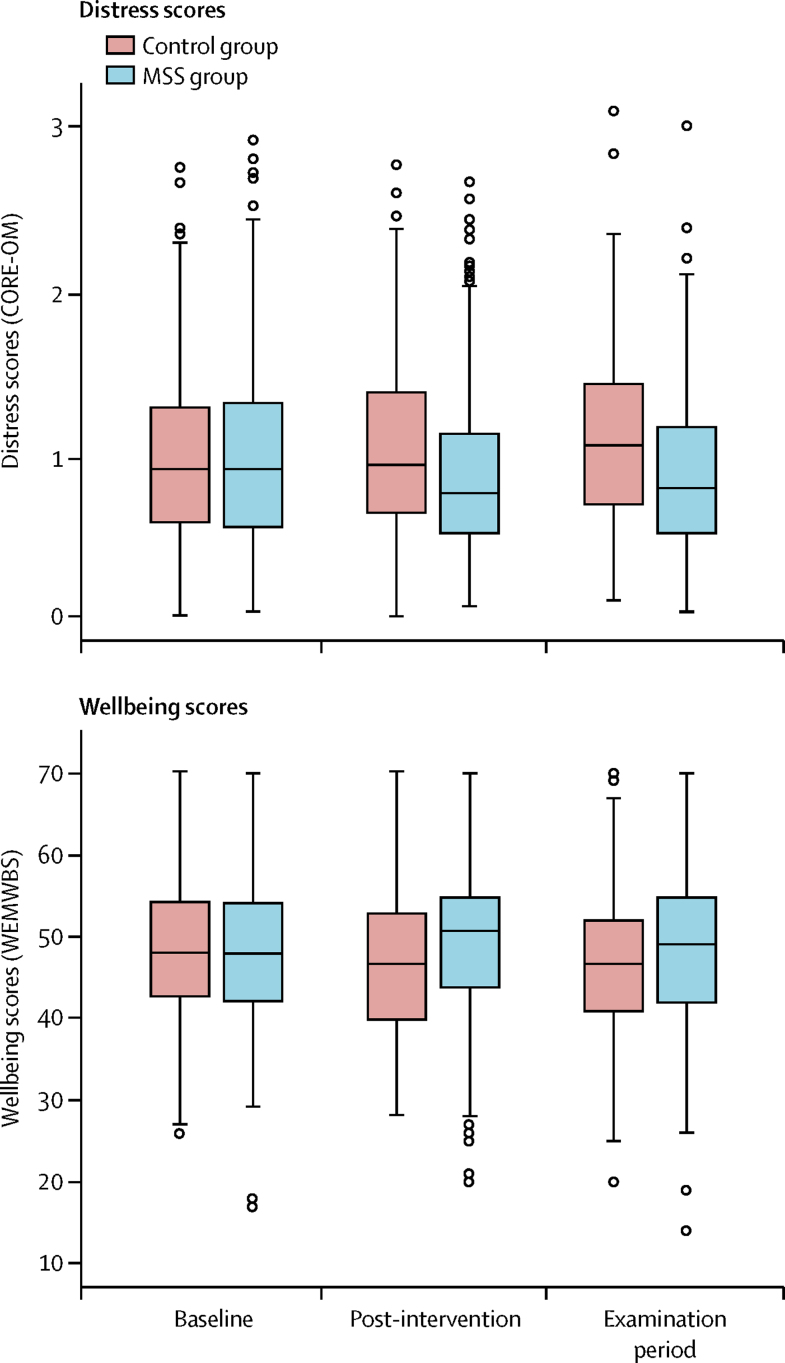
BACKGROUND: The rising number of young people going to university has led to concerns about an increasing demand for student mental health services. We aimed to assess whether provision of mindfulness courses to university students would improve their resilience to stress. METHODS: We did this pragmatic randomised controlled trial at the University of Cambridge, UK. Students aged 18 years or older with no severe mental illness or crisis (self-assessed) were randomly assigned (1:1), via remote survey software using computer-generated random numbers, to receive either an 8 week mindfulness course adapted for university students (Mindfulness Skills for Students [MSS]) plus mental health support as usual, or mental health support as usual alone. Participants and the study management team were aware of group allocation, but allocation was concealed from the researchers, outcome assessors, and study statistician. The primary outcome was self-reported psychological distress during the examination period, as measured with the Clinical Outcomes in Routine Evaluation Outcome Measure (CORE-OM), with higher scores indicating more distress. The primary analysis was by intention to treat. This trial is registered with the Australia and New Zealand Clinical Trials Registry, number ACTRN12615001160527. FINDINGS: Between Sept 28, 2015, and Jan 15, 2016, we randomly assigned 616 students to the MSS group (n=309) or the support as usual group (n=307). 453 (74%) participants completed the CORE-OM during the examination period and 182 (59%) MSS participants completed at least half of the course. MSS reduced distress scores during the examination period compared with support as usual, with mean CORE-OM scores of 0·87 (SD 0·50) in 237 MSS participants versus 1·11 (0·57) in 216 support as usual participants (adjusted mean difference -0·14, 95% CI -0·22 to -0·06; p=0·001), showing a moderate effect size (β -0·44, 95% CI -0·60 to -0·29; p<0·0001). 123 (57%) of 214 participants in the support as usual group had distress scores above an accepted clinical threshold compared with 88 (37%) of 235 participants in the MSS group. On average, six students (95% CI four to ten) needed to be offered the MSS course to prevent one from experiencing clinical levels of distress. No participants had adverse reactions related to self-harm, suicidality, or harm to others. INTERPRETATION: Our findings show that provision of mindfulness training could be an effective component of a wider student mental health strategy. Further comparative effectiveness research with inclusion of controls for non-specific effects is needed to define a range of additional, effective interventions to increase resilience to stress in university students. FUNDING: University of Cambridge and National Institute for Health Research Collaboration for Leadership in Applied Health Research and Care East of England.
Overview
The claims and statistics of this paper haven’t been checked yet.
Run the check — free, no account needed. It reads the open-access text and checks the sources it cites.
Integrity signals
Registry
Cites
Statistics
Figures
Verification
Claims the paper makes
The claims and statistics of this paper haven’t been checked yet.
Run the check — free, no account needed. It reads the open-access text and checks the sources it cites.
Claims other papers make about this one
Each is checked against this paper’s own text: does it say what the citing paper says it does?
The source backs part of the claim, not all of it — or backs it for a different population, condition or comparison.
In the citing paper
“As both a skill and a therapy, mindfulness has been shown to improve symptoms of anxiety, depression, stress, and other mental states (Galante et al. 2018; Ji et al. 2021; Johannsen et al. 2022; Zhu et al. 2021).”
From Changes in Mental Health and EEG Biomarkers of Undergraduates Under Different Patterns of Mindfulness (2024) · cites this paper as Galante et al. 2018
Experimental — accuracy not yet measuredThe source backs part of the claim, not all of it — or backs it for a different population, condition or comparison.
In the citing paper
“Systematic reviews conducted on the effectiveness of meditation programs and mindfulness-based intervention programs led to improvements in resilience to stress, anxiety and depression among university students and other populations, whether delivered offline [9] or online [10–14].”
From Effectiveness of online mindfulness interventions on medical students’ mental health: a systematic review (2021) · cites this paper as [9]
Experimental — accuracy not yet measuredThe check wasn’t confident either way, so it gives no verdict — never disputed.
In the citing paper
“However, none of neuroscientific studies have explored whether and how brief mindfulness training influences certain psychological features especially social support in college students during the COVID-19 pandemic.”
From Changes in Mental Health and EEG Biomarkers of Undergraduates Under Different Patterns of Mindfulness (2024) · cites this paper as Galante et al. 2018
Experimental — accuracy not yet measuredThe check wasn’t confident either way, so it gives no verdict — never disputed.
In the citing paper
“Although personality traits are relatively stable through time they are not cast in stone and can be enhanced, as research has shown, through specific interventions (for reviews and metanalyses see Galante et al., 2018; Gilmartin et al., 2017; Jayawardene et al., 2017; McConville et al., 2017; Quaglia et al., 2016; Spinelli et al., 2018).”
From Specific mindfulness traits protect against negative effects of trait anxiety on medical student wellbeing during high-pressure periods (2021) · cites this paper as Galante et al., 2018
Experimental — accuracy not yet measuredIn the citing paper
“We know from trials in older students that the key skills taught during MT can protect against deterioration in mental health during periods of stress, even if there are no apparent MT-related mental health benefits prior to the onset of stress.11”
In the citing paper
“Four studies set up independent data monitoring and ethics committees [52,85,92,171].”
In the citing paper
“The direction of this bias could favour the effects of MBPs because participants who feel unwell may be less likely to attend assessment sessions or complete self–reported outcomes [52].”
In the citing paper
“Two studies reported a participant abandoning the MBP because s/he felt it was being counterproductive [52,186].”
In the citing paper
“One study actively monitored clinically meaningful adverse events with no significant differences between trial arms [52].”
Self-check
Percentages, sums and reported differences re-computed from the paper’s own numbers.
The self-check needs the paper’s full text.
Citations
Cites
Cohen, J. (1992) · Psychological Bulletin · doi:10.1037//0033-2909.112.1.155 · Cited by 8,771
Our future: a Lancet commission on adolescent health and wellbeing
Patton, G. C., Sawyer, S. M., Santelli, J. S., Ross, D. A., Afifi, R., Allen, N. B., Arora, M., Azzopardi, P., Baldwin, W., Bonell, C., et al. (2016) · The Lancet · doi:10.1016/s0140-6736(16)00579-1 · Cited by 3,785
Meditation Programs for Psychological Stress and Well-being: A Systematic Review and Meta-analysis
Goyal, M., Singh, S., Sibinga, E. M. S., Gould, N. F., Rowland-Seymour, A., Sharma, R., Berger, Z., Sleicher, D., Maron, D. D., Shihab, H. M., et al. (2014) · JAMA Internal Medicine · doi:10.1001/jamainternmed.2013.13018 · Cited by 2,380
Mrazek, M. D., Franklin, M. S., Phillips, D. T., Baird, B., & Schooler, J. W. (2013) · Psychological Science · doi:10.1177/0956797612459659 · Cited by 1,063
Interventions to reduce stress in university students: A review and meta-analysis
Regehr, C., Glancy, D., & Pitts, A. (2013) · Journal of Affective Disorders · doi:10.1016/j.jad.2012.11.026 · Cited by 956
de Vibe, M., Solhaug, I., Tyssen, R., Friborg, O., Rosenvinge, J. H., Sørlie, T., & Bjørndal, A. (2013) · BMC Medical Education · doi:10.1186/1472-6920-13-107 · Cited by 398
Effect of kindness-based meditation on health and well-being: A systematic review and meta-analysis.
Galante, J., Galante, I., Bekkers, M.-J., & Gallacher, J. (2014) · Journal of Consulting and Clinical Psychology · doi:10.1037/a0037249 · Cited by 380
Self-citationMcConville, J., McAleer, R., & Hahne, A. (2017) · EXPLORE · doi:10.1016/j.explore.2016.10.002 · Cited by 336
The mental health of university students in the United Kingdom
Macaskill, A. (2013) · British Journal of Guidance and Counselling · doi:10.1080/03069885.2012.743110 · Cited by 335
Greeson, J. M., Juberg, M. K., Maytan, M., James, K. M., & Rogers, H. (2014) · Journal of American College Health · doi:10.1080/07448481.2014.887571 · Cited by 251
Cited by
Sorted by citations
Items 401–500 of 517
Eljabri, M. (2018) · e-space (Manchester Metropolitan University) · Cited by 1
Markus, E. D. (2019) · 2019 International Conference on Power Electronics, Control and Automation (ICPECA) · doi:10.1109/icpeca47973.2019.8975600 · Cited by 1
“Schools usually run clinics and routine checks on students to ensure this is achieved [9], [10].”
BackgroundPouraboli, B., Arianfar, M., Abadian, L., Abazari, F., & Dehghan, M. (2022) · Research Square · doi:10.21203/rs.3.rs-1187247/v1 · Cited by 1
“Emotional intelligence (EI) skills are potentially effective in coping with stress[1].”
BackgroundFeasibility of an online mindfulness-based program for mothers of NICU graduates in JapanPreprint
Suzuki, K., Bublitz, M. H., Park, J. J., Arimisty, T., & Proulx, J. A. (2023) · doi:10.31234/osf.io/y7nqw · Cited by 1
Mindful Steps Forward: Exploring the Impact of a Mindfulness-Based Intervention on Social Anxiety
M, A., Rajendran, N. R., Lavanya, L., & Nambi, S. (2024) · Malaysian Journal of Medicine and Health Sciences · doi:10.47836/mjmhs.20.s13.2
Response to "Why mindfulness matters in medical education"
Hales, J. M. (2018) · The British Student Doctor Journal · doi:10.18573/bsdj.42
“(2) studied 616 Cambridge University students demonstrating significantly reduced, self-reported psychological stress during the exam period in the group receiving a mindfulness skills course plus normal support, compared with those receiving normal support alone.”
BackgroundJones, P. B. (2018) · Social Psychiatry and Psychiatric Epidemiology · doi:10.1007/s00127-018-1564-4
Self-citationDeveloping Emotional Intelligence
(2022) · Wiley eBooks · doi:10.1002/9781119814535.ch5
Kakovost na področju visokošolskega izobraževanja s poudarkom na učenju in poučevanju
Grmek, M. I., & Bezjak, Š. (2021) · doi:10.18690/978-961-286-466-8.2
Bakračevič, K., & Pšunder, M. (2021) · doi:10.18690/978-961-286-466-8.5
Pojmovanja visokošolskih učiteljev treh držav o učenju in poučevanju
Grmek, M. I., & Krečić, M. J. (2021) · doi:10.18690/978-961-286-466-8.7
Kang, H., & Kim, A. (2021) · The Korean Association of General Education · doi:10.46392/kjge.2021.15.3.207
Uvajanje čuječnosti v študijski proces
Tekavc, A. (2021) · Pedagoški inštitut eBooks · doi:10.32320/978-961-270-339-4.299-310
The Impact of Mindfulness Practices and the Implementation of Technology in Higher Education
Sharif, S., Statti, A. L. C., & Torres, K. M. (2021) · Advances in human and social aspects of technology book series · doi:10.4018/978-1-7998-8318-0.ch010
Academic rank and salary status of medical laboratory sciences faculty.
Maturen, A., Sm, R., & Florek-Ebeling, D. B. (1981) · PubMed
Tejada-Simon, M. V., & Lodhi, S. (2022) · OBM Integrative and Complementary Medicine · doi:10.21926/obm.icm.2201009
“Page 10/18 the demands and challenges are alike [66-68].”
McKenzie, S. P. (2022) · Springer eBooks · doi:10.1007/978-3-030-97170-0_9
(2022) · Elsevier eBooks · doi:10.1016/b978-2-294-77691-5.00009-9
Veldhoven, B. D.-V., & Rouwet, E. V. (2022) · Bohn Stafleu van Loghum eBooks · doi:10.1007/978-90-368-2761-4_18
Veldhoven, B. D.-V., & Rouwet, E. V. (2020) · Bohn Stafleu van Loghum eBooks · doi:10.1007/978-90-368-2324-1_17
(2020) · Elsevier eBooks · doi:10.1016/b978-2-294-75486-9.00037-1
Students’ Perceptions on the Use of Radio Drama to Develop Speaking Skills
Saidalvi, A., Sa’adan, N., Taib, S. A., & Fakhruddin, W. F. W. W. (2022) · International Journal of Academic Research in Progressive Education and Development · doi:10.6007/ijarped/v11-i2/12951
Westbrock, A., & Dohnke, B. (2022) · Current Psychology · doi:10.1007/s12144-022-03114-x
“The content was derived from the traditional MBSR (Kabat-Zinn, 2013) but modified according to other MBIs for students (Eskic et al., 2019; Galante et al., 2018; Kuhlmann et al., 2016; Lynch et al., 2018) focussing on students’ needs and interests.”
MethodVivência acadêmica e sintomas depressivos em universitários durante a pandemia de Coronavírus
Alves, G. C., da Silva, C. C. P., Silva, C. M., & Milani, R. G. (2021) · REVISTA DE PSICOLOGIA DA UNESP · doi:10.5935/1984-9044.20210010 · Cited by 1
de Albuquerque, L. M. N. F. (2021) · doi:10.11606/d.7.2021.tde-13012022-142657
Elementos para el afrontamiento de riesgos emocionales y físicos por covid-19
Hurtado, G. I. V., Vargas, J. C. R., Arenas, M. E. R., Barona, M. A., Cortés, H. S. R., Paredes, S. R. V., Quintero, K. R., Osorio, L. G., Millán, A. F. C., Cuervo, J. T. R., et al. (2022) · Universidad Nacional Abierta y a Distancia eBooks · doi:10.22490/9789586518789
Cendales, A. S., Cuadra, I. M. T. D. L., Fajardo, A. P. R., Rodríguez, M. V., & Palencia-Sánchez, F. (2023) · doi:10.31234/osf.io/fhpjx
MENTAL HEALTH AND WELL-BEING – PERSPECTIVE OF UNDERGRADUATE URBAN COLLEGE GOERS
Ray, S. (2023) · INTERANTIONAL JOURNAL OF SCIENTIFIC RESEARCH IN ENGINEERING AND MANAGEMENT · doi:10.55041/ijsrem24724
A brief intervention decreases student distress
Shearin, S., Wang, J., REISCH, J. S., & Brewer‐Mixon, K. (2023) · The Clinical Teacher · doi:10.1111/tct.13629
“14,15 Although support for mindfulness is growing, further research is needed to understand its specific benefits.”
BackgroundUniversidades Promotoras de Saúde: o que fazem e para quem fazem?
de Souza, K. M., Ennes, L. M. C., de Oliveira, A. B., de Almeida, G. S., Toledo, N. D. N., & da Silva, N. C. (2023) · Peer Review · doi:10.53660/990.prw2564
Lei, Y., Xiang, X., Chen, L., He, M., Li, S., & Wang, Q. (2023) · Current HIV Research · doi:10.2174/011570162x262976231026090819
Adigun, A. A., Mustapha, I. A., Adisa, S. A., & Tukur, H. A. (2023) · Futurity Education · doi:10.57125/fed.2023.12.25.09
Gan, R., Chen, S., & Xue, J. (2023) · Research Square · doi:10.21203/rs.3.rs-3589123/v1
Compassion: From Neuroscience to New Horizons and Innovative, Inclusive Research Agendas
Waddington, K., Manley, J. Y., Edginton, T., & Kanov, J. (2024) · Frontiers research topics · doi:10.3389/978-2-8325-4230-9
Oliveira, R. A., & Véras, R. M. (2023) · Aprender - Caderno de Filosofia e Psicologia da Educação · doi:10.22481/aprender.i30.13759
Mirza, H. (2023) · Governance and Society Review · doi:10.32350/gsr.21.03
Effects of Meditative Practices on Academic Stress and Resilience of Ninth-graders
Kaur, R., & Sharma, L. (2024) · Journal of Applied Consciousness Studies · doi:10.4103/jacs.jacs_130_23
جابر, أ. آ. ص. ع. ا. أ. م. د. غ. ف. (2024) · Mağallaẗ Al-Tarbiyyaẗ wa Ṯaqāfiẗ Al-Ṯifl · doi:10.21608/jkfb.2024.340047
Virk, N. K., Gogia, D., & Choudhary, V. (2024) · Advances in psychology, mental health, and behavioral studies (APMHBS) book series · doi:10.4018/979-8-3693-2651-0.ch006
جابر, أ. آ. ص. ع. ا. أ. م. د. غ. ف. (2024) · Mağallaẗ Al-Tarbiyyaẗ wa Ṯaqāfiẗ Al-Ṯifl · doi:10.21608/jkfb.2024.343676
Schlechter, P., Meyer, T., Hagen, M., Baranova, K., & Nexhmedin Morina, B. (2024) · doi:10.31219/osf.io/ngxtz
Sim, S., Maldonado, I., Castelnau, P., Barantin, L., el-Hage, W., Andersson, F., & Cottier, J. (2024) · Douleurs : Évaluation - Diagnostic - Traitement · doi:10.1016/j.douler.2024.03.001
Goldstein, M. A., & Goldstein, M. C. (2024) · Oxford University Press eBooks · doi:10.1093/med/9780197640739.003.0008
Vrshek‐Schallhorn, S., Alligood, B. N., Fletcher, A. C., & Jensen, M. R. (2024) · Journal of First-generation Student Success · doi:10.1080/26906015.2024.2332236
“…skills training course significantly reduced prospective clinical-level distress in a randomized controlled trial of N = 616 UK college students (Galante et al., 2018), had persisting benefits 1 year later especially during more stressful times (Galante et al., 2021), and may have had a…”
Comparative Analysis of Stress Levels Among Undergraduate Students at St. John's College, Agra
Shrivastava, U. G., Thakur, A., Singh, T. P., Dhakar, J. S., Jain, S., Agrawal, A., Pachori, H., & Thakur, S. (2024) · Cureus · doi:10.7759/cureus.67452
“These factors contribute to elevated stress levels, which can adversely affect students' overall well-being and their ability to succeed academically [1,3].”
BackgroundYuan, Z. (2024) · Applied Mathematics and Nonlinear Sciences · doi:10.2478/amns-2024-2503
Smart, C. M., Chim, L. S., Nicoll, P. M., Viczko, J., & Qualls, L. K. (2024) · Emerging Adulthood · doi:10.1177/21676968241289630
“Importantly, mindfulness has been studied in terms of enhancing student mental health broadly (Huang et al., 2018) as well as resilience enhancement speci fi cally (e.g., Galante et al., 2018; Ramasubramanian, 2017).”
Investigating the effects of Mindfulness Meditation on Stress Reduction
Tariq, K., Zaffar, F., Riaz, A. M., Hayat, U., Idrees, S., & Khan, Z. K. (2025) · Bulletin of Business and Economics (BBE) · doi:10.61506/01.00579
Stang, P., Köllner, M. G., & Rico-Dresel, D. (2025) · GeroPsych · doi:10.1024/1662-9647/a000346
Kerrigan, D. L., Mantsios, A. R., Moreno, L., Gómez, H., Pérez, M., Donastorg, Y., Karver, T. S., Savage, V., Sibinga, E. M. S., & Barrington, C. (2025) · Mindfulness · doi:10.1007/s12671-025-02615-7
“Prior studies have also found that greater mindfulness is associated with increased resilience and better mental health among youth living with HIV in resource-constrained settings (Bajaj & Pande, 2016; Dow et al., 2018; Galante et al., 2018).”
Pandya, S. P. (2025) · International Journal of Educational Research · doi:10.1016/j.ijer.2025.102655 · Cited by 1
Using Mindfulness Strategies in Strengthening the Well-Being of Students in Universities
Oyoo, S. A., & Olendo, R. A. (2025) · Springer eBooks · doi:10.1007/978-3-031-88793-2_14
Fang, S., Chung, M. C., & Wang, N. (2025) · Children and Youth Services Review · doi:10.1016/j.childyouth.2025.108470
Prakash, A., Hariharan, R., & Rout, G. K. (2025) · Sustainable Futures · doi:10.1016/j.sftr.2025.101015
Chung, K. Y., & Mo, K. Y. (2025) · Journal of Evidence-Based Social Work · doi:10.1080/26408066.2025.2547220
Gaete, J., Núñez, D., Romo, V., Ramírez, S., Barrera, F. A., & Araya, R. (2025) · Research Square · doi:10.21203/rs.3.rs-5837565/v1
Beaufort, Q., Angel, L., Barantin, L., Andersson, F., Gissot, V., Sizaret, E., Vilain-Abraham, F. L., El‐Hage, W., & Cottier, J. (2025) · Research Square · doi:10.21203/rs.3.rs-7722934/v1
ESTRATÉGIAS DE ENFRENTAMENTO À ANSIEDADE EM ESTUDANTES DE MEDICINA: UMA REVISÃO INTEGRATIVA
Vásquez, C. A. C., Araújo, G. R. M., Lima, J. P. C., Santos, M. E. D. S., de Freitas, M. N. V., Viana, M. G., & Ximenes, K. W. F. (2025) · Aracê. · doi:10.56238/arev7n11-166
Morgan, J. I., & Nicklin, A. (2025) · Journal of Further and Higher Education · doi:10.1080/0309877x.2025.2588460 · Cited by 1
Mindfulness y su Influencia en el Bienestar y Rendimiento Académico de Estudiantes Universitarios
Callisaya-Condori, J. C. (2025) · Revista Docentes 2 0 · doi:10.37843/rted.v18i2.670
Moreira, S. C. F., Goiato, M. C., Bortoleto, A. L. F., Antônio, I. C., Líbera, J. D., Túrcio, K. H. L., & dos Santos, D. M. (2025) · Psicologia e Saúde em Debate · doi:10.22289/2446-922x.v11a2a60
Rodríguez-Quiles, J. A., Monreal‐Bartolomé, A., & García‐Campayo, J. (2025) · Revista Electrónica Complutense de Investigación en Educación Musical - RECIEM · doi:10.5209/reciem.100751
Cortesi, M., Pendenza, F., Haddon, E., & Schiavio, A. (2025) · PLoS ONE · doi:10.1371/journal.pone.0338938
de Sousa, G. M., Lima-Araújo, G. L. D., Araújo, D. B. D., & de Sousa, M. B. C. (2021) · Figshare · doi:10.6084/m9.figshare.13684528
de Sousa, G. M., Lima-Araújo, G. L. D., Araújo, D. B. D., & de Sousa, M. B. C. (2021) · Figshare · doi:10.6084/m9.figshare.13684534
de Sousa, G. M., Lima-Araújo, G. L. D., Araújo, D. B. D., & de Sousa, M. B. C. (2021) · Figshare · doi:10.6084/m9.figshare.13684531
Polese, D., Costanzi, F., Bianchi, P., Frega, A., Bellati, F., Marco, M. P. D., Parisi, P., Bruni, O., Caserta, D., & Cozza, G. (2024) · Figshare · doi:10.6084/m9.figshare.26682793
Chilson, C. (2019) · Emerald Group Publishing Limited eBooks · doi:10.1108/978-1-64113-921-220251006
Mindfulness as a mediator between psychological distress and well-being among university students
Meda-Lara, R. M., Restrepo, J. E., Gómez-Tabares, A. S., & Juárez-Rodríguez, P. (2025) · Psychology Health & Medicine · doi:10.1080/13548506.2025.2604269
Cuevas, H. F., & Vega, D. J. R. (2025) · Revista Multidisciplinar Epistemología de las Ciencias · doi:10.71112/df379q38
DIGITAL MEDIA-BASED MINDFULNESS INTERVENTIONS IN EDUCATION SETTING: SYSTEMATIC LITERATURE REVIEW
Fuadina, N., & Febrianti, T. (2025) · Counsenesia Indonesian Journal Of Guidance and Counseling · doi:10.36728/cijgc.v6i2.5711
“Empirical findings indicate that mindfulness interventions can improve academic achievement (Ostermann, 2022) and strengthen resilience in student populations (Galante, 2018).”
Queirolo, L., Annalisa, B., Tommaso, C., Otello, M., Facco, E., Zanette, G., Stellini, E., & Navalesi, P. (2026) · Research Square · doi:10.21203/rs.3.rs-8555017/v1
Napoli, A. O., Venook, R. D., & Salehi, S. (2025) · IEEE Frontiers in Education Conference (FIE) · doi:10.1109/fie63693.2025.11328520
“Other outcomes linked to resilience have included problem solving skills [12] and psychological distress and mental wellbeing [13].”
Benítez-Agudelo, J. C., Navarro-Jiménez, E., & Clemente‐Suárez, V. J. (2026) · Frontiers in Psychology · doi:10.3389/fpsyg.2026.1704398
Verma, E. (2026) · IGI Global eBooks · doi:10.4018/979-8-3373-3877-4.ch007
The Emergence of Mindfulness, Flourishing, and Wellness in Higher Education
Son, N. D. (2026) · IGI Global eBooks · doi:10.4018/979-8-3373-3877-4.ch001
Cheng, C., & Chen, X. (2026) · Clinical Nursing Research · doi:10.1177/10547738261429342
“These characteristics contribute to higher levels of life satisfaction by mitigating the negative effects of stress (Galante et al., 2018).”
Adaptation au stress en contexte scolaire
Angelini, G., & Romano, L. (2025) · Dunod eBooks · doi:10.3917/dunod.bouju.2025.01.0260
Walkon, L., Nazmifar, M., Izad, T., Lloyd, R., & Mohiyeddini, C. (2026) · Frontiers in Psychology · doi:10.3389/fpsyg.2026.1809618
Kuzmina, D. A. (2026) · Izvestiya of Saratov University Educational Acmeology Developmental Psychology · doi:10.18500/2304-9790-2026-15-1-62-70
Herrera-Plasencia, P. M., & Antón, C. A. C. (2026) · Educación Médica · doi:10.1016/j.edumed.2026.101185
Ronkainen, H., Kenttä, G., Lundgren, T., Ihalainen, J. K., Valtonen, M., & Lappalainen, R. I. (2026) · The Sport Psychologist · doi:10.1123/tsp.2025-0108
Redd, K., Kennedy, K. R., & Bräuer, M. (2026) · Frontiers in Education · doi:10.3389/feduc.2026.1798646
“…either in person or online through formats such as mindfulness-based stress reduction (MBSR), mindfulness based cognitive therapy (MBCT), or acceptance and commitment therapy (ACT) based training (Galante et al., 2018; Gallo et al., 2023; González-Martin et al., 2023; Simonsson et al., 2021).”
Vasiou, A., Vasilaki, E., Veloni, M., Smaropoulou, C., & Gkontelos, A. (2026) · International Journal of Applied Positive Psychology · doi:10.1007/s41042-026-00298-6
“Mindfulness-based programs, grati - tude interventions, and self-compassion training have proven effective in improving emotional regulation, reducing stress, and promoting the calm affective states asso - ciated with psychological well-being (Neff & Germer, 2013 ; Galante et al., 2018 ).”
Chen, Z., Duan, W.-J., Huang, K., Yu, X., Zhang, G.-L., & Du, X.-Q. (2026) · Child & Youth Care Forum · doi:10.1007/s10566-026-09954-z
Toledo, M. C., Okamoto, M., Guerra-Domínguez, M. P., & Ballesteros-Valdés, R. (2026) · Research Square · doi:10.21203/rs.3.rs-9603205/v1
How AI Can Enhance Psychological Resilience
Gavankar, M. S., & Ghosh, S. (2026) · IGI Global eBooks · doi:10.4018/979-8-3373-7986-9.ch019
Zhang, Q., Zhang, Z., Xu, C., Xu, X., Li, M., Ma, J., & Li, Y. (2026) · Frontiers in Psychology · doi:10.3389/fpsyg.2026.1714878
“Existing research has established a solid foundation for the boosting eect of mindfulness on resilience (Galante et al., 2018; O’Connor et al., 2023; Tanaka et al., 2023).”
Koyuncu, F., & Yuceer, B. (2026) · Nurse Education in Practice · doi:10.1016/j.nepr.2026.104888
Simerly, G., Broman‐Fulks, J. J., Webb, R. M., & Emery, L. (2026) · Journal of American College Health · doi:10.1080/07448481.2026.2673432
“12,13 In addition, the frequency of mindfulness practice is negatively associated with symptom severity.”
Resilience Building and Enhancing Mental Health: A Scoping Review of School-to-University Programs
nakorn, S. N., & Chandler, G. E. (2026) · Journal of Psychosocial Nursing and Mental Health Services · doi:10.3928/02793695-20260619-02
Carson, W. O., Valenti, M., BEGAY, K. R., Carvajal, S. C., Carroll, S. R., YUAN, N., & Cordova-Marks, F. M. (2026) · Journal of American College Health · doi:10.1080/07448481.2026.2690492
Metadata
- Authors
- Galante, J., Dufour, G., Vainre, M., Wagner, A. P., Stochl, J., Benton, A., Lathia, N., Howarth, E., & Jones, P. B.
- Affiliations
- University of Cambridge (GB)
- National Institute for Health and Care Research (GB)
- University of East Anglia (GB)
- University College London (GB)
- Corresponding author
- Galante, Julieta
- ORCID
- Venue
- The Lancet Public Health
- Publisher
- Elsevier BV
- Published
- 2018-02
- Volume
- 3
- Issue
- 2
- Pages
- e72-e81
- ISSN
- 2468-2667 (ISSN-L)
- PMC
- PMC5813792
- OpenAlex
- W2778288638
- Cited by
- 516
- References
- 31
- Citations by year
- 2026: 42 · 2025: 69 · 2024: 67 · 2023: 68 · 2022: 71 · 2021: 86 · 2020: 56 · 2019: 46 · 2018: 9
- FWCI
- 37.99
- Type
- journal article
- Language
- en
- Open access
- gold
- doi.org
- Licence
- Locations
- The Lancet Public Health (publishedVersion, cc-by)
- Europe PMC (PubMed Central) (publishedVersion, cc-by)
- PubMed Central (publishedVersion, cc-by)
- PubMed (publishedVersion)
- UEA Digital Repository (University of East Anglia) (submittedVersion)
- DOAJ (DOAJ: Directory of Open Access Journals) (submittedVersion, cc-by-sa)
- Apollo (University of Cambridge) (submittedVersion, cc-by)
- Apollo (cc-by)
- Funders
- National Institute for Health Research
- University of Cambridge
- Topics
- Social Sciences › Psychology › Clinical Psychology › Mindfulness and Compassion Interventions
- Social Sciences › Psychology › Developmental and Educational Psychology › Student Stress and Coping
- Social Sciences › Psychology › Applied Psychology › Digital Mental Health Interventions
- Keywords
- mindfulness-based interventions, stress resilience, university students, student mental health, psychological distress, exam period, mental health support, CORE-OM, student well-being, academic stress, student satisfaction, student engagement, student attendance
- MeSH terms
- Adolescent, Adult, Female, United Kingdom, Health Promotion, Humans, Male, Mental Health Services, Stress, Psychological, Student Health Services, Students, Universities, Program Evaluation, Resilience, Psychological, Young Adult, Mindfulness
About these checks
Registry, retraction, Cites and statistics results are computed, not judged, with one exception: a printed reference that no index lists is read once by a model before it counts as a citation error. Claims are extracted by a model and kept only when their quote appears verbatim in the text; each cited source is then checked, with a model’s help, for whether it says what the claim relies on. Those verdicts can be wrong — read the claim’s quote and the cited source before relying on one.
Statistics and arithmetic are recomputed, not judged.
Confidence bands are shown only for fields calibrated on our annotated test set. None is calibrated yet, so no band is shown.
What counts as a claim ›How we measure confidence ›How we check this ›
Are you an author, or do you see a problem with this page? Request a review
