

The DOI matches its Crossref record; 30 of the 31 references it cites were found in a registry or an index.
A mindfulness-based intervention to increase resilience to stress in university students (the Mindful Student Study): a pragmatic randomised controlled trial
Open accessAbstract
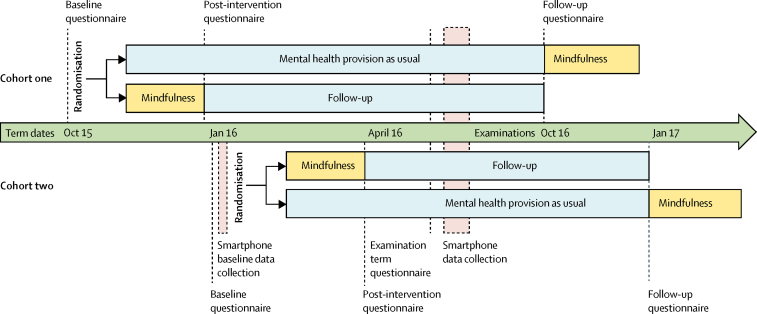
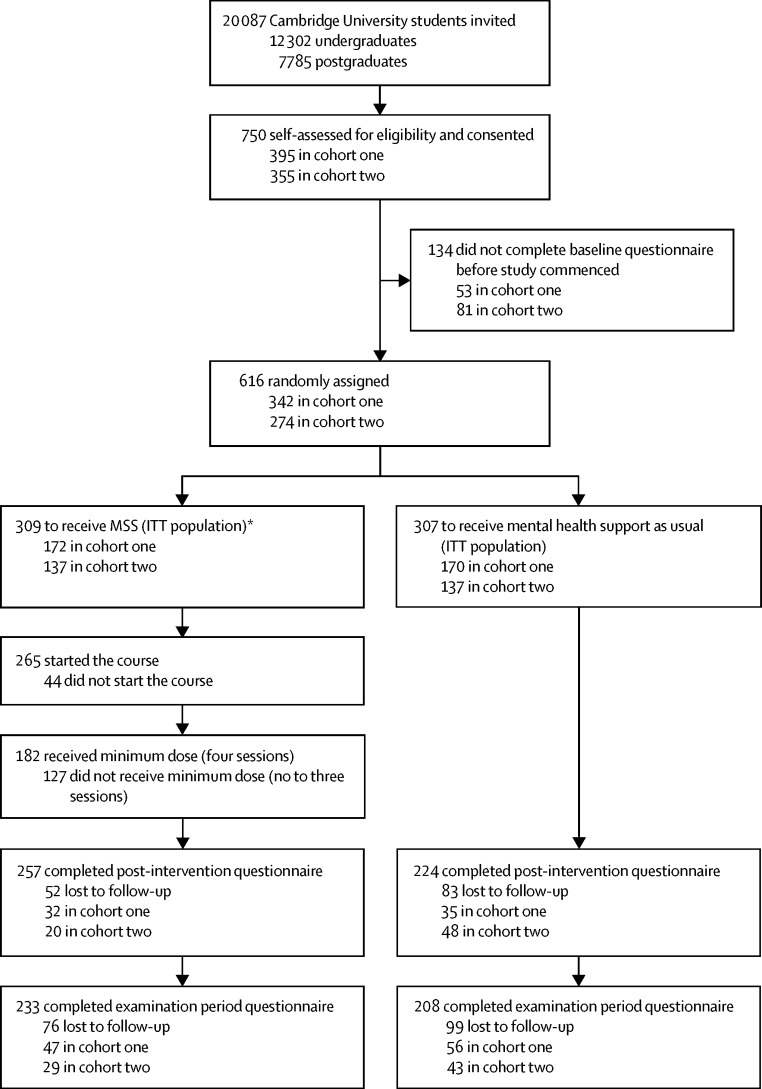
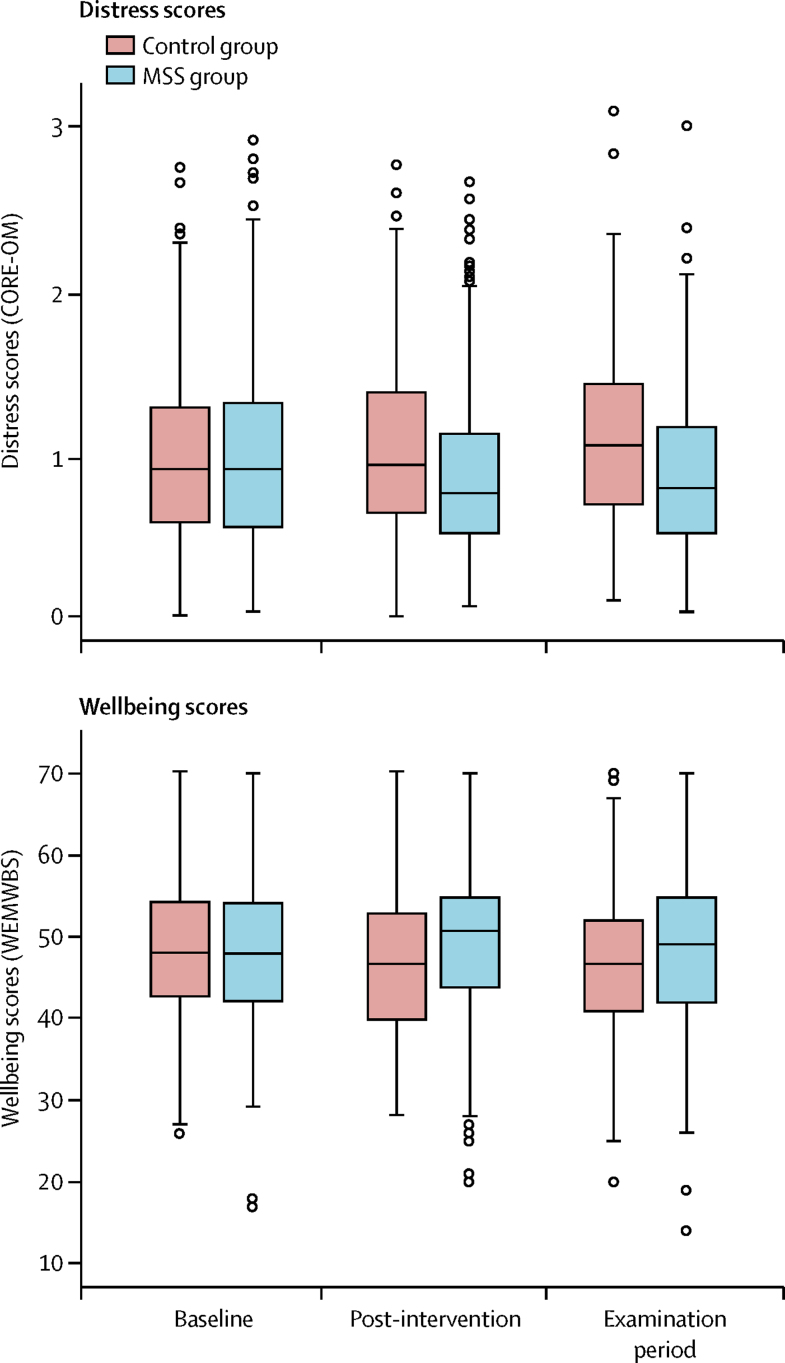
BACKGROUND: The rising number of young people going to university has led to concerns about an increasing demand for student mental health services. We aimed to assess whether provision of mindfulness courses to university students would improve their resilience to stress. METHODS: We did this pragmatic randomised controlled trial at the University of Cambridge, UK. Students aged 18 years or older with no severe mental illness or crisis (self-assessed) were randomly assigned (1:1), via remote survey software using computer-generated random numbers, to receive either an 8 week mindfulness course adapted for university students (Mindfulness Skills for Students [MSS]) plus mental health support as usual, or mental health support as usual alone. Participants and the study management team were aware of group allocation, but allocation was concealed from the researchers, outcome assessors, and study statistician. The primary outcome was self-reported psychological distress during the examination period, as measured with the Clinical Outcomes in Routine Evaluation Outcome Measure (CORE-OM), with higher scores indicating more distress. The primary analysis was by intention to treat. This trial is registered with the Australia and New Zealand Clinical Trials Registry, number ACTRN12615001160527. FINDINGS: Between Sept 28, 2015, and Jan 15, 2016, we randomly assigned 616 students to the MSS group (n=309) or the support as usual group (n=307). 453 (74%) participants completed the CORE-OM during the examination period and 182 (59%) MSS participants completed at least half of the course. MSS reduced distress scores during the examination period compared with support as usual, with mean CORE-OM scores of 0·87 (SD 0·50) in 237 MSS participants versus 1·11 (0·57) in 216 support as usual participants (adjusted mean difference -0·14, 95% CI -0·22 to -0·06; p=0·001), showing a moderate effect size (β -0·44, 95% CI -0·60 to -0·29; p<0·0001). 123 (57%) of 214 participants in the support as usual group had distress scores above an accepted clinical threshold compared with 88 (37%) of 235 participants in the MSS group. On average, six students (95% CI four to ten) needed to be offered the MSS course to prevent one from experiencing clinical levels of distress. No participants had adverse reactions related to self-harm, suicidality, or harm to others. INTERPRETATION: Our findings show that provision of mindfulness training could be an effective component of a wider student mental health strategy. Further comparative effectiveness research with inclusion of controls for non-specific effects is needed to define a range of additional, effective interventions to increase resilience to stress in university students. FUNDING: University of Cambridge and National Institute for Health Research Collaboration for Leadership in Applied Health Research and Care East of England.
Overview
The claims and statistics of this paper haven’t been checked yet.
Run the check — free, no account needed. It reads the open-access text and checks the sources it cites.
Integrity signals
Registry
Cites
Statistics
Figures
Verification
Claims the paper makes
The claims and statistics of this paper haven’t been checked yet.
Run the check — free, no account needed. It reads the open-access text and checks the sources it cites.
Claims other papers make about this one
Each is checked against this paper’s own text: does it say what the citing paper says it does?
The source backs part of the claim, not all of it — or backs it for a different population, condition or comparison.
In the citing paper
“As both a skill and a therapy, mindfulness has been shown to improve symptoms of anxiety, depression, stress, and other mental states (Galante et al. 2018; Ji et al. 2021; Johannsen et al. 2022; Zhu et al. 2021).”
From Changes in Mental Health and EEG Biomarkers of Undergraduates Under Different Patterns of Mindfulness (2024) · cites this paper as Galante et al. 2018
Experimental — accuracy not yet measuredThe source backs part of the claim, not all of it — or backs it for a different population, condition or comparison.
In the citing paper
“Systematic reviews conducted on the effectiveness of meditation programs and mindfulness-based intervention programs led to improvements in resilience to stress, anxiety and depression among university students and other populations, whether delivered offline [9] or online [10–14].”
From Effectiveness of online mindfulness interventions on medical students’ mental health: a systematic review (2021) · cites this paper as [9]
Experimental — accuracy not yet measuredThe check wasn’t confident either way, so it gives no verdict — never disputed.
In the citing paper
“However, none of neuroscientific studies have explored whether and how brief mindfulness training influences certain psychological features especially social support in college students during the COVID-19 pandemic.”
From Changes in Mental Health and EEG Biomarkers of Undergraduates Under Different Patterns of Mindfulness (2024) · cites this paper as Galante et al. 2018
Experimental — accuracy not yet measuredThe check wasn’t confident either way, so it gives no verdict — never disputed.
In the citing paper
“Although personality traits are relatively stable through time they are not cast in stone and can be enhanced, as research has shown, through specific interventions (for reviews and metanalyses see Galante et al., 2018; Gilmartin et al., 2017; Jayawardene et al., 2017; McConville et al., 2017; Quaglia et al., 2016; Spinelli et al., 2018).”
From Specific mindfulness traits protect against negative effects of trait anxiety on medical student wellbeing during high-pressure periods (2021) · cites this paper as Galante et al., 2018
Experimental — accuracy not yet measuredIn the citing paper
“We know from trials in older students that the key skills taught during MT can protect against deterioration in mental health during periods of stress, even if there are no apparent MT-related mental health benefits prior to the onset of stress.11”
In the citing paper
“Four studies set up independent data monitoring and ethics committees [52,85,92,171].”
In the citing paper
“The direction of this bias could favour the effects of MBPs because participants who feel unwell may be less likely to attend assessment sessions or complete self–reported outcomes [52].”
In the citing paper
“Two studies reported a participant abandoning the MBP because s/he felt it was being counterproductive [52,186].”
In the citing paper
“One study actively monitored clinically meaningful adverse events with no significant differences between trial arms [52].”
Self-check
Percentages, sums and reported differences re-computed from the paper’s own numbers.
The self-check needs the paper’s full text.
Citations
Cites
Cohen, J. (1992) · Psychological Bulletin · doi:10.1037//0033-2909.112.1.155 · Cited by 8,771
Our future: a Lancet commission on adolescent health and wellbeing
Patton, G. C., Sawyer, S. M., Santelli, J. S., Ross, D. A., Afifi, R., Allen, N. B., Arora, M., Azzopardi, P., Baldwin, W., Bonell, C., et al. (2016) · The Lancet · doi:10.1016/s0140-6736(16)00579-1 · Cited by 3,785
Meditation Programs for Psychological Stress and Well-being: A Systematic Review and Meta-analysis
Goyal, M., Singh, S., Sibinga, E. M. S., Gould, N. F., Rowland-Seymour, A., Sharma, R., Berger, Z., Sleicher, D., Maron, D. D., Shihab, H. M., et al. (2014) · JAMA Internal Medicine · doi:10.1001/jamainternmed.2013.13018 · Cited by 2,380
Mrazek, M. D., Franklin, M. S., Phillips, D. T., Baird, B., & Schooler, J. W. (2013) · Psychological Science · doi:10.1177/0956797612459659 · Cited by 1,063
Interventions to reduce stress in university students: A review and meta-analysis
Regehr, C., Glancy, D., & Pitts, A. (2013) · Journal of Affective Disorders · doi:10.1016/j.jad.2012.11.026 · Cited by 956
de Vibe, M., Solhaug, I., Tyssen, R., Friborg, O., Rosenvinge, J. H., Sørlie, T., & Bjørndal, A. (2013) · BMC Medical Education · doi:10.1186/1472-6920-13-107 · Cited by 398
Effect of kindness-based meditation on health and well-being: A systematic review and meta-analysis.
Galante, J., Galante, I., Bekkers, M.-J., & Gallacher, J. (2014) · Journal of Consulting and Clinical Psychology · doi:10.1037/a0037249 · Cited by 380
Self-citationMcConville, J., McAleer, R., & Hahne, A. (2017) · EXPLORE · doi:10.1016/j.explore.2016.10.002 · Cited by 336
The mental health of university students in the United Kingdom
Macaskill, A. (2013) · British Journal of Guidance and Counselling · doi:10.1080/03069885.2012.743110 · Cited by 335
Greeson, J. M., Juberg, M. K., Maytan, M., James, K. M., & Rogers, H. (2014) · Journal of American College Health · doi:10.1080/07448481.2014.887571 · Cited by 251
Cited by
Sorted by citations
Goldberg, S. B., Riordan, K. M., Sun, S., & Davidson, R. J. (2022) · Perspectives on Psychological Science · doi:10.1177/1745691620968771 · Cited by 520
A systematic review and meta-analysis of psychological interventions to improve mental wellbeing
van Agteren, J., Iasiello, M., Lo, L., Bartholomaeus, J., Kopsaftis, Z., Carey, M., & Kyrios, M. (2021) · Nature Human Behaviour · doi:10.1038/s41562-021-01093-w · Cited by 510
Galante, J., Friedrich, C., Dawson, A. F., Modrego-Alarcón, M., Gebbing, P., Delgado-Suárez, I., Gupta, R., Dean, L., Dalgleish, T., White, I. R., et al. (2021) · PLOS Medicine · doi:10.1371/journal.pmed.1003481 · Cited by 319
Self-citationDawson, A. F., Brown, W. W., Anderson, J., Datta, B., Donald, J. N., Hong, K., Allan, S., Mole, T. B., Jones, P. B., & Galante, J. (2020) · Applied Psychology: Health and Well-Being · doi:10.1111/aphw.12188 · Cited by 312
Self-citationDuffy, A. C., Keown‐Stoneman, C. D. G., Goodday, S., Horrocks, J., Lowe, M. P., King, N., Pickett, W., McNevin, S. H., Cunningham, S., Rivera, D., et al. (2020) · BJPsych Open · doi:10.1192/bjo.2020.24 · Cited by 260
Barriers to high school and university students’ physical activity: A systematic review
Silva, R. M. F., Mendonça, C. R., Azevedo, V. D., Memon, A. R., Noll, P. R. E. S., & Noll, M. A. (2022) · PLoS ONE · doi:10.1371/journal.pone.0265913 · Cited by 311
Rith-Najarian, L. R., Boustani, M. M., & Chorpita, B. F. (2019) · Journal of Affective Disorders · doi:10.1016/j.jad.2019.06.035 · Cited by 176
Psychological interventions to foster resilience in healthcare students
Kunzler, A. M., Helmreich, I., König, J., Chmitorz, A., Wessa, M., Binder, H., & Lieb, K. (2020) · Cochrane Database of Systematic Reviews · doi:10.1002/14651858.cd013684 · Cited by 177
Lai, A. Y.-K., Lee, L., Wang, M.-P., Feng, Y., Lai, T. T.-K., Ho, L.-M., Lam, V. S.-F., Ip, M. S.-M., & Lam, T.-H. (2020) · Frontiers in Psychiatry · doi:10.3389/fpsyt.2020.584240 · Cited by 237
Stress management interventions for college students: A systematic review and meta-analysis.
Amanvermez, Y., Rahmadiana, M., Karyotaki, E., de Wit, L. M., Ebert, D. D., Kessler, R. C., & Cuijpers, P. J. (2020) · Clinical Psychology Science and Practice · doi:10.1111/cpsp.12342 · Cited by 194
Soto, C. J., Napolitano, C. M., & Roberts, B. W. (2020) · Current Directions in Psychological Science · doi:10.1177/0963721420978613 · Cited by 177
Wang, Q., Sun, W., & Wu, H. (2022) · BMC Medical Education · doi:10.1186/s12909-022-03326-6 · Cited by 131
Effects of Mindfulness-Based Interventions on Alexithymia: A Systematic Review
Norman, H., Marzano, L., Coulson, M., & Oskis, A. (2019) · Evidence Based Mental Health · doi:10.1136/ebmental-2018-300029 · Cited by 128
Barkham, M., Broglia, E., Dufour, G., Fudge, M., Knowles, L., Percy, A. K., Turner, A., & Williams, C. (2019) · Counselling and Psychotherapy Research · doi:10.1002/capr.12227 · Cited by 128
Self-citationCamacho-Zúñiga, C., Pego, L., Escamilla, J., & Hosseini, S. (2021) · Heliyon · doi:10.1016/j.heliyon.2021.e06465 · Cited by 148
Mindfulness-Based Programs: Why, When, and How to Adapt?
Loucks, E. B., Crane, R. S., Sanghvi, M. A., Montero‐Marín, J., Proulx, J. A., Brewer, J. A., & Kuyken, W. (2022) · Global Advances in Health and Medicine · doi:10.1177/21649561211068805 · Cited by 116
Galante, J., Friedrich, C., Collaboration of Mindfulness Trials (CoMinT), Aeamla-Or, N., Arts-de Jong, M., Barrett, B., Bögels, S. M., Buitelaar, J. K., Checovich, M. M., Christopher, M. S., et al. (2023) · Nature Mental Health · doi:10.1038/s44220-023-00081-5 · Cited by 113
Self-citationMental health in distance learning: a taxonomy of barriers and enablers to student mental wellbeing
Lister, K., Seale, J., & Douce, C. (2021) · Open Learning The Journal of Open Distance and e-Learning · doi:10.1080/02680513.2021.1899907 · Cited by 109
Du, C., Zan, M. C. H., Cho, M. J., Fenton, J. I., Hsiao, P. Y., Hsiao, R., Keaver, L., Lai, C.-C., Lee, H., Ludy, M.-J., et al. (2021) · Nutrients · doi:10.3390/nu13020442 · Cited by 108
Mental health in medical, dentistry and veterinary students: cross-sectional online survey
Knipe, D. W., Maughan, C., Gilbert, J., Dymock, D., Moran, P., & Gunnell, D. (2018) · BJPsych Open · doi:10.1192/bjo.2018.61 · Cited by 96
Paterson, C. C., Paterson, N., Jackson, W. J., & Work, F. (2019) · Nurse Education Today · doi:10.1016/j.nedt.2019.104236 · Cited by 96
Modrego‐Alarcón, M., del Hoyo, Y. L., García‐Campayo, J., Pérez‐Aranda, A., Navarro‐Gil, M., Beltrán-Ruiz, M., Morillo, H., Delgado-Suárez, I., Oliván-Arévalo, R., & Montero‐Marín, J. (2021) · Behaviour Research and Therapy · doi:10.1016/j.brat.2021.103866 · Cited by 109
de Sousa, G. M., de Lima-Araujo, G. L., de Araújo, D. B., & de Sousa, M. B. C. (2021) · BMC Psychology · doi:10.1186/s40359-021-00520-x · Cited by 125
Czajkowski, A.-M. L., Greasley, A., & Allis, M. (2020) · Musicae Scientiae · doi:10.1177/1029864920941570 · Cited by 110
Dodd, A. L., Priestley, M., Tyrrell, K., Cygan, S., Newell, C., & Byrom, N. C. (2021) · Journal of Mental Health · doi:10.1080/09638237.2021.1875419 · Cited by 89
Yakobi, O., Smilek, D., & Danckert, J. (2021) · Cognitive Therapy and Research · doi:10.1007/s10608-020-10177-2 · Cited by 85
da Silva, C. C. G., Bolognani, C. V., Amorim, F. F., & Imoto, A. M. (2023) · Systematic Reviews · doi:10.1186/s13643-023-02244-y · Cited by 84
Mindfulness as a way to cope with COVID‐19‐related stress and anxiety.
Weis, R., Ray, S. D., & Cohen, T. A. (2021) · Counselling and Psychotherapy Research · doi:10.1002/capr.12375 · Cited by 82
Mindfulness practice for protecting mental health during the COVID-19 pandemic
Zhu, J. L., Schülke, R., Vatansever, D., Xi, D., Yan, J., Zhao, H., Xie, X., Feng, J., Chen, M. Y., Sahakian, B. J., et al. (2021) · Translational Psychiatry · doi:10.1038/s41398-021-01459-8 · Cited by 83
González-Martín, A., Aibar-Almazán, A., Rivas-Campo, Y., Castellote-Caballero, Y., & Carcelén-Fraile, M. D. C. (2023) · Frontiers in Public Health · doi:10.3389/fpubh.2023.1284632 · Cited by 88
Mindfulness-based interventions in undergraduate students: a systematic review
Chiodelli, R., de Mello, L. T. N., de Jesús, S. N., Beneton, E. R., Russell, T. A., & Andretta, I. (2020) · Journal of American College Health · doi:10.1080/07448481.2020.1767109 · Cited by 93
Du, C., Zan, M., Cho, M. J., Fenton, J., Hsiao, P., Hsiao, R., Keaver, L., Lai, C.-C., Lee, H., Ludy, M., et al. (2020) · Clocks & Sleep · doi:10.3390/clockssleep2030025 · Cited by 62
Kotera, Y., Green, P., & Sheffield, D. (2021) · International Journal of Mental Health and Addiction · doi:10.1007/s11469-020-00466-y · Cited by 134
Mindfulness-based interventions for adolescent health
Lin, J., Chadi, N., & Shrier, L. A. (2019) · Current Opinion in Pediatrics · doi:10.1097/mop.0000000000000760 · Cited by 80
Resilience, stress and burnout in student midwives
Eaves, J. L., & Payne, N. (2019) · Nurse Education Today · doi:10.1016/j.nedt.2019.05.012 · Cited by 73
Gong, Z. Z., Wang, H., Zhong, M., & Shao, Y. (2023) · BMC Psychiatry · doi:10.1186/s12888-023-04783-z · Cited by 105
Tan, Y., Huang, C., Geng, Y., Cheung, S. P., & Zhang, S. (2021) · Frontiers in Psychology · doi:10.3389/fpsyg.2021.671553 · Cited by 73
Hirshberg, M. J., Frye, C., Dahl, C. J., Riordan, K. M., Vack, N. J., Sachs, J., Goldman, R., Davidson, R. J., & Goldberg, S. B. (2022) · Journal of Educational Psychology · doi:10.1037/edu0000739 · Cited by 78
Li, Y., Zhang, X., Shi, M., Guo, S., & Wang, L. (2019) · Health and Quality of Life Outcomes · doi:10.1186/s12955-019-1099-8 · Cited by 142
Kukihara, H., Yamawaki, N., Ando, M., Nishio, M., Kimura, H., & Tamura, Y. (2020) · Health and Quality of Life Outcomes · doi:10.1186/s12955-020-01486-x · Cited by 79
Gewalt, S. C., Berger, S. J., Brinster, R., & Breuer, M. (2022) · PLoS ONE · doi:10.1371/journal.pone.0273928 · Cited by 79
Forycka, J., Pawłowicz, E., Burczyńska, A., Cegielska, N., Harendarz, K., & Nowicki, M. P. (2022) · PLoS ONE · doi:10.1371/journal.pone.0261652 · Cited by 77
Medlicott, E., Phillips, A., Crane, C., Hinze, V., Taylor, L., Tickell, A., Montero-Marin, J., & Kuyken, W. (2021) · International Journal of Environmental Research and Public Health · doi:10.3390/ijerph18116023 · Cited by 67
Galante, J., Stochl, J., Dufour, G., Vainre, M., Wagner, A. P., & Jones, P. B. (2021) · Journal of Epidemiology and Community Health · doi:10.1136/jech-2020-214390 · Cited by 68
Self-citationZarotti, N., Povah, C., & Simpson, J. (2019) · Personality and Individual Differences · doi:10.1016/j.paid.2019.109795 · Cited by 83
Recabarren, R. E., Gaillard, C., Guillod, M., & Martin-Söelch, C. (2019) · Frontiers in Psychiatry · doi:10.3389/fpsyt.2019.00088 · Cited by 66
Mindfulness, mindful consumption, and life satisfaction
Gupta, S., & Verma, H. V. (2019) · Journal of Applied Research in Higher Education · doi:10.1108/jarhe-11-2018-0235 · Cited by 72
Rauschenberg, C., Boecking, B., Paetzold, I., Schruers, K., Schick, A., van Amelsvoort, T., & Reininghaus, U. (2021) · JMIR Mental Health · doi:10.2196/25650 · Cited by 63
Tecson, K. M., Wilkinson, L. R., Smith, B. J., & Ko, J. M. (2019) · Baylor University Medical Center Proceedings · doi:10.1080/08998280.2019.1625660 · Cited by 64
Resilience in educational system: A systematic review and directions for future research
Borazon, E. Q., & Chuang, H. (2023) · International Journal of Educational Development · doi:10.1016/j.ijedudev.2023.102761 · Cited by 106
Loving-Kindness Meditation Promotes Mental Health in University Students
Totzeck, C., Teismann, T., Hofmann, S. G., von Brachel, R., Pflug, V., Wannemüller, A., & Margraf, J. (2020) · Mindfulness · doi:10.1007/s12671-020-01375-w · Cited by 63
Yang, M., Li, X., Qin, X., Tian, X., Zhang, H., & Wen, H. (2025) · Frontiers in Psychiatry · doi:10.3389/fpsyt.2025.1602808 · Cited by 60
Wu, C., Liu, Y., Ma, S., Jing, G., Zhou, W., Qu, L., Wang, Z., Cheng, M., & Wu, Y. (2021) · BMC Psychiatry · doi:10.1186/s12888-021-03058-9 · Cited by 59
Liu, M., Mejía-Lancheros, C., Lachaud, J., Nisenbaum, R. A., Stergiopoulos, V., & Hwang, S. W. (2020) · American Journal of Preventive Medicine · doi:10.1016/j.amepre.2019.12.017 · Cited by 57
Mindfulness and contemplative approaches in education
Weare, K. (2019) · Current Opinion in Psychology · doi:10.1016/j.copsyc.2019.06.001 · Cited by 56
Aizik-Reebs, A., Yuval, K., Hadash, Y., Gebremariam, S. G., & Bernstein, A. (2021) · Clinical Psychological Science · doi:10.1177/2167702621998641 · Cited by 57
Miranda, J. O., & Cruz, R. N. C. (2020) · Current Psychology · doi:10.1007/s12144-020-00806-0 · Cited by 61
Liu, X., Li, Y., & Cao, X. (2024) · Humanities and Social Sciences Communications · doi:10.1057/s41599-024-02785-0 · Cited by 54
Yogeswaran, V., & El Morr, C. (2021) · BMC Public Health · doi:10.1186/s12889-021-12341-z · Cited by 62
“Systematic reviews conducted on the effectiveness of meditation programs and mindfulness-based intervention programs led to improvements in resilience to stress, anxiety and depression among university students and other populations, whether delivered offline [9] or online [10–14].”
BackgroundMitigating Students’ Anxiety: The Role of Resilience and Mindfulness Among Chinese EFL Learners
Shen, Y. (2022) · Frontiers in Psychology · doi:10.3389/fpsyg.2022.940443 · Cited by 65
Current evidence and opportunities in child and adolescent public mental health: a research review
Fazel, M. S., & Soneson, E. (2023) · Journal of Child Psychology and Psychiatry · doi:10.1111/jcpp.13889 · Cited by 59
Katajavuori, N., Vehkalahti, K., & Asikainen, H. (2023) · Current Psychology · doi:10.1007/s12144-021-01837-x · Cited by 50
“23 23 *Total number of the students n = 97, n = the number of students who mentioned the theme, **% = the proportion of the students who mentioned the category 1 3 also been shown in earlier studies (Galante et al., 2018; Levin et al., 2017; Räsänen et al., 2016; Waters et al., 2017).”
BackgroundMindfulness-Based College: A Stage 1 Randomized Controlled Trial for University Student Well-Being
Loucks, E. B., Nardi, W. R., Gutman, R., Saadeh, F. B., Li, Y., Vago, D. R., Fiske, L. B., Spas, J. J., & Harrison, A. (2021) · Psychosomatic Medicine · doi:10.1097/psy.0000000000000860 · Cited by 51
Renfrew, M. E., Morton, D. P., Morton, J. K., Hinze, J. S., Beamish, P., Przybylko, G., & Craig, B. A. (2020) · Journal of Medical Internet Research · doi:10.2196/15592 · Cited by 54
Salazar de Pablo, G., De Micheli, A., Solmi, M., Oliver, D., Catalan, A., Verdino, V., Di Maggio, L., Bonoldi, I., Radua, J., Baccaredda Boy, O., et al. (2021) · Harvard Review of Psychiatry · doi:10.1097/hrp.0000000000000294 · Cited by 51
Nair, B., & Otaki, F. (2021) · Frontiers in Public Health · doi:10.3389/fpubh.2021.699030 · Cited by 72
Alhawatmeh, H. N., Rababa, M., Alfaqih, M. A., Albataineh, R., Hweidi, I. M., & Awwad, A. A. (2022) · Advances in Medical Education and Practice · doi:10.2147/amep.s348062 · Cited by 50
Štochl, J., Soneson, E., Wagner, A. P., Khandaker, G. M., Goodyer, I. M., & Jones, P. B. (2018) · Psychological Medicine · doi:10.1017/s0033291718003288 · Cited by 50
Self-citationResilience and Stress as Mediators in the Relationship of Mindfulness and Happiness
Bajaj, B., Khoury, B., & Sengupta, S. (2022) · Frontiers in Psychology · doi:10.3389/fpsyg.2022.771263 · Cited by 64
Johnson, B. T., Acabchuk, R. L., George, E. A., Nardi, W. R., Sun, S., Salmoirago‐Blotcher, E., Scharf, J. Y., & Loucks, E. B. (2023) · Mindfulness · doi:10.1007/s12671-023-02212-6 · Cited by 61
Chen, X.-Y., Liu, X., Shi, X., Chen, H., & Fan, F. (2022) · Journal of Psychiatric Research · doi:10.1016/j.jpsychires.2022.09.021 · Cited by 48
Fino, E., Martoni, M., & Russo, P. M. (2021) · Advances in Health Sciences Education · doi:10.1007/s10459-021-10039-w · Cited by 46
Farrer, L. M., Gulliver, A., Katruss, N., Fassnacht, D. B., Kyrios, M., & Batterham, P. J. (2019) · Internet Interventions · doi:10.1016/j.invent.2019.100276 · Cited by 46
O’Driscoll, M., Byrne, S., Byrne, H., Lambert, S., & Sahm, L. J. (2019) · Currents in Pharmacy Teaching and Learning · doi:10.1016/j.cptl.2019.05.013 · Cited by 45
Arslan, Ü., & Asıcı, E. (2021) · Current Psychology · doi:10.1007/s12144-020-01251-9 · Cited by 54
Pan, Y., Li, F., Liang, H., Shen, X., Bing, Z., Cheng, L., & Dong, Y. (2024) · Evidence-based Complementary and Alternative Medicine · doi:10.1155/2024/8872685 · Cited by 67
Assessing the essential pre-conditions of an authentic sustainability curriculum
Lengyel, A., Szőke, S., Kovács, S., Dávid, L. D., Bába, É. B., & Müller, A. (2019) · International Journal of Sustainability in Higher Education · doi:10.1108/ijshe-09-2018-0150 · Cited by 51
DeTore, N. R., Luther, L., Deng, W., Zimmerman, J., Leathem, L. D., Burke, A. S., Nyer, M. B., & Holt, D. J. (2022) · Psychological Medicine · doi:10.1017/s0033291722000046 · Cited by 45
Wimmer, L., von Stockhausen, L., & Bellingrath, S. (2019) · Brain and Behavior · doi:10.1002/brb3.1390 · Cited by 41
Sadowski, I., Böke, N., Mettler, J., Heath, N. L., & Khoury, B. (2020) · Current Psychology · doi:10.1007/s12144-020-01056-w · Cited by 53
The Effects of Mindfulness-Based Interventions on Suicide Outcomes: A Meta-Analysis
Schmelefske, E., Per, M., Khoury, B., & Heath, N. L. (2020) · Archives of Suicide Research · doi:10.1080/13811118.2020.1833796 · Cited by 42
Teleoperated Robot Coaching for Mindfulness Training: A Longitudinal Study
Bodala, I. P., Churamani, N., & Güneş, H. (2021) · IEEE RO-MAN · doi:10.1109/ro-man50785.2021.9515371 · Cited by 44
Lohner, M. S., & Aprea, C. (2021) · Frontiers in Psychology · doi:10.3389/fpsyg.2021.702683 · Cited by 55
Martínez‐Rubio, D., Navarrete, J., & Montero‐Marín, J. (2021) · International Journal of Environmental Research and Public Health · doi:10.3390/ijerph19010154 · Cited by 48
Effectiveness of a Brief Online Mindfulness-Based Intervention for University Students
Fagioli, S., Pallini, S., Mastandrea, S., & Barcaccia, B. (2023) · Mindfulness · doi:10.1007/s12671-023-02128-1 · Cited by 41
Resilience Interventions Conducted in Western and Eastern Countries—A Systematic Review
Blessin, M., Lehmann, S., Kunzler, A. M., van Dick, R., & Lieb, K. (2022) · International Journal of Environmental Research and Public Health · doi:10.3390/ijerph19116913 · Cited by 40
Bóo, S. J. M., Childs‐Fegredo, J., Cooney, S., Datta, B., Dufour, G., Jones, P. B., & Galante, J. (2019) · Counselling and Psychotherapy Research · doi:10.1002/capr.12282 · Cited by 50
Self-citationNekić, M., & Mamić, S. (2019) · Behavioral Sciences · doi:10.3390/bs9120135 · Cited by 55
Hafeman, D., Ostroff, A. N., Feldman, J. A., Hickey, M. B., Phillips, M. L., Creswell, D. J., Birmaher, B. B., & Goldstein, T. R. (2020) · Journal of Affective Disorders · doi:10.1016/j.jad.2020.06.042 · Cited by 39
Baumgartner, J. N., & Schneider, T. R. (2021) · Journal of American College Health · doi:10.1080/07448481.2021.1950728 · Cited by 54
An, A., Hoang, H., Trang, L., Vo, Q., Tran, L., Le, T., Le, A., McCormick, A., Du Old, K., Williams, N. S., et al. (2022) · IBRO Neuroscience Reports · doi:10.1016/j.ibneur.2022.05.004 · Cited by 37
Castellote‐Caballero, Y., Carcelén‐Fraile, M. D. C., Aibar‐Almazán, A., Rivas-Campo, Y., & González-Martín, A. M. (2024) · Frontiers in Public Health · doi:10.3389/fpubh.2024.1406937 · Cited by 54
Evaluating mindfulness training for medical and PhD nursing students
Noble, H., Reid, J., Walsh, I. K., Ellison, S. E., & McVeigh, C. (2019) · British Journal of Nursing · doi:10.12968/bjon.2019.28.12.798 · Cited by 35
Psychological resilience and mood disorders: a systematic review and meta-analysis
Imran, A., Tariq, S., Kapczinski, F. P., & Cardoso, T. D. A. (2022) · Trends in Psychiatry and Psychotherapy · doi:10.47626/2237-6089-2022-0524 · Cited by 52
O’Driscoll, M., Sahm, L. J., Byrne, H., Lambert, S., & Byrne, S. (2019) · Currents in Pharmacy Teaching and Learning · doi:10.1016/j.cptl.2019.05.014 · Cited by 37
Özcan, N. A., Şahin, S., & Çankır, B. (2021) · Current Psychology · doi:10.1007/s12144-021-01590-1 · Cited by 41
Turner, L., Galante, J., Vainre, M., Štochl, J., Dufour, G., & Jones, P. B. (2020) · Scientific Reports · doi:10.1038/s41598-020-62274-7 · Cited by 40
Self-citationNature-Based Meditation, Rumination and Mental Wellbeing
Owens, M., & Bunce, H. L. I. (2022) · International Journal of Environmental Research and Public Health · doi:10.3390/ijerph19159118 · Cited by 37
Xu, J., & Yang, X. (2023) · Current Psychology · doi:10.1007/s12144-022-04214-4 · Cited by 41
Peixoto, L. S. A., Gondim, S. M. G., & Pereira, C. R. (2021) · Trends in Psychology · doi:10.1007/s43076-021-00092-0 · Cited by 50
Metadata
- Authors
- Galante, J., Dufour, G., Vainre, M., Wagner, A. P., Stochl, J., Benton, A., Lathia, N., Howarth, E., & Jones, P. B.
- Affiliations
- University of Cambridge (GB)
- National Institute for Health and Care Research (GB)
- University of East Anglia (GB)
- University College London (GB)
- Corresponding author
- Galante, Julieta
- ORCID
- Venue
- The Lancet Public Health
- Publisher
- Elsevier BV
- Published
- 2018-02
- Volume
- 3
- Issue
- 2
- Pages
- e72-e81
- ISSN
- 2468-2667 (ISSN-L)
- PMC
- PMC5813792
- OpenAlex
- W2778288638
- Cited by
- 516
- References
- 31
- Citations by year
- 2026: 42 · 2025: 69 · 2024: 67 · 2023: 68 · 2022: 71 · 2021: 86 · 2020: 56 · 2019: 46 · 2018: 9
- FWCI
- 37.99
- Type
- journal article
- Language
- en
- Open access
- gold
- doi.org
- Licence
- Locations
- The Lancet Public Health (publishedVersion, cc-by)
- Europe PMC (PubMed Central) (publishedVersion, cc-by)
- PubMed Central (publishedVersion, cc-by)
- PubMed (publishedVersion)
- UEA Digital Repository (University of East Anglia) (submittedVersion)
- DOAJ (DOAJ: Directory of Open Access Journals) (submittedVersion, cc-by-sa)
- Apollo (University of Cambridge) (submittedVersion, cc-by)
- Apollo (cc-by)
- Funders
- National Institute for Health Research
- University of Cambridge
- Topics
- Social Sciences › Psychology › Clinical Psychology › Mindfulness and Compassion Interventions
- Social Sciences › Psychology › Developmental and Educational Psychology › Student Stress and Coping
- Social Sciences › Psychology › Applied Psychology › Digital Mental Health Interventions
- Keywords
- mindfulness-based interventions, stress resilience, university students, student mental health, psychological distress, exam period, mental health support, CORE-OM, student well-being, academic stress, student satisfaction, student engagement, student attendance
- MeSH terms
- Adolescent, Adult, Female, United Kingdom, Health Promotion, Humans, Male, Mental Health Services, Stress, Psychological, Student Health Services, Students, Universities, Program Evaluation, Resilience, Psychological, Young Adult, Mindfulness
About these checks
Registry, retraction, Cites and statistics results are computed, not judged, with one exception: a printed reference that no index lists is read once by a model before it counts as a citation error. Claims are extracted by a model and kept only when their quote appears verbatim in the text; each cited source is then checked, with a model’s help, for whether it says what the claim relies on. Those verdicts can be wrong — read the claim’s quote and the cited source before relying on one.
Statistics and arithmetic are recomputed, not judged.
Confidence bands are shown only for fields calibrated on our annotated test set. None is calibrated yet, so no band is shown.
What counts as a claim ›How we measure confidence ›How we check this ›
Are you an author, or do you see a problem with this page? Request a review
