

Impact of delays on effectiveness of contact tracing strategies for COVID-19: a modelling study
Open accessPublished version of a preprint
The DOI matches its Crossref record; 38 of the 38 references it cites were found in a registry or an index.
Abstract
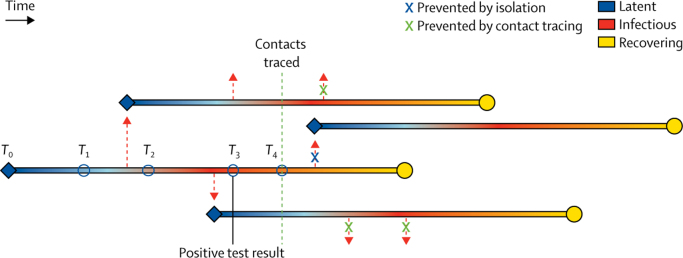
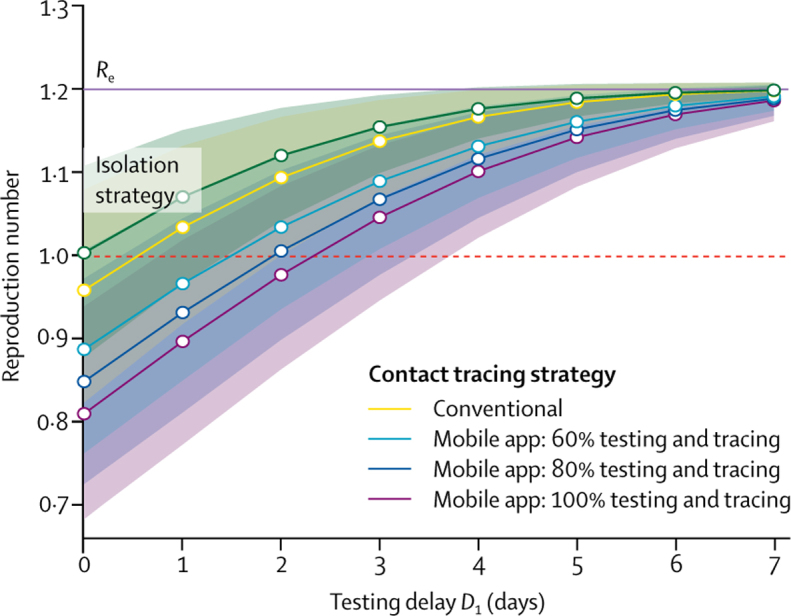
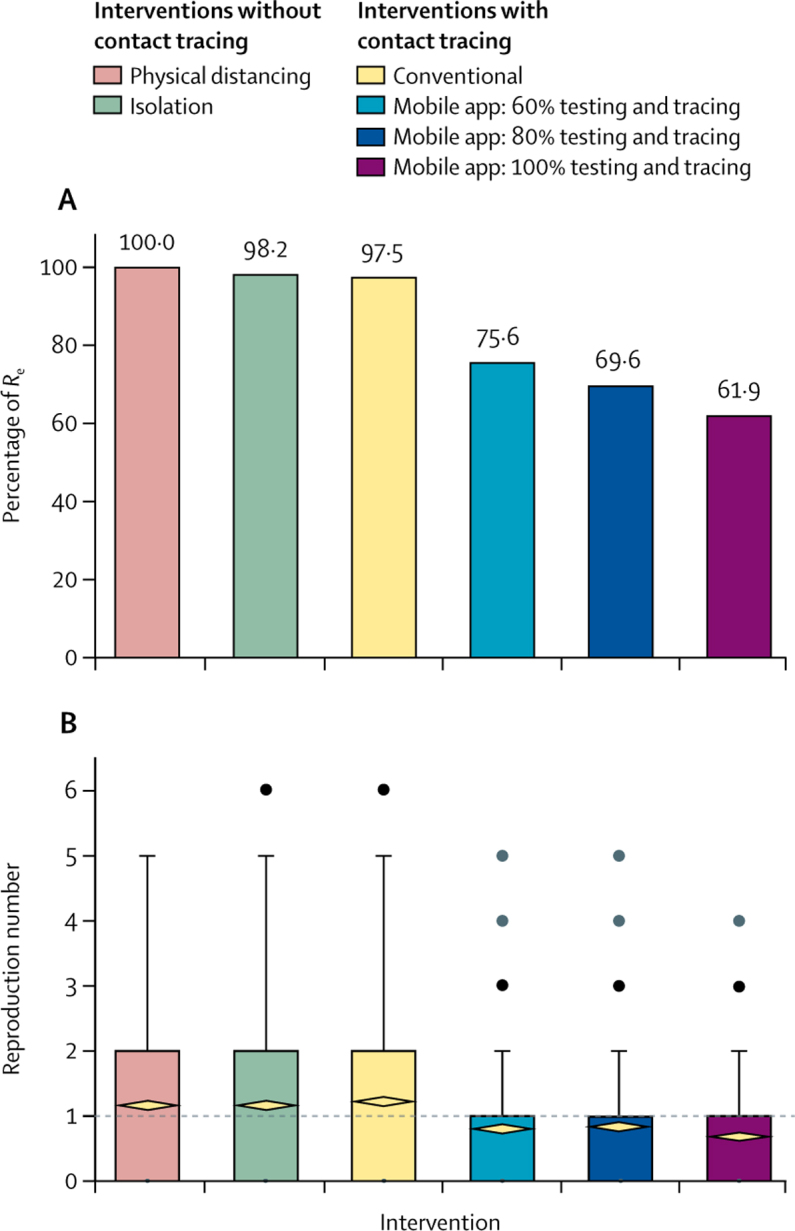
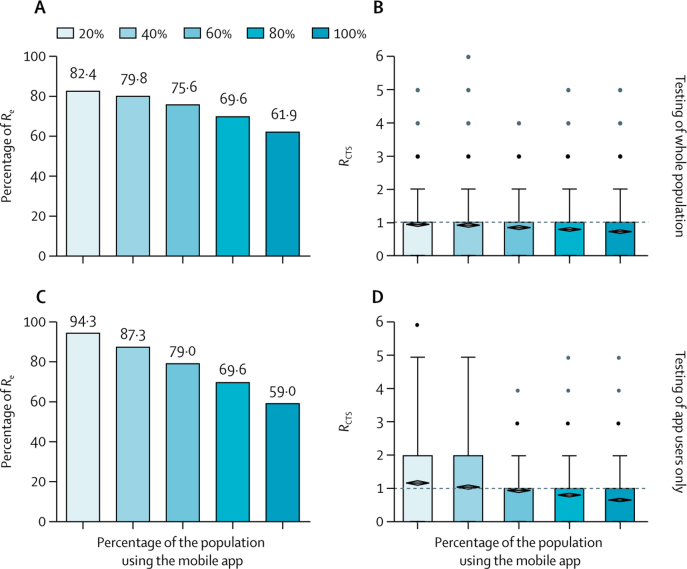
Background In countries with declining numbers of confirmed cases of COVID-19, lockdown measures are gradually being lifted. However, even if most physical distancing measures are continued, other public health measures will be needed to control the epidemic. Contact tracing via conventional methods or mobile app technology is central to control strategies during de-escalation of physical distancing. We aimed to identify key factors for a contact tracing strategy to be successful. Methods We evaluated the impact of timeliness and completeness in various steps of a contact tracing strategy using a stochastic mathematical model with explicit time delays between time of infection and symptom onset, and between symptom onset, diagnosis by testing, and isolation (testing delay). The model also includes tracing of close contacts (eg, household members) and casual contacts, followed by testing regardless of symptoms and isolation if testing positive, with different tracing delays and coverages. We computed effective reproduction numbers of a contact tracing strategy ( R CTS ) for a population with physical distancing measures and various scenarios for isolation of index cases and tracing and quarantine of their contacts. Findings For the most optimistic scenario (testing and tracing delays of 0 days and tracing coverage of 100%), and assuming that around 40% of transmissions occur before symptom onset, the model predicts that the estimated effective reproduction number of 1·2 (with physical distancing only) will be reduced to 0·8 (95% CI 0·7–0·9) by adding contact tracing. The model also shows that a similar reduction can be achieved when testing and tracing coverage is reduced to 80% ( R CTS 0·8, 95% CI 0·7–1·0). A testing delay of more than 1 day requires the tracing delay to be at most 1 day or tracing coverage to be at least 80% to keep R CTS below 1. With a testing delay of 3 days or longer, even the most efficient strategy cannot reach R CTS values below 1. The effect of minimising tracing delay (eg, with app-based technology) declines with decreasing coverage of app use, but app-based tracing alone remains more effective than conventional tracing alone even with 20% coverage, reducing the reproduction number by 17·6% compared with 2·5%. The proportion of onward transmissions per index case that can be prevented depends on testing and tracing delays, and given a 0-day tracing delay, ranges from up to 79·9% with a 0-day testing delay to 41·8% with a 3-day testing delay and 4·9% with a 7-day testing delay. Interpretation In our model, minimising testing delay had the largest impact on reducing onward transmissions. Optimising testing and tracing coverage and minimising tracing delays, for instance with app-based technology, further enhanced contact tracing effectiveness, with the potential to prevent up to 80% of all transmissions. Access to testing should therefore be optimised, and mobile app technology might reduce delays in the contact tracing process and optimise contact tracing coverage. Funding ZonMw, Fundação para a Ciência e a Tecnologia, and EU Horizon 2020 RECOVER.
Overview
The claims and statistics of this paper haven’t been checked yet.
Free: it reads the open-access text and checks the first 5 claims that cite a source we can check. Create a free account to check every claim.
Integrity signals
Registry
Cites
Statistics
Figures
Verification
Claims the paper makes
The claims and statistics of this paper haven’t been checked yet.
Free: it reads the open-access text and checks the first 5 claims that cite a source we can check. Create a free account to check every claim.
Self-check
Percentages, sums and reported differences re-computed from the paper’s own numbers.
The self-check needs the paper’s full text.
Citations
Cites
Chen, N., Zhou, M., Dong, X., Qu, J., Gong, F., Han, Y., Qiu, Y., Wang, J., Liu, Y., Wei, Y., et al. (2020) · The Lancet · doi:10.1016/s0140-6736(20)30211-7 · Cited by 21,415
Wang, D., Hu, B., Hu, C., Zhu, F., Liu, X., Zhang, J., Wang, B., Xiang, H., Cheng, Z., Xiong, Y., et al. (2020) · JAMA · doi:10.1001/jama.2020.1585 · Cited by 20,148
La certeza de lo impredecible: Cultura Educación y Sociedad en tiempos de COVID19
Martínez González, M. (2020) · DSPACE System - Metalibrary (University of the Coast) · Cited by 18,463
Martínez–González, M. B. (2020) · DSPACE System - Metalibrary (University of the Coast) · Cited by 18,294
Chan, J. F.-W., Yuan, S., Kok, K.-H., To, K. K.-W., Chu, H., Yang, J., Xing, F., Liu, J., Yip, C. C.-Y., Poon, R. W.-S., et al. (2020) · The Lancet · doi:10.1016/s0140-6736(20)30154-9 · Cited by 8,944
Temporal dynamics in viral shedding and transmissibility of COVID-19
He, X., Lau, E. H. Y., Wu, P., Deng, X., Wang, J., Hao, X., Lau, Y. C., Wong, J. Y., Guan, Y., Tan, X., et al. (2020) · Nature Medicine · doi:10.1038/s41591-020-0869-5 · Cited by 4,247
Social Contacts and Mixing Patterns Relevant to the Spread of Infectious Diseases
Mossong, J., Hens, N., Jit, M., Beutels, P., Auranen, K., Mikolajczyk, R., Massari, M., Salmaso, S., Tomba, G. S., Wallinga, J., et al. (2008) · PLoS Medicine · doi:10.1371/journal.pmed.0050074 · Cited by 2,900
Feasibility of controlling COVID-19 outbreaks by isolation of cases and contacts
Hellewell, J., Abbott, S., Gimma, A., Bosse, N. I., Jarvis, C. I., Russell, T. W., Munday, J. D., Kucharski, A. J., Edmunds, W. J., Sun, F., et al. (2020) · The Lancet Global Health · doi:10.1016/s2214-109x(20)30074-7 · Cited by 2,550
Quantifying SARS-CoV-2 transmission suggests epidemic control with digital contact tracing
Ferretti, L., Wymant, C., Kendall, M., Zhao, L., Nurtay, A., Abeler-Dörner, L., Parker, M., Bonsall, D., & Fraser, C. (2020) · Science · doi:10.1126/science.abb6936 · Cited by 2,512
Prevalence of Asymptomatic SARS-CoV-2 Infection: A Narrative Review
Oran, D. P., & Topol, E. J. (2020) · Annals of Internal Medicine · doi:10.7326/m20-3012 · Cited by 2,279
Cited by
Items 501–600 of 683
Aguilar‐Palacio, I., Maldonado, L., Malo, S., Castel-Feced, S., Cebollada, A., Aguilar‐Latorre, A., & Rabanaque, M. J. (2024) · Heliyon · doi:10.1016/j.heliyon.2024.e34840 · Cited by 4
“This is probably associated with a better diagnostic strategy, given the high vulnerability of LTC patients and the known importance of minimizing testing delays in order to reduce COVID-19 transmission [23].”
BackgroundSivaraman, K., Dhawan, S., Chopra, A., & Bhat, G. S. (2026) · COVID · doi:10.3390/covid6090161 · Cited by 3
Trevino, J., Keswani, M., & Pourmand, A. (2022) · Telemedicine Journal and e-Health · doi:10.1089/tmj.2021.0148 · Cited by 3
“21”
Bruno, D. M., Afable, A., Pervil-Ulysse, M., Putman, J. S., & Demissie, K. (2022) · Academic Medicine · doi:10.1097/acm.0000000000004624 · Cited by 2
Dubiniecki, C., Gottschall, S., & Praught, J. (2022) · Health Promotion and Chronic Disease Prevention in Canada · doi:10.24095/hpcdp.42.3.02 · Cited by 2
Geospatial Technology for Human Well-Being and Health: An Overview
Faruque, F. (2022) · Springer eBooks · doi:10.1007/978-3-030-71377-5_1 · Cited by 3
Chen, G., Palmer, J. R. B., Bartumeus, F., & Alba, A. (2022) · Infectious Disease Modelling · doi:10.1016/j.idm.2022.11.001 · Cited by 2
“Furthermore, most of these models did not consider how physical distancing might impact the performance of contact tracing operational systems (Kretzschmar et al., 2020; Quilty et al., 2021; Vecino-Ortiz et al., 2021).”
Risk factors of infection among close contacts of COVID-19: A systematic review and meta-analysis
Gao, C., Jiang, J., Mao, J., Yu, X., Zheng, X.-F., & Zhang, J.-C. (2023) · Medicine · doi:10.1097/md.0000000000034314 · Cited by 2
“At the same time, index cases are required to provide as much information as possible about contacts who have acquired infection risk within a given period of time before the test results are available.[9] The main objectives of contact tracing are to identify potentially infected individuals before the onset of sever…”
BackgroundIdentifying Complicated Contagion Scenarios from Cascade Data
Harrison, G., Aljundi, A. A., Chen, J., Ravi, S. S., Vullikanti, A. K. S., MARATHE, M. V., & Adiga, A. (2023) · ACM SIGKDD Conference on Knowledge Discovery and Data Mining (KDD) · doi:10.1145/3580305.3599841 · Cited by 2
Melka, A. B., & Louzoun, Y. (2021) · Scientific Reports · doi:10.1038/s41598-021-82691-6 · Cited by 2
Paucar, L. H. G., Bencomo, N., & Sutcliffe, A. (2021) · IEEE International Requirements Engineering Conference Workshops (REW) · doi:10.1109/rew53955.2021.00026 · Cited by 2
Effectiveness of contact tracing apps for SARS-CoV-2: an updated systematic review
Jenniskens, K., Bootsma, M., Damen, J. A., Ghannad, M., Oerbekke, M. S., Vernooij, R. W. M., Spijker, R., Moons, K. G. M., Kretzschmar, M., & Hooft, L. (2022) · F1000Research · doi:10.12688/f1000research.110668.1 · Cited by 2
Self-citationEmbedding RFID Chips in Human Beings
Fudge, T. P., Hall, L., & McCain, K. (2022) · Advances in human and social aspects of technology book series · doi:10.4018/978-1-6684-5892-1.ch013 · Cited by 2
Kotsiou, O. S., Zidros, T., & Gourgoulianis, K. I. (2020) · The Science of The Total Environment · doi:10.1016/j.scitotenv.2020.141323 · Cited by 2
“8 days) (Lauer et al., 2020). Considering the lag of 5 days for virus incubation, a fiveday earlier infection time point was used for correlation analysis, showing, similarly, not appreciable correlations betweenmeteorological variables and daily or cumulative COVID-19 incidence or mortality (Table 2). Prata et al. (2…”
Contact tracing and isolation reduces covid-19 incidence in a structured agent-based modelPreprint
Low, M., & Geffen, N. (2020) · medRxiv · doi:10.1101/2020.10.06.20207761 · Cited by 2
“[7] A recent branch process modelling study found that in most scenarios, highly effective contact tracing and case isolation is enough to control a new SARS-CoV-2 outbreak within 3 months, but that ’the probability of control decreases with long delays from symptom onset to isolation’.”
BackgroundPrevisões sobre o Futuro da Pandemia: O Papel dos Modelos Matemáticos
Gomes, M. C., Nunes, A., Nogueira, J. M., Rebelo, C., Viana, J., & Rozhnova, G. (2020) · Acta Médica Portuguesa · doi:10.20344/amp.15049 · Cited by 2
Self-citationScreening for an Infectious Disease as a Problem in Stochastic ControlPreprint
Mareček, J. (2020) · arXiv (Cornell University) · doi:10.48550/arxiv.2011.00635 · Cited by 3
“…number of tests required by contact tracing exceeds the capacity for performing tests [3], or once the contact tracing becomes futile by other means, the importance of statistical approaches to the allocation of tests to communities [7, 8, 9] and, hypothetically, [10], individuals, becomes clear.”
BackgroundWong, S. T., Romney, M. G., Matic, N., Haase, K. R., Ranger, M., Dhari, R., Affleck, F., Tan, E., Ndateba, I., Tobias, E., et al. (2021) · SSRN Electronic Journal · doi:10.2139/ssrn.3854624 · Cited by 2
Mehta, A., Spencer, B., Garg, A., Kalmorge, P., González, R., Taussig, K., & Fortna, R. R. (2022) · medRxiv · doi:10.1101/2022.03.23.22272094 · Cited by 2
“Studies have shown that of 73 the various steps required in the process of testing and diagnosing an active infection, 74 minimizing testing delay had the largest impact on reducing onward transmissions [4, 5].”
BackgroundTrust and accountability in times of pandemics
Martínez-Bravo, M., & Sanz, C. (2023) · Documentos de trabajo/Documento de trabajo - Banco de España, Servicio de Estudios · doi:10.53479/29471 · Cited by 2
Jeong, Y. D., Nishiyama, T., Park, H., Ishikane, M., Iwamoto, N., Aihara, K., Watashi, K., de Coul, E. O., Hart, W. S., Thompson, R. N., et al. (2023) · medRxiv · doi:10.1101/2023.10.04.23296551 · Cited by 2
Dalal, D. K., Randall, J. G., Danna, G. C., & Ash, J. (2023) · Personnel Assessment and Decisions · doi:10.25035/pad.2023.01.005 · Cited by 2
COVID-19 Spread Detection and Controlling with Fog-based Infection Probability Evaluation Model
Singh, M. B., Mahawar, S., Singh, H. K., & Pratap, A. (2023) · International Conference on Distributed Computing and Networking (ICDCN) · doi:10.1145/3571306.3571435 · Cited by 1
“Bluetooth and person-to-person COVID19 contact tracing [9], [12] is very useful in controlling infectious diseases [1], [10].”
BackgroundSanders, M., Fogarty, C. T., Morley, C. P., Schultz, S. H., Devine, M., Sridhar, S. B., & Fiscella, K. A. (2022) · Family Medicine · doi:10.22454/fammed.2022.501410 · Cited by 1
Miller, D. A., Duncan, L., Termini, L., Prebil, L. A., Witt, D. J., & McCurdy, S. A. (2023) · Open Forum Infectious Diseases · doi:10.1093/ofid/ofad048 · Cited by 1
“Delayed test results increase risk for ongoing severe acute respiratory syndrome coronavirus 2 (SARS-CoV-2) transmission from unidentified infectious individuals during their most contagious windows [6].”
BackgroundImplementation and Performance of a Point-of-Care COVID-19 Test Program in 4000 California Schools
Marchand, C. L., Rizzo, K. R., Nakamura, R. M., Bornstein, L. M., Bardach, N. S., Pritchard, D., Medlin, S., Ahmed, A., Cornejo, M., Moser, L., et al. (2024) · The Journal of Pediatrics · doi:10.1016/j.jpeds.2024.114178 · Cited by 1
Alrawashdeh, A., Simmons, N., Alhawarat, M., Maayeh, M., & Kheirallah, K. A. (2024) · Journal of Multidisciplinary Healthcare · doi:10.2147/jmdh.s475335 · Cited by 1
Ojokoh, B. A., Aribisala, B. S., Gabriel, A. J., Babalola, O., Sarumi, O. A., Igbe, T., Omisore, O., Afolayan, A. H., Taiwo, A. E., Chukwuocha, U. M., et al. (2026) · Annals of Data Science · doi:10.1007/s40745-026-00682-8 · Cited by 1
Bezold, C. P., Sizemore, E. E., Halter, H. M., Bartlett, D. L., Hay, K. A., & Ali, H. (2022) · Online Journal of Public Health Informatics · doi:10.5210/ojphi.v14i1.12449 · Cited by 1
“Effective monitoring must be initiated in a timely manner [4].”
BackgroundComparing the efficiency of forward and backward contact tracing
Juul, J. L., & Strogatz, S. H. (2023) · Physical review. E · doi:10.1103/physreve.108.034308 · Cited by 2
Mokryn, O., Abbey, A., Marmor, Y., & D, Y. S. M. (2024) · Journal of Biomedical Informatics · doi:10.1016/j.jbi.2024.104601 · Cited by 2
Helms, Y. B., van der Meer, A., Crutzen, R., Ferreira, J. A., Kretzschmar, M., Timen, A., Hamdiui, N., & Stein, M. L. (2024) · JMIR Public Health and Surveillance · doi:10.2196/56943 · Cited by 1
“During large-scale outbreaks, however, PHS may lack the human resources required to perform CT in a sufficiently complete (in terms of the proportion of at-risk contacts identified and notified) and timely manner to effectively reduce transmission and prevent (severe) disease among contacts [4,5].”
BackgroundSelf-citationTrust and accountability in times of crisis
Martínez-Bravo, M., & Sanz, C. (2024) · Economica · doi:10.1111/ecca.12556 · Cited by 3
COVID-19 transmission dynamics: age-specific patterns and super spreaders in South Korea
Yoon, G., Choi, H., Lee, H., Abdulali, A., Chowell, G., & Lee, S. (2026) · BMC Public Health · doi:10.1186/s12889-026-26712-x · Cited by 1
“Moreover, network-based evaluations of contact-tracing strategies can significantly enhance their effectiveness, helping to prevent future SSEs [18].”
Xuan, J., He, S., Tang, S., & Xiao, Y. (2026) · BMC Public Health · doi:10.1186/s12889-026-27349-6 · Cited by 1
“…so resolutely and decisively, even if its implementation failed to cut off the exponential growth rapidly, such that each outbreak continued to spread for an additional week, then the total number of reported cases in the 80 outbreaks would have increased by more than 100 times [18, 33, 35].”
Bahig, S., Oughton, M., Vandesompele, J., & Brukner, I. (2026) · Pandemics · doi:10.3390/pandemics1020007 · Cited by 1
“Prior work has shown that delay can undermine testing, tracing, and isolation strategies, and that testing frequency and turnaround time can be as important as analytical sensitivity for population-level control [2–4].”
Contreras, S., Dönges, P., Müller, L., Mallick, P., Paltra, S., Hvid, U., Kettlitz, R., Reitenbach, A., Lind, R. A., Aguiar, M., et al. (2026) · EClinicalMedicine · doi:10.1016/j.eclinm.2026.104101 · Cited by 1
“This interaction illustrates that the real-world effectiveness of NPIs is not determined solely by their epidemiological properties, but also by the social conditions under which they are implemented.”
Self-citationPredicting missing links in COVID-19 infection networks
Dimitriou, P. A., Silvestros, V., Constantinou, E., Pitris, C., & Kolios, P. (2026) · PLOS complex systems. · doi:10.1371/journal.pcsy.0000124 · Cited by 1
Rosser, E. N., Marx, M. A., Park, S., Aldos, L. F., Dutta, R., Grantz, K. H., Lee, K. H., Peeples, L.-M., Gurley, E. S., & Lee, E. C. (2026) · Research Connections · doi:10.1093/rescon/vmag165 · Cited by 1
The impact of contact tracing on the spread of COVID-19: an egocentric agent-based model
Pilny, A. N., Xiang, L., Huber, C. J., Silberman, W. R., & Goatley-Soan, S. (2021) · Connections · doi:10.21307/connections-2021.022 · Cited by 1
“The current results largely replicate the models put forth by Kretzschmar et al. (2020), who find significant delays in the effectiveness in contact tracing even after one day.”
Non-pharmaceutical interventions taken by China during the prevention and control of COVID-19
Yuan, Z. (2022) · Highlights in Science Engineering and Technology · doi:10.54097/hset.v6i.935 · Cited by 2
Shrivastava, S. R., & Shrivastava, P. S. (2022) · GERMS · doi:10.18683/germs.2022.1329 · Cited by 1
Sweeney, K., Halter, H. M., Krell, K., McCormick, D. B., Brown, J. E., Simons, A., Santiago-Rosas, C. J., Luna-Anavitate, S., Ramos-Colón, M. V., Marzán-Rodriguez, M., et al. (2022) · Journal of Public Health Management and Practice · doi:10.1097/phh.0000000000001552 · Cited by 1
Aidoo, E. K., Squire, D. S., Atuahene, O. O.-D., Badu, K., Botchway, F. A., Osei‐Adjei, G., Sakyi, S. A., Amoah, L. E., Appiah, M., Duku‐Takyi, R., et al. (2022) · COVID · doi:10.3390/covid2090091 · Cited by 1
“Most of all, it is important to curtail delays in diagnostics, contact identification and the subsequent isolation of all possibly infected persons [32].”
BackgroundMoku, P. R., Marshall, C., Dougherty, C. C., Messner, C., Chau, M. H., Medina, D., & Exten, C. L. (2022) · Annals of Epidemiology · doi:10.1016/j.annepidem.2022.10.009 · Cited by 1
“Effective tracing of infected individuals and cases with potential exposure can help identify a majority of secondary infections (11, 23, 24).”
BackgroundSource identification via contact tracing in the presence of asymptomatic patients
Ódor, G., Vuckovic, J., Ndoye, M.-A. S., & Thiran, P. (2023) · Applied Network Science · doi:10.1007/s41109-023-00566-3 · Cited by 1
Althobaiti, A., Hamdan, K., Sobhy, M. A., Rawas, R., Takahashi, M., Artyukh, O., & Tehseen, M. (2023) · Journal of Visualized Experiments · doi:10.3791/65822 · Cited by 1
Mongin, D., Bürgisser, N., the Covid-SMC Study Group, & Courvoisier, D. S. (2024) · Eurosurveillance · doi:10.2807/1560-7917.es.2024.29.3.2300228 · Cited by 3
“Forward contact tracing is highly effective only if all contacts are identified (by the index case or by an app), notified before they become contagious [7] and comply with protective measures (quarantine, face masks).”
BackgroundBrown, K. A., Ulloa, A. C., Buchan, S. A., Daneman, N., Gournis, E., Laxer, R. E., Schwartz, K. L., & Edwards, J. (2024) · Clinical Infectious Diseases · doi:10.1093/cid/ciae526 · Cited by 1
Ayo-Farai, O., Gopep, N. S., Alarape-Raji, A., Adnan, H., Ahmed, M., Arif, R., Kashif, E., Oduoye, M. O., & Haider, M. U. (2025) · Virology Journal · doi:10.1186/s12985-025-02857-w · Cited by 1
“Another study showed the impact of delay on effective contact tracing strategies for COVID-19 [64].”
InfluentialBartolomucci, F., & Bresolin, G. (2025) · Electronic Markets · doi:10.1007/s12525-025-00831-6 · Cited by 1
“…much research has been conducted on the limited effectiveness of these solutions in mitigating pandemic contagion (Curioso & Carrasco-Escobar, 2020; Kretzschmar et al., 2020; Munzert et al., 2021; Whitelaw et al., 2020), insights into why they are able to unlock privately held data could be…”
Contact Tracing in Turkey’s Struggle with COVID-19: Its Scope, Components, and Stages
Aslan, M. N., & Uçar, A. (2021) · Anadolu Kliniği Tıp Bilimleri Dergisi · doi:10.21673/anadoluklin.848367 · Cited by 1
Saha, D., & Vasuprada, T. M. (2021) · Journal of Developing Societies · doi:10.1177/0169796x21996833 · Cited by 1
“As pointed out by Kretzschmar et al. (2020), if lockdowns have to be eased, then effective contact tracing is very important.”
BackgroundTourism and Contact Tracing Apps in the COVID-19 Era
Konidaris, A., Stellatou, O., Polykalas, S. E., & Katsoni, V. (2021) · Springer proceedings in business and economics · doi:10.1007/978-3-030-72469-6_18 · Cited by 2
Contributions et coordination des makers face à la crise du Covid-19
Viseur, R., & Charleux, A. (2021) · Terminal · doi:10.4000/terminal.7630 · Cited by 9
Isolation thresholds for curbing SARS-CoV-2 resurgence
Yakob, L. (2021) · Epidemiology and Infection · doi:10.1017/s0950268821001692 · Cited by 1
Kontaktkutatás, vezetői információs rendszer
Bokányi, E., Pollner, P., & Joó, T. (2021) · Scientia et Securitas · doi:10.1556/112.2021.00015 · Cited by 2
Gras-Valentí, P., Vidal, I., Montiel-Higuero, I., Escribano, I., Algado-Sellés, N., Chico-Sánchez, P., Ventero, M. P., Jiménez-Sepúlveda, N. J., Molina-Pardines, C., Merino, E., et al. (2021) · Revista Española de Quimioterapia · doi:10.37201/req/054.2021 · Cited by 1
Variant-specific interventions to slow down replacement and prevent outbreaks
Majeed, B. J., Tosato, M., & Wu, J. (2021) · Mathematical Biosciences · doi:10.1016/j.mbs.2021.108703 · Cited by 2
Distributed Clustering Algorithm for Adaptive Pandemic Control
Insausti, X., Zárraga-Rodríguez, M., Nolasco-Ferencikova, C., & Gutiérrez-Gutiérrez, J. (2021) · IEEE Access · doi:10.1109/access.2021.3131777 · Cited by 1
“In particular, studies have predicted them to be beneficial in mitigating the spread of the virus, specifically during the de-escalation of physical distancing [13].”
BackgroundYuan, H., Hossain, M. P., Wen, T., & Wang, M. (2022) · BMC Infectious Diseases · doi:10.1186/s12879-022-07190-z · Cited by 1
“Furthermore, a higher contact tracing coverage together with a shorter delay of being traced enables more cases to be identified earlier [23, 24].”
BackgroundDubiniecki, C., Gottschall, S., & Praught, J. (2022) · Promotion de la santé et prévention des maladies chroniques au Canada · doi:10.24095/hpcdp.42.3.02f · Cited by 1
Mansell, V. E., Emeto, T. I., & Davis, S. (2022) · Communicable Diseases Intelligence · doi:10.33321/cdi.2022.46.20 · Cited by 1
Laboratory.Based Surveillance of COVID.19 in South Batinah, Oman, March-July 2020
Almayahi, Z. K., Al-Kindi, N., Shaqsi, N. A., Hattali, N. A., Hattali, A. A., Dhuhli, K. S. A., & Beatty, M. E. (2022) · Dr Sulaiman Al Habib Medical Journal · doi:10.1007/s44229-022-00008-9 · Cited by 1
“Mathematical modeling of transmission has shown that minimizing testing and tracing delays could prevent as much as 80% of COVID-19 transmission [8].”
BackgroundCao, Y., Whittington, J. D., Kausrud, K., Li, R., & Stenseth, N. C. (2022) · GeoHealth · doi:10.1029/2022gh000589 · Cited by 1
Health Policy and the Fight Against COVID-19: A Narrative Review of Ghana’s Response
Akpeke, H., Dzando, G., Kumah, A., Keronei, D., Donyi, A. B., Salifu, S., Nonoh, E. A., Yabila, D. N., Yahaya, H., & Dorvlo, G. G. K. (2022) · Health in Emergencies & Disasters Quarterly · doi:10.32598/hdq.7.3.443.1 · Cited by 1
“Training of healthcare providers towards contact tracing and increasing health surveillance has been well documented across the world as a public health intervention strategy to identify early, manage, and prevent the spread of COVID-19 [27-29].”
BackgroundDigital Point Solutions for Extending Contact Tracing Capacity
Santos, A., Nuñez, G., La, S., Dorsey, J. H., Patel, S. S., Luk, K. G., Brillantes, K., Birnbaum, R., Boyette, M., Bergquist, E. P., et al. (2022) · Sexually Transmitted Diseases · doi:10.1097/olq.0000000000001712 · Cited by 1
“A case identified by a positive laboratory result required investigation; however, an overwhelmed case investigation team could be potentially unable to investigate at least 80% of cases—the required threshold to reduce virus transmission.(4) For completed case investigations, incomplete or inaccurate data may have be…”
BackgroundQiu, S., Xu, D., Dai, J., Zhang, L., Tian, X., Li, X., Chen, D., Zhou, R., & Liu, W. (2022) · Journal of Medical Virology · doi:10.1002/jmv.28287 · Cited by 2
Analysis of digital contact tracing technologies employed during COVID-19 Pandemic
Kainyu, F., & Mwadulo, M. W. (2022) · African Journal of Science Technology and Social Sciences · doi:10.58506/ajstss.v1i2.112 · Cited by 1
“A local device stores the information and if a user tests positive their Bluetooth contacts are uploaded to a central database and their contacts are alerted thus reducing time required for contact tracing thereby containing the spread of the infectious diseases (Kretzschmar et al., 2020).”
Intervenciones no farmacológicas para enfrentar la pandemia de COVID-19 en Bogotá D. C.
Rios, D. S., Zapata, L. S., & Moyano, D. (2021) · Boletín Epidemiológico Distrital - Bed · doi:10.56085/01238590.182 · Cited by 1
Cheung, N. N., Boers, S. A., Kiani, S., Jansen, R., Mook-Kanamori, D. O., Janssens, L., Feltkamp, M. C. W., Kroes, A. C. M., & Mourik, B. C. (2020) · medRxiv · doi:10.1101/2020.11.20.20234898 · Cited by 1
“One of the cornerstones of successful outbreak 47 management is prompt diagnosis of patients suspected of SARS-CoV-2 infection (1).”
BackgroundContact Tracing: Computational Bounds, Limitations and ImplicationsPreprint
Kong, Q., García–Herranz, M., Dotú, I., & Cebrián, M. (2021) · arXiv (Cornell University) · doi:10.48550/arxiv.2102.13349 · Cited by 1
“Therefore, a rich set of literature has studied the effectiveness of applying contact tracing in controlling epidemics [7, 22, 29] and, especially, in the ongoing COVID-19 pandemic [2, 9, 18, 25, 32].”
BackgroundResultCOVID-19: Optimal Allocation of Ventilator Supply under Uncertainty and RiskPreprint
Yin, X., Büyüktahtakın, İ. E., & Patel, B. (2021) · arXiv (Cornell University) · doi:10.48550/arxiv.2103.06813 · Cited by 1
Imported COVID-19 cases: A hot topic with a lack of a clear definition
Lu, G., Müller, O., & Li, Y. (2021) · International Journal of Infectious Diseases · doi:10.1016/j.ijid.2021.02.081 · Cited by 1
Craig, K. J. T., Rizvi, R. F., Willis, V. C., Kassler, W. J., & Jackson, G. P. (2021) · doi:10.2196/preprints.32468 · Cited by 1
A Behavioural Decision-Making Framework For Agent-Based Models
Nguyen, K. (2023) · Utrecht University Repository (Utrecht University) · doi:10.33540/472 · Cited by 5
(2023) · PeerJ Computer Science · doi:10.7287/peerj-cs.1211v0.1/reviews/2 · Cited by 1
Siddiqui, S. M., Arizti-Sanz, J., Rao, A. S., Ozonoff, A., & Sabeti, P. C. (2025) · Applied Biosafety · doi:10.1089/apb.2024.0063 · Cited by 2
Back-projection improves inference from sparsely sampled genomic surveillance dataPreprint
Finney, E., Lee, B., Ahmed, S. F., Sohail, M. S., Quadeer, A. A., McKay, M. R., & Barton, J. P. (2025) · bioRxiv (Cold Spring Harbor Laboratory) · doi:10.1101/2025.06.29.662219 · Cited by 1
Social Media Polls on Twitter and Mastodon: Rapid Data Collection for Public HealthPreprint
Mortaga, M., Nunner, H., Paltra, S., Stellbrink, L., Friedel, J., Harries, M., Krepel, J., Lange, B., the MuSPAD Study Group, Priesemann, V., et al. (2025) · medRxiv · doi:10.1101/2025.07.01.25330629 · Cited by 1
Elementi metodologici per una riflessione sui dati dell’epidemia di sars-cov-2
Napoli, A. D., Franco, F., & Quintaliani, G. (2020) · Giornale di Clinica Nefrologica e Dialisi · doi:10.33393/gcnd.2020.2179
Kumar, A. (2020) · medRxiv · doi:10.1101/2020.11.30.20240762
“[15, 16, 10] The individuals for COVID -19 are primarily identified based on direct-contacts, travel history, symptoms, and random sampling.”
BackgroundCovid-19 and the environment – the role of the Public Health Institute
Ulm, L., Hrga, I., Stjepanović, B., Večenaj, A., Krivohlavek, A., Tešić, V., Ličina, M. L. K., Šostar, Z., Šikić, S., Jergović, M., et al. (2020) · Molecular and experimental biology in medicine · doi:10.33602/mebm.3.2.2
“Contact tracing is extremely important to alert the individuals with the highest risk of coronavirus exposure and prevent the negative consequences.(1) After the first few dozen imported cases, the onset of”
BackgroundImproving epidemic testing and containment strategies using machine learning
Natali, L., Helgadóttir, S., Maragò, O. M., & Volpe, G. (2021) · Emerging Topics in Artificial Intelligence (ETAI) · doi:10.1117/12.2593594
Effects of control measures and their impacts on COVID-19 transmission dynamicsPreprint
Supatgiat, C. (2021) · Research Square · doi:10.21203/rs.3.rs-363517/v2
Magan, M. A., & Dwomoh, D. (2021) · International Journal of Infectious Diseases and Therapy · doi:10.11648/j.ijidt.20210602.16
“However, the success of testing and tracing efforts hinges on minimizing the delay between symptom onset and testing and isolation of index cases [10], with a gap of 48 hours or less being critical for reducing the reproductive number [9].”
BackgroundProtecting Privacy in COVID-19 Digital Contact Tracing
Turner, N. M. (2021) · Digital Commons - Colby (Colby College)
Genis, H., MacPhee, S., Vandenbergh, N., Yu, C., Andany, N., Chan, A. K., Daneman, N., & Lam, P. W. (2021) · Journal of the Association of Medical Microbiology and Infectious Disease Canada · doi:10.3138/jammi-2020-0052
Bartolome, G. J. C., Ignaco, M. A. E., Julian, R. L. D. J., & Buco, J. P. D. (2021) · Lecture notes in networks and systems · doi:10.1007/978-981-16-1781-2_71
Frank, J. W., Marion, G., & Doeschl‐Wilson, A. (2021) · Public Health · doi:10.1016/j.puhe.2021.10.003
What research says to the practitioner: Writing apprehension
Kay, J. F., Johnston, H., & Markle, G. C. (2016)
Miao, Y., & Hua, Z. (2021) · Service Science · doi:10.1287/serv.2021.0291 · Cited by 1
Home Monitoring for Fever: An Inexpensive Screening Method to Prevent Household Spread of COVID-19Preprint
Kim, J. J., Threadcraft, M. A., Xue, W., Yue, S., Wenzel, R. P., & Southwick, F. S. (2021) · medRxiv · doi:10.1101/2021.12.21.21268203
“These conditions delay rapid identification, isolation, contact tracing, and early treatment of those who are infected by SARS-CoV-2 [3].”
BackgroundContact Tracing Application for Aviation- A Digital Inoculation
Gounder, M. P., & Sharma, N. A. (2021) · IEEE Asia-Pacific Conference on Computer Science and Data Engineering (CSDE) · doi:10.1109/csde53843.2021.9718447
Effects of control measures and their importance on COVID-19 transmission dynamicsPreprint
Supatgiat, C. (2021) · Research Square · doi:10.21203/rs.3.rs-363517/v1
Understanding How Socioeconomic Inequalities Drive Inequalities In COVID-19 InfectionsPreprint
Laajaj, R., Webb, D., Aristizábal, D., Behrentz, E., Bernal, R., Buitrago, G., Cucunubá, Z. M., de la Hoz, F., Gaviría, A., Hernandéz, L. J., et al. (2021) · Research Square · doi:10.21203/rs.3.rs-1106866/v1
Raymenants, J., Geenen, C., Thibaut, J., Gorissen, S., Nelissen, K., & André, E. (2021) · Research Square · doi:10.21203/rs.3.pex-1666/v2
Tirachini, A., Guevara, C. Á., Munizaga, M. A., Carrasco, J. A., Astroza, S., & Hurtubia, R. (2022) · SSRN Electronic Journal · doi:10.2139/ssrn.4022866 · Cited by 1
A tale of two island nations: SARS-COV-2 management in Mauritius and New Zealand (Preprint)Preprint
Teeluck, M., Jeeneea, R., & Sukon, K. S. (2020) · doi:10.2196/preprints.25710
Suder, S., & Siibak, A. (2022) · Revista Internacional del Trabajo · doi:10.1111/ilrs.12247
Metadata
- Authors
- Kretzschmar, M. E., Rozhnova, G., Bootsma, M. C. J., van Boven, M., van de Wijgert, J. H. H. M., & Bonten, M. J. M.
- Affiliations
- Utrecht University (NL)
- University of Lisbon (PT)
- Corresponding author
- Kretzschmar, Mirjam E
- Venue
- The Lancet Public Health
- Publisher
- Elsevier BV
- Published
- 2020-08
- Volume
- 5
- Issue
- 8
- Pages
- e452-e459
- ISSN
- 2468-2667 (ISSN-L)
- PMC
- PMC7365652
- OpenAlex
- W3042453924
- Cited by
- 697
- References
- 37
- Citations by year
- 2026: 34 · 2025: 29 · 2024: 48 · 2023: 77 · 2022: 166 · 2021: 277 · 2020: 64
- FWCI
- 23.03
- Type
- journal article
- Language
- en
- Open access
- gold
- doi.org
- Licence
- cc-by-nc-nd
- www.elsevier.com/tdm/userlicense/1.0/ (tdm)
- www.elsevier.com/legal/tdmrep-license (tdm)
- creativecommons.org/licenses/by-nc-nd/4.0/ (vor)
- Locations
- The Lancet Public Health (publishedVersion, cc-by-nc-nd)
- medRxiv (acceptedVersion, cc-by-nc-nd)
- PubMed Central (publishedVersion, cc-by-nc-nd)
- PubMed (publishedVersion)
- DOAJ (DOAJ: Directory of Open Access Journals) (submittedVersion, cc-by-sa)
- Utrecht University Repository (Utrecht University) (submittedVersion, other-oa)
- Utrecht University Repository (Utrecht University) (submittedVersion, cc-by-nc-nd)
- Funders
- ZonMw (91216062, 10430022010001)
- Horizon 2020 (101003589, H2020-101003589)
- Fundação para a Ciência e a Tecnologia (131_596787873)
- Topics
- Physical Sciences › Mathematics › Modeling and Simulation › COVID-19 epidemiological studies
- Physical Sciences › Computer Science › Information Systems › COVID-19 Digital Contact Tracing
- Physical Sciences › Mathematics › Applied Mathematics › Mathematical and Theoretical Epidemiology and Ecology Models
- Keywords
- COVID-19 pandemic, contact tracing, effective reproduction number, social distancing, quarantine, isolation, pre-symptomatic transmission, stochastic epidemic model, epidemic control measures, household contacts, casual contact, SARS-CoV-2 transmission prevention
- MeSH terms
- COVID-19, COVID-19 Testing, Humans, Models, Theoretical, Pneumonia, Viral, Quarantine, Time Factors, Public Health Practice, Contact Tracing, Coronavirus Infections, Clinical Laboratory Techniques, Pandemics, Mobile Applications
About these checks
Registry, retraction, Cites and statistics results are computed, not judged, with one exception: a printed reference that no index lists is read once by a model before it counts as a citation error. Claims are extracted by a model and kept only when their quote appears verbatim in the text; each cited source is then checked, with a model’s help, for whether it says what the claim relies on. Those verdicts can be wrong — read the claim’s quote and the cited source before relying on one.
Statistics and arithmetic are recomputed, not judged.
Confidence bands are shown only for fields calibrated on our annotated test set. None is calibrated yet, so no band is shown.
What counts as a claim ›How we measure confidence ›How we check this ›
Are you an author, or do you see a problem with this page? Request a review
Data sources
Bibliographic data: Semantic Scholar, OpenAlex, Crossref.
Contains information from the Semantic Scholar Academic Graph Datasets, made available under the ODC Attribution License (ODC-BY 1.0).
Semantic Scholar’s data is described in: Kinney, R., et al. (2023). The Semantic Scholar Open Data Platform. arXiv:2301.10140.
