

Health care’s response to climate change: A carbon footprint assessment of the NHS in England
Open accessThe DOI matches its Crossref record; 25 of the 26 references it cites were found in a registry or an index.
Abstract
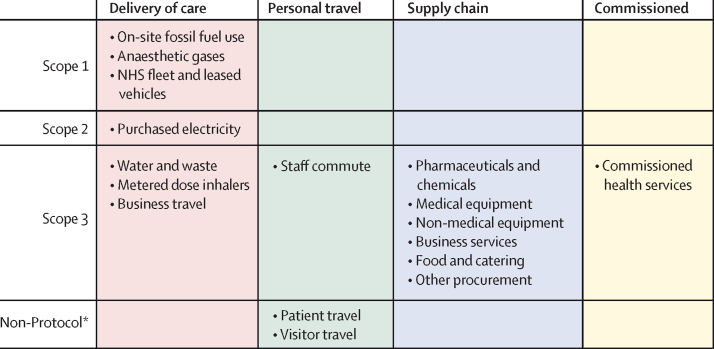
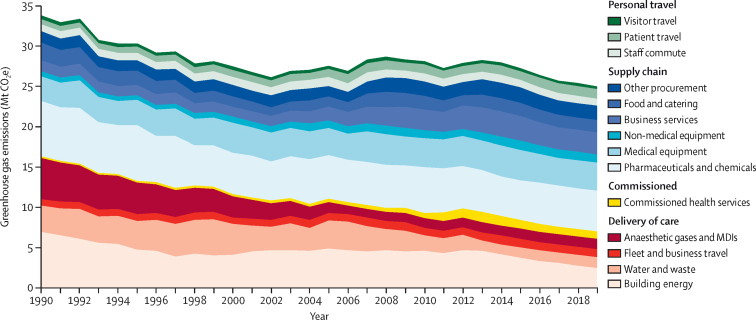
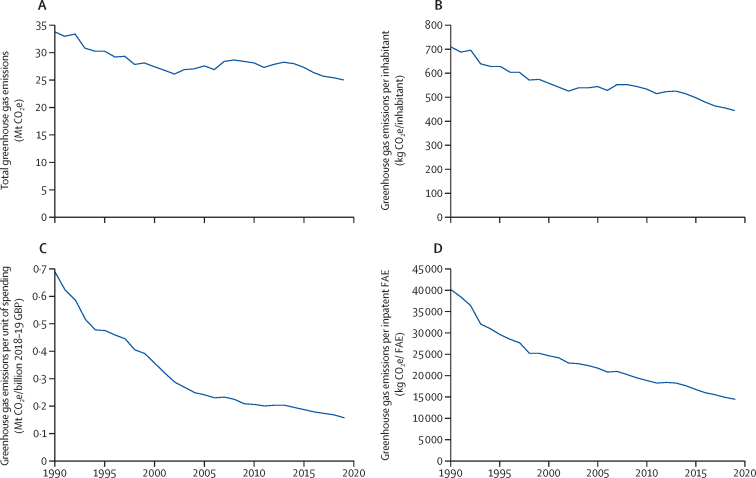
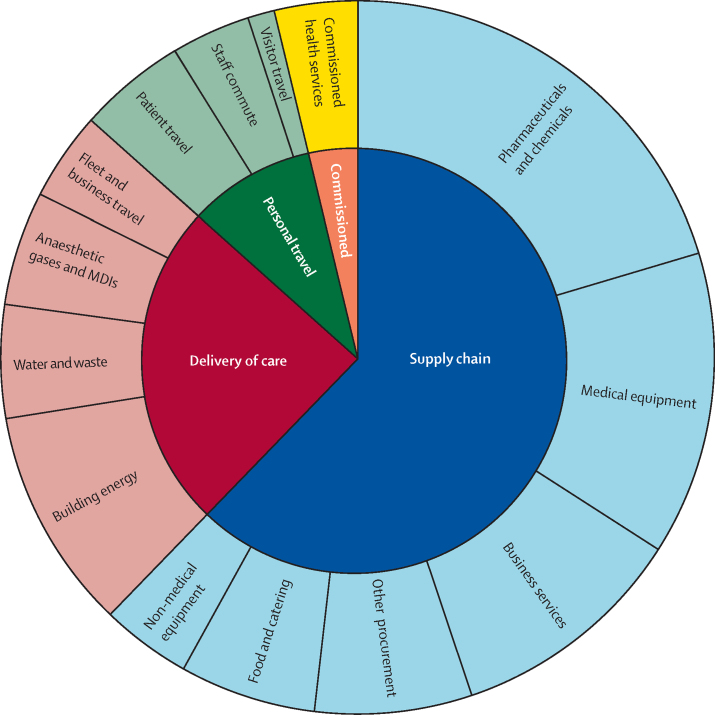
BACKGROUND: Climate change threatens to undermine the past 50 years of gains in public health. In response, the National Health Service (NHS) in England has been working since 2008 to quantify and reduce its carbon footprint. This Article presents the latest update to its greenhouse gas accounting, identifying interventions for mitigation efforts and describing an approach applicable to other health systems across the world. METHODS: A hybrid model was used to quantify emissions within Scopes 1, 2, and 3 of the Greenhouse Gas Protocol, as well as patient and visitor travel emissions, from 1990 to 2019. This approach complements the broad coverage of top-down economic modelling with the high accuracy of bottom-up data wherever available. Available data were backcasted or forecasted to cover all years. To enable the identification of measures to reduce carbon emissions, results were disaggregated by organisation type. FINDINGS: In 2019, the health service's emissions totalled 25 megatonnes of carbon dioxide equivalent, a reduction of 26% since 1990, and a decrease of 64% in the emissions per inpatient finished admission episode. Of the 2019 footprint, 62% came from the supply chain, 24% from the direct delivery of care, 10% from staff commute and patient and visitor travel, and 4% from private health and care services commissioned by the NHS. INTERPRETATION: This work represents the longest and most comprehensive accounting of national health-care emissions globally, and underscores the importance of incorporating bottom-up data to improve the accuracy of top-down modelling and enabling detailed monitoring of progress as health systems act to reduce emissions. FUNDING: Wellcome Trust.
Overview
The claims and statistics of this paper haven’t been checked yet.
Free: it reads the open-access text and checks the first 5 claims that cite a source we can check. Create a free account to check every claim.
Integrity signals
Registry
Cites
Statistics
Figures
Verification
Claims the paper makes
The claims and statistics of this paper haven’t been checked yet.
Free: it reads the open-access text and checks the first 5 claims that cite a source we can check. Create a free account to check every claim.
Claims other papers make about this one
Each is checked against this paper’s own text: does it say what the citing paper says it does?
The check wasn’t confident either way, so it gives no verdict — never disputed.
In the citing paper
“Unfortunately, the awareness of the healthcare community regarding the negative impact of the sector on the natural environment and society, and in turn the responsibility for dealing with it, is very low [23].”
From Towards Green and Sustainable Healthcare: A Literature Review and Research Agenda for Green Leadership in the Healthcare Sector (2023) · cites this paper as [23]
Experimental — accuracy not yet measured
Self-check
Percentages, sums and reported differences re-computed from the paper’s own numbers.
The self-check needs the paper’s full text.
Citations
Cites
(2014) · doi:10.59327/ipcc/ar5-9789291691432 · Cited by 5,217
Watts, N., Amann, M., Arnell, N., Ayeb-Karlsson, S., Belesova, K., Boykoff, M., Byass, P., Cai, W., Campbell-Lendrum, D., Capstick, S., et al. (2019) · The Lancet · doi:10.1016/s0140-6736(19)32596-6 · Cited by 1,472
Self-citationThe environmental footprint of health care: a global assessment
Lenzen, M., Malik, A., Li, M., Fry, J., Weisz, H., Pichler, P.-P., Chaves, L. S. M., Capon, A., & Pencheon, D. (2020) · The Lancet Planetary Health · doi:10.1016/s2542-5196(20)30121-2 · Cited by 1,211
Environmental impacts of the U.S. health care system and effects on public health
Eckelman, M. J., & Sherman, J. (2016) · PLOS ONE · doi:10.1371/journal.pone.0157014 · Cited by 1,017
Self-citationInternational comparison of health care carbon footprints
Pichler, P.-P., Jaccard, I. S., Weisz, U., & Weisz, H. (2019) · Environmental Research Letters · doi:10.1088/1748-9326/ab19e1 · Cited by 812
The carbon footprint of Australian health care
Malik, A., Lenzen, M., McAlister, S., & McGain, F. (2018) · The Lancet Planetary Health · doi:10.1016/s2542-5196(17)30180-8 · Cited by 534
Eckelman, M. J., Sherman, J. D., & MacNeill, A. J. (2018) · PLOS Medicine · doi:10.1371/journal.pmed.1002623 · Cited by 346
Self-citationThe green print: Advancement of environmental sustainability in healthcare
Sherman, J. D., Thiel, C., MacNeill, A., Eckelman, M. J., Dubrow, R., Hopf, H., Lagasse, R., Bialowitz, J., Costello, A., Forbes, M., et al. (2020) · Resources, Conservation and Recycling · doi:10.1016/j.resconrec.2020.104882 · Cited by 327
Self-citationEDITORIAL: CARBON FOOTPRINT AND INPUT–OUTPUT ANALYSIS – AN INTRODUCTION
Wiedmann, T. (2009) · Economic Systems Research · doi:10.1080/09535310903541256 · Cited by 298
Estimated Global Disease Burden From US Health Care Sector Greenhouse Gas Emissions
Eckelman, M. J., & Sherman, J. D. (2018) · American Journal of Public Health · doi:10.2105/ajph.2017.303846 · Cited by 258
Self-citation
Research works printed but not linked: 1
- 28. NHS Sustainable Development Unit. Goods and services carbon hotspots. NHS England breakdown of goods and services carbon footprint by organisation type. Cambridge: NHS Sustainable Development Unit, 2012.
Cited by
Items 301–400 of 1,000
Begum, H., Gray, W. K., Simpson, R., Ingleton, R., & Phull, M. (2025) · The Lancet Regional Health - Europe · doi:10.1016/j.lanepe.2025.101333 · Cited by 11
“This issue has also been highlighted by Tennison et al. 10 Future work on individual procedures should look to build on what we have done and further investigate key sensitivities and uncertainties around speci fi c estimates.”
Environmentally sustainable health care: the opportunities and challenges of life cycle assessments
Rasmussen, A. R., Hauschild, M. Z., & Brorson, S. (2025) · The Lancet Planetary Health · doi:10.1016/j.lanplh.2025.101294 · Cited by 11
Talla, A. W. O., Ascierto, A., Sanvido, A., Severi, P., Trabuio, A., Ceccolini, F., Fortini, F., Sega, F. V. D., Levenson, A. S., Vaccarezza, M., et al. (2025) · Frontiers in Climate · doi:10.3389/fclim.2025.1647942 · Cited by 11
Promoting sustainable pharmacy for tackling environmental pharmaceutical pollution
Egaña, I., Akhrimenko, V., Ayerbe, M., Osinaga, E. A., Lertxundi, U., & Orive, G. (2025) · Drug Discovery Today · doi:10.1016/j.drudis.2025.104559 · Cited by 12
Spotlight environmental sustainability: a strategic priority for NICE
Sharma, M., Walpole, S. C., & Shah, K. K. (2022) · Journal of Public Health · doi:10.1093/pubmed/fdac077 · Cited by 11
Fears, R., Holzeis, C. C., Caussy, D., Harper, S. L., Hoe, V. C. W., McNeil, J. N., Mogwitz, J., ter Meulen, V., & Haines, A. (2023) · Global Policy · doi:10.1111/1758-5899.13210 · Cited by 11
“…health care and social care sectors for hospitals and other infrastructure to measure their carbon footprint and implement plans for reducing it to net zero as soon as possible (EASAC and FEAM, 2021; Romanello et al., 2021); NHS England has helped to pioneer these ambitions (Tennison et al., 2021).”
Desmet, K., Bracke, P., Deproost, E., Goossens, P. J. J., Vandewalle, J., Vercruysse, L., Beeckman, D., Hecke, A. V., Kinnaer, L., & Verhaeghe, S. T. L. (2023) · Journal of Psychiatric and Mental Health Nursing · doi:10.1111/jpm.12951 · Cited by 11
Moderating effect of governance on healthcare and environmental emissions
Subramaniam, Y., Loganathan, N., & Subramaniam, T. (2023) · Journal of Environmental Management · doi:10.1016/j.jenvman.2023.119646 · Cited by 11
Malcolm, J., Dodd, A., Shaikh, M., Cassels-Brown, A., & Buchan, J. C. (2023) · Eye · doi:10.1038/s41433-023-02902-4 · Cited by 12
“The United Kingdom National Health Service (NHS) alone produces approximately 25 megatons of carbon dioxide equivalent (CO2e) annually (2021 estimate) [5].”
Assessing waste and carbon impacts of health system at a regional level
Malik, A., Goodlet, J., Li, M., Mora, C. J., Fry, J., Munro, A., Mill, S., Noonan, A., & Lenzen, M. (2024) · Resources Conservation and Recycling · doi:10.1016/j.resconrec.2024.107750 · Cited by 11
The carbon footprint of health care delivery in Western Australia's public health system
Irwin, A., Malik, A., Vyas, A., Bateman, C., & Joyce, S. (2024) · The Lancet Regional Health - Western Pacific · doi:10.1016/j.lanwpc.2024.101115 · Cited by 11
A Scoping Review of Interventions to Reduce the Environmental Footprint of Healthcare
Seppänen, A., & Or, Z. (2025) · Value in Health · doi:10.1016/j.jval.2025.01.021 · Cited by 11
S2k-Leitlinie Klimabewusste Verordnung von Inhalativa
Schmiemann, G., Dörks, M., Grah, C., Deutsche Gesellschaft für Allgemeinmedizin und Familienmedizin (DEGAM), B., & Deutsche Gesellschaft für Pneumologie und Beatmungsmedizin (DGP), B. (2025) · Pneumologie · doi:10.1055/a-2561-9329 · Cited by 11
Net zero surgery: proof of concept and uncertainties
Bhangu, A. A., Frankling, C., Glasbey, J. C., Kamarajah, S. K., Li, E., Nepogodiev, D., Picciochi, M., & Simoes, J. (2022) · Bulletin of The Royal College of Surgeons of England · doi:10.1308/rcsbull.2022.129 · Cited by 11
Sustainability of dermatological offices and clinics: challenges and potential solutions
Niebel, D., Herrmann, A., Balzer, S., Hecker, C., Koch, S., Luhmann, E., Becker‐Weimann, S. Y., Tischler, M., Löffler, C., & Saha, S. (2023) · JDDG Journal der Deutschen Dermatologischen Gesellschaft · doi:10.1111/ddg.14952 · Cited by 11
Carbon Footprint of Elective Endovascular Abdominal Aortic Aneurysm Repair
Sénémaud, J. N., Gouél‐Cheron, A., Tesmoingt, C., Barret, É., Montravers, P., & Castier, Y. (2023) · European Journal of Vascular and Endovascular Surgery · doi:10.1016/j.ejvs.2023.08.062 · Cited by 11
Kar, A., Pant, A., & Shah, R. (2024) · Cureus · doi:10.7759/cureus.70342 · Cited by 11
Roberts, F., Roberts, T., Gelfer, Y., & Hing, C. B. (2024) · Annals of The Royal College of Surgeons of England · doi:10.1308/rcsann.2024.0008 · Cited by 10
“28 The Greener NHS Programme 29 seeks to reduce the environmental impact of healthcare and create a sustainable model for the future.”
BackgroundKing, J., Woodcock, A. A., Anzueto, A., Wilkinson, A., Janson, C., Henderson, R., Fulmali, S., & Plank, M. W. (2025) · Allergy · doi:10.1111/all.70141 · Cited by 10
“…inhalers contributed only 0.03% of human-related annual GHG emissions in 2014 [7], they have historically contributed a large proportion of healthcare GHG emissions; 12% of the primary patient care carbon footprint in the National Health Service between 1990 and 2019 was due to inhalers [8, 9].”
InfluentialGordon, L. B., Liu, K. T., Hudak, N., & Auerbach, A. D. (2023) · Journal of Hospital Medicine · doi:10.1002/jhm.13098 · Cited by 10
Borrega, J. G., Hermes, C., König, V., Kitz, V. M., Möller, S., Stark, D., Janssens, U., Mager, D., & Kochanek, M. (2023) · Medizinische Klinik - Intensivmedizin und Notfallmedizin · doi:10.1007/s00063-023-01039-2 · Cited by 10
Could building more satellite centres reduce the carbon footprint of external beam radiotherapy?
Chuter, R. (2023) · IPEM-Translation · doi:10.1016/j.ipemt.2023.100021 · Cited by 10
Pediatric telemedicine visits reduce greenhouse gas emissions
Grabski, D. F., Meyer, M. J., & Gander, J. W. (2024) · The Journal of Climate Change and Health · doi:10.1016/j.joclim.2024.100309 · Cited by 10
“As an example, the National Health Service contributes 25 million tonnes (metric ton = 2204 pounds) of carbon emissions per year of which 10 % can be attributed to patient travel [4,5].”
Ayyaz, F., Joyner, J., Cheetham, M., Briggs, T. W. R., & Gray, W. K. (2024) · Annals of The Royal College of Surgeons of England · doi:10.1308/rcsann.2023.0111 · Cited by 11
e-Health and environmental sustainability in vascular surgery
Stevenin, G., Canonge, J., Gervais, M., Fiore, A., Lareyre, F., Touma, J., Desgranges, P., Raffort, J., & Sénémaud, J. N. (2024) · Seminars in Vascular Surgery · doi:10.1053/j.semvascsurg.2024.08.005 · Cited by 10
Climate Therapy: Sustainability Solutions for Breast Cancer Care in the Anthropocene Era
O’Reilly, S., Lynch, E., Hwang, E. S., Brown, M. J., O’Donovan, T., Hennessy, M., McGinty, G. B., Barry, A. S., Weadick, C., van Leeuwen, R., et al. (2024) · Clinical Breast Cancer · doi:10.1016/j.clbc.2024.11.010 · Cited by 10
van Bree, E. M., Snijder, L. E., Ossebaard, H. C., & Brakema, E. A. (2025) · Journal of Medical Internet Research · doi:10.2196/67538 · Cited by 10
“Therefore, countries increasingly set ambitions to transition to environmentally sustainable health care, focusing on, for example, resource use, energy consumption, and patient travel [7,8].”
Environmentally sustainable orthopaedics and trauma: systems and behaviour change
Baid, H., Holland, J., & Pirro, F. (2022) · Orthopaedics and Trauma · doi:10.1016/j.mporth.2022.07.002 · Cited by 10
Davies, J. F., McGain, F., & Francis, J. (2023) · International Journal of Environmental Research and Public Health · doi:10.3390/ijerph20053978 · Cited by 10
A breath of fresh AIR: reducing the carbon footprint of asthma
Hatter, L., Bruce, P., & Beasley, R. W. (2022) · Journal of Medical Economics · doi:10.1080/13696998.2022.2078573 · Cited by 10
“Healthcare systems globally contribute an estimated 4–5% of total greenhouse gas emissions [1].”
BackgroundGeddes, O., Twohig, H., Dahlmann, F., Eccles, A., Karaba, F., Nunes, A. R., Spencer, R. A., & Dale, J. R. (2025) · BMJ Open · doi:10.1136/bmjopen-2024-095457 · Cited by 9
Mohamed, A., Fuad, U., Elsayed, A., & Elasad, A. (2025) · Cureus · doi:10.7759/cureus.91369 · Cited by 9
Environmental sustainability in healthcare: impacts of climate change, challenges and opportunities
Koh, E. Y.-P., Chan, W. F., Lim, H. C. S., Tan, B. K. T., Ong, C. T.-M., Singh, P. A., Tan, M. B. H., Sim, M. J. H., Ong, L. W., Tan, H., et al. (2025) · Singapore Medical Journal · doi:10.4103/singaporemedj.smj-2025-050 · Cited by 9
“[105] Low-carbon alternatives such as dry powder inhalers (DPIs) yield high carbon savings with roughly 20 times lower carbon footprint.”
Villalobos-Quesada, M. J., Ho, K., Chavannes, N. H., & Talboom-Kamp, E. P. W. A. (2023) · European Journal of General Practice · doi:10.1080/13814788.2023.2273615 · Cited by 9
“Dirty Dry Eye”– A waste volume analysis from topical therapy in keratoconjunctivitis sicca
Schilcher, A. V., Roth, M., Steindor, F. A., Helweh, R., & Geerling, G. (2024) · Graefe s Archive for Clinical and Experimental Ophthalmology · doi:10.1007/s00417-024-06431-y · Cited by 9
Rothwell, E., McElvaney, J., Fitzpatrick, A., van Hove, M., Göpfert, A., Standing, L., & Walpole, S. C. (2024) · Future Healthcare Journal · doi:10.1016/j.fhj.2024.100141 · Cited by 9
Hu, E. P., Burch, H., Kayak, E. A., & McGain, F. (2024) · Anaesthesia and Intensive Care · doi:10.1177/0310057x241262796 · Cited by 9
“12,26,27 The recent (December, 2023) publication of Australia’s first National Health and Climate Strategy (National Strategy) provides an important framework for standardised metrics and monitoring of national greenhouse gas data, inclusive of N 2 O. 7,8 The National Strategy sourced data for…”
BackgroundHospital action plan for mitigating anaesthetic nitrous oxide emissions
Chakera, A., & Fuhrmann, A. (2024) · British Journal of Anaesthesia · doi:10.1016/j.bja.2024.08.021 · Cited by 9
Supporting the drive for net zero by decarbonising general practice – A longitudinal study protocol
Nunes, A. R., Atherton, H., Dahlmann, F., Eccles, A., Geddes, O., Gregg, M., Jowett, S. M., Karaba, F., Nelson, L., Spencer, R. A., et al. (2024) · NIHR Open Research · doi:10.3310/nihropenres.13833.1 · Cited by 9
The environmental impact of telemonitoring vs. on-site cardiac follow-up: a mixed-method study
van Bree, E. M., Snijder, L. E., ter Haar, S., Atsma, D. E., & Brakema, E. A. (2025) · European Heart Journal - Digital Health · doi:10.1093/ehjdh/ztaf012 · Cited by 9
Vanholder, R. C. (2022) · Kidney and Dialysis · doi:10.3390/kidneydial2030041 · Cited by 9
Evaluating a hospital’s carbon footprint – A method using energy, materials and financial data
Lum, B. X., Tay, H. M., Phang, R., Tan, S. B., & Liu, E. H. (2022) · Journal of Hospital Administration · doi:10.5430/jha.v11n2p33 · Cited by 9
Bara, V., Schoeler, N. E., Carroll, J. H., Simpson, Z., & Cameron, T. (2023) · Epilepsy & Behavior · doi:10.1016/j.yebeh.2023.109280 · Cited by 9
“23 megatonnes of carbon dioxide equivalents (CO2e) in 2019 [19].”
BackgroundChallenges to decarbonizing medication prescribing and use practices: A call to action
Chen, C., Jeong, M. S. (., Aboujaoude, E., & Bridgeman, M. B. (2023) · Journal of the American Pharmacists Association · doi:10.1016/j.japh.2023.12.004 · Cited by 9
Ahmed, N., Bennati, S., & Anglani, N. (2024) · IEEE International Energy Conference (ENERGYCON) · doi:10.1109/energycon58629.2024.10488801 · Cited by 9
“Reducing hospitals' carbon footprints is therefore critical for mitigating climate change [4].”
BackgroundLightfoot, S. J., Grant, T., Boyden, A., & McAlister, S. (2024) · British Journal of Anaesthesia · doi:10.1016/j.bja.2024.05.031 · Cited by 10
Digital Technology: Introduction to the cognitive hospital
Simon, J. R., Sales-i-Coll, M., Pozo‐Rosich, P., Gates, D., Patt, C., Hennessey, I. A. M., Emery, L., Hueto-Madrid, J. A., Carbonell-Cobo, M., Garcia-Cuyàs, F., et al. (2022) · Future Healthcare Journal · doi:10.7861/fhj.2021-0016 · Cited by 9
Lehoux, P., Wagner, M., Ganache, I., Truchon, C., Neveu, B., Sirois, M., Caron, M., & de Guise, M. (2026) · International Journal of Technology Assessment in Health Care · doi:10.1017/s0266462326103997 · Cited by 9
“Provincial and national HTA agencies may prefer a health system level analysis, recognizing that interventions representing the largest sources of emissions are likely to vary across settings (17;18).”
Medical industry contributions to the climate crisis: Behind the green drapes
Downey, G. P. (2023) · Canadian Journal of Respiratory Critical Care and Sleep Medicine · doi:10.1080/24745332.2023.2268075 · Cited by 9
Environmental Impact of Dermatology and Action Towards It: A Narrative Review
Niebel, D., Tso, S., Parker, E. R., Rosenbach, M., Tan, E., Thio, H. B., Coates, S. J., Andersen, L. K., Hecker, C., Saha, S., et al. (2025) · International Journal of Dermatology · doi:10.1111/ijd.17810 · Cited by 8
“Further dermatological aspects related to climate change are beyond the scope of this article and have been reviewed in detail elsewhere [10–14].”
Demarré, L., Huysveld, S., Vanderwee, K., Duprez, V., Cadena, E., Dewulf, J., Malfait, S., Kieckens, E., & Fraeyman, N. (2024) · The International Journal of Life Cycle Assessment · doi:10.1007/s11367-024-02417-4 · Cited by 8
“Tennison et al. 2021).”
Braybrooke, A., Pegg, M., Naylor, R., Bailey, J., Scott, J., Burgess, R., Yu, D., Wathall, S., Jordan, K. P., Malcolm, R., et al. (2025) · The International Journal of Health Planning and Management · doi:10.1002/hpm.3919 · Cited by 8
“…that the healthcare sector is responsible for approximately 4.6% (2000 MtCO 2 e per annum) of all global GHG emissions, with additional evidence [13,14] suggesting that the United Kingdom's (UK) National Health Service (NHS) alone emits 25 MtCO 2 e per annum, roughly equivalent to the total…”
InfluentialPisarra, M., & Marsilio, M. (2025) · Journal of Public Budgeting Accounting & Financial Management · doi:10.1108/jpbafm-05-2024-0078 · Cited by 9
Sustainability in Cataract and Refractive Surgery: Current Challenges and Future Perspectives
Surico, P. L., Parmar, U. P. S., Sun, C.-C., & Lanzetta, P. (2025) · Journal of Ophthalmology · doi:10.1155/joph/4632626 · Cited by 8
“Globally, health care accounts for nearly 5% of greenhouse gas (GHG) emissions, a key driver of climate change [21].”
Josephson, C. B., Beniczky, S., Denaxas, S., Ikeda, A., Jehi, L. E., Mwesige, A. K., Jetté, N., Jones, G. D., Ryvlin, P., Sen, A., et al. (2025) · Epilepsia · doi:10.1002/epi.70058 · Cited by 8
Interventions to reduce greenhouse gas emissions from health-system solid waste: a systematic review
McGushin, A., Okokon, E. O., Haddock, R., O’Brien, A. T., Turner, M. R., McGain, F., McGinley, C., Wyns, A., Vardoulakis, S., & Skellern, M. (2026) · The Lancet Planetary Health · doi:10.1016/j.lanplh.2025.101418 · Cited by 8
Health for All Policies: The Co-Benefits of Intersectoral Action
Greer, S. L., Falkenbach, M., Vissapragada, P., Wismar, M., Siciliani, L., Perroud, J., Montás, M. C., Dering, B., Cylus, J., Sørensen, K., et al. (2024) · Cambridge University Press eBooks · doi:10.1017/9781009467766 · Cited by 8
Hammer, S., Lang-Illievich, K., Heuschneider, L., Bader, M., & Bornemann‐Cimenti, H. (2024) · Sustainability · doi:10.3390/su16114529 · Cited by 8
“As emerging economies progress and expand, it is expected that the carbon emissions from healthcare, particularly anesthesia, will rise in these nations [4].”
BackgroundSack, F., Irwin, A., van der Zalm, R., Ho, L., Celermajer, D., & Celermajer, D. S. (2024) · Frontiers in Public Health · doi:10.3389/fpubh.2024.1386826 · Cited by 8
“As Tennison et al. comment in their carbon footprint assessment of the NHS, “The selection of a less carbon-intensive and resource intensive care practices where clinically appropriate can reduce both emissions and costs” (3 p.e90).”
MethodInfluentialSalih, T., Elgie, L. D., Acheampong, Y., & Moonesinghe, R. (2024) · British Journal of Anaesthesia · doi:10.1016/j.bja.2024.07.021 · Cited by 8
Towards planetary health systems: a manifesto for a revised quadruple aim for healthcare improvement
Perilli, A., Adduci, A., Ricciardi, W., de Belvis, A. G., & Cadeddu, C. (2024) · Global Sustainability · doi:10.1017/sus.2024.39 · Cited by 8
“Hospital care, which is intrinsically energy-and resource-intensive, has a larger carbon footprint than primary care (Malik et al., 2018; Nicolet et al., 2022; Pichler et al., 2019; Tennison et al., 2021).”
Why We Should, and How We Can, Reduce the Climate Toxicity of Cancer Care
Lynch, E., Bredin, P., Weadick, C., Dorney, N., van Leeuwen, R. W. F., & O’Reilly, S. (2024) · JCO Oncology Practice · doi:10.1200/op-24-00680 · Cited by 9
Sustainable practices in ophthalmology—steps towards environmental stewardship in healthcare
Winklmair, N., Chang, D. F., & Findl, O. (2024) · Wiener Medizinische Wochenschrift · doi:10.1007/s10354-024-01063-7 · Cited by 9
Environmental impact of the enhanced recovery pathway in colorectal surgery: A simulation study
Slim, K., Véziant, J., Enguix, A., & Zieleskiewicz, L. (2024) · Colorectal Disease · doi:10.1111/codi.17247 · Cited by 8
Contributions of Medical Greenhouse Gases to Climate Change and Their Possible Alternatives
Wang, J., & DasSarma, S. (2024) · International Journal of Environmental Research and Public Health · doi:10.3390/ijerph21121548 · Cited by 8
Inhaled Anesthetics: Beyond the Operating Room
Darwish, D., Kumar, P., Urs, K., & Dave, S. (2024) · Journal of Clinical Medicine · doi:10.3390/jcm13247513 · Cited by 8
“IAs account for nearly 3% of the healthcare-related carbon footprint of high-income countries [155].”
Friedericy, H. J., Venema, P. A. H. T., Lockyer, J., Kweekel, D. M., van der Eijk, A. C., Jansen, F. W., & Sarton, E. Y. (2024) · European Journal of Anaesthesiology Intensive Care · doi:10.1097/ea9.0000000000000065 · Cited by 8
Ahmed, Z., Zargaran, A., Zargaran, D., Sousi, S., Hakimnia, K., Glynou, S. P., Davies, J. T., Hamilton, S., & Mosahebi, A. (2024) · Plastic & Reconstructive Surgery Global Open · doi:10.1097/gox.0000000000006374 · Cited by 8
Rullier, A., Amintas, S., Marques, M., Bail, B. L., Belleannée, G., Dubus, P. R., Vergara, R., & Bernard, N. (2025) · Pathology · doi:10.1016/j.pathol.2024.12.639 · Cited by 8
Al-Abbasi, G., Brennan, C., Ohly, N. E., & Gee, C. W. (2025) · Annals of The Royal College of Surgeons of England · doi:10.1308/rcsann.2024.0114 · Cited by 8
Net zero in healthcare buildings: Lessons from assessing the strategies of 214 NHS trusts in England
Amamou, A., Blenkinsop, S., Winter, C., & Heidrich, O. (2025) · Building and Environment · doi:10.1016/j.buildenv.2025.112966 · Cited by 8
Perspectives on technology: All STEPS count – an integrated framework for net zero urological care
Hyde, J., King, E., John, J. B., O’Flynn, K. J., Pearce, I., McGrath, J. S., Gray, W. K., & Phull, M. (2025) · British Journal of Urology · doi:10.1111/bju.16800 · Cited by 8
“[5,7].”
Sustainability and environmental impact of on‐line hemodiafiltration
Chazot, C. (2022) · Seminars in Dialysis · doi:10.1111/sdi.13093 · Cited by 8
“Health-care activities represent around 5% of global greenhouse gas emissions.(1) Dialysis therapy impact on environment is significant.”
BackgroundTwigg, A. J., Wilkinson, A., & Smith, J. N. (2022) · British Journal of Clinical Pharmacology · doi:10.1111/bcp.15511 · Cited by 8
“to delivery of care and 3% of the carbon footprint plus (which the health service can influence) of the NHS in England, are an important area for action as healthcare systems seek to de-carbonise in response to the climate emergency.(1,2) Inhalers can be divided into high carbon footprint inhalers that contain hydrofl…”
BackgroundLee, A. E., Stanley, G. H. M., Wade, R. G., Berwick, D., Vinicombe, V., Salence, B. K., Musbahi, E., Poli, A. R. C. S. D., Savu, M., Batchelor, J., et al. (2023) · British journal of surgery · doi:10.1093/bjs/znad008 · Cited by 9
CO2-Fußabdruck der Intensivmedizin – „let’s go green“
Bein, T. (2023) · Medizinische Klinik - Intensivmedizin und Notfallmedizin · doi:10.1007/s00063-023-01012-z · Cited by 8
The role of mental health nurses in planetary health
Hallett, C., Barrett, T., Brown, H., Lacny, A., & Williams, J. (2023) · International Journal of Mental Health Nursing · doi:10.1111/inm.13183 · Cited by 9
Reducing patient and planetary harms from high anticholinergic burden medication
Smith, H., & Fligelstone, H. (2024) · BMJ · doi:10.1136/bmj-2023-075708 · Cited by 8
Waele, J. J. D., Leroux‐Roels, I., & Morris, A. C. (2024) · Intensive Care Medicine · doi:10.1007/s00134-024-07319-5 · Cited by 8
Lin, X., Tian, T., Shi, C., Wang, P., Chen, S., Guo, T., Li, Z., Liang, B., Zhang, W., Qin, P., et al. (2023) · Sustainable Cities and Society · doi:10.1016/j.scs.2023.104413 · Cited by 8
Xi, D., Zhang, M., & Veronesi, G. (2026) · Technological Forecasting and Social Change · doi:10.1016/j.techfore.2025.124519 · Cited by 7
Castagnini, F., Castagnini, L., Donati, D., & Traina, F. (2022) · Environmental Science and Pollution Research · doi:10.1007/s11356-022-21236-4 · Cited by 7
Zhang, W., Chu, Q., & Wu, G. (2023) · Urban Climate · doi:10.1016/j.uclim.2023.101598 · Cited by 7
Carbon savings potential of virtual care in obstructive sleep apnea and otitis media with effusion
Heffernan, A., Lalande, A., Chadha, R., MacNeill, A. J., & Chadha, N. K. (2024) · Laryngoscope Investigative Otolaryngology · doi:10.1002/lio2.1221 · Cited by 7
“30”
BackgroundSchulz, B., Euler, A., LEON, J. F., Kraft, D., Yvonne, K., Michael, T., Kubik-Huch Rahel, A., & Niemann, T. (2024) · Academic Radiology · doi:10.1016/j.acra.2024.05.004 · Cited by 7
Value‐added based inequity in global virtual water trade
Ma, W., Li, C., Kou, J., Ma, Z., Yang, H., & Xue, B. (2024) · Geographical Journal · doi:10.1111/geoj.12603 · Cited by 7
Lynch, M., McCaffery, K. J., Barratt, A. L., Bell, K., Miller, F. A., McGain, F., Colagiuri, P., & Pickles, K. M. (2024) · BMC Health Services Research · doi:10.1186/s12913-024-11903-2 · Cited by 7
Sue‐Chue‐Lam, C., Yanikomeroglu, S., Baginskis, D., Hamad, D. M., Wong, B. M., Simms, N., & Born, K. B. (2025) · BMJ Quality & Safety · doi:10.1136/bmjqs-2025-018519 · Cited by 7
Nunes, A. R., Atherton, H., Dahlmann, F., Eccles, A., Geddes, O., Gregg, M., Karaba, F., Spencer, R. A., Twohig, H., & Dale, J. R. (2025) · Family Practice · doi:10.1093/fampra/cmaf050 · Cited by 7
“[1] Knowledge (50%); [3] Social/professional role and identity (40%); [11] Environmental context and resources (70”
InfluentialBouchier, F., Boje, A., & Reynolds, G. (2025) · International Journal of Pharmaceutics X · doi:10.1016/j.ijpx.2025.100395 · Cited by 7
“The manufacture of pharmaceuticals contributed close to a third of the overall carbon footprint for Britain ’ s National Health Service (NHS) in 2019 (Tennison et al., 2021).”
Comparative Effectiveness and Safety of LAMA-LABA Inhalers in Chronic Obstructive Pulmonary Disease
Portela, G., Wang, S. V., Suissa, S., & Feldman, W. B. (2026) · JAMA Internal Medicine · doi:10.1001/jamainternmed.2025.8087 · Cited by 7
Family doctors well suited to being climate leaders
Hale, I., & Bell, R. W. (2023) · Canadian Family Physician · doi:10.46747/cfp.6904230 · Cited by 7
Self-removal of catheter after robot-assisted radical prostatectomy: a feasibility study
Chedid, W. A., Carbin, D. D., Innes, M., Casson, H., Broe, M. P., Hossain, M. K., Frajkoulis, G., Whiting, D., Adamou, C., Kusuma, V. R. M., et al. (2023) · Journal of Robotic Surgery · doi:10.1007/s11701-023-01690-z · Cited by 9
“The NHS UK can leverage its size to mitigate its own emissions thereby setting a model for the world [13].”
BackgroundThe climate impact of dialysis
Phua, E., & Shen, Y. (2023) · Current Opinion in Nephrology & Hypertension · doi:10.1097/mnh.0000000000000940 · Cited by 7
“100 www.co-nephrolhypertens.com”
BackgroundThe Role of Ethical Responsibility in the Management of Environmentally Sustainable Health Care
Chen-Xu, J. (2024) · Acta Médica Portuguesa · doi:10.20344/amp.20883 · Cited by 7
Eco-sustainability in ophthalmology
Lee, G. G., Menean, M., Williams, B. K., & Nicola, M. D. (2024) · Current Opinion in Ophthalmology · doi:10.1097/icu.0000000000001070 · Cited by 7
“TRAVEL AND TELEMEDICINE staff commute and patient travel accounts for 10% of healthcare emissions in England [40].”
Purpose and limitations of carbon footprinting for healthcare
Rizan, C., Thiel, C. L., & Bhutta, M. F. (2024) · Journal of the Royal Society of Medicine · doi:10.1177/01410768241274047 · Cited by 7
Circular strategy assessment for digital services: The CADiS framework
Tarpani, R. R. Z., Mendoza, J. M. F., Piedra‐Muñoz, L., & Gallego‐Schmid, A. (2024) · Sustainable Production and Consumption · doi:10.1016/j.spc.2024.11.007 · Cited by 7
Bleeding green: Sustainability in practice in a clinical skills teaching laboratory
Alyeddin, W. F., Peters, S., Zembrzycka, A. A., Hudson, L., & Tun, S. (2022) · The Journal of Climate Change and Health · doi:10.1016/j.joclim.2022.100149 · Cited by 7
Acute Respiratory Infection Hubs: A Service Model with Potential to Optimise Infection Management
Jawad, S., Buckingham, A., Richardson, C., Molloy, A., Owolabi, B., & Inada-Kim, M. (2023) · Antibiotics · doi:10.3390/antibiotics12050819 · Cited by 7
Metadata
- Authors
- Tennison, I., Roschnik, S., Ashby, B., Boyd, R., Hamilton, I., Oreszczyn, T., Owen, A., Romanello, M., Ruyssevelt, P., Sherman, J. D., Smith, A. Z. P., Steele, K., Watts, N., & Eckelman, M. J.
- Affiliations
- NHS England (GB)
- Arup Group (United Kingdom) (GB)
- University College London (GB)
- University of Leeds (GB)
- Yale University (US)
- Northeastern University (US)
- Corresponding author
- Eckelman, Matthew J
- ORCID
- Venue
- The Lancet Planetary Health
- Publisher
- Elsevier BV
- Published
- 2021-02
- Volume
- 5
- Issue
- 2
- Pages
- e84-e92
- ISSN
- 2542-5196 (ISSN-L)
- PMC
- PMC7887664
- OpenAlex
- W3127500650
- Semantic Scholar
- a1762bc0f4da5ef3f86d7b8d6807200964d0b7e1
- Cited by
- 1,039
- References
- 26
- Citations by year
- 2026: 134 · 2025: 222 · 2024: 221 · 2023: 317 · 2022: 105 · 2021: 40
- FWCI
- 55.35
- Type
- journal article
- Language
- en
- Open access
- gold
- doi.org
- Licence
- cc-by
- www.elsevier.com/tdm/userlicense/1.0/ (tdm)
- www.elsevier.com/legal/tdmrep-license (tdm)
- creativecommons.org/licenses/by/4.0/ (vor)
- Locations
- The Lancet Planetary Health (publishedVersion, cc-by)
- PubMed Central (publishedVersion, cc-by)
- PubMed (publishedVersion)
- White Rose Research Online (University of Leeds, The University of Sheffield, University of York) (acceptedVersion)
- DOAJ (DOAJ: Directory of Open Access Journals) (submittedVersion, cc-by-sa)
- UCL Discovery (University College London) (submittedVersion)
- Funders
- Wellcome Trust (209734/Z/17/Z)
- Topics
- Physical Sciences › Environmental Science › Environmental Engineering › Environmental Impact and Sustainability
- Physical Sciences › Environmental Science › Health, Toxicology and Mutagenesis › Climate Change and Health Impacts
- Physical Sciences › Engineering › Architecture › Healthcare Facilities Design and Sustainability
- Keywords
- healthcare emissions, carbon footprint, National Health Service, greenhouse gas accounting, climate change mitigation, supply chain emissions, Greenhouse Gas Protocol
- MeSH terms
- Greenhouse Gases, Carbon Dioxide, Delivery of Health Care, England, Humans, State Medicine, Transportation, Health Care Sector, Climate Change, Carbon Footprint
About these checks
Registry, retraction, Cites and statistics results are computed, not judged, with one exception: a printed reference that no index lists is read once by a model before it counts as a citation error. Claims are extracted by a model and kept only when their quote appears verbatim in the text; each cited source is then checked, with a model’s help, for whether it says what the claim relies on. Those verdicts can be wrong — read the claim’s quote and the cited source before relying on one.
Statistics and arithmetic are recomputed, not judged.
Confidence bands are shown only for fields calibrated on our annotated test set. None is calibrated yet, so no band is shown.
What counts as a claim ›How we measure confidence ›How we check this ›
Are you an author, or do you see a problem with this page? Request a review
Data sources
Bibliographic data: Semantic Scholar, OpenAlex, Crossref.
Contains information from the Semantic Scholar Academic Graph Datasets, made available under the ODC Attribution License (ODC-BY 1.0).
Semantic Scholar’s data is described in: Kinney, R., et al. (2023). The Semantic Scholar Open Data Platform. arXiv:2301.10140.
