

Applications of digital technology in COVID-19 pandemic planning and response
Open accessThe DOI matches its Crossref record; 17 of the 17 references it cites were found in a registry or an index.
Abstract
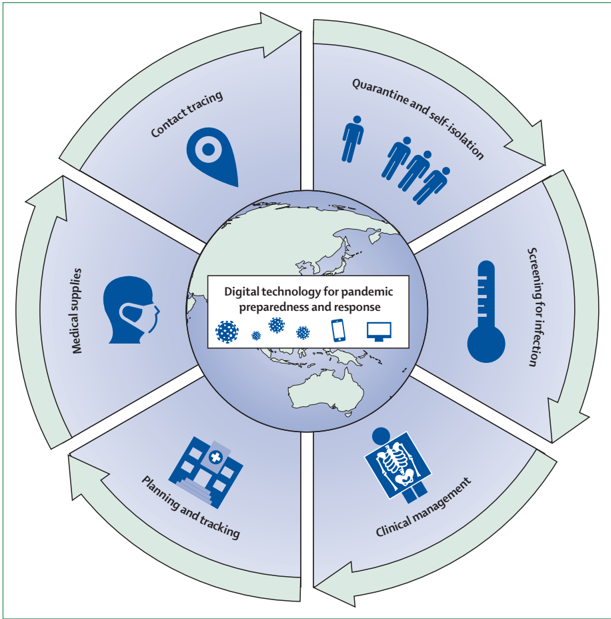
With high transmissibility and no effective vaccine or therapy, COVID-19 is now a global pandemic. Government-coordinated efforts across the globe have focused on containment and mitigation, with varying degrees of success. Countries that have maintained low COVID-19 per-capita mortality rates appear to share strategies that include early surveillance, testing, contact tracing, and strict quarantine. The scale of coordination and data management required for effective implementation of these strategies has-in most successful countries-relied on adopting digital technology and integrating it into policy and health care. This Viewpoint provides a framework for the application of digital technologies in pandemic management and response, highlighting ways in which successful countries have adopted these technologies for pandemic planning, surveillance, testing, contact tracing, quarantine, and health care.
Overview
The claims and statistics of this paper haven’t been checked yet.
Free: it reads the open-access text and checks the first 5 claims that cite a source we can check. Create a free account to check every claim.
Integrity signals
Registry
Cites
Statistics
Figures
Verification
Claims the paper makes
The claims and statistics of this paper haven’t been checked yet.
Free: it reads the open-access text and checks the first 5 claims that cite a source we can check. Create a free account to check every claim.
Claims other papers make about this one
Each is checked against this paper’s own text: does it say what the citing paper says it does?
The cited source says what the claim attributes to it.
In the citing paper
“The current COVID-19 pandemic has highlighted the need for effective infectious disease surveillance at national and state levels 57 ,”
From Multimodal biomedical AI (2022) · cites this paper as [57]
In the citing paper
“Digitization of the healthcare system can aid in the management of the pandemic, mitigating the disruption of societal systems [1].”
From Global Interest in Telehealth During COVID-19 Pandemic: An Analysis of Google Trends™ (2020) · cites this paper as [1]
In the citing paper
“For example, Singapore implemented a mobile phone application, TraceTogether, which pushes notifications to devices in close proximity as 2 m apart and sharing information [175].”
From Human-centred artificial intelligence for mobile health sensing: challenges and opportunities (2023) · cites this paper as [175]
Self-check
Percentages, sums and reported differences re-computed from the paper’s own numbers.
The self-check needs the paper’s full text.
Citations
Cites
A novel coronavirus from patients with pneumonia in China, 2019
Zhu, N., Zhang, D., Wang, W., Li, X., Yang, B., Song, J., Zhao, X., Huang, B., Shi, W., Lu, R., et al. (2020) · New England Journal of Medicine · doi:10.1056/nejmoa2001017 · Cited by 28,244
Wu, J. T., Leung, K., & Leung, G. M. (2020) · The Lancet · doi:10.1016/s0140-6736(20)30260-9 · Cited by 4,389
An Introduction to Statistical Learning: with Applications in R
James, G. M., Witten, D., Hastie, T. J., & Tibshirani, R. J. (2018) · doi:10.25334/q4ht55 · Cited by 2,912
Quantifying SARS-CoV-2 transmission suggests epidemic control with digital contact tracing
Ferretti, L., Wymant, C., Kendall, M., Zhao, L., Nurtay, A., Abeler-Dörner, L., Parker, M., Bonsall, D., & Fraser, C. (2020) · Science · doi:10.1126/science.abb6936 · Cited by 2,512
Li, L., Qin, L., Xu, Z., Yin, Y., Wang, X., Kong, B., Bai, J., Lu, Y., Fang, Z., Song, Q., et al. (2020) · Radiology · doi:10.1148/radiol.2020200905 · Cited by 1,927
Sohil, F., Sohali, M. U., & Shabbir, J. (2022) · Statistical Theory and Related Fields · doi:10.1080/24754269.2021.1980261 · Cited by 1,624
Response to COVID-19 in Taiwan: Big Data Analytics, New Technology, and Proactive Testing
Wang, C. J., Ng, C. Y., & Brook, R. H. (2020) · JAMA · doi:10.1001/jama.2020.3151 · Cited by 1,391
Prediction models need appropriate internal, internal-external, and external validation
Steyerberg, E. W., & Harrell, F. E. (2016) · Journal of Clinical Epidemiology · doi:10.1016/j.jclinepi.2015.04.005 · Cited by 1,304
Torous, J., Jän Myrick, K., Rauseo-Ricupero, N., & Firth, J. (2020) · JMIR Mental Health · doi:10.2196/18848 · Cited by 946
COVID-19 and artificial intelligence: protecting health-care workers and curbing the spread
McCall, B. (2020) · The Lancet Digital Health · doi:10.1016/s2589-7500(20)30054-6 · Cited by 396
Research works printed but not linked: 3
- 12. Naudé W. Artificial intelligence vs. COVID-19: an early review. https://www.iza.org/publications/dp/13110/artificial-intelligence- against-covid-19-an-early-review (accessed May 22, 2020).
- 31. Cisco. Study reveals 74 percent of consumers open to virtual doctor visits. https://newsroom.cisco.com/press-release-content?type=web content&articleId=1148539 (accessed May 21, 2020).
- 35. Health Affairs. Ensuring the growth of telehealth during COVID-19 does not exacerbate disparities in care. https://www.healthaffairs. org/do/10.1377/hblog20200505.591306/full/ (accessed May 21, 2020). · doi:10.1377/hblog20200505.591306/full/
Cited by
Items 201–300 of 1,000
Yodsuban, P., Pengpid, S., Amornchai, R., Siripoon, P., Kasemsuk, W., & Buasai, N. (2022) · International Journal of Nursing Sciences · doi:10.1016/j.ijnss.2022.12.014 · Cited by 26
“Approaches using digital technology can support the monitoring of patients undergoing self-isolation [36,37].”
BackgroundIdentification of Clinical Features Associated with Mortality in COVID-19 Patients
Eskandarian, R., Alizadehsani, R., Behjati, M., Zahmatkesh, M., Sani, Z. A., Haddadi, A., Kakhi, K., Roshanzamir, M., Shoeibi, A., Hussain, S., et al. (2023) · Operations Research Forum · doi:10.1007/s43069-022-00191-3 · Cited by 28
A fairness assessment of mobility-based COVID-19 case prediction models
Erfani, A., & Frías-Martínez, V. (2023) · PLoS ONE · doi:10.1371/journal.pone.0292090 · Cited by 27
Mao, Z., Zou, Q., Yao, H., & Wu, J. (2021) · BMC Public Health · doi:10.1186/s12889-021-12065-0 · Cited by 27
“Therefore, health intervention measures based on big data technology, such as contact tracing and isolation, need to be limited to a necessary scope, and the public’s right to privacy and informed consent and human rights in general should be fully protected [28, 39].”
BackgroundIslam, A., Islam, M., Uzir, M. U. H., Wahab, S. A., & Latiff, A. S. A. (2020) · International Journal of Scientific Research and Management (IJSRM) · doi:10.18535/ijsrm/v8i12.em02 · Cited by 29
“In fact, instead of flesh-and-blood spooks, many Governments are now depending on sensors and strong algorithms (Whitelaw et al., 2020; Woo, 2020).”
BackgroundMachine learning approach to dynamic risk modeling of mortality in COVID-19: a UK Biobank study
Dabbah, M. A., Reed, A. B., Booth, A., Yassaee, A., Despotović, A., Klasmer, B., Binning, E., Aral, M., Plans, D., Morelli, D., et al. (2021) · Scientific Reports · doi:10.1038/s41598-021-95136-x · Cited by 29
Zarouali, B., Strycharz, J., Helberger, N., & de Vreese, C. H. (2022) · Behaviour and Information Technology · doi:10.1080/0144929x.2021.2022208 · Cited by 27
“Privacy concern refers to the degree to which a user is concerned about threats to their informational privacy online, usually in the context in which their personal data is being collected (Xu, Michael, and Chen 2013).”
Fang, M. L., Walker, M., Wong, K. L. Y., Sixsmith, J., Remund, L., & Sixsmith, A. J. (2022) · Healthcare Management Forum · doi:10.1177/08404704221107362 · Cited by 32
Artificial intelligence applications used in the clinical response to COVID-19: A scoping review
Mann, S., Berdahl, C. T., Baker, L., & Girosi, F. (2022) · PLOS Digital Health · doi:10.1371/journal.pdig.0000132 · Cited by 26
“Previous studies on the role of AI in the clinical response to COVID-19 have reviewed possible use cases [10,11], challenges to deployment [12–14], potential impacts on health equity [15], and recommendations to improve AI model quality [16,17].”
BackgroundAlfian, S. D., Insani, W. N., Puspitasari, I. M., Wawruch, M., & Abdulah, R. (2023) · Telemedicine Journal and e-Health · doi:10.1089/tmj.2022.0406 · Cited by 28
Nielsen, M. M., & Jordanoski, Z. (2023) · Digital Government Research and Practice · doi:10.1145/3604569 · Cited by 28
“…in public service delivery [UNDESA 2020 ] to providing innovative solutions in times of crisis, including the fight against the pandemic and its effects on healthcare, services, and society at large [Mazzucato and Kattel 2020 ; Meyerhoff and Kelly 2011 ; Shaw et al. 2020 ; Whitelaw et al. 2020 ].”
BackgroundFacilitators and barriers of mHealth interventions during the Covid-19 pandemic: systematic review
Amiri, P., Nadri, H., & Bahaadinbeigy, K. (2023) · BMC Health Services Research · doi:10.1186/s12913-023-10171-w · Cited by 25
“During Covid-19 pandemic, mHealth was more attractive due to the possibility of remote monitoring, screening, triage, diagnosis, and monitoring by governments, health professionals, and healthcare organizations [19–21].”
BackgroundCOVID-19 related regulatory change for pharmacists – The case for its retention post the pandemic
Lynch, M. R., & O’Leary, A. C. (2020) · Research in Social and Administrative Pharmacy · doi:10.1016/j.sapharm.2020.07.037 · Cited by 28
The importance of local context in COVID-19 models
Eggo, R. M., Dawa, J., Kucharski, A. J., & Cucunubá, Z. M. (2021) · Nature Computational Science · doi:10.1038/s43588-020-00014-7 · Cited by 26
Wong, S. M. Y., Hui, C. L. M., Suen, Y. N., Wong, C. S. M., Chan, S. K. W., Lee, E. H. M., Chang, W. C., & Chen, E. Y. H. (2021) · Australian & New Zealand Journal of Psychiatry · doi:10.1177/00048674211025710 · Cited by 25
“Particularly in the context of COVID-19 where face-to-face socialisation is severely restricted, digital technology became uniquely important (Whitelaw et al., 2020).”
Backgroundadvantages of digital applications in public health services on automation era
Ernawati, K., Nugroho, B., Suryana, C., Riyanto, A., & Fatmawati, E. (2022) · International Journal of Health Sciences · doi:10.53730/ijhs.v6n1.3684 · Cited by 41
“This study aims to identify the advantages of digital applications in public health services in the era of automation (Whitelaw et al., 2020).”
BackgroundSalimian, S., & Mousavi, S. M. (2022) · Arabian Journal for Science and Engineering · doi:10.1007/s13369-022-07168-8 · Cited by 24
“Meanwhile, DT selection for the healthcare industry in the COVID-19 pandemic application can be distinguished as a type of multiple criteria decision-making (MCDM) problem [10].”
BackgroundAisyah, D. N., Lokopessy, A. F., Naman, M., Diva, H., Manikam, L., Adisasmito, W. B. B., & Kozlakidis, Z. (2023) · Interactive Journal of Medical Research · doi:10.2196/41308 · Cited by 31
“For example, Whitelaw et al [16] grouped technologies used in more than 10 countries into different functions for pandemic planning and responses, such as tracking, screening for infection, contact tracing, quarantine and self-isolation, and clinical management.”
MethodLee, H.-S., Degtereva, E. A., & Zobov, A. M. (2021) · Economies · doi:10.3390/economies9040184 · Cited by 28
“Multiple studies reveal that digital technology played a critical role in surveilling and controlling the COVID-19 disease (Kumar et al. 2020; Ting et al. 2020; Whitelaw et al. 2020; He et al. 2021) and will be necessary in the post-COVID-19 era (Strusani and Houngbonon 2020; Xie et al. 2020).”
BackgroundRamachandran, S., Chang, H.-J., Worthington, C., Kushniruk, A., Ibáñez-Carrasco, F., Davies, H., McKee, G., Brown, A., Gilbert, M., & Iyamu, I. (2024) · JMIR Public Health and Surveillance · doi:10.2196/52798 · Cited by 23
The Impact of the COVID-19 Self-Isolation Policy on the Occupations of Vulnerable Groups
Amirudin, A., Urbański, M., Saputra, J., Johansyah, M. D., Latip, L., Tarmizi, A., & Afrizal, T. (2021) · International Journal of Environmental Research and Public Health · doi:10.3390/ijerph18126452 · Cited by 23
Wireless Heart Rate Variability in Assessing Community COVID-19
Drury, R. L., Jarczok, M. N., Owens, A. P., & Thayer, J. F. (2021) · Frontiers in Neuroscience · doi:10.3389/fnins.2021.564159 · Cited by 24
Karanasios, S. (2021) · Information Systems Journal · doi:10.1111/isj.12372 · Cited by 30
Awamleh, F. T., & Bustami, A. N. (2022) · SAGE Open · doi:10.1177/21582440221119478 · Cited by 28
“Moreover, AI appears as an IT proactive stance that enhances the workplace ability to strive in the COVID-19 pandemic, essentially in the companies (Nabi, 2020; Whitelaw et al., 2020).”
BackgroundInfluentialHealthcare System Digital Transformation across Four European Countries: A Multiple-Case Study
Fonda, F., Galazzi, A., Chiappinotto, S., Justi, L., Frydensberg, M. S., Boesen, R. L., Macur, M., Andrés, E., Reixach, E., & Palese, A. (2023) · Healthcare · doi:10.3390/healthcare12010016 · Cited by 23
“HCPs should be helped to mitigate resistance [51] by programmes aimed at developing the ability to use digital technologies in public health [10,52,53].”
BackgroundRaguindin, P. Z. J., Lising, R. L. S., & Custodio, Z. U. (2021) · European Journal of Educational Research · doi:10.12973/eu-jer.10.1.427 · Cited by 27
“As a response to the virus's high-transmissibility, social distancing and "lockdown" were reinforced (Whitelaw et al., 2020).”
BackgroundGonçalves, B. V., Mendes, R., Folgado, H., Figueiredo, P., Travassos, B. F. R., Barros, H., Fernandes, A. C., Beckert, P., & Brito, J. (2020) · Sensors · doi:10.3390/s20216163 · Cited by 22
Positioning Africa’s public health doctoral students to lead societal transformation and development
Ndejjo, R., Ssemugabo, C., Osuret, J., Zziwa, E. B., Fonn, S., Alfvén, T., Mukanga, D., Khayesi, M., & Wanyenze, R. K. (2022) · BMJ Global Health · doi:10.1136/bmjgh-2021-007996 · Cited by 22
Dzandu, M. D. (2022) · Technological Forecasting and Social Change · doi:10.1016/j.techfore.2022.122217 · Cited by 22
“Another key precondition for generating public and individual trust and enhancing the acceptability or adoption of technological interventions such as the contact tracing app is a legal and ethical framework (Mbunge, 2020; Whitelaw et al., 2020; Stahl et al., 2016a, b; Akinnuwesi et al., 2022).”
Living in the era of codes: a reflection on China’s health code system
Yu, H. (2022) · BioSocieties · doi:10.1057/s41292-022-00290-8 · Cited by 27
“The plane was eventually instructed to et al. 2020).”
Bannister-Tyrrell, M., Chen, M., Choi, V., Miglietta, A., & Galea, G. (2023) · The Lancet Regional Health - Western Pacific · doi:10.1016/j.lanwpc.2022.100647 · Cited by 22
“2 In addition to describing the characteristics of the implementation of DCT interventions, the public health outcomes of interest were the adoption, use and effectiveness of DCT interventions.”
Owolabi, B. O., & Owolabi, F. A. (2025) · International Journal of Research Publication and Reviews · doi:10.55248/gengpi.6.0525.1994 · Cited by 22
Topological and Thermodynamic Entropy Measures for COVID-19 Pandemic through Graph Theory
Nandini, G. K., Rajan, R. S., Shantrinal, A. A., Rajalaxmi, T. M., Rajasingh, I., & Balasubramanian, K. (2020) · Symmetry · doi:10.3390/sym12121992 · Cited by 21
“42 million deaths worldwide up to now [1,2].”
BackgroundKurniawan, J. F., Tjhia, B., Wu, V. M., Shin, A. J., Sit, N. L. J., Pham, T. V., Nguyen, A., Li, C., Kumar, R., Aguilar‐Rivera, M., et al. (2021) · Advanced Materials Technologies · doi:10.1002/admt.202001229 · Cited by 23
Beks, H., King, O., Clapham, R. P., Alston, L. V., Glenister, K., McKinstry, C., Quilliam, C., Wellwood, I., Williams, C., & Shee, A. W. (2022) · Journal of Medical Internet Research · doi:10.2196/26515 · Cited by 21
“There has been little scope to address these barriers during the pandemic, where there has been a greater focus on the use of ICT in COVID-19 surveillance [33-35], and delivery of telehealth consultations [3,36].”
Digital Technologies to Enhance Infectious Disease Surveillance in Tanzania: A Scoping Review
Mustafa, U.-K., Kreppel, K. S., Brinkel, J., & Sauli, E. (2023) · Healthcare · doi:10.3390/healthcare11040470 · Cited by 23
Kenna, P. M., Broadfield, L. A., Willems, A., Masyn, S., Pattery, T., & Draghia, R. (2023) · Expert Review of Vaccines · doi:10.1080/14760584.2023.2184091 · Cited by 22
“Countries have applied digital health technologies for pandemic response planning, surveillance, testing, contact tracing, quarantine, and health care [8,11,12,14,15].”
BackgroundLa soledad de los pacientes con COVID-19 al final de sus vidas
Consuegra‐Fernández, M., & Fernández-Trujillo, A. (2020) · Revista de Bioética y Derecho · doi:10.1344/rbd2020.50.31683 · Cited by 34
Telemonitoring in the Covid-19 Era: The Tuscany Region Experience
Panicacci, S., Donati, M., Lubrano, A., Vianello, A., Ruiu, A., Melani, L., Tomei, A., & Fanucci, L. (2021) · Healthcare · doi:10.3390/healthcare9050516 · Cited by 22
The potential and challenges of Health 4.0 to face COVID-19 pandemic: a rapid review
Loeza-Mejía, C.-I., Sánchez-DelaCruz, E., Pozos-Parra, P., & Landero-Hernández, L.-A. (2021) · Health and Technology · doi:10.1007/s12553-021-00598-8 · Cited by 21
“Assisted diagnosis Lack of specialized physicians in remote places Partial or strict quarantine Automatic diagnosis [30] AI [15, 22, 23, 25, 35, 79] Cloud computing [30] Deep learning [30, 36, 37, 79–83] Fog computing [29, 30] Machine learning [15, 36, 84] Sensors [12]”
BackgroundInfluentialHernando, R., & Macías, J. A. (2022) · Behaviour and Information Technology · doi:10.1080/0144929x.2021.2022209 · Cited by 21
“In recent times, the outbreak of COVID-19 has increased the utilisation of QR codes throughout the world (Whitelaw et al. 2020).”
BackgroundNunes, N., Adamo, G., Ribeiro, M., de Gouveia, B. R. F. O., Gouveia, É. R., Teixeira, P. J., & Nisi, V. (2022) · JMIR Human Factors · doi:10.2196/35434 · Cited by 21
Kolopaking, L. M., Wahyono, E. B., Irmayani, N. R., Habibullah, H., & Erwinsyah, R. G. (2022) · International Journal of Sustainable Development and Planning · doi:10.18280/ijsdp.170713 · Cited by 23
Automation in Hospitals and Health Care
Ugajin, A. (2023) · Springer handbooks · doi:10.1007/978-3-030-96729-1_56 · Cited by 28
Ali, S. G., Zhang, C., Guan, Z., Chen, T., Wu, Q., Li, P., Yang, P., Ghazanfar, Z., Jung, Y., Chen, Y., et al. (2024) · The Visual Computer · doi:10.1007/s00371-024-03391-6 · Cited by 22
“The COVID-19 pandemic has expedited the development of digital health technology, making telemedicine, AI, and big data predictive analytics integral solutions in healthcare [20, 41, 75].”
Kang, S., Shin, J. H., Kim, J. H., Kang, H. S., Jeong, C. K., Lee, H. E., & Bae, B. (2024) · Nano Energy · doi:10.1016/j.nanoen.2024.109742 · Cited by 20
A Person-to-Person and Person-to-Place COVID-19 Contact Tracing System Based on OGC IndoorGML
Ojagh, S., Saeedi, S., & Liang, S. H. L. (2020) · ISPRS International Journal of Geo-Information · doi:10.3390/ijgi10010002 · Cited by 23
“High transmissibility of the novel severe acute respiratory syndrome coronavirus 2 (SARS-CoV-2) has made the COVID-19 disease a global health crisis [1,2].”
BackgroundTay, Y. L., Abdullah, Z., Chelladorai, K., Low, L. L., & Tong, S. F. (2021) · International Journal of Environmental Research and Public Health · doi:10.3390/ijerph18168778 · Cited by 21
Alami, H., Lehoux, P., Attieh, R., Fortin, J., Fleet, R. P., Niang, M., Offredo, K., Rouquet, R., Ahmed, M. A. A., & Ly, B. A. (2021) · Frontiers in Digital Health · doi:10.3389/fdgth.2021.721898 · Cited by 24
Ford, K. L., Portz, J. D., Zhou, S., Gornail, S., Moore, S. L., Zhang, X., & Bull, S. S. (2021) · Frontiers in Digital Health · doi:10.3389/fdgth.2021.616278 · Cited by 23
Sujarwoto, S., Holipah, H., & Maharani, A. (2022) · International Journal of Environmental Research and Public Health · doi:10.3390/ijerph19074287 · Cited by 19
Spectroscopic methods for COVID-19 detection and early diagnosis
Bedair, A., Okasha, K. M., & Mansour, F. R. (2022) · Virology Journal · doi:10.1186/s12985-022-01867-2 · Cited by 22
“Protection have been the core of pandemic management due to the high transmissibility, the elevated fatality rate (more than 1%) and the lack of viable antiviral treatments [1].”
BackgroundZhou, L., & Ouyang, F. (2023) · Frontiers in Public Health · doi:10.3389/fpubh.2023.1008378 · Cited by 19
“In addition, existing researches focus on multiple principals jointly responding to public crises, using Big Data and other technologies to improve urban community emergency governance, and innovating the governance mode and system, but the research on the community public health governance mechanism of multiple princ…”
BackgroundKlein, B., LaRock, T., McCabe, S., Torres, L., Friedland, L., Kos, M., Privitera, F., Lake, B., Kraemer, M. U. G., Brownstein, J. S., et al. (2024) · PLOS Digital Health · doi:10.1371/journal.pdig.0000430 · Cited by 19
“Indeed, that was the approach that some countries, such as South Korea, Taiwan, and China had followed [50–52].”
BackgroundLi, X., Zhang, M., Liu, W., & Wang, Z. (2024) · Technological Forecasting and Social Change · doi:10.1016/j.techfore.2024.123320 · Cited by 19
Lam, K., Purkayastha, S., & Kinross, J. K. (2021) · Journal of Medical Internet Research · doi:10.2196/25849 · Cited by 19
“COVID-19 has dramatically sped up this transformation with rapid global uptake in numerous digital platforms across health care [1].”
Peña‐Ramos, J. A., López, F. R., Sánchez‐Bayón, A., & Sastre, F. J. (2021) · International Journal of Environmental Research and Public Health · doi:10.3390/ijerph182412907 · Cited by 21
A Comparison of Case Fatality Risk of COVID-19 between Singapore and Japan
Kayano, T., & Nishiura, H. (2020) · Journal of Clinical Medicine · doi:10.3390/jcm9103326 · Cited by 19
Design a smart infrastructure monitoring system: a response in the age of COVID-19 pandemic
Saud, S. N., & Kamal, A. A. A. (2021) · Innovative Infrastructure Solutions · doi:10.1007/s41062-021-00515-y · Cited by 18
Innovative response initiatives in the European Union to mitigate the effects of COVID-19
Almeida, F. L. (2021) · Journal of Enabling Technologies · doi:10.1108/jet-09-2020-0039 · Cited by 18
Kolarić, B., Ambriović‐Ristov, A., Tabain, I., & Vilibić‐Čavlek, T. (2021) · Croatian Medical Journal · doi:10.3325/cmj.2021.62.630 · Cited by 19
Online spiritual meets (OSMs) and user behavior – A divine application of technology during COVID-19
Katoch, R., & Rana, A. K. (2022) · Computers in Human Behavior · doi:10.1016/j.chb.2022.107514 · Cited by 21
Assaye, B. T., Kassa, M., Mengistie, M. B., Tizie, S. B., & Shimie, A. W. (2023) · Digital Health · doi:10.1177/20552076231180436 · Cited by 18
“As a result, there is a need to consider improving the dissemination of information to professionals about potential health consequences and resilience strategies.(45) In the era of technology, health literacy has extended to include digital health literacy.”
BackgroundFu, X., Ghauri, P. N., & Lu, J. (2025) · Research Policy · doi:10.1016/j.respol.2025.105173 · Cited by 22
Behne, A., Krüger, N., Beinke, J. H., & Teuteberg, F. (2021) · BMC Medical Informatics and Decision Making · doi:10.1186/s12911-021-01579-7 · Cited by 18
Southwick, L., Guntuku, S. C., Klinger, E. V., Pelullo, A., McCalpin, H. J., & Merchant, R. M. (2021) · International Review of Psychiatry · doi:10.1080/09540261.2020.1854195 · Cited by 18
“(Whitelaw et al., 2020) Most notably, countries with flattened COVID-19 incidence curves (e.g. South Korea, Taiwan, Singapore) and who maintained low mortality rates, adopted the aforementioned digital technologies.”
BackgroundIslam, S. (2021) · Bangladesh Journal of Medical Science · doi:10.3329/bjms.v20i5.55399 · Cited by 19
Challenges and opportunities for utilizing MSME digital marketing applications in tourism areas
Ramdan, A. M., Pramiarsih, E. E., Herdhiana, R., Zahara, R., & Lisnawati, C. (2022) · International journal of business economics & management · doi:10.21744/ijbem.v5n3.1912 · Cited by 17
“See the challenges faced; scientists are trying to see if advanced exhibition procedures can increase the number of tourists in Indonesia's regions and islands (Whitelaw et al., 2020; Ibnkahla, 2000; Paolini et al., 2019).”
BackgroundUdeagu, C.-C. N., Huang, J. S., Misra, K., Terilli, T., Ramos, Y., Alexander, M., Kim, C., Madad, S., Williams, R., Bethala, S., et al. (2022) · Public Health Reports · doi:10.1177/00333549221110833 · Cited by 17
Majeed, A., & Zhang, X. (2023) · COVID · doi:10.3390/covid3010006 · Cited by 18
“Another study discussed the technologies used in planning responses to COVID-19 including pandemic planning, testing, surveillance, quarantine, contact tracing, and health care [14].”
BackgroundWahyuni, H. I., Fitrah, A. A., Eprilianto, D. F., & Mardalena, I. (2023) · Information Polity · doi:10.3233/ip-211545 · Cited by 18
“…– defined as the use of information and communication technology (ICT) in government to positively transform the relationship between government and society (Veit & Huntgeburth, 2014) – has played a significant role (see, for example, Nam, 2020; Yen, 2020; Goggin, 2020; Whitelaw et al., 2020).”
Jiang, J., & Zheng, Z. (2023) · JMIR mhealth and uhealth · doi:10.2196/48714 · Cited by 20
“These technological innovations have allowed for an unprecedented level of information collection, aggregation, analysis, and dissemination [3], and have brought significant benefits, such as the ability to track cases, identify potential outbreaks, and inform public health interventions [4,5].”
Transforming Governance: A Systematic Review of AI Applications in Policymaking
Hisham, A. ‘. B., Yusof, N. A. M., Salleh, S. H., & Abas, H. (2024) · Journal of Science Technology and Innovation Policy · doi:10.11113/jostip.v10n1.148 · Cited by 21
“During the COVID-19 pandemic, AI tools were instrumental in tracking virus transmission, modeling infection rates, and supporting vaccine distribution efforts (Whitelaw et al ., 2020).”
COVID-19 and tobacco cessation: lessons from India
Arora, M., Nazar, G. P., Sharma, N., Jain, N., Davidson, F., Mohan, S., Mohan, D., Ali, M. K., Mohan, V., Tandon, N., et al. (2021) · Public Health · doi:10.1016/j.puhe.2021.11.010 · Cited by 17
Attitudes Towards COVID-19 Contact Tracing Apps: A Cross-National Survey
Nurgalieva, L., Ryan, S., & Doherty, G. J. (2021) · IEEE Access · doi:10.1109/access.2021.3136649 · Cited by 18
Ali, Y., & Khan, H. U. (2023) · Computer Networks · doi:10.1016/j.comnet.2023.109605 · Cited by 23
“Bluetooth-based contact tracing is considered the best choice because of its low power, accuracy and minimum false positive rate [119].”
Singh, S., Charles, V., & Pandey, U. (2023) · Annals of Operations Research · doi:10.1007/s10479-023-05207-7 · Cited by 19
Pei, X., Chen, Z. T., & Zhang, L. (2024) · Information Technology for Development · doi:10.1080/02681102.2023.2300669 · Cited by 21
“This has become an increasingly pressing issue, especially given the large number of elderly adults who have been forced to adapt to the digi-talization in China during the pandemic, including those with disadvantaged socio-economic status (Whitelaw et al., 2020).”
Standaar, L. M. B., van Tuyl, L. H. D., Suijkerbuijk, A. W. M., Brabers, A. E. M., & Friele, R. D. (2024) · JMIR Formative Research · doi:10.2196/49585 · Cited by 16
Didyk, C., Lewis, L. K., & Lange, B. S. (2021) · Disability and Rehabilitation · doi:10.1080/09638288.2021.1979664 · Cited by 16
Machine Learning Approaches for COVID-19 Pandemic
Adetunji, C. O., Olaniyan, O. T., Adeyomoye, O., Dare, A., Adeniyi, M. J., Enoch, A., Ребезов, М. Б., Petukhova, E. P., & Shariati, M. A. (2021) · Springer eBooks · doi:10.1007/978-3-030-79753-9_8 · Cited by 28
Ensemble Feature Selection Approach for Detecting Denial of Service Attacks in RPL Networks
Al-Amiedy, T. A., Anbar, M., Belaton, B., Kabla, A. H. H., & Khudayer, B. H. (2021) · Communications in computer and information science · doi:10.1007/978-981-16-8059-5_21 · Cited by 18
Lim, S. C., Kataria, I., Ngongo, C. J., Usek, V. S., Kudtarkar, S. R., Chandran, A., & Mustapha, F. I. (2022) · Global Health Promotion · doi:10.1177/17579759221091197 · Cited by 16
“The COVID-19 pandemic has changed people’s dietary and physical activity patterns, presenting an opportunity to revisit how we address NCD prevention and control and hastening the dominance of digital tools for health monitoring, promotion, and surveillance (30,31).”
BackgroundThe Role of Data-Driven Solutions for SMEs in Responding to COVID-19
Almeida, F. L., & Wasim, J. (2022) · International Journal of Innovation and Technology Management · doi:10.1142/s0219877023500013 · Cited by 18
Information Privacy Behaviors during the COVID-19 Pandemic: Focusing on the Restaurant Context
Lee, E., Kim, J.-Y., Kim, J., & Koo, C. (2022) · Information Systems Frontiers · doi:10.1007/s10796-022-10321-1 · Cited by 18
“Considering the pandemic situation, this study conducted a survey on residents in South Korea (a representative Eastern country), the United Kingdom and the United States (Western countries), which are actively using ICT to prevent COVID-19 infection (Whitelaw et al., 2020).”
The role of talent development on business performance in Islamic rural banks
Nurfadilah, D., Samidi, S., & Daryanto, W. M. (2022) · Frontiers in Education · doi:10.3389/feduc.2022.1045729 · Cited by 18
Wichmann, B., & Wichmann, R. M. (2023) · Scientific Reports · doi:10.1038/s41598-023-40727-z · Cited by 17
Digital Health in Canadian Schools of Nursing—Part B: Academic Nurse Administrators’ Perspectives
Nagle, L., Kleib, M., & Furlong, K. E. (2020) · Quality Advancement in Nursing Education - Avancées en formation infirmière · doi:10.17483/2368-6669.1256 · Cited by 17
“…of digital health solutions to supplant traditional in-person care with virtual care, as well as support effective outbreak Published by Quality Advancement in Nursing Education - Avancées en formation infirmière, 2020 24 management (Denadai, 2020; Peek, Sujan & Scott, 2020; Whitelaw et al, 2020).”
Francombe, J., Ali, G., Gloinson, E. R., Feijao, C., Morley, K. I., Gunashekar, S., & Gomes, H. D. C. (2022) · JMIR Public Health and Surveillance · doi:10.2196/34605 · Cited by 15
Progress in COVID research and developments during pandemic
Shukla, S. K., Patra, S., Das, T. R., Kumar, D., Mishra, A., & Tiwari, A. (2022) · View · doi:10.1002/viw.20210020 · Cited by 17
Kang, B., Oh, E. G., Kim, S., Jang, Y., Choi, J., Konlan, K. D., & Lee, H. (2024) · BMC Nursing · doi:10.1186/s12912-024-02406-w · Cited by 18
“The challenges presented by the global pandemic emphasized the vital and irreplaceable role of digital technologies [54].”
BackgroundLiu, J., Liu, M., & Liang, D. (2024) · Energy Economics · doi:10.1016/j.eneco.2024.108121 · Cited by 17
Data trust and data privacy in the COVID-19 period
Biddle, N., Edwards, B., Gray, M., Hiscox, M., McEachern, S., & Sollis, K. (2022) · Data & Policy · doi:10.1017/dap.2021.36 · Cited by 15
“There have also been a number of direct demands for our data in order to help with the tracking and tracing of contact with thosewho are suspected of having been infected (Whitelaw et al., 2020).”
BackgroundHR During Covid-19 Era: Study On Recent HR Transformations Through Technological Tools And Trends
Saxena, M., Bagga, T., & Gupta, S. K. (2021) · International Conference on Cloud Computing, Data Science & Engineering (Confluence) · doi:10.1109/confluence51648.2021.9377167 · Cited by 15
Savitzky–Golay filter energy features-based approach to face recognition using symbolic modeling
Kagawade, V. C., & Angadi, S. (2021) · Pattern Analysis and Applications · doi:10.1007/s10044-021-00991-z · Cited by 11
“There is also a need for artificial intelligence (AI)-based face recognition systems to facilitate COVID-19 preparedness and the tracking and monitoring of patient, and so the spread of COVID-19 virus infection can be reduced [2, 26].”
BackgroundBeyond Wellness Monitoring: Continuous Multiparameter Remote Automated Monitoring of Patients
McGillion, M. H., Allan, K. S., Ross-Howe, S., Jiang, W., Graham, M. M., Marcucci, M., Johnson, A. P., Scott, T., Ouellette, C., Kocetkov, D., et al. (2021) · Canadian Journal of Cardiology · doi:10.1016/j.cjca.2021.10.011 · Cited by 17
The German COVID-19 Digital Contact Tracing App: A Socioeconomic Evaluation
Ellmann, S., Maryschok, M., Schöffski, O., & Emmert, M. (2022) · International Journal of Environmental Research and Public Health · doi:10.3390/ijerph192114318 · Cited by 17
Fischer, A., Elbéji, A., Aguayo, G., & Fagherazzi, G. (2022) · Interactive Journal of Medical Research · doi:10.2196/40655 · Cited by 16
“For example, a smartwatch application has been developed in Germany to help COVID-19 diagnosis based on a few vital signs [17], and 2 remote monitoring systems—Telecare-COVID (based on phone calls) and CareSimple-COVID (a telemonitoring app)—are used in Canada and are well accepted by the users [18].”
The meaning of Freedom after Covid-19
Farina, M., & Lavazza, A. (2021) · History & Philosophy of the Life Sciences · doi:10.1007/s40656-020-00354-7 · Cited by 17
Digital Health Technologies in Improving Access to Care for Underserved Populations
Widjaja, A. B., Sanjaya, M. H., Fitriati, R., Fitriana, F. W., & Keloko, A. B. (2024) · The journal of academic science. · doi:10.59613/azka9r10 · Cited by 14
“The authors concluded that addressing infrastructure disparities is vital to fully leverage digital health in underserved settings during both regular and emergency situations (Whitelaw et al., 2020).”
Influential
Metadata
- Authors
- Whitelaw, S., Mamas, M. A., Topol, E., & Van Spall, H. G. C.
- Affiliations
- McMaster University (CA)
- University of Manchester (GB)
- Scripps Research Institute (US)
- Venue
- The Lancet Digital Health
- Publisher
- Elsevier BV
- Published
- 2020-08
- Volume
- 2
- Issue
- 8
- Pages
- e435-e440
- ISSN
- 2589-7500 (ISSN-L)
- PMC
- PMC7324092
- OpenAlex
- W3037795158
- Semantic Scholar
- 47342aa15810afcb61deb6a2faaecd52fba67777
- Cited by
- 992
- References
- 17
- Citations by year
- 2026: 48 · 2025: 72 · 2024: 97 · 2023: 184 · 2022: 241 · 2021: 288 · 2020: 61
- FWCI
- 182.23
- Type
- journal article
- Language
- en
- Update notices
- erratum (2021-03-01)
- Open access
- gold
- doi.org
- Licence
- cc-by
- www.elsevier.com/tdm/userlicense/1.0/ (tdm)
- www.elsevier.com/legal/tdmrep-license (tdm)
- creativecommons.org/licenses/by/4.0/ (vor)
- Locations
- The Lancet Digital Health (publishedVersion, cc-by)
- PubMed Central (publishedVersion, cc-by)
- PubMed (publishedVersion)
- Keele Research Repository (Keele University) (submittedVersion, cc-by)
- MacSphere (McMaster University) (submittedVersion, cc-by)
- Funders
- Canadian Institutes of Health Research
- Topics
- Physical Sciences › Computer Science › Information Systems › COVID-19 Digital Contact Tracing
- Health Sciences › Medicine › Epidemiology › Data-Driven Disease Surveillance
- Physical Sciences › Computer Science › Information Systems › Healthcare during COVID-19 Pandemic
- Keywords
- COVID-19 pandemic, digital technologies, pandemic planning, pandemic response, contact tracing, quarantine, testing, disease surveillance, health data management, health policy
- MeSH terms
- Digital Technology, COVID-19, SARS-CoV-2, Humans, Quarantine, Risk Factors, Contact Tracing, Disease Management, Pandemics
About these checks
Registry, retraction, Cites and statistics results are computed, not judged, with one exception: a printed reference that no index lists is read once by a model before it counts as a citation error. Claims are extracted by a model and kept only when their quote appears verbatim in the text; each cited source is then checked, with a model’s help, for whether it says what the claim relies on. Those verdicts can be wrong — read the claim’s quote and the cited source before relying on one.
Statistics and arithmetic are recomputed, not judged.
Confidence bands are shown only for fields calibrated on our annotated test set. None is calibrated yet, so no band is shown.
What counts as a claim ›How we measure confidence ›How we check this ›
Are you an author, or do you see a problem with this page? Request a review
Data sources
Bibliographic data: Semantic Scholar, OpenAlex, Crossref.
Contains information from the Semantic Scholar Academic Graph Datasets, made available under the ODC Attribution License (ODC-BY 1.0).
Semantic Scholar’s data is described in: Kinney, R., et al. (2023). The Semantic Scholar Open Data Platform. arXiv:2301.10140.
