

Applications of digital technology in COVID-19 pandemic planning and response
Open accessThe DOI matches its Crossref record; 17 of the 17 references it cites were found in a registry or an index.
Abstract
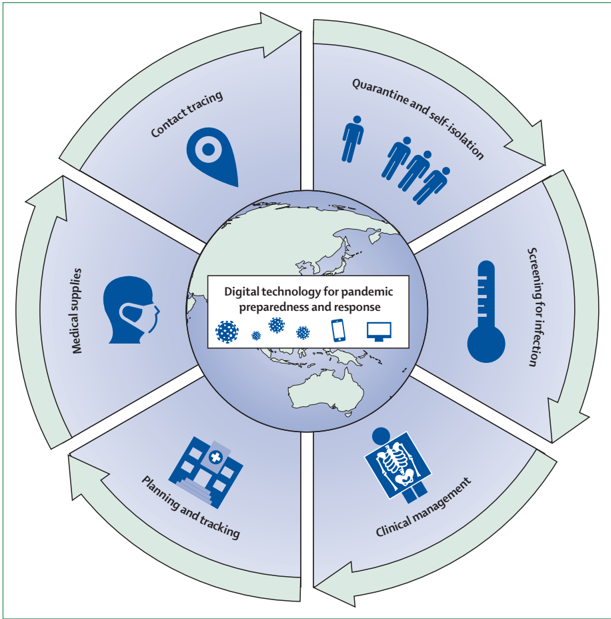
With high transmissibility and no effective vaccine or therapy, COVID-19 is now a global pandemic. Government-coordinated efforts across the globe have focused on containment and mitigation, with varying degrees of success. Countries that have maintained low COVID-19 per-capita mortality rates appear to share strategies that include early surveillance, testing, contact tracing, and strict quarantine. The scale of coordination and data management required for effective implementation of these strategies has-in most successful countries-relied on adopting digital technology and integrating it into policy and health care. This Viewpoint provides a framework for the application of digital technologies in pandemic management and response, highlighting ways in which successful countries have adopted these technologies for pandemic planning, surveillance, testing, contact tracing, quarantine, and health care.
Overview
The claims and statistics of this paper haven’t been checked yet.
Free: it reads the open-access text and checks the first 5 claims that cite a source we can check. Create a free account to check every claim.
Integrity signals
Registry
Cites
Statistics
Figures
Verification
Claims the paper makes
The claims and statistics of this paper haven’t been checked yet.
Free: it reads the open-access text and checks the first 5 claims that cite a source we can check. Create a free account to check every claim.
Claims other papers make about this one
Each is checked against this paper’s own text: does it say what the citing paper says it does?
The cited source says what the claim attributes to it.
In the citing paper
“The current COVID-19 pandemic has highlighted the need for effective infectious disease surveillance at national and state levels 57 ,”
From Multimodal biomedical AI (2022) · cites this paper as [57]
In the citing paper
“Digitization of the healthcare system can aid in the management of the pandemic, mitigating the disruption of societal systems [1].”
From Global Interest in Telehealth During COVID-19 Pandemic: An Analysis of Google Trends™ (2020) · cites this paper as [1]
In the citing paper
“For example, Singapore implemented a mobile phone application, TraceTogether, which pushes notifications to devices in close proximity as 2 m apart and sharing information [175].”
From Human-centred artificial intelligence for mobile health sensing: challenges and opportunities (2023) · cites this paper as [175]
Self-check
Percentages, sums and reported differences re-computed from the paper’s own numbers.
The self-check needs the paper’s full text.
Citations
Cites
A novel coronavirus from patients with pneumonia in China, 2019
Zhu, N., Zhang, D., Wang, W., Li, X., Yang, B., Song, J., Zhao, X., Huang, B., Shi, W., Lu, R., et al. (2020) · New England Journal of Medicine · doi:10.1056/nejmoa2001017 · Cited by 28,244
Wu, J. T., Leung, K., & Leung, G. M. (2020) · The Lancet · doi:10.1016/s0140-6736(20)30260-9 · Cited by 4,389
An Introduction to Statistical Learning: with Applications in R
James, G. M., Witten, D., Hastie, T. J., & Tibshirani, R. J. (2018) · doi:10.25334/q4ht55 · Cited by 2,912
Quantifying SARS-CoV-2 transmission suggests epidemic control with digital contact tracing
Ferretti, L., Wymant, C., Kendall, M., Zhao, L., Nurtay, A., Abeler-Dörner, L., Parker, M., Bonsall, D., & Fraser, C. (2020) · Science · doi:10.1126/science.abb6936 · Cited by 2,512
Li, L., Qin, L., Xu, Z., Yin, Y., Wang, X., Kong, B., Bai, J., Lu, Y., Fang, Z., Song, Q., et al. (2020) · Radiology · doi:10.1148/radiol.2020200905 · Cited by 1,927
Sohil, F., Sohali, M. U., & Shabbir, J. (2022) · Statistical Theory and Related Fields · doi:10.1080/24754269.2021.1980261 · Cited by 1,624
Response to COVID-19 in Taiwan: Big Data Analytics, New Technology, and Proactive Testing
Wang, C. J., Ng, C. Y., & Brook, R. H. (2020) · JAMA · doi:10.1001/jama.2020.3151 · Cited by 1,391
Prediction models need appropriate internal, internal-external, and external validation
Steyerberg, E. W., & Harrell, F. E. (2016) · Journal of Clinical Epidemiology · doi:10.1016/j.jclinepi.2015.04.005 · Cited by 1,304
Torous, J., Jän Myrick, K., Rauseo-Ricupero, N., & Firth, J. (2020) · JMIR Mental Health · doi:10.2196/18848 · Cited by 946
COVID-19 and artificial intelligence: protecting health-care workers and curbing the spread
McCall, B. (2020) · The Lancet Digital Health · doi:10.1016/s2589-7500(20)30054-6 · Cited by 396
Research works printed but not linked: 3
- 12. Naudé W. Artificial intelligence vs. COVID-19: an early review. https://www.iza.org/publications/dp/13110/artificial-intelligence- against-covid-19-an-early-review (accessed May 22, 2020).
- 31. Cisco. Study reveals 74 percent of consumers open to virtual doctor visits. https://newsroom.cisco.com/press-release-content?type=web content&articleId=1148539 (accessed May 21, 2020).
- 35. Health Affairs. Ensuring the growth of telehealth during COVID-19 does not exacerbate disparities in care. https://www.healthaffairs. org/do/10.1377/hblog20200505.591306/full/ (accessed May 21, 2020). · doi:10.1377/hblog20200505.591306/full/
Cited by
Items 601–700 of 1,000
Casà, C., Corvari, B., Cellini, F., Cornacchione, P., D’Aviero, A., Reina, S., Franco, S. D., Salvati, A., Colloca, G. F., Cesario, A., et al. (2023) · Healthcare · doi:10.3390/healthcare11131950 · Cited by 3
Priyansyah, R. N., Fuady, I., & Pratamawaty, B. B. (2023) · Human Technology · doi:10.14254/1795-6889.2023.19-2.7 · Cited by 3
“In Singapore, the mobile application uses short-distance Bluetooth signals that automatically detect individuals close in proximity; through this, the government can detect the individuals an infected person has contacted (Whitelaw et al., 2020).”
BackgroundPeng, Z., Namyalo, P. K., Chen, X., Lv, M., & Coyte, P. C. (2023) · BMC Public Health · doi:10.1186/s12889-023-17437-2 · Cited by 3
“The importance of applying digital governance to enable individuals to make informed choices in the context of the pandemic has been stressed [8, 9, 11], but its implementation can be impeded by the unwillingness of individuals to share their information with governments when adopting health…”
BackgroundAli, A. B., C, T. J., & Kumar, T. V. R. (2024) · Public Library Quarterly · doi:10.1080/01616846.2023.2301272 · Cited by 4
“Along with primary interpersonal interactions between individuals, online platforms became essential for social gatherings and group discussions as well (Whitelaw et al. 2020; Wong et al. 2021).”
Montaña-Niño, S. X., & Burgess, J. (2024) · New Media & Society · doi:10.1177/14614448231201644 · Cited by 3
“In the first year of the COVID-19 pandemic, government health authorities used devices and systems to collect population-level epidemiological data (Goggin, 2020; Lupton, 2021; Whitelaw et al., 2020).”
MethodAssessment of Resilient Governance Capacity toward COVID-19 in Chinese Cities
Peng, Y. M., Zhang, Y., & Gu, X. (2024) · Natural Hazards Review · doi:10.1061/nhrefo.nheng-2013 · Cited by 3
Enhancing patient participation in discharge medication communication: a feasibility pilot trial
Tobiano, G., Manias, E., Chaboyer, W. P., Latimer, S. L., Teasdale, T. L., Wren, K., Jenkinson, K., & Marshall, A. P. (2024) · BMJ Open · doi:10.1136/bmjopen-2023-083462 · Cited by 3
“37 As a result, researchers have increasingly replaced paper-based patient information materials with QR codes linked to websites.”
BADEL, F., Baeza, J. L., & Lasch, H. (2025) · Düzce Üniversitesi Bilim ve Teknoloji Dergisi · doi:10.29130/dubited.1427136 · Cited by 4
Ojha, J. C., Bhattarai, P. C., & Devkota, B. (2025) · International Journal of Disaster Risk Management · doi:10.18485/ijdrm.2025.7.1.27 · Cited by 3
Bibliometric Analysis of Hospital Design: Knowledge Mapping Evolution and Research Trends
Liu, J., & Yeo, Y. (2025) · Buildings · doi:10.3390/buildings15173196 · Cited by 3
Governing the pandemics: Moving towards an assertive institutional environment
Cho, M. J., Saravanan, V., & Kim, E. J. (2021) · Journal of Global Health · doi:10.7189/jogh.11.03021 · Cited by 3
COVID-19 Outbreak in Jordan: A 150 Days of Successful Response and Re-Open Strategy
Saidan, M. N., Al‐Weshah, R. A., Masa’deh, R. M. T., Saidan, H., & Kheirallah, K. A. (2021) · Studies in systems, decision and control · doi:10.1007/978-3-030-67151-8_5 · Cited by 3
Covid19 tracking algorithm and conceptualization of an associated patient monitoring system
Varun, S. S., & Nagaraj, R. (2021) · International Conference on Trends in Electronics and Informatics (ICOEI) · doi:10.1109/icoei51242.2021.9452910 · Cited by 3
Giansanti, D., Scrivano, N., & Gulino, R. A. (2021) · Journal of Public Health and Emergency · doi:10.21037/jphe-21-22 · Cited by 3
Fänge, A. M., Christensen, J. M., Backhouse, T., Kenkmann, A., Killett, A., Fisher, O., Chiatti, C., & Lethin, C. (2022) · Healthcare · doi:10.3390/healthcare10020306 · Cited by 5
WITHDRAWNPreprint
Datta, S. (2021) · ChemRxiv · doi:10.26434/chemrxiv.13102877.v21 · Cited by 3
Keumala, C. M., Zainuddin, Z., & Fauzan, F. (2021) · Jurnal Inovasi Pendidikan Ekonomi (JIPE) · doi:10.24036/011123600 · Cited by 2
Pandemic Solutionism: The Power of Big Tech during the COVID-19 Crisis
Maschewski, F., & Nosthoff, A.-V. (2022) · Digital Culture & Society · doi:10.14361/dcs-2022-080104 · Cited by 4
Taiwan's digital divide during the COVID‐19 pandemic and its implications for e‐public services
Chang, C. C., & Wong, N. W. M. (2025) · Asian Politics & Policy · doi:10.1111/aspp.70005 · Cited by 2
Comparative analysis between digital PCR and blood culture for blood pathogen detection
Zhao, M., Yan, Y., Lifeng, Y., Chen, H., Zhang, M., Guo, Y., Zhang, S., Huang, R., Cai, F., & Zhang, L. (2025) · Frontiers in Medicine · doi:10.3389/fmed.2025.1615409 · Cited by 2
“This assay is not affected by complex components in the sample and can simultaneously detect multiple pathogens and resistance genes (6–8).”
Lee, K. H., & Chang, H. (2025) · Healthcare Informatics Research · doi:10.4258/hir.2025.31.4.378 · Cited by 2
“Despite these challenges, publication rates remained highly stable, with 44 papers published consistently in 2020, 2021, and 2022 —demonstrating the field’s resilience and adaptability [10].”
Zhai, S., Goodman, A., Smith, A. C., Diminic, S., & Zhou, X. (2026) · Interactive Journal of Medical Research · doi:10.2196/80386 · Cited by 2
“Organizational support further enhances workforce readiness and policy development, sustaining long-term adoption [100].”
Adapting digital technology to the gastroenterology and endoscopy practice in the pandemic era
Aguila, E. J. T., & Cua, I. H. Y. (2020) · Advances in digestive medicine · doi:10.1002/aid2.13262 · Cited by 2
“Digital technology has largely played a role in different pandemic policies in the attempts to flatten the COVID-19 incidence curves worldwide.(1) While the health care system continues to manage this crisis, institutions and companies have integrated digital solutions and made abrupt transitions to remote videoconfer…”
BackgroundInfluentialCo-location Detection System Using Mobile Magnetometer Data
Kosasih, D. I., Lim, H., & Gook, L. B. (2020) · International Conference on Information and Communication Technology Convergence (ICTC) · doi:10.1109/ictc49870.2020.9289619 · Cited by 2
“Many countries and research communities have developed system to stop this pandemic as well as preventing or mitigating future pandemic [2].”
BackgroundStaunton, C., Hannay, E., John, O., Johnson, M., Kadam, R., & Sampath, R. (2021) · BMJ Global Health · doi:10.1136/bmjgh-2021-006095 · Cited by 2
The Norwegian COVID-19 Tracing App Experiment: Lessons for Governance and Civic Activism
Sandvik, K. B. (2021) · IEEE Technology and Society Magazine · doi:10.1109/mts.2021.3101824 · Cited by 3
DETERMINATION OF RESEARCH TRENDS IN COVID-19 LITERATURE USING TOPIC MODEL APPROACH
Codal, E. S. A. K. S. (2021) · IADIS International Conference Information Systems · doi:10.33965/is2021_202103l020 · Cited by 3
“Web conferencing systems and digital monitoring are also used to provide patients with remote healthcare (Whitelaw et al., 2020).”
MethodGhita, M., Benhadou, S., Medromi, H., & Griguer, H. (2021) · Advances in Science, Technology & Innovation/Advances in science, technology & innovation · doi:10.1007/978-3-030-80458-9_7 · Cited by 5
Mishra, S., Mathur, P., Gupta, A. K., Baag, S., Nagwanshi, K. K., Tailor, S., & Verma, A. (2021) · International Conference on Image Information Processing (ICIIP) · doi:10.1109/iciip53038.2021.9702595 · Cited by 2
Preparing for the Future Crisis: Frontier Technologies Hold the Key
Srivastava, S. K., Sarkar-Swaisgood, M., Kim, S. E., & Dewi, M. B. K. (2022) · Springer eBooks · doi:10.1007/978-981-16-5074-1_19 · Cited by 2
Gentelet, K., & Bahary-Dionne, A. (2021) · Éthique Publique · doi:10.4000/ethiquepublique.6441 · Cited by 2
Duties of government and the supreme of law in emergency: Coronavirus disaster outbreak in Indonesia
Kurniawan, R. F., Kristhy, M. E., & Lubis, F. W. (2022) · International Journal of Health Sciences · doi:10.53730/ijhs.v6n2.8903 · Cited by 2
“…of Health Sciences, 6(2), 931–941. https://doi.org/10.53730/ijhs.v6n2.8903 933 This COVID-19 outbreak may be the first occasion when citizens, especially pro-democracy and human rights groups, demand that the government enact limitations immediately (Whitelaw et al., 2020; Vecchio et al., 2020).”
BackgroundInfluentialRole of Technology in Detection of COVID-19
Lohiya, D. V., & Pathak, S. S. (2022) · Cureus · doi:10.7759/cureus.29138 · Cited by 2
“Despite having just 0%-5% of COVID mortality per 100,000 individuals, the United States had 10 times the number of deaths per capita, has three times the number of censorious care beds per 100,000 people and has been in the rank of number one in epidemic preparations earlier to the COVID-19 pandemic [5].”
BackgroundKumar, M. R. S., Obaid, A. J., Sankar, S., Pandey, D., & Abdulbaqi, A. S. (2022) · Lecture notes in networks and systems · doi:10.1007/978-981-19-1412-6_15 · Cited by 2
Precision public-health intervention for care coordination: a real-world study
Andrade, A. Q. D., Calabretto, J., Pratt, N. L., Ellett, L. M. K., LeBlanc, V. T., & Roughead, E. E. (2022) · British Journal of General Practice · doi:10.3399/bjgp.2022.0067 · Cited by 2
“Besides their importance in usual public health contexts, the results suggest that solutions using current digital infrastructure can be useful in emergency preparedness systems [50].”
Li, Z., Xu, R., Shen, Y., Cao, J., Wang, B., Zhang, Y., & Li, S. (2022) · Frontiers in Public Health · doi:10.3389/fpubh.2022.982289 · Cited by 2
Lobo, E. H., Abdelrazek, M., Khosravi, A., Karmakar, C. K., & Islam, S. M. S. (2022) · Springer series on bio- and neurosystems · doi:10.1007/978-3-031-10031-4_11 · Cited by 3
Li, X., & Wanitwattanakosol, J. (2022) · World Symposium on Software Engineering (WSSE) · doi:10.1145/3568364.3568391 · Cited by 2
Zhang, L., & Rafiq, M. Y. (2023) · Digital Health · doi:10.1177/20552076231170689 · Cited by 2
“In other Asian countries, both Singapore and South Korea adapted aggressive digital contact tracing and managed to successfully contain the spread.(26) It demonstrates the commonality for capable countries to introduce some digital health programmes, but none of them have implemented such widespread, longterm, and man…”
BackgroundEffect of digital gap on virtual care in the time of COVID-19 pandemic: empirical evidence in Taiwan
Chou, Y., & Pan, H.-H. (2023) · Asia Pacific Journal of Social Work and Development · doi:10.1080/02185385.2023.2210112 · Cited by 2
“Particularly, scholars largely attribute the success of Taiwan’s suppression of the spread of COVID-19 to its digital governance in contact-tracing, real-time communication, and medical supply (Jian et al., 2020; Whitelaw et al., 2020; Yen, 2020).”
BackgroundAguinaldo, B. E., Natividad, M. C. B., Gorospe, R. A. B., & Solis, J. S. B. (2023) · AIP conference proceedings · doi:10.1063/5.0124106 · Cited by 2
National digital health legislation: lessons and recommendations
Venkatasubramanian, A., & Patnaik, A. (2023) · Oxford Open Digital Health · doi:10.1093/oodh/oqad008 · Cited by 2
Personalized Medicine Through Artificial Intelligence: A Public Health Perspective
Cascini, F., Buttigieg, S., Pastorino, R., Ricciardi, W., & Boccia, S. (2023) · Springer eBooks · doi:10.1007/978-3-031-32614-1_1 · Cited by 4
The Role of Artificial Intelligence in Tackling Covid-19
Özdemir, G. S. (2023) · Springer eBooks · doi:10.1007/978-3-031-39611-3_8 · Cited by 2
Innovative blockchain-based Agent digital passport solution
Sarhan, A. Y. (2023) · Procedia Computer Science · doi:10.1016/j.procs.2023.10.075 · Cited by 2
Revisión de la literatura: la importancia de las TIC en la gestión municipal
Vílchez, F. E. E., Flores, E. C. C., Ordinola, E. A. V., Avalos, M. M. S., Llerena, S. L. S., & Tirado, V. S. D. M. (2024) · PUERTO MADERO EDITORIAL eBooks · doi:10.55204/pmea.66.c134 · Cited by 2
Exploring tourism SMEs crisis management practices during Covid-19 at Boudha, Kathmandu
Oli, A., Devkota, N., Danuwar, R. K., Kayestha, M., Dhakal, A., Baral, D. K., Timalsina, D. P., Koirala, A., & Tiwari, D. R. (2024) · Smart Tourism · doi:10.54517/st.v5i1.2704 · Cited by 2
“According to Permatasari and Mahyuni [19], crisis management practices will fail without the appropriate training and education programs.”
BackgroundMethodYoungui, B. T., Mambo, A., Machekano, R. N., Kana, R., Epée, E., Tenkeu, S. Z., Tsigaing, P. N., Ndongo, M. L. A., Njoukam, C. M., Bichara, L., et al. (2024) · EClinicalMedicine · doi:10.1016/j.eclinm.2024.102730 · Cited by 3
“9 – 11 Nonetheless, the success of these digital contact-tracing strategies depends on the type of technology used and the context in which implementation takes place.”
Khan, H. U., Ali, Y., Akbar, M. A., & Khan, F. N. (2024) · Heliyon · doi:10.1016/j.heliyon.2024.e35137 · Cited by 3
“Digital health technologies can help in providing pandemic strategies and reactions in ways that are hard to attain manually [4,5].”
BackgroundBayuna, K. A., Suasti, N. M. A., & Syahputra, A. N. (2024) · Jurnal Ilmu Kepolisian · doi:10.35879/jik.v18i2.461 · Cited by 2
El‐Toukhy, S., Hegeman, P., Zuckerman, G., Das, A. R., Moses, N., Troendle, J. F., & Powell‐Wiley, T. M. (2024) · JMIR Research Protocols · doi:10.2196/57382 · Cited by 2
“Indeed, mobile technologies have been central to public health response to the COVID-19 pandemic [129,130]—from crowdsourcing platforms for contact tracing [131] to symptom reporting [132-134] and sensor data collection [107,135].”
BackgroundSeretlo, R. J., Mokgatle, M. M., & Smuts, H. (2024) · Digital Health · doi:10.1177/20552076241272704 · Cited by 2
“…this study corroborate the results of previous research that showed the how an mHealth app was more helpful and attractive due to its possibilities of remote monitoring across different entities such as governments, health professionals, and healthcare organizations, 47 – 49 as cited by the study.”
ResultEfficient Projection-Based Algorithms for Tip Decomposition on Dynamic Bipartite Graphs
Weng, T., Liu, Y., Sha, M., Chen, X., Zhou, X., Li, K., & Tan, K. (2024) · IEEE Transactions on Knowledge and Data Engineering · doi:10.1109/tkde.2024.3486310 · Cited by 2
Economic Resilience: Fiscal Policy, Tourism, and ICT in COVID-19
Castro, C., & Dieguez, T. (2024) · European Conference on Management, Leadership and Governance (ECMLG) · doi:10.34190/ecmlg.20.1.3171 · Cited by 2
Mohtasham, M., Mahdavirad, F., Jabbari, A. A., & Mazdayasna, G. (2025) · Journalism and Media · doi:10.3390/journalmedia6010034 · Cited by 2
“…scholars have been working on these issues including economy (Padhan & Prabheesh, 2021; Susskind & Vines, 2020), technology (Kumar et al., 2020; Whitelaw et al., 2020), mental health (Cullen et al., 2020; Talevi et al., 2020), teaching and education (Pokhrel & Chhetri, 2021; Daniel, 2020;…”
Digital Technologies in a Post-Pandemic Southeast Asia: Measures for Enhancing Regional Approaches
Putra, B. A. (2025) · F1000Research · doi:10.12688/f1000research.165762.1 · Cited by 2
Matei, A., Chin, Y. F., Hughes, T., & Mahmalji, W. (2025) · Cureus · doi:10.7759/cureus.87891 · Cited by 2
“It also plays an integral role in minimising contact and cross-2025 contamination [15].”
Transisi New Normal Akibat Pandemi Covid-19 Sebagai Refleksi Perbaikan Ekonomi Sosial Di Indonesia
Baharuddin, T., Salahudin, S., Qodir, Z., & Jubba, H. (2021) · Journal of Government and Politics (JGOP) · doi:10.31764/jgop.v3i1.5351 · Cited by 2
Elucidating Engineering Ethics Education during the COVID-19 Pandemic Era.
Park, M., & Passmore, D. L. (2020) · International Journal of Multidisciplinary Perspectives in Higher Education · Cited by 5
Arquitectura conceptual de plataforma tecnológica de vigilancia epidemiológica para la COVID-19
Atencio, P., Torres, G. S., Palomino, R. I., Branch, J. W., & Burgos, D. (2021) · Campus Virtuales · Cited by 11
Adalar, H. (2021) · Education Quarterly Reviews · doi:10.31014/aior.1993.04.02.288 · Cited by 4
Davis, C., Wright, S. S., Babcock, M., Kingdon, E., Broussard, D., Oyervides, O., & Carr, D. (2021) · Sexually Transmitted Diseases · doi:10.1097/olq.0000000000001547 · Cited by 2
Influence of Reduced Noise Levels on Human Health During Quarantine Lockdown
Shwetha, T. S., & Dhariwala, H. (2021) · Springer eBooks · doi:10.1007/978-3-030-73295-0_7 · Cited by 2
Advances in Technology: Preparedness for Handling Pandemic Challenges
Sinha, S., & Thada, V. (2021) · Wiley eBooks · doi:10.1002/9781119769088.ch8 · Cited by 2
The Problem of Misinformation and Fake News
Shehata, A. M. K. (2021) · Advances in information quality and management · doi:10.4018/978-1-7998-7503-1.ch005 · Cited by 3
Privacy and Data Protection in Software Services
Senigaglia, R., Irti, C., & Bernes, A. (2021) · Services and business process reengineering · doi:10.1007/978-981-16-3049-1 · Cited by 4
Potential and role of artificial intelligence in current medical healthcare
Hung, C.-M., Shi, H., Lee, P., Chang, C., Rau, K., Lee, H.-M., Tseng, C.-H., Pei, S., Tsai, K.-J., & Chiu, C. (2022) · WArtificial Intelligence in Cancer · doi:10.35713/aic.v3.i1.1 · Cited by 3
Sistem Praktik Dokter Online Berbasis Website di Masa Pandemi
Absari, D. T., & Soesanto, D. (2022) · KELUWIH Jurnal Sains dan Teknologi · doi:10.24123/saintek.v3i1.4843 · Cited by 2
Covid-19 Tracker: A data visualization tool for time series data of pandemic in India
Talavia, Y., Singh, P., & Manoharan, S. (2021) · IEEE Asia-Pacific Conference on Computer Science and Data Engineering (CSDE) · doi:10.1109/csde53843.2021.9718425 · Cited by 2
Determinants of tuberculosis treatment outcomes in Asia and Africa
Yuliyani, Y., & Sartika, R. A. D. (2022) · International Journal of Health Sciences · doi:10.53730/ijhs.v6n1.1666 · Cited by 2
Challenges of Post-COVID-19 for a Sustainable Development Society
de Serpa, S. N. F., & Ferreira, C. M. (2022) · MDPI eBooks · doi:10.3390/books978-3-0365-3837-2 · Cited by 2
Digital Transformation and Health Systems Performance in Global Settings During COVID-19
ElSayed, O., & Mansour, W. (2022) · Advances in human services and public health (AHSPH) book series · doi:10.4018/978-1-7998-8973-1.ch003 · Cited by 3
Iqbal, F. M., Joshi, M., Khan, S. N., Wright, M., Ashrafian, H., & Darzi, A. W. (2022) · JMIR Research Protocols · doi:10.2196/38437 · Cited by 2
“Given this digital acceleration, further research into implementation strategies are of growing importance [33,34].”
BackgroundQuispe-Lavalle, B., Sierra-Liñan, F., & Cabanillas-Carbonell, M. (2022) · International Journal of Advanced Computer Science and Applications · doi:10.14569/ijacsa.2022.0130834 · Cited by 2
Basir, M. T., & Abbas, S. R. (2022) · Elsevier eBooks · doi:10.1016/b978-0-323-90042-3.25001-9 · Cited by 4
Ullah, S., Khan, F. U., Trifan, V. A., Spînu, A. E., & Sanda, G. (2022) · International Journal of Environmental Research and Public Health · doi:10.3390/ijerph192114127 · Cited by 3
Seberger, J. S., & Patil, S. (2022) · Proceedings of the ACM on Human-Computer Interaction · doi:10.1145/3555596 · Cited by 2
“These techniques include wearing masks, maintaining physical distance from others, staying at home, tracking the spread of infection via digital means, and screening for infection using Weband cloud-based tools [68].”
MethodPrasartkaew, C., Kanchanasatian, K., & Maneesilp, K. (2022) · International Technical Conference on Circuits/Systems, Computers and Communications (ITC-CSCC) · doi:10.1109/itc-cscc55581.2022.9895002 · Cited by 2
“The use of digital technology has become more intense and popular in terms of laws [7] – [9].”
BackgroundSheikh, H. I., Prins, J. E. J., & Schrijvers, E. (2023) · Research for policy · doi:10.1007/978-3-031-21448-6_5 · Cited by 2
International Business - New Insights on Changing Scenarios
Mohiuddin, M., Ed-Dafali, S., Hosseini, E., & Al-Azad, S. (2023) · Business, management and economics · doi:10.5772/intechopen.105385 · Cited by 2
Wafaie, K., Mohammed, H., Sergani, A. M. E., Rizk, M. Z., Zhu, L., Vandevska‐Radunovic, V., & Qiao, Y. (2023) · Seminars in Orthodontics · doi:10.1053/j.sodo.2023.07.002 · Cited by 2
Rethinking Cities for Resilience and Growth in the Post-COVID-19 World
Dang, T. (2023) · Asian Development Bank Institute eBooks · doi:10.56506/rxlb2366 · Cited by 2
A contribution spanning three time periods offered by artificial intelligence and synthetic biology
Sven, D. A., Bellman, F., & Nurdiyanto, H. (2023) · International Journal of Artificial Intelligence Research · doi:10.29099/ijair.v7i1.348 · Cited by 4
“A-Life is also closely connected with new trends in AI, including complex adaptive systems[8].”
BackgroundZhang, X., He, Y., Li, Q., & Zhou, B. (2023) · IEEE Internet of Things Journal · doi:10.1109/jiot.2023.3317422 · Cited by 2
“Therefore, the universality, accuracy, and application cost of positioning and tracking technology determine a system’s promotion ability [6].”
BackgroundSong, S., Park, J., & Rho, M. J. (2024) · Frontiers in Public Health · doi:10.3389/fpubh.2024.1343734 · Cited by 2
“Scholars have conducted diverse studies on infectious diseases, such as COVID-19 (8, 31–35), and healthcare (36–39) apps and technologies.”
BackgroundAminu-Ibrahim, A., Ogbete, J. C., & Ambali, K. B. (2022) · Shodhshauryam International Scientific Refereed Research Journal · doi:10.32628/shisrrj225486 · Cited by 8
Gibbs, H. P., Waterlow, N. R., Cheshire, J. A., Danon, L., Liu, Y., Grundy, C., Kucharski, A. J., LSHTM CMMID COVID-19 Working Group, & Eggo, R. M. (2021) · medRxiv · doi:10.1101/2021.06.22.21259336 · Cited by 2
WITHDRAWNPreprint
Datta, S. (2020) · ChemRxiv · doi:10.26434/chemrxiv.13102877.v11 · Cited by 2
A health promotion programme for young people with intellectual disabilities during the pandemic
Pázmány, V., Barabás, Á., & Erdei, R. J. (2022) · Fogyatékosság és társadalom. · doi:10.31287/ft.en.2022.2 · Cited by 11
The Impact of Internet Access on COVID-19 Spread in Indonesia
Kunz, J., Propper, C., & Trinh, T. (2024) · doi:10.22617/wps240232-2 · Cited by 3
TURASAY, K., & Özgeldi, M. (2022) · the Journal of Academic Social Sciences · doi:10.29228/asos.62262 · Cited by 2
Liana, C., & Haniza, N. (2022) · International journal of social sciences · doi:10.21744/ijss.v5n4.1978 · Cited by 1
Technology Adoption and Healthcare Supply Chain Performance in Ghana: The Role of User Attitude
Dza, M., Oduro, R., & Yunusah, H. (2023) · Public Administration Research · doi:10.5539/par.v12n1p25 · Cited by 4
Service Design Methods for the Design of Smart Surfaces
Häkkilä, J., Löchtefeld, M., Brun, D., & Colley, A. (2023) · Springer series in design and innovation · doi:10.1007/978-3-031-29306-1_13 · Cited by 1
COVID-19 and mobile applications: A survey
Mushib, S. M., & Ali, I. T. (2024) · AIP conference proceedings · doi:10.1063/5.0190478 · Cited by 1
Clustering endemic places of Covid-19 by using K-mean
Mushib, S. M., & Ali, I. T. (2024) · AIP conference proceedings · doi:10.1063/5.0190479 · Cited by 1
Farhani, S., Roslina, A. J., Mazlina, M. N., Hasliza, H. N., Bing, L. L., Sulaiman, N. A., Zufida, Z. R. Z., & Khalimah, R. S. (2024) · Malaysian Family Physician · doi:10.51866/oa.205 · Cited by 1
Yeoh, Z.-Y., Beh, H. C., Hashim, M. M. A. A. M., Hadi, H. A., Chuan, D. R., & Othman, S. B. (2024) · Malaysian Family Physician · doi:10.51866/oa.653 · Cited by 1
Timely Personalized Exposure Risk Estimation for Air Travelers
Chan, C., & Wen, T. (2025) · IEEE Transactions on Computational Social Systems · doi:10.1109/tcss.2024.3523336 · Cited by 1
“Previous studies reported that taking advantage of exposure risk estimation may reduce the probability of infection during domestic and international travel [21], [28], [40], [90].”
A brief review of methods for determining time-activity patterns in California
Yu, H., Hasan, M. H., Ji, Y., & Ivey, C. E. (2025) · Journal of the Air & Waste Management Association · doi:10.1080/10962247.2025.2455119 · Cited by 1
“During the COVID-19 pandemic, multiple countries used CDR data to perform population-wide surveillance and tracking (Whitelaw et al. 2020) and such technology is proven to be effective (Nisar et al. 2023).”
Metadata
- Authors
- Whitelaw, S., Mamas, M. A., Topol, E., & Van Spall, H. G. C.
- Affiliations
- McMaster University (CA)
- University of Manchester (GB)
- Scripps Research Institute (US)
- Venue
- The Lancet Digital Health
- Publisher
- Elsevier BV
- Published
- 2020-08
- Volume
- 2
- Issue
- 8
- Pages
- e435-e440
- ISSN
- 2589-7500 (ISSN-L)
- PMC
- PMC7324092
- OpenAlex
- W3037795158
- Semantic Scholar
- 47342aa15810afcb61deb6a2faaecd52fba67777
- Cited by
- 992
- References
- 17
- Citations by year
- 2026: 48 · 2025: 72 · 2024: 97 · 2023: 184 · 2022: 241 · 2021: 288 · 2020: 61
- FWCI
- 182.23
- Type
- journal article
- Language
- en
- Update notices
- erratum (2021-03-01)
- Open access
- gold
- doi.org
- Licence
- cc-by
- www.elsevier.com/tdm/userlicense/1.0/ (tdm)
- www.elsevier.com/legal/tdmrep-license (tdm)
- creativecommons.org/licenses/by/4.0/ (vor)
- Locations
- The Lancet Digital Health (publishedVersion, cc-by)
- PubMed Central (publishedVersion, cc-by)
- PubMed (publishedVersion)
- Keele Research Repository (Keele University) (submittedVersion, cc-by)
- MacSphere (McMaster University) (submittedVersion, cc-by)
- Funders
- Canadian Institutes of Health Research
- Topics
- Physical Sciences › Computer Science › Information Systems › COVID-19 Digital Contact Tracing
- Health Sciences › Medicine › Epidemiology › Data-Driven Disease Surveillance
- Physical Sciences › Computer Science › Information Systems › Healthcare during COVID-19 Pandemic
- Keywords
- COVID-19 pandemic, digital technologies, pandemic planning, pandemic response, contact tracing, quarantine, testing, disease surveillance, health data management, health policy
- MeSH terms
- Digital Technology, COVID-19, SARS-CoV-2, Humans, Quarantine, Risk Factors, Contact Tracing, Disease Management, Pandemics
About these checks
Registry, retraction, Cites and statistics results are computed, not judged, with one exception: a printed reference that no index lists is read once by a model before it counts as a citation error. Claims are extracted by a model and kept only when their quote appears verbatim in the text; each cited source is then checked, with a model’s help, for whether it says what the claim relies on. Those verdicts can be wrong — read the claim’s quote and the cited source before relying on one.
Statistics and arithmetic are recomputed, not judged.
Confidence bands are shown only for fields calibrated on our annotated test set. None is calibrated yet, so no band is shown.
What counts as a claim ›How we measure confidence ›How we check this ›
Are you an author, or do you see a problem with this page? Request a review
Data sources
Bibliographic data: Semantic Scholar, OpenAlex, Crossref.
Contains information from the Semantic Scholar Academic Graph Datasets, made available under the ODC Attribution License (ODC-BY 1.0).
Semantic Scholar’s data is described in: Kinney, R., et al. (2023). The Semantic Scholar Open Data Platform. arXiv:2301.10140.
