

Dating the Egyptian Old Kingdom: The reign of Djedkare (5th dynasty)
Open accessThe DOI matches its Crossref record; 41 of the 44 references it cites were found in a registry or an index, and 1 are not checked yet; none of the 53 sources its claims cite is checked for support yet.
Abstract
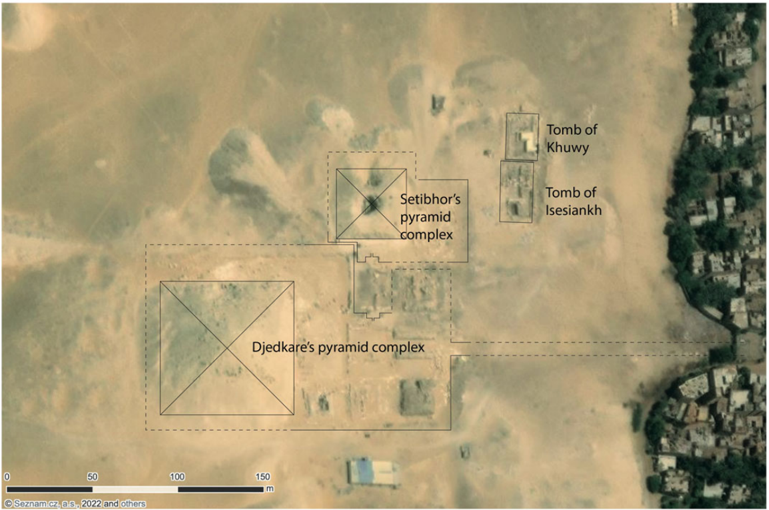
This study aims to discuss the chronology of the Egyptian 5th dynasty of the Old Kingdom and the tentative date of accession of king Djedkare based on material from his royal necropolis at South Saqqara and non-royal cemetery of Abusir South, Egypt. A series of radiocarbon (14 C) dates were established through analysis of archaeological material from several monuments at the necropolis, including the king’s pyramid complex, pyramid complex of his queen, and two elite tombs (Isesiankh and Khuwy). In addition, two samples from non-royal tombs in the Abusir South cemetery, were taken into consideration for further precision during the modeling, associated with king Huni (end 3rd dynasty) and king Niuserre (5th dynasty). The contextualized 14 C dates together with re-evaluation of historical evidence on Djedkare’s rule, results in a new model of temporal probability density which can be further refined with any new data from archaeological research. It shows that Djedkare’s reign can be currently modelled between 2503 and 2449 BCE (95.4%), thus slightly older than expected by literature. This presented model provides a more precise chronological frame for the late 5th dynasty period of Egyptian history, which was period of a significant socio-economic transformation.
Checked 2026-11-23 · 1 reference not checked yet
Overview
CoChat Summary
TL;DR
This paper presents contextualized radiocarbon dates and Bayesian modeling for the reign of Egyptian 5th-dynasty king Djedkare, using samples from South Saqqara and Abusir South. It estimates Djedkare’s accession to 2503–2449 BCE (95.4%) in the final model, slightly older than several current literature estimates.
Key findings
- In the final model including previous published dates (10 dates), Djedkare’s accession date is 2503–2449 BCE (95.4%) and the end of his reign is 2461–2411 BCE (95.4%).
- Intermediate models give: Djedkare’s cemetery samples only (7 dates), accession 2518–2460 BCE and end 2467–2412 BCE; adding Niuserre and Huni dates (9 dates), accession 2508–2454 BCE and end 2468–2415 BCE.
- The reign length was constrained to 29–44 years; the paper states historical/archaeological evidence indicates a minimum of 22 years from the highest cattle count and at least 29 years or more, possibly 44 years.
- The results are consistent with Kitchen’s suggested accession date of 2431 BCE but are higher/older than Shaw’s 2414 BCE, Verner’s 2402 BCE, and Hornung et al.’s 2365 BCE.
Methods
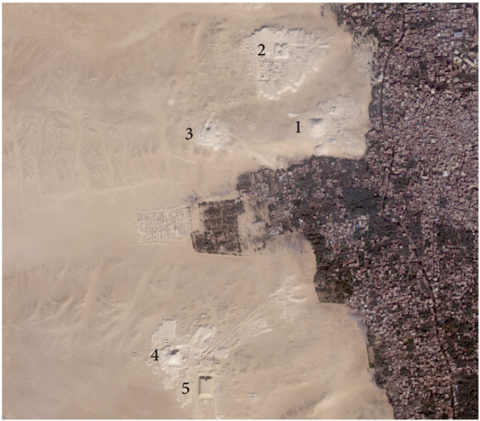
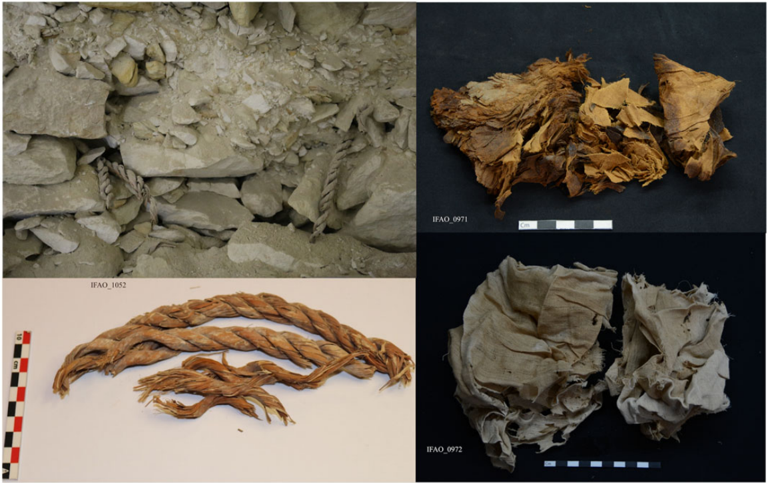
- Eight samples were selected from Djedkare’s necropolis in 2021–2022 and one from Abusir South in 2017; materials included rope, charcoal, textiles, and wood from Djedkare’s pyramid substructure, Setibhor’s pyramid complex, the tombs of Isesiankh and Khuwy, and Nefer’s tomb AS 68d. Additional previous dates used in modeling were an Acacia sp. sample from mastaba AS 54 attributed to Huni and an Oxford papyrus sample BM 10735/10.
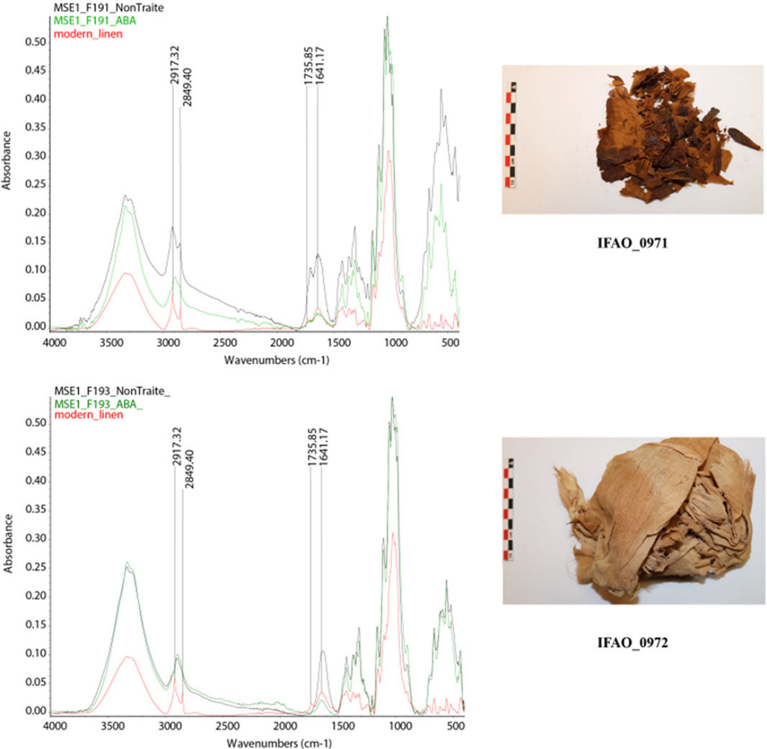
- Samples were pretreated by AAA, combusted, converted to benzene, and measured by liquid scintillation counting; δ13C was measured by IRMS. ATR-FTIR and digital microscopy were used to assess contamination.
- Radiocarbon results were calibrated with IntCal20 and modeled in OxCal v4.4.4 using Bayesian statistics, phases/sequences, outlier distributions, and a Delta_R seasonal effect of 16 ± 4 14C yrs.
Limitations
- The paper states the dataset is small, two charcoal pieces come from a single context, and definitive interpretations are difficult; it also notes a lack of a priori constraints before and after Djedkare’s reign, a relatively low number of 14C dates, and calibration plateaus, so more constraints and analyses are needed.
- The paper states that the exact origin of some charcoal is uncertain, IFAO_1056 was intrusive and excluded from modeling, no skeletal remains were found for Isesiankh so his age at death is unknown, wood species could not be identified, and possible organic contamination on IFAO_0971 was suspected but not definitively demonstrated.
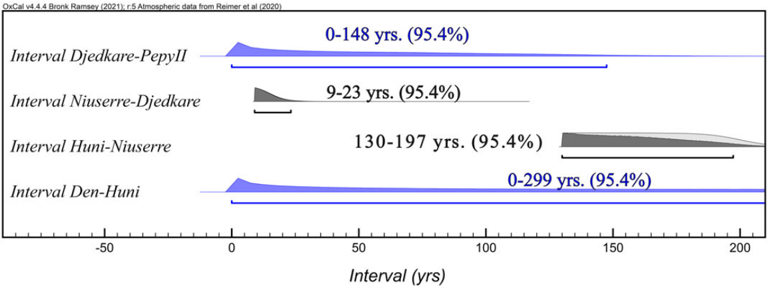
- The paper states that it cannot definitively demonstrate whether the cattle census was biennial or irregular during Djedkare’s reign, and that the Den–Huni interval remains flexible, reaching up to 299 years, showing more constraints are needed in that part of the model.
Model-written summary. Check it against the paper before relying on it.
Integrity signals
Registry
Cites
Statistics
Figures
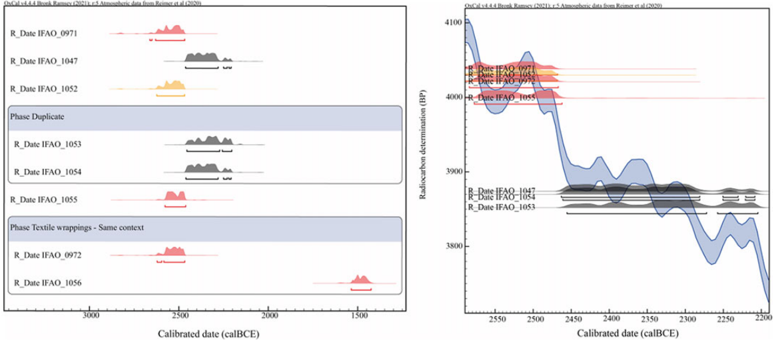
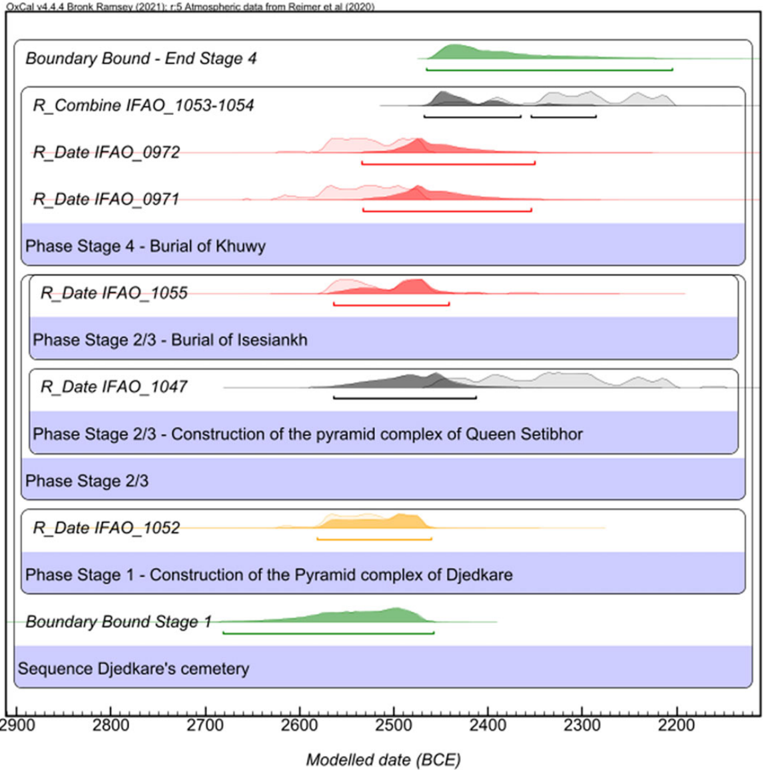
![Figure 7 Modeling of the previous sequence by constraining the whole sequence to have lasted from 29 to 44 years maximum. a] simulated boundaries for the beginning and end of Djedkare ' s reign; b] correlation graph between the two previous simulated boundaries; c] modeling of the interval corresponding to the duration of Djedkare ' s reign, described a priori as After(29)&Before (44 .0135 5*T(5)), d] results modeled on the calibration curve (IntCal20).](https://figures.cochat.ai/paper-figures/4563520cb2544a078912c2bd34431eb7/dating-the-egyptian-old-kingdom-the-reign-of-djedkare-5th-dynasty-figure-7.png)
![Figure 8 Niuserre ' s reign. a] Modeled boundaries corresponding to the end of the 3rd dyn., the end of Niuserre reign and surrounding the reign of Djedkare; b] plotting results on the calibration curve (IntCal20); c] correlation plot between the start (x-axis) and end (y-axis- modeled probability density for Djedkare ' s reign.](https://figures.cochat.ai/paper-figures/55b124507ddc4215b31190e85a48d118/dating-the-egyptian-old-kingdom-the-reign-of-djedkare-5th-dynasty-figure-8.png)
Verification
Claims the paper makes
0 Valid · 1 Not valid · 33 Not checked · 106 Own results and interpretations
None of the sources cited for this claim have been checked yet.
In the paper
“IFAO_0971 is a textile fragment from the mummy wrappings collected on the mummified remains (Ikram et al. 2023;Megahed and Vymazalová 2019).”
§ Dating the Egyptian Old Kingdom: The reign of Djedkare (5th dynasty) > Sampling
What the sources say
- Not checked yetcites Ikram et al. 2023 matched to “Pushing boundaries: Old Kingdom mummification revised” (2023) source
- Not checked yetcites Megahed and Vymazalová 2019
plainSingle case- Asserted: passes — The authors put it forward as true.
- Checkable: passes — It can be checked against evidence.
- Load-bearing: passes — The paper’s conclusions depend on it.
- Based: passes — The paper gives a reason why it holds.
A result the paper reports from its own data — it cites no other source for it, so there is none to check. The quote shows it is in the paper.
In the paper
“It shows that Djedkare's reign can be currently modelled between 2503 and 2449 BCE (95.4%), thus slightly older than expected by literature.”
§ Dating the Egyptian Old Kingdom: The reign of Djedkare (5th dynasty) > Abstract
plain- Asserted: passes — The authors put it forward as true.
- Checkable: passes — It can be checked against evidence.
- Load-bearing: passes — The paper’s conclusions depend on it.
- Based: passes — The paper gives a reason why it holds.
- Rests on an assumption not shown here.
In the paper
“Sample IFAO_1047 are pieces of charcoal collected in queen Setibhor's pyramid complex, namely in the portico of her funerary temple (Megahed et al. 2019) inside the pit for the western column base, which itself is missing.”
§ Dating the Egyptian Old Kingdom: The reign of Djedkare (5th dynasty) > Sampling
What the sources say
- Not checked yetcites Megahed et al. 2019
plainSingle case- Asserted: passes — The authors put it forward as true.
- Checkable: passes — It can be checked against evidence.
- Load-bearing: unclear — It is unclear whether the paper’s conclusions depend on it.
- Based: passes — The paper gives a reason why it holds.
In the paper
“Besides, if the charcoal outlier-model distribution is a student's t-distribution instead of a Normal function (Bronk Ramsey et al., 2009b), it gives 2468-2411 BCE (95.4%).”
§ Dating the Egyptian Old Kingdom: The reign of Djedkare (5th dynasty) > Length of Djedkare's reign
What the sources say
- Not matchedcites Bronk Ramsey et al., 2009b
More than one paper fits this citation.
plainstates a cause- Asserted: passes — The authors put it forward as true.
- Checkable: passes — It can be checked against evidence.
- Load-bearing: unclear — It is unclear whether the paper’s conclusions depend on it.
- Based: passes — The paper gives a reason why it holds.
- Not matched
A result the paper states — it cites no source for it, so there is none to check. The quote shows it is in the paper.
In the paper
“No skeletal remains were found in Isesiankh's tomb”
§ Dating the Egyptian Old Kingdom: The reign of Djedkare (5th dynasty) > Contextualized archaeological samples and the reign of Djedkare
plainSingle case- Asserted: passes — The authors put it forward as true.
- Checkable: passes — It can be checked against evidence.
- Load-bearing: unclear — It is unclear whether the paper’s conclusions depend on it.
- Based: passes — The paper gives a reason why it holds.
73 more claims
Create a free account to see all 140 claims and to verify the 17 references still open.
- Probably not a substantial claim. 35
- It may state two separate claims as one. 33
- The quote only partly states this claim. 1
Self-check
Percentages, sums and reported differences re-computed from the paper’s own numbers.
Each contradiction between two passages listed here was confirmed by an independent check.
Rated minor: it would not touch a result — a value no result rests on, a p-value that stays on the same side of the significance level, or a conflict that is clerical, resolved elsewhere in the paper, or outside its own findings.
In the paper
§ Dating the Egyptian Old Kingdom: The reign of Djedkare (5th dynasty) > Abstract
“It shows that Djedkare's reign can be currently modelled between 2503 and 2449 BCE (95.4%), thus slightly older than expected by literature.”
§ Dating the Egyptian Old Kingdom: The reign of Djedkare (5th dynasty) > Conclusion
“| With previous published | 10 | 2503-2449 (95.4%) | 2461-2411 (95.4%) |”
Citations
Cites
Bayesian Analysis of Radiocarbon Dates
Bronk Ramsey, C. (2009) · Radiocarbon · doi:10.1017/s0033822200033865 · Cited by 8,725
The IntCal20 Northern Hemisphere Radiocarbon Age Calibration Curve (0–55 cal kBP)
Reimer, P. J., Austin, W. E. N., Bard, E., Bayliss, A., Blackwell, P. G., Bronk Ramsey, C., Butzin, M., Cheng, H., Edwards, R. L., Friedrich, M., et al. (2020) · Radiocarbon · doi:10.1017/rdc.2020.41 · Cited by 7,900 · cited 2×
“4.4 software (Bronk Ramsey 1995, 2009a, 2009b, 2017), using the IntCal20 calibration curve (Reimer et al. 2020).”
InfluentialDiscussion Reporting of 14 C Data
Stuiver, M., & Polach, H. A. (1977) · Radiocarbon · doi:10.1017/s0033822200003672 · Cited by 5,640
Radiocarbon Calibration and Analysis of Stratigraphy: The OxCal Program
Bronk Ramsey, C. (1995) · Radiocarbon · doi:10.1017/s0033822200030903 · Cited by 2,409
Dealing with outliers and offsets in radiocarbon dating
Bronk Ramsey, C. (2009) · Radiocarbon · doi:10.1017/s0033822200034093 · Cited by 1,204
Methods for Summarizing Radiocarbon Datasets
Ramsey, C. B. (2017) · Radiocarbon · doi:10.1017/rdc.2017.108 · Cited by 1,179
Reporting 14C Activities and Concentrations
Mook, W. G., & van der Plicht, J. (1999) · Radiocarbon · doi:10.1017/s0033822200057106 · Cited by 456 · cited 2×
“The 14 C activity is calculated in percent relative to the activity of an international standard of oxalic acid NIST SRM 4990C (OxII), using the Libby half-life (5568 yr) and taking into account the isotopic fractionation normalised to – 25 ‰ (versus VPDB) (Mook and van der Plicht 1999; Stuiver and Polach 1977).”
(2006) · doi:10.1163/9789047404002 · Cited by 365
Radiocarbon-Based Chronology for Dynastic Egypt
Ramsey, C. B., Dee, M. W., Rowland, J. M., Higham, T. F. G., Harris, S. A., Brock, F., Quiles, A., Wild, E. M., Marcus, E. S., & Shortland, A. J. (2010) · Science · doi:10.1126/science.1189395 · Cited by 282
The Oxford History Of Ancient Egypt
(2000) · doi:10.1093/oso/9780198150343.001.0001 · Cited by 173
Research works printed but not linked: 28
- Megahed M (2023) The revival of the royal cemetery of king Djedkare at south Saqqara. Scribe 12, 26-37.
- Bárta M, Vachala B et al. (Forthcoming) Abusir XXI. The Tomb of Inti. Prague: Charles University, Faculty of Arts.
- Bárta M et al. (2014a) Abusir XXIII. The Tomb of the Sun Priest Neferinpu (AS 37). Prague: Charles University in Prague, Faculty of Arts.
- Bárta M and Brůna V (eds) (2021) The Pyramid Fields of Ancient Egypt: A Satellite Atlas. Prague: Faculty of Arts, Charles University.
- Megahed M, Jánosi P and Vymazalová H (2018) Djedkare's pyramid complex: Preliminary report on the 2017 season. Prague Egyptological Studies 21, 34-44.
- Bárta M (2011) An Abusir mastaba from the reign of Huni. In Callender VG, Bareš L, Bárta M, Janák J and Krejčí J (eds), Times, Signs and Pyramids. Studies in Honour of Miroslav Verner on the Occasion of His Seventieth Birthday. Prague: Czech Institute of Egyptology, 41-50.
- Vymazalová H and Dulíková V (2012) Sheretnebty: A king's daughter from Abusir South. Archiv orientální 80(3), 339-356.
- Bárta M et al. (2009) Abusir XIII. Tomb Complex of the Vizier Qar, His Sons Qar Junior and Senedjemib, and Iykai. Prague: Czech Institute of Egyptology, Faculty of Arts, Charles University in Prague, Dryada.
- Bárta M (2017)
- Vymazalová H (2024) Gracious of Arm, Isesiankh -new evidence from Djedkare's royal cemetery at Saqqara. In Kamrin J, Khaled MI and Leitz Ch (eds), The Kingdom of the Mummies: Essays in Memory of Ramadan B. Hussein (Supplément aux Annales du Service des Antiquités de l'Egypte, Cahier 46). Cairo : Ministry of Tourism and Antiquities, 507-518.
- Verner M (2008) The system of dating in the Old Kingdom. In Vymazalová H, Bárta M (eds), Chronology and Archaeology in Ancient Egypt (The Third Millennium BC). Prague: Czech institute of Egyptology, Faculty of Arts, 23-43.
- Posener-Kriéger P (1976) Les archives du temple funéraire de Néferirkarê-Kakaï (Les papyrus d'Abousir). Traduction et commentaire I-II. BiEtud 65. Le Caire: Institut français d'archéologie orientale.
- Megahed M and Vymazalová H (2023) Le paradis de Khououy dans la cimetiére "Parfait" de Djedkarê à Saqqâra Sud. Egypte, Afrique & Orient 111, 29-38.
- Mathieu B (2001) Travaux de l'Institut français d'archéologie orientale en 2000-2001. Bulletin de l'Institut français d'archéologie orientale 101, 449-610.
- Vymazalová H (Forthcomingb) Early decorated burial chambers in the Old Kingdom. In Bárta M (ed), Elites Conference. Sheffield: Equinox.
- Bárta M (2020) The world on the (non)-royal tombs in Abusir. In Bárta M, editor. Kings of the Sun. Studies. Prague: National Museum and Charles University, 85-102.
- Kitchen KA (2000) The historical chronology of Ancient Egypt, "Current Assessment". In Bietak M (ed), The Synchronisation of Civilizations in the Eastern Mediterranean in the Second Millennium B.C. Proceedings of the International Symposium at Schloß Haindorf, 15th-17th of November 1996 and at the Austrian Academy, Vienna 11-12 May 1998. Wien: Österreichischen Akademie der Wissenschaften, 39-52.
- Megahed M, Jánosi P and Vymazalová H (2019) Djedkare's pyramid complex: Preliminary report on the 2018 season, Prague Egyptological Studies 23, 12-36.
- Megahed M and Vymazalová H (2020) Notes on the newly discovered name of Djedkare's queen. In Kamrin J, Bárta M, Ikram S, Lehner M and Megahed M (eds), Guardian of Ancient Egypt: Studies in Honor of Zahi Hawass. Prague: Charles University, Faculty of Arts, 1023-1041.
- Vymazalová H (Forthcominga) Life after the Pyramid Age: Secondary cemetery at Djedkare's necropolis at Saqqara (Egypt). In Alušík T et al. (eds), Prehistoric, Ancient and Medieval Medicine. New Perspectives and Challenges for the Twenty-first Century (BAR International Studies). Oxford.
- Hashesh Z and Gabr A (2020) Human remains from Djedkare's cemetery, Egypt, preliminary results of the study seasons 2018-2019. Bioarchaeology of the Near East 14, 106-122.
- Posener-Kriéger P and de Cenival J-L (1968) Hieratic Papyri in the British Museum, Series V. The Abu Sir Papyri. London: Trustees of the British Museum.
- Bárta M (2001) Abusir V. The Cemeteries at Abusir South I. Prague: SetOut, Czech Institute of Egyptology.
- Spalinger A (1994) Dated texts of the Old Kingdom. Studien zur Altägyptischen Kultur 21, 275-319.
- Verner M (2001) Archaeological remarks on the 4th and 5th dynasty chronology. Archiv Orientalni 69(3), 263-418.
- Verner M and Callender VG (2002) Abusir VI. Djedkare's Family Cemetery. Prague: Czech Institute of Egyptology Faculty of Arts, Charles University in Prague.
- Quiles A and Tristant Y (2023) Radiocarbon-based modelling of the reign of King Den (1st Dynasty, Egypt) and the start of the Old Kingdom. Radiocarbon 65(2), 485-504. doi: 10.1017/RDC.2023. · doi:10.1017/rdc.2023
- Nolan JS (2008) Lunar intercalations and "cattle counts" during the Old Kingdom: The Hebsed in context. In Vymazalová H, Bárta M (eds), Chronology and Archaeology in Ancient Egypt (The Third Millennium BC). Prague: Czech Institute of Egyptology, Faculty of Arts, 44-60.
Cited by
Making Fire or Woodworking? Bone Artefacts from Djedkare’s Necropolis, South Saqqara (Egypt)
Vymazalová, H., Sůvová, Z., & Megahed, M. (2026) · Interdisciplinaria Archaeologica - Natural Sciences in Archaeology · doi:10.24916/iansa.2026.1.4
Self-citation
Metadata
- Authors
- Quiles, A., Vymazalová, H., Bárta, M., & Megahed, M.
- Affiliations
- Charles University (CZ)
- Venue
- Radiocarbon
- Publisher
- Cambridge University Press (CUP)
- Published
- 2024-11-05
- Volume
- 67
- Issue
- 1
- Pages
- 155-175
- ISSN
- 0033-8222 (ISSN-L)
- 1945-5755
- OpenAlex
- W4404069476
- Semantic Scholar
- f719352708ab6c8f2d150c7d1b9e75fe7480e5eb
- Cited by
- 1
- References
- 44
- Citations by year
- 2026: 1
- FWCI
- 0.89
- Type
- journal article
- Language
- en
- Open access
- hybrid
- doi.org
- Locations
- Radiocarbon (publishedVersion, cc-by)
- HAL (submittedVersion, cc-by-nc-nd)
- Funders
- Univerzita Karlova v Praze
- University of Cambridge
- Agence Nationale de la Recherche (ANR-19-CE27-0010)
- Grantová Agentura České Republiky
- Topics
- Social Sciences › Arts and Humanities › Archeology (arts and humanities) › Ancient Egypt and Archaeology
- Social Sciences › Archeology › Archaeology and ancient environmental studies
- Social Sciences › Arts and Humanities › Archeology (arts and humanities) › Ancient and Medieval Archaeology Studies
- Keywords
- Fifth Dynasty, Old Kingdom, Egyptian chronology, radiocarbon dating, elite tombs, socio-economic change
About these checks
Registry, retraction, Cites and statistics results are computed, not judged, with one exception: a printed reference that no index lists is read once by a model before it counts as a citation error. Claims are extracted by a model and kept only when their quote appears verbatim in the text; each cited source is then checked, with a model’s help, for whether it says what the claim relies on. Those verdicts can be wrong — read the claim’s quote and the cited source before relying on one.
A language model drew the claims from the paper on 2026-11-23, under version 3 of the claim definition (model deepseek-v4.1-flash, prompt extract-v3).
A second model labelled each claim on 2026-11-23 (model jev-1.13-20260917, definition revision gold-guideline-v0.2).
Statistics and arithmetic are recomputed, not judged.
Confidence bands are shown only for fields calibrated on our annotated test set. None is calibrated yet, so no band is shown.
What counts as a claim ›How we measure confidence ›How we check this ›
Are you an author, or do you see a problem with this page? Request a review
Data sources
Bibliographic data: Semantic Scholar, OpenAlex, Crossref.
Contains information from the Semantic Scholar Academic Graph Datasets, made available under the ODC Attribution License (ODC-BY 1.0).
Semantic Scholar’s data is described in: Kinney, R., et al. (2023). The Semantic Scholar Open Data Platform. arXiv:2301.10140.
