

How Censorship in China Allows Government Criticism but Silences Collective Expression
Open accessThe DOI matches its Crossref record; 53 of the 54 references it cites were found in a registry or an index, and 1 are not checked yet; none of the 12 sources its claims cite is checked for support yet.
Abstract
We offer the first large scale, multiple source analysis of the outcome of what may be the most extensive effort to selectively censor human expression ever implemented. To do this, we have devised a system to locate, download, and analyze the content of millions of social media posts originating from nearly 1,400 different social media services all over China before the Chinese government is able to find, evaluate, and censor (i.e., remove from the Internet) the subset they deem objectionable. Using modern computer-assisted text analytic methods that we adapt to and validate in the Chinese language, we compare the substantive content of posts censored to those not censored over time in each of 85 topic areas. Contrary to previous understandings, posts with negative, even vitriolic, criticism of the state, its leaders, and its policies are not more likely to be censored. Instead, we show that the censorship program is aimed at curtailing collective action by silencing comments that represent, reinforce, or spur social mobilization, regardless of content. Censorship is oriented toward attempting to forestall collective activities that are occurring now or may occur in the future—and, as such, seem to clearly expose government intent.
Checked 2026-11-22 · 1 reference not checked yet
Overview
CoChat Summary
TL;DR
The paper uses large-scale, real-time collection of Chinese social media posts to test why China censors online expression. It finds that censorship does not target criticism of the state or leaders; instead, it targets posts with collective action potential, regardless of whether they support or criticize the government.
Key findings
- Across the data, an average of approximately 13% of all social media posts were censored. Ex ante political sensitivity had only a weak relationship with censorship: Low and Medium categories were censored at 16% and 17%, respectively, versus 24% for High.
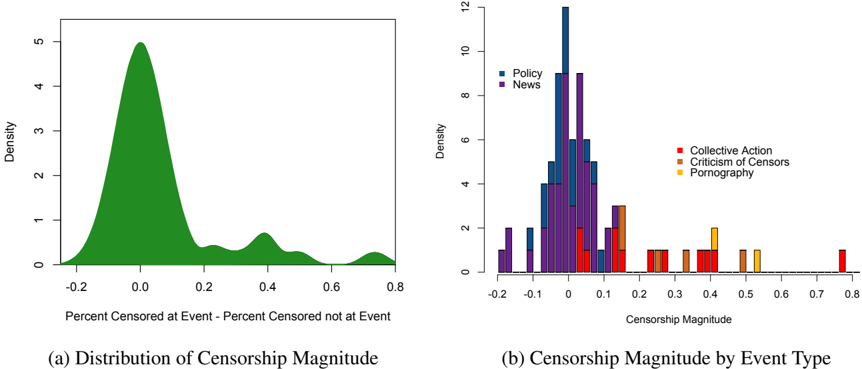
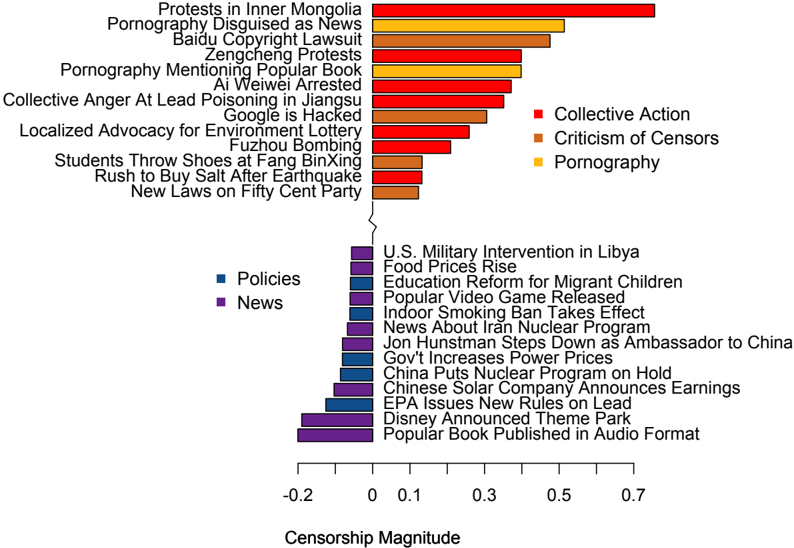
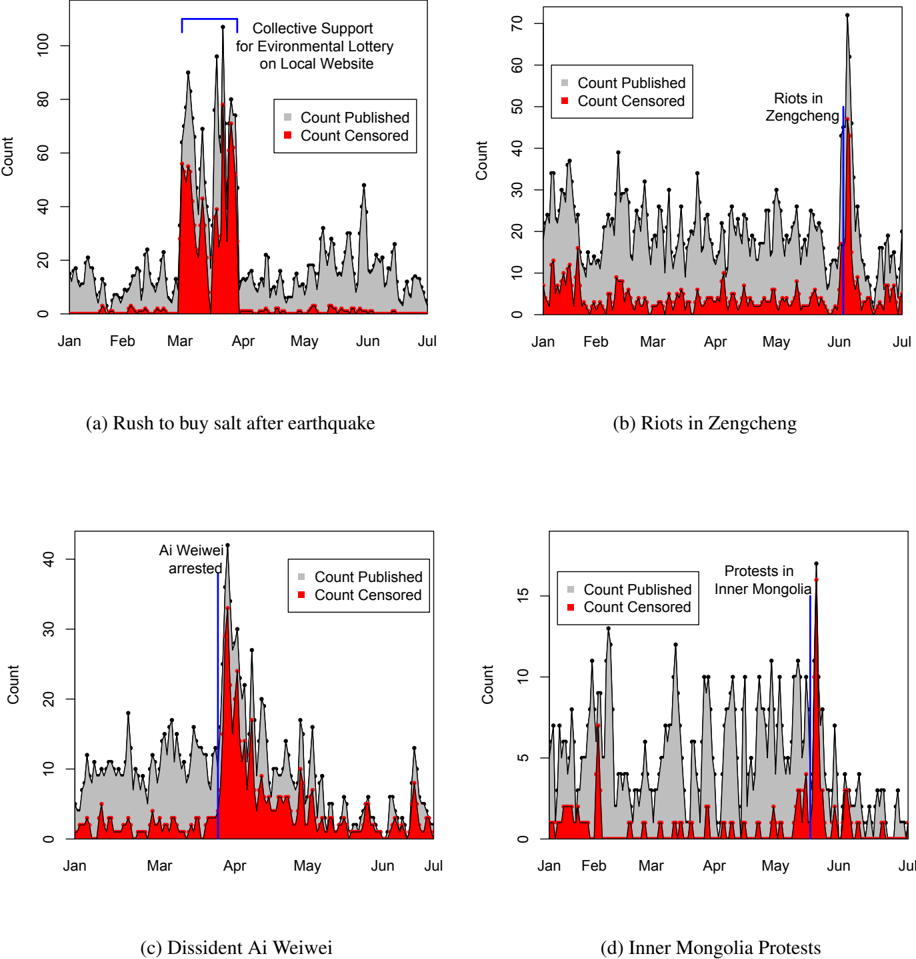
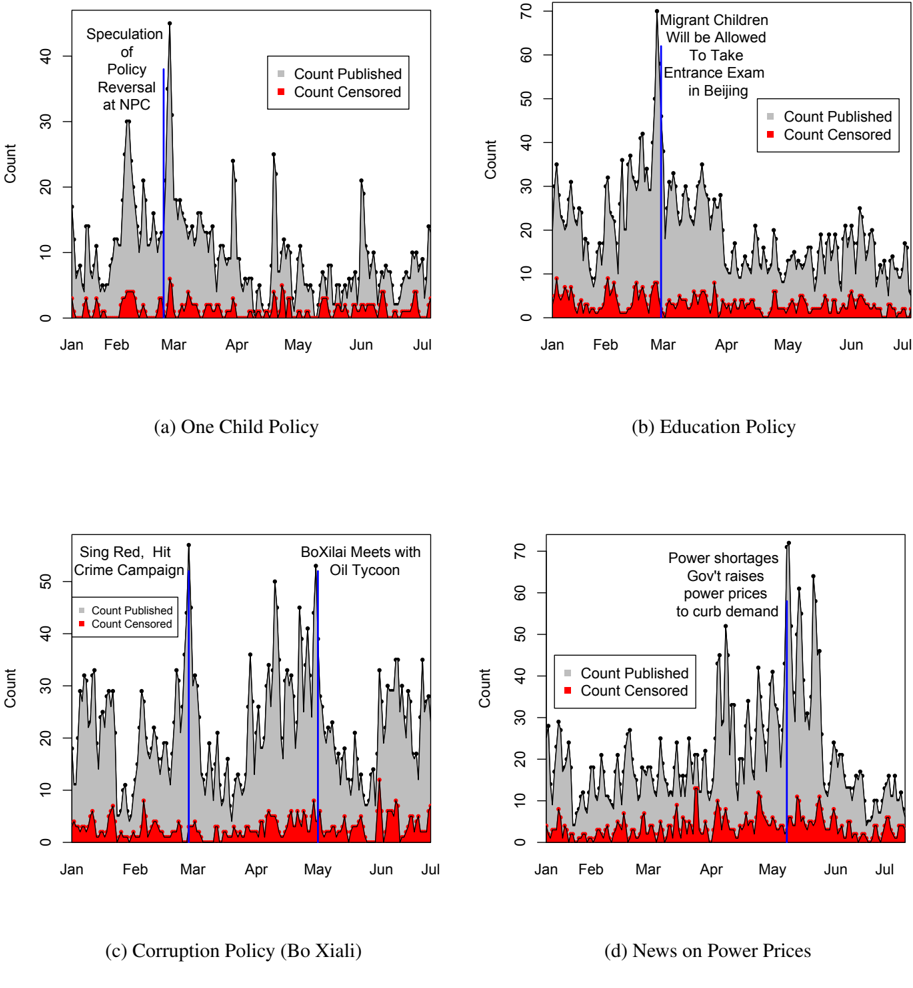
- Censorship was much higher during volume bursts tied to collective action: average censorship magnitude was 27% for collective action, compared with -1% for policy and -4% for news.
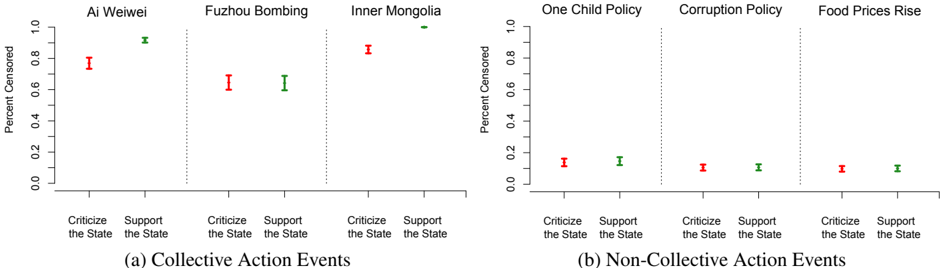
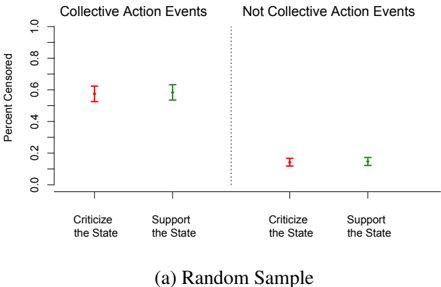
- For collective action events such as Ai Weiwei’s arrest, Inner Mongolia protests, and Fuzhou bombings, posts were censored at about 80% on average whether they criticized or supported the state. For non-collective-action events such as the one child policy, corruption policy, and food prices, censorship was about 10% on average for both critical and supportive posts.
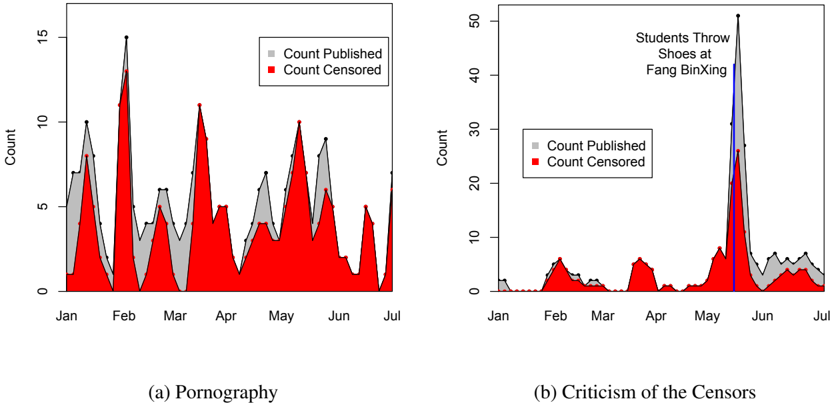
- Censorship also targeted pornography and criticism of the censors, but not government policy or other news. The authors argue censorship is aimed at curtailing collective action by silencing comments that represent, reinforce, or spur social mobilization.
Methods
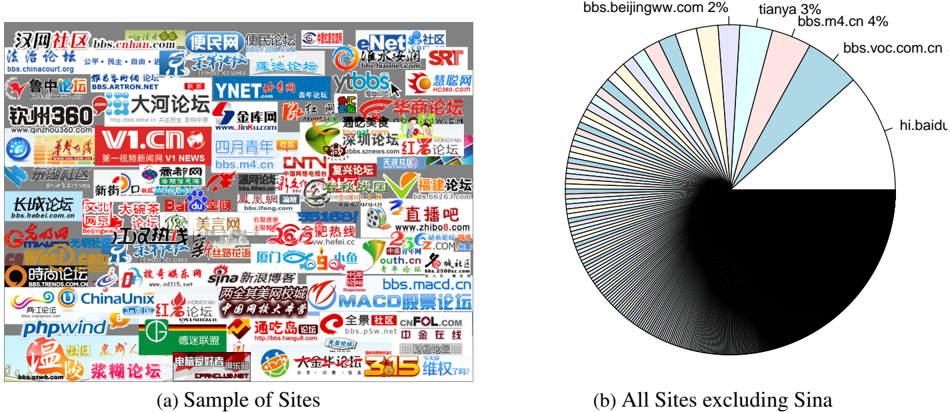
- The authors built a system to locate, download, and analyze posts from 1,382 Chinese websites during the first half of 2011, before government censors could remove them. They collected 3,674,698 posts, randomly selected 127,283 for further analysis, and overall collected and analyzed 11,382,221 posts.
- They used a stratified random sampling design covering 85 topic areas across three hypothesized political sensitivity levels, detected 87 volume bursts in 67 of the 85 topic areas using robust regression-based burst detection, and classified events into collective action potential, criticism of censors, pornography, government policies, and other news.
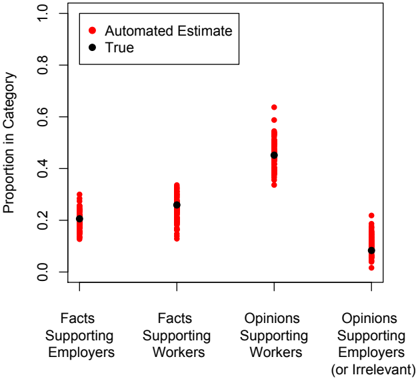
- To analyze content, they adapted the Hopkins and King “ReadMe” automated text analysis method to Chinese and extended it with a Bayesian procedure to estimate the percent censored within categories. Validation used native Chinese speakers coding 1,000 posts about 2010 labor strikes, with 100 as training and 900 as test; event coding reliability was 98.9% (86 of 87 events).
Limitations
- The paper states that its methodology misses self-censorship and censorship that may occur before the post is obtained; it also does not quantify the direct effects of the Great Firewall, keyword blocking, or search filtering.
- The authors state they have not studied physical violence, such as arrest of bloggers, or threats of the same; although many officials and levels of government influence censorship decisions, their data only sometimes distinguish among these sources, and they cannot determine the consequences of these limitations.
- The authors note that the presumably smaller number of discussions they cannot observe are likely to be those of most interest to the Chinese government, and they offer little evidence connecting social media findings to press freedom or other types of human expression in China. They also state that the predictive analysis was conducted retrospectively and with only three events, so further prospective validation would be valuable.
Model-written summary. Check it against the paper before relying on it.
Integrity signals
Registry
Cites
Statistics
Figures
Verification
Claims the paper makes
0 Valid · 7 Not valid · 7 Not checked · 88 Own results and interpretations
A result the paper reports from its own data — it cites no other source for it, so there is none to check. The quote shows it is in the paper.
In the paper
“Our data show that the Chinese censorship program allows for a wide variety of criticisms of the Chinese government, its officials, and its policies.”
§ How Censorship in China Allows Government Criticism but Silences Collective Expression * > Outline of Results
plain- Asserted: passes — The authors put it forward as true.
- Checkable: passes — It can be checked against evidence.
- Load-bearing: passes — The paper’s conclusions depend on it.
- Based: passes — The paper gives a reason why it holds.
A result the paper reports from its own data — it cites no other source for it, so there is none to check. The quote shows it is in the paper.
In the paper
“Contrary to previous understandings, posts with negative, even vitriolic, criticism of the state, its leaders, and its policies are not more likely to be censored.”
- Also stated in: § 1 Introduction · plain
“we find that when the Chinese people write scathing criticisms of their government and its leaders, the probability that their post will be censored does not increase.”
§ How Censorship in China Allows Government Criticism but Silences Collective Expression * > Abstract
plain- Asserted: passes — The authors put it forward as true.
- Checkable: passes — It can be checked against evidence.
- Load-bearing: passes — The paper’s conclusions depend on it.
- Based: passes — The paper gives a reason why it holds.
- Also stated in: § 1 Introduction · plain
A result the paper reports from its own data — it cites no other source for it, so there is none to check. The quote shows it is in the paper.
In the paper
“Large increases in online volume are good predictors of censorship when these increases are associated with events related to collective action, e.g., protest on the ground.”
§ How Censorship in China Allows Government Criticism but Silences Collective Expression * > Outline of Results
plainstates an association- Asserted: passes — The authors put it forward as true.
- Checkable: passes — It can be checked against evidence.
- Load-bearing: passes — The paper’s conclusions depend on it.
- Based: passes — The paper gives a reason why it holds.
A result the paper reports from its own data — it cites no other source for it, so there is none to check. The quote shows it is in the paper.
In the paper
“In addition, we measure sentiment within each of these events and show that during these events, the government censors views that are both supportive and critical of the state.”
§ How Censorship in China Allows Government Criticism but Silences Collective Expression * > Outline of Results
plainstates a cause- Asserted: passes — The authors put it forward as true.
- Checkable: passes — It can be checked against evidence.
- Load-bearing: passes — The paper’s conclusions depend on it.
- Based: passes — The paper gives a reason why it holds.
A result the paper reports from its own data — it cites no other source for it, so there is none to check. The quote shows it is in the paper.
In the paper
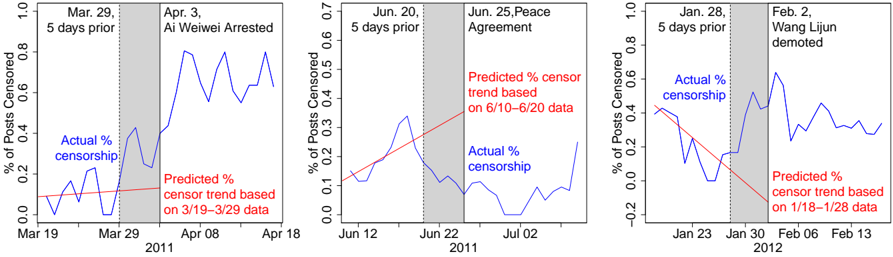
“We thus conduct the same analysis for the demotion of Wang Lijun in Panel (c) of Figure 11, and again see a large difference in actual and predicted percent censorship before Wang's demotion.”
§ How Censorship in China Allows Government Criticism but Silences Collective Expression * > Additional information
plainSingle case- Asserted: passes — The authors put it forward as true.
- Checkable: passes — It can be checked against evidence.
- Load-bearing: unclear — It is unclear whether the paper’s conclusions depend on it.
- Based: passes — The paper gives a reason why it holds.
46 more claims
Create a free account to see all 102 claims and every source verdict.
- Probably not a substantial claim. 26
- It may state two separate claims as one. 33
Claims other papers make about this one
Each is checked against this paper’s own text: does it say what the citing paper says it does?
The source backs part of the claim, not all of it — or backs it for a different population, condition or comparison.
In the citing paper
“Authorities are keen to review social media posts and have contentious messages removed (King etal., 2013) to ensure that potential threats remain invisible.”
From How Dictators Control the Internet: A Review Essay (2020) · cites this paper as King et al., 2013
Experimental — accuracy not yet measuredThe source backs part of the claim, not all of it — or backs it for a different population, condition or comparison.
In the citing paper
“In most autocratic regimes, governmental interference in digital infrastructure and communication is commonplace.”
From How Dictators Control the Internet: A Review Essay (2020) · cites this paper as King et al., 2013
Experimental — accuracy not yet measuredThe source backs part of the claim, not all of it — or backs it for a different population, condition or comparison.
In the citing paper
“First, the timing of censorship during a coup is consistent with many studies that have shown that Internet censorship is targeted during sensitive political time periods and periods of potential power transitions, such as elections and large-scale protests [23,25,44,47,73].”
From A multi-perspective view of Internet censorship in Myanmar (2021) · cites this paper as [44]
Experimental — accuracy not yet measuredThe cited source says what the claim attributes to it.
In the citing paper
“research has shown how mobilization organized through public coordination is repressed using that very same public information-for instance, repression is preemptively increased before focal days (Truex 2019); and autocracies censor online calls for collective action (King, Pan, and Roberts 2013), coerce online opinion leaders (Pan and Siegel 2020), and at times, turn off the internet entirely.”
From Coordinated Dis-Coordination (2024) · cites this paper as King, Pan, and Roberts 2013
The check wasn’t confident either way, so it gives no verdict — never disputed.
In the citing paper
“In China, for instance, two virtual police officers remind citizens that their browsing behavior is monitored (King etal., 2013).”
From How Dictators Control the Internet: A Review Essay (2020) · cites this paper as King et al., 2013
Experimental — accuracy not yet measured
1 more claim about this paper
Create a free account to see every claim other papers make about this one.
Citations
Cites
Robust estimation of a location parameter
Huber, P. J. (1964) · The Annals of Mathematical Statistics · doi:10.1214/aoms/1177703732 · Cited by 7,228
Robust Regression and Outlier Detection
Piepel, G. F. (1989) · Technometrics · doi:10.1080/00401706.1989.10488524 · Cited by 6,144
Robust Regression and Outlier Detection
Rousseeuw, P. J., & Leroy, A. M. (1987) · Wiley Series in Probability and Statistics · doi:10.1002/0471725382 · Cited by 5,609
Logistic Regression in Rare Events Data
King, G., & Zeng, L. (2001) · Political Analysis · doi:10.1093/oxfordjournals.pan.a004868 · Cited by 4,316 · cited 1×
“We do this via well-known and widely used case-control methodology (King and Zeng 2001).”
MethodSelf-citationDemocracy and Development: Political Institutions and Well-Being in the World, 1950–1990
Przeworski, A., Alvarez, M. E., Cheibub, J. A., & Limongi, F. (2000) · doi:10.1017/cbo9780511804946 · Cited by 2,845
Rightful Resistance in Rural China
O'Brien, K. J., & Li, L. (2006) · Cambridge University Press eBooks · doi:10.1017/cbo9780511791086 · Cited by 1,104
The Dynamics of Informational Cascades: The Monday Demonstrations in Leipzig, East Germany, 1989–91
Lohmann, S. (1994) · World Politics · doi:10.2307/2950679 · Cited by 1,035 · cited 1×
“Protests in East Germany, Eastern Europe, and most recently the Middle East have all preceded regime change (Ash 2002; Lohmann 1994; Przeworski et al. 2000).”
BackgroundRightful Resistance in Rural China
O'Brien, K., & Li, L.-J. (2006) · doi:10.1017/cbo9780511791086.003 · Cited by 987
China's Changing of the Guard: Authoritarian Resilience
Nathan, A. J. (2003) · Journal of Democracy · doi:10.1353/jod.2003.0019 · Cited by 927
Sparks and prairie fires: A theory of unanticipated political revolution
Kuran, T. (1989) · Public Choice · doi:10.1007/bf00116762 · Cited by 905 · cited 1×
“In fact, Kuran (1989) and Lohmann (2002) show that it is information about a collective action event that propels collective action and so distinguishing this from explicit calls for collective action would be difficult if not impossible.”
Background
Research works printed but not linked: 13
- 22. Freedom House. 2012. "Freedom of the Press, 2012." www.freedomhouse.org.
- 8. Chang, Parris. 1983. Elite Conflict in the Post-Mao China. New York: Occasional Papers Reprints.
- 26. Hinton, Harold. 1955. The "Unprincipled Dispute" Within Chinese Communist Top Lead- ership. Washington, DC: U.S. Information Agency.
- 44. Perry, Elizabeth. 2002. Challenging the Mandate of Heaven: Social Protest and State Power in China. Armork, NY: M. E. Sharpe.
- 52. Schurmann, Franz. 1966. Ideology and Organization in Communist China. Berkeley, CA: University of California Press.
- Tsai, 2007, Capitalism without Democracy: The Private Sector in Contemporary China
- 48. Qiang, Xiao. 2011. The Rise of Online Public Opinion and Its Political Impact. In Chang- ing Media, Changing China, ed. Susan Shirk. New York: Oxford University Press pp. 202-224.
- 9. Charles, David. 1966. The Dismissal of Marshal P'eng Teh-huai. In China Under Mao: Politics Takes Command, ed. Roderick MacFarquhar. Cambridge: MIT University Press pp. 20-33.
- 54. Shirk, Susan. 2007. China: Fragile Superpower: How China's Internal Politics Could Derail Its Peaceful Rise. New York: Oxford University Press.
- 56. Teiwes, Frederick. 1979. Politics and Purges in China: Retification and the Decline of Party Norms. Armork, NY: M. E. Sharpe. Tsai, Kellee. 2007a. Capitalism without Democracy: The Private Sector in Contemporary China. Ithaca, NY: Cornell University Press.
- 15. Duan, Qing. 2007. China's IT Leadership. Vdm Verlag.
- 38. MacFarquhar, Roderick. 1974. The Origins of the Cultural Revolution Volume 1: Contra- dictions Among the People 1956-1957. New York: Columbia University Press.
- 12. Chen, Xiaoyan and Peng Hwa Ang. 2011. Internet Police in China: Regulation, Scope and Myths. In Online Society in China: Creating, Celebrating, and Instrumentalising the Online Carnival, ed. David Herold and Peter Marolt. New York: Routledge pp. 40-52.
Cited by
Items 2,301–2,400 of 2,443
ZHAO, Q. (2025) · Филология научные исследования · doi:10.7256/2454-0749.2025.12.77192
Beyond the WEIRD World: linking Bureaucracy and Democracy in Developing Countries
Schnell, S. (2025) · Perspectives on Public Management and Governance · doi:10.1093/ppmgov/gvaf024 · Cited by 1
Shackelford, S. J., Douzet, F., & Ankersen, C. (2025) · Cambridge University Press eBooks · doi:10.1017/9781009574105.007
Liu, J. (2025) · Cambridge University Press eBooks · doi:10.1017/9781009574105.014
Ling, G., & Tian, X. (2025) · Journal of Agricultural Economics · doi:10.1111/1477-9552.70020
Engaging the Public Through Design: How Digital Platforms Nudge Public Engagement
Yang, W., & Wu, J. (2025) · Governance · doi:10.1111/gove.70104 · Cited by 1
Social Media Listening Platforms in Wartime Russia
Сергеевна, Л. О., & Лебедев, П. А. (2026) · Communist and Post-Communist Studies · doi:10.1525/cpcs.2025.2477849 · Cited by 1
Gläßel, C., & Scharpf, A. (2025) · Oxford University Press eBooks · doi:10.1093/9780197831229.003.0001
Gläßel, C., & Scharpf, A. (2025) · Oxford University Press eBooks · doi:10.1093/9780197831229.002.0006
The Relationship between Repression and Coups
Gläßel, C., & Scharpf, A. (2025) · Oxford University Press eBooks · doi:10.1093/9780197831229.003.0007
Gläßel, C., & Scharpf, A. (2025) · Oxford University Press eBooks · doi:10.1093/9780197831229.003.0002
Career Pressure and Excessive Disloyalty
Gläßel, C., & Scharpf, A. (2025) · Oxford University Press eBooks · doi:10.1093/9780197831229.003.0005
Dissecting the Authoritarian Security Apparatus
Gläßel, C., & Scharpf, A. (2025) · Oxford University Press eBooks · doi:10.1093/9780197831229.003.0003
Gläßel, C., & Scharpf, A. (2025) · Oxford University Press eBooks · doi:10.1093/9780197831229.002.0005
Gläßel, C., & Scharpf, A. (2025) · Oxford University Press eBooks · doi:10.1093/9780197831229.002.0002
Gläßel, C., & Scharpf, A. (2025) · Oxford University Press eBooks · doi:10.1093/9780197831229.002.0007
Career Pressure and Excessive Loyalty
Gläßel, C., & Scharpf, A. (2025) · Oxford University Press eBooks · doi:10.1093/9780197831229.003.0004
Gläßel, C., & Scharpf, A. (2025) · Oxford University Press eBooks · doi:10.1093/9780197831229.003.0008
Extending the Logic of Career Pressure
Gläßel, C., & Scharpf, A. (2025) · Oxford University Press eBooks · doi:10.1093/9780197831229.003.0006
More than diversion: Economic turmoil, foreign-policy assertiveness, and China’s balance of risk
Xiaolin, D. (2026) · Contemporary Security Policy · doi:10.1080/13523260.2025.2609738
“Additionally, there is a lack of an effective mechanism that allows for a collective expression of popular will in China due to the institutional settings and the government’s control over media (King et al., 2013).”
The Sustainability of Obedience: A Comparative Analysis of Political Behavior Between Fear and Trust
Uygur, M. R., Tekin, F., work., T. A. C. E. T. T., Sever, F., work., T. A. C. E. T. T., & Toye, S. A. (2026) · Highlights of Sustainability · doi:10.54175/hsustain5010002 · Cited by 1
Xu, W., Gao, L., & Wu, J. (2026) · Journal of Aging & Social Policy · doi:10.1080/08959420.2026.2618140
69Chapter 3 Naked Bodies: Acceptability and Legibility in Chinese Art Comics
Stember, N. (2025) · De Gruyter eBooks · doi:10.1515/9783111438184-004
Gause, L., & Bautista-Chavez, A. M. (2026) · Annual Review of Political Science · doi:10.1146/annurev-polisci-042224-082228
Risk assessment of earthquake online public opinion based on behavioral motivation
Yang, S., Wu, H., & Liu, J. (2026) · Scientific Reports · doi:10.1038/s41598-026-36051-x
Private social media accounts as a productive resistance tactic: a qualitative study from China
Bao, H., & Shang, A. (2026) · Behaviour and Information Technology · doi:10.1080/0144929x.2026.2621782
“The state manages and guides online information, and content shared on social media platforms in China is subject to government censorship (King, Pan, and Roberts 2013; Miao, Jiang, and Pang 2021).”
Usul, A. R. (2026) · All Azimuth A Journal of Foreign Policy and Peace · doi:10.20991/allazimuth.1665472 · Cited by 3
The More You Know, the Less You Learn: Information Monitoring and Decision-Making BiasPreprint
Zhang, X., & Cao, X. (2026) · SSRN Electronic Journal · doi:10.2139/ssrn.6166846
Kwong, Y. (2026) · Journal of Asian and African Studies · doi:10.1177/00219096261416511 · Cited by 1
CDNE: Community deception from node and edge perspectives
Kang, Y., Tang, J., Fan, B., & Yuan, H. (2026) · Neurocomputing · doi:10.1016/j.neucom.2026.133039 · Cited by 1
Zhao, L., Liu, J., & Wang, X. (2026) · Social Media + Society · doi:10.1177/20563051261417300 · Cited by 2
“However, Chinese content governance typically constrain activism with negative consequence potential rather than specific viewpoint adherence (King et al., 2013).”
The limits of AI for authoritarian control
Yang, E. (2026) · American Journal of Political Science · doi:10.1111/ajps.70045 · Cited by 4
“…existing studies have focused on how domestic mechanisms, such as elections (Cox, 2009; Rozenas, 2010; Miller, 2015) and strategic (non-)censorship (King, Pan and Roberts, 2013; Lorentzen, 2014; Chen and Xu, 2017), allow autocrats to strike a delicate balance in the trade-off, the role of…”
Rating villagers’ morality: Techno-moral governance via a data scoring system in rural China
Sun, Y., Wang, W. Y., & Li, L. (2026) · Big Data & Society · doi:10.1177/20539517261424163
“…’ in the conventional knowledge about social governance that tends to concentrate on the discursive construction of public opinion in the digital era (King et al., 2013, 2017; Liu and Zhao, 2021; Schneider, 2018; Yang, 2017), we also hope to highlight the test-bed nature of rural China and how…”
Four voices, one region: local and Western media coverage of regional relations in Central Asia
Mukasheva, Z., Akhmedyanova, D., & Nogayeva, A. (2026) · Central Asian Survey · doi:10.1080/02634937.2025.2611917
Gohdes, A., Koh, A., & Schumann, M. P. (2025) · De Gruyter eBooks · doi:10.1515/9783111298559-005
Strong state, weak enforcement: bureaucratic forbearance of China’s social insurance policies
Zhang, H., & Zhang, Y. (2026) · Political Science Research and Methods · doi:10.1017/psrm.2026.10091 · Cited by 5
Limitations of State Surveillance
Cai, Y., & Huang, X. (2026) · Asian Survey · doi:10.1525/as.2026.2859621
Ward, P., & Song, W. (2026) · Asian Survey · doi:10.1525/as.2026.2826755
Kulichkina, A., Balluff, P., Righetti, N., & Waldherr, A. (2026) · EPJ Data Science · doi:10.1140/epjds/s13688-026-00637-2 · Cited by 3
Totalitarian influence and war support in China: Shaping public opinion on Ukraine and Taiwan
Lin, K.-C. J., & Chen, C.-J. J. (2026) · The Sociological Review · doi:10.1177/00380261261423712 · Cited by 6
“…filtering out statements that contradict its official narrative and thus might be detrimental to the government’s legitimacy (Kuang, 2018); by shielding the public from any influence by such discourse, it prevents the initiation of collective action against the government (King et al., 2013).”
Location, Location, Reaction: How Mandatory IP Disclosure Silences Critics and Sparks Backlash
Li, S., Xu, P., & Guo, Y. (2026) · Policy & Internet · doi:10.1002/poi3.70034 · Cited by 1
“Moreover, negative sentiment serves as a primary channel through which citizens express their emotions on public issues, allowing for both individual venting (Wong and Liang 2023) and collective mobilization (King et al. 2013).”
Natee, W., Chaisriya, K., Charoenthansakul, T., & Gilbert, L. H. (2026) · Journalism and Media · doi:10.3390/journalmedia7010065 · Cited by 1
“King et al. (2013) demonstrate how authoritarian states strategically tolerate low-risk criticism while suppressing collective expression—an insight directly relevant to understanding why some protest-related tweets become widely amplified while others remain less visible.”
State Tolerance and Social Critique of Chinese Stand-Up Comedy
Zhang, Z., & Xie, L. (2026) · International Journal of Politics Culture and Society · doi:10.1007/s10767-026-09569-1
“…the content focus of stand-up comedy, which emphasizes social rather than overtly political commentary—a distinction extensively doc - umented in studies of Chinese political communication and contentious media (Cai, 2010 ; Chen, 2012 ; King et al., 2013; Repnikova, 2017; Dimitrov & Zhang, 2021 ).”
Deciphering China’s Central Asia policy: insights from state media narratives
Zhou, Y. (2025) · Journal of Contemporary East Asia Studies · doi:10.1080/24761028.2026.2647683
Globalization and Political Protests: The Role of Imported Movies
Sun, L., & Li, Q. (2026) · International Studies Quarterly · doi:10.1093/isq/sqag016
Leaders Online: Social Media Communication by Political Leaders Across Regime Types
Zimmer, P., & Hummel, S. (2026) · Political Research Quarterly · doi:10.1177/10659129261437125
“” Leaders of less democratic countries can utilize censorship to avoid discussing un-pleasant topics or narratives entirely (King et al. 2013) or deploy social media as part of a broader, cohesive information campaign (Guriev and Treisman 2019).”
Computational Social Science in der Vergleichenden Politikwissenschaft
Stier, S., & Maerz, S. F. (2026) · Springer eBooks · doi:10.1007/978-3-658-02993-7_76-1
Political Satire and the Decline of Discourse Quality: Evidence from China’s Online Public Sphere
Chen, X., & Guan, T. (2026) · The China Quarterly · doi:10.1017/s0305741026102124
Reyhan, D. (2017) · theses.fr (ABES) · doi:10.70675/8dff2af3z3e45z4e58za152z9e67a3ff8dba · Cited by 2
Fang, L., & Meng, T. (2026) · Political Studies Review · doi:10.1177/14789299261435673
Essays on Media and Government in China
Zhuang, M. (2020) · theses.fr (ABES) · doi:10.70675/da10f054zbd58z4974z9b09zf044bc82986b
State Media Questioning at Chinese Ministry of Foreign Affairs Press Conferences, 2020–2025
Yang, L., Ioki, A., & Yang, H. R. (2026) · Journal of Chinese Political Science · doi:10.1007/s11366-026-09938-9
“Double bind regulation" of the internet and social media in contemporary China
Ma, A. (2022) · theses.fr (ABES) · doi:10.70675/343e4959z198fz42cdzb205zcdcf5ca6021a · Cited by 1
Analyse économique des médias : aspects positifs et normatifs
Hu, J. (2023) · theses.fr (ABES) · doi:10.70675/c8df577cz48ebz40d1z9296z7190e401bc11
The politics of newswriting : three essays on how journalists cover politics
Shen, R. (2024) · theses.fr (ABES) · doi:10.70675/01d0eae8z52b1z4d10z97d8z8a40763bb73a · Cited by 2
Guan, T., Yang, Y., & Chen, X. (2026) · Politics & Policy · doi:10.1111/polp.70133
“Early scholar-ship on Weibo governance has shown how China's approach to digital control developed through iterative campaigns targeting rumor-spreading, mobilizational content, and politically sensitive events (e.g., Sullivan 2014; King et al. 2013).”
User anonymity and the informativeness of social media: evidence from a natural experiment
Huang, K., Wang, Y., Wong, T. J., & Zhang, T. (2026) · Review of Accounting Studies · doi:10.1007/s11142-026-09953-4 · Cited by 8
“A plausible explanation is that Chinese regulators are more sensitive to content that could incite collective action, such as protests (King et al. 2013, 2014), while posts on Guba are primarily focused on firm fundamentals and stock investments (Wang et al. 2025), making them less likely to…”
The Media Agenda‐Setting Role of Protests in Nondemocratic Regimes: A Case Study From Hungary
Susánszky, P., & Haunss, S. (2026) · Sociological Forum · doi:10.1111/socf.70072
How Opinion Leaders Shape Trust and Information Sharing?Preprint
Liu, C., Cao, Y., & Hou, Y. (2026) · SSRN Electronic Journal · doi:10.2139/ssrn.6636654
Self-censorship in communist China: text analysis of sermons from state-registered churches
Lee, S. (2026) · NPL report DEM-TQD · doi:10.1017/s1755048326100315
Talking the Party Line: Private Chinese Companies Between State Alignment and Business Interests
Mokry, S. (2026) · Global Studies Quarterly · doi:10.1093/isagsq/ksag067
Managing Dissent: Institutional Control and Political Discourse Polarisation in Uganda
walusimbi, A., Giuranno, M. G., & Ravenda, D. (2026) · The Journal of Development Studies · doi:10.1080/00220388.2026.2658549 · Cited by 1
Nguyen, H. T., Hoang, T.-D., Le, D.-A. Q., Tran, T.-N. T., & Ho, M.-T. (2026) · Society · doi:10.1007/s12115-026-01198-w
Digital vs. state media in Cuba: counter-flows and support for normalizing US relations
Gainous, J., Gray, T. J., & Wagner, K. M. (2026) · Frontiers in Political Science · doi:10.3389/fpos.2026.1780532
Tan, X., & Wang, W. (2026) · Asian Journal of Communication · doi:10.1080/01292986.2026.2669632 · Cited by 1
Annaka, S., Higashijima, M., & Kato, G. (2026) · Political Studies · doi:10.1177/00323217261429650
Spontaneous action coalescence: rethinking collective contention under high surveillance
Luqiu, L. R., & Kang, Y. (2026) · Social movement studies · doi:10.1080/14742837.2026.2673003
Margetts, H. Z., & Hood, C. C. (2026) · International series on public policy · doi:10.1007/978-3-032-06026-6_8
Speaking Fast and Low: The Acoustics of Authoritarian PoliticsPreprint
Giani, M., & Shayo, M. (2026) · SSRN Electronic Journal · doi:10.2139/ssrn.6753838
Li, J., Cheng, Y., & Ahmad, T. (2026) · Public Relations Review · doi:10.1016/j.pubrev.2026.102710 · Cited by 2
Lin, F., & Ouyang, Y. (2026) · Big Data & Society · doi:10.1177/20539517261442374 · Cited by 2
“…opinion and information access, which not only grant states unprecedented powers of monitoring and intervention (G ’ sell, 2025; Deibert, 2019; King et al., 2013), but also enlist new actors, such as tech giants and internet platforms, into power dynamics (Gunitsky, 2015; Roberts and…”
InfluentialDeference vs. defiance: deciphering media’s influence on censorship support in China
Li, D., & Steve, G. (2026) · Asian Journal of Communication · doi:10.1080/01292986.2026.2667545
“First, parochially oriented individuals encounter carefully curated domestic content that projects an image of accountability while suppressing potential collective actions rooted in grievances against governance (King et al., 2013, 2014, 2017; Lorentzen, 2014).”
The Sound of Silence: Championing Democracy in an Authoritarian Society
Huang, H. (2026) · Perspectives on Politics · doi:10.1017/s1537592726104770
Wang, X. (2026) · Frontiers in Political Science · doi:10.3389/fpos.2026.1805385
The Language Barrier to Human Rights Information: A Global Analysis of Google Search Results
Terman, R., & Cuppernull, P. (2026) · International Studies Quarterly · doi:10.1093/isq/sqag040
Measuring human capital with social media data and machine learning
Jakob, M., & Heinrich, S. (2026) · Scientific Reports · doi:10.1038/s41598-026-53076-4
Feng, H., Xuan, C., & Shu, M. (2026) · Chinese Journal of Communication · doi:10.1080/17544750.2026.2682842 · Cited by 1
Hashtag activism and the sousveillance of China’s Social Credit System
Liu, X. (2026) · China Information · doi:10.1177/0920203x261456486
Непочатов, Д. (2026) · Філософія та політологія в контексті сучасної культури · doi:10.15421/352624
Loose bricks in the wall: Underground press and political opposition in non-democracies
Tcaci, O. (2026) · Public Choice · doi:10.1007/s11127-026-01401-w
From platform carnival to official discourse: How “truth” is produced in Chinese online news
Li, J., & Hu, S. (2026) · PLoS ONE · doi:10.1371/journal.pone.0348284
Repression after coups: the role of deposed leader partisanship
Aaskoven, L., & Bjørnskov, C. (2026) · Journal of Peace Research · doi:10.1093/jopres/xjag044
Cheng, A. (2026) · Local Government Studies · doi:10.1080/03003930.2026.2684604 · Cited by 1
Expressive Constraint and Monarchical Legitimacy in Eswatini
Awoyemi, A. (2026) · Representation · doi:10.1080/00344893.2026.2688262
“The narrower implication is that repression can stabilise rule by filtering public signals and raising coordination costs rather than by producing loyal consent (King et al., 2013; Kuran, 1991, 1995; Lorentzen, 2014; Truex, 2016).”
InfluentialReassurance and pride: Narrating and legitimating digital surveillance in China
Yang, Y., Guo, D., & Kostka, G. (2026) · International Political Science Review · doi:10.1177/01925121261451171
Strategic Censorship? Public Opinion, Authoritarian Politics, and the International Trade Regime
Chung, S. (2026) · International Studies Quarterly · doi:10.1093/isq/sqag038
Laughing at Power, Laughing with Power: Political Humor and State Response in China
Chang, Y. (2026) · Springer eBooks · doi:10.1007/978-3-031-87993-7_75-1
Fan, Z. (2026) · SSRN Electronic Journal · doi:10.2139/ssrn.7003306
Lau, J. C. (2026) · ACM Conference on Fairness, Accountability, and Transparency (FAccT) · doi:10.1145/3805689.3806495
“King, Pan, and Roberts [16] provide evidence for why this weather is so difficult to predict.”
Xin, J., & Zhang, H. (2026) · Complexity · doi:10.1155/cplx/4899778
Recommending the state: How social media algorithms curate state-created content in China
Lu, Y., Liu, X., & Zhou, C. (2026) · Journal of Communication · doi:10.1093/joc/jqag010 · Cited by 2
Factors that influence a country to exercise its capacity for digital repression
Clarke, G., & Johnson, D. (2026) · Journal of Information Technology & Politics · doi:10.1080/19331681.2026.2697183
Sword and Shield: Uses and Strategies of LLMs in Navigating Disinformation
Lim, G., Tan, B. C. Z., Sim, K., Shi, W., Chew, M. H., Hee, M. S., Lee, R. K.-W., Perrault, S. T., & Choo, K. T. W. (2026) · Proceedings of the ACM on Human-Computer Interaction · doi:10.1145/3817008 · Cited by 1
“Disinformers, including individuals, activist groups, businesses, and state actors [72], pursue outcomes like financial gain [37], reputational benefits [25] and power [1].”
Jawla, P. (2026) · Digest of Middle East Studies · doi:10.1111/dome.70027
Heidemann, A.-S. (2026) · Journal of Current Chinese Affairs · doi:10.1177/18681026261459129
Qin, S., & Lee, W. (2026) · PLoS ONE · doi:10.1371/journal.pone.0352452
“First, the analysis relies exclusively on posts that remained visible on Weibo, introducing a specific form of survivorship bias akin to informative censoring [68].”
Yang, L. (2026) · SN Social Sciences · doi:10.1007/s43545-026-01581-8
“In authoritarian settings, that tradition now intersects with scholarship on digital authoritarianism, networked control, and censorship infrastructure (Deibert 2013; King et al. 2013, 2014, 2017; MacKinnon 2012; Roberts 2018).”
Bi, Y., & Han, L. (2026) · Journal of Gender Studies · doi:10.1080/09589236.2026.2704607
Metadata
- Authors
- KING, G., PAN, J., & ROBERTS, M. E.
- Affiliations
- Harvard University (US)
- Corresponding author
- KING, GARY
- PAN, JENNIFER
- Venue
- American Political Science Review
- Publisher
- Cambridge University Press (CUP)
- Published
- 2013-05
- Volume
- 107
- Issue
- 2
- Pages
- 326-343
- ISSN
- 0003-0554 (ISSN-L)
- 1537-5943
- OpenAlex
- W2144188763
- Cited by
- 2,415
- References
- 48
- Citations by year
- 2026: 161 · 2025: 206 · 2024: 249 · 2023: 272 · 2022: 230 · 2021: 193 · 2020: 206 · 2019: 157 · 2018: 178 · 2017: 153 · 2016: 137 · 2015: 120 · 2014: 91 · 2013: 54
- FWCI
- 395.09
- Type
- journal article
- Language
- en
- Open access
- green
- nrs.harvard.edu
- Licence
- Locations
- American Political Science Review (publishedVersion)
- Digital Access to Scholarship at Harvard (DASH) (Harvard University) (submittedVersion, cc-by)
- RePEc: Research Papers in Economics (submittedVersion)
- Topics
- Social Sciences › Communication › Social Media and Politics
- Social Sciences › Law › Freedom of Expression and Defamation
- Social Sciences › Sociology and Political Science › Media Influence and Politics
- Keywords
- internet censorship, Chinese government, social media, collective action, social mobilization, political criticism, online speech
About these checks
Registry, retraction, Cites and statistics results are computed, not judged, with one exception: a printed reference that no index lists is read once by a model before it counts as a citation error. Claims are extracted by a model and kept only when their quote appears verbatim in the text; each cited source is then checked, with a model’s help, for whether it says what the claim relies on. Those verdicts can be wrong — read the claim’s quote and the cited source before relying on one.
A language model drew the claims from the paper on 2026-10-11, under version 3 of the claim definition (model deepseek-v4.1-flash, prompt extract-v3).
A second model labelled each claim on 2026-10-11 (model jev-1.13-20260917, definition revision gold-guideline-v0.2).
Statistics and arithmetic are recomputed, not judged.
Confidence bands are shown only for fields calibrated on our annotated test set. None is calibrated yet, so no band is shown.
What counts as a claim ›How we measure confidence ›How we check this ›
Are you an author, or do you see a problem with this page? Request a review
Data sources
Bibliographic data: Semantic Scholar, OpenAlex, Crossref.
Contains information from the Semantic Scholar Academic Graph Datasets, made available under the ODC Attribution License (ODC-BY 1.0).
Semantic Scholar’s data is described in: Kinney, R., et al. (2023). The Semantic Scholar Open Data Platform. arXiv:2301.10140.
