

How Censorship in China Allows Government Criticism but Silences Collective Expression
Open accessThe DOI matches its Crossref record; 53 of the 54 references it cites were found in a registry or an index, and 1 are not checked yet; none of the 12 sources its claims cite is checked for support yet.
Abstract
We offer the first large scale, multiple source analysis of the outcome of what may be the most extensive effort to selectively censor human expression ever implemented. To do this, we have devised a system to locate, download, and analyze the content of millions of social media posts originating from nearly 1,400 different social media services all over China before the Chinese government is able to find, evaluate, and censor (i.e., remove from the Internet) the subset they deem objectionable. Using modern computer-assisted text analytic methods that we adapt to and validate in the Chinese language, we compare the substantive content of posts censored to those not censored over time in each of 85 topic areas. Contrary to previous understandings, posts with negative, even vitriolic, criticism of the state, its leaders, and its policies are not more likely to be censored. Instead, we show that the censorship program is aimed at curtailing collective action by silencing comments that represent, reinforce, or spur social mobilization, regardless of content. Censorship is oriented toward attempting to forestall collective activities that are occurring now or may occur in the future—and, as such, seem to clearly expose government intent.
Checked 2026-11-22 · 1 reference not checked yet
Overview
CoChat Summary
TL;DR
The paper uses large-scale, real-time collection of Chinese social media posts to test why China censors online expression. It finds that censorship does not target criticism of the state or leaders; instead, it targets posts with collective action potential, regardless of whether they support or criticize the government.
Key findings
- Across the data, an average of approximately 13% of all social media posts were censored. Ex ante political sensitivity had only a weak relationship with censorship: Low and Medium categories were censored at 16% and 17%, respectively, versus 24% for High.
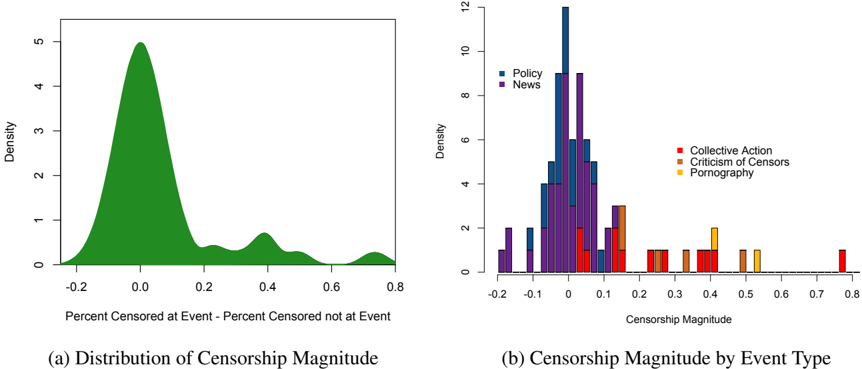
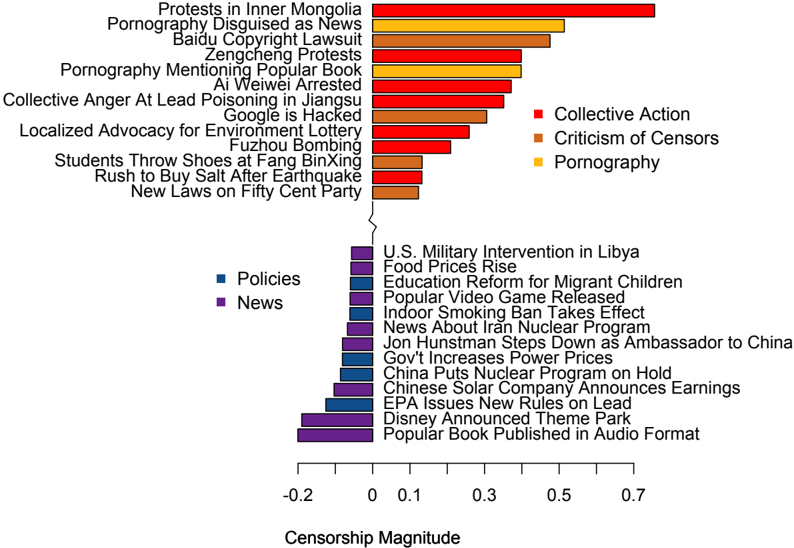
- Censorship was much higher during volume bursts tied to collective action: average censorship magnitude was 27% for collective action, compared with -1% for policy and -4% for news.
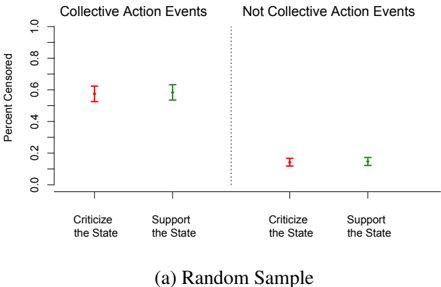
- For collective action events such as Ai Weiwei’s arrest, Inner Mongolia protests, and Fuzhou bombings, posts were censored at about 80% on average whether they criticized or supported the state. For non-collective-action events such as the one child policy, corruption policy, and food prices, censorship was about 10% on average for both critical and supportive posts.
- Censorship also targeted pornography and criticism of the censors, but not government policy or other news. The authors argue censorship is aimed at curtailing collective action by silencing comments that represent, reinforce, or spur social mobilization.
Methods
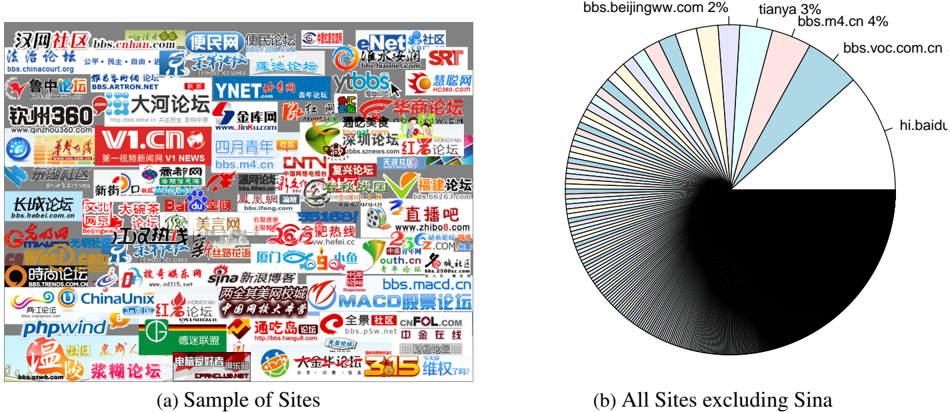
- The authors built a system to locate, download, and analyze posts from 1,382 Chinese websites during the first half of 2011, before government censors could remove them. They collected 3,674,698 posts, randomly selected 127,283 for further analysis, and overall collected and analyzed 11,382,221 posts.
- They used a stratified random sampling design covering 85 topic areas across three hypothesized political sensitivity levels, detected 87 volume bursts in 67 of the 85 topic areas using robust regression-based burst detection, and classified events into collective action potential, criticism of censors, pornography, government policies, and other news.
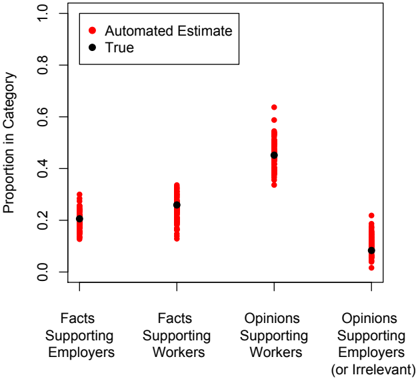
- To analyze content, they adapted the Hopkins and King “ReadMe” automated text analysis method to Chinese and extended it with a Bayesian procedure to estimate the percent censored within categories. Validation used native Chinese speakers coding 1,000 posts about 2010 labor strikes, with 100 as training and 900 as test; event coding reliability was 98.9% (86 of 87 events).
Limitations
- The paper states that its methodology misses self-censorship and censorship that may occur before the post is obtained; it also does not quantify the direct effects of the Great Firewall, keyword blocking, or search filtering.
- The authors state they have not studied physical violence, such as arrest of bloggers, or threats of the same; although many officials and levels of government influence censorship decisions, their data only sometimes distinguish among these sources, and they cannot determine the consequences of these limitations.
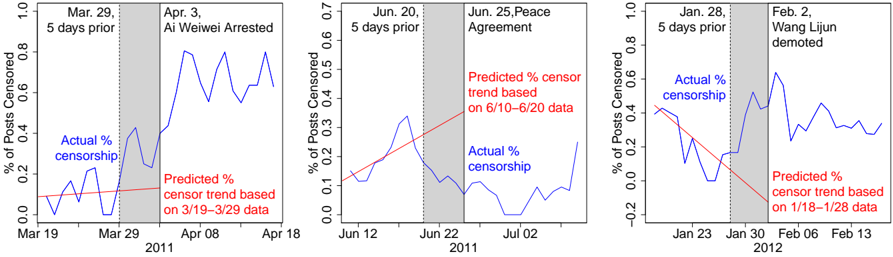
- The authors note that the presumably smaller number of discussions they cannot observe are likely to be those of most interest to the Chinese government, and they offer little evidence connecting social media findings to press freedom or other types of human expression in China. They also state that the predictive analysis was conducted retrospectively and with only three events, so further prospective validation would be valuable.
Model-written summary. Check it against the paper before relying on it.
Integrity signals
Registry
Cites
Statistics
Figures
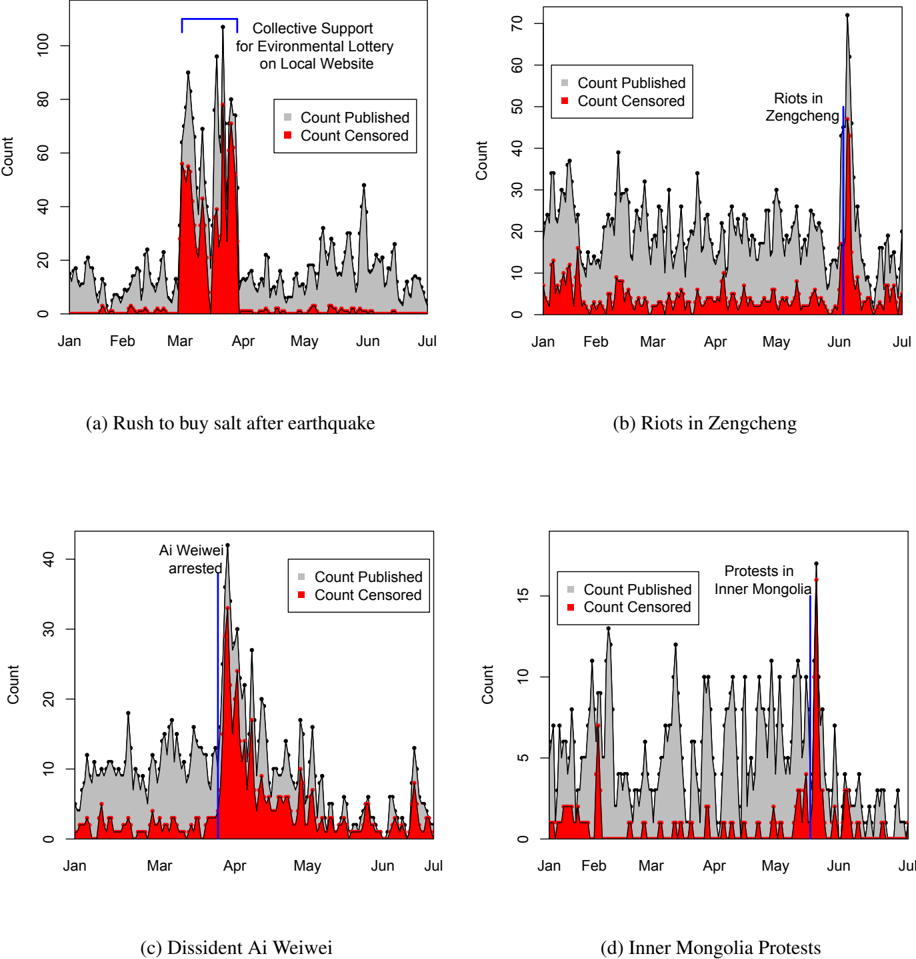
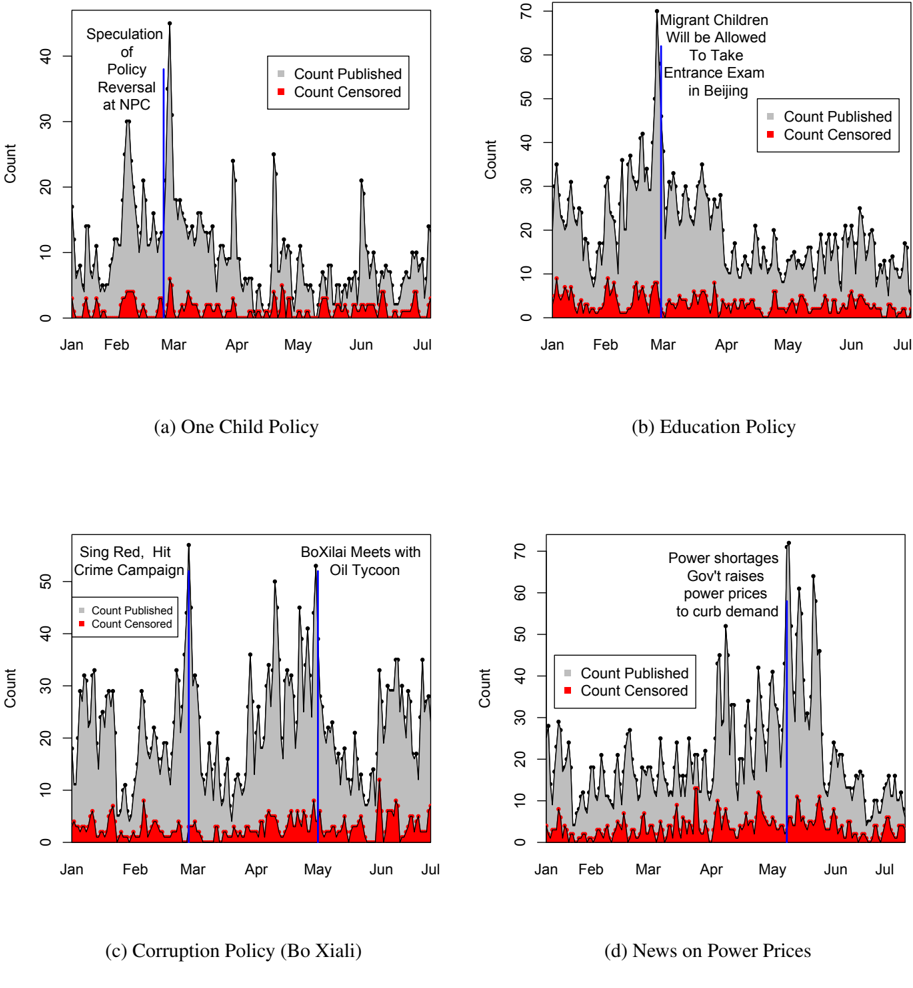
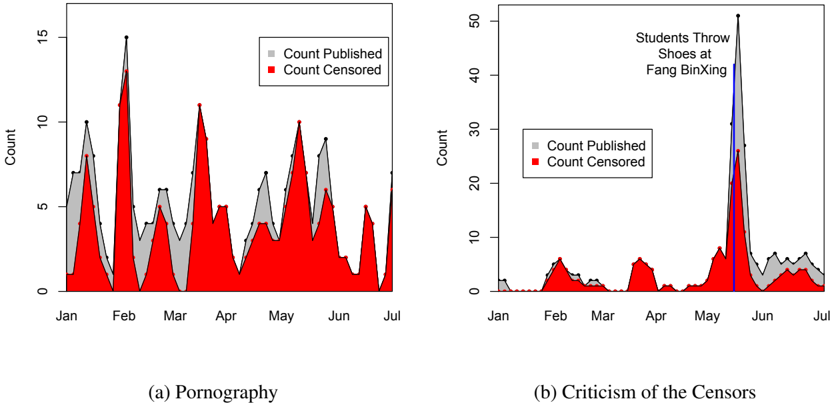
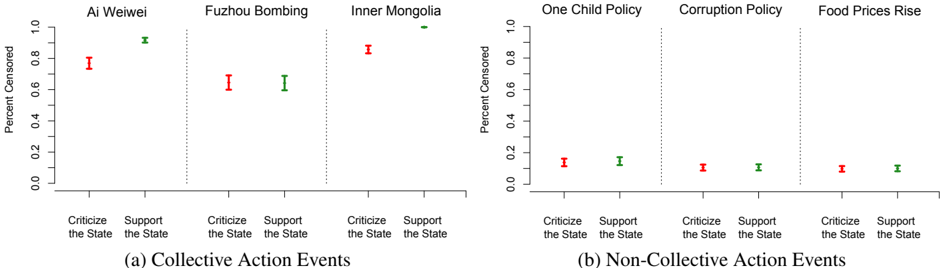
Verification
Claims the paper makes
0 Valid · 7 Not valid · 7 Not checked · 88 Own results and interpretations
A result the paper reports from its own data — it cites no other source for it, so there is none to check. The quote shows it is in the paper.
In the paper
“Our data show that the Chinese censorship program allows for a wide variety of criticisms of the Chinese government, its officials, and its policies.”
§ How Censorship in China Allows Government Criticism but Silences Collective Expression * > Outline of Results
plain- Asserted: passes — The authors put it forward as true.
- Checkable: passes — It can be checked against evidence.
- Load-bearing: passes — The paper’s conclusions depend on it.
- Based: passes — The paper gives a reason why it holds.
A result the paper reports from its own data — it cites no other source for it, so there is none to check. The quote shows it is in the paper.
In the paper
“Contrary to previous understandings, posts with negative, even vitriolic, criticism of the state, its leaders, and its policies are not more likely to be censored.”
- Also stated in: § 1 Introduction · plain
“we find that when the Chinese people write scathing criticisms of their government and its leaders, the probability that their post will be censored does not increase.”
§ How Censorship in China Allows Government Criticism but Silences Collective Expression * > Abstract
plain- Asserted: passes — The authors put it forward as true.
- Checkable: passes — It can be checked against evidence.
- Load-bearing: passes — The paper’s conclusions depend on it.
- Based: passes — The paper gives a reason why it holds.
- Also stated in: § 1 Introduction · plain
A result the paper reports from its own data — it cites no other source for it, so there is none to check. The quote shows it is in the paper.
In the paper
“Large increases in online volume are good predictors of censorship when these increases are associated with events related to collective action, e.g., protest on the ground.”
§ How Censorship in China Allows Government Criticism but Silences Collective Expression * > Outline of Results
plainstates an association- Asserted: passes — The authors put it forward as true.
- Checkable: passes — It can be checked against evidence.
- Load-bearing: passes — The paper’s conclusions depend on it.
- Based: passes — The paper gives a reason why it holds.
A result the paper reports from its own data — it cites no other source for it, so there is none to check. The quote shows it is in the paper.
In the paper
“In addition, we measure sentiment within each of these events and show that during these events, the government censors views that are both supportive and critical of the state.”
§ How Censorship in China Allows Government Criticism but Silences Collective Expression * > Outline of Results
plainstates a cause- Asserted: passes — The authors put it forward as true.
- Checkable: passes — It can be checked against evidence.
- Load-bearing: passes — The paper’s conclusions depend on it.
- Based: passes — The paper gives a reason why it holds.
A result the paper reports from its own data — it cites no other source for it, so there is none to check. The quote shows it is in the paper.
In the paper
“We thus conduct the same analysis for the demotion of Wang Lijun in Panel (c) of Figure 11, and again see a large difference in actual and predicted percent censorship before Wang's demotion.”
§ How Censorship in China Allows Government Criticism but Silences Collective Expression * > Additional information
plainSingle case- Asserted: passes — The authors put it forward as true.
- Checkable: passes — It can be checked against evidence.
- Load-bearing: unclear — It is unclear whether the paper’s conclusions depend on it.
- Based: passes — The paper gives a reason why it holds.
46 more claims
Create a free account to see all 102 claims and every source verdict.
- Probably not a substantial claim. 26
- It may state two separate claims as one. 33
Claims other papers make about this one
Each is checked against this paper’s own text: does it say what the citing paper says it does?
The source backs part of the claim, not all of it — or backs it for a different population, condition or comparison.
In the citing paper
“Authorities are keen to review social media posts and have contentious messages removed (King etal., 2013) to ensure that potential threats remain invisible.”
From How Dictators Control the Internet: A Review Essay (2020) · cites this paper as King et al., 2013
Experimental — accuracy not yet measuredThe source backs part of the claim, not all of it — or backs it for a different population, condition or comparison.
In the citing paper
“In most autocratic regimes, governmental interference in digital infrastructure and communication is commonplace.”
From How Dictators Control the Internet: A Review Essay (2020) · cites this paper as King et al., 2013
Experimental — accuracy not yet measuredThe source backs part of the claim, not all of it — or backs it for a different population, condition or comparison.
In the citing paper
“First, the timing of censorship during a coup is consistent with many studies that have shown that Internet censorship is targeted during sensitive political time periods and periods of potential power transitions, such as elections and large-scale protests [23,25,44,47,73].”
From A multi-perspective view of Internet censorship in Myanmar (2021) · cites this paper as [44]
Experimental — accuracy not yet measuredThe cited source says what the claim attributes to it.
In the citing paper
“research has shown how mobilization organized through public coordination is repressed using that very same public information-for instance, repression is preemptively increased before focal days (Truex 2019); and autocracies censor online calls for collective action (King, Pan, and Roberts 2013), coerce online opinion leaders (Pan and Siegel 2020), and at times, turn off the internet entirely.”
From Coordinated Dis-Coordination (2024) · cites this paper as King, Pan, and Roberts 2013
The check wasn’t confident either way, so it gives no verdict — never disputed.
In the citing paper
“In China, for instance, two virtual police officers remind citizens that their browsing behavior is monitored (King etal., 2013).”
From How Dictators Control the Internet: A Review Essay (2020) · cites this paper as King et al., 2013
Experimental — accuracy not yet measured
1 more claim about this paper
Create a free account to see every claim other papers make about this one.
Citations
Cites
Robust estimation of a location parameter
Huber, P. J. (1964) · The Annals of Mathematical Statistics · doi:10.1214/aoms/1177703732 · Cited by 7,228
Robust Regression and Outlier Detection
Piepel, G. F. (1989) · Technometrics · doi:10.1080/00401706.1989.10488524 · Cited by 6,144
Robust Regression and Outlier Detection
Rousseeuw, P. J., & Leroy, A. M. (1987) · Wiley Series in Probability and Statistics · doi:10.1002/0471725382 · Cited by 5,609
Logistic Regression in Rare Events Data
King, G., & Zeng, L. (2001) · Political Analysis · doi:10.1093/oxfordjournals.pan.a004868 · Cited by 4,316 · cited 1×
“We do this via well-known and widely used case-control methodology (King and Zeng 2001).”
MethodSelf-citationDemocracy and Development: Political Institutions and Well-Being in the World, 1950–1990
Przeworski, A., Alvarez, M. E., Cheibub, J. A., & Limongi, F. (2000) · doi:10.1017/cbo9780511804946 · Cited by 2,845
Rightful Resistance in Rural China
O'Brien, K. J., & Li, L. (2006) · Cambridge University Press eBooks · doi:10.1017/cbo9780511791086 · Cited by 1,104
The Dynamics of Informational Cascades: The Monday Demonstrations in Leipzig, East Germany, 1989–91
Lohmann, S. (1994) · World Politics · doi:10.2307/2950679 · Cited by 1,035 · cited 1×
“Protests in East Germany, Eastern Europe, and most recently the Middle East have all preceded regime change (Ash 2002; Lohmann 1994; Przeworski et al. 2000).”
BackgroundRightful Resistance in Rural China
O'Brien, K., & Li, L.-J. (2006) · doi:10.1017/cbo9780511791086.003 · Cited by 987
China's Changing of the Guard: Authoritarian Resilience
Nathan, A. J. (2003) · Journal of Democracy · doi:10.1353/jod.2003.0019 · Cited by 927
Sparks and prairie fires: A theory of unanticipated political revolution
Kuran, T. (1989) · Public Choice · doi:10.1007/bf00116762 · Cited by 905 · cited 1×
“In fact, Kuran (1989) and Lohmann (2002) show that it is information about a collective action event that propels collective action and so distinguishing this from explicit calls for collective action would be difficult if not impossible.”
Background
Research works printed but not linked: 13
- 22. Freedom House. 2012. "Freedom of the Press, 2012." www.freedomhouse.org.
- 8. Chang, Parris. 1983. Elite Conflict in the Post-Mao China. New York: Occasional Papers Reprints.
- 26. Hinton, Harold. 1955. The "Unprincipled Dispute" Within Chinese Communist Top Lead- ership. Washington, DC: U.S. Information Agency.
- 44. Perry, Elizabeth. 2002. Challenging the Mandate of Heaven: Social Protest and State Power in China. Armork, NY: M. E. Sharpe.
- 52. Schurmann, Franz. 1966. Ideology and Organization in Communist China. Berkeley, CA: University of California Press.
- Tsai, 2007, Capitalism without Democracy: The Private Sector in Contemporary China
- 48. Qiang, Xiao. 2011. The Rise of Online Public Opinion and Its Political Impact. In Chang- ing Media, Changing China, ed. Susan Shirk. New York: Oxford University Press pp. 202-224.
- 9. Charles, David. 1966. The Dismissal of Marshal P'eng Teh-huai. In China Under Mao: Politics Takes Command, ed. Roderick MacFarquhar. Cambridge: MIT University Press pp. 20-33.
- 54. Shirk, Susan. 2007. China: Fragile Superpower: How China's Internal Politics Could Derail Its Peaceful Rise. New York: Oxford University Press.
- 56. Teiwes, Frederick. 1979. Politics and Purges in China: Retification and the Decline of Party Norms. Armork, NY: M. E. Sharpe. Tsai, Kellee. 2007a. Capitalism without Democracy: The Private Sector in Contemporary China. Ithaca, NY: Cornell University Press.
- 15. Duan, Qing. 2007. China's IT Leadership. Vdm Verlag.
- 38. MacFarquhar, Roderick. 1974. The Origins of the Cultural Revolution Volume 1: Contra- dictions Among the People 1956-1957. New York: Columbia University Press.
- 12. Chen, Xiaoyan and Peng Hwa Ang. 2011. Internet Police in China: Regulation, Scope and Myths. In Online Society in China: Creating, Celebrating, and Instrumentalising the Online Carnival, ed. David Herold and Peter Marolt. New York: Routledge pp. 40-52.
Cited by
Items 1,701–1,800 of 2,443
The Dilemma of Surveillance: Predicting the Future of the Surveillance State
Medrano, J. (2015) · Trinity College Digital Repository (Trinity College, Hartford CT)
Participatory Democracy in the Chinese Cyber World: Case Studies from Weibo
Li, D. (2014) · USF Scholarship Repository (University of San Francisco)
Galvis, F., & Angela, M. (2015)
Benjamins, M. P. (2013) · Lund University Publications Student Papers (Lund University)
Dimitrov, M. K. (2013) · Cambridge University Press eBooks · doi:10.1017/cbo9781139565028.016
Ang, Y. Y. (2013) · SSRN Electronic Journal · doi:10.2139/ssrn.2244661
Battering Ram, Virus, or Beta-Institution? A Case Study of Chinese Local Government MicrobloggingPreprint
Schlæger, J., & Jiang, M. (2013) · SSRN Electronic Journal · doi:10.2139/ssrn.2258565
Analysing “Long Data” on Collective Violence in Indonesia
MEYER, D. A., & Stein, A. A. (2015) · Asian journal of social science · doi:10.1163/15685314-04305006
“Their results contradicted conventional wisdom that the purpose of Chinese censorship is to silence criticism of the government, and showed instead that the primary purpose is to disrupt collective actions (King et al., 2013).”
ResultUnderstanding political behavior: Essays in experimental political economy
Robalo, P. B. (2014) · UvA-DARE (University of Amsterdam)
Alternative Images of China in 2035: A Case Study of Tamkang University Workshops
Hoffman, J. (2014) · Tamkang University Institutional Repository (TKUIR)
Jiang, W. (2015) · MacSphere (McMaster University) · doi:10.71548/7529
Courtship, relationship, marriage and the state: regulation of contemporary Chinese popular media
Bai, M. (2015) · Illinois Digital Environment for Access to Learning and Scholarship (University of Illinois at Urbana-Champaign)
Assessing the Impact of International Human Rights Pressures: the Dominican Republic and China
Batista, L. (2014) · CUNY Academic Works (City University of New York)
The canary in the coal mine: Beijing News and the crisis of Chinese journalism
Li, K. (2014) · HKBU Institutional Repository (Hong Kong Baptist University)
A Comparative Study on the Chinese Government Publicity Weibo: Shanghai vs. Tianjin
Zhu, J., Wu, J., & Chen, N. E. (2013)
Remaking Guangzhou: Political engagement and place-making on Sina Weibo
Wang, W. Y. (2015) · QUT ePrints (Queensland University of Technology)
"Draw My Topics": Find Desired Topics fast from large scale of CorpusPreprint
Dou, J., Sun, N., & Zou, X. (2016) · arXiv (Cornell University) · doi:10.48550/arxiv.1602.01428
“We demonstrate the toolkit’s use on the Diachronic People’s Daily Corpus in Chinese.”
MethodLiao, H. (2014) · SSRN Electronic Journal
Davis, M. T. (2015) · New Global Studies · doi:10.1515/ngs-2015-0001
Yu, P. (2015) · Digital Commons - Lingnan (Lingnan University)
Perspectives on Cybersecurity: A Collaborative StudyPreprint
Choucri, N., & Jackson, C. (2016) · SSRN Electronic Journal · doi:10.2139/ssrn.2734336
Institutional Change in Authoritarian Settings: A Study of Environmental Penalties in ChinaPreprint
Marquis, C., & Bird, Y. (2016) · SSRN Electronic Journal · doi:10.2139/ssrn.2747091
The Causal Relationship between Government Opinions and Chinese Stock Market in Social Media Era
Gong, X., & Sriboonchitta, S. (2015) · Studies in computational intelligence · doi:10.1007/978-3-319-27284-9_31
Zhang, Y. (2016) · Advances in human and social aspects of technology book series · doi:10.4018/978-1-5225-0212-8.ch003
Workers' rights defence on China's internet: an analysis of
Tang, L., Shan, D., & Yang, P. (2016)
Can Economic Interdependence Dampen Nationalism? The Peace-Loving Public in ChinaPreprint
Yue, J. (2015) · SSRN Electronic Journal · doi:10.2139/ssrn.2583404
CHINA'S RISE TO POWER: AN EXAMINATION OF DOMESTIC, REGIONAL AND GLOBAL IMPACTS
Ackermann, M. (2014)
Making Inferences Using Incidentally Collected DataPreprint
Mellon, J. (2016) · SocArXiv (OSF Preprints) · doi:10.31235/osf.io/x7bfs
Yeung, D., & Cevallos, A. S. (2016) · RAND Corporation eBooks · doi:10.7249/rr1308
Social Accountability in Countries Where Space for Citizen-State Engagement Is Formally Constrained
Aslam, G., Grandvoinnet, H., Plummer, J., Gandhi, J., & Wicklin, W. A. V. (2015) · World Bank, Washington, DC eBooks · doi:10.1596/978-1-4648-0481-6_ch5
Brodsky, J. (2016) · Journal of Transnational American Studies · doi:10.5070/t871025712
Making the Censored Public: The 1989 Tiananmen Square Protests in Chinese Fiction and Film
Chen, T. C. (2016) · eScholarship (California Digital Library)
Research on Chinese Social Media Censorship as Contemporary Archaeology : Notes on Time-Sensitivity
Cader, J. (2016) · 情報学研究 : 学環 : 東京大学大学院情報学環紀要 · doi:10.15083/00032003
The Effect of Rural Factors on Migrant Integration in China
Tyner, A. (2014) · eScholarship (California Digital Library)
Cerón, A., Curini, L., Iacus, S. M., & Porro, G. (2012)
Introduction: A Question of Balance
Perry, S., & Roda, C. (2016) · Palgrave Macmillan UK eBooks · doi:10.1057/978-1-137-58805-0_1
The Power of Creativity: How Web-Based Parody Encourages Chinese Civil Participation
Boczar, A. (2015) · International ResearchScape Journal · doi:10.25035/irj.03.01.01
The Autocratic Root of Social DistrustPreprint
Jin, X., & Xu, X. (2016) · RePEc: Research Papers in Economics
Wrongful Convictions: A Comparative PerspectivePreprint
Zalman, M. (2016) · SSRN Electronic Journal · doi:10.2139/ssrn.2899482
Sina Weibo and Twitter : a clone or a reverse?
Ho, H. T. (2016) · Digital Commons - Lingnan (Lingnan University)
Chinese films and the sense of place: Beijing as 'Thirdspace' from In the Heat of the Sun to Mr Six
Zou, H. (2016) · University of Adelaide Press eBooks · doi:10.20851/publics-07 · Cited by 1
Communication, Censorship, and CoordinationPreprint
Hoshino, T. (2016) · SSRN Electronic Journal · doi:10.2139/ssrn.2879020
Social Media Users Collectively Speak Up: Evidence From Central Asian Kyrgyz Republic
Kurambayev, B. (2017) · Advances in social networking and online communities book series · doi:10.4018/978-1-5225-2495-3.ch002
Comparing Approaches to Combating Corruption: The Guangdong and Chongqing Models
Stromseth, J. R., Malesky, E. J., Gueorguiev, D. D., Hairong, L., Xixin, W., & Brinton, C. (2017) · Cambridge University Press eBooks · doi:10.1017/9781316388501.005
Authoritarian Media Bias in International Context: A Tale of Commercial PeacePreprint
Ji, C., & Liu, H. (2017) · SSRN Electronic Journal · doi:10.2139/ssrn.2956129
Gui, X.-W. (2017) · Rural China · doi:10.1163/22136746-01401010
Repnikova, M. (2017) · Cambridge University Press eBooks · doi:10.1017/9781108164474.003
Restrictions on Critical Journalism: How They Are Applied and Negotiated
Repnikova, M. (2017) · Cambridge University Press eBooks · doi:10.1017/9781108164474.005
Xiong, B. (2017) · CU Scholar (University of Colorado Boulder)
Howard, P. N., Savage, S., Flores-Saviaga, C., Toxtli, C., & Monroy‐Hernández, A. (2017) · arXiv (Cornell University) · doi:10.48550/arxiv.1710.03330 · Cited by 2
“Sin embargo, esta posibilidad depende de los intereses de censura y de control de la información por parte de las élites gobernantes [19, 20, 37].”
BackgroundThe King Arrives: Chinese Government Inspections and Their Effects
Xi, J. (2017) · University of North Texas Digital Library (University of North Texas) · doi:10.12794/metadc1011819
"All of My Business": Governmental Social Media and Authoritarian Responsiveness
Chuan, L. (2017) · DukeSpace (Duke University)
The 2016 US Presidential Election and Its Chinese Audience
Yue, J., Li, Y., & Sundquist, J. L. (2017) · Communications in computer and information science · doi:10.1007/978-981-10-6805-8_26
Kornai, J. (2017) · Zarządzanie Publiczne · doi:10.15678/zp.2017.41.3.01
Talk of Rights: The Rise and Fall of Collective Bargaining in Southern China.
Chen, P. (2017) · Deep Blue (University of Michigan)
Tan, J. (2017) · Minerva Access (University of Melbourne)
Big Data e política: aferindo o potencial preditivo da world wide web nas eleições europeias de 2014
Godinho, L. M. D. A. (2018) · Observatorio (OBS*) · doi:10.15847/obsobs12220181076
Perceived Agenda-Setting Effects: Factors Impacting Awareness of Media Influence
Su, L. (2017) · Journalism and mass communication · doi:10.17265/2160-6579/2017.10.001
“King, PAN, and Roberts (2013) found that the governments’ censorship focuses more on avoiding collective controversial action than “defend the government, its leaders, and their policies from criticism”.”
Background数字化时代中国纸媒行业的受贿现象 (Chinese Newspaper Corruption in the Digital Age)Preprint
Hassid, J. (2018) · SSRN Electronic Journal · doi:10.2139/ssrn.3198745
Minard, P. (2014) · Carleton University's Institutional Repository (MacOdrum Library, Carleton University) · doi:10.22215/etd/2014-10446
“Translation by David Bandurski (2013) via China Media Project, http://cmp.hku.hk/2013/04/12/32599/ 52 King et al (2012) cite estimates of 20,000-50,000.”
MethodFrom Passiveness to Activeness: the Transformation of Chinars Regulatory Measures on Weibo
Bei, G. (2018) · International Conference on Social Science and Education Reform (ICSSER) · doi:10.2991/icsser-18.2018.89
Understanding human rights journalism in the context of China : the case of the Beijing Olympics
Luo, D. (2017) · Northumbria Research Link (Northumbria University)
Censored: Distraction and Diversion Inside China's Great Firewall by Margaret E. Roberts
Sundquist, J. L. (2016) · China review international · doi:10.1353/cri.2016.0161 · Cited by 1
Tilley, M. (2018) · Digital Access to Scholarship at Harvard (DASH) (Harvard University)
The Role of Mass Media in Reshaping Local Governance and Its Limitations
Wu, F., & Huang, Q. (2019) · Springer eBooks · doi:10.1007/978-981-13-2799-5_13
Informal Elite Competition and Power-Sharing under Authoritarianism
Hong, J. Y., & Yang, Y. (2018) · Rare & Special e-Zone (The Hong Kong University of Science and Technology)
Understanding Chinese rural protests through a social movement lens: a study of the Wukan protest
Bin, S. (2018) · The University of Queensland · doi:10.14264/uql.2018.355 · Cited by 1
The Use of Brand Function in Sport Event Sponsorship
Masterman, G. R. (2018) · Sheffield Hallam University · doi:10.7190/shu-thesis-00136
Thøgersen, S. (2018) · Slagmark - Tidsskrift for idéhistorie · doi:10.7146/sl.v0i69.104325 · Cited by 1
Assessing Post Deletion in Sina Weibo: Multi-modal Classification of Hot TopicsPreprint
Arefi, M. N., Pandi, R., Tschantz, M. C., et al. (2019) · arXiv (Cornell University) · doi:10.48550/arxiv.1906.10861
Huang, J.-N. (2019) · China An International Journal · doi:10.1353/chn.2019.0017 · Cited by 2
Rise of Facebook in the USA and WeChat in China: Commodification of Users
Choudhury, N. (2019) · Advances in multimedia and interactive technologies book series · doi:10.4018/978-1-7998-1041-4.ch014
Gaudin, J. (2019) · Revue Gouvernance · doi:10.7202/1063716ar
Media Framing of Conflicts and Crises
Yan, F. (2019) · Springer eBooks · doi:10.1007/978-981-32-9076-1_7
Navarria, G. (2019) · Springer eBooks · doi:10.1007/978-981-13-3293-7_10
The Role of Social Networks as a Public Sphere During the Rise of Chinese Cybernationalism
Lian, D., & de Frutos, S. V. (2019) · Journalism and mass communication · doi:10.17265/2160-6579/2019.04.004
Why Regimes Repress: The Factors that Lead to Censorship of Social Media
Hasan, E. (2019) · American Journal of Undergraduate Research · doi:10.33697/ajur.2019.028
Linguistic Fingerprints of Internet Censorship: the Case of SinaWeiboPreprint
Ng, K. Y., Feldman, A., & Peng, J. (2020) · arXiv (Cornell University) · doi:10.48550/arxiv.2001.08845
“Question 1 explores how humans perform on the task of censorship classification; question 2 explores whether a blogpost is controversial; question 3 serves as a way to explore in our data the concept of Collective Action Potential (CAP) suggested by King et al.(2013).”
BackgroundResultInfluentialWill Microblogs Shape China's Civil Society Under President's Xi's Surveillance State?
Yang, K. C. C., & Kang, Y. (2020) · Advances in electronic government, digital divide, and regional development book series · doi:10.4018/978-1-7998-1791-8.ch007
Historical and Conceptual Context of Chinese International Students’ Citizenship
Zhang, X. (2020) · Governance and citizenship in Asia · doi:10.1007/978-981-15-1021-2_2
The Chinese dream: hukou, social mobility and regime support in China
Huang, X. L. (2022) · Rutgers University Community Repository (Rutgers University) · doi:10.7282/t3-ef6w-t867
The United States: Fairness vs. Equality
Lebow, R. N. (2018) · Cambridge University Press eBooks · doi:10.1017/9781108578820.007
The United States: Self-Interest
Lebow, R. N. (2018) · Cambridge University Press eBooks · doi:10.1017/9781108578820.006
Lebow, R. N. (2018) · Cambridge University Press eBooks · doi:10.1017/9781108578820.004
Moi, the Provincial Administration, and Multiparty Elections
Hassan, M. (2020) · Cambridge University Press eBooks · doi:10.1017/9781108858960.008
Elite Incorporation and the Diversity of the State
Hassan, M. (2020) · Cambridge University Press eBooks · doi:10.1017/9781108858960.005
The Provincial Administration under President Kenyatta
Hassan, M. (2020) · Cambridge University Press eBooks · doi:10.1017/9781108858960.006
The Origins of the Kenyan State
Hassan, M. (2020) · Cambridge University Press eBooks · doi:10.1017/9781108858960.004
The Provincial Administration during President Moi’s Autocratic Years
Hassan, M. (2020) · Cambridge University Press eBooks · doi:10.1017/9781108858960.007
Metadata
- Authors
- KING, G., PAN, J., & ROBERTS, M. E.
- Affiliations
- Harvard University (US)
- Corresponding author
- KING, GARY
- PAN, JENNIFER
- Venue
- American Political Science Review
- Publisher
- Cambridge University Press (CUP)
- Published
- 2013-05
- Volume
- 107
- Issue
- 2
- Pages
- 326-343
- ISSN
- 0003-0554 (ISSN-L)
- 1537-5943
- OpenAlex
- W2144188763
- Cited by
- 2,415
- References
- 48
- Citations by year
- 2026: 161 · 2025: 206 · 2024: 249 · 2023: 272 · 2022: 230 · 2021: 193 · 2020: 206 · 2019: 157 · 2018: 178 · 2017: 153 · 2016: 137 · 2015: 120 · 2014: 91 · 2013: 54
- FWCI
- 395.09
- Type
- journal article
- Language
- en
- Open access
- green
- nrs.harvard.edu
- Licence
- Locations
- American Political Science Review (publishedVersion)
- Digital Access to Scholarship at Harvard (DASH) (Harvard University) (submittedVersion, cc-by)
- RePEc: Research Papers in Economics (submittedVersion)
- Topics
- Social Sciences › Communication › Social Media and Politics
- Social Sciences › Law › Freedom of Expression and Defamation
- Social Sciences › Sociology and Political Science › Media Influence and Politics
- Keywords
- internet censorship, Chinese government, social media, collective action, social mobilization, political criticism, online speech
About these checks
Registry, retraction, Cites and statistics results are computed, not judged, with one exception: a printed reference that no index lists is read once by a model before it counts as a citation error. Claims are extracted by a model and kept only when their quote appears verbatim in the text; each cited source is then checked, with a model’s help, for whether it says what the claim relies on. Those verdicts can be wrong — read the claim’s quote and the cited source before relying on one.
A language model drew the claims from the paper on 2026-10-11, under version 3 of the claim definition (model deepseek-v4.1-flash, prompt extract-v3).
A second model labelled each claim on 2026-10-11 (model jev-1.13-20260917, definition revision gold-guideline-v0.2).
Statistics and arithmetic are recomputed, not judged.
Confidence bands are shown only for fields calibrated on our annotated test set. None is calibrated yet, so no band is shown.
What counts as a claim ›How we measure confidence ›How we check this ›
Are you an author, or do you see a problem with this page? Request a review
Data sources
Bibliographic data: Semantic Scholar, OpenAlex, Crossref.
Contains information from the Semantic Scholar Academic Graph Datasets, made available under the ODC Attribution License (ODC-BY 1.0).
Semantic Scholar’s data is described in: Kinney, R., et al. (2023). The Semantic Scholar Open Data Platform. arXiv:2301.10140.
