

How Censorship in China Allows Government Criticism but Silences Collective Expression
Open accessThe DOI matches its Crossref record; 53 of the 54 references it cites were found in a registry or an index, and 1 are not checked yet; none of the 12 sources its claims cite is checked for support yet.
Abstract
We offer the first large scale, multiple source analysis of the outcome of what may be the most extensive effort to selectively censor human expression ever implemented. To do this, we have devised a system to locate, download, and analyze the content of millions of social media posts originating from nearly 1,400 different social media services all over China before the Chinese government is able to find, evaluate, and censor (i.e., remove from the Internet) the subset they deem objectionable. Using modern computer-assisted text analytic methods that we adapt to and validate in the Chinese language, we compare the substantive content of posts censored to those not censored over time in each of 85 topic areas. Contrary to previous understandings, posts with negative, even vitriolic, criticism of the state, its leaders, and its policies are not more likely to be censored. Instead, we show that the censorship program is aimed at curtailing collective action by silencing comments that represent, reinforce, or spur social mobilization, regardless of content. Censorship is oriented toward attempting to forestall collective activities that are occurring now or may occur in the future—and, as such, seem to clearly expose government intent.
Checked 2026-11-22 · 1 reference not checked yet
Overview
CoChat Summary
TL;DR
The paper uses large-scale, real-time collection of Chinese social media posts to test why China censors online expression. It finds that censorship does not target criticism of the state or leaders; instead, it targets posts with collective action potential, regardless of whether they support or criticize the government.
Key findings
- Across the data, an average of approximately 13% of all social media posts were censored. Ex ante political sensitivity had only a weak relationship with censorship: Low and Medium categories were censored at 16% and 17%, respectively, versus 24% for High.
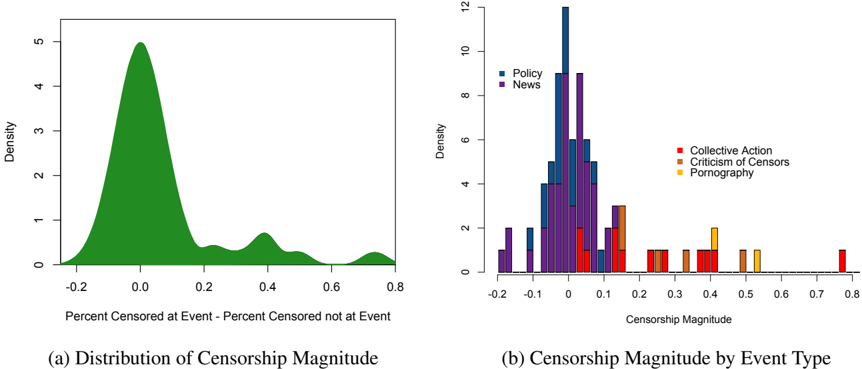
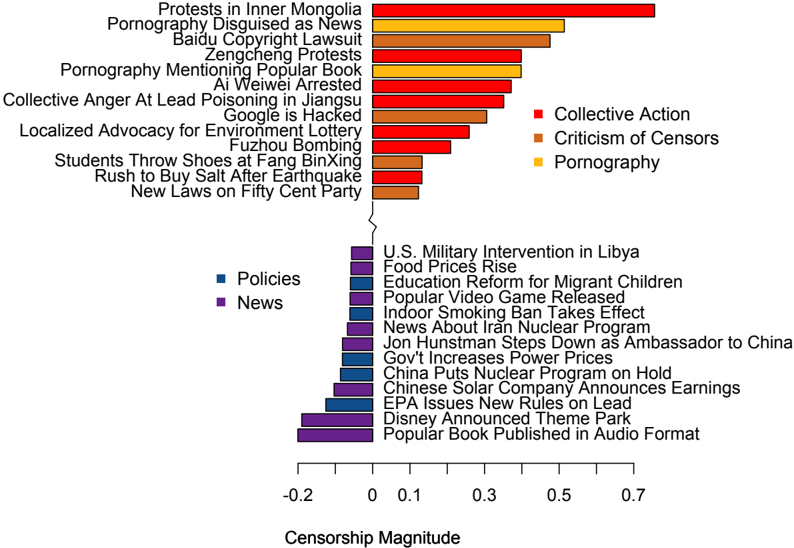
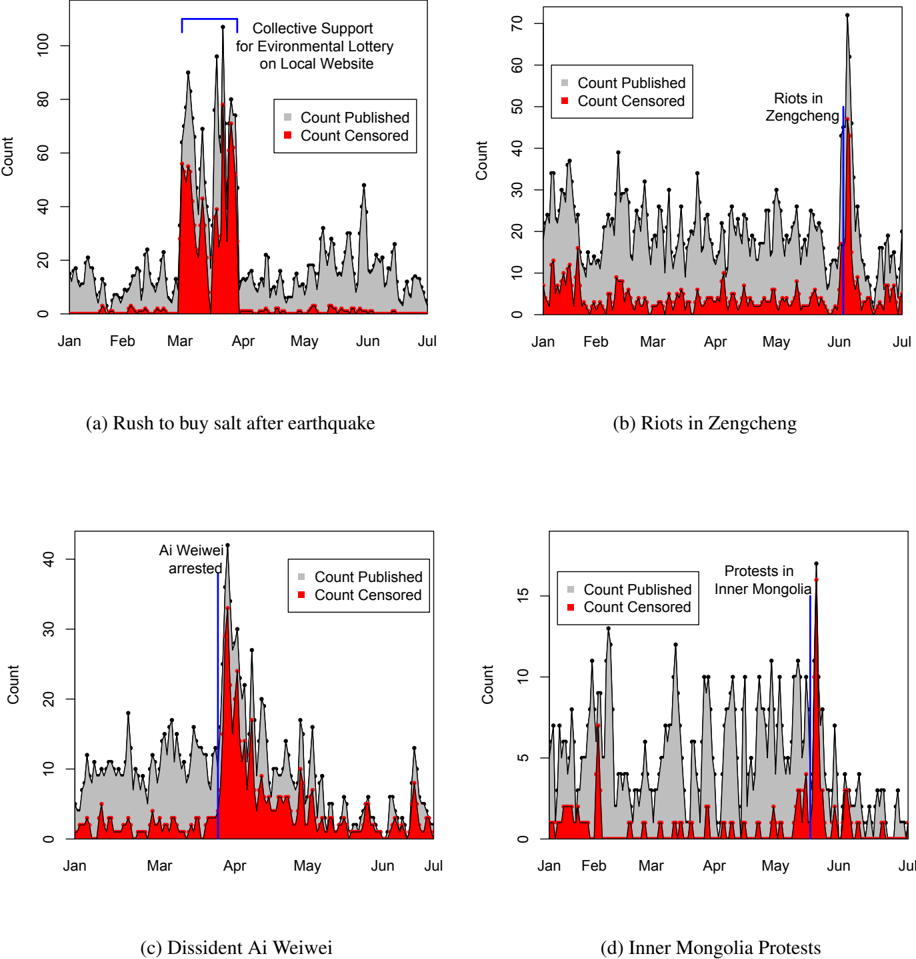
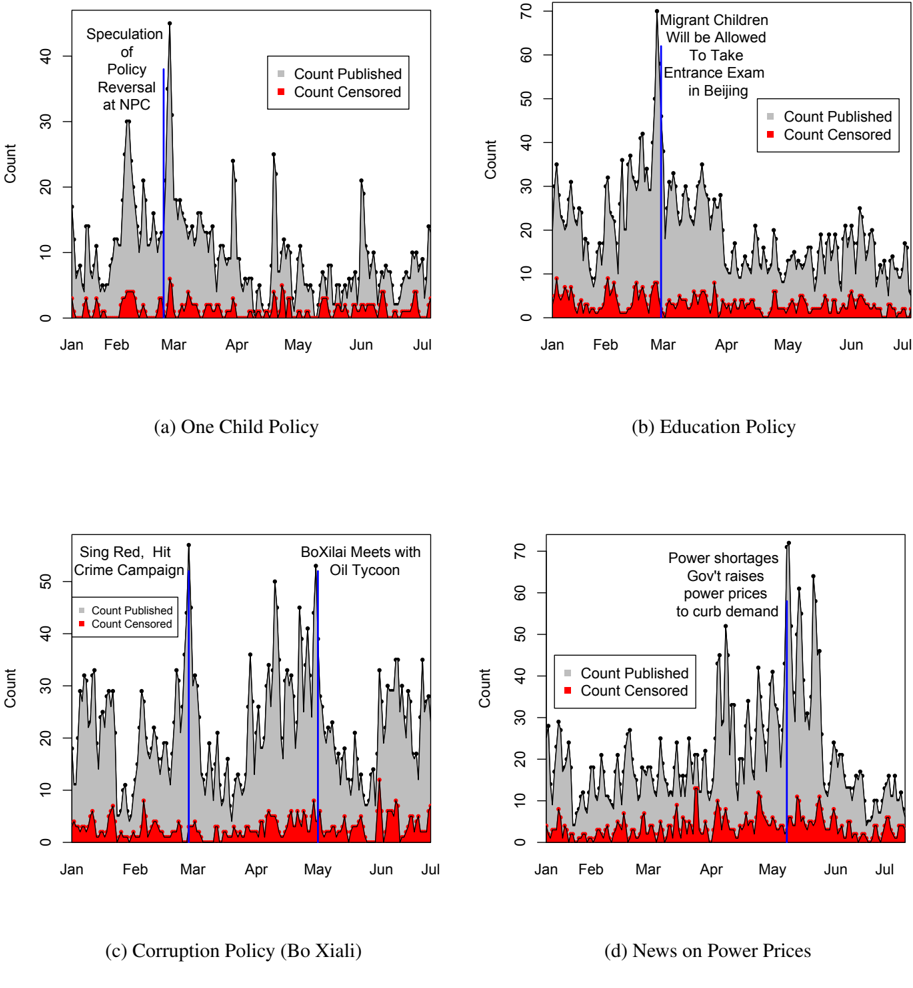
- Censorship was much higher during volume bursts tied to collective action: average censorship magnitude was 27% for collective action, compared with -1% for policy and -4% for news.
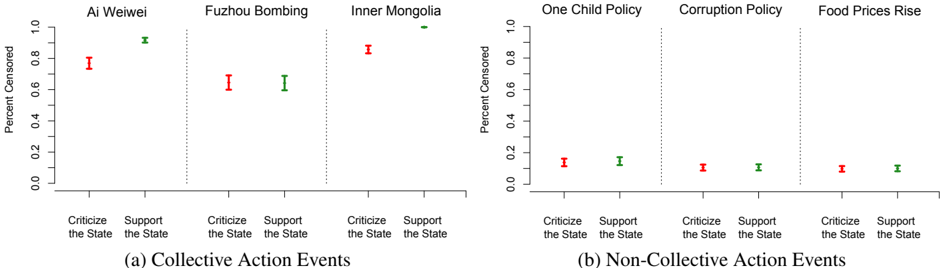
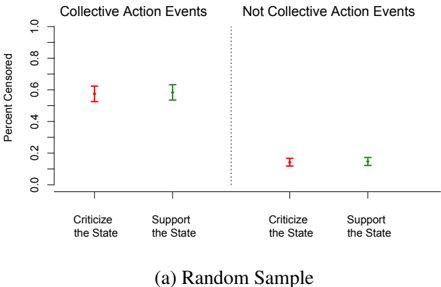
- For collective action events such as Ai Weiwei’s arrest, Inner Mongolia protests, and Fuzhou bombings, posts were censored at about 80% on average whether they criticized or supported the state. For non-collective-action events such as the one child policy, corruption policy, and food prices, censorship was about 10% on average for both critical and supportive posts.
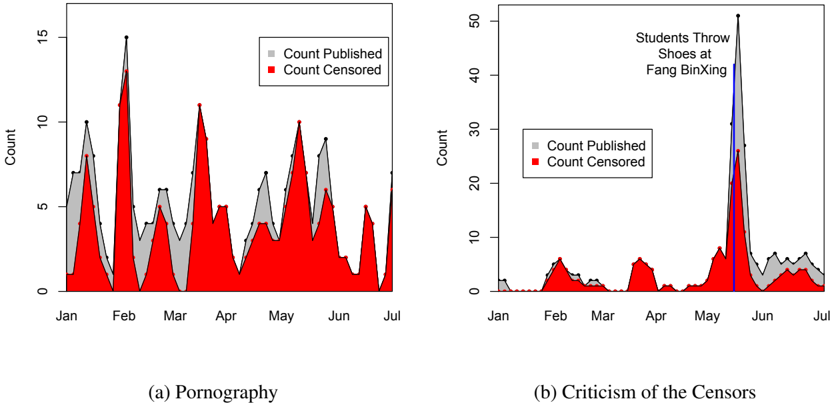
- Censorship also targeted pornography and criticism of the censors, but not government policy or other news. The authors argue censorship is aimed at curtailing collective action by silencing comments that represent, reinforce, or spur social mobilization.
Methods
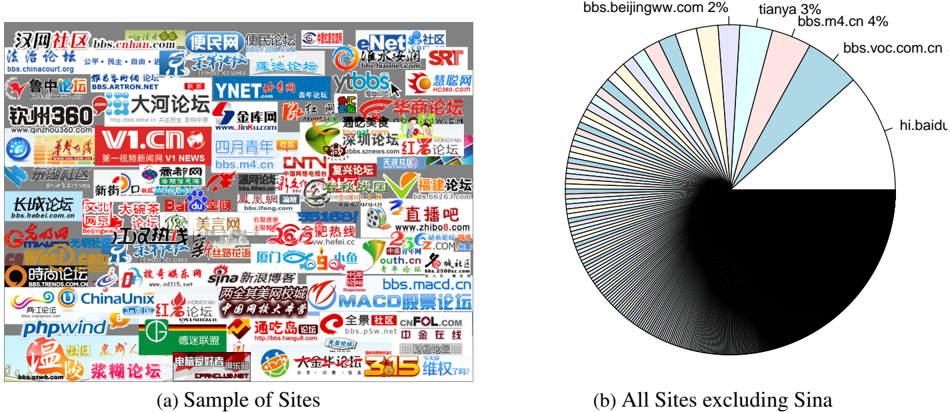
- The authors built a system to locate, download, and analyze posts from 1,382 Chinese websites during the first half of 2011, before government censors could remove them. They collected 3,674,698 posts, randomly selected 127,283 for further analysis, and overall collected and analyzed 11,382,221 posts.
- They used a stratified random sampling design covering 85 topic areas across three hypothesized political sensitivity levels, detected 87 volume bursts in 67 of the 85 topic areas using robust regression-based burst detection, and classified events into collective action potential, criticism of censors, pornography, government policies, and other news.
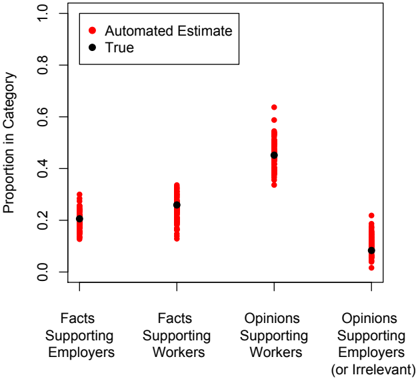
- To analyze content, they adapted the Hopkins and King “ReadMe” automated text analysis method to Chinese and extended it with a Bayesian procedure to estimate the percent censored within categories. Validation used native Chinese speakers coding 1,000 posts about 2010 labor strikes, with 100 as training and 900 as test; event coding reliability was 98.9% (86 of 87 events).
Limitations
- The paper states that its methodology misses self-censorship and censorship that may occur before the post is obtained; it also does not quantify the direct effects of the Great Firewall, keyword blocking, or search filtering.
- The authors state they have not studied physical violence, such as arrest of bloggers, or threats of the same; although many officials and levels of government influence censorship decisions, their data only sometimes distinguish among these sources, and they cannot determine the consequences of these limitations.
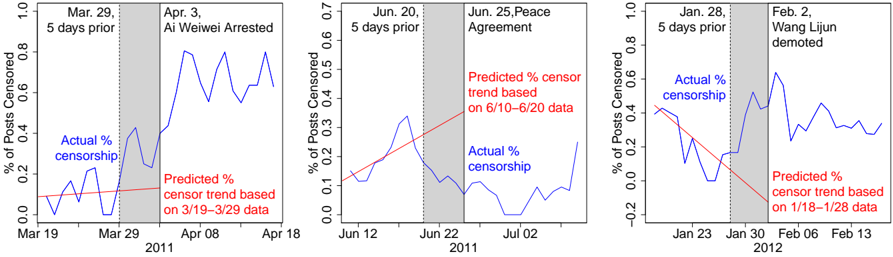
- The authors note that the presumably smaller number of discussions they cannot observe are likely to be those of most interest to the Chinese government, and they offer little evidence connecting social media findings to press freedom or other types of human expression in China. They also state that the predictive analysis was conducted retrospectively and with only three events, so further prospective validation would be valuable.
Model-written summary. Check it against the paper before relying on it.
Integrity signals
Registry
Cites
Statistics
Figures
Verification
Claims the paper makes
0 Valid · 7 Not valid · 7 Not checked · 88 Own results and interpretations
A result the paper reports from its own data — it cites no other source for it, so there is none to check. The quote shows it is in the paper.
In the paper
“Our data show that the Chinese censorship program allows for a wide variety of criticisms of the Chinese government, its officials, and its policies.”
§ How Censorship in China Allows Government Criticism but Silences Collective Expression * > Outline of Results
plain- Asserted: passes — The authors put it forward as true.
- Checkable: passes — It can be checked against evidence.
- Load-bearing: passes — The paper’s conclusions depend on it.
- Based: passes — The paper gives a reason why it holds.
A result the paper reports from its own data — it cites no other source for it, so there is none to check. The quote shows it is in the paper.
In the paper
“Contrary to previous understandings, posts with negative, even vitriolic, criticism of the state, its leaders, and its policies are not more likely to be censored.”
- Also stated in: § 1 Introduction · plain
“we find that when the Chinese people write scathing criticisms of their government and its leaders, the probability that their post will be censored does not increase.”
§ How Censorship in China Allows Government Criticism but Silences Collective Expression * > Abstract
plain- Asserted: passes — The authors put it forward as true.
- Checkable: passes — It can be checked against evidence.
- Load-bearing: passes — The paper’s conclusions depend on it.
- Based: passes — The paper gives a reason why it holds.
- Also stated in: § 1 Introduction · plain
A result the paper reports from its own data — it cites no other source for it, so there is none to check. The quote shows it is in the paper.
In the paper
“Large increases in online volume are good predictors of censorship when these increases are associated with events related to collective action, e.g., protest on the ground.”
§ How Censorship in China Allows Government Criticism but Silences Collective Expression * > Outline of Results
plainstates an association- Asserted: passes — The authors put it forward as true.
- Checkable: passes — It can be checked against evidence.
- Load-bearing: passes — The paper’s conclusions depend on it.
- Based: passes — The paper gives a reason why it holds.
A result the paper reports from its own data — it cites no other source for it, so there is none to check. The quote shows it is in the paper.
In the paper
“In addition, we measure sentiment within each of these events and show that during these events, the government censors views that are both supportive and critical of the state.”
§ How Censorship in China Allows Government Criticism but Silences Collective Expression * > Outline of Results
plainstates a cause- Asserted: passes — The authors put it forward as true.
- Checkable: passes — It can be checked against evidence.
- Load-bearing: passes — The paper’s conclusions depend on it.
- Based: passes — The paper gives a reason why it holds.
A result the paper reports from its own data — it cites no other source for it, so there is none to check. The quote shows it is in the paper.
In the paper
“We thus conduct the same analysis for the demotion of Wang Lijun in Panel (c) of Figure 11, and again see a large difference in actual and predicted percent censorship before Wang's demotion.”
§ How Censorship in China Allows Government Criticism but Silences Collective Expression * > Additional information
plainSingle case- Asserted: passes — The authors put it forward as true.
- Checkable: passes — It can be checked against evidence.
- Load-bearing: unclear — It is unclear whether the paper’s conclusions depend on it.
- Based: passes — The paper gives a reason why it holds.
46 more claims
Create a free account to see all 102 claims and every source verdict.
- Probably not a substantial claim. 26
- It may state two separate claims as one. 33
Claims other papers make about this one
Each is checked against this paper’s own text: does it say what the citing paper says it does?
The source backs part of the claim, not all of it — or backs it for a different population, condition or comparison.
In the citing paper
“Authorities are keen to review social media posts and have contentious messages removed (King etal., 2013) to ensure that potential threats remain invisible.”
From How Dictators Control the Internet: A Review Essay (2020) · cites this paper as King et al., 2013
Experimental — accuracy not yet measuredThe source backs part of the claim, not all of it — or backs it for a different population, condition or comparison.
In the citing paper
“In most autocratic regimes, governmental interference in digital infrastructure and communication is commonplace.”
From How Dictators Control the Internet: A Review Essay (2020) · cites this paper as King et al., 2013
Experimental — accuracy not yet measuredThe source backs part of the claim, not all of it — or backs it for a different population, condition or comparison.
In the citing paper
“First, the timing of censorship during a coup is consistent with many studies that have shown that Internet censorship is targeted during sensitive political time periods and periods of potential power transitions, such as elections and large-scale protests [23,25,44,47,73].”
From A multi-perspective view of Internet censorship in Myanmar (2021) · cites this paper as [44]
Experimental — accuracy not yet measuredThe cited source says what the claim attributes to it.
In the citing paper
“research has shown how mobilization organized through public coordination is repressed using that very same public information-for instance, repression is preemptively increased before focal days (Truex 2019); and autocracies censor online calls for collective action (King, Pan, and Roberts 2013), coerce online opinion leaders (Pan and Siegel 2020), and at times, turn off the internet entirely.”
From Coordinated Dis-Coordination (2024) · cites this paper as King, Pan, and Roberts 2013
The check wasn’t confident either way, so it gives no verdict — never disputed.
In the citing paper
“In China, for instance, two virtual police officers remind citizens that their browsing behavior is monitored (King etal., 2013).”
From How Dictators Control the Internet: A Review Essay (2020) · cites this paper as King et al., 2013
Experimental — accuracy not yet measured
1 more claim about this paper
Create a free account to see every claim other papers make about this one.
Citations
Cites
Robust estimation of a location parameter
Huber, P. J. (1964) · The Annals of Mathematical Statistics · doi:10.1214/aoms/1177703732 · Cited by 7,228
Robust Regression and Outlier Detection
Piepel, G. F. (1989) · Technometrics · doi:10.1080/00401706.1989.10488524 · Cited by 6,144
Robust Regression and Outlier Detection
Rousseeuw, P. J., & Leroy, A. M. (1987) · Wiley Series in Probability and Statistics · doi:10.1002/0471725382 · Cited by 5,609
Logistic Regression in Rare Events Data
King, G., & Zeng, L. (2001) · Political Analysis · doi:10.1093/oxfordjournals.pan.a004868 · Cited by 4,316 · cited 1×
“We do this via well-known and widely used case-control methodology (King and Zeng 2001).”
MethodSelf-citationDemocracy and Development: Political Institutions and Well-Being in the World, 1950–1990
Przeworski, A., Alvarez, M. E., Cheibub, J. A., & Limongi, F. (2000) · doi:10.1017/cbo9780511804946 · Cited by 2,845
Rightful Resistance in Rural China
O'Brien, K. J., & Li, L. (2006) · Cambridge University Press eBooks · doi:10.1017/cbo9780511791086 · Cited by 1,104
The Dynamics of Informational Cascades: The Monday Demonstrations in Leipzig, East Germany, 1989–91
Lohmann, S. (1994) · World Politics · doi:10.2307/2950679 · Cited by 1,035 · cited 1×
“Protests in East Germany, Eastern Europe, and most recently the Middle East have all preceded regime change (Ash 2002; Lohmann 1994; Przeworski et al. 2000).”
BackgroundRightful Resistance in Rural China
O'Brien, K., & Li, L.-J. (2006) · doi:10.1017/cbo9780511791086.003 · Cited by 987
China's Changing of the Guard: Authoritarian Resilience
Nathan, A. J. (2003) · Journal of Democracy · doi:10.1353/jod.2003.0019 · Cited by 927
Sparks and prairie fires: A theory of unanticipated political revolution
Kuran, T. (1989) · Public Choice · doi:10.1007/bf00116762 · Cited by 905 · cited 1×
“In fact, Kuran (1989) and Lohmann (2002) show that it is information about a collective action event that propels collective action and so distinguishing this from explicit calls for collective action would be difficult if not impossible.”
BackgroundReconsidering the Robustness of Authoritarianism in the Middle East: Lessons from the Arab Spring
Bellin, E. (2012) · Comparative Politics · doi:10.5129/001041512798838021 · Cited by 875
State Capacity and Local Agent Control in China: CCP Cadre Management from a Township Perspective
Edin, M. (2003) · The China Quarterly · doi:10.1017/s0009443903000044 · Cited by 855
A Method of Automated Nonparametric Content Analysis for Social Science
Hopkins, D. J., & King, G. (2010) · American Journal of Political Science · doi:10.1111/j.1540-5907.2009.00428.x · Cited by 765 · cited 3×
“We thus adapt to the Chinese language the methodology introduced in the English language by Hopkins and King (2010).”
BackgroundMethodSelf-citationAgainst the Law: Labor Protests in China’s Rustbelt and Sunbelt
Lee, C. K. (2007) · University of California Press eBooks · doi:10.1525/9780520940642 · Cited by 744
Rightful resistance in rural China
(2007) · Choice Reviews Online · doi:10.5860/choice.44-3516 · Cited by 648
Against the Law: Labor Protests in China's Rustbelt and Sunbelt
Tierney, R., & Lee, C. K. (2008) · Labour History · doi:10.2307/27516326 · Cited by 593
The power of the Internet in China: citizen activism online
(2010) · Choice Reviews Online · doi:10.5860/choice.47-2828 · Cited by 567
Why Resource-poor Dictators Allow Freer Media: A Theory and Evidence from Panel Data
EGOROV, G., GURIEV, S., & SONIN, K. (2009) · American Political Science Review · doi:10.1017/s0003055409990219 · Cited by 546
Accountability without Democracy: Solidary Groups and Public Goods Provision in Rural China
Tsai, L. L. (2007) · Cambridge University Press eBooks · doi:10.1017/cbo9780511800115 · Cited by 539
Consent of the networked: the world-wide struggle for Internet freedom
(2012) · Choice Reviews Online · doi:10.5860/choice.50-0700 · Cited by 531
Information Manipulation, Coordination, and Regime Change*
Edmond, C. (2013) · The Review of Economic Studies · doi:10.1093/restud/rdt020 · Cited by 433
China's Local Political Budget Cycles
Guo, G. (2009) · American Journal of Political Science · doi:10.1111/j.1540-5907.2009.00390.x · Cited by 417
The Power of the Internet in China: Citizen Activism Online
Yang, G. (2009) · Columbia University Press eBooks · doi:10.7312/yang14420 · Cited by 330
KUNG, J. K.-S., & CHEN, S. (2011) · American Political Science Review · doi:10.1017/s0003055410000626 · Cited by 298 · cited 1×
“Studies of China today rely on government statistics, public opinion surveys, interviews with local officials, as well as measures of the visible actions of government officials and the government as a whole (Guo 2009; Kung and Chen 2011; Shih 2008; Tsai 2007a, b).”
Social Protest and Contentious Authoritarianism in China
Chen, X. (2011) · Cambridge University Press eBooks · doi:10.1017/cbo9781139053310 · Cited by 294 · cited 2×
“Chen (2012) argues that small, isolated protests have a long tradition in China and are an expected part of government.”
BackgroundCensorship and deletion practices in Chinese social media
Bamman, D., O'Connor, B., & Smith, N. (2012) · First Monday · doi:10.5210/fm.v17i3.3943 · Cited by 288 · cited 1×
“We begin with social media blogs in which it is at least possible for writers to express themselves fully, prior to possible censorship, and leaving to other research social media services that constrain authors to very short Twitter-like (weibo) posts (e.g., Bamman, O’Connor, and Smith 2012).”
BackgroundRegularizing Rioting: Permitting Public Protest in an Authoritarian Regime
Lorentzen, P. L. (2010) · SSRN Electronic Journal · doi:10.2139/ssrn.995330 · Cited by 270
The Polish Revolution: Solidarity
Campbell, J. C., Ash, T. G., Ruane, K., & Weschler, L. (1984) · Foreign Affairs · doi:10.2307/20042051 · Cited by 228
Strong society, smart state: the rise of public opinion in China's Japan policy
(2012) · Choice Reviews Online · doi:10.5860/choice.49-5311 · Cited by 223
(2010) · Choice Reviews Online · doi:10.5860/choice.48-2396 · Cited by 222
The Resistance of Chinese Laid-off Workers in the Reform Period
Cai, Y. (2002) · The China Quarterly · doi:10.1017/s0009443902000219 · Cited by 205
Digital Communication and Political Change in China
Esarey, A., & Xiao, Q. (2011) · International journal of communication · Cited by 205
Subsistence Crises, Managerial Corruption and Labour Protests in China
Chen, F. (2000) · The China Journal · doi:10.2307/2667476 · Cited by 188
Improving Anchoring Vignettes: Designing Surveys to Correct Interpersonal Incomparability
Hopkins, D. J., & King, G. (2010) · Public Opinion Quarterly · doi:10.1093/poq/nfq011 · Cited by 186
Self-citationGeneral purpose computer-assisted clustering and conceptualization
Grimmer, J., & King, G. (2011) · Proceedings of the National Academy of Sciences · doi:10.1073/pnas.1018067108 · Cited by 179 · cited 1×
“We also went further and analyzed (by hand and via computer-assisted methods described in Grimmer and King 2011) the smaller number of uncensored posts during volume bursts associated with events that have collective action potential, such as in panel (a) of Figure 5 where the red area does not…”
BackgroundSelf-citationChanging media, changing China
(2011) · Choice Reviews Online · doi:10.5860/choice.48-7148 · Cited by 175
Myth of the Social Volcano: Popular Responses to Rising Inequality in China
Whyte, M. K. (2011) · The People's Republic of China at 60 · doi:10.1163/9781684171217_021 · Cited by 166
Political Expression in the Chinese Blogosphere: Below the Radar
Esarey, A., & Qiang, X. (2008) · Asian Survey · doi:10.1525/as.2008.48.5.752 · Cited by 165 · cited 2×
“Esarey and Xiao (2008) find that Chinese bloggers use satire to convey criticism of the state in order to avoid harsh repression.”
BackgroundNathan, A. J. (2001) · Foreign Affairs · doi:10.2307/20050041 · Cited by 141
Hegemony and Workers' Politics in China
Blecher, M. J. (2002) · The China Quarterly · doi:10.1017/s0009443902000190 · Cited by 133
(2011) · Routledge eBooks · doi:10.4324/9780203828519 · Cited by 86
Strong Society, Smart State: The Rise of Public Opinion in China's Japan Policy
Reilly, J. (2011) · doi:10.7312/reil15806 · Cited by 69
Collective Action Cascades: An Informational Rationale for the Power in Numbers
Lohmann, S. (2000) · Journal of Economic Surveys · doi:10.1111/1467-6419.00128 · Cited by 52
Traffic in Social Media II: Modeling Bursty Popularity
Ratkiewicz, J., Menczer, F., Fortunato, S., Flammini, A., & Vespignani, A. (2010) · 2010 IEEE Second International Conference on Social Computing · doi:10.1109/socialcom.2010.63 · Cited by 38 · cited 1×
“Second, conversation in social media in almost all topic areas (and countries) is well known to be highly “bursty,” that is, with periods of stability punctuated by occasional sharp spikes in volume around specific subjects (Ratkiewicz et al. 2010).”
BackgroundDimitrov, M. (2008) · Current History · doi:10.1525/curh.2008.107.705.24 · Cited by 34 · cited 2×
“For example, Dimitrov (2008) argues that regimes collapse when its people stop bringing grievances to the state, since it is an indicator that the state is no longer regarded as legitimate.”
BackgroundInformation Manipulation, Coordination, and Regime Change
Edmond, C. (2011) · doi:10.3386/w17395 · Cited by 32
China’s many Internets: participation and digital game play across a changing technology landscape
Lindtner, S., & Szablewicz, M. (2011) · doi:10.4324/9780203828519-12 · Cited by 23 · cited 1×
“…may increase the space for public discourse (Duan 2007; Edmond 2012; Egorov, Guriev, and Sonin 2009; Esarey and Xiao 2008, 2011; Herold 2011; Lindtner and Szablewicz 2011; MacKinnon 2012; Yang 2009; Xiao 2011), by beginning to build an empirically documented theory of why the government…”
Background(2011) · doi:10.4324/9780203828519-9 · Cited by 22
The Origins of the Cultural Revolution. Volume 2: The Great Leap Forward, 1958–1960
Uhalley, S. (1984) · Pacific Affairs · doi:10.2307/2759144 · Cited by 21
10. Permanent Rebellion? Continuities and Discontinuities in Chinese Protest
Perry, E. J. (2008) · Harvard University Press eBooks · doi:10.4159/9780674041585-012 · Cited by 17
Lorentzen, P. L. (2012) · doi:10.2139/ssrn.2101862 · Cited by 3
Popular Protest: Playing by the Rules
Perry, E. (2010) · China Today, China Tomorrow · doi:10.5040/9798216384144.ch-001 · Cited by 3
Research works printed but not linked: 13
- 22. Freedom House. 2012. "Freedom of the Press, 2012." www.freedomhouse.org.
- 8. Chang, Parris. 1983. Elite Conflict in the Post-Mao China. New York: Occasional Papers Reprints.
- 26. Hinton, Harold. 1955. The "Unprincipled Dispute" Within Chinese Communist Top Lead- ership. Washington, DC: U.S. Information Agency.
- 44. Perry, Elizabeth. 2002. Challenging the Mandate of Heaven: Social Protest and State Power in China. Armork, NY: M. E. Sharpe.
- 52. Schurmann, Franz. 1966. Ideology and Organization in Communist China. Berkeley, CA: University of California Press.
- Tsai, 2007, Capitalism without Democracy: The Private Sector in Contemporary China
- 48. Qiang, Xiao. 2011. The Rise of Online Public Opinion and Its Political Impact. In Chang- ing Media, Changing China, ed. Susan Shirk. New York: Oxford University Press pp. 202-224.
- 9. Charles, David. 1966. The Dismissal of Marshal P'eng Teh-huai. In China Under Mao: Politics Takes Command, ed. Roderick MacFarquhar. Cambridge: MIT University Press pp. 20-33.
- 54. Shirk, Susan. 2007. China: Fragile Superpower: How China's Internal Politics Could Derail Its Peaceful Rise. New York: Oxford University Press.
- 56. Teiwes, Frederick. 1979. Politics and Purges in China: Retification and the Decline of Party Norms. Armork, NY: M. E. Sharpe. Tsai, Kellee. 2007a. Capitalism without Democracy: The Private Sector in Contemporary China. Ithaca, NY: Cornell University Press.
- 15. Duan, Qing. 2007. China's IT Leadership. Vdm Verlag.
- 38. MacFarquhar, Roderick. 1974. The Origins of the Cultural Revolution Volume 1: Contra- dictions Among the People 1956-1957. New York: Columbia University Press.
- 12. Chen, Xiaoyan and Peng Hwa Ang. 2011. Internet Police in China: Regulation, Scope and Myths. In Online Society in China: Creating, Celebrating, and Instrumentalising the Online Carnival, ed. David Herold and Peter Marolt. New York: Routledge pp. 40-52.
Cited by
Tucker, J. A., Guess, A., Barbera, P., Vaccari, C., Siegel, A., Sanovich, S., Stukal, D., & Nyhan, B. (2018) · doi:10.2139/ssrn.3144139 · Cited by 1,222
KING, G., PAN, J., & ROBERTS, M. E. (2017) · American Political Science Review · doi:10.1017/s0003055417000144 · Cited by 1,028
“Our rules followed the principle articulated in footnote 20 of King et al. (2014) of trying to avoid influencing the system that we were studying, which has the added advantage of reducing the chance for bias.”
BackgroundMethodResultInfluentialSelf-citationSocial Data: Biases, Methodological Pitfalls, and Ethical Boundaries
Olteanu, A., Castillo, C., Diaz, F., & Kiciman, E. (2016) · doi:10.2139/ssrn.2886526 · Cited by 763
Social Data: Biases, Methodological Pitfalls, and Ethical Boundaries
Olteanu, A., Castillo, C., Diaz, F., & Kıcıman, E. (2019) · Frontiers in Big Data · doi:10.3389/fdata.2019.00013 · Cited by 763
Computational Grounded Theory: A Methodological Framework
Nelson, L. K. (2020) · Sociological Methods & Research · doi:10.1177/0049124117729703 · Cited by 697
“Other disciplines in the social sciences, including political scientists (Grimmer 2010; King, Pan, and Roberts 2013; Schwartz and Ungar 2015) and psychologists (Tausczik and Pennebaker 2010; Yu and Ho 2014), have already incorporated computational methods into their repertoire, adapting a range of…”
BackgroundMethod
Metadata
- Authors
- KING, G., PAN, J., & ROBERTS, M. E.
- Affiliations
- Harvard University (US)
- Corresponding author
- KING, GARY
- PAN, JENNIFER
- Venue
- American Political Science Review
- Publisher
- Cambridge University Press (CUP)
- Published
- 2013-05
- Volume
- 107
- Issue
- 2
- Pages
- 326-343
- ISSN
- 0003-0554 (ISSN-L)
- 1537-5943
- OpenAlex
- W2144188763
- Cited by
- 2,415
- References
- 48
- Citations by year
- 2026: 161 · 2025: 206 · 2024: 249 · 2023: 272 · 2022: 230 · 2021: 193 · 2020: 206 · 2019: 157 · 2018: 178 · 2017: 153 · 2016: 137 · 2015: 120 · 2014: 91 · 2013: 54
- FWCI
- 395.09
- Type
- journal article
- Language
- en
- Open access
- green
- nrs.harvard.edu
- Licence
- Locations
- American Political Science Review (publishedVersion)
- Digital Access to Scholarship at Harvard (DASH) (Harvard University) (submittedVersion, cc-by)
- RePEc: Research Papers in Economics (submittedVersion)
- Topics
- Social Sciences › Communication › Social Media and Politics
- Social Sciences › Law › Freedom of Expression and Defamation
- Social Sciences › Sociology and Political Science › Media Influence and Politics
- Keywords
- internet censorship, Chinese government, social media, collective action, social mobilization, political criticism, online speech
About these checks
Registry, retraction, Cites and statistics results are computed, not judged, with one exception: a printed reference that no index lists is read once by a model before it counts as a citation error. Claims are extracted by a model and kept only when their quote appears verbatim in the text; each cited source is then checked, with a model’s help, for whether it says what the claim relies on. Those verdicts can be wrong — read the claim’s quote and the cited source before relying on one.
A language model drew the claims from the paper on 2026-10-11, under version 3 of the claim definition (model deepseek-v4.1-flash, prompt extract-v3).
A second model labelled each claim on 2026-10-11 (model jev-1.13-20260917, definition revision gold-guideline-v0.2).
Statistics and arithmetic are recomputed, not judged.
Confidence bands are shown only for fields calibrated on our annotated test set. None is calibrated yet, so no band is shown.
What counts as a claim ›How we measure confidence ›How we check this ›
Are you an author, or do you see a problem with this page? Request a review
Data sources
Bibliographic data: Semantic Scholar, OpenAlex, Crossref.
Contains information from the Semantic Scholar Academic Graph Datasets, made available under the ODC Attribution License (ODC-BY 1.0).
Semantic Scholar’s data is described in: Kinney, R., et al. (2023). The Semantic Scholar Open Data Platform. arXiv:2301.10140.
