

How Censorship in China Allows Government Criticism but Silences Collective Expression
Open accessThe DOI matches its Crossref record; 53 of the 54 references it cites were found in a registry or an index, and 1 are not checked yet; none of the 12 sources its claims cite is checked for support yet.
Abstract
We offer the first large scale, multiple source analysis of the outcome of what may be the most extensive effort to selectively censor human expression ever implemented. To do this, we have devised a system to locate, download, and analyze the content of millions of social media posts originating from nearly 1,400 different social media services all over China before the Chinese government is able to find, evaluate, and censor (i.e., remove from the Internet) the subset they deem objectionable. Using modern computer-assisted text analytic methods that we adapt to and validate in the Chinese language, we compare the substantive content of posts censored to those not censored over time in each of 85 topic areas. Contrary to previous understandings, posts with negative, even vitriolic, criticism of the state, its leaders, and its policies are not more likely to be censored. Instead, we show that the censorship program is aimed at curtailing collective action by silencing comments that represent, reinforce, or spur social mobilization, regardless of content. Censorship is oriented toward attempting to forestall collective activities that are occurring now or may occur in the future—and, as such, seem to clearly expose government intent.
Checked 2026-11-22 · 1 reference not checked yet
Overview
CoChat Summary
TL;DR
The paper uses large-scale, real-time collection of Chinese social media posts to test why China censors online expression. It finds that censorship does not target criticism of the state or leaders; instead, it targets posts with collective action potential, regardless of whether they support or criticize the government.
Key findings
- Across the data, an average of approximately 13% of all social media posts were censored. Ex ante political sensitivity had only a weak relationship with censorship: Low and Medium categories were censored at 16% and 17%, respectively, versus 24% for High.
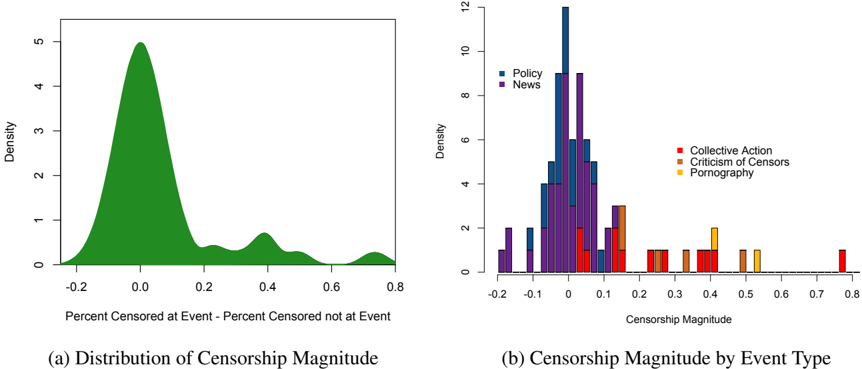
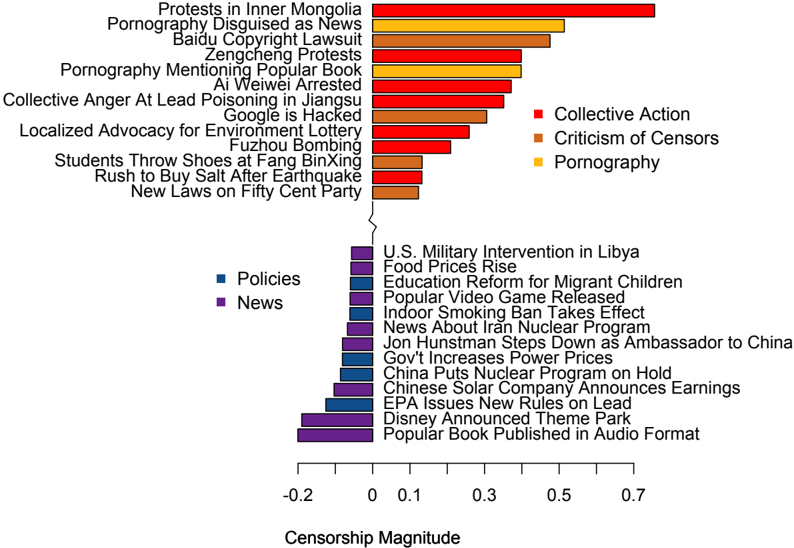
- Censorship was much higher during volume bursts tied to collective action: average censorship magnitude was 27% for collective action, compared with -1% for policy and -4% for news.
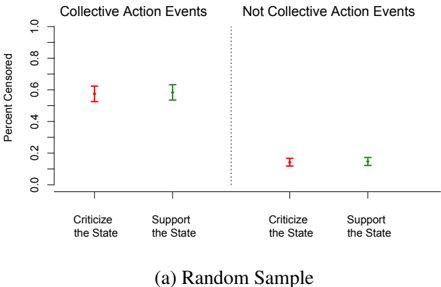
- For collective action events such as Ai Weiwei’s arrest, Inner Mongolia protests, and Fuzhou bombings, posts were censored at about 80% on average whether they criticized or supported the state. For non-collective-action events such as the one child policy, corruption policy, and food prices, censorship was about 10% on average for both critical and supportive posts.
- Censorship also targeted pornography and criticism of the censors, but not government policy or other news. The authors argue censorship is aimed at curtailing collective action by silencing comments that represent, reinforce, or spur social mobilization.
Methods
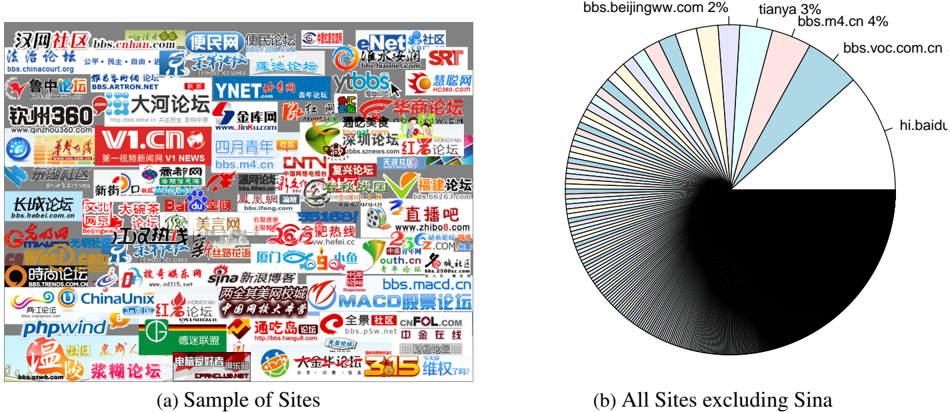
- The authors built a system to locate, download, and analyze posts from 1,382 Chinese websites during the first half of 2011, before government censors could remove them. They collected 3,674,698 posts, randomly selected 127,283 for further analysis, and overall collected and analyzed 11,382,221 posts.
- They used a stratified random sampling design covering 85 topic areas across three hypothesized political sensitivity levels, detected 87 volume bursts in 67 of the 85 topic areas using robust regression-based burst detection, and classified events into collective action potential, criticism of censors, pornography, government policies, and other news.
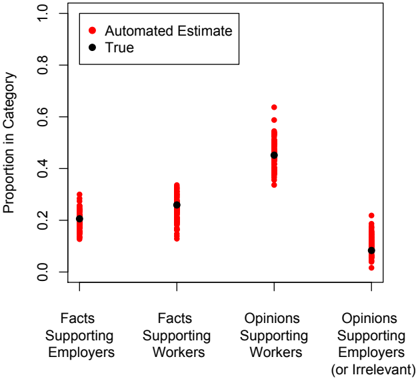
- To analyze content, they adapted the Hopkins and King “ReadMe” automated text analysis method to Chinese and extended it with a Bayesian procedure to estimate the percent censored within categories. Validation used native Chinese speakers coding 1,000 posts about 2010 labor strikes, with 100 as training and 900 as test; event coding reliability was 98.9% (86 of 87 events).
Limitations
- The paper states that its methodology misses self-censorship and censorship that may occur before the post is obtained; it also does not quantify the direct effects of the Great Firewall, keyword blocking, or search filtering.
- The authors state they have not studied physical violence, such as arrest of bloggers, or threats of the same; although many officials and levels of government influence censorship decisions, their data only sometimes distinguish among these sources, and they cannot determine the consequences of these limitations.
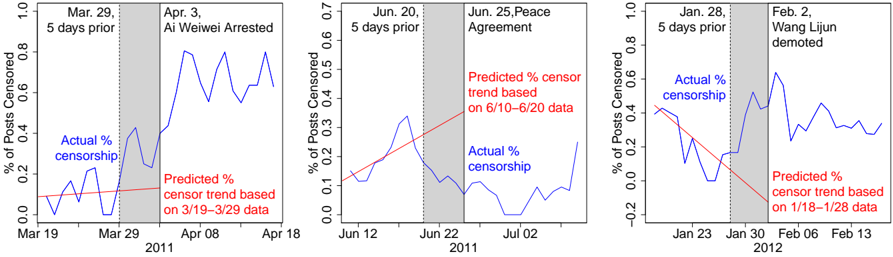
- The authors note that the presumably smaller number of discussions they cannot observe are likely to be those of most interest to the Chinese government, and they offer little evidence connecting social media findings to press freedom or other types of human expression in China. They also state that the predictive analysis was conducted retrospectively and with only three events, so further prospective validation would be valuable.
Model-written summary. Check it against the paper before relying on it.
Integrity signals
Registry
Cites
Statistics
Figures
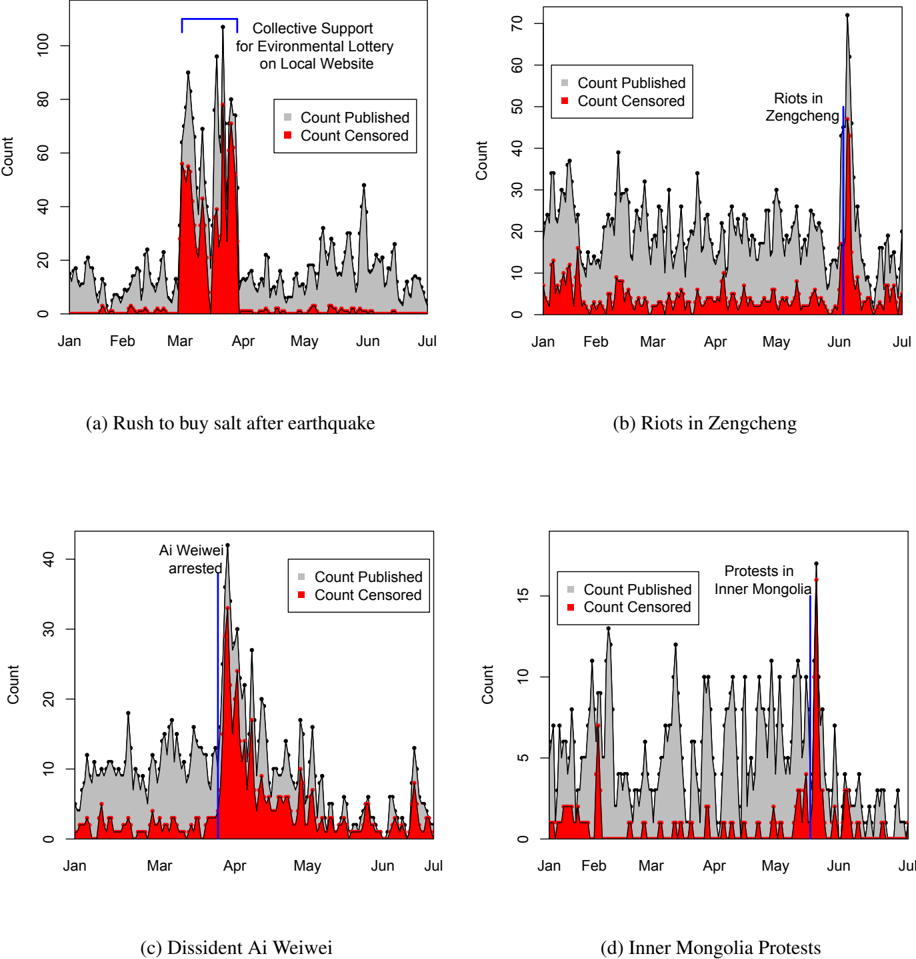
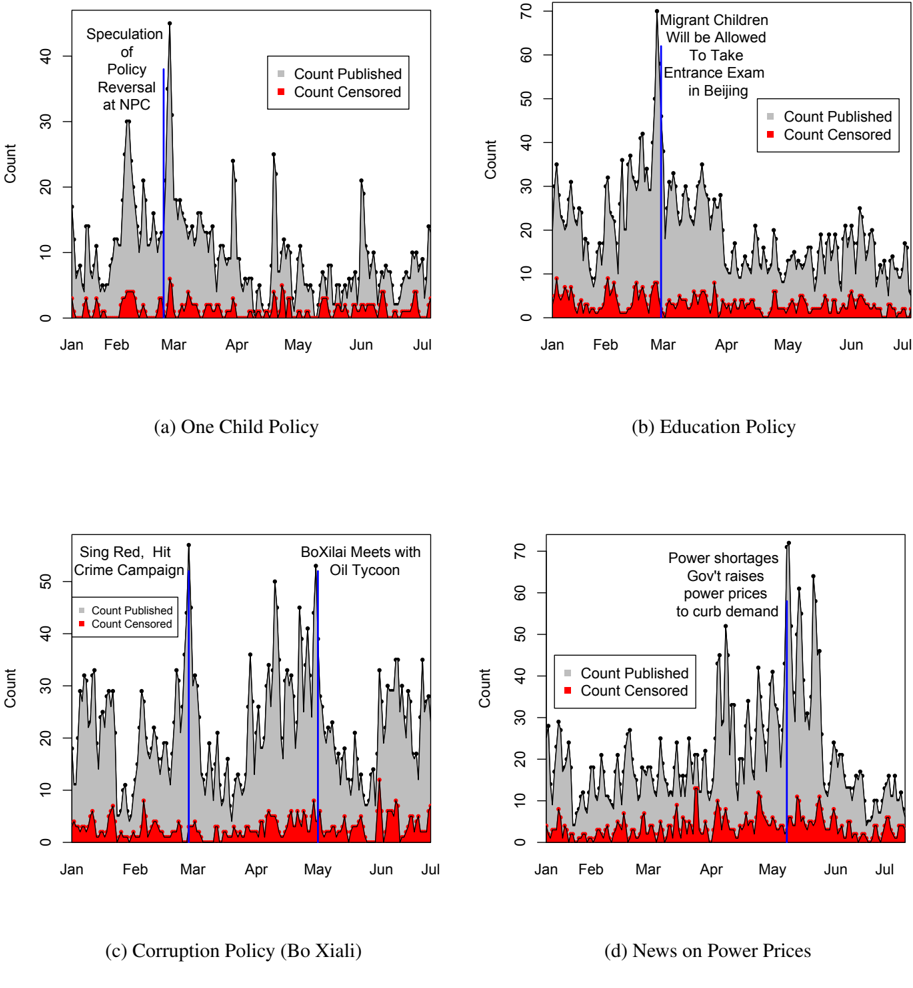
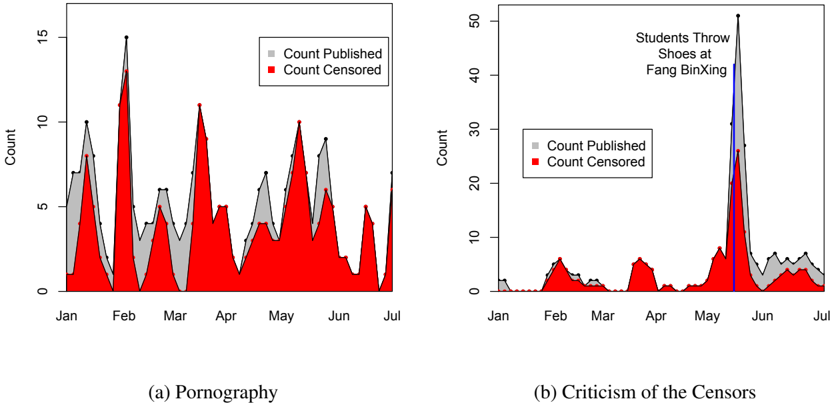
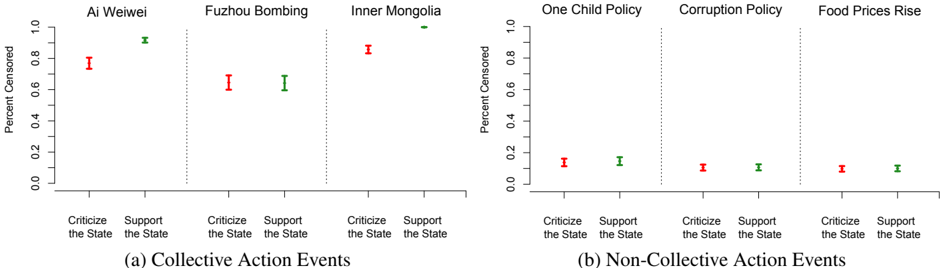
Verification
Claims the paper makes
0 Valid · 7 Not valid · 7 Not checked · 88 Own results and interpretations
A result the paper reports from its own data — it cites no other source for it, so there is none to check. The quote shows it is in the paper.
In the paper
“Our data show that the Chinese censorship program allows for a wide variety of criticisms of the Chinese government, its officials, and its policies.”
§ How Censorship in China Allows Government Criticism but Silences Collective Expression * > Outline of Results
plain- Asserted: passes — The authors put it forward as true.
- Checkable: passes — It can be checked against evidence.
- Load-bearing: passes — The paper’s conclusions depend on it.
- Based: passes — The paper gives a reason why it holds.
A result the paper reports from its own data — it cites no other source for it, so there is none to check. The quote shows it is in the paper.
In the paper
“Contrary to previous understandings, posts with negative, even vitriolic, criticism of the state, its leaders, and its policies are not more likely to be censored.”
- Also stated in: § 1 Introduction · plain
“we find that when the Chinese people write scathing criticisms of their government and its leaders, the probability that their post will be censored does not increase.”
§ How Censorship in China Allows Government Criticism but Silences Collective Expression * > Abstract
plain- Asserted: passes — The authors put it forward as true.
- Checkable: passes — It can be checked against evidence.
- Load-bearing: passes — The paper’s conclusions depend on it.
- Based: passes — The paper gives a reason why it holds.
- Also stated in: § 1 Introduction · plain
A result the paper reports from its own data — it cites no other source for it, so there is none to check. The quote shows it is in the paper.
In the paper
“Large increases in online volume are good predictors of censorship when these increases are associated with events related to collective action, e.g., protest on the ground.”
§ How Censorship in China Allows Government Criticism but Silences Collective Expression * > Outline of Results
plainstates an association- Asserted: passes — The authors put it forward as true.
- Checkable: passes — It can be checked against evidence.
- Load-bearing: passes — The paper’s conclusions depend on it.
- Based: passes — The paper gives a reason why it holds.
A result the paper reports from its own data — it cites no other source for it, so there is none to check. The quote shows it is in the paper.
In the paper
“In addition, we measure sentiment within each of these events and show that during these events, the government censors views that are both supportive and critical of the state.”
§ How Censorship in China Allows Government Criticism but Silences Collective Expression * > Outline of Results
plainstates a cause- Asserted: passes — The authors put it forward as true.
- Checkable: passes — It can be checked against evidence.
- Load-bearing: passes — The paper’s conclusions depend on it.
- Based: passes — The paper gives a reason why it holds.
A result the paper reports from its own data — it cites no other source for it, so there is none to check. The quote shows it is in the paper.
In the paper
“We thus conduct the same analysis for the demotion of Wang Lijun in Panel (c) of Figure 11, and again see a large difference in actual and predicted percent censorship before Wang's demotion.”
§ How Censorship in China Allows Government Criticism but Silences Collective Expression * > Additional information
plainSingle case- Asserted: passes — The authors put it forward as true.
- Checkable: passes — It can be checked against evidence.
- Load-bearing: unclear — It is unclear whether the paper’s conclusions depend on it.
- Based: passes — The paper gives a reason why it holds.
46 more claims
Create a free account to see all 102 claims and every source verdict.
- Probably not a substantial claim. 26
- It may state two separate claims as one. 33
Claims other papers make about this one
Each is checked against this paper’s own text: does it say what the citing paper says it does?
The source backs part of the claim, not all of it — or backs it for a different population, condition or comparison.
In the citing paper
“Authorities are keen to review social media posts and have contentious messages removed (King etal., 2013) to ensure that potential threats remain invisible.”
From How Dictators Control the Internet: A Review Essay (2020) · cites this paper as King et al., 2013
Experimental — accuracy not yet measuredThe source backs part of the claim, not all of it — or backs it for a different population, condition or comparison.
In the citing paper
“In most autocratic regimes, governmental interference in digital infrastructure and communication is commonplace.”
From How Dictators Control the Internet: A Review Essay (2020) · cites this paper as King et al., 2013
Experimental — accuracy not yet measuredThe source backs part of the claim, not all of it — or backs it for a different population, condition or comparison.
In the citing paper
“First, the timing of censorship during a coup is consistent with many studies that have shown that Internet censorship is targeted during sensitive political time periods and periods of potential power transitions, such as elections and large-scale protests [23,25,44,47,73].”
From A multi-perspective view of Internet censorship in Myanmar (2021) · cites this paper as [44]
Experimental — accuracy not yet measuredThe cited source says what the claim attributes to it.
In the citing paper
“research has shown how mobilization organized through public coordination is repressed using that very same public information-for instance, repression is preemptively increased before focal days (Truex 2019); and autocracies censor online calls for collective action (King, Pan, and Roberts 2013), coerce online opinion leaders (Pan and Siegel 2020), and at times, turn off the internet entirely.”
From Coordinated Dis-Coordination (2024) · cites this paper as King, Pan, and Roberts 2013
The check wasn’t confident either way, so it gives no verdict — never disputed.
In the citing paper
“In China, for instance, two virtual police officers remind citizens that their browsing behavior is monitored (King etal., 2013).”
From How Dictators Control the Internet: A Review Essay (2020) · cites this paper as King et al., 2013
Experimental — accuracy not yet measured
1 more claim about this paper
Create a free account to see every claim other papers make about this one.
Citations
Cites
Robust estimation of a location parameter
Huber, P. J. (1964) · The Annals of Mathematical Statistics · doi:10.1214/aoms/1177703732 · Cited by 7,228
Robust Regression and Outlier Detection
Piepel, G. F. (1989) · Technometrics · doi:10.1080/00401706.1989.10488524 · Cited by 6,144
Robust Regression and Outlier Detection
Rousseeuw, P. J., & Leroy, A. M. (1987) · Wiley Series in Probability and Statistics · doi:10.1002/0471725382 · Cited by 5,609
Logistic Regression in Rare Events Data
King, G., & Zeng, L. (2001) · Political Analysis · doi:10.1093/oxfordjournals.pan.a004868 · Cited by 4,316 · cited 1×
“We do this via well-known and widely used case-control methodology (King and Zeng 2001).”
MethodSelf-citationDemocracy and Development: Political Institutions and Well-Being in the World, 1950–1990
Przeworski, A., Alvarez, M. E., Cheibub, J. A., & Limongi, F. (2000) · doi:10.1017/cbo9780511804946 · Cited by 2,845
Rightful Resistance in Rural China
O'Brien, K. J., & Li, L. (2006) · Cambridge University Press eBooks · doi:10.1017/cbo9780511791086 · Cited by 1,104
The Dynamics of Informational Cascades: The Monday Demonstrations in Leipzig, East Germany, 1989–91
Lohmann, S. (1994) · World Politics · doi:10.2307/2950679 · Cited by 1,035 · cited 1×
“Protests in East Germany, Eastern Europe, and most recently the Middle East have all preceded regime change (Ash 2002; Lohmann 1994; Przeworski et al. 2000).”
BackgroundRightful Resistance in Rural China
O'Brien, K., & Li, L.-J. (2006) · doi:10.1017/cbo9780511791086.003 · Cited by 987
China's Changing of the Guard: Authoritarian Resilience
Nathan, A. J. (2003) · Journal of Democracy · doi:10.1353/jod.2003.0019 · Cited by 927
Sparks and prairie fires: A theory of unanticipated political revolution
Kuran, T. (1989) · Public Choice · doi:10.1007/bf00116762 · Cited by 905 · cited 1×
“In fact, Kuran (1989) and Lohmann (2002) show that it is information about a collective action event that propels collective action and so distinguishing this from explicit calls for collective action would be difficult if not impossible.”
Background
Research works printed but not linked: 13
- 22. Freedom House. 2012. "Freedom of the Press, 2012." www.freedomhouse.org.
- 8. Chang, Parris. 1983. Elite Conflict in the Post-Mao China. New York: Occasional Papers Reprints.
- 26. Hinton, Harold. 1955. The "Unprincipled Dispute" Within Chinese Communist Top Lead- ership. Washington, DC: U.S. Information Agency.
- 44. Perry, Elizabeth. 2002. Challenging the Mandate of Heaven: Social Protest and State Power in China. Armork, NY: M. E. Sharpe.
- 52. Schurmann, Franz. 1966. Ideology and Organization in Communist China. Berkeley, CA: University of California Press.
- Tsai, 2007, Capitalism without Democracy: The Private Sector in Contemporary China
- 48. Qiang, Xiao. 2011. The Rise of Online Public Opinion and Its Political Impact. In Chang- ing Media, Changing China, ed. Susan Shirk. New York: Oxford University Press pp. 202-224.
- 9. Charles, David. 1966. The Dismissal of Marshal P'eng Teh-huai. In China Under Mao: Politics Takes Command, ed. Roderick MacFarquhar. Cambridge: MIT University Press pp. 20-33.
- 54. Shirk, Susan. 2007. China: Fragile Superpower: How China's Internal Politics Could Derail Its Peaceful Rise. New York: Oxford University Press.
- 56. Teiwes, Frederick. 1979. Politics and Purges in China: Retification and the Decline of Party Norms. Armork, NY: M. E. Sharpe. Tsai, Kellee. 2007a. Capitalism without Democracy: The Private Sector in Contemporary China. Ithaca, NY: Cornell University Press.
- 15. Duan, Qing. 2007. China's IT Leadership. Vdm Verlag.
- 38. MacFarquhar, Roderick. 1974. The Origins of the Cultural Revolution Volume 1: Contra- dictions Among the People 1956-1957. New York: Columbia University Press.
- 12. Chen, Xiaoyan and Peng Hwa Ang. 2011. Internet Police in China: Regulation, Scope and Myths. In Online Society in China: Creating, Celebrating, and Instrumentalising the Online Carnival, ed. David Herold and Peter Marolt. New York: Routledge pp. 40-52.
Cited by
Tucker, J. A., Guess, A., Barbera, P., Vaccari, C., Siegel, A., Sanovich, S., Stukal, D., & Nyhan, B. (2018) · doi:10.2139/ssrn.3144139 · Cited by 1,222
KING, G., PAN, J., & ROBERTS, M. E. (2017) · American Political Science Review · doi:10.1017/s0003055417000144 · Cited by 1,028
“Our rules followed the principle articulated in footnote 20 of King et al. (2014) of trying to avoid influencing the system that we were studying, which has the added advantage of reducing the chance for bias.”
BackgroundMethodResultInfluentialSelf-citationSocial Data: Biases, Methodological Pitfalls, and Ethical Boundaries
Olteanu, A., Castillo, C., Diaz, F., & Kiciman, E. (2016) · doi:10.2139/ssrn.2886526 · Cited by 763
Social Data: Biases, Methodological Pitfalls, and Ethical Boundaries
Olteanu, A., Castillo, C., Diaz, F., & Kıcıman, E. (2019) · Frontiers in Big Data · doi:10.3389/fdata.2019.00013 · Cited by 763
Computational Grounded Theory: A Methodological Framework
Nelson, L. K. (2020) · Sociological Methods & Research · doi:10.1177/0049124117729703 · Cited by 697
“Other disciplines in the social sciences, including political scientists (Grimmer 2010; King, Pan, and Roberts 2013; Schwartz and Ungar 2015) and psychologists (Tausczik and Pennebaker 2010; Yu and Ho 2014), have already incorporated computational methods into their repertoire, adapting a range of…”
BackgroundMethodSources of Authoritarian Responsiveness: A Field Experiment in China
Chen, J., Pan, J., & Xu, Y. (2016) · American Journal of Political Science · doi:10.1111/ajps.12207 · Cited by 636
Self-citationLorentzen, P. (2014) · American Journal of Political Science · doi:10.1111/ajps.12065 · Cited by 602
Cantoni, D., Chen, Y., Yang, D. Y., Yuchtman, N., & Zhang, Y. J. (2017) · Journal of Political Economy · doi:10.1086/690951 · Cited by 556
Political Effects of the Internet and Social Media
Zhuravskaya, E., Petrova, M., & Enikolopov, R. (2020) · Annual Review of Economics · doi:10.1146/annurev-economics-081919-050239 · Cited by 560
Guriev, S., & Treisman, D. (2019) · Journal of Economic Perspectives · doi:10.1257/jep.33.4.100 · Cited by 560
Ceron, A., Curini, L., Iacus, S. M., & Porro, G. (2014) · New Media & Society · doi:10.1177/1461444813480466 · Cited by 510
“Note, however, that the Internet ceases to be a free environment for political debate whenever users are confronted with censorship, such as occurs in authoritarian regimes (King et al., 2012).”
BackgroundHow Social Media Facilitates Political Protest: Information, Motivation, and Social Networks
Jost, J. T., Barberá, P., Bonneau, R., Langer, M., Metzger, M., Nagler, J., Sterling, J., & Tucker, J. A. (2018) · Political Psychology · doi:10.1111/pops.12478 · Cited by 492
Social Media and Protest Participation: Evidence From Russia
Enikolopov, R., Makarin, A., & Petrova, M. (2020) · Econometrica · doi:10.3982/ecta14281 · Cited by 489
Computer-Assisted Text Analysis for Comparative Politics
Lucas, C., Nielsen, R. A., Roberts, M. E., Stewart, B. M., Storer, A., & Tingley, D. (2015) · Political Analysis · doi:10.1093/pan/mpu019 · Cited by 366
Self-citationCorrupting the Cyber-Commons: Social Media as a Tool of Autocratic Stability
Gunitsky, S. (2015) · Perspectives on Politics · doi:10.1017/s1537592714003120 · Cited by 465
Reverse-engineering censorship in China: Randomized experimentation and participant observation
King, G., Pan, J., & Roberts, M. E. (2014) · Science · doi:10.1126/science.1251722 · Cited by 421
Self-citationMinimax Optimal Procedures for Locally Private Estimation
Duchi, J. C., Jordan, M. I., & Wainwright, M. J. (2018) · Journal of the American Statistical Association · doi:10.1080/01621459.2017.1389735 · Cited by 386
“( We use data identical to that used in the articles (King, Pan, and Roberts 2013, 2014).”
MethodFrom Liberation to Turmoil: Social Media And Democracy
Tucker, J. A., Theocharis, Y., Roberts, M. E., & Barberá, P. (2017) · Journal of Democracy · doi:10.1353/jod.2017.0064 · Cited by 395
Self-citationWhy Does China Allow Freer Social Media? Protests versus Surveillance and Propaganda
Qin, B., Strömberg, D., & Wu, Y. (2017) · Journal of Economic Perspectives · doi:10.1257/jep.31.1.117 · Cited by 353
“[20] King, Gary, Jennifer Pan, and Margaret E Roberts.”
InfluentialThe Power of the Street: Evidence from Egypt’s Arab Spring
Acemoglu, D., Hassan, T. A., & Tahoun, A. (2018) · The Review of Financial Studies · doi:10.1093/rfs/hhx086 · Cited by 343
Spontaneous Collective Action: Peripheral Mobilization During the Arab Spring
STEINERT-THRELKELD, Z. C. (2017) · American Political Science Review · doi:10.1017/s0003055416000769 · Cited by 331
Zhong, B., Huang, Y., & Liu, Q. (2021) · Computers in Human Behavior · doi:10.1016/j.chb.2020.106524 · Cited by 335
How the news media activate public expression and influence national agendas
King, G., Schneer, B., & White, A. (2017) · Science · doi:10.1126/science.aao1100 · Cited by 333
Self-citationBig data in the policy cycle: Policy decision making in the digital era
Höchtl, J., Parycek, P., & Schöllhammer, R. (2016) · Journal of Organizational Computing and Electronic Commerce · doi:10.1080/10919392.2015.1125187 · Cited by 331
“…by countries like China or Singapore, which, rather than simply banning political discussions, observe and quantify them in order to gain information about the policy preferences of their citizens and use them as early warning systems for potential political unrest (King, Pan, and Roberts 2013).”
BackgroundTo Repress or to Co‐opt? Authoritarian Control in the Age of Digital Surveillance
Xu, X. (2021) · American Journal of Political Science · doi:10.1111/ajps.12514 · Cited by 316
Large-Scale Computerized Text Analysis in Political Science: Opportunities and Challenges
Wilkerson, J., & Casas, A. (2017) · Annual Review of Political Science · doi:10.1146/annurev-polisci-052615-025542 · Cited by 300
“King et al. (2013) use ReadMe to classify millions of social media posts for topic in a study of government censorship in China.”
BackgroundHow Social Media Is Changing Conflict
Zeitzoff, T. (2017) · Journal of Conflict Resolution · doi:10.1177/0022002717721392 · Cited by 296
“For instance, King, Pan, and Roberts (2013) show that Chinese censors allow dissent on microblogging platforms, but any talk of collective action is censored.”
BackgroundEmpowering activists or autocrats? The Internet in authoritarian regimes
Rød, E. G., & Weidmann, N. B. (2015) · Journal of Peace Research · doi:10.1177/0022343314555782 · Cited by 290
“1 As the example of China shows, sophisticated suppression of certain types of content can tilt reporting clearly in the government’s favor and eliminate dangerous seeds of discontent (MacKinnon, 2011; King, Pan & Roberts, 2013).”
Managing Land Carrying Capacity: Key to Achieving Sustainable Production Systems for Food Security
Wang, X. (2022) · Land · doi:10.3390/land11040484 · Cited by 291
“However, governance may be a key instrument to tackle issues of water security and scarcity, which often seem to be the “result of, and expression of, poor governance in the first place, rather than a physical condition” [28].”
BackgroundWhat autocracies say (and what citizens hear): proposing four mechanisms of autocratic legitimation
Dukalskis, A., & Gerschewski, J. (2017) · Contemporary Politics · doi:10.1080/13569775.2017.1304320 · Cited by 281
Democratic Authoritarianism: Origins and Effects
Brancati, D. (2014) · Annual Review of Political Science · doi:10.1146/annurev-polisci-052013-115248 · Cited by 279
Constituency Service under Nondemocratic Rule: Evidence from China
Distelhorst, G., & Hou, Y. (2017) · The Journal of Politics · doi:10.1086/690948 · Cited by 303
China in a World of Orders: Rethinking Compliance and Challenge in Beijing's International Relations
Johnston, A. I. (2019) · International Security · doi:10.1162/isec_a_00360 · Cited by 273
Big data and AI - A transformational shift for government: So, what next for research?
Pencheva, I., Esteve, M., & Mikhaylov, S. J. (2020) · Public Policy and Administration · doi:10.1177/0952076718780537 · Cited by 272
“For example, real-time censoring techniques and analytics on policy preferences have been used in China to identify and warn policymakers of potential salient issues and political unrest (King et al., 2013).”
BackgroundHow the World Changed Social Media
Miller, D., Costa, E., Haynes, N., McDonald, T., Nicolescu, R., Sinanan, J., Spyer, J., Venkatraman, S., & Wang, X. (2016) · UCL Press eBooks · doi:10.2307/j.ctt1g69z35 · Cited by 1,317
#thyghgapp: Instagram Content Moderation and Lexical Variation in Pro-Eating Disorder Communities
Chancellor, S., Pater, J. A., Clear, T., Gilbert, E., & De Choudhury, M. (2016) · Proceedings of the 19th ACM Conference on Computer-Supported Cooperative Work & Social Computing · doi:10.1145/2818048.2819963 · Cited by 255
“Several studies have examined attributes and impacts of Chinese censorship on social media [3,17,22,25,28] or social media censorship more broadly [38].”
Background3G Internet and Confidence in Government
Guriev, S., Melnikov, N., & Zhuravskaya, E. (2021) · The Quarterly Journal of Economics · doi:10.1093/qje/qjaa040 · Cited by 255
Internet, News, and Political Trust: The Difference Between Social Media and Online Media Outlets
Ceron, A. (2015) · Journal of Computer-Mediated Communication · doi:10.1111/jcc4.12129 · Cited by 253
Fang, K., & Repnikova, M. (2018) · New Media & Society · doi:10.1177/1461444817731923 · Cited by 255
“…dominant subfields in research on communication in China, unraveling the intricate dynamics of control and resistance between party regulators (e.g. King et al., 2013; MacKinnon, 2011; Schneider, 2016) and savvy social media users, who negotiate restrictions and engage in subversive and…”
BackgroundThe Impact of Media Censorship: 1984 or Brave New World?
Chen, Y., & Yang, D. Y. (2019) · American Economic Review · doi:10.1257/aer.20171765 · Cited by 250
“4 King, Pan, and Roberts ( 2013, 2014 show that the censorship algorithm prioritizes to eliminate information related to collective actions.”
Earl, J. (2022) · Science Advances · doi:10.1126/sciadv.abl8198 · Cited by 250
“For instance, the Chinese government issues censor-ship directives to Internet, print, television, and other media services such as gaming and instant messaging services ( 61 , 132 – 138 ), censoring approximately 13% of all social media posts on Chinese sites ( 139 ).”
BackgroundSelf-citationComputer‐Assisted Keyword and Document Set Discovery from Unstructured Text
King, G., Lam, P., & Roberts, M. E. (2017) · American Journal of Political Science · doi:10.1111/ajps.12291 · Cited by 229
Self-citationWhy Do Authoritarian Regimes Allow Citizens to Voice Opinions Publicly?
Chen, J., & Xu, Y. (2017) · The Journal of Politics · doi:10.1086/690303 · Cited by 242
How Sudden Censorship Can Increase Access to Information
HOBBS, W. R., & ROBERTS, M. E. (2018) · American Political Science Review · doi:10.1017/s0003055418000084 · Cited by 241
“…grip on information environments, increasing their use of search filtering, content removal, and website blocking (Deibert et al. 2010; Kelly, Cook, and Truong 2012; Shirk 2011), along with rapid online censorship during large-scale collective action events (King, Pan, and Roberts 2013, 2014).”
BackgroundSelf-citationChina’s Weibo: Is faster different?
Sullivan, J. (2014) · New Media & Society · doi:10.1177/1461444812472966 · Cited by 237
“King et al. (2012) find that ‘mobilization issues’ are strongly censored, consistent with the fear that all authoritarian regimes have of like-minded people coalescing in mind or body.”
BackgroundInfluentialFu, K.-W., Chan, C.-H., & Chau, M. (2013) · IEEE Internet Computing · doi:10.1109/mic.2013.28 · Cited by 233
How Autocrats Manipulate Economic News: Evidence from Russia’s State-Controlled Television
Rozenas, A., & Stukal, D. (2019) · The Journal of Politics · doi:10.1086/703208 · Cited by 237
Lawless: The Secret Rules That Govern Our Digital Lives
Suzor, N. P. (2019) · doi:10.1017/9781108666428 · Cited by 236
Nelson, L. K., Burk, D., Knudsen, M., & McCall, L. (2021) · Sociological Methods & Research · doi:10.1177/0049124118769114 · Cited by 234
Rauchfleisch, A., & Schäfer, M. S. (2015) · Information, Communication & Society · doi:10.1080/1369118x.2014.940364 · Cited by 232
Koesel, K. J., & Bunce, V. J. (2013) · Perspectives on Politics · doi:10.1017/s1537592713002107 · Cited by 230
Pan, J., & Xu, Y. (2018) · The Journal of Politics · doi:10.1086/694255 · Cited by 241
Self-citationHow much should we trust the dictator’s GDP growth estimates?
Martínez, L. R. (2022) · Journal of Political Economy · doi:10.1086/720458 · Cited by 228
“and Leigh, A. (2010). Do Output Contractions Trigger Democratic Change? American Economic Journal: Macroeconomics, 2(4):124–57.”
Hiding individuals and communities in a social network
Waniek, M., Michalak, T., Wooldridge, M., & Rahwan, T. (2018) · RePEc: Research Papers in Economics · Cited by 213
Hiding individuals and communities in a social network
Waniek, M., Michalak, T. P., Wooldridge, M. J., & Rahwan, T. (2018) · Nature Human Behaviour · doi:10.1038/s41562-017-0290-3 · Cited by 207
“cial networking sites and other internet content is policed, and anti-governmental blogs and activities are censored [17, 18].”
BackgroundProtests as Strategic Games: Experimental Evidence from Hong Kong's Antiauthoritarian Movement*
Cantoni, D., Yang, D. Y., Yuchtman, N., & Zhang, Y. J. (2019) · The Quarterly Journal of Economics · doi:10.1093/qje/qjz002 · Cited by 209
“See also Granovetter (1978); Kuran (1989, 1991, 1997); Chwe (2000); Fearon (2011); Kricheli et al. (2011); Egorov and Sonin (2018) for models of protests in which participation is a game of strategic complements. Some recent theoretical work allows for the possibility of strategic substitutability in the context of th…”
BackgroundInfluentialSelective responsiveness: Online public demands and government responsiveness in authoritarian China
Su, Z., & Meng, T. (2016) · Social Science Research · doi:10.1016/j.ssresearch.2016.04.017 · Cited by 202
“The first choice is to delete the original posts which are related to collective actions (King et al., 2013).”
BackgroundMethodQin, B., Strömberg, D., & Wu, Y. (2018) · American Economic Review · doi:10.1257/aer.20170947 · Cited by 200
The structural topic model and applied social sciencePreprint
Roberts, M. E., Stewart, B., Tingley, D. H., & Airoldi, E. M. (n.d.) · RePEc: Research Papers in Economics · Cited by 299
Self-citationA theory of informational autocracy
Guriev, S., & Treisman, D. (2020) · Journal of Public Economics · doi:10.1016/j.jpubeco.2020.104158 · Cited by 205
Repression Technology: Internet Accessibility and State Violence
Gohdes, A. R. (2020) · American Journal of Political Science · doi:10.1111/ajps.12509 · Cited by 203
“Research on China shows that significantly more content inciting collective organization is removed than other content, even when it explicitly criticises the ruling party (King, Pan and Roberts, 2013).”
BackgroundPolitical Effects of the Internet and Social Media
Zhuravskaya, E., Petrova, M., & Enikolopov, R. (2019) · SSRN Electronic Journal · doi:10.2139/ssrn.3439957 · Cited by 199
Communication Technology and Protest
Little, A. T. (2016) · The Journal of Politics · doi:10.1086/683187 · Cited by 192
“This distinction is consistent with the main empirical results of King et al. (2013, 2014), who find that China aggressively censors references to planned or ongoing collective action, which is best interpreted as decreasing bs, but does not censor complaints about the regime, which would…”
ResultZhang, H., & Pan, J. (2019) · Sociological Methodology · doi:10.1177/0081175019860244 · Cited by 177
“…Iran’s Intranet; Deibert 2008) to filtering search results (Bamman, O’Connor, and Smith 2012) to removing content after it has appeared online (King, Pan, and Roberts 2013; Zhu et al. 2013) to using physical repression to induce self-censorship (Pan and Siegel 2018; Stern and Hassid 2012).”
BackgroundSelf-citationConditional Receptivity to Citizen Participation: Evidence From a Survey Experiment in China
Meng, T., Pan, J., & Yang, P. (2017) · Comparative Political Studies · doi:10.1177/0010414014556212 · Cited by 180
“, 2010; Liu, 2003; Ren, 2005; Tang & Chen, 2003; Shi, 1997; Tao, 2006; Xiang & Song, 1997; Yu, 2007; Zhong & Mol, 2007), speech on certain issues, for example, discussions of ongoing protests, is sharply curtailed through censorship and at times physical repression (King et al., 2013; Lorentzen, 2013; Shirk, 2010).”
BackgroundInfluentialSelf-citationDisguised Collective Action in China
Fu, D. (2017) · Comparative Political Studies · doi:10.1177/0010414015626437 · Cited by 182
The Impact of China on Cybersecurity: Fiction and Friction
Lindsay, J. R. (2015) · International Security · doi:10.1162/isec_a_00189 · Cited by 183
Huang, H. (2017) · British Journal of Political Science · doi:10.1017/s0007123415000253 · Cited by 179
“29 King, Pan, and Roberts 2013.”
Performance Management, High-Powered Incentives, and Environmental Policies in China
Liang, J., & Langbein, L. (2015) · International Public Management Journal · doi:10.1080/10967494.2015.1043167 · Cited by 178
“Grassroots activism is not a daily watchdog for political and administrative accountability in the area of pollution control and environmental protection in China, especially when the pollutant is invisible (King, Pan, and Roberts 2013).”
BackgroundMedia Politics in China: Improvising Power under Authoritarianism
Repnikova, M. (2017) · Cambridge University Press eBooks · doi:10.1017/9781108164474 · Cited by 181
Innovating and changing the policy-cycle: Policy-makers be prepared!
Janssen, M., & Helbig, N. (2018) · Government Information Quarterly · doi:10.1016/j.giq.2015.11.009 · Cited by 179
“Even high-censorship countries like China allow for a greater fl ow of information and government criticism (King, Pan, & Roberts, 2013).”
BackgroundAuthoritarian Audiences, Rhetoric, and Propaganda in International Crises: Evidence from China
Weiss, J. C., & Dafoe, A. (2019) · International Studies Quarterly · doi:10.1093/isq/sqz059 · Cited by 173
“, King et al. (2013), Pan and Chen (2018), Huang (2015b), Brady (2009).”
From Internet to social safety net: The policy consequences of online participation in China
Jiang, J., Meng, T., & Zhang, Q. (2019) · Governance · doi:10.1111/gove.12391 · Cited by 174
The power of policy networks in authoritarian regimes: Changing environmental policy in China
Teets, J. (2018) · Governance · doi:10.1111/gove.12280 · Cited by 170
Regime Threats and State Solutions: Bureaucratic Loyalty and Embeddedness in Kenya
Hassan, M. (2020) · Cambridge University Press eBooks · doi:10.1017/9781108858960 · Cited by 168
Sources of Authoritarian Responsiveness: A Field Experiment in ChinaPreprint
Chen, J., Pan, J., & Xu, Y. (2014) · SSRN Electronic Journal · doi:10.2139/ssrn.2479953 · Cited by 169
Self-citationHow Saudi Crackdowns Fail to Silence Online Dissent
PAN, J., & SIEGEL, A. A. (2020) · American Political Science Review · doi:10.1017/s0003055419000650 · Cited by 167
Self-citationLying or Believing? Measuring Preference Falsification From a Political Purge in China
Jiang, J., & Yang, D. L. (2016) · Comparative Political Studies · doi:10.1177/0010414015626450 · Cited by 188
“activist style as documented by many existing studies (King et al., 2013; Yang, 2013).”
MethodManufacturing Consent in Cyberspace: China's “Fifty-Cent Army”
Han, R. (2015) · Journal of Current Chinese Affairs · doi:10.1177/186810261504400205 · Cited by 164
WeChat: social and political development of China’s dominant messaging app
Harwit, E. (2017) · Chinese Journal of Communication · doi:10.1080/17544750.2016.1213757 · Cited by 164
“In a comprehensive data-driven study, King, Pan, and Roberts (2013) focused on Internet content to examine the targets of government censors.”
BackgroundWeibo network, information diffusion and implications for collective action in China
Huang, R., & Sun, X. (2014) · Information, Communication & Society · doi:10.1080/1369118x.2013.853817 · Cited by 161
“For example, the secondary role of micro-blogs as a mobilization structure might hinge on the state’s effort to silence collective action (King et al., 2013).”
BackgroundStrömberg, D. (2015) · Annual Review of Economics · doi:10.1146/annurev-economics-080213-041101 · Cited by 158
Marquis, C., & Bird, Y. (2018) · Organization Science · doi:10.1287/orsc.2018.1212 · Cited by 161
“In other cases, the state may limit press freedom and closely monitor the development of the media, especially the internet, and guide it to serve the state’s interests (King et al. 2013, 2017).”
BackgroundMattingly, D. C., & Yao, E. (2022) · Comparative Political Studies · doi:10.1177/00104140211047403 · Cited by 203
The Political Economy of Development in China and Vietnam
Malesky, E., & London, J. (2014) · Annual Review of Political Science · doi:10.1146/annurev-polisci-041811-150032 · Cited by 159
“…constituency views (Malesky & Schuler 2010, Truex 2012); ( g) pilot recentralization in ten Vietnamese provinces (Malesky et al. 2014); and (h) the partial liberalization of the media and internet to gather current information on societal grievances (Lorentzen 2009, Shirk 2009, King et al. 2013).”
BackgroundGrassroots Participation and Repression under Hu Jintao and Xi Jinping
Fu, D., & Distelhorst, G. (2018) · The China Journal · doi:10.1086/694299 · Cited by 158
Enikolopov, R., Petrova, M., & Sonin, K. (2018) · American Economic Journal: Applied Economics · doi:10.1257/app.20160089 · Cited by 151
Zeng, J., Stevens, T., & Chen, Y. (2017) · Politics & Policy · doi:10.1111/polp.12202 · Cited by 221
“These factors, and its sophisticated Internet governance strategy, make China a authoritarian use of Internet governance and its political implications (Hughes and Wacker 2003; King, Pan, and Roberts 2013; Noesselt 2014; Yang 2009; Zeng 2016a; Zheng 2007).”
BackgroundHan, X. (2018) · Feminist Media Studies · doi:10.1080/14680777.2018.1447430 · Cited by 156
Defending the Authoritarian Regime Online: China's “Voluntary Fifty-cent Army”
Han, R. (2015) · The China Quarterly · doi:10.1017/s0305741015001216 · Cited by 154
Does the Central Environmental Inspection actually work?
Li, R., Zhou, Y., Bi, J., Liu, M., & Li, S. (2019) · Journal of Environmental Management · doi:10.1016/j.jenvman.2019.109602 · Cited by 154
Battering Ram, Virus, or Beta-Institution? A Case Study of Chinese Local Government Microblogging
Schlæger, J., & Jiang, M. (2013) · China Information · doi:10.1177/0920203x14533901 · Cited by 167
Making the World Safe for Dictatorship
Dukalskis, A. (2021) · doi:10.1093/oso/9780197520130.001.0001 · Cited by 151
Shen, X., & Truex, R. (2020) · British Journal of Political Science · doi:10.1017/s0007123419000735 · Cited by 174
Bimber, B., & Gil de Zúñiga, H. (2020) · New Media & Society · doi:10.1177/1461444819893980 · Cited by 147
“Until recently a technique primarily associated with the Chinese regime (King et al., 2013), this affordance of social media has been exploited in the Philippines in support of Rodrigo Duterte, in Turkey in support of the Justice and Development Party, in Kenyan opposition groups, and in other…”
MethodNavigating the Local Modes of Big Data: The Case of Topic Models
Roberts, M. E., Stewart, B. M., & Tingley, D. (2016) · Computational Social Science · doi:10.1017/cbo9781316257340.004 · Cited by 138
“The ideal selection criterion is the utility of the model for the analyst, which is an inherently subjective and application specific assessment (Grimmer and King, 2011; Grimmer and Stewart, 2013).”
BackgroundSelf-citationDemocracy, autocracy and the news: the impact of regime type on media freedom
Stier, S. (2015) · Democratization · doi:10.1080/13510347.2014.964643 · Cited by 140
The New Public Address System: Why Do World Leaders Adopt Social Media?
Barberá, P., & Zeitzoff, T. (2017) · International Studies Quarterly · doi:10.1093/isq/sqx047 · Cited by 167
Media Disruption and Revolutionary Unrest: Evidence From Mubarak's Quasi-Experiment
Hassanpour, N. (2014) · Political Communication · doi:10.1080/10584609.2012.737439 · Cited by 136
“Similarly, King, Pan, and Roberts (2013) find the Chinese censorship operations to be a preamble to the regime’s political actions.”
BackgroundPersistent Political Engagement: Social Interactions and the Dynamics of Protest Movements
Bursztyn, L., Cantoni, D., Yang, D. Y., Yuchtman, N., & Zhang, Y. J. (2021) · American Economic Review Insights · doi:10.1257/aeri.20200261 · Cited by 179
“5 Our work also contributes to a growing empirical literature on the political economy of popular dissent in the Greater China the region: for example, Lorentzen (2013) highlights the central government’s tolerance of certain types of protests; King et al. (2013) study information control policies that aim at suppress…”
Background
Metadata
- Authors
- KING, G., PAN, J., & ROBERTS, M. E.
- Affiliations
- Harvard University (US)
- Corresponding author
- KING, GARY
- PAN, JENNIFER
- Venue
- American Political Science Review
- Publisher
- Cambridge University Press (CUP)
- Published
- 2013-05
- Volume
- 107
- Issue
- 2
- Pages
- 326-343
- ISSN
- 0003-0554 (ISSN-L)
- 1537-5943
- OpenAlex
- W2144188763
- Cited by
- 2,415
- References
- 48
- Citations by year
- 2026: 161 · 2025: 206 · 2024: 249 · 2023: 272 · 2022: 230 · 2021: 193 · 2020: 206 · 2019: 157 · 2018: 178 · 2017: 153 · 2016: 137 · 2015: 120 · 2014: 91 · 2013: 54
- FWCI
- 395.09
- Type
- journal article
- Language
- en
- Open access
- green
- nrs.harvard.edu
- Licence
- Locations
- American Political Science Review (publishedVersion)
- Digital Access to Scholarship at Harvard (DASH) (Harvard University) (submittedVersion, cc-by)
- RePEc: Research Papers in Economics (submittedVersion)
- Topics
- Social Sciences › Communication › Social Media and Politics
- Social Sciences › Law › Freedom of Expression and Defamation
- Social Sciences › Sociology and Political Science › Media Influence and Politics
- Keywords
- internet censorship, Chinese government, social media, collective action, social mobilization, political criticism, online speech
About these checks
Registry, retraction, Cites and statistics results are computed, not judged, with one exception: a printed reference that no index lists is read once by a model before it counts as a citation error. Claims are extracted by a model and kept only when their quote appears verbatim in the text; each cited source is then checked, with a model’s help, for whether it says what the claim relies on. Those verdicts can be wrong — read the claim’s quote and the cited source before relying on one.
A language model drew the claims from the paper on 2026-10-11, under version 3 of the claim definition (model deepseek-v4.1-flash, prompt extract-v3).
A second model labelled each claim on 2026-10-11 (model jev-1.13-20260917, definition revision gold-guideline-v0.2).
Statistics and arithmetic are recomputed, not judged.
Confidence bands are shown only for fields calibrated on our annotated test set. None is calibrated yet, so no band is shown.
What counts as a claim ›How we measure confidence ›How we check this ›
Are you an author, or do you see a problem with this page? Request a review
Data sources
Bibliographic data: Semantic Scholar, OpenAlex, Crossref.
Contains information from the Semantic Scholar Academic Graph Datasets, made available under the ODC Attribution License (ODC-BY 1.0).
Semantic Scholar’s data is described in: Kinney, R., et al. (2023). The Semantic Scholar Open Data Platform. arXiv:2301.10140.
