

How Censorship in China Allows Government Criticism but Silences Collective Expression
Open accessThe DOI matches its Crossref record; 53 of the 54 references it cites were found in a registry or an index, and 1 are not checked yet; none of the 12 sources its claims cite is checked for support yet.
Abstract
We offer the first large scale, multiple source analysis of the outcome of what may be the most extensive effort to selectively censor human expression ever implemented. To do this, we have devised a system to locate, download, and analyze the content of millions of social media posts originating from nearly 1,400 different social media services all over China before the Chinese government is able to find, evaluate, and censor (i.e., remove from the Internet) the subset they deem objectionable. Using modern computer-assisted text analytic methods that we adapt to and validate in the Chinese language, we compare the substantive content of posts censored to those not censored over time in each of 85 topic areas. Contrary to previous understandings, posts with negative, even vitriolic, criticism of the state, its leaders, and its policies are not more likely to be censored. Instead, we show that the censorship program is aimed at curtailing collective action by silencing comments that represent, reinforce, or spur social mobilization, regardless of content. Censorship is oriented toward attempting to forestall collective activities that are occurring now or may occur in the future—and, as such, seem to clearly expose government intent.
Checked 2026-11-22 · 1 reference not checked yet
Overview
CoChat Summary
TL;DR
The paper uses large-scale, real-time collection of Chinese social media posts to test why China censors online expression. It finds that censorship does not target criticism of the state or leaders; instead, it targets posts with collective action potential, regardless of whether they support or criticize the government.
Key findings
- Across the data, an average of approximately 13% of all social media posts were censored. Ex ante political sensitivity had only a weak relationship with censorship: Low and Medium categories were censored at 16% and 17%, respectively, versus 24% for High.
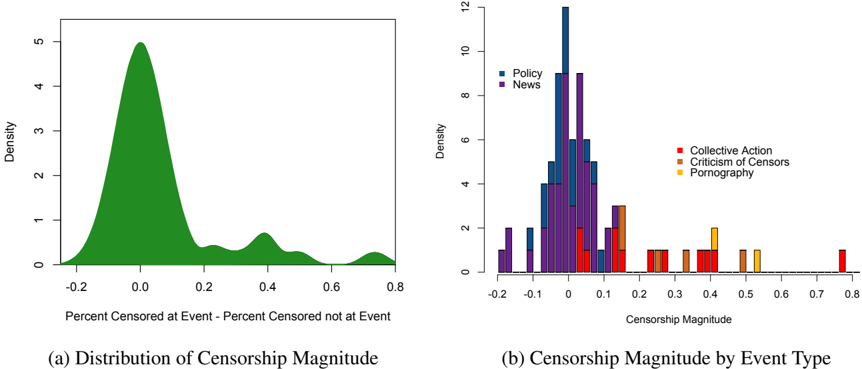
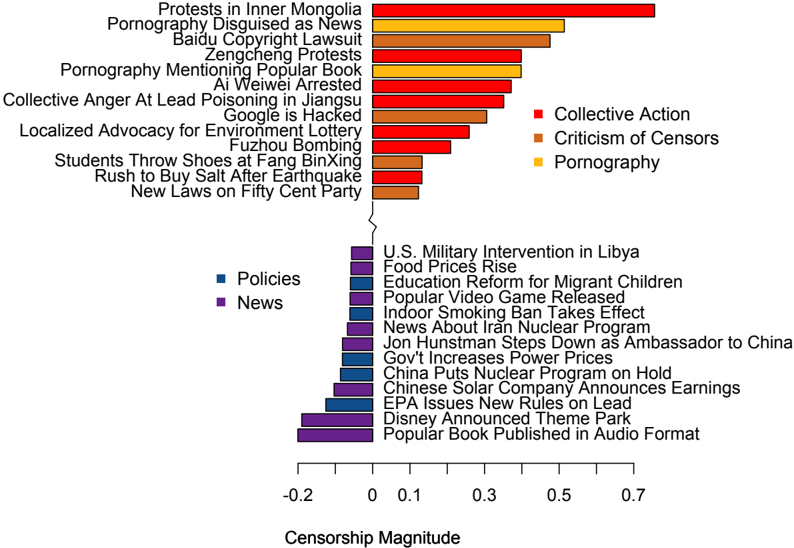
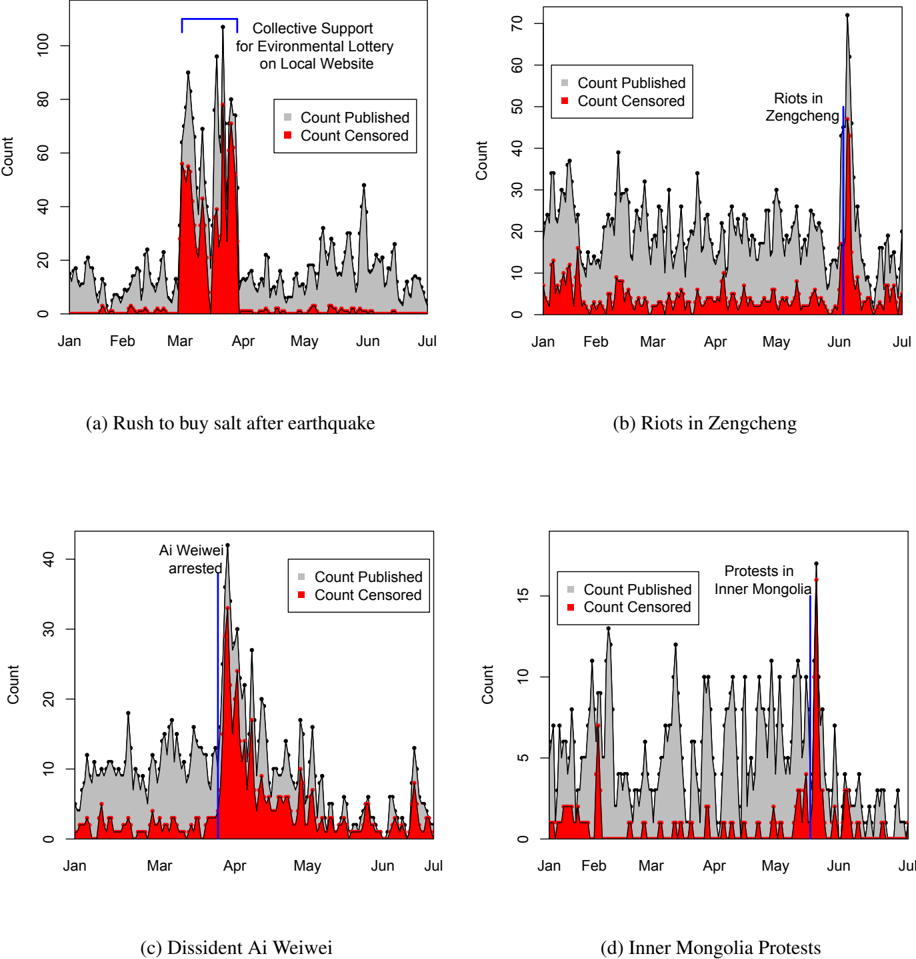
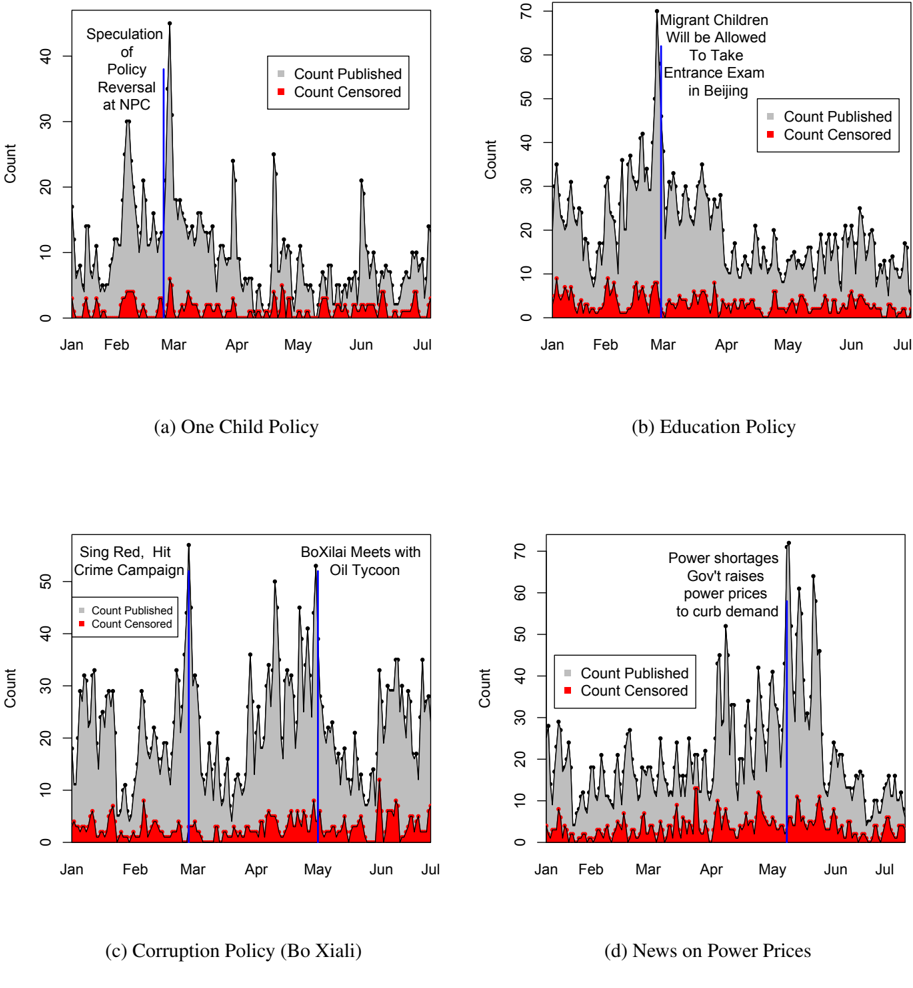
- Censorship was much higher during volume bursts tied to collective action: average censorship magnitude was 27% for collective action, compared with -1% for policy and -4% for news.
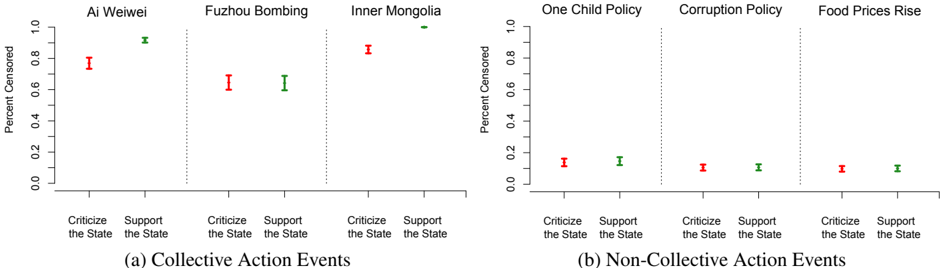
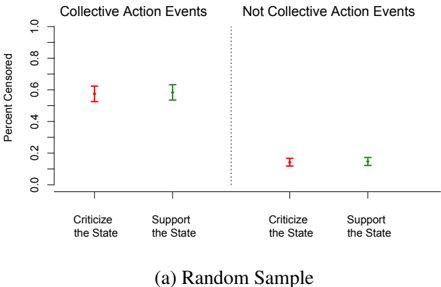
- For collective action events such as Ai Weiwei’s arrest, Inner Mongolia protests, and Fuzhou bombings, posts were censored at about 80% on average whether they criticized or supported the state. For non-collective-action events such as the one child policy, corruption policy, and food prices, censorship was about 10% on average for both critical and supportive posts.
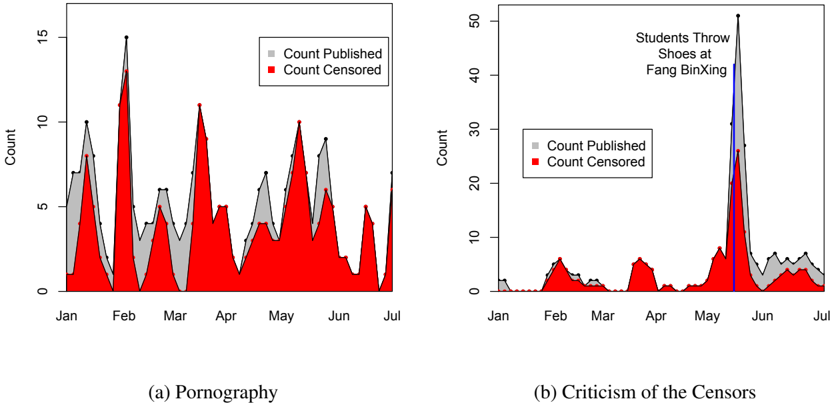
- Censorship also targeted pornography and criticism of the censors, but not government policy or other news. The authors argue censorship is aimed at curtailing collective action by silencing comments that represent, reinforce, or spur social mobilization.
Methods
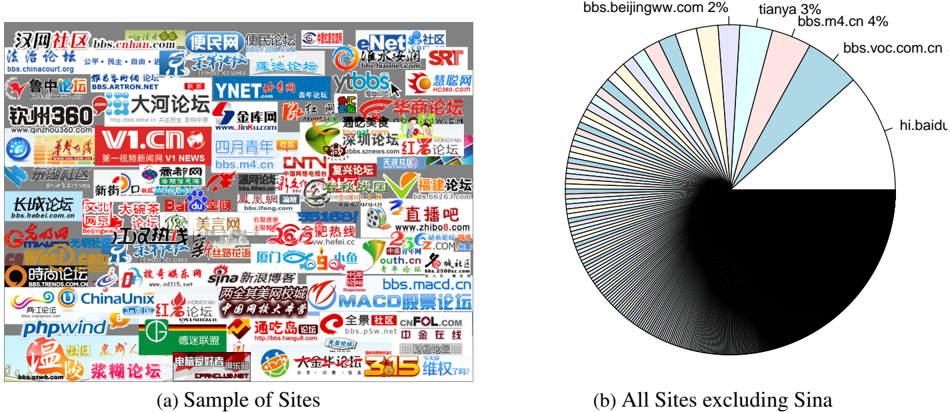
- The authors built a system to locate, download, and analyze posts from 1,382 Chinese websites during the first half of 2011, before government censors could remove them. They collected 3,674,698 posts, randomly selected 127,283 for further analysis, and overall collected and analyzed 11,382,221 posts.
- They used a stratified random sampling design covering 85 topic areas across three hypothesized political sensitivity levels, detected 87 volume bursts in 67 of the 85 topic areas using robust regression-based burst detection, and classified events into collective action potential, criticism of censors, pornography, government policies, and other news.
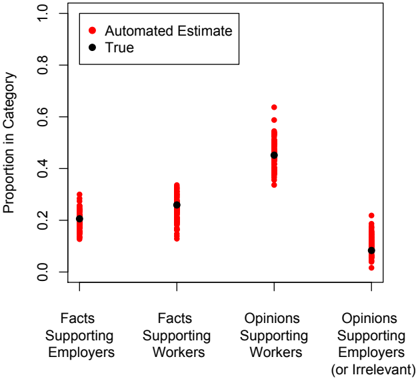
- To analyze content, they adapted the Hopkins and King “ReadMe” automated text analysis method to Chinese and extended it with a Bayesian procedure to estimate the percent censored within categories. Validation used native Chinese speakers coding 1,000 posts about 2010 labor strikes, with 100 as training and 900 as test; event coding reliability was 98.9% (86 of 87 events).
Limitations
- The paper states that its methodology misses self-censorship and censorship that may occur before the post is obtained; it also does not quantify the direct effects of the Great Firewall, keyword blocking, or search filtering.
- The authors state they have not studied physical violence, such as arrest of bloggers, or threats of the same; although many officials and levels of government influence censorship decisions, their data only sometimes distinguish among these sources, and they cannot determine the consequences of these limitations.
- The authors note that the presumably smaller number of discussions they cannot observe are likely to be those of most interest to the Chinese government, and they offer little evidence connecting social media findings to press freedom or other types of human expression in China. They also state that the predictive analysis was conducted retrospectively and with only three events, so further prospective validation would be valuable.
Model-written summary. Check it against the paper before relying on it.
Integrity signals
Registry
Cites
Statistics
Figures
Verification
Claims the paper makes
0 Valid · 7 Not valid · 7 Not checked · 88 Own results and interpretations
A result the paper reports from its own data — it cites no other source for it, so there is none to check. The quote shows it is in the paper.
In the paper
“Our data show that the Chinese censorship program allows for a wide variety of criticisms of the Chinese government, its officials, and its policies.”
§ How Censorship in China Allows Government Criticism but Silences Collective Expression * > Outline of Results
plain- Asserted: passes — The authors put it forward as true.
- Checkable: passes — It can be checked against evidence.
- Load-bearing: passes — The paper’s conclusions depend on it.
- Based: passes — The paper gives a reason why it holds.
A result the paper reports from its own data — it cites no other source for it, so there is none to check. The quote shows it is in the paper.
In the paper
“Contrary to previous understandings, posts with negative, even vitriolic, criticism of the state, its leaders, and its policies are not more likely to be censored.”
- Also stated in: § 1 Introduction · plain
“we find that when the Chinese people write scathing criticisms of their government and its leaders, the probability that their post will be censored does not increase.”
§ How Censorship in China Allows Government Criticism but Silences Collective Expression * > Abstract
plain- Asserted: passes — The authors put it forward as true.
- Checkable: passes — It can be checked against evidence.
- Load-bearing: passes — The paper’s conclusions depend on it.
- Based: passes — The paper gives a reason why it holds.
- Also stated in: § 1 Introduction · plain
A result the paper reports from its own data — it cites no other source for it, so there is none to check. The quote shows it is in the paper.
In the paper
“Large increases in online volume are good predictors of censorship when these increases are associated with events related to collective action, e.g., protest on the ground.”
§ How Censorship in China Allows Government Criticism but Silences Collective Expression * > Outline of Results
plainstates an association- Asserted: passes — The authors put it forward as true.
- Checkable: passes — It can be checked against evidence.
- Load-bearing: passes — The paper’s conclusions depend on it.
- Based: passes — The paper gives a reason why it holds.
A result the paper reports from its own data — it cites no other source for it, so there is none to check. The quote shows it is in the paper.
In the paper
“In addition, we measure sentiment within each of these events and show that during these events, the government censors views that are both supportive and critical of the state.”
§ How Censorship in China Allows Government Criticism but Silences Collective Expression * > Outline of Results
plainstates a cause- Asserted: passes — The authors put it forward as true.
- Checkable: passes — It can be checked against evidence.
- Load-bearing: passes — The paper’s conclusions depend on it.
- Based: passes — The paper gives a reason why it holds.
A result the paper reports from its own data — it cites no other source for it, so there is none to check. The quote shows it is in the paper.
In the paper
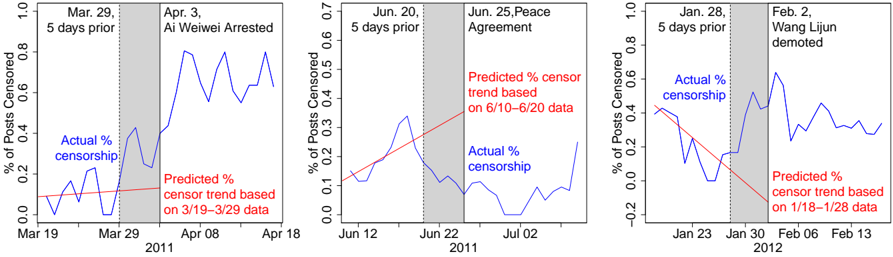
“We thus conduct the same analysis for the demotion of Wang Lijun in Panel (c) of Figure 11, and again see a large difference in actual and predicted percent censorship before Wang's demotion.”
§ How Censorship in China Allows Government Criticism but Silences Collective Expression * > Additional information
plainSingle case- Asserted: passes — The authors put it forward as true.
- Checkable: passes — It can be checked against evidence.
- Load-bearing: unclear — It is unclear whether the paper’s conclusions depend on it.
- Based: passes — The paper gives a reason why it holds.
46 more claims
Create a free account to see all 102 claims and every source verdict.
- Probably not a substantial claim. 26
- It may state two separate claims as one. 33
Claims other papers make about this one
Each is checked against this paper’s own text: does it say what the citing paper says it does?
The source backs part of the claim, not all of it — or backs it for a different population, condition or comparison.
In the citing paper
“Authorities are keen to review social media posts and have contentious messages removed (King etal., 2013) to ensure that potential threats remain invisible.”
From How Dictators Control the Internet: A Review Essay (2020) · cites this paper as King et al., 2013
Experimental — accuracy not yet measuredThe source backs part of the claim, not all of it — or backs it for a different population, condition or comparison.
In the citing paper
“In most autocratic regimes, governmental interference in digital infrastructure and communication is commonplace.”
From How Dictators Control the Internet: A Review Essay (2020) · cites this paper as King et al., 2013
Experimental — accuracy not yet measuredThe source backs part of the claim, not all of it — or backs it for a different population, condition or comparison.
In the citing paper
“First, the timing of censorship during a coup is consistent with many studies that have shown that Internet censorship is targeted during sensitive political time periods and periods of potential power transitions, such as elections and large-scale protests [23,25,44,47,73].”
From A multi-perspective view of Internet censorship in Myanmar (2021) · cites this paper as [44]
Experimental — accuracy not yet measuredThe cited source says what the claim attributes to it.
In the citing paper
“research has shown how mobilization organized through public coordination is repressed using that very same public information-for instance, repression is preemptively increased before focal days (Truex 2019); and autocracies censor online calls for collective action (King, Pan, and Roberts 2013), coerce online opinion leaders (Pan and Siegel 2020), and at times, turn off the internet entirely.”
From Coordinated Dis-Coordination (2024) · cites this paper as King, Pan, and Roberts 2013
The check wasn’t confident either way, so it gives no verdict — never disputed.
In the citing paper
“In China, for instance, two virtual police officers remind citizens that their browsing behavior is monitored (King etal., 2013).”
From How Dictators Control the Internet: A Review Essay (2020) · cites this paper as King et al., 2013
Experimental — accuracy not yet measured
1 more claim about this paper
Create a free account to see every claim other papers make about this one.
Citations
Cites
Robust estimation of a location parameter
Huber, P. J. (1964) · The Annals of Mathematical Statistics · doi:10.1214/aoms/1177703732 · Cited by 7,228
Robust Regression and Outlier Detection
Piepel, G. F. (1989) · Technometrics · doi:10.1080/00401706.1989.10488524 · Cited by 6,144
Robust Regression and Outlier Detection
Rousseeuw, P. J., & Leroy, A. M. (1987) · Wiley Series in Probability and Statistics · doi:10.1002/0471725382 · Cited by 5,609
Logistic Regression in Rare Events Data
King, G., & Zeng, L. (2001) · Political Analysis · doi:10.1093/oxfordjournals.pan.a004868 · Cited by 4,316 · cited 1×
“We do this via well-known and widely used case-control methodology (King and Zeng 2001).”
MethodSelf-citationDemocracy and Development: Political Institutions and Well-Being in the World, 1950–1990
Przeworski, A., Alvarez, M. E., Cheibub, J. A., & Limongi, F. (2000) · doi:10.1017/cbo9780511804946 · Cited by 2,845
Rightful Resistance in Rural China
O'Brien, K. J., & Li, L. (2006) · Cambridge University Press eBooks · doi:10.1017/cbo9780511791086 · Cited by 1,104
The Dynamics of Informational Cascades: The Monday Demonstrations in Leipzig, East Germany, 1989–91
Lohmann, S. (1994) · World Politics · doi:10.2307/2950679 · Cited by 1,035 · cited 1×
“Protests in East Germany, Eastern Europe, and most recently the Middle East have all preceded regime change (Ash 2002; Lohmann 1994; Przeworski et al. 2000).”
BackgroundRightful Resistance in Rural China
O'Brien, K., & Li, L.-J. (2006) · doi:10.1017/cbo9780511791086.003 · Cited by 987
China's Changing of the Guard: Authoritarian Resilience
Nathan, A. J. (2003) · Journal of Democracy · doi:10.1353/jod.2003.0019 · Cited by 927
Sparks and prairie fires: A theory of unanticipated political revolution
Kuran, T. (1989) · Public Choice · doi:10.1007/bf00116762 · Cited by 905 · cited 1×
“In fact, Kuran (1989) and Lohmann (2002) show that it is information about a collective action event that propels collective action and so distinguishing this from explicit calls for collective action would be difficult if not impossible.”
Background
Research works printed but not linked: 13
- 22. Freedom House. 2012. "Freedom of the Press, 2012." www.freedomhouse.org.
- 8. Chang, Parris. 1983. Elite Conflict in the Post-Mao China. New York: Occasional Papers Reprints.
- 26. Hinton, Harold. 1955. The "Unprincipled Dispute" Within Chinese Communist Top Lead- ership. Washington, DC: U.S. Information Agency.
- 44. Perry, Elizabeth. 2002. Challenging the Mandate of Heaven: Social Protest and State Power in China. Armork, NY: M. E. Sharpe.
- 52. Schurmann, Franz. 1966. Ideology and Organization in Communist China. Berkeley, CA: University of California Press.
- Tsai, 2007, Capitalism without Democracy: The Private Sector in Contemporary China
- 48. Qiang, Xiao. 2011. The Rise of Online Public Opinion and Its Political Impact. In Chang- ing Media, Changing China, ed. Susan Shirk. New York: Oxford University Press pp. 202-224.
- 9. Charles, David. 1966. The Dismissal of Marshal P'eng Teh-huai. In China Under Mao: Politics Takes Command, ed. Roderick MacFarquhar. Cambridge: MIT University Press pp. 20-33.
- 54. Shirk, Susan. 2007. China: Fragile Superpower: How China's Internal Politics Could Derail Its Peaceful Rise. New York: Oxford University Press.
- 56. Teiwes, Frederick. 1979. Politics and Purges in China: Retification and the Decline of Party Norms. Armork, NY: M. E. Sharpe. Tsai, Kellee. 2007a. Capitalism without Democracy: The Private Sector in Contemporary China. Ithaca, NY: Cornell University Press.
- 15. Duan, Qing. 2007. China's IT Leadership. Vdm Verlag.
- 38. MacFarquhar, Roderick. 1974. The Origins of the Cultural Revolution Volume 1: Contra- dictions Among the People 1956-1957. New York: Columbia University Press.
- 12. Chen, Xiaoyan and Peng Hwa Ang. 2011. Internet Police in China: Regulation, Scope and Myths. In Online Society in China: Creating, Celebrating, and Instrumentalising the Online Carnival, ed. David Herold and Peter Marolt. New York: Routledge pp. 40-52.
Cited by
Items 1,601–1,700 of 2,443
Zhong, Z.-J., & Zhang, X. (2017) · China An International Journal · doi:10.1353/chn.2017.0015 · Cited by 1
Social Media, Political Institutions and the Principal–Agent Dilemma
Cerón, A. (2017) · Springer eBooks · doi:10.1007/978-3-319-52627-0_1 · Cited by 1
How Chinese People Use the Internet
Negro, G. (2017) · Springer eBooks · doi:10.1007/978-3-319-60405-3_4 · Cited by 1
China’s Engagement in Cyberspace
Domingo, F. C. (2016) · Journal of Asian Security and International Affairs · doi:10.1177/2347797016645456 · Cited by 2
Citizens' Use of the Internet and Public Service Delivery
Zhu, Q., Škorić, M. M., & Peng, T. (2018) · International Journal of Public Administration in the Digital Age · doi:10.4018/ijpada.2018070103 · Cited by 1
Wang, Q. (2018) · Global Media and China · doi:10.1177/2059436418775532 · Cited by 1
Information equality and democracy in the information age: Cross-national time-series analyses
Yoon, J.-H. (2018) · Asian Journal of Comparative Politics · doi:10.1177/2057891118783091 · Cited by 1
Shelton, C., Cleven, E., & Hoffman, A. M. (2018) · International Interactions · doi:10.1080/03050629.2019.1529668 · Cited by 3
“China is trying to distract social media users in order to frustrate them from using those platforms to coordinate antigovernment protests (King, Pan, and Roberts 2013).”
BackgroundMapping Cantonese: The Pro-Cantonese Protest and Sina Weibo in Guangzhou
Wang, W. Y. (2019) · Springer eBooks · doi:10.1007/978-3-319-73400-2_100-1 · Cited by 1
Should China Spend on UNPKOs? Findings from a Survey
Primiano, C. B. (2019) · China Report · doi:10.1177/0009445518818217 · Cited by 1
Zeng, Y. (2017) · Media Asia · doi:10.1080/01296612.2017.1374629 · Cited by 1
Yan, P. S. (2019) · Lecture notes in computer science · doi:10.1007/978-3-030-15742-5_36 · Cited by 3
Fahmi, U. (2019) · Policy & Governance Review · doi:10.30589/pgr.v3i1.123 · Cited by 6
Apollo: A System for Tracking Internet Censorship
Joyce, E., Goldeck, M., Leberknight, C. S., & Feldman, A. (2018) · AIS Electronic Library (AISeL) · Cited by 1
Die Nutzung von Webdaten in den Sozialwissenschaften
Munzert, S., & Nyhuis, D. (2020) · Springer eBooks · doi:10.1007/978-3-658-16936-7_22 · Cited by 2
Does Repression Prevent Successful Campaigns?
Tanneberg, D. (2020) · Contributions to political science · doi:10.1007/978-3-030-35477-0_4 · Cited by 1
The Dark and Light Sides of Big Data: How Big Data Is Transforming Political Sociology
Jenkins, J. C. (2020) · Cambridge University Press eBooks · doi:10.1017/9781108147828.013 · Cited by 1
Chua, Y. T., & Collier, B. (2019) · APWG Symposium on Electronic Crime Research (eCrime) · doi:10.1109/ecrime47957.2019.9037500 · Cited by 6
“China for creatively circumventing filtering and monitoring by social media platforms, allowing individuals to communicate discreetly [29].”
BackgroundHassan, M. (2020) · Cambridge University Press eBooks · doi:10.1017/9781108858960.002 · Cited by 1
User Perceptions of Information Quality in China: The Boomerang Decade
Guo, Y., & Klein, B. D. (2020) · AIS Electronic Library (AISeL) · Cited by 2
Borgman, C. L. (2020) · doi:10.4000/books.oep.14732 · Cited by 1
Controlling Critical Messengers: Foreign Correspondents in China
Dukalskis, A. (2021) · Oxford University Press eBooks · doi:10.1093/oso/9780197520130.003.0005 · Cited by 1
Menciptakan Ruang Siber yang Kondusif bagi Pegiat Anti-Korupsi
Wijayanto, W., Sardini, N. H., & Elsitra, G. N. (2021) · Integritas Jurnal Antikorupsi · doi:10.32697/integritas.v7i1.732 · Cited by 4
Pillay, A. M. (2021) · Strategic Review for Southern Africa · doi:10.35293/srsa.v43i1.412 · Cited by 1
Online Political Participation and Formation of Subjectivity
Fu, J. (2021) · Perspectives on children and young people · doi:10.1007/978-981-16-5532-6_5 · Cited by 2
Zettl-Schabath, K. (2021) · Zeitschrift für Friedens- und Konfliktforschung · doi:10.1007/s42597-021-00064-2 · Cited by 2
“…als ob sich ein Großteil der Befürchtungen der damaligen Internetpioniere weitestgehend bewahrheitet hätte, blickt man auf die wissenschaftlichen Debatten rund um staatliche Überwachungs-, Zensur- und Kontrollmaßnahmen im digitalen Raum (Deibert 2009; Klimburg 2011; King et al. 2013; Inglis 2019).”
BackgroundNyhuis, D. (2020) · Springer eBooks · doi:10.1007/978-3-658-30237-5_12 · Cited by 1
Authoritarian Governance and China’s Party-Centric Model
Taylor, M. (2022) · Springer eBooks · doi:10.1007/978-3-031-11252-2_2 · Cited by 2
Building Digital Authoritarianism: From the Great Firewall to the New IP
Taylor, M. (2022) · Springer eBooks · doi:10.1007/978-3-031-11252-2_1 · Cited by 5
Digital Authoritarianism in the Xi Jinping Era
Taylor, M. (2022) · Springer eBooks · doi:10.1007/978-3-031-11252-2_4 · Cited by 2
Methods for Learning to Quantify
Esuli, A., Fabris, A., Moreo, A., & Sebastiani, F. (2023) · The information retrieval series · doi:10.1007/978-3-031-20467-8_4 · Cited by 4
4. Das Mixed-Methods-Forschungsdesign
Zettl-Schabath, K. (2023) · Politik in der digitalen Gesellschaft · doi:10.14361/9783839468883-006 · Cited by 1
Can Egalitarian Considerations Justify Representative Democracy?
Landa, D., & Pevnick, R. (2025) · Oxford University Press eBooks · doi:10.1093/oso/9780198897538.003.0004 · Cited by 1
Capone, V. (2013) · Cited by 1
Threshold of Herd Effect for Online Events in China
Liu, T., Chen, K., & Zhong, Y. (2015) · Lecture notes in computer science · doi:10.1007/978-3-319-15168-7_47 · Cited by 1
Sprouting from Fissures: Pluralizing the Conceptions of China
Xie, T. (2014) · doi:10.14418/wes01.1.999 · Cited by 1
The Chinese Communist Party's capacity to rule : legitimacy, ideology, and party cohesion
Zeng, J. (2026) · Warwick Research Archive Portal (University of Warwick) · doi:10.82444/warw.33649576 · Cited by 5
Mobile Activism and Contentious Politics in Contemporary ChinaPreprint
Jun, L. (2013) · SSRN Electronic Journal · doi:10.2139/ssrn.2258519 · Cited by 5
Individual rights and government control: A qualitative study of China's censorship
Pei, D. (2014) · doi:10.31274/etd-180810-3538 · Cited by 1
Yoon, H. Y. (2016) · SSRN Electronic Journal · doi:10.2139/ssrn.2782442 · Cited by 1
The Roles of Transparency in Regime Change: Striking When the Iron's Gone ColdPreprint
Quigley, D., & Toscani, F. G. (2016) · SSRN Electronic Journal · doi:10.2139/ssrn.2768455 · Cited by 1
“Important contributions include, among others, Morris and Shin [1998], Corsetti et al.”
Zhao, Y. (2016) · Figshare · Cited by 2
Andrelczyk, C. (2016) · ISU Red - Research and eData (Illinois State University) · doi:10.30707/etd2016.andrelczyk.c · Cited by 1
Framing 2014 Hong Kong Protest
Ye, L. (2016) · The Research Repository @ WVU (West Virginia University) · doi:10.33915/etd.7004 · Cited by 2
“In addition, the government utilizes the world’s most-advanced system for censoring and monitoring online news content, launched automated programs, and pay thousands of human censors to screen content generated by the users and delete posts that discorded the directives (King et al., 2013).”
BackgroundSocial Media and AuthoritarianismPreprint
Gayo-Avello, D. (2015) · SSRN Electronic Journal · doi:10.2139/ssrn.2878705 · Cited by 2
Strong Weibo, smart government: governmentality and the regulation of social media in China
Bei, G. (2015) · Adelaide Research & Scholarship (AR&S) (University of Adelaide) · Cited by 7
Criticism in News and Its Effects on Authoritarian Duration in China
Chen, D. (2014) · KU ScholarWorks (University of Kansas) · Cited by 4
Content Effects: Political Communication
Semetko, H. A., & Tworzecki, H. (2017) · Wiley eBooks · doi:10.1002/9781118783764.wbieme0124 · Cited by 1
Cerón, A., Curini, L., Iacus, S. M., & Porro, G. (2012) · IrInSubria (University of Insubria) · Cited by 1
Twitter and teargas: the power and fragility of networks protest, by Zeynep Tufekci
Summers, E. (2017) · Internet Histories · doi:10.1080/24701475.2017.1383639 · Cited by 1
“She highlights the work of King, Pan, and Roberts (2013) that analysed how China ’ s so-called 50 Cent Army of web commenters shapes public opinion not simply by censoring material on the web, but by drawing attention elsewhere at key moments.”
BackgroundInteracting with users in social networks : the follow-back problem
Rajagopalan, K. (2016) · DSpace@MIT (Massachusetts Institute of Technology) · Cited by 2
Karpf, D. (2016) · Oxford University Press eBooks · doi:10.1093/obo/9780199756223-0169 · Cited by 2
Cerón, A., Curini, L., & Iacus, S. M. (2018) · arXiv (Cornell University) · doi:10.48550/arxiv.1804.04059 · Cited by 1
Chinese Cyber Nationalism: The 2012 Diaoyu Islands Dispute on Sina Weibo
Feng, M. (2017) · Figshare · Cited by 1
Judicial Independence and Human Rights in AutocraciesPreprint
Shadmehr, M., Boleslavsky, R., & Ginsburg, T. (2019) · SSRN Electronic Journal · doi:10.2139/ssrn.3419727 · Cited by 2
Big Data for Sociological Research
Radford, J. P., & Lazer, D. M. J. (2019) · Wiley eBooks · doi:10.1002/9781119429333.ch24 · Cited by 4
Conceptual & Theoretical Frameworks
Repnikova, M. (2017) · Cited by 1
Censorship Can be Counterproductive: Sensitivity and Media CredibilityPreprint
Wu, Z. (2020) · doi:10.33774/apsa-2020-hmh99-v2 · Cited by 1
How Modern Dictators Survive: Cooptation, Censorship, Propaganda, and RepressionPreprint
Guriev, S. M., & Treisman, D. S. (2015) · HAL · Cited by 24
China’s Leninist Response to COVID-19: From Information Suppression to Total MobilizationPreprint
Shih, V. (2020) · SSRN Electronic Journal · doi:10.2139/ssrn.3756580 · Cited by 1
Political Self-Censorship in Authoritarian States: The Spatial-Temporal Dimension of TroublePreprint
Chang, C., & Manion, M. (2019) · SSRN Electronic Journal · doi:10.2139/ssrn.3497976 · Cited by 1
Capabilities and conflict in the cyber domain: an empirical study
Craig, A. J. S. (2020) · ORCA Online Research @Cardiff (Cardiff University) · Cited by 3
Investigating Chinese Microblogging through a Citizen Journalism Perspective
Cheng, B. (2020) · UTS ePRESS (University of Technology Sydney) · Cited by 3
He, T. (2016) · Research Publications (Maastricht University) · doi:10.26481/dis.20160701th · Cited by 1
Violation of Bright Lines, Term Limit Evasion and Information ControlPreprint
Jang, J. (2020) · SSRN Electronic Journal · doi:10.2139/ssrn.3582395 · Cited by 1
Attention to Biased Media and Perceptions of InequalityPreprint
Chen, J. (2020) · SSRN Electronic Journal · doi:10.2139/ssrn.3515718 · Cited by 1
Evade and Deceive? Citizen Responses to SurveillancePreprint
Eck, K., Hatz, S., Crabtree, C. D., et al. (2020) · doi:10.31235/osf.io/546dw · Cited by 1
Contriving the Future by Tampering with the Past: A Deferral Tactic in Chinese Internet CensorshipPreprint
Su, Y., Sun, S., & Liu, J. (2019) · SocArXiv (OSF Preprints) · doi:10.31235/osf.io/whe5x · Cited by 1
Teaching Computational Social Science for AllPreprint
Kim, J. Y., & Ng, Y. M. M. (2021) · doi:10.31235/osf.io/pf7n6 · Cited by 1
de la Fuente, E. (2022) · Research Publications (Maastricht University) · doi:10.26481/dis.20220624ef · Cited by 4
A Short Review of Social Movements in ChinaPreprint
Chai, P. (2022) · SSRN Electronic Journal · doi:10.2139/ssrn.4097672 · Cited by 1
Information Access Control as Mass Communications Strategy
Voiovich, J. (2022) · Springer eBooks · doi:10.1007/978-3-030-44556-0_7 · Cited by 1
Participatory Censorship in Authoritarian RegimesPreprint
Yang, T. Z. (2022) · SSRN Electronic Journal · doi:10.2139/ssrn.4167554 · Cited by 1
Untapped Potential: Designed Digital Trace Data in Online Survey ExperimentsPreprint
Macke, E., Daviss, C., & Williams-Baron, E. (2022) · doi:10.31235/osf.io/frhj6 · Cited by 1
Babb, C. M. (2022) · Carleton University's Institutional Repository (MacOdrum Library, Carleton University) · doi:10.22215/etd/2022-15146 · Cited by 4
Does Affluence Influence Authoritarian Responsiveness? Evidence from Urban ChinaPreprint
Fu, J., Li, Z., & Yan, H. (2022) · SSRN Electronic Journal · doi:10.2139/ssrn.4253200 · Cited by 1
Creation, Consumption, and Control of Sensitive ContentPreprint
Wu, Y. (2022) · SSRN Electronic Journal · doi:10.2139/ssrn.4314935 · Cited by 1
Regime type and Data Manipulation: Evidence from the COVID-19 PandemicPreprint
Wigley, S. (2023) · doi:10.31219/osf.io/dv7q2 · Cited by 1
The cognitive foundations of ideological orthodoxyPreprint
Marie, A., & Petersen, M. B. (2023) · OSF Preprints (OSF Preprints) · doi:10.31219/osf.io/78puz · Cited by 1
Das politische System der VR China
Heberer, T. (2023) · Springer eBooks · doi:10.1007/978-3-658-39485-1_3 · Cited by 1
Marie, A., & Petersen, M. B. (2023) · doi:10.31219/osf.io/xtzkm · Cited by 1
Pollution Matters: The Political Impact of Information DisclosurePreprint
Chen, X., Shen, X., & Zhuge, A. (2023) · SSRN Electronic Journal · doi:10.2139/ssrn.4486089 · Cited by 1
Munging the Ghosts in the Machine: Coded Bias and the Craft of Wrangling Archival DataPreprint
Yung, V., & Colyvas, J. A. (2023) · doi:10.31235/osf.io/2dve6 · Cited by 1
How Technology Changes Authoritarian State Surveillance: Evidence from ChinaPreprint
liu, Z. (2023) · SocArXiv (OSF Preprints) · doi:10.31235/osf.io/3zpcj · Cited by 2
Yang, Y. (2023) · SSRN Electronic Journal · doi:10.2139/ssrn.4560720 · Cited by 2
Never Meet Your Heroes: Community Policing in Contemporary ChinaPreprint
Rothschild, V., & Zhu, H. (2023) · SSRN Electronic Journal · doi:10.2139/ssrn.4589502 · Cited by 1
“…Wright, et al., 2018), security agencies (Greitens, 2016; Hassan, 2017; Scharpf and Gläßel, 2020), and new surveillance (Frantz, Kendall-Taylor, and Wright, 2020; Xu, 2020; Beraja et al., 2022) and censorship (King et al., 2013; Roberts, 2018) technologies to prevent and contain mass protest.”
BackgroundAuthoritarian Actions Abroad Database (AAAD)—Codebook, Version 5 (September 2020)
Dukalskis, A. (2021) · Oxford University Press eBooks · doi:10.1093/oso/9780197520130.005.0002 · Cited by 2
Blum, A. (2024) · SSRN Electronic Journal · doi:10.2139/ssrn.4672426 · Cited by 4
Resistance but Loyalty: Revolutionary Legacies and Contained ContentionPreprint
Lu, W., Bai, H., & Fan, S. (2024) · SSRN Electronic Journal · doi:10.2139/ssrn.4797721 · Cited by 1
Exposing State Repression: Digital Discursive Contention by Chinese ProtestorsPreprint
Fu, D., & Gobel, C. (2024) · SSRN Electronic Journal · doi:10.2139/ssrn.4826824 · Cited by 1
Zhang, R., Li, H. Z., Afonso, Liu, Z., & Lee, Y. (2024) · doi:10.31219/osf.io/qw7gx · Cited by 1
Strategies of Political Control and Regime Survival in AutocraciesPreprint
Kim, W., Nazrullaeva, E., Neundorf, A., Northmore‐Ball, K., & Tertytchnaya, K. (2025) · SSRN Electronic Journal · doi:10.2139/ssrn.5064279 · Cited by 2
Xu, W. (2025) · SocArXiv (OSF Preprints) · doi:10.31235/osf.io/dkv8r_v1 · Cited by 1
Liu, M. (2025) · doi:10.33774/apsa-2025-g9w01 · Cited by 1
Nationwide shutdowns and government offensives
Gohdes, A. R. (2024) · Repression in the Digital Age · doi:10.1093/oso/9780197743577.003.0005
Strategic disruptions: The subnational targeting of internet shutdowns in India
Miner, M. (2025) · Journal of Peace Research · doi:10.1177/00223433251342434 · Cited by 1
“These digital tactics are often more subtle, involving fewer unpredictable actors and lower risks of public backlash (King et al., 2013; Qin et al., 2017; Roberts, 2018; Shadmehr and Bernhardt, 2015).”
Internet en China : cambios en el panorama informativo del pais
Morán, D. M. (2012)
China's Adaptive Internet Management Strategy after the Emergence of Social Networks
Ekman, A. (2014) · John Wiley & Sons, Inc. eBooks · doi:10.1002/9781119009009.ch3
Metadata
- Authors
- KING, G., PAN, J., & ROBERTS, M. E.
- Affiliations
- Harvard University (US)
- Corresponding author
- KING, GARY
- PAN, JENNIFER
- Venue
- American Political Science Review
- Publisher
- Cambridge University Press (CUP)
- Published
- 2013-05
- Volume
- 107
- Issue
- 2
- Pages
- 326-343
- ISSN
- 0003-0554 (ISSN-L)
- 1537-5943
- OpenAlex
- W2144188763
- Cited by
- 2,415
- References
- 48
- Citations by year
- 2026: 161 · 2025: 206 · 2024: 249 · 2023: 272 · 2022: 230 · 2021: 193 · 2020: 206 · 2019: 157 · 2018: 178 · 2017: 153 · 2016: 137 · 2015: 120 · 2014: 91 · 2013: 54
- FWCI
- 395.09
- Type
- journal article
- Language
- en
- Open access
- green
- nrs.harvard.edu
- Licence
- Locations
- American Political Science Review (publishedVersion)
- Digital Access to Scholarship at Harvard (DASH) (Harvard University) (submittedVersion, cc-by)
- RePEc: Research Papers in Economics (submittedVersion)
- Topics
- Social Sciences › Communication › Social Media and Politics
- Social Sciences › Law › Freedom of Expression and Defamation
- Social Sciences › Sociology and Political Science › Media Influence and Politics
- Keywords
- internet censorship, Chinese government, social media, collective action, social mobilization, political criticism, online speech
About these checks
Registry, retraction, Cites and statistics results are computed, not judged, with one exception: a printed reference that no index lists is read once by a model before it counts as a citation error. Claims are extracted by a model and kept only when their quote appears verbatim in the text; each cited source is then checked, with a model’s help, for whether it says what the claim relies on. Those verdicts can be wrong — read the claim’s quote and the cited source before relying on one.
A language model drew the claims from the paper on 2026-10-11, under version 3 of the claim definition (model deepseek-v4.1-flash, prompt extract-v3).
A second model labelled each claim on 2026-10-11 (model jev-1.13-20260917, definition revision gold-guideline-v0.2).
Statistics and arithmetic are recomputed, not judged.
Confidence bands are shown only for fields calibrated on our annotated test set. None is calibrated yet, so no band is shown.
What counts as a claim ›How we measure confidence ›How we check this ›
Are you an author, or do you see a problem with this page? Request a review
Data sources
Bibliographic data: Semantic Scholar, OpenAlex, Crossref.
Contains information from the Semantic Scholar Academic Graph Datasets, made available under the ODC Attribution License (ODC-BY 1.0).
Semantic Scholar’s data is described in: Kinney, R., et al. (2023). The Semantic Scholar Open Data Platform. arXiv:2301.10140.
