

How Censorship in China Allows Government Criticism but Silences Collective Expression
Open accessThe DOI matches its Crossref record; 53 of the 54 references it cites were found in a registry or an index, and 1 are not checked yet; none of the 12 sources its claims cite is checked for support yet.
Abstract
We offer the first large scale, multiple source analysis of the outcome of what may be the most extensive effort to selectively censor human expression ever implemented. To do this, we have devised a system to locate, download, and analyze the content of millions of social media posts originating from nearly 1,400 different social media services all over China before the Chinese government is able to find, evaluate, and censor (i.e., remove from the Internet) the subset they deem objectionable. Using modern computer-assisted text analytic methods that we adapt to and validate in the Chinese language, we compare the substantive content of posts censored to those not censored over time in each of 85 topic areas. Contrary to previous understandings, posts with negative, even vitriolic, criticism of the state, its leaders, and its policies are not more likely to be censored. Instead, we show that the censorship program is aimed at curtailing collective action by silencing comments that represent, reinforce, or spur social mobilization, regardless of content. Censorship is oriented toward attempting to forestall collective activities that are occurring now or may occur in the future—and, as such, seem to clearly expose government intent.
Checked 2026-11-22 · 1 reference not checked yet
Overview
CoChat Summary
TL;DR
The paper uses large-scale, real-time collection of Chinese social media posts to test why China censors online expression. It finds that censorship does not target criticism of the state or leaders; instead, it targets posts with collective action potential, regardless of whether they support or criticize the government.
Key findings
- Across the data, an average of approximately 13% of all social media posts were censored. Ex ante political sensitivity had only a weak relationship with censorship: Low and Medium categories were censored at 16% and 17%, respectively, versus 24% for High.
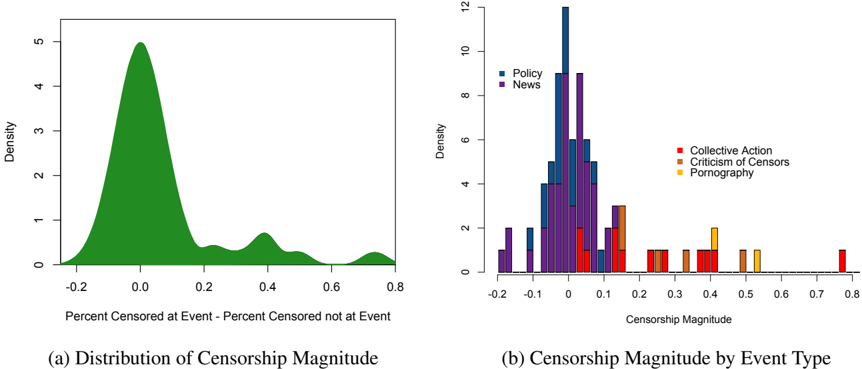
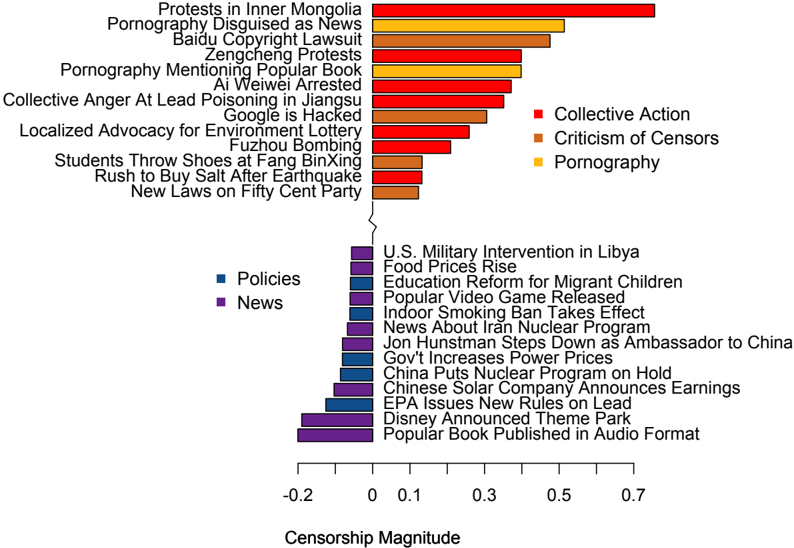
- Censorship was much higher during volume bursts tied to collective action: average censorship magnitude was 27% for collective action, compared with -1% for policy and -4% for news.
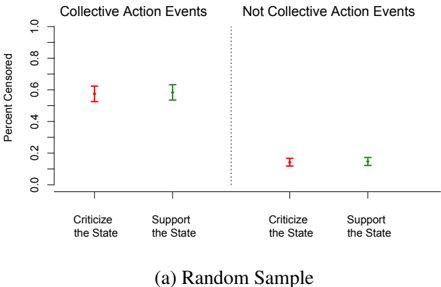
- For collective action events such as Ai Weiwei’s arrest, Inner Mongolia protests, and Fuzhou bombings, posts were censored at about 80% on average whether they criticized or supported the state. For non-collective-action events such as the one child policy, corruption policy, and food prices, censorship was about 10% on average for both critical and supportive posts.
- Censorship also targeted pornography and criticism of the censors, but not government policy or other news. The authors argue censorship is aimed at curtailing collective action by silencing comments that represent, reinforce, or spur social mobilization.
Methods
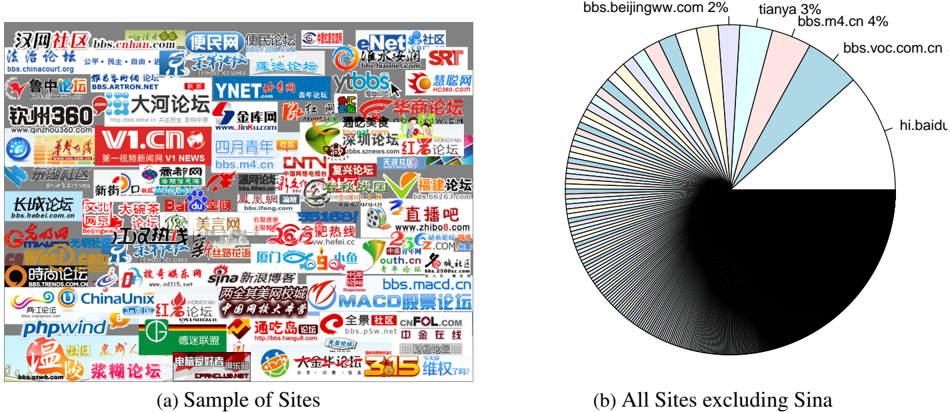
- The authors built a system to locate, download, and analyze posts from 1,382 Chinese websites during the first half of 2011, before government censors could remove them. They collected 3,674,698 posts, randomly selected 127,283 for further analysis, and overall collected and analyzed 11,382,221 posts.
- They used a stratified random sampling design covering 85 topic areas across three hypothesized political sensitivity levels, detected 87 volume bursts in 67 of the 85 topic areas using robust regression-based burst detection, and classified events into collective action potential, criticism of censors, pornography, government policies, and other news.
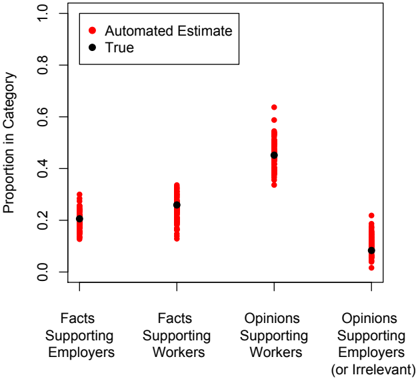
- To analyze content, they adapted the Hopkins and King “ReadMe” automated text analysis method to Chinese and extended it with a Bayesian procedure to estimate the percent censored within categories. Validation used native Chinese speakers coding 1,000 posts about 2010 labor strikes, with 100 as training and 900 as test; event coding reliability was 98.9% (86 of 87 events).
Limitations
- The paper states that its methodology misses self-censorship and censorship that may occur before the post is obtained; it also does not quantify the direct effects of the Great Firewall, keyword blocking, or search filtering.
- The authors state they have not studied physical violence, such as arrest of bloggers, or threats of the same; although many officials and levels of government influence censorship decisions, their data only sometimes distinguish among these sources, and they cannot determine the consequences of these limitations.
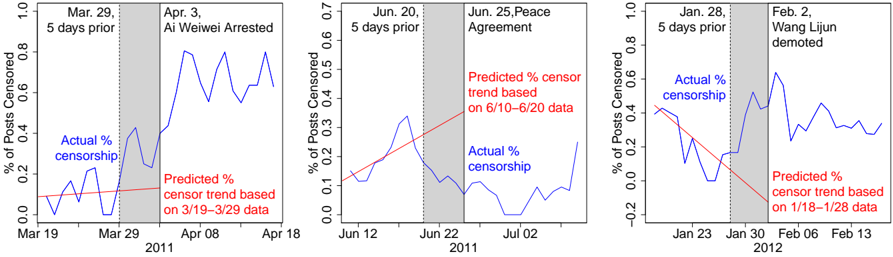
- The authors note that the presumably smaller number of discussions they cannot observe are likely to be those of most interest to the Chinese government, and they offer little evidence connecting social media findings to press freedom or other types of human expression in China. They also state that the predictive analysis was conducted retrospectively and with only three events, so further prospective validation would be valuable.
Model-written summary. Check it against the paper before relying on it.
Integrity signals
Registry
Cites
Statistics
Figures
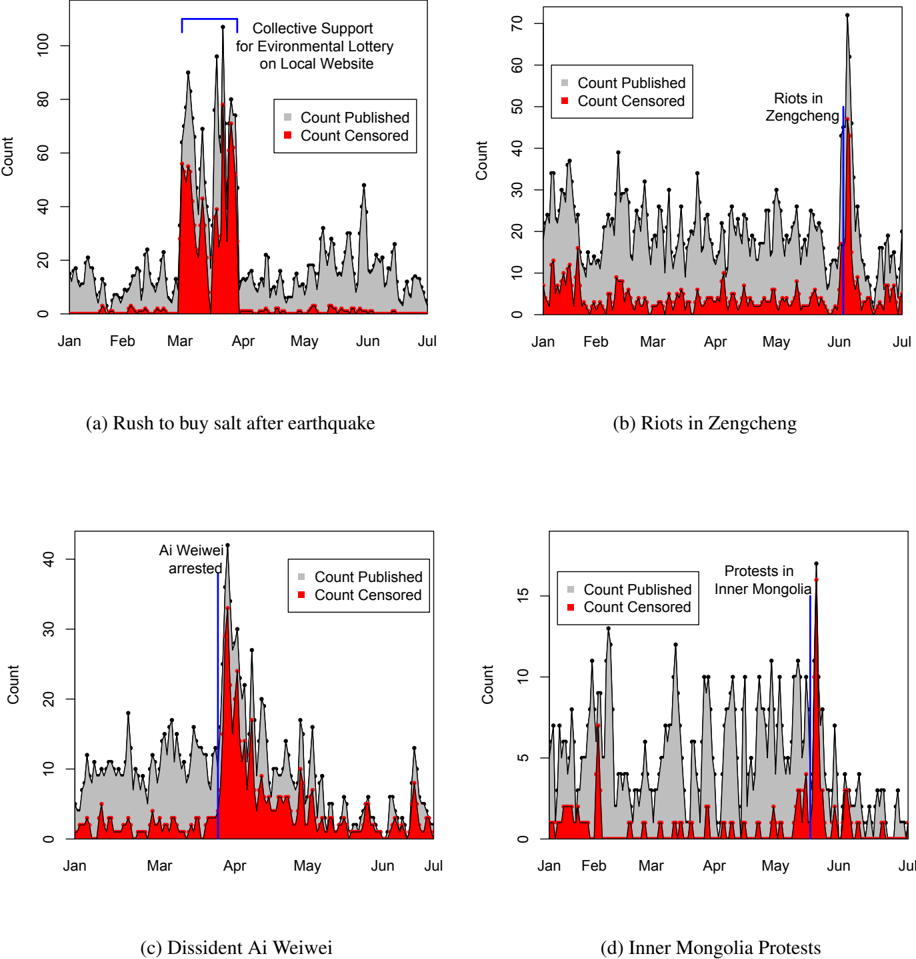
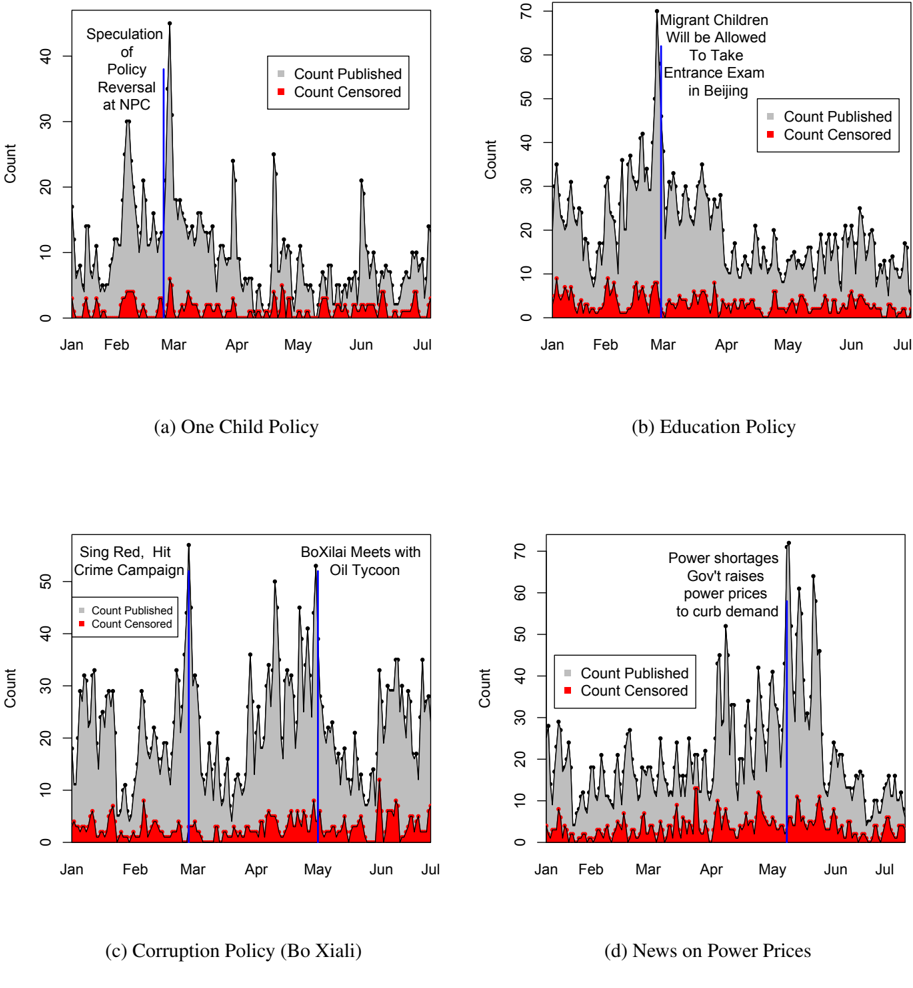
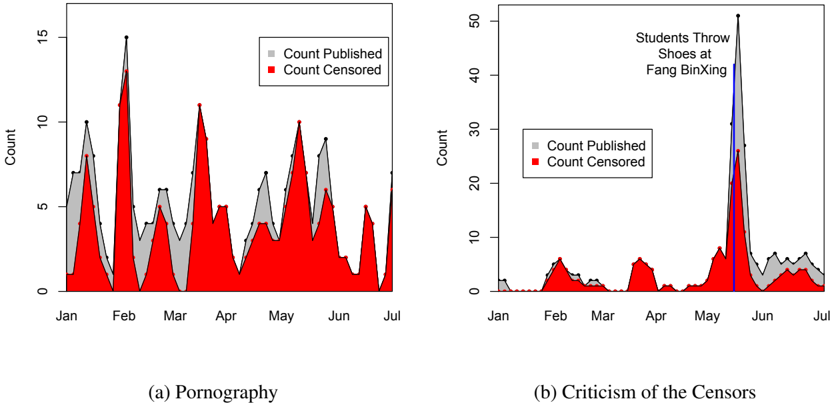
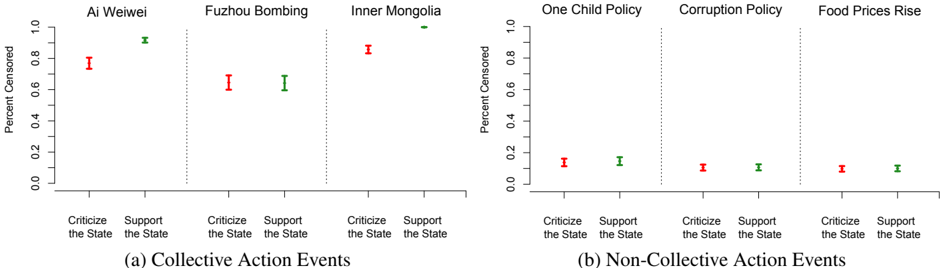
Verification
Claims the paper makes
0 Valid · 7 Not valid · 7 Not checked · 88 Own results and interpretations
A result the paper reports from its own data — it cites no other source for it, so there is none to check. The quote shows it is in the paper.
In the paper
“Our data show that the Chinese censorship program allows for a wide variety of criticisms of the Chinese government, its officials, and its policies.”
§ How Censorship in China Allows Government Criticism but Silences Collective Expression * > Outline of Results
plain- Asserted: passes — The authors put it forward as true.
- Checkable: passes — It can be checked against evidence.
- Load-bearing: passes — The paper’s conclusions depend on it.
- Based: passes — The paper gives a reason why it holds.
A result the paper reports from its own data — it cites no other source for it, so there is none to check. The quote shows it is in the paper.
In the paper
“Contrary to previous understandings, posts with negative, even vitriolic, criticism of the state, its leaders, and its policies are not more likely to be censored.”
- Also stated in: § 1 Introduction · plain
“we find that when the Chinese people write scathing criticisms of their government and its leaders, the probability that their post will be censored does not increase.”
§ How Censorship in China Allows Government Criticism but Silences Collective Expression * > Abstract
plain- Asserted: passes — The authors put it forward as true.
- Checkable: passes — It can be checked against evidence.
- Load-bearing: passes — The paper’s conclusions depend on it.
- Based: passes — The paper gives a reason why it holds.
- Also stated in: § 1 Introduction · plain
A result the paper reports from its own data — it cites no other source for it, so there is none to check. The quote shows it is in the paper.
In the paper
“Large increases in online volume are good predictors of censorship when these increases are associated with events related to collective action, e.g., protest on the ground.”
§ How Censorship in China Allows Government Criticism but Silences Collective Expression * > Outline of Results
plainstates an association- Asserted: passes — The authors put it forward as true.
- Checkable: passes — It can be checked against evidence.
- Load-bearing: passes — The paper’s conclusions depend on it.
- Based: passes — The paper gives a reason why it holds.
A result the paper reports from its own data — it cites no other source for it, so there is none to check. The quote shows it is in the paper.
In the paper
“In addition, we measure sentiment within each of these events and show that during these events, the government censors views that are both supportive and critical of the state.”
§ How Censorship in China Allows Government Criticism but Silences Collective Expression * > Outline of Results
plainstates a cause- Asserted: passes — The authors put it forward as true.
- Checkable: passes — It can be checked against evidence.
- Load-bearing: passes — The paper’s conclusions depend on it.
- Based: passes — The paper gives a reason why it holds.
A result the paper reports from its own data — it cites no other source for it, so there is none to check. The quote shows it is in the paper.
In the paper
“We thus conduct the same analysis for the demotion of Wang Lijun in Panel (c) of Figure 11, and again see a large difference in actual and predicted percent censorship before Wang's demotion.”
§ How Censorship in China Allows Government Criticism but Silences Collective Expression * > Additional information
plainSingle case- Asserted: passes — The authors put it forward as true.
- Checkable: passes — It can be checked against evidence.
- Load-bearing: unclear — It is unclear whether the paper’s conclusions depend on it.
- Based: passes — The paper gives a reason why it holds.
46 more claims
Create a free account to see all 102 claims and every source verdict.
- Probably not a substantial claim. 26
- It may state two separate claims as one. 33
Claims other papers make about this one
Each is checked against this paper’s own text: does it say what the citing paper says it does?
The source backs part of the claim, not all of it — or backs it for a different population, condition or comparison.
In the citing paper
“Authorities are keen to review social media posts and have contentious messages removed (King etal., 2013) to ensure that potential threats remain invisible.”
From How Dictators Control the Internet: A Review Essay (2020) · cites this paper as King et al., 2013
Experimental — accuracy not yet measuredThe source backs part of the claim, not all of it — or backs it for a different population, condition or comparison.
In the citing paper
“In most autocratic regimes, governmental interference in digital infrastructure and communication is commonplace.”
From How Dictators Control the Internet: A Review Essay (2020) · cites this paper as King et al., 2013
Experimental — accuracy not yet measuredThe source backs part of the claim, not all of it — or backs it for a different population, condition or comparison.
In the citing paper
“First, the timing of censorship during a coup is consistent with many studies that have shown that Internet censorship is targeted during sensitive political time periods and periods of potential power transitions, such as elections and large-scale protests [23,25,44,47,73].”
From A multi-perspective view of Internet censorship in Myanmar (2021) · cites this paper as [44]
Experimental — accuracy not yet measuredThe cited source says what the claim attributes to it.
In the citing paper
“research has shown how mobilization organized through public coordination is repressed using that very same public information-for instance, repression is preemptively increased before focal days (Truex 2019); and autocracies censor online calls for collective action (King, Pan, and Roberts 2013), coerce online opinion leaders (Pan and Siegel 2020), and at times, turn off the internet entirely.”
From Coordinated Dis-Coordination (2024) · cites this paper as King, Pan, and Roberts 2013
The check wasn’t confident either way, so it gives no verdict — never disputed.
In the citing paper
“In China, for instance, two virtual police officers remind citizens that their browsing behavior is monitored (King etal., 2013).”
From How Dictators Control the Internet: A Review Essay (2020) · cites this paper as King et al., 2013
Experimental — accuracy not yet measured
1 more claim about this paper
Create a free account to see every claim other papers make about this one.
Citations
Cites
Robust estimation of a location parameter
Huber, P. J. (1964) · The Annals of Mathematical Statistics · doi:10.1214/aoms/1177703732 · Cited by 7,228
Robust Regression and Outlier Detection
Piepel, G. F. (1989) · Technometrics · doi:10.1080/00401706.1989.10488524 · Cited by 6,144
Robust Regression and Outlier Detection
Rousseeuw, P. J., & Leroy, A. M. (1987) · Wiley Series in Probability and Statistics · doi:10.1002/0471725382 · Cited by 5,609
Logistic Regression in Rare Events Data
King, G., & Zeng, L. (2001) · Political Analysis · doi:10.1093/oxfordjournals.pan.a004868 · Cited by 4,316 · cited 1×
“We do this via well-known and widely used case-control methodology (King and Zeng 2001).”
MethodSelf-citationDemocracy and Development: Political Institutions and Well-Being in the World, 1950–1990
Przeworski, A., Alvarez, M. E., Cheibub, J. A., & Limongi, F. (2000) · doi:10.1017/cbo9780511804946 · Cited by 2,845
Rightful Resistance in Rural China
O'Brien, K. J., & Li, L. (2006) · Cambridge University Press eBooks · doi:10.1017/cbo9780511791086 · Cited by 1,104
The Dynamics of Informational Cascades: The Monday Demonstrations in Leipzig, East Germany, 1989–91
Lohmann, S. (1994) · World Politics · doi:10.2307/2950679 · Cited by 1,035 · cited 1×
“Protests in East Germany, Eastern Europe, and most recently the Middle East have all preceded regime change (Ash 2002; Lohmann 1994; Przeworski et al. 2000).”
BackgroundRightful Resistance in Rural China
O'Brien, K., & Li, L.-J. (2006) · doi:10.1017/cbo9780511791086.003 · Cited by 987
China's Changing of the Guard: Authoritarian Resilience
Nathan, A. J. (2003) · Journal of Democracy · doi:10.1353/jod.2003.0019 · Cited by 927
Sparks and prairie fires: A theory of unanticipated political revolution
Kuran, T. (1989) · Public Choice · doi:10.1007/bf00116762 · Cited by 905 · cited 1×
“In fact, Kuran (1989) and Lohmann (2002) show that it is information about a collective action event that propels collective action and so distinguishing this from explicit calls for collective action would be difficult if not impossible.”
Background
Research works printed but not linked: 13
- 22. Freedom House. 2012. "Freedom of the Press, 2012." www.freedomhouse.org.
- 8. Chang, Parris. 1983. Elite Conflict in the Post-Mao China. New York: Occasional Papers Reprints.
- 26. Hinton, Harold. 1955. The "Unprincipled Dispute" Within Chinese Communist Top Lead- ership. Washington, DC: U.S. Information Agency.
- 44. Perry, Elizabeth. 2002. Challenging the Mandate of Heaven: Social Protest and State Power in China. Armork, NY: M. E. Sharpe.
- 52. Schurmann, Franz. 1966. Ideology and Organization in Communist China. Berkeley, CA: University of California Press.
- Tsai, 2007, Capitalism without Democracy: The Private Sector in Contemporary China
- 48. Qiang, Xiao. 2011. The Rise of Online Public Opinion and Its Political Impact. In Chang- ing Media, Changing China, ed. Susan Shirk. New York: Oxford University Press pp. 202-224.
- 9. Charles, David. 1966. The Dismissal of Marshal P'eng Teh-huai. In China Under Mao: Politics Takes Command, ed. Roderick MacFarquhar. Cambridge: MIT University Press pp. 20-33.
- 54. Shirk, Susan. 2007. China: Fragile Superpower: How China's Internal Politics Could Derail Its Peaceful Rise. New York: Oxford University Press.
- 56. Teiwes, Frederick. 1979. Politics and Purges in China: Retification and the Decline of Party Norms. Armork, NY: M. E. Sharpe. Tsai, Kellee. 2007a. Capitalism without Democracy: The Private Sector in Contemporary China. Ithaca, NY: Cornell University Press.
- 15. Duan, Qing. 2007. China's IT Leadership. Vdm Verlag.
- 38. MacFarquhar, Roderick. 1974. The Origins of the Cultural Revolution Volume 1: Contra- dictions Among the People 1956-1957. New York: Columbia University Press.
- 12. Chen, Xiaoyan and Peng Hwa Ang. 2011. Internet Police in China: Regulation, Scope and Myths. In Online Society in China: Creating, Celebrating, and Instrumentalising the Online Carnival, ed. David Herold and Peter Marolt. New York: Routledge pp. 40-52.
Cited by
Items 1,501–1,600 of 2,443
Understanding digital authoritarianism in Africa: the case of Nigeria
Achinivu, C. (2025) · Journal of Contemporary African Studies · doi:10.1080/02589001.2025.2548785 · Cited by 4
“China’s is now a sophisticated ecosystem of digital control – one that does not indiscriminately censor but that targets content that might mobilize collective action while leaving an impression of openness (King, Pan, and Roberts 2013).”
“Propaganda State 2.0” in China
Han, R. (2025) · The China Quarterly · doi:10.1017/s0305741025101574 · Cited by 4
Public Participation in China's State‐Created ICT Spaces: Explaining Participation Patterns
Rabe, W., Bondes, M., Abels, C. M., & Kostka, G. (2025) · Regulation & Governance · doi:10.1111/rego.70090 · Cited by 6
Daminov, I. (2025) · Post-Soviet Affairs · doi:10.1080/1060586x.2025.2583417 · Cited by 1
“Some studies suggest that authoritarian regimes might even welcome topic-specific criticisms of the regime under certain circumstances and use them as a feedback mechanism (King, Pan, and Roberts 2013).”
Ma, M., Romanov, D., Libman, A., & Kostka, G. (2025) · Political Research Quarterly · doi:10.1177/10659129251395307 · Cited by 1
“Social media platforms are signi fi cant channels through which au-thoritarian states conduct propaganda and project narratives (Chen et al. 2024; King et al. 2013; Lu et al. 2022).”
A typology of authoritarian social policy design under uncertainty
Brik, A. B. (2025) · Policy Design and Practice · doi:10.1080/25741292.2025.2574114 · Cited by 1
“Third, in practice, authoritarian governments have relied on policy instruments that reinforce control – such as repression and selective co-optation – rather than systemic solutions, resulting in uneven and often unsustainable outcomes (Gerschewski, 2013; King, Pan and Roberts, 2013).”
InfluentialBorders in Cyberspace: Digital Sovereignty Through a Bordering Lens
Hulvey, R., & Simmons, B. A. (2025) · International Studies Quarterly · doi:10.1093/isq/sqaf047 · Cited by 2
Communication Games to Study Emerging Disinformation Scenarios With LLMs
Lim, G., Tan, B. C. Z., Sim, K., Shi, W., Chew, M. H., Hee, M. S., Lee, R. K.-W., Perrault, S. T., & Choo, K. T. W. (2025) · ACM Conference on Computer Supported Cooperative Work (CSCW) · doi:10.1145/3715070.3749236 · Cited by 1
“As a result, research often relies on retrospective methods like content analyses [24, 34, 41, 52] and algorithmic signals [2, 19, 28, 50], limiting our understanding of how deceptive strategies evolve during an ongoing interaction.”
Friends and enemies: external threats and the delegitimization of foreign media in China
Lim, L. (2025) · Contemporary Politics · doi:10.1080/13569775.2025.2586182 · Cited by 1
“…as possessing one of the most sophisticated systems of information control in the world, comprising censorship of the Internet (Han & Shao, 2022; King et al., 2013; Lorentzen, 2014; Roberts, 2018), the use of propaganda in the party press (Carter & Carter, 2023; Huang, 2015b; Mattingly & Yao,…”
Internet Censorship in Authoritarian Contexts: A Case Study of Kazakhstan
Rakhmetov, B. (2025) · Journal of Eurasian Studies · doi:10.1177/18793665251411329 · Cited by 5
“Internet censorship, de fi ned as state-led efforts to suppress, restrict, or control the fl ow of online content (King et al., 2013; Robert, 2018), has become a key instrument of state power in the digital era, with scholars examining its evolution and diverse forms.”
Making a Career in Dictatorship: The Secret Logic behind Repression and Coups
Gläßel, C., & Scharpf, A. (2025) · doi:10.1093/9780197831229.001.0001 · Cited by 1
Civilizational dissonance: Alexander Dugin and the limits of Sino-Russian ideological convergence
Laruelle, M. A., & Liu, V. (2026) · Studies in East European Thought · doi:10.1007/s11212-025-09825-8 · Cited by 3
“Similarly, King et al. (2013) argue that China’s censorship system is not designed simply to suppress all dissenting ideas, but rather to manage discourse strategically—allowing some criticism while curbing collective mobilization—to calibrate responsiveness and protect regime legitimacy.”
Weaponizing emotion: Chinese Communist Youth League’s soft propaganda on Douyin
Yan, Z., Li, A., & Wang, H. (2026) · Asian Journal of Communication · doi:10.1080/01292986.2025.2612172 · Cited by 1
“…have focused more on the role of formal education, traditional media, infrastructures, along with censorship tech - niques (Harwit & Clark, 2001; King et al., 2013; Rosen, 1993; Zhao, 1998), recent scholar-ship has highlighted the trend of ‘ideotainment’, a strategy that fuses elements of…”
Strategies of political control and regime survival in autocracies
Kim, W., Nazrullaeva, E., Neundorf, A., Northmore‐Ball, K., & Tertytchnaya, K. (2026) · Democratization · doi:10.1080/13510347.2025.2611256 · Cited by 3
Li, Y., Yu, H., & Li, N. (2026) · Public Performance & Management Review · doi:10.1080/15309576.2026.2616447 · Cited by 1
Ding, W., Bhuiyan, H., & Hossain, M. K. (2026) · IEEE Access · doi:10.1109/access.2026.3664185 · Cited by 2
“From a computational social science perspective, social media platforms like Weibo serve as a unique ‘sensor’ for Chinese public opinion dynamics, where user interactions reflect the complex interplay between state policy communication and individual interest expression [13], [14].”
Zou, W., & Liang, P. (2026) · Journal of Development Economics · doi:10.1016/j.jdeveco.2026.103757 · Cited by 1
The “Solo of Deliberator”: Political Deliberation and Discourse Quality in China’s Cyberspace
Guan, T., & Chen, X. (2026) · Social Media + Society · doi:10.1177/20563051261419385 · Cited by 1
“The internet in the Chinese context is often theorized to function as a “safety valve” (MacKinnon, 2011), a digital domain for dissipating public dissent on issues like income disparity or corruption, thereby mitigating social unrest (e.g. King et al., 2013).”
Violence against journalists and freedom of the press: Evidence from Mexico
Jurado, A. C. C., & Morales, J. S. (2026) · Journal of Development Economics · doi:10.1016/j.jdeveco.2026.103775 · Cited by 4
“Journalism is dead”? Digital press criticism and challenges to media legitimacy in China
Wang, H., Wan, C., & Nolan, D. (2026) · Chinese Journal of Communication · doi:10.1080/17544750.2026.2630317 · Cited by 1
Autocratization through academic capture: When and how would-be autocrats threaten academic freedom
Panaro, A. V. (2026) · International Journal of Educational Research · doi:10.1016/j.ijer.2026.102984 · Cited by 3
Zhou, S., & Yang, X. (2026) · Asian Journal of Communication · doi:10.1080/01292986.2026.2649635 · Cited by 1
“Institutionalized and politically oriented media enjoy advantages in transmitting legitimacy signals and authoritative narratives (People’s Daily, 2025), whereas social media operated by individuals and foreign media face substantial structural constraints (King et al., 2013; Tai, 2014).”
Digital nationalism and internalized misogyny: gendered discourses in China’s digital spaces
Sun, L. (2026) · Humanities and Social Sciences Communications · doi:10.1057/s41599-026-07175-2 · Cited by 3
“xpression of collective action and political activism on the Chinese internet frequently attracts surveillance and censorship (King et al., 2013; Wallis, 2015).”
Generative AI So White: Racial Biases in AI Imagery Across the United States and China
Wang, Z., Zhu, J., Wang, Z., Zhai, V. J., & Wu, J. (2026) · Science Communication · doi:10.1177/10755470261428542 · Cited by 4
“…normative categories of womanhood and manhood (Spivak, 1988), they enact a form of epistemic violence that stabilizes gen-dered hierarchies and participate in a broader rationality of rule that organizes online censorship and digital governance in China (King et al., 2013; Z. Wang et al., 2023).”
Social media influence on collaborative planning: framing strategies in online public participation
He, J., Li, Z., Lin, Y., Hooimeijer, P., & Monstadt, J. (2026) · Planning Practice and Research · doi:10.1080/02697459.2026.2665271 · Cited by 3
杨, 燕., & Yang, Z. (2026) · Journal of Chinese Political Science · doi:10.1007/s11366-026-09946-9 · Cited by 3
Outsourcing Surveillance: Online Opinion Management in China
Ong, L. H., Nie, H., & Lee, J. (2026) · Cambridge University Press eBooks · doi:10.1017/9781009631969 · Cited by 2
Duan, C., Jia, Z., & Chen, S. (2026) · Global Public Policy and Governance · doi:10.1007/s43508-026-00149-9 · Cited by 1
“Prior research has largely equated closer departmen - tal proximity to the power center with heightened perceived pressure and correspond - ingly higher responsiveness (Du & Zhu, 2024 ; King et al., 2013).”
Ren, L., & Wang, R. (2026) · Governance · doi:10.1111/gove.70142 · Cited by 1
Deescalating a Trade War: Strategies of Reciprocation amid US-China Great Power Competition
Quek, K., & Yeung, E. S. F. (2026) · Cambridge University Press eBooks · doi:10.1017/9781009659208 · Cited by 1
Yang, L., Lin, Q., & Lin, Z. (2026) · Media and Communication · doi:10.17645/mac.12302 · Cited by 1
“As King et al. (2013) demonstrate, sharp criticism may remain online for a period, yet once a topic signals mobilization, intervention tends to be swift and stringent.”
The Diffusion of Microblogging in the Public Sector: Evidence from Chinese Provinces
Ma, L. (2015) · Public administration and information technology · doi:10.1007/978-3-319-17722-9_10 · Cited by 1
Conclusioni: Dai social media alla politica (e ritorno)
Cerón, A., Curini, L., & Iacus, S. M. (2014) · SxI Springer per l'Innovazione · doi:10.1007/978-88-470-5532-2_5 · Cited by 1
Gagliardone, I., & Trinchero, D. (2014) · JUNCO | Journal of UNiversities and international development COoperation · doi:10.13135/2531-8772/599 · Cited by 1
CAN WE SAY MORE NOW? A CLOSER LOOK AT ONLINE PUBLIC OPINION CHANGE IN CHINA
Duan, R. (2013) · UKnowledge (University of Kentucky) · Cited by 1
Editors' Introduction to Technology, Data, and Politics
Greitens, S. C., & Koehler‐Derrick, G. (2013) · PS Political Science & Politics · doi:10.1017/s1049096513000255 · Cited by 1
“…and Weidmann 2012); and non-Western Data, and Politics ........................................................................................................................ blogs, microblogs, and website content (Bamman, O’Connor, and Smith 2012; King, Pan, and Roberts 2012; Nielsen 2012).”
Internationale Dimensionen des »chinesischen« Internets
Noesselt, N. (2014) · Zeitschrift für Internationale Beziehungen · doi:10.5771/0946-7165-2014-1-161
Moody, P. R. (2015) · Springer eBooks · doi:10.1007/978-3-658-11181-6_7 · Cited by 1
Virtual public sphere: the potential of democratization
Antonyuk, A. M. (2016) · Vestnik Tomskogo gosudarstvennogo universiteta Filosofiya Sotsiologiya Politologiya · doi:10.17223/1998863x/33/15 · Cited by 1
Microblogs, Jasmine Revolution, and Civil Unrest
Yang, K. C. C., & Kang, Y. (2015) · Advances in electronic government, digital divide, and regional development book series · doi:10.4018/978-1-4666-8502-4.ch007 · Cited by 1
Fowler, J. H., Mocanu, D., STEINERT-THRELKELD, Z., & Vespignani, A. (2014) · Cited by 1
Social Stability and Promotion in the Communist Party of China
Mirić, S. (2018) · Digital Commons - USU (Utah State University) · doi:10.26076/bbaf-6e61 · Cited by 1
WHAT IS BEYOND THE FAÇADE? RESEARCH PROGRAM OF E-PARTICIPATION IN NON-DEMOCRACIES
Kabanov, Y. (2018) · Вестник Пермского университета Политология · doi:10.17072/2218-1067-2018-3-50-66 · Cited by 4
Post factum clarity: failure to identify spontaneous threats
Dvir, R. (2018) · Intelligence & National Security · doi:10.1080/02684527.2018.1560604 · Cited by 1
Aligning Media Policy with Executive Dominance
George, C. (2019) · Springer eBooks · doi:10.1007/978-981-13-1556-5_10 · Cited by 2
Feng Shui, Science, and Politics in Contemporary China
Matthews, M. R. (2019) · Science: Philosophy, history and education · doi:10.1007/978-3-030-18822-1_9 · Cited by 1
#TurkeyIsNotAChicken: How Pro-government Netizens Explain the Coup Attempt to Western Audiences
Yeşil, B. (2019) · Middle East Journal of Culture and Communication · doi:10.1163/18739865-01202002 · Cited by 3
Doing Labor Activism in South China: The Complicity of Uncertainty
Pan, D. (2020) · Routledge eBooks · doi:10.4324/9780367810092 · Cited by 2
China und Hongkong am Scheideweg
Cantoni, D. (2020) · Perspektiven der Wirtschaftspolitik · doi:10.1515/pwp-2020-0014 · Cited by 2
Social Transformation and Digital Cultures in the Post-Reform Era
Peng, A. Y. (2020) · Springer eBooks · doi:10.1007/978-3-030-59969-0_2 · Cited by 1
Wrongful Convictions: A Comparative Perspective
Zalman, M. (2016) · Cambridge University Press eBooks · doi:10.1017/9781108550710.027 · Cited by 2
Promoting and Controlling the China Dream: China’s External Propaganda and Repression
Dukalskis, A. (2021) · Oxford University Press eBooks · doi:10.1093/oso/9780197520130.003.0006 · Cited by 2
Bartlett, R. S. (2014) · ScholarsArchive (Brigham Young University) · Cited by 2
What Can Comparative Authoritarianism Tell Us About China Under Xi Jinping (and Vice Versa)?
Tung, H. H., & Wu, W. (2021) · Issues & Studies · doi:10.1142/s1013251121500132 · Cited by 1
(2020) · International Journal of Innovative Technology and Exploring Engineering · doi:10.35940/ijitee.l1013.10812s319 · Cited by 1
「幸福な監視国家」の経済学: ―産業政策・監視技術・文化対立―
梶谷, 懐. (2022) · Japanese Journal of Comparative Economics · doi:10.5760/jjce.59.1_1 · Cited by 1
A Decade in Pixels: Analyzing Incidents of State-Sponsored Surveillance From the Last Decade
Vats, A., & Masoni, C. (2022) · Advances in information security, privacy, and ethics book series · doi:10.4018/978-1-7998-8641-9.ch014 · Cited by 1
Regional variation in Chinese internet fi ltering
Wright, J. (2016) · Routledge eBooks · doi:10.4324/9781315744117-16 · Cited by 1
Overview: Strengthening the analog foundation of the digital revolution
Bank, W. (2016) · World Bank, Washington, DC eBooks · doi:10.1596/978-1-4648-0671-1_ov · Cited by 3
Wolfsfeld, G., Sheafer, T., & Althaus, S. L. (2022) · Oxford University Press eBooks · doi:10.1093/oso/9780197634998.003.0002 · Cited by 1
Cao, J., & Chen, Y. (2022) · Economic and Industrial Democracy · doi:10.1177/0143831x221119259 · Cited by 3
“…the Internet is more difficult to control while, at the same time, the Chinese government has a higher tolerance for freedom of speech enacted via the Internet, even permitting online criticisms of the government (King et al., 2013); this means that workers are enjoying more freedom of expression.”
BackgroundWallace, J. (2022) · Oxford University Press eBooks · doi:10.1093/oso/9780197627655.003.0006 · Cited by 1
Ma, Z. (2023) · Réseaux · doi:10.3917/res.236.0211 · Cited by 2
Armed forces and airwaves: media control and military coups in autocracies
Eschenauer-Engler, T. (2023) · Contemporary Politics · doi:10.1080/13569775.2023.2173874 · Cited by 2
“…(digital) media (cf. Diamond, 2010; Groshek, 2009), others emphasise that media can become a tool of repression and authoritarian resilience (e.g. King et al., 2013; Rød & Weidmann, 2015; Stockmann & Gallagher, 2011) or find that freer media can actually serve autocrats’ interests (Egorov et…”
BackgroundEsuli, A., Fabris, A., Moreo, A., & Sebastiani, F. (2023) · The information retrieval series · doi:10.1007/978-3-031-20467-8_1 · Cited by 1
Die Regulierung von Internetinhalten am Beispiel Hassrede: Ein Forschungsüberblick
Schünemann, W. J., & Steiger, S. (2023) · Springer eBooks · doi:10.1007/978-3-662-65964-9_8 · Cited by 5
Sentiment Gradient - Improving Sentiment Analysis with Entropy Increase
da Silva, F. C. D., García, A. C. B., & Siqueira, S. W. M. (2023) · INTELIGENCIA ARTIFICIAL · doi:10.4114/intartif.vol26iss71pp114-130 · Cited by 1
“Humans communicate by humor as it delivers a serious message in popular and light way, therefore it is common to encounter such figurative language in social media, in services/product reviews as well as critiques to society and politics (even more on strict governments) [13].”
BackgroundGovernmental information hoarding and its effects on journalism practice
Bakata, N. B., Ngange, K. L., Assala, L.-C. B., & Ndod, S. N. (2023) · Corporate Law & Governance Review · doi:10.22495/clgrv5i1p12 · Cited by 3
“…are relevant to this study because they portray that the government has a way of gatekeeping some information from media personnel and this has various effects as it encourages malpractices, makes audiences passive, limits transparency, and promotes little or no accountability (King et al., 2013).”
BackgroundInfluentialTheory-Grounded Computational Text Analysis
McCarthy, A. D., & Dore, G. M. D. (2023) · Proceedings of the conference - Association for Computational Linguistics. Meeting · doi:10.18653/v1/2023.acl-short.136 · Cited by 7
“They uncover more descriptive findings in data: the rate of an apple’s fall, the topics of refugees’ tweets (Walk et al., 2022), the space given to marginalized groups in textbooks (Lucy et al., 2020), or patterns of state censorship (Bamman et al., 2012; King et al., 2013).”
BackgroundKo, J. (2023) · Oxford University Press eBooks · doi:10.1093/oso/9780197684566.003.0001 · Cited by 1
China’s Popular Journalism in the Digital Media Era
Huang, C. (2023) · East Asian popular culture · doi:10.1007/978-3-031-40530-3_6 · Cited by 1
Pan, Y., & Shu, Z. (2023) · Chinese Journal of Communication · doi:10.1080/17544750.2023.2293860 · Cited by 2
“Evidence suggests that negative online comments about the government are tolerated as long as they do not incite collective activities (King et al., 2013).”
Pernia, R. A. (2023) · Asian Journal of Political Science · doi:10.1080/02185377.2023.2293708 · Cited by 1
“Even with the advent of the so-called ‘ Big data ’ revolution, causal inference is instrumental in explaining, for instance, the Chinese authoritarian regime ’ s censorship mechanisms (King et al., 2013, 2014).”
MethodSOSYAL MEDYA EKSENLİ DİJİTAL SEFERBERLİK VE PROTESTO HAREKETLERİ ÜZERİNE BİR LİTERATÜR İNCELEMESİ
MOUSAVİ, S., & Törenli, N. (2023) · Intermedia International e-journal · doi:10.56133/intermedia.1348867 · Cited by 3
Lifu, G. (2024) · De Gruyter eBooks · doi:10.1515/9783110767995-010 · Cited by 2
Land: Presence and Credibility
Gartzke, E. A., Lindsay, J. R., & Kagotani, K. (2024) · Oxford University Press eBooks · doi:10.1093/oso/9780197754443.003.0008 · Cited by 1
Consequences of democratic backsliding in popular culture: evidence from blacklist in South Korea
Son, B. (2024) · Democratization · doi:10.1080/13510347.2024.2343103 · Cited by 3
The Supply of Digital Authoritarianism to Africa: an Empirical Study
Achinivu, C. (2024) · The African Review · doi:10.1163/1821889x-bja10110 · Cited by 3
Wang, C., & Westwood, S. J. (2024) · The China Quarterly · doi:10.1017/s030574102400047x · Cited by 3
Rights in China: Myths, Abuses, and Politics
Liu, S., & Li, S. (2024) · Annual Review of Sociology · doi:10.1146/annurev-soc-090523-050016 · Cited by 6
Song, Y., Xu, R., Huang, Y. C., Ni, S., & Fan, Y. (2024) · Social Science Computer Review · doi:10.1177/08944393241258217 · Cited by 1
“Studies show that Chinese of fi cials respond to the public ’ s agenda to seek advancement by maintaining political stability (King et al., 2013).”
Media Censorship and Consumer Identity
Александровна, Л. П., & Kim, T. (2024) · Journal of the Association for Consumer Research · doi:10.1086/731918 · Cited by 2
Kang, S., & Petrova, M. G. (2024) · Journal of Civil Society · doi:10.1080/17448689.2024.2397461 · Cited by 2
“Censorship in autocratic contexts such as China tends to target remarks on social media associated with citizens’ mobilization, thereby seeking to stifle collective dissent (King et al., 2013).”
Informed Inattention: How Political Connections Undermine Judicial Responsiveness in China
Guo, Z., Li, Z., & Lin, T. (2024) · Chinese Political Science Review · doi:10.1007/s41111-024-00260-4 · Cited by 3
“These findings contradict the conventional wisdom that the Chinese government is predisposed to respond more actively to societal threats (King et al. 2013; Chen et al. 2016).”
InfluentialThe Ethical Consideration of Datafication in Platforms: The Case of Chinese Social Credit SEP
Zheng, Z., & Hu, A. (2024) · Springer eBooks · doi:10.1007/978-981-97-5404-5_7 · Cited by 1
Xi Jinping’s Important Speeches as Data
Asei, I., Jaehwan, L., & Hongyong, Z. (2024) · Asia-Pacific Review · doi:10.1080/13439006.2024.2398371 · Cited by 1
“In elucidating the governance mechanisms of authoritarian regimes, text data has made fresh academic contributions in empirical research on censor-ship (King, Pan, and Roberts 2013) and in issues such as measuring the ideological shifts of political leaders (Guriev and Treisman 2019).”
Bogs, A. (2024) · Regulation & Governance · doi:10.1111/rego.12646 · Cited by 4
Oversight of the Legal System in an Authoritarian Regime: Police and Court Monitoring in Russia
McCarthy, L. A. (2025) · Journal of Law and Courts · doi:10.1017/jlc.2024.27 · Cited by 2
Egorov, G., & Сонин, К. И. (2025) · Springer eBooks · doi:10.1007/978-3-031-50810-3_10 · Cited by 2
Propaganda and Blame Attribution during Economic Downturns: Evidence from China
Elfström, M., & Li, X. (2025) · Studies in Comparative International Development · doi:10.1007/s12116-025-09466-2 · Cited by 6
Wu, W., Liu, J., Fleming, K., & Lu, X. (2025) · Mass Communication & Society · doi:10.1080/15205436.2025.2494759 · Cited by 3
“In China, active government involvement in social media content may further influence discussion dynamics by prioritizing specific narratives (King et al., 2013).”
Liu, Z. J. (2025) · Journal of the European Economic Association · doi:10.1093/jeea/jvaf018 · Cited by 4
Stockmann, D., & Luo, T. (2025) · Regulation & Governance · doi:10.1111/rego.70036 · Cited by 2
Shaking hands in public. What elite co-appearances tell us about the politics behind the scenes.
Keller, F. (2015) · Cited by 2
Internet Censorship in China: Examining User Awareness
Wang, D. (2015) · Cited by 1
A Gradual Political Change? The Agenda Setting Effect of Online Activism in China 1994-2011
Yuan, Y. (2016) · Advances in public policy and administration (APPA) book series · doi:10.4018/978-1-5225-1081-9.ch014 · Cited by 1
Paradise, Panopticon, or Laboratory? A Tale of the Internet in China
Wang, D., & Wang, K. C. (2016) · Philosophy of engineering and technology · doi:10.1007/978-3-319-45538-9_7 · Cited by 1
Concept, Chronology, and Drivers of Transparency Reform
Stromseth, J. R., Malesky, E. J., Gueorguiev, D. D., Hairong, L., Xixin, W., & Brinton, C. (2017) · Cambridge University Press eBooks · doi:10.1017/9781316388501.003 · Cited by 1
Disrespect for Human Rights and Contentious Participation: Evidence from China
Wang, C., Weng, D. L.-C., Barnstead, L., & Dumond, G. K. (2017) · Journal of Chinese Political Science · doi:10.1007/s11366-017-9475-x · Cited by 1
“with political rights to participate in politics without harsh constraints and physical punishments, the Chinese government has placed serious restrictions prohibiting its citizens from engaging in any form of collective action [16].”
Background
Metadata
- Authors
- KING, G., PAN, J., & ROBERTS, M. E.
- Affiliations
- Harvard University (US)
- Corresponding author
- KING, GARY
- PAN, JENNIFER
- Venue
- American Political Science Review
- Publisher
- Cambridge University Press (CUP)
- Published
- 2013-05
- Volume
- 107
- Issue
- 2
- Pages
- 326-343
- ISSN
- 0003-0554 (ISSN-L)
- 1537-5943
- OpenAlex
- W2144188763
- Cited by
- 2,415
- References
- 48
- Citations by year
- 2026: 161 · 2025: 206 · 2024: 249 · 2023: 272 · 2022: 230 · 2021: 193 · 2020: 206 · 2019: 157 · 2018: 178 · 2017: 153 · 2016: 137 · 2015: 120 · 2014: 91 · 2013: 54
- FWCI
- 395.09
- Type
- journal article
- Language
- en
- Open access
- green
- nrs.harvard.edu
- Licence
- Locations
- American Political Science Review (publishedVersion)
- Digital Access to Scholarship at Harvard (DASH) (Harvard University) (submittedVersion, cc-by)
- RePEc: Research Papers in Economics (submittedVersion)
- Topics
- Social Sciences › Communication › Social Media and Politics
- Social Sciences › Law › Freedom of Expression and Defamation
- Social Sciences › Sociology and Political Science › Media Influence and Politics
- Keywords
- internet censorship, Chinese government, social media, collective action, social mobilization, political criticism, online speech
About these checks
Registry, retraction, Cites and statistics results are computed, not judged, with one exception: a printed reference that no index lists is read once by a model before it counts as a citation error. Claims are extracted by a model and kept only when their quote appears verbatim in the text; each cited source is then checked, with a model’s help, for whether it says what the claim relies on. Those verdicts can be wrong — read the claim’s quote and the cited source before relying on one.
A language model drew the claims from the paper on 2026-10-11, under version 3 of the claim definition (model deepseek-v4.1-flash, prompt extract-v3).
A second model labelled each claim on 2026-10-11 (model jev-1.13-20260917, definition revision gold-guideline-v0.2).
Statistics and arithmetic are recomputed, not judged.
Confidence bands are shown only for fields calibrated on our annotated test set. None is calibrated yet, so no band is shown.
What counts as a claim ›How we measure confidence ›How we check this ›
Are you an author, or do you see a problem with this page? Request a review
Data sources
Bibliographic data: Semantic Scholar, OpenAlex, Crossref.
Contains information from the Semantic Scholar Academic Graph Datasets, made available under the ODC Attribution License (ODC-BY 1.0).
Semantic Scholar’s data is described in: Kinney, R., et al. (2023). The Semantic Scholar Open Data Platform. arXiv:2301.10140.
