

Reconsidering the Role of Procedures for Decision Acceptance
Open accessThe DOI matches its Crossref record; 87 of the 87 references it cites were found in a registry or an index.
Abstract
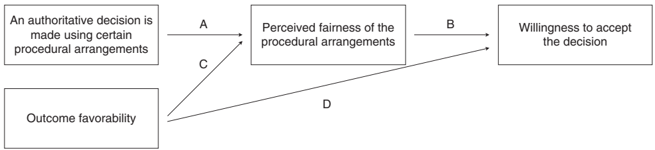
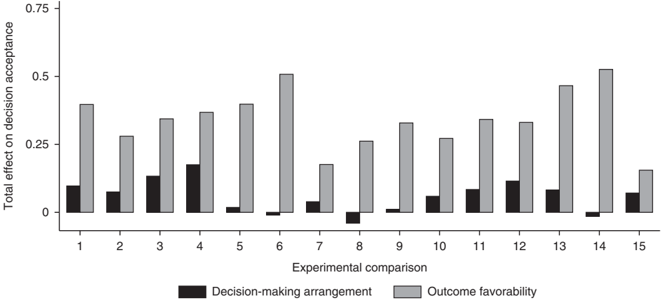
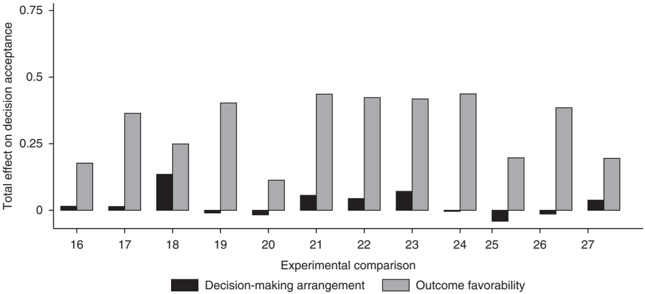
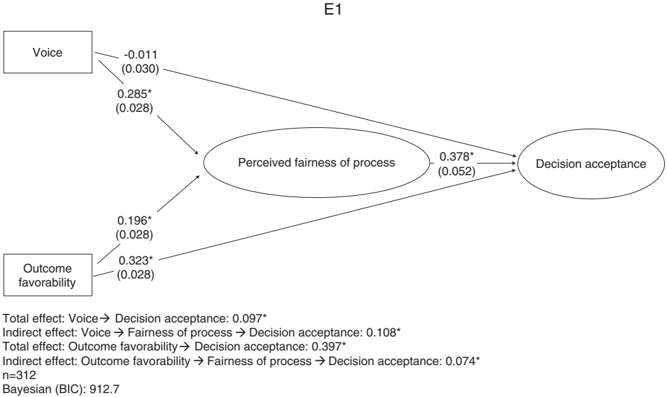
Procedural fairness theory posits that the way in which authoritative decisions are made strongly impacts people’s willingness to accept them. This article challenges this claim by contending that democratic governments can achieve little in terms of acceptance of policy decisions by the procedural means at their disposal. Instead, outcome favorability is the dominant determinant of decision acceptance. The article explicates that while central parts of procedural fairness theory are true, outcome favorability is still overwhelmingly the strongest determinant of individuals’ willingness to accept authoritative decisions. It improves on previous research by locating all key variables into one causal model and testing this model using appropriate data. Findings from a large number of experiments (both vignette and field) reproduce the expected relationships from previous research and support the additional predictions.
Overview
The claims and statistics of this paper haven’t been checked yet.
Free: it reads the open-access text and checks the first 5 claims that cite a source we can check. Create a free account to check every claim.
Integrity signals
Registry
Cites
Statistics
Figures

Verification
Claims the paper makes
The claims and statistics of this paper haven’t been checked yet.
Free: it reads the open-access text and checks the first 5 claims that cite a source we can check. Create a free account to check every claim.
Self-check
Percentages, sums and reported differences re-computed from the paper’s own numbers.
The self-check needs the paper’s full text.
Citations
Cites
Advances In Experimental Social Psychology
(2022) · Advances in Experimental Social Psychology · doi:10.1016/s0065-2601(22)x0002-6 · Cited by 22,259
Mediation in experimental and nonexperimental studies: New procedures and recommendations.
Shrout, P. E., & Bolger, N. (2002) · Psychological Methods · doi:10.1037/1082-989x.7.4.422 · Cited by 11,335 · cited 1×
“51 Shrout and Bolger 2002.”
The case for motivated reasoning.
Kunda, Z. (1990) · Psychological Bulletin · doi:10.1037/0033-2909.108.3.480 · Cited by 9,022
The Social Psychology of Procedural Justice
Lind, E. A., & Tyler, T. R. (1988) · Critical Issues in Social Justice · doi:10.1007/978-1-4899-2115-4 · Cited by 6,585
Participation and Democratic Theory
Pateman, C. (1970) · doi:10.1017/cbo9780511720444 · Cited by 6,159
Motivated Skepticism in the Evaluation of Political Beliefs
Taber, C. S., & Lodge, M. (2006) · American Journal of Political Science · doi:10.1111/j.1540-5907.2006.00214.x · Cited by 4,344
Procedural Justice: A Psychological Analysis
Thibaut, J. W., & Walker, L. (1975) · Medical Entomology and Zoology · Cited by 3,241
A Relational Model of Authority in Groups
Tyler, T. R., & Lind, E. A. (1992) · Advances in Experimental Social Psychology · doi:10.1016/s0065-2601(08)60283-x · Cited by 2,977
Procedural Justice: A Psychological Analysis
Caldeira, G. A., Thibaut, J., Walker, L., & Nagel, S. S. (1976) · The Western Political Quarterly · doi:10.2307/448155 · Cited by 2,907
Interactional justice : communication criteria of fairness
Bies, R. (1986) · Medical Entomology and Zoology · Cited by 2,761
Research works printed but not linked: 4
- Tyler, Tom. 1990. Why People Obey the Law: Procedural Justice, Legitimacy and Compliance. New Haven, CT: Yale University Press.
- Muthen, Linda, and Muthen Bengt. 1998-2010. Mplus Users' Guide, 6th Edition, Los Angeles, CA: Muthen and Muthen.
- --. 2006. Psychological Perspectives on Legitimacy and Legitimation. Annual Review of Psychology 57:375-400.
- Tom, and Steven Blader. 2003. The Group Engagement Model: Procedural Justice, Social Identity, and Cooperative Behavior. Personality and Social Psychology Review 7:349-61.
Cited by
Items 101–200 of 241
Zhelyazkova, A., Lindner, T., Heinkelmann‐Wild, T., & Kanas, A. (2025) · Governance · doi:10.1111/gove.70065 · Cited by 5
All on board? The role of institutional design for public support for differentiated integration
de Blok, L., Heermann, M., Schuessler, J., Leuffen, D., & Vries, C. E. D. (2024) · European Union Politics · doi:10.1177/14651165241246384 · Cited by 5
“…fairness research where it has repeatedly been shown that the fairness of procedures is closely linked to other core facts of legitimacy, such as decision acceptance and trust in authorities (e.g. Esaiasson et al., 2019; Grimes, 2006), while legitimacy in turn encourages consent (Tyler, 2003).”
Public opinion towards interest groups: The differential impact of ties to cause and business groups
Rasmussen, A., & Reher, S. (2025) · European Journal of Political Research · doi:10.1111/1475-6765.12716 · Cited by 5
Baccini, A., & Re, C. (2025) · Scientometrics · doi:10.1007/s11192-025-05255-9 · Cited by 5
“It is a signal that people subjected to the decision are respected, that decision-makers can be trusted and that the final decision can be considered fair (Esaiasson et al., 2019, p. 293).”
Who Should Get a Say? Race, Law Enforcement Guidelines, and Systems of Representation
Kevins, A., & Robison, J. (2020) · Political Psychology · doi:10.1111/pops.12688 · Cited by 5
Practicing Ballot Secrecy: Postal Voting and the Witness Requirement at the 2019 Finnish Elections
Weide, M. (2021) · Frontiers in Political Science · doi:10.3389/fpos.2021.630001 · Cited by 5
Agerberg, M., & Wängnerud, L. (2025) · American Journal of Political Science · doi:10.1111/ajps.70021 · Cited by 4
Demokratiezufriedenheit und Institutionenvertrauen in Baden-Württemberg
Vetter, A., & Brettschneider, F. (2023) · Zeitschrift für Politikwissenschaft · doi:10.1007/s41358-023-00358-2 · Cited by 4
Zanani, A. K. (2024) · Journal of Public Child Welfare · doi:10.1080/15548732.2024.2439314 · Cited by 4
“Lastly, decisions that benefit citizens have been shown to be a key factor in citizens’ evaluation of the state and trust in the government (Allen & Birch, 2015; Esaiasson et al., 2016; Hansen, 2021; Van Ryzin, 2011).”
Negative References to Amicus Briefs in Judicial Reasoning
Lindholm, J., Naurin, D., & Schroeder, P. A. (2025) · Journal of Law and Courts · doi:10.1017/jlc.2025.4 · Cited by 4
Alıca, B., & Schakel, A. H. (2025) · Journal of Public Policy · doi:10.1017/s0143814x25000066 · Cited by 4
“…that the degree to which a decision coincides with an individual ’ s preference is the dominant determinant of support for a decision (Arnesen 2017; Esaiasson et al. 2019; 7 The impact of a preference for self-rule can be mainly ascribed to self-rule item 1 ( “ having power divided up between…”
InfluentialOutcome Isn’t Everything: Electoral Consequences of Implementing or Withdrawing Unpopular Policies
Gren, S., & Leuschner, E. (2024) · Political Behavior · doi:10.1007/s11109-024-09936-8 · Cited by 4
“Here, research on responsive policymaking and procedural fairness during the policymaking process offers an interesting starting point (e.g., Esaiasson et al., 2016; Grimes & Esaiasson, 2014).”
EU intervention vs. national autonomy: do citizens really care?
Oger, S. A. S. D., & Sánchez-Cuenca, I. (2020) · European Politics and Society · doi:10.1080/23745118.2020.1865061 · Cited by 4
“Our findings on Spain are matched by a growing stock of empirical evidence by comparativists (Arnesen, 2017; Esaiasson et al., 2019; FernandezAlbertos & Kuo, 2020; Werner, 2020).”
ResultBradford, B., Creutzfeldt, N., & Steffek, F. (2022) · Law & Social Inquiry · doi:10.1017/lsi.2022.55 · Cited by 5
“…favorable outcome, and, if it is the case that favorable outcomes shape perceptions of procedural justice, then it may be the outcome, not the quality of the process, that accounts for satisfaction, trust in the decision maker, legitimacy, and so on (Doherty and Walak 2012; Esaiasson et al. 2019).”
BackgroundDemokratie als Selbst-Regieren
Geißel, B. (2024) · Verlag Barbara Budrich eBooks · doi:10.2307/jj.17207124 · Cited by 4
Broderstad, T. S., Arnesen, S., Johannesson, M. P., & Linde, J. (2025) · Scandinavian Political Studies · doi:10.1111/1467-9477.70011 · Cited by 4
Electoral input and political legitimacy
Stiers, D. (2025) · West European Politics · doi:10.1080/01402382.2025.2521591 · Cited by 5
How Men React to Shifts in Gender Representation: Ignored Interests? Good for Society?
Reidinger, V. (2025) · Political Research Quarterly · doi:10.1177/10659129251364219 · Cited by 3
“…that citizens ’ satisfaction with institutions is in fl uenced by their perceptions of how these institutions function procedurally — particularly the fairness of the conditions under which they operate (Easton 1965; Esaiasson et al. 2019; Esaiasson et al. 2012; Folger 1984; Lind and Tyler 1988).”
Confronting value-based argumentation frameworks with people’s assessment of argument strength
Bodanza, G. A., & Freidín, E. (2023) · Argument & Computation · doi:10.3233/aac-220008 · Cited by 3
“This is in line with findings about the influence of leniency bias on mock jury deliberations [39] and the outcome favorability as a strong determinant of individuals’ willingness to accept authoritative decisions [32].”
Lingier, L. (2024) · Electoral Studies · doi:10.1016/j.electstud.2024.102769 · Cited by 3
Do the origins of climate assemblies shape public reactions? Examining the impact of partisanship
Kevins, A., & Robison, J. (2025) · European Journal of Political Research · doi:10.1111/1475-6765.12743 · Cited by 3
“…have a stronger impact on evaluations than procedural ones, factors that promote perceived fairness and unbiasedness are important because they may improve legitimacy perceptions even among those who stand to lose from the institution’s actions (Esaiasson et al., 2019; Werner & Marien, 2022).”
Šerek, J., Mužík, M., Lomičová, L., & Juhová, D. S. (2021) · Acta Politica · doi:10.1057/s41269-021-00217-4 · Cited by 3
Rose, J., & van der Eijk, C. (2022) · Societies · doi:10.3390/soc12030085 · Cited by 3
Outcomes or participation? Experimentally testing competing sources of legitimacy for taxation
Engel, C., Mittone, L., & Morreale, A. (2023) · Economic Inquiry · doi:10.1111/ecin.13188 · Cited by 5
Judge-Made Lore: Public Management and Public Authority
Prebble, M. (2020) · Perspectives on Public Management and Governance · doi:10.1093/ppmgov/gvaa021 · Cited by 3
Pragmatic citizens: A bottom-up perspective on participatory politics
Werner, H. (2020) · UvA-DARE (University of Amsterdam) · Cited by 17
Does civilian oversight impact police legitimacy?
Schiff, K. J., Schiff, D. S., Moy, B. J., McCrain, J., Mourtgos, S. M., & Adams, I. T. (2025) · PNAS Nexus · doi:10.1093/pnasnexus/pgaf267 · Cited by 2
“Like other political arenas, the public often judges institutional arrangements more by the results they deliver than by the fairness of their underlying procedures (30, 33 ).”
Advancing Future-Orientation in Policymaking: Institutions, Individuals and Risks
Koskimaa, V., & Rapeli, L. (2024) · Routledge eBooks · doi:10.4324/9781003198055 · Cited by 3
Turkenburg, J. (2025) · Representation · doi:10.1080/00344893.2025.2534411 · Cited by 2
“This theory holds that citizens generally value fairness and wish to be treated fairly in interactions with government (Esaiasson et al., 2019).”
van Elsas, E., Sipma, T., & Meijers, M. J. (2025) · European Journal of Political Research · doi:10.1017/s1475676525100194 · Cited by 4
“Research on procedural fairness acknowledges the role of outcome favourability on legitimacy (ie people like procedures more when they promote their self-interest, see Esaiasson et al., 2019; Werner, 2020).”
Kramon, E. (2025) · British Journal of Political Science · doi:10.1017/s000712342510094x · Cited by 2
“Second, participants had more positive legitimacy evaluations when they get their preferred outcome, consistent with prior research (Esaiasson et al. 2019; Goldberg and Bächtiger 2023).”
Brojáč, J., Šerek, J., Forstmeier, S., Đorđević, A., Ilić, V., Padoan, E., Štěpánková, L., Möbert, A., Masling, A., Marangoni, F., et al. (2025) · Journal of Youth and Adolescence · doi:10.1007/s10964-025-02297-3 · Cited by 2
“…among trustors, such as generalized dispositional trust or betrayal sensitiv - ity (Thielmann & Hilbig, 2015), the perceived fairness of resource distribution (Esaiasson et al., 2019; Walster & Wal - ster, 1975), or the perceived procedural justice (Blader & Tyler, 2009; Tyler & Blader, 2003).”
Bertlich, T., Kazarovytska, F., & Imhoff, R. (2026) · Journal of Experimental Social Psychology · doi:10.1016/j.jesp.2026.104905 · Cited by 2
Public Service or Propaganda? How Americans Evaluate Political Advocacy by Executive Agencies
Henderson, M., & Hamilton, J. M. (2019) · Social Science Quarterly · doi:10.1111/ssqu.12736 · Cited by 2
Fernández-Martínez, J. L., Alarcón, P., & Font, J. (2020) · Acta Politica · doi:10.1057/s41269-020-00176-2 · Cited by 2
Backström, K., Karv, T., & Strandberg, K. (2022) · Politiikka · doi:10.37452/politiikka.109455 · Cited by 2
Trust the process: citizen participation and procedural legitimacy in constitutional change
Cozza, J. F. (2024) · Journal of Elections Public Opinion and Parties · doi:10.1080/17457289.2024.2421556 · Cited by 2
“Though there are numerous conceptualizations of legitimacy in the literature, many scholars recognize that there are both procedural and substantive dimensions to the concept (see Tyler 2006; Parkinson 2015; Rhodes-Purdy 2017; Kriesi 2013; Esaiasson et al. 2016; Clayton, O’Brien, and Piscopo 2018).”
InfluentialLingier, L., Kern, A., & Wauters, B. (2024) · Journal of Elections Public Opinion and Parties · doi:10.1080/17457289.2024.2421552 · Cited by 2
“These findings are in line with earlier studies which indicate that the impact of procedural fairness gets trumped by the outcome of the decision (Anderson, Bowler, and Listhaug 2005; Arnesen 2017; Beaudonnet et al. 2014; Esaiasson et al. 2016).”
InfluentialForging Just Climate Policies: Reconciling Justice Perceptions in Deliberative Mini‐Publics
Kulha, K. (2025) · Environmental Policy and Governance · doi:10.1002/eet.2165 · Cited by 2
Tapia, C., Gassen, N. S., & Lundgren, A. (2025) · Environmental Science & Policy · doi:10.1016/j.envsci.2025.104185 · Cited by 2
Favourable outcomes, procedural fairness, and political support: results from a survey experiment
Magalhães, P. C., & Abril, T. (2018) · Imprensa de Ciências Sociais eBooks · doi:10.31447/ics9789726715047.03 · Cited by 2
Modulation of the leniency bias in the discursive dilemma
Bodanza, G. A., Freidín, E., Linares, S., & Delbianco, F. (2018) · International Journal of Psychology · doi:10.1002/ijop.12545 · Cited by 2
Bodanza, G. A. (2022) · Revista Iberoamericana de Argumentación · doi:10.15366/ria2021.23.004 · Cited by 2
Why Adopt Direct Democracy? Much More Than a Simple Vote
Altman, D. (2018) · Cambridge University Press eBooks · doi:10.1017/9781108634397.007 · Cited by 2
Kras, H. R. (2023) · Politics & Gender · doi:10.1017/s1743923x23000351 · Cited by 3
“When people have strong policy preferences, or if there is polarization around a topic, then research suggests that procedural fairness might be used instrumentally, or disregarded altogether (e.g., Esaiasson et al. 2016).”
BackgroundBodanza, G. A., & Freidín, E. (2021) · Cogency · doi:10.32995/cogency.v13i1.368 · Cited by 1
Losers’ Consent in a Deliberative Assembly
Blais, A., Daoust, J., Dassonneville, R. C., & Fournier, P. (2025) · Canadian Journal of Political Science · doi:10.1017/s0008423924000775 · Cited by 1
“When using other procedures to take decisions, including letting experts decide and organizing referenda, citizens ’ acceptance of the decision also appears to vary as a function of whether the outcome matches individuals ’ preferences (Esaiasson et al., 2019; Marien and Kern, 2018).”
Li, Y., Yu, H., & Li, N. (2026) · Public Performance & Management Review · doi:10.1080/15309576.2026.2616447 · Cited by 1
“A fundamental premise of this theory is that citizens evaluate not only the outcomes of government actions but also the procedures through which their concerns are managed (Esaiasson et al., 2019; Lind & Tyler, 1988; Martin et al., 2022).”
What Electoral Outcomes Foster Electoral Consent and Dissent?
Blais, A., Bol, D., & Plescia, C. (2026) · Politics and Governance · doi:10.17645/pag.11468 · Cited by 1
“In principle, this legitimacy should not be contingent on partisanship but should instead depend on whether elections are conducted freely and fairly, irrespective of who wins or loses (Birch, 2011; Esaiasson et al., 2019).”
Tribal Politics: A Theory of Issue-Based Identities
HOBOLT, S. B., & Tilley, J. R. (2026) · Oxford University Press eBooks · doi:10.1093/9780198911746.003.0002 · Cited by 1
Koenen, S., Jacobs, K., & Lehr, A. (2026) · Political Behavior · doi:10.1007/s11109-026-10132-z · Cited by 1
Corruption and the legitimacy of courts: experimental evidence from Brazil
Vilaça, L. (2026) · Social Forces · doi:10.1093/sf/soag029 · Cited by 1
The Power and Perils of Participatory Democracy
Abbott, J., & McNulty, S. L. (2026) · Oxford University Press eBooks · doi:10.1093/9780198948735.001.0001 · Cited by 1
Webb, A., Grömping, M., & Mauk, M. (2026) · European Journal of Political Research · doi:10.1017/s1475676526101509 · Cited by 1
The Democracy–Decarbonization Dilemma: Can Climate Assemblies Provide an Escape Route?
Green, F., & Zadra, M. (2026) · Perspectives on Politics · doi:10.1017/s1537592726105921 · Cited by 1
How Can Direct Democracy Be Improved? Citizens’ Commissions and Citizens’ Counterproposals
Altman, D. (2018) · Cambridge University Press eBooks · doi:10.1017/9781108634397.008 · Cited by 1
Does democratic backsliding depend on the policy issue? Evidence from a conjoint experiment
Christensen, H. S., & Saikkonen, I. A. L. (2025) · Journal of Elections Public Opinion and Parties · doi:10.1080/17457289.2025.2513302 · Cited by 1
“…exert powerful influence over political preferences such as studies on process preferences (Arnesen 2017; Christensen, Him-melroos, and Setälä 2020; Esaiasson et al. 2019; Werner 2020) showing that process preferences are guided by citizens’ instrumental concerns about what procedures they…”
Arnesen, S., Bergh, J., Christensen, D. A., & Aardal, B. (2019) · Norsk statsvitenskapelig tidsskrift · doi:10.18261/issn.1504-2936-2019-02-01
de Blok, L., & Kumlin, S. (2018) · SSRN Electronic Journal · doi:10.2139/ssrn.3292177
Democratic Innovations for Representative Governments
Altman, D. (2018) · Cambridge University Press eBooks · doi:10.1017/9781108634397.002
Lost and blown away? How do losers of party leadership contests react?
Lingier, L., Kern, A., & Wauters, B. (2020) · Ghent University Academic Bibliography (Ghent University)
Left or Right? Investigating Potential Ideological Biases in Contemporary Direct Democracy
Altman, D. (2018) · Cambridge University Press eBooks · doi:10.1017/9781108634397.006
Status Quo Bias? Political Change through Direct Democracy
Altman, D. (2018) · Cambridge University Press eBooks · doi:10.1017/9781108634397.005
Conclusions: A New Democratic Equilibrium
Altman, D. (2018) · Cambridge University Press eBooks · doi:10.1017/9781108634397.009
Breaking Through: The Rebirth of Direct Democracy in the Age of the Nation-State
Altman, D. (2018) · Cambridge University Press eBooks · doi:10.1017/9781108634397.003
Altman, D. (2018) · Cambridge University Press eBooks · doi:10.1017/9781108634397.001
Catching On: Waves of Adoption of Citizen-Initiated Mechanisms of Direct Democracy since World War I
Altman, D. (2018) · Cambridge University Press eBooks · doi:10.1017/9781108634397.004
Altman, D. (2018) · Cambridge University Press eBooks · doi:10.1017/9781108634397.010
Consultation Tools and Agenda-Setting
Fraussen, B. (2022) · Routledge eBooks · doi:10.4324/9781003163954-15 · Cited by 1
Vaccine Policies in the Workplace
Park, S., Choi, Y., & Park, H. S. (2022) · Asian Communication Research · doi:10.20879/acr.2022.19.3.139
Does Democratic Backsliding Depend on the Policy Issue? Evidence from a Conjoint ExperimentPreprint
Christensen, H. S., & Saikkonen, I. A. L. (2023) · SocArXiv (OSF Preprints) · doi:10.31235/osf.io/sx74n
Brummel, L. (2023) · Utrecht University Repository (Utrecht University) · doi:10.33540/1686 · Cited by 1
Scott, Z., Lomičová, L., & Šerek, J. (2023) · Journal of Social and Political Psychology · doi:10.5964/jspp.6895
“Some recent experimental findings pointed out the importance of outcome favorability as the main explanatory factor for people’s willingness to accept a collective decision (e.g. Arnesen, 2017; Christensen et al., 2020; Esaiasson et al., 2019).”
BackgroundPolitik und Recht erleben, Zukunft mitgestalten
Fink, S., & Schwerdtfeger, A. (2023) · doi:10.17875/gup2023-2410
Mazepus, H. (2024) · PsyArXiv (OSF Preprints) · doi:10.31234/osf.io/tcgq6
Brummel, L., & Toshkov, D. (2026) · Political Studies · doi:10.31219/osf.io/neh5u
Blame, Public Consultations, and the Impact of Gender
Kevins, A., & Vis, B. (2024) · Oxford University Press eBooks · doi:10.1093/oso/9780198896388.003.0029
Licht, J. D. F., Karlsson, D., & Skoog, L. (2024) · Palgrave studies in sub-national governance · doi:10.1007/978-3-031-64463-4_3
Licht, J. D. F., Karlsson, D., & Skoog, L. (2024) · Palgrave studies in sub-national governance · doi:10.1007/978-3-031-64463-4_6
Building Political Agreements: Pragmatic and Responsive Decision-Makers
del Río, A., & Coller, X. (2024) · American Behavioral Scientist · doi:10.1177/00027642241285020
“These preferences are not trivial, as they influence citizens’ willingness to accept policy outcomes, trust in the political system, and participation in politics (Bertsou, 2022; Boulianne, 2018; Esaiasson et al., 2019; Jäske, 2019; Lavezzolo et al., 2021; Towfigh, 2016).”
Acceptance of COVID-19-related Government Restrictions
Yanagi, I., Okada, I., Kubo, Y., & Kikuchi, H. (2023) · Journal of Behavioral Public Administration · doi:10.30636/jbpa.61.307
“…attention in the literature include 1) voice, the extent to which opinions are reflected in the decision-making process (Doherty & Wolak, 2012; Esaiasson et al., 2019; de Fine Licht, 2011; Grillos et al., 2021; Martin et al., 2020; Nakatani, 2021; Rhodes-Purdy, 2021; Terwel et al., 2010;…”
BackgroundKönig, P. D., & Arnesen, S. (2025) · SocArXiv (OSF Preprints) · doi:10.31235/osf.io/732ez_v1 · Cited by 1
Does Democratic Backsliding Depend on the Policy Issue? Evidence from a Conjoint ExperimentPreprint
Christensen, H. S., & Saikkonen, I. A. L. (2025) · SocArXiv (OSF Preprints) · doi:10.31235/osf.io/sx74n_v2
Punishment Among Allies: Public Attitudes Towards Sanctions in the European UnionPreprint
Toshkov, D., & Mazepus, H. (2025) · OSF Preprints (OSF Preprints) · doi:10.31219/osf.io/bgxep_v1
Punishment Among Allies: Public Attitudes Towards Sanctions in the European UnionPreprint
Toshkov, D., & Mazepus, H. (2025) · OSF Preprints (OSF Preprints) · doi:10.31219/osf.io/bgxep_v2
Brummel, L., Toshkov, D., & Carroll, B. J. (2025) · Governance · doi:10.1111/gove.70056
Beyers, J., Poljak, Ž., & Mulder, A. D. (2025) · Interest Groups & Advocacy · doi:10.1057/s41309-025-00257-7
Kindt, R. (2025) · Radboud Repository (Radboud University)
Koskimaa, V., & Rapeli, L. (2024) · OAPEN (The OAPEN Foundation)
Bischoff, I., Luong, N., Madias, K., Soyalp, L., & Szaban, M. (2024) · RePEc: Research Papers in Economics
Werner, H., & Mariën, S. (2018) · Lirias (KU Leuven)
Lingier, L. (2021) · Ghent University Academic Bibliography (Ghent University)
Werner, H., & Mariën, S. (2018) · Lirias (KU Leuven) · Cited by 1
Bürger:innenbeteiligung an der Verkehrswende: Potentiale & Grenzen für Akzeptanz und Nachhaltigkeit
Escher, T., Mark, L., & Holec, K. (2026) · Springer eBooks · doi:10.1007/978-3-658-04777-1_66-1
Acceptance of Consolidation of Public Facilities:
Yanagi, I. (2024) · The Annuals of Japanese Political Science Association · doi:10.7218/nenpouseijigaku.75.2_150
Dunn, K. P., Wang, X., & Vrakopoulos, C. (2026) · Political Studies · doi:10.1177/00323217251412735
Bias perceptions and trust in public service institutions
van Elsas, E., Meijers, M. J., & Sipma, T. (2026) · Journal of European Public Policy · doi:10.1080/13501763.2025.2611890
Realignment: From Identities to Votes
HOBOLT, S. B., & Tilley, J. R. (2026) · Oxford University Press eBooks · doi:10.1093/9780198911746.003.0009
Metadata
- Authors
- Esaiasson, P., Persson, M., Gilljam, M., & Lindholm, T.
- Affiliations
- Stockholm University (SE)
- University of Gothenburg (SE)
- Corresponding author
- Esaiasson, Peter
- Venue
- British Journal of Political Science
- Publisher
- Cambridge University Press (CUP)
- Published
- 2016-12-12
- Volume
- 49
- Issue
- 1
- Pages
- 291-314
- ISSN
- 0007-1234 (ISSN-L)
- 1469-2112
- OpenAlex
- W2564544276
- Semantic Scholar
- ba279b256fbf4813703f3236f1005ed3d2f7cb8a
- Cited by
- 223
- References
- 86
- Citations by year
- 2026: 50 · 2025: 26 · 2024: 26 · 2023: 22 · 2022: 25 · 2021: 26 · 2020: 19 · 2019: 8 · 2018: 20 · 2017: 1
- FWCI
- 27.64
- Type
- journal article
- Language
- en
- Open access
- hybrid
- doi.org
- Locations
- British Journal of Political Science (publishedVersion, cc-by)
- RePEc: Research Papers in Economics (submittedVersion)
- Funders
- Vetenskapsrådet
- Riksbankens Jubileumsfond (P10-0210:1)
- Topics
- Social Sciences › Public Administration › Public Policy and Administration Research
- Social Sciences › Economics, Econometrics and Finance › Economics and Econometrics › Experimental Behavioral Economics Studies
- Social Sciences › Decision Sciences › General Decision Sciences › Decision-Making and Behavioral Economics
- Keywords
- procedural justice, decision acceptance, outcome favorability, policy acceptance, democratic government, causal models, public opinion
About these checks
Registry, retraction, Cites and statistics results are computed, not judged, with one exception: a printed reference that no index lists is read once by a model before it counts as a citation error. Claims are extracted by a model and kept only when their quote appears verbatim in the text; each cited source is then checked, with a model’s help, for whether it says what the claim relies on. Those verdicts can be wrong — read the claim’s quote and the cited source before relying on one.
Statistics and arithmetic are recomputed, not judged.
Confidence bands are shown only for fields calibrated on our annotated test set. None is calibrated yet, so no band is shown.
What counts as a claim ›How we measure confidence ›How we check this ›
Are you an author, or do you see a problem with this page? Request a review
Data sources
Bibliographic data: Semantic Scholar, OpenAlex, Crossref.
Contains information from the Semantic Scholar Academic Graph Datasets, made available under the ODC Attribution License (ODC-BY 1.0).
Semantic Scholar’s data is described in: Kinney, R., et al. (2023). The Semantic Scholar Open Data Platform. arXiv:2301.10140.
