

Reconsidering the Role of Procedures for Decision Acceptance
Open accessThe DOI matches its Crossref record; 87 of the 87 references it cites were found in a registry or an index.
Abstract
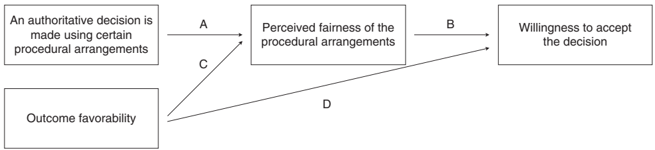
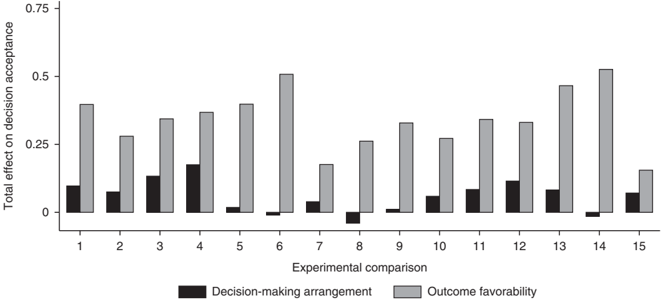
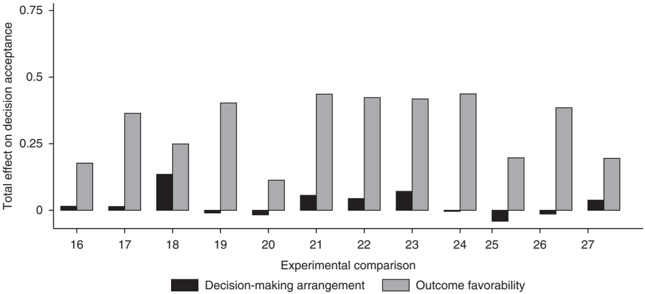
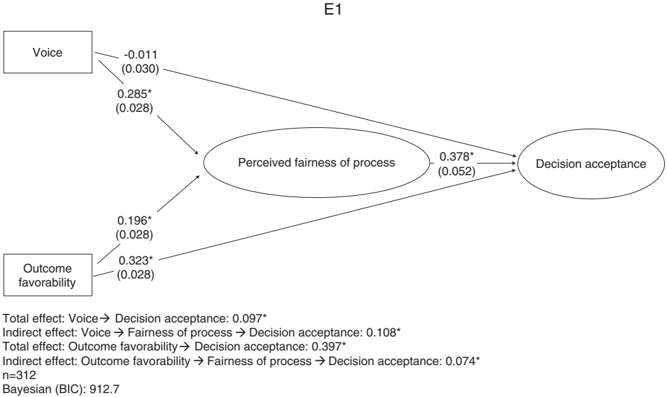
Procedural fairness theory posits that the way in which authoritative decisions are made strongly impacts people’s willingness to accept them. This article challenges this claim by contending that democratic governments can achieve little in terms of acceptance of policy decisions by the procedural means at their disposal. Instead, outcome favorability is the dominant determinant of decision acceptance. The article explicates that while central parts of procedural fairness theory are true, outcome favorability is still overwhelmingly the strongest determinant of individuals’ willingness to accept authoritative decisions. It improves on previous research by locating all key variables into one causal model and testing this model using appropriate data. Findings from a large number of experiments (both vignette and field) reproduce the expected relationships from previous research and support the additional predictions.
Overview
The claims and statistics of this paper haven’t been checked yet.
Free: it reads the open-access text and checks the first 5 claims that cite a source we can check. Create a free account to check every claim.
Integrity signals
Registry
Cites
Statistics
Figures

Verification
Claims the paper makes
The claims and statistics of this paper haven’t been checked yet.
Free: it reads the open-access text and checks the first 5 claims that cite a source we can check. Create a free account to check every claim.
Self-check
Percentages, sums and reported differences re-computed from the paper’s own numbers.
The self-check needs the paper’s full text.
Citations
Cites
Advances In Experimental Social Psychology
(2022) · Advances in Experimental Social Psychology · doi:10.1016/s0065-2601(22)x0002-6 · Cited by 22,259
Mediation in experimental and nonexperimental studies: New procedures and recommendations.
Shrout, P. E., & Bolger, N. (2002) · Psychological Methods · doi:10.1037/1082-989x.7.4.422 · Cited by 11,335 · cited 1×
“51 Shrout and Bolger 2002.”
The case for motivated reasoning.
Kunda, Z. (1990) · Psychological Bulletin · doi:10.1037/0033-2909.108.3.480 · Cited by 9,022
The Social Psychology of Procedural Justice
Lind, E. A., & Tyler, T. R. (1988) · Critical Issues in Social Justice · doi:10.1007/978-1-4899-2115-4 · Cited by 6,585
Participation and Democratic Theory
Pateman, C. (1970) · doi:10.1017/cbo9780511720444 · Cited by 6,159
Motivated Skepticism in the Evaluation of Political Beliefs
Taber, C. S., & Lodge, M. (2006) · American Journal of Political Science · doi:10.1111/j.1540-5907.2006.00214.x · Cited by 4,344
Procedural Justice: A Psychological Analysis
Thibaut, J. W., & Walker, L. (1975) · Medical Entomology and Zoology · Cited by 3,241
A Relational Model of Authority in Groups
Tyler, T. R., & Lind, E. A. (1992) · Advances in Experimental Social Psychology · doi:10.1016/s0065-2601(08)60283-x · Cited by 2,977
Procedural Justice: A Psychological Analysis
Caldeira, G. A., Thibaut, J., Walker, L., & Nagel, S. S. (1976) · The Western Political Quarterly · doi:10.2307/448155 · Cited by 2,907
Interactional justice : communication criteria of fairness
Bies, R. (1986) · Medical Entomology and Zoology · Cited by 2,761
Psychological Perspectives on Legitimacy and Legitimation
Tyler, T. R. (2006) · Annual Review of Psychology · doi:10.1146/annurev.psych.57.102904.190038 · Cited by 2,381
The Principles of Representative Government
Manin, B. (1997) · Cambridge University Press eBooks · doi:10.1017/cbo9780511659935 · Cited by 2,339
Political Trust and Trustworthiness
Levi, M., & Stoker, L. (2000) · Annual Review of Political Science · doi:10.1146/annurev.polisci.3.1.475 · Cited by 2,190
Four Systems of Policy, Politics, and Choice
Lowi, T. J. (1972) · Public Administration Review · doi:10.2307/974990 · Cited by 1,985
Research on Negotiation in Organizations
Lewicki, R. J. (1990) · Medical Entomology and Zoology · Cited by 1,907
Handbook of Organizational Justice
(2013) · Psychology Press eBooks · doi:10.4324/9780203774847 · Cited by 1,615
The principles of representative government
(1998) · Choice Reviews Online · doi:10.5860/choice.35-3567 · Cited by 1,431
Phillips, A. (1998) · Democracy · doi:10.1093/0198294158.001.0001 · Cited by 1,395
Field Experiments: Design, Analysis, and Interpretation
Green, D. (2024) · doi:10.61700/sgeirzx0v0mjh1252 · Cited by 1,320
Lodge, M., & Taber, C. S. (2013) · doi:10.1017/cbo9781139032490 · Cited by 1,281
Folger, R. (1977) · Journal of Personality and Social Psychology · doi:10.1037//0022-3514.35.2.108 · Cited by 1,032
Uncertainty management by means of fairness judgments
van den Bos, K., & Lind, E. A. (2002) · Advances in Experimental Social Psychology · doi:10.1016/s0065-2601(02)80003-x · Cited by 913
Disrespect and the Experience of Injustice
Miller, D. T. (2001) · Annual Review of Psychology · doi:10.1146/annurev.psych.52.1.527 · Cited by 840
Social Justice: Outcome and Procedure
Tyler, T. R. (2000) · International Journal of Psychology · doi:10.1080/002075900399411 · Cited by 774
Social Justice in a Diverse Society
Tyler, T. R., Boeckmann, R. J., Smith, H. J., & Huo, Y. J. (2019) · Routledge eBooks · doi:10.4324/9780429306310 · Cited by 667
Introducing Procedural Utility: Not Only What, but Also How Matters
Frey, B. S., Benz, M., & Stutzer, A. (2004) · Journal of Institutional and Theoretical Economics · doi:10.1628/0932456041960560 · Cited by 607
Social justice in a diverse society
(1997) · Choice Reviews Online · doi:10.5860/choice.35-1237 · Cited by 572
van den Bos, K., Vermunt, R., & Wilke, H. A. M. (1997) · Journal of Personality and Social Psychology · doi:10.1037//0022-3514.72.1.95 · Cited by 452
Experimental Political Science and the Study of Causality: From Nature to the Lab
Morton, R. B., & Williams, K. C. (2010) · Cambridge University Press eBooks · doi:10.1017/cbo9780511762888 · Cited by 444
DIRECT DEMOCRACY: New Approaches to Old Questions
Lupia, A., & Matsusaka, J. G. (2004) · Annual Review of Political Science · doi:10.1146/annurev.polisci.7.012003.104730 · Cited by 408
Democratic procedures and liberal consensus
(2001) · Choice Reviews Online · doi:10.5860/choice.38-3000 · Cited by 378
Why people cooperate: the role of social motivations
(2011) · Choice Reviews Online · doi:10.5860/choice.48-5389 · Cited by 375
VOICE, CONTROL, AND BELONGING: The Double-Edged Sword of Procedural Fairness
MacCoun, R. J. (2005) · Annual Review of Law and Social Science · doi:10.1146/annurev.lawsocsci.1.041604.115958 · Cited by 343
The Role of the Representative: Some Empirical Observations on the Theory of Edmund Burke
Eulau, H., Wahlke, J. C., Buchanan, W., & Ferguson, L. C. (1959) · American Political Science Review · doi:10.2307/1951941 · Cited by 340
Brockner, J. (2002) · The Academy of Management Review · doi:10.2307/4134369 · Cited by 331
Experimental Political Science and the Study of Causality: From Nature to the Lab
Morton, R. B., & Williams, K. C. (2010) · Cited by 314
Gibson, J. L., Caldeira, G. A., & Spence, L. K. (2005) · Political Research Quarterly · doi:10.1177/106591290505800201 · Cited by 309
The effects of trust in authority and procedural fairness on cooperation.
De Cremer, D., & Tyler, T. R. (2007) · Journal of Applied Psychology · doi:10.1037/0021-9010.92.3.639 · Cited by 307 · cited 1×
“19 De Cremer and Tyler 2007.”
Skitka, L. J. (2002) · Personality and Social Psychology Bulletin · doi:10.1177/0146167202288003 · Cited by 284
The Civic Culture Transformed: From Allegiant to Assertive Citizens
(2014) · Cambridge University Press eBooks · doi:10.1017/cbo9781139600002 · Cited by 278
Van den Bos, K., Wilke, H. A. M., Lind, E. A., & Vermunt, R. (1998) · Journal of Personality and Social Psychology · doi:10.1037//0022-3514.74.6.1493 · Cited by 266
The Civic Culture Transformed: From Allegiant To Assertive Citizens
Welzel, C., & Dalton, R. J. (2015) · Medical Entomology and Zoology · Cited by 261
Mullen, E., & Skitka, L. J. (2006) · Journal of Personality and Social Psychology · doi:10.1037/0022-3514.90.4.629 · Cited by 245 · cited 1×
“Identifying a situation in which D dwarfs B, Skitka and colleagues argue that procedural fairness assessments are of little importance for individuals who have a strong moral conviction on the outcome.17 12 Mullen and Skitka 2006; Skitka 2002.”
BackgroundWhat Is the Relationship Between Justice and Morality
Folger, R. G., Cropanzano, R., & Goldman, B. M. (2005) · Journal of International Crisis and Risk Communication Research · Cited by 229
Smith, D., & Tolbert, C. (2004) · University of Michigan Press eBooks · doi:10.3998/mpub.11467 · Cited by 225
Organizing consent: The role of procedural fairness in political trust and compliance
Grimes, M. (2006) · European Journal of Political Research · doi:10.1111/j.1475-6765.2006.00299.x · Cited by 224
Tyler, T. R. (1994) · Law & Society Review · doi:10.2307/3053998 · Cited by 215
Theoretical and Cultural Perspectives on Organizational Justice
Gilliland, S. W., Steiner, D. D., & Skarlicki, D. P. (2001) · Cited by 213
Skitka, L. J., Winquist, J., & Hutchinson, S. (2003) · Social Justice Research · doi:10.1023/a:1026336131206 · Cited by 203
Brennan, G., & Pettit, P. (1990) · British Journal of Political Science · doi:10.1017/s000712340000586x · Cited by 196
(2005) · Choice Reviews Online · doi:10.5860/choice.42-5560 · Cited by 191
Esaiasson, P., Gilljam, M., & Persson, M. (2012) · European Journal of Political Research · doi:10.1111/j.1475-6765.2011.02052.x · Cited by 190
Self-citationContemporary justice research: A new look at familiar questions
Ambrose, M. L. (2002) · Organizational Behavior and Human Decision Processes · doi:10.1016/s0749-5978(02)00030-4 · Cited by 179
When Due Process Is of No Consequence: Moral Mandates and Presumed Defendant Guilt or Innocence
Skitka, L. J., & Houston, D. A. (2001) · Social Justice Research · doi:10.1023/a:1014372008257 · Cited by 161
Accepting Authoritative Decisions: Humans as Wary Cooperators
Hibbing, J. R., & Alford, J. R. (2004) · American Journal of Political Science · doi:10.1111/j.0092-5853.2004.00056.x · Cited by 153
Procedural Justice Theory and Evaluations of the Lawmaking Process
Gangl, A. (2003) · Political Behavior · doi:10.1023/a:1023847829172 · Cited by 149
Terwel, B. W., Harinck, F., Ellemers, N., & Daamen, D. D. L. (2010) · Journal of Experimental Psychology Applied · doi:10.1037/a0019977 · Cited by 138
Acculturation discrepancies and well-being: the moderating role of conformity
Roccas, S., Horenczyk, G., & Schwartz, S. H. (2000) · European Journal of Social Psychology · doi:10.1002/(sici)1099-0992(200005/06)30:3<323::aid-ejsp992>3.0.co;2-5 · Cited by 136
van Prooijen, J.-W., van den Bos, K., & Wilke, H. A. M. (2004) · Journal of Personality and Social Psychology · doi:10.1037/0022-3514.87.1.66 · Cited by 135
Ulbig, S. G. (2008) · Public Opinion Quarterly · doi:10.1093/poq/nfn030 · Cited by 128
Tyler, T. R. (2020) · Crime, Inequality and the State · doi:10.4324/9781003060581-4 · Cited by 125 · cited 1×
“Fair procedures are important because they: signal to people that they are respected by decision-makers (Tyler 1994; Tyler and Lind 1992), show that decision-makers can be trusted (Brockner 2002), enable individuals to reduce uncertainty about how to evaluate outcomes (Van den Bos and Lind 2002),…”
BackgroundColquitt, J. (2002) · Journal of Management · doi:10.1016/s0149-2063(02)00157-5 · Cited by 124
Hechter, M. (2013) · Cambridge University Press eBooks · doi:10.1017/cbo9781107337084 · Cited by 123
When Do the Ends Justify the Means? Evaluating Procedural Fairness
Doherty, D., & Wolak, J. (2011) · Political Behavior · doi:10.1007/s11109-011-9166-9 · Cited by 120
What is responsible for the fair process effect
van den Bos, K. (2005) · Cited by 105
International encyclopedia of elections
Butler, D. (2001) · Representation · doi:10.1080/00344890108523163 · Cited by 92
On the Relation Between Trust and Fairness in Environmental Risk Management
Earle, T. C., & Siegrist, M. (2008) · Risk Analysis · doi:10.1111/j.1539-6924.2008.01091.x · Cited by 90
Folk conceptions of fairness and unfairness
Lupfer, M. B., Weeks, K. P., Doan, K. A., & Houston, D. A. (2000) · European Journal of Social Psychology · doi:10.1002/(sici)1099-0992(200005/06)30:3<405::aid-ejsp997>3.0.co;2-u · Cited by 89
Can We Talk?: The Rise of Rude, Nasty, Stubborn Politics
Shea, D. M., & Fiorina, M. P. (2012) · Medical Entomology and Zoology · Cited by 88
Persson, M., Esaiasson, P., & Gilljam, M. (2013) · European Political Science Review · doi:10.1017/s1755773912000173 · Cited by 81
Self-citationToward Understanding the Psychology of Reactions to Perceived Fairness: The Role of Affect Intensity
van den Bos, K., Maas, M., Waldring, I., & Semin, G. R. (2003) · Social Justice Research · doi:10.1023/a:1024252104717 · Cited by 80
van den Bos, K. (2001) · Data Archiving and Networked Services (DANS) · Cited by 74
When do fair procedures not matter? A test of the identity violation effect.
Mayer, D. M., Greenbaum, R. L., Kuenzi, M. L., & Shteynberg, G. (2009) · Journal of Applied Psychology · doi:10.1037/a0013108 · Cited by 72
Leung, K., Tong, K.-K., & Lind, E. A. (2007) · Journal of Personality and Social Psychology · doi:10.1037/0022-3514.92.3.476 · Cited by 68
Democratic Procedures and Liberal Consensus
Klosko, G. (2004) · Oxford University Press eBooks · doi:10.1093/acprof:oso/9780199270200.001.0001 · Cited by 63
Emerging Issues in the Social Psychology of Justice
Folger, R. G. (1984) · Critical issues in social justice · doi:10.1007/978-1-4613-2683-0_1 · Cited by 58 · cited 1×
“6 Folger 1984.”
Handbook of Psychology, Volume 5: Personality and Social Psychology
Weiner, I. B., Millon, T., & Lerner, M. (2012) · University of Groningen research database (University of Groningen / Centre for Information Technology) · Cited by 55
Napier, J. L., & Tyler, T. R. (2008) · Social Justice Research · doi:10.1007/s11211-008-0083-y · Cited by 51 · cited 1×
“17 For a critique of this so-called moral mandate theory, see Napier and Tyler (2008).”
BackgroundBianchi, E. C., Brockner, J., van den Bos, K., Seifert, M., Moon, H. K., van Dijke, M., & Cremer, D. D. (2014) · Personality and Social Psychology Bulletin · doi:10.1177/0146167214556237 · Cited by 51
Helwig, C. C., Arnold, M. L., Tan, D., & Boyd, D. R. (2006) · Cognitive Development · doi:10.1016/j.cogdev.2006.07.002 · Cited by 50
van Houwelingen, G., van Dijke, M., & Cremer, D. D. (2016) · Journal of Management · doi:10.1177/0149206314530166 · Cited by 43
Moral Convictions Often Override Concerns About Procedural Fairness: A Reply to Napier and Tyler
Skitka, L. J., & Mullen, E. (2008) · Social Justice Research · doi:10.1007/s11211-008-0085-9 · Cited by 39
Gilljam, M., Esaiasson, P., & Lindholm, T. (2009) · Educational Assessment Evaluation and Accountability · doi:10.1007/s11092-009-9084-0 · Cited by 33
Self-citationCrosby, F. J., & Franco, J. L. (2003) · Personality and Social Psychology Review · doi:10.1207/s15327957pspr0704_08 · Cited by 27
Ellenbroek, M., Verkuyten, M., Thijs, J. T., & Poppe, E. (2014) · Journal of Community & Applied Social Psychology · doi:10.1002/casp.2189 · Cited by 26
Justice Theory and Research: A Social Functionalist Perspective
Skitka, L. J., & Wisneski, D. C. (2012) · Wiley eBooks · doi:10.1002/9781118133880.hop205019 · Cited by 20
Wu, X., & Wang, E. (2013) · Journal of Applied Social Psychology · doi:10.1111/j.1559-1816.2012.01002.x · Cited by 18 · cited 1×
“28 Terwel et al. 2010; Wu and Wang 2013.”
Research works printed but not linked: 4
- Tyler, Tom. 1990. Why People Obey the Law: Procedural Justice, Legitimacy and Compliance. New Haven, CT: Yale University Press.
- Muthen, Linda, and Muthen Bengt. 1998-2010. Mplus Users' Guide, 6th Edition, Los Angeles, CA: Muthen and Muthen.
- --. 2006. Psychological Perspectives on Legitimacy and Legitimation. Annual Review of Psychology 57:375-400.
- Tom, and Steven Blader. 2003. The Group Engagement Model: Procedural Justice, Social Identity, and Cooperative Behavior. Personality and Social Psychology Review 7:349-61.
Cited by
All Male Panels? Representation and Democratic Legitimacy
Clayton, A., O'Brien, D. Z., & Piscopo, J. M. (2019) · American Journal of Political Science · doi:10.1111/ajps.12391 · Cited by 322
“…theories of procedural fairness, which emphasize how the nature of citizen involvement in, and influence over, political decisions affects legitimacy beliefs (see De Fine Licht et al. 2014; Esaiasson, Gilljam, and Persson 2012; Esaiasson et al. 2016; Persson, Esaiasson, and Gilljam 2013).”
BackgroundStrebel, M. A., Kübler, D., & Marcinkowski, F. (2019) · European Journal of Political Research · doi:10.1111/1475-6765.12293 · Cited by 142
“On the one hand, we do not use field experiments, as in Tyler (1994) or Esaiasson et al. (2012, 2016b), but an experiment embedded in a population-based survey.2 A limitation of traditional experimental designs is that they only allow for assessing the effect of one treatment at a time.”
BackgroundMethodCatching the ‘Deliberative Wave’? How (Disaffected) Citizens Assess Deliberative Citizen Forums
Goldberg, S., & Bächtiger, A. (2022) · British Journal of Political Science · doi:10.1017/s0007123422000059 · Cited by 137
The Winner Takes It All: Revisiting the Effect of Direct Democracy on Citizens’ Political Support
Mariën, S., & Kern, A. (2017) · Political Behavior · doi:10.1007/s11109-017-9427-3 · Cited by 139
“A recent pioneering study addresses this lacuna and shows that outcome favorability is indeed critical in the decision acceptance of the outcomes of a direct democratic process (Esaiasson et al. 2016).”
BackgroundMethodWerner, H. (2019) · European Journal of Political Research · doi:10.1111/1475-6765.12358 · Cited by 122
“…the role of such considerations by building on research on instrumental reactions to electoral loss in the American context (Bowler & Donovan 2007; Smith et al. 2010) and on research on the role of outcome favourability for the evaluation of decision-making processes (e.g., Esaiasson et al. 2016).”
Background
Metadata
- Authors
- Esaiasson, P., Persson, M., Gilljam, M., & Lindholm, T.
- Affiliations
- Stockholm University (SE)
- University of Gothenburg (SE)
- Corresponding author
- Esaiasson, Peter
- Venue
- British Journal of Political Science
- Publisher
- Cambridge University Press (CUP)
- Published
- 2016-12-12
- Volume
- 49
- Issue
- 1
- Pages
- 291-314
- ISSN
- 0007-1234 (ISSN-L)
- 1469-2112
- OpenAlex
- W2564544276
- Cited by
- 223
- References
- 86
- Citations by year
- 2026: 50 · 2025: 26 · 2024: 26 · 2023: 22 · 2022: 25 · 2021: 26 · 2020: 19 · 2019: 8 · 2018: 20 · 2017: 1
- FWCI
- 27.64
- Type
- journal article
- Language
- en
- Open access
- hybrid
- doi.org
- Locations
- British Journal of Political Science (publishedVersion, cc-by)
- RePEc: Research Papers in Economics (submittedVersion)
- Funders
- Vetenskapsrådet
- Riksbankens Jubileumsfond (P10-0210:1)
- Topics
- Social Sciences › Public Administration › Public Policy and Administration Research
- Social Sciences › Economics, Econometrics and Finance › Economics and Econometrics › Experimental Behavioral Economics Studies
- Social Sciences › Decision Sciences › General Decision Sciences › Decision-Making and Behavioral Economics
- Keywords
- procedural justice, decision acceptance, outcome favorability, policy acceptance, democratic government, causal models, public opinion
About these checks
Registry, retraction, Cites and statistics results are computed, not judged, with one exception: a printed reference that no index lists is read once by a model before it counts as a citation error. Claims are extracted by a model and kept only when their quote appears verbatim in the text; each cited source is then checked, with a model’s help, for whether it says what the claim relies on. Those verdicts can be wrong — read the claim’s quote and the cited source before relying on one.
Statistics and arithmetic are recomputed, not judged.
Confidence bands are shown only for fields calibrated on our annotated test set. None is calibrated yet, so no band is shown.
What counts as a claim ›How we measure confidence ›How we check this ›
Are you an author, or do you see a problem with this page? Request a review
Data sources
Bibliographic data: Semantic Scholar, OpenAlex, Crossref.
Contains information from the Semantic Scholar Academic Graph Datasets, made available under the ODC Attribution License (ODC-BY 1.0).
Semantic Scholar’s data is described in: Kinney, R., et al. (2023). The Semantic Scholar Open Data Platform. arXiv:2301.10140.
