

Reconsidering the Role of Procedures for Decision Acceptance
Open accessThe DOI matches its Crossref record; 87 of the 87 references it cites were found in a registry or an index.
Abstract
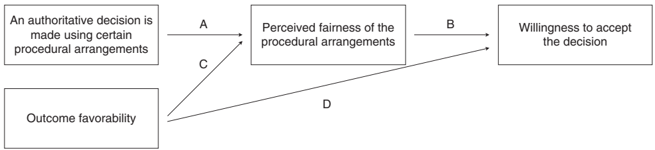
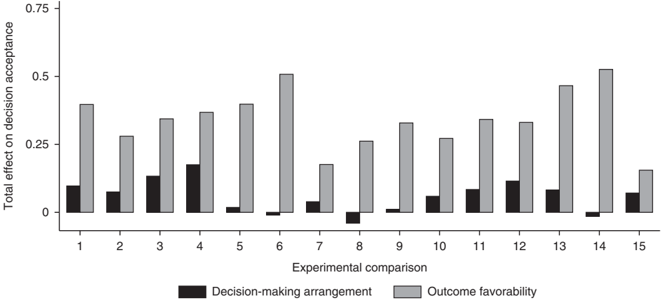
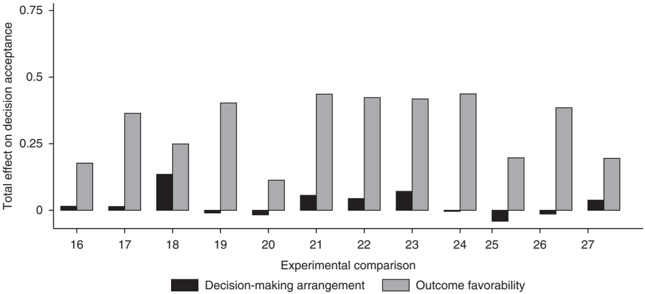
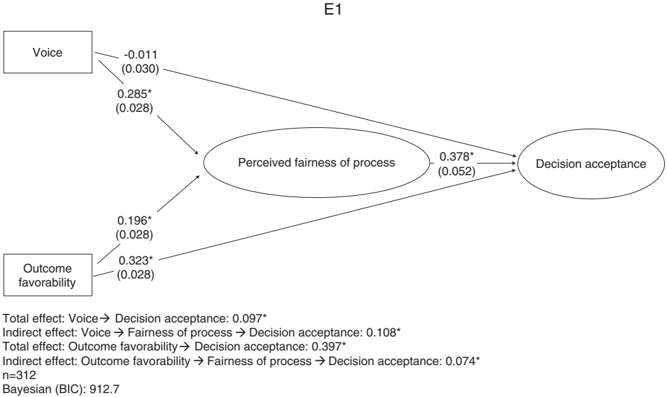
Procedural fairness theory posits that the way in which authoritative decisions are made strongly impacts people’s willingness to accept them. This article challenges this claim by contending that democratic governments can achieve little in terms of acceptance of policy decisions by the procedural means at their disposal. Instead, outcome favorability is the dominant determinant of decision acceptance. The article explicates that while central parts of procedural fairness theory are true, outcome favorability is still overwhelmingly the strongest determinant of individuals’ willingness to accept authoritative decisions. It improves on previous research by locating all key variables into one causal model and testing this model using appropriate data. Findings from a large number of experiments (both vignette and field) reproduce the expected relationships from previous research and support the additional predictions.
Overview
The claims and statistics of this paper haven’t been checked yet.
Free: it reads the open-access text and checks the first 5 claims that cite a source we can check. Create a free account to check every claim.
Integrity signals
Registry
Cites
Statistics
Figures

Verification
Claims the paper makes
The claims and statistics of this paper haven’t been checked yet.
Free: it reads the open-access text and checks the first 5 claims that cite a source we can check. Create a free account to check every claim.
Self-check
Percentages, sums and reported differences re-computed from the paper’s own numbers.
The self-check needs the paper’s full text.
Citations
Cites
Advances In Experimental Social Psychology
(2022) · Advances in Experimental Social Psychology · doi:10.1016/s0065-2601(22)x0002-6 · Cited by 22,259
Mediation in experimental and nonexperimental studies: New procedures and recommendations.
Shrout, P. E., & Bolger, N. (2002) · Psychological Methods · doi:10.1037/1082-989x.7.4.422 · Cited by 11,335 · cited 1×
“51 Shrout and Bolger 2002.”
The case for motivated reasoning.
Kunda, Z. (1990) · Psychological Bulletin · doi:10.1037/0033-2909.108.3.480 · Cited by 9,022
The Social Psychology of Procedural Justice
Lind, E. A., & Tyler, T. R. (1988) · Critical Issues in Social Justice · doi:10.1007/978-1-4899-2115-4 · Cited by 6,585
Participation and Democratic Theory
Pateman, C. (1970) · doi:10.1017/cbo9780511720444 · Cited by 6,159
Motivated Skepticism in the Evaluation of Political Beliefs
Taber, C. S., & Lodge, M. (2006) · American Journal of Political Science · doi:10.1111/j.1540-5907.2006.00214.x · Cited by 4,344
Procedural Justice: A Psychological Analysis
Thibaut, J. W., & Walker, L. (1975) · Medical Entomology and Zoology · Cited by 3,241
A Relational Model of Authority in Groups
Tyler, T. R., & Lind, E. A. (1992) · Advances in Experimental Social Psychology · doi:10.1016/s0065-2601(08)60283-x · Cited by 2,977
Procedural Justice: A Psychological Analysis
Caldeira, G. A., Thibaut, J., Walker, L., & Nagel, S. S. (1976) · The Western Political Quarterly · doi:10.2307/448155 · Cited by 2,907
Interactional justice : communication criteria of fairness
Bies, R. (1986) · Medical Entomology and Zoology · Cited by 2,761
Research works printed but not linked: 4
- Tyler, Tom. 1990. Why People Obey the Law: Procedural Justice, Legitimacy and Compliance. New Haven, CT: Yale University Press.
- Muthen, Linda, and Muthen Bengt. 1998-2010. Mplus Users' Guide, 6th Edition, Los Angeles, CA: Muthen and Muthen.
- --. 2006. Psychological Perspectives on Legitimacy and Legitimation. Annual Review of Psychology 57:375-400.
- Tom, and Steven Blader. 2003. The Group Engagement Model: Procedural Justice, Social Identity, and Cooperative Behavior. Personality and Social Psychology Review 7:349-61.
Cited by
Items 201–241 of 241
Two Tribes: Affective Polarization and Brexit Identities
HOBOLT, S. B., & Tilley, J. R. (2026) · Oxford University Press eBooks · doi:10.1093/9780198911746.003.0006
Transformation: From an Issue to an Identity
HOBOLT, S. B., & Tilley, J. R. (2026) · Oxford University Press eBooks · doi:10.1093/9780198911746.003.0005
HOBOLT, S. B., & Tilley, J. R. (2026) · Oxford University Press eBooks · doi:10.1093/9780198911746.005.0002
The EU Issue: Elite Division and Public Indifference
HOBOLT, S. B., & Tilley, J. R. (2026) · Oxford University Press eBooks · doi:10.1093/9780198911746.003.0003
HOBOLT, S. B., & Tilley, J. R. (2026) · Oxford University Press eBooks · doi:10.1093/9780198911746.003.0001
HOBOLT, S. B., & Tilley, J. R. (2026) · Oxford University Press eBooks · doi:10.1093/9780198911746.002.0004
Tribal Bias: Seeing the World through a Brexit Lens
HOBOLT, S. B., & Tilley, J. R. (2026) · Oxford University Press eBooks · doi:10.1093/9780198911746.003.0007
HOBOLT, S. B., & Tilley, J. R. (2026) · Oxford University Press eBooks · doi:10.1093/9780198911746.002.0005
HOBOLT, S. B., & Tilley, J. R. (2026) · Oxford University Press eBooks · doi:10.1093/9780198911746.003.0010
The Trigger: The Brexit Referendum and its Fallout
HOBOLT, S. B., & Tilley, J. R. (2026) · Oxford University Press eBooks · doi:10.1093/9780198911746.003.0004
Identity Anchors: Tribes, Traits, and Echo Chambers
HOBOLT, S. B., & Tilley, J. R. (2026) · Oxford University Press eBooks · doi:10.1093/9780198911746.003.0008
HOBOLT, S. B., & Tilley, J. R. (2026) · Oxford University Press eBooks · doi:10.1093/9780198911746.005.0001
Escher, T., & Holec, K. (2026) · Journal für Mobilität und Verkehr · doi:10.34647/jmv.nr26.id243
Democratic Values in Citizen Participation: What Citizens Prioritize in Participation
Sipma, T., & Hendriks, F. (2026) · Policy Studies Journal · doi:10.1111/psj.70115
The role of procedural fairness in EU legitimacy: Lessons from the Spitzenkandidaten process
Meiners, P., Goldberg, A. C., & de Wilde, P. (2026) · European Journal of Political Research · doi:10.1017/s147567652610084x
Lindvall, D., & Pfeiffer, F. (2026) · Scandinavian Political Studies · doi:10.1111/1467-9477.70041
Kim, N. K., Nam, Y., Yang, J., & Cho, W. (2026) · European Political Science Review · doi:10.1017/s1755773926100411
Wang, D., Liu, B., Xiao, J., Liu, J., & Yu, W. (2026) · Chinese Public Administration Review · doi:10.1177/15396754261428991
“Well-designed participatory mechanisms can even produce “frustration effects” and erode trust when citizens perceive their input as cosmetic rather than consequential (Esaiasson et al., 2019).”
Supti, T. I., Muhanad, A., Barhamgi, M., Khan, K. M., Erbad, A., Yankouskaya, A., & Ali, R. (2026) · SSRN Electronic Journal · doi:10.2139/ssrn.6574195
Xu, G., Zhang, Y., & Zhang, X. (2026) · SSRN Electronic Journal · doi:10.2139/ssrn.6589389
Kindt, R., van Dijk, L., & Jacobs, K. (2026) · European Political Science Review · doi:10.1017/s175577392610040x
“We do this because earlier research has highlighted that different types of considerations can influence each other (e.g., Esaiasson et al. 2019, Werner 2020a).”
InfluentialKoiranen, I., & Christensen, H. S. (2026) · Political Studies · doi:10.1177/00323217261450951
Reidinger, V., Leemann, L., & Slapin, J. B. (2026) · Political Science Research and Methods · doi:10.1017/psrm.2026.10103
Beyond dualism: the hybridization of technocracy and democracy in Europe
Cozzolino, A., & Zucaro, A. (2026) · European Political Science Review · doi:10.1017/s1755773926100514
Is sortition the ideal? Examining public reactions to climate assemblies
Kevins, A., & Robison, J. (2026) · Political Psychology · doi:10.1111/pops.70164
“…antecedents to institutional legitimacy: (1) whether decision-making processes were biased and (2) whether one's own views were given a fair hearing, and hence whether they are likely to find the assembly's output acceptable (Esaiasson et al., 2019; Kevins & Robison, 2021; Werner & Marien, 2022).”
How Do Citizens Perceive Fairness in Public Works Bidding?:
Watanabe, Y. (2025) · The Annuals of Japanese Political Science Association · doi:10.7218/nenpouseijigaku.76.1_307
Vuk, V. (2026) · Policy & Internet · doi:10.1002/poi3.70053
Does support for democracy increase losers’ consent?
Blais, A., Bol, D., & Plescia, C. (2026) · Political Studies · doi:10.1177/00323217261463105 · Cited by 1
Beyond the hassle: how favorable outcomes reduce the subjective experience of administrative burden
Hansen, F. G., & Halling, A. (2026) · International Public Management Journal · doi:10.1080/10967494.2026.2696855 · Cited by 1
Paulis, E., Vittori, D., Pilet, J., Verhasselt, L., Rojon, S., & Kies, R. (2026) · Humanities and Social Sciences Communications · doi:10.1057/s41599-026-08654-2
“This aligns with previous research, which fi nds that while process perceptions matter, outcome evaluations are often more in fl uential (Arnesen, 2017; Esaiasson et al., 2019; Jäske, 2019; Sterbel et al., 2019; Werner and Marien, 2022).”
InfluentialWerner, H. (2026) · Representation · doi:10.1080/00344893.2026.2685510 · Cited by 2
Voter reactions to party policy repositioning: The role of inclusive intra-party decision-making
Marini, S., Lingier, L., Luypaert, J., & Wagner, M. (2026) · Electoral Studies · doi:10.1016/j.electstud.2026.103132
Coincidental Representation: How Congruence and Influence shape Public Satisfaction with Government
Mathisen, R. (2026) · Political Behavior · doi:10.1007/s11109-026-10195-y
König, P. D. (2026) · The American Review of Public Administration · doi:10.1177/02750740261481775
Hemesath, S., Tepe, M., Aljuneidi, S., & Boll, S. (2026) · International Journal of Public Administration · doi:10.1080/01900692.2026.2724993
Not just mirror images: how political trust and distrust relate to public service experiences
Gillissen, M., Goubin, S., & de Blok, L. (2026) · Journal of European Public Policy · doi:10.1080/13501763.2026.2746012
The effect of mass–elite congruence in representational style on citizens’ democratic satisfaction
Mongrain, P., & Junius, N. (2026) · European Political Science Review · doi:10.1017/s175577392610071x
Youth Representation and Democratic Legitimacy
Sundström, A., McClean, C. T., & Stockemer, D. (2026) · British Journal of Political Science · doi:10.1017/s0007123426101823
“…committees as more fair and trustworthy – regardless of policy issue, the committee ’ s decision, or even whether a policy is mentioned – suggests that youth presence carries legitimacy benefits that extend beyond outcome favorability (Agerberg and Wängnerud 2026; Esaiasson et al. 2019).”
Пивовар, М. С. (2026) · Kherson State University Herald Series Legal Sciences · doi:10.32999/ksu2307-8049/2026-4-6
Metadata
- Authors
- Esaiasson, P., Persson, M., Gilljam, M., & Lindholm, T.
- Affiliations
- Stockholm University (SE)
- University of Gothenburg (SE)
- Corresponding author
- Esaiasson, Peter
- Venue
- British Journal of Political Science
- Publisher
- Cambridge University Press (CUP)
- Published
- 2016-12-12
- Volume
- 49
- Issue
- 1
- Pages
- 291-314
- ISSN
- 0007-1234 (ISSN-L)
- 1469-2112
- OpenAlex
- W2564544276
- Semantic Scholar
- ba279b256fbf4813703f3236f1005ed3d2f7cb8a
- Cited by
- 223
- References
- 86
- Citations by year
- 2026: 50 · 2025: 26 · 2024: 26 · 2023: 22 · 2022: 25 · 2021: 26 · 2020: 19 · 2019: 8 · 2018: 20 · 2017: 1
- FWCI
- 27.64
- Type
- journal article
- Language
- en
- Open access
- hybrid
- doi.org
- Locations
- British Journal of Political Science (publishedVersion, cc-by)
- RePEc: Research Papers in Economics (submittedVersion)
- Funders
- Vetenskapsrådet
- Riksbankens Jubileumsfond (P10-0210:1)
- Topics
- Social Sciences › Public Administration › Public Policy and Administration Research
- Social Sciences › Economics, Econometrics and Finance › Economics and Econometrics › Experimental Behavioral Economics Studies
- Social Sciences › Decision Sciences › General Decision Sciences › Decision-Making and Behavioral Economics
- Keywords
- procedural justice, decision acceptance, outcome favorability, policy acceptance, democratic government, causal models, public opinion
About these checks
Registry, retraction, Cites and statistics results are computed, not judged, with one exception: a printed reference that no index lists is read once by a model before it counts as a citation error. Claims are extracted by a model and kept only when their quote appears verbatim in the text; each cited source is then checked, with a model’s help, for whether it says what the claim relies on. Those verdicts can be wrong — read the claim’s quote and the cited source before relying on one.
Statistics and arithmetic are recomputed, not judged.
Confidence bands are shown only for fields calibrated on our annotated test set. None is calibrated yet, so no band is shown.
What counts as a claim ›How we measure confidence ›How we check this ›
Are you an author, or do you see a problem with this page? Request a review
Data sources
Bibliographic data: Semantic Scholar, OpenAlex, Crossref.
Contains information from the Semantic Scholar Academic Graph Datasets, made available under the ODC Attribution License (ODC-BY 1.0).
Semantic Scholar’s data is described in: Kinney, R., et al. (2023). The Semantic Scholar Open Data Platform. arXiv:2301.10140.
