

The Uses of Comparative History in Macrosocial Inquiry
Open accessThe DOI matches its Crossref record; 35 of the 36 references it cites were found in a registry or an index; none of the 44 sources its claims cite is checked for support yet.
Abstract
Comparative history is not new. As long as people have investigated social life, there has been recurrent fascination with juxtaposing historical patterns from two or more times or places. Part of the appeal comes from the general usefulness of looking at historical trajectories in order to study social change. Indeed, practitioners of comparative history from Alexis de Tocqueville and Max Weber to Marc Bloch, Reinhard Bendix, and Barrington Moore, Jr. have typically been concerned with understanding societal dynamics and epochal transformations of cultures and social structures. Attention to historical sequences is indispensable to such understanding. Obviously, though, not all investigations of social change use explicit juxtapositions of distinct histories. We may wonder, therefore: What motivates the use of comparisons as opposed to focussing on single historical trajectories? What purposes are pursued—and how—through the specific modalities of comparative history?
Overview
CoChat Summary
## TL;DR
The paper argues that comparative history in macrosocial inquiry has at least three distinct logics: parallel demonstration of theory, contrast of contexts, and macro-causal analysis. It shows that these logics have different purposes, case-selection rules, and strengths/limitations, and that some influential works combine two of them in segmented ways.
## Key findings
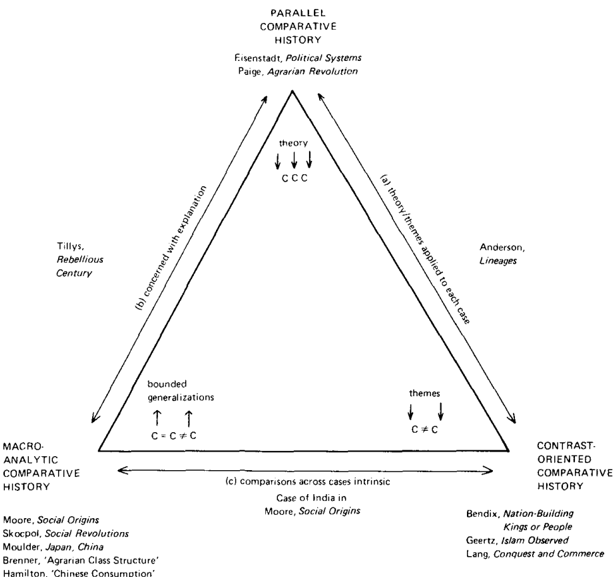
- The authors identify three major logics of comparative history: Parallel comparative history, Contrast-oriented comparative history, and Macro-analytic comparative history.
- In Parallel comparative history, cases are juxtaposed mainly to show that a theory applies repeatedly across relevant historical trajectories; the paper says this does not validate the theory, because cases are selected by the theory and are used to illustrate and clarify it.
- In Contrast-oriented comparative history, the goal is to highlight the unique features of each case and how context shapes outcomes; the paper says this approach offers rich, holistic, chronological accounts but tends to avoid explicit explanation.
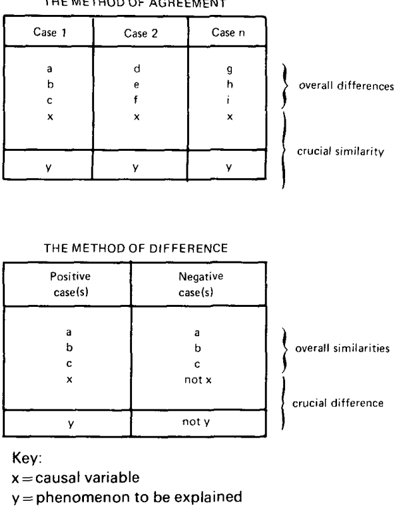
- In Macro-analytic comparative history, scholars use comparisons to make causal inferences about macro-level phenomena, often by approximating John Stuart Mill’s Method of Agreement and Method of Difference; the paper argues this is the best way to attempt validation of causal hypotheses when cases are intrinsically limited.
## Methods
- Conceptual/methodological essay based on comparative analysis of published comparative-historical works; the authors use examples to illustrate each logic rather than providing full methodological dissections.
- The paper’s examples include works by Eisenstadt, Paige, Geertz, Lang, Bendix, Moore, Moulder, Brenner, Hamilton, Anderson, and the Tillys.
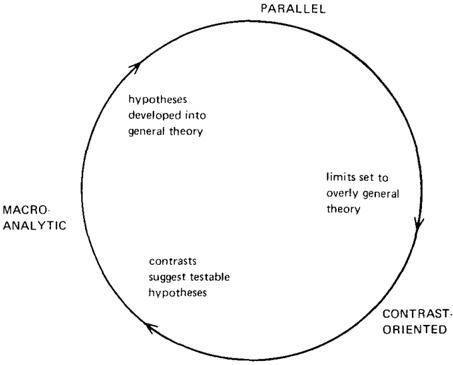
- Main analytic frame is a typology/triangle of comparative history, with discussion of how each logic uses cases, theory, chronology, and causal inference.
## Limitations
- The paper states that it does not present full methodological dissections of the works it uses as illustrations, and that many issues about theory and concepts relative to evidence are skirted.
- It explicitly notes that perfectly controlled comparisons are never really feasible in sociohistorical research, because societies cannot be broken apart into manipulable variables and history rarely provides exactly the needed cases.
- Evident from the text: the argument is illustrative rather than systematic empirical testing of the typology itself, since it relies on selected published examples rather than a comprehensive sample.
Model-written summary. Check it against the paper before relying on it.
Integrity signals
Registry
Cites
Statistics
Figures
Verification
Claims the paper makes
0 Valid · 1 Not valid · 49 Not checked · 126 Own results and interpretations
A result the paper states — it cites no source for it, so there is none to check. The quote shows it is in the paper.
In the paper
“The primary mode of demonstrating the theory is something other than comparative history in both books.”
plain- Asserted: passes — The authors put it forward as true.
- Checkable: passes — It can be checked against evidence.
- Load-bearing: passes — The paper’s conclusions depend on it.
- Based: passes — The paper gives a reason why it holds.
A result the paper states — it cites no source for it, so there is none to check. The quote shows it is in the paper.
In the paper
“Eisenstadt relies chiefly upon conceptual elaboration and deduction from structure-functionalist premises”
plain- Asserted: passes — The authors put it forward as true.
- Checkable: passes — It can be checked against evidence.
- Load-bearing: unclear — It is unclear whether the paper’s conclusions depend on it.
- Based: passes — The paper gives a reason why it holds.
A result the paper states — it cites no source for it, so there is none to check. The quote shows it is in the paper.
In the paper
“Despite considerable differences of subject-matter and theoretical approach, both S. N. Eisenstadt's The Political Systems of Empires and Jeffery M. Paige's Agrarian Revolution use comparative history in this way.”
plain- Asserted: passes — The authors put it forward as true.
- Checkable: passes — It can be checked against evidence.
- Load-bearing: passes — The paper’s conclusions depend on it.
- Based: passes — The paper gives a reason why it holds.
A result the paper states — it cites no source for it, so there is none to check. The quote shows it is in the paper.
In the paper
“Nevertheless, in both Eisenstadt's and Paige's books, comparative history serves as an ancillary mode of theoretical demonstration.”
plain- Asserted: passes — The authors put it forward as true.
- Checkable: passes — It can be checked against evidence.
- Load-bearing: passes — The paper’s conclusions depend on it.
- Based: passes — The paper gives a reason why it holds.
A result the paper states — it cites no source for it, so there is none to check. The quote shows it is in the paper.
In the paper
“Within each of his routes, Moore primarily argues along the lines of the Method of Agreement.”
plain- Asserted: passes — The authors put it forward as true.
- Checkable: passes — It can be checked against evidence.
- Load-bearing: unclear — It is unclear whether the paper’s conclusions depend on it.
- Based: passes — The paper gives a reason why it holds.
74 more claims
Create a free account to see all 176 claims and every source verdict.
- Probably not a substantial claim. 82
- It may state two separate claims as one. 36
Citations
Cites
States and Social Revolutions: A Comparative Analysis of France, Russia and China
Skocpol, T. (1979) · Cambridge University Press · doi:10.1017/cbo9780511815805 · Cited by 5,408
Self-citationComparative Politics and the Comparative Method
Lijphart, A. (1971) · American Political Science Review · doi:10.2307/1955513 · Cited by 3,151
Hechter, M., & Wallerstein, I. (1975) · Contemporary Sociology · doi:10.2307/2063180 · Cited by 2,590
Social Origins of Dictatorship and Democracy: Lord and Peasant in the Making of the Modern World.
Ness, G. D., & Moore, B. (1967) · American Sociological Review · doi:10.2307/2092029 · Cited by 2,261
Lineages of the Absolutist State
Rothkrug, L., & Anderson, P. (1976) · The American Historical Review · doi:10.2307/1851205 · Cited by 1,694
The Rise and Future Demise of the World Capitalist System: Concepts for Comparative Analysis
Wallerstein, I. (1974) · Comparative Studies in Society and History · doi:10.1017/s0010417500007520 · Cited by 1,466
AGRARIAN CLASS STRUCTURE AND ECONOMIC DEVELOPMENT IN PRE-INDUSTRIAL EUROPE
Brenner, R. (1976) · Past and Present · doi:10.1093/past/70.1.30 · Cited by 1,193
Appleby, A. B., & Walerstein, I. (1975) · The American Historical Review · doi:10.2307/1852102 · Cited by 1,066
Feld, M. D. (1975) · History: Reviews of New Books · doi:10.1080/03612759.1975.9945059 · Cited by 775
The Rebellious Century: 1830–1930
Tilly, C., Tilly, L., & Tilly, R. (1975) · Harvard University Press eBooks · doi:10.4159/harvard.9780674434004 · Cited by 685
Research works printed but not linked: 8
- 1973, Politics and Society, 4, 10
- Bloch, 1934, Une Étude Régionale: Geographie ou Histoire?, Annales d'Histoire Economique el Sociale, 6, 81
- Mill , “Two Methods,” in Etzioni and Du Bow , eds., Comparative Perspectives, pp. 210–13.
- Anderson, 1967, Land and Work in Medieval Europe: Selected Papers by- Marc Bloch, 44
- 1967, Comparative Sociology: A Codification of Cross-Societal Analysis
- 1977, Poor People's Movements
- Political Systems, he also does a bit of causal analysis using an approximation to controlled comparison. Specifically Eisenstadt uses Macro-analytic comparative history when he argues (pp. 106–7) that some societies had one, but not both, necessary conditions to become bureaucratic empires, contrasting these “failed” cases to “successful” ones.
- Bendix, 1977, Nation-Building and Citizenship, 16
Cited by
Items 201–300 of 1,062
Akhter, M., & Ormerod, K. J. (2015) · Geoforum · doi:10.1016/j.geoforum.2015.01.012 · Cited by 36
Trampusch, C. (2010) · European Journal of Industrial Relations · doi:10.1177/0959680110375129 · Cited by 39
“Following the method of contrast of contexts, I use the recent literature on training regimes as a frame of reference ‘for pointing out differences between or among the cases’ (Skocpol and Somers, 1980: 178).”
MethodInfluentialOptics of the State: The Politics of Making Poverty Visible in Brazil and Mexico
Leão, L. D. S. (2022) · American Journal of Sociology · doi:10.1086/719936 · Cited by 37
Continuity through Co-optation: Rural Politics and Regime Resilience in Morocco and Mauritania
Buehler, M. (2015) · Mediterranean Politics · doi:10.1080/13629395.2015.1071453 · Cited by 34
Preparing for disaster: a comparative analysis of education for critical infrastructure collapse
Kitagawa, K., Preston, J., & Chadderton, C. (2016) · Journal of Risk Research · doi:10.1080/13669877.2016.1178661 · Cited by 27
“It should be also noted that we are in line with the ‘contrast of contexts’ (Skocpol and Somers 1980) approach as this macro-comparative mapping aims to identify the key characteristics of the approaches to CIP and preparedness through the analysis of country-specific contexts.”
ResultDifferent Methods- Contradictory Results? Research On Development and Democracy1
Rueschemeyer, D. (1991) · International Journal of Comparative Sociology · doi:10.1163/002071591x00023 · Cited by 27
Clemency in Southeast Asian Death Penalty CasesPreprint
Pascoe, D. (2014) · SSRN Electronic Journal · doi:10.2139/ssrn.2459414 · Cited by 27
“44 See, for example, Skocpol and Somers, 2006: 206-207; and Anckar, 2007: 54.”
Anzolin, G., & Benassi, C. (2024) · Socio-Economic Review · doi:10.1093/ser/mwae010 · Cited by 33
No ordinary press owners: press barons as a Weberian ideal type
Chalaby, J. K. (1997) · Media Culture & Society · doi:10.1177/016344397019004007 · Cited by 34
The Uses of Cross-Cultural Comparison in Ancient Social History
Golden, M. (2018) · Project Muse (Johns Hopkins University) · Cited by 28
The Corporatist Antecedent of Contemporary State-Islam Relations
Laurence, J. C. (2009) · European Political Science · doi:10.1057/eps.2009.15 · Cited by 26
Civilization in Color: The Multicultural City in Three Millennia
Briggs, X. D. S. (2004) · City and Community · doi:10.1111/j.1535-6841.2004.00091.x · Cited by 28
Hope and Honor: Jewish Resistance during the Holocaust
Einwohner, R. L. (2022) · doi:10.1093/oso/9780190079437.001.0001 · Cited by 27
dos Santos, K. L., & Jacobi, P. R. (2022) · Geo Geography and Environment · doi:10.1002/geo2.104 · Cited by 24
Negative Case Selection: Justifications and Consequences for Set-Theoretic MMR
Mikkelsen, K. S. (2015) · Sociological Methods & Research · doi:10.1177/0049124115591015 · Cited by 39
The diachronic analysis of pastoralism through comparative variables
Nixon, L., & Price, S. (2001) · The Annual of the British School at Athens · doi:10.1017/s0068245400005359 · Cited by 25
Siracusa, C., & Acacio, K. (2004) · Journal of International Migration and Integration / Revue de l integration et de la migration internationale · doi:10.1007/s12134-004-1017-7 · Cited by 24
Expropriations of Foreign Property and Political Alliances: A Business Historical Approach
Bucheli, M., & Decker, S. (2020) · Enterprise & Society · doi:10.1017/eso.2019.66 · Cited by 24
The Politics of Comprehensive School Reforms: Cleavages and Coalitions
Sass, K. (2022) · Cambridge University Press eBooks · doi:10.1017/9781009235211 · Cited by 33
Origins of Authority: The Organization of Medical Care in Sweden
Gustafsson, R. Å. (1989) · International Journal of Health Services · doi:10.2190/k1rd-d03b-0nhh-h0wy · Cited by 24
Trampusch, C., & Spies, D. C. (2013) · New Political Economy · doi:10.1080/13563467.2013.861414 · Cited by 29
“Hence, we aim to ‘illustrate and clarify’ and, ‘potentially refine’ theoretical accounts (that is, how the rural sector affects the origins of capitalism) and we do this through parallel comparative history, thus by showing ‘the theory at work again and again’ (Skocpol and Somers 1980: 191).”
BackgroundMethodInfluentialBorder Lines: Indigenous Peoples in Genocide Studies*
Bischoping, K., & Fingerhut, N. (1996) · Canadian Review of Sociology/Revue canadienne de sociologie · doi:10.1111/j.1755-618x.1996.tb00958.x · Cited by 34
A Case for the Case Study: How and Why They Matter
Longhofer, J. L., Floersch, J. E., & Hartmann, E. (2017) · Clinical Social Work Journal · doi:10.1007/s10615-017-0631-8 · Cited by 54
Populist Peril to Democracy: The Sacralization and Singularization of Competitive Elections
Sozen, Y. (2019) · Political Studies Review · doi:10.1177/1478929918814613 · Cited by 23
“They can only illustrate and clarify it—and, potentially, refine it” (Skocpol and Somers, 1980: 191).”
BackgroundPolitical Institutions and the Comparative Medicalization of Abortion
Halfmann, D. (2019) · Journal of Health and Social Behavior · doi:10.1177/0022146519843935 · Cited by 41
“The arguments of single-country studies are also reanalyzed in light of cross-national patterns (Skocpol and Somers 1980).”
BackgroundСоколов, М. М. (2021) · Europe Asia Studies · doi:10.1080/09668136.2021.1902945 · Cited by 34
Rational Choice Theory and the Comparative Method: An emerging synthesis?
Mahoney, J. (2000) · Studies in Comparative International Development · doi:10.1007/bf02687472 · Cited by 36
Wailes, N. (1999) · The International Journal of Human Resource Management · doi:10.1080/095851999340099 · Cited by 23
Rome, Tenochtitlan, and Beyond: Comparing Empires Across Space and TimePreprint
Scheidel, W. (2015) · SSRN Electronic Journal · doi:10.2139/ssrn.2610432 · Cited by 23
Postmodernistic archival science — Rethinking the methodology of a science
Fredriksson, B. (2003) · Archives and Museum Informatics · doi:10.1007/bf02435657 · Cited by 29
Halfmann, D. (2003) · Social Problems · doi:10.1525/sp.2003.50.4.567 · Cited by 28
Health Financing in Brazil, Russia and India: What Role Does the International Community Play?
Sridhar, D., & Gómez, E. J. (2010) · Health Policy and Planning · doi:10.1093/heapol/czq016 · Cited by 25
“Our purpose for comparing Brazil, Russia and India is not to illustrate or test the effectiveness of a generalizable theory about the determinants of domestic spending for diseases (Przerworski and Tuene 1970), but rather to highlight each country’s unique policy response (Skocpol and Somers 1980; Katznelson 1997).”
BackgroundIf Crisis or War Comes: A Study of Risk Communication of Eight European Union Member States
Petridou, E., Danielsson, E., Olofsson, A., Lundgren, M., & Große, C. (2019) · Journal of International Crisis and Risk Communication Research · doi:10.30658/jicrcr.2.2.3 · Cited by 30
“This interpretive dimension in social sciences is accommodated within small N comparative studies as elaborated in Skocpol and Somers (1980).”
MethodWhere History and Sociology Meet: Forms of Discourse and Sociohistorical Inquiry
Hall, J. R. (1992) · Sociological Theory · doi:10.2307/201957 · Cited by 44
Yarbrough, L. B. (2012) · Cited by 21
Shaping institutional change in skill formation: the role of background ideas in growth strategies
Ivardi, C. (2025) · Journal of European Public Policy · doi:10.1080/13501763.2025.2490188 · Cited by 21
“I rely on ‘parallel demonstrations of theory,’ juxtaposing two different historical cases to show the validity of my argument across them (Skocpol & Somers, 1980).”
Kuyucu, T., & Danış, D. (2014) · Urban Affairs Review · doi:10.1177/1078087414553818 · Cited by 25
Evangelicals and Emergent Moral Protest
Gahr, J., & Young, M. (2014) · Mobilization An International Quarterly · doi:10.17813/maiq.19.2.r51v21rj4527m450 · Cited by 21
Negotiating In/visibility: The Political Economy of Lesbian Activism and Rights Advocacy
Hildebrandt, T., & Chua, L. J. (2017) · Development and Change · doi:10.1111/dech.12314 · Cited by 38
“CASE SELECTION AND RESEARCH METHODS We take the approach of ‘parallel demonstration of theory’ (Skocpol and Somers, 1980) and use two independent but complementary case studies on LGBT activism in China and Myanmar to explain the ‘political economy of in/visibility’ and its account of processes.”
MethodRotten Apples or Rotten System? Media Framing of Political Corruption in New Zealand and Italy
Berti, C. (2018) · Journalism Studies · doi:10.1080/1461670x.2018.1530068 · Cited by 21
“This study, instead, is based on a comparative analysis of most different cases (Skocpol and Somers 1980; Dogan and Pelassy 1990).”
BackgroundHartshorn, I. M., & Sil, R. (2018) · Economic and Industrial Democracy · doi:10.1177/0143831x18780321 · Cited by 20
“Here, our modest ambition is to offer ‘parallel demonstrations’ (Skocpol and Somers, 1980) across two distinct episodes separated in time and space to illuminate the challenges that may be hidden from view when unions that helped to topple an old regime subsequently seek to act as allies or partners of the new governi…”
BackgroundHarris, J., & Maia, J. L. (2021) · Global Public Health · doi:10.1080/17441692.2021.1981973 · Cited by 28
“…in comparative historical sociology that aims to use historical comparison to understand broader social dynamics through ‘contrast-oriented design’ (Skocpol & Somers, 1980), in the sections that follow we draw out contrasting initial pictures of the public–private mix in Brazil and Thailand…”
BackgroundHagan, J. L., & HANSFORD-BOWLES, S. (2005) · Social movement studies · doi:10.1080/14742830500329945 · Cited by 23
“For further discussion of the broad influence of Mill’s methods of agreement and difference on comparative sociology, see Ragin and Zaret (1983, pp. 736–737), Skocpol and Somers (1980), and Zelditch (1971).”
MethodInternationalizing "International Communication"
Lee, C.-C. (2015) · University of Michigan Press eBooks · doi:10.3998/nmw.12748916.0001.001 · Cited by 42
The ‘meaning’ of children in Dutch and German family policy
Knijn, T., & Ostner, I. (2009) · Comparative social research · doi:10.1016/s0195-6310(07)00003-8 · Cited by 20
Clemency in Southeast Asian Death Penalty Cases
Pascoe, D. (2014) · Asian Law Centre briefing papers · doi:10.46580/124337 · Cited by 49
Worker self-management in the Third World, 1952–1979
Plys, K. V. M. (2016) · International Journal of Comparative Sociology · doi:10.1177/0020715215627190 · Cited by 21
“I analyse the set of cases (Ragin, 2014: xxiii–xxiv) of worker selfmanaged enterprises in the Third World that begin from 1952 to 1979 that were all terminated by the state (Skocpol and Somers, 1980: 183).”
BackgroundA framework for congruence analysis in comparative historical analysis of political change
Møller, J. Ø. (2016) · Quality & Quantity · doi:10.1007/s11135-016-0391-5 · Cited by 22
Rutanen, N., Amorim, K. D. S., Colus, K. M., & Piattoeva, N. (2013) · International Journal of Early Childhood · doi:10.1007/s13158-013-0095-0 · Cited by 21
A política pública como campo multidisciplinar
Marques, E. C. L., & de Faria, C. A. P. (2018) · Editora FIOCRUZ eBooks · doi:10.7476/9786557080825 · Cited by 39
The uniqueness of Islamic fundamentalism
Ben‐Dor, G. (1996) · Terrorism and Political Violence · doi:10.1080/09546559608427356 · Cited by 21
Creative Learning and Policy Ideas: The Global Rise of Green GrowthPreprint
Allan, B. B., & Meckling, J. (2021) · SSRN Electronic Journal · doi:10.2139/ssrn.3765002 · Cited by 19
Men in Politics: Revisiting Patterns of Gendered Parliamentary Representation in Thailand and Beyond
Bjarnegård, E. (2009) · Uppsala University Publications (Uppsala University) · Cited by 33
Of Riots and Rainbows: South Africa, the US, and the Pitfalls of Comparison
Barnard, R. (2005) · American Literary History · doi:10.1093/alh/aji023 · Cited by 18
The Freedmen's Bureau and the Politics of Institutional Structure
Lieberman, R. C. (1994) · Social Science History · doi:10.1017/s0145553200017089 · Cited by 32
Reuter, E., & Krauspe, T. (2022) · Organization & Environment · doi:10.1177/10860266221107645 · Cited by 25
“For each case, we bracketed distinct temporal episodes (Miles & Huberman, 1994; Skocpol & Somers, 1980), which enabled us to observe and compare episodes of business model schema stability and episodes of business model schema change.”
MethodInstitutions, Ideologies, and Comparative Political Theory
Simon, J. (2019) · Perspectives on Politics · doi:10.1017/s1537592719001178 · Cited by 20
“…of difference is more powerful than the method of agreement, because it is less likely to produce inferences biased by the omission of variables, but both methods offer advantages, and they can be combined to compensate for their respective weaknesses (Geddes 1990; Skocpol and Somers 1980, 183).”
BackgroundThe recycling of e-waste in the Industrialised Global South: the case of Sao Paulo Macrometropolis
dos Santos, K. L. (2020) · International Journal of Urban Sustainable Development · doi:10.1080/19463138.2020.1790373 · Cited by 22
“The comparisons developed among them are controlled in the unit homogeneity of the cases analysed (Skocpol and Sommers 1980), which were formal recycling companies that operate within different municipalities of Sao Paulo Macrometropolis.”
BackgroundEvidence for development effectiveness
Khagram, S., Thomas, C. W., Lucero, C., & Mathes, S. (2009) · Journal of Development Effectiveness · doi:10.1080/19439340903141415 · Cited by 23
“This is typically done by drawing on established theory, either though the congruence method (George and Bennet 2005) or parallel demonstration of theory (Skocpol and Somers 1980).”
MethodBlock, D., & DuPuis, E. M. (2001) · American Journal of Economics and Sociology · doi:10.1111/1536-7150.t01-2-00055 · Cited by 18
Epistemology And Sociohistorical Inquiry
Hall, J. R. (1990) · Annual Review of Sociology · doi:10.1146/annurev.so.16.080190.001553 · Cited by 26
Comparative History of Science
Pyenson, L. (2002) · History of Science · doi:10.1177/007327530204000101 · Cited by 18
Arif, S., Nihayah, R. W., Rarasati, N., et al. (2022) · doi:10.35489/bsg-rise-wp_2022/111 · Cited by 18
“The method suggests that the variation in the outcome of interest between two or more entities can be explained by the differences in the hypothesised explanatory variable controlling the systemic similarities of these entities (Skocpol and Somers, 1980; Przeworski and Teune, 1970).”
MethodMabin, A., & Harrison, P. (2022) · Progress in Planning · doi:10.1016/j.progress.2022.100664 · Cited by 22
La etnografía y el trabajo de campo en las ciencias sociales
Bazán, C. O. (2014) · doi:10.22201/iia.9786070256325p.2014 · Cited by 42
A ‘distributive regime’: Rethinking global migration control
Punter, D. E., van der Veen, H., van Wingerden, E., & Vigneswaran, D. (2019) · Political Geography · doi:10.1016/j.polgeo.2019.01.014 · Cited by 19
Simon, M., Budke, A., & Schäbitz, F. (2020) · Heliyon · doi:10.1016/j.heliyon.2020.e04420 · Cited by 28
Rodrigues, L. L., & Craig, R. (2022) · Accounting Organizations and Society · doi:10.1016/j.aos.2021.101330 · Cited by 19
Giraud, O. (2003) · CNRS Éditions eBooks · doi:10.4000/books.editionscnrs.8651 · Cited by 36
Working Class Culture, Occupational Recruitment, and Union Politics
Kimeldorf, H. (1985) · Social Forces · doi:10.1093/sf/64.2.359 · Cited by 17
Watson, J. (2010) · Northumbria Research Link (Northumbria University) · Cited by 17
Monopoly Politics: Competition and Learning in the Evolution of Policy Regimes
Peinert, E. (2025) · Oxford University Press eBooks · doi:10.1093/oso/9780197789506.001.0001 · Cited by 16
A Comparative Cyberconflict Analysis of Digital Activism Across Post-Soviet Countries
Karatzogianni, A., Miazhevich, G., & Denisova, A. (2017) · Comparative Sociology · doi:10.1163/15691330-12341415 · Cited by 30
“The act of “mobilization”, therefore, can be defined as the deliberate activation of social networks to diffuse political information and influence the opinions of others (Theocharis, 2015: 5); it does not call for offline action of establishment of organizations or structures.”
Fintech Data Infrastructure for ESG Disclosure Compliance
Duran, R. E., & Tierney, P. (2023) · Journal of risk and financial management · doi:10.3390/jrfm16080378 · Cited by 37
Parading Protest: Orange Parades in Northern Ireland and Temperance Parades in Antebellum America
Smithey, L. A., & Young, M. (2010) · Social movement studies · doi:10.1080/14742837.2010.522307 · Cited by 16
“We present what Skocpol and Somers (1980) have called ‘parallel demonstration of theory’ (p. 176).”
BackgroundSchützeichel, R. (2009) · VS Verlag für Sozialwissenschaften eBooks · doi:10.1007/978-3-531-91600-2_14 · Cited by 18
Westnes, P., Hatakenaka, S., Gjelsvik, M., & Lester, R. K. (2009) · Higher Education Policy · doi:10.1057/hep.2009.14 · Cited by 26
Gómez, E. J. (2010) · Health Policy and Planning · doi:10.1093/heapol/czq047 · Cited by 16
“The purpose of my comparison between the US and Brazil was not to create, illustrate or test for the effectiveness of a generalizable theory about how and when governments respond to AIDS (Przeworski and Teune 1970), but rather to accentuate their unique responses (Skocpol and Somers 1980; Katznelson 1997).”
BackgroundThe link between UHC reforms and health system governance: lessons from Asia
Hort, K., Jayasuriya, R., & Dayal, P. (2017) · Journal of Health Organization and Management · doi:10.1108/jhom-11-2016-0220 · Cited by 15
Roberts, C. J., Edwards, D. J., Sing, M. C. P., & Aigbavboa, C. O. (2021) · Architectural Engineering and Design Management · doi:10.1080/17452007.2021.1956422 · Cited by 17
“Comparative materials are utilised to analyse ‘casual mechanisms across sets of comparable cases’, and construct ‘parallel demonstrations of theory’ (Ragin, 1989; Skocpol & Somers, 1980).”
MethodSil, R. (2004) · Cambridge University Press eBooks · doi:10.1017/cbo9780511492174.014 · Cited by 22
Post-Colonial Journeys: Historical Roots of Immigration and Integration
Riley, D., & Emigh, R. J. (2002) · Comparative Sociology · doi:10.1163/156913302100418484 · Cited by 15
Power and Crisis: Explaining Varieties of Commercial Banking Systems in Argentina, Brazil and Mexico
Etchemendy, S., & Puente, I. (2017) · Journal of Politics in Latin America · doi:10.1177/1866802x1700900101 · Cited by 15
Racism Is Not Enough: Minority Coalition Building in San Francisco, Seattle, and Vancouver
Kim, J. Y. (2020) · Studies in American Political Development · doi:10.1017/s0898588x20000115 · Cited by 15
USING LABORATORY EXPERIMENTS TO TEST THEORIES OF CORPORATE BEHAVIOR
Kanazawa, S. (1999) · Rationality and Society · doi:10.1177/104346399011004004 · Cited by 15
Griffin, L. J., Botsko, C., & McCammon, H. J. (1990) · Springer eBooks · doi:10.1007/978-1-4613-0625-2_9 · Cited by 15
Two or Three Approaches to Explanatory Case Study ResearchPreprint
Haverland, M., & Blatter, J. (2012) · SSRN Electronic Journal · Cited by 19
Finding the Question: A Puzzle-Based Approach to the Logic of Discovery
Day, C. W., & Koivu, K. L. (2018) · Journal of Political Science Education · doi:10.1080/15512169.2018.1493594 · Cited by 35
“For crosscase analysis, see Elman (2005), Locke and Thelen (1995), Mahoney (2000), and Skocpol and Somers (1980).”
MethodUeberbacher, F., & Scherer, A. G. (2019) · Administrative Science Quarterly · doi:10.1177/0001839219855033 · Cited by 23
Kaplan, R., & Kinderman, D. P. (2019) · Theory and Society · doi:10.1007/s11186-019-09340-w · Cited by 19
“We chose cases from across the global North/ South divide because the purpose of comparison is to demonstrate that the explanation being developed holds from case to case, regardless of considerable cross-case heterogeneity (Skocpol and Somers 1980).”
MethodAgainst a Study of the History of Public Administration: A Manifesto1
Raadschelders, J. C. N., Wagenaar, P., Rutgers, M. R., et al. (2000) · Administrative Theory & Praxis · doi:10.1080/10841806.2000.11643490 · Cited by 14
“…general arguments advocating the study of administrative history included: the formulation of ever-higher levels of generalization (Caldwell, 1955, p. 454), the development of grand theory (Nash, 1969, p. 63), and the preference for macro-causal analysis (Skocpol & Somers, 1980, pp. 175-180).”
BackgroundHistorical Sociology, Narrative and Event-Structure Analysis: Fifteen Years Later
Griffin, L. J. (2007) · Sociologia · doi:10.2383/25956 · Cited by 34
“But it was the her 1984 edited volume Vision and Method in Historical Sociology, and, for my money, at least, her introduction and conclusion [Skcopol 1984a; 1984b] to that book that fuelled and cemented her authority in the practice of historical sociology [see also Bonnell 1980; Skocpol and Somers 1980].”
BackgroundUrban violence in South Africa
Osaghae, E. E. (1994) · doi:10.4000/books.ifra.785 · Cited by 14
Hoffman, A. J., & Ocasio, W. C. (2017) · SSRN Electronic Journal · doi:10.2139/ssrn.2944055 · Cited by 15
On Whose Terms? Understanding the Global Expansion of National Oil Companies
Cheon, A. (2015) · doi:10.7916/d89s1q4m · Cited by 16
Rethinking Historical Sociology: Learning from W. E. B. Du Bois and the Black Radical Tradition
Hammer, R., & Itzigsohn, J. (2024) · Du Bois Review Social Science Research on Race · doi:10.1017/s1742058x24000110 · Cited by 19
Fisk, J. M., Good, A. J., & Nelson, S. G. (2018) · Risk Hazards & Crisis in Public Policy · doi:10.1002/rhc3.12156 · Cited by 16
Savvides, N., Milhano, S., Mangas, C. F., Freire, C. S., & Lopes, S. (2021) · Journal of Education and Work · doi:10.1080/13639080.2021.2002831 · Cited by 20
“We thus use the comparison of cases to argue that the theory is potentially valid across a wide variety of cases, which is a rationale of comparison that Skocpol and Somers (1980, 176) have dubbed a ‘parallel demonstration of theory’.”
MethodThe Limits of Normalization: Taking Stock of the EU ‐ US Comparative Literature
Tortola, P. D. (2014) · JCMS Journal of Common Market Studies · doi:10.1111/jcms.12143 · Cited by 21
“In their seminal article on comparative historical analysis, Skocpol and Somers (1980) identify three distinct uses of this method: making macro-causal inferences, applying existing theories to different socio-political contexts, and contrasting contexts themselves.”
Han, S.-I., Chung, M.-K., & Park, M.-S. (2013) · Community Development Journal · doi:10.1093/cdj/bst040 · Cited by 13
Metadata
- Authors
- Skocpol, T., & Somers, M.
- Affiliations
- Harvard University (US)
- Venue
- Comparative Studies in Society and History
- Publisher
- Cambridge University Press (CUP)
- Published
- 1980-04
- Volume
- 22
- Issue
- 2
- Pages
- 174-197
- ISSN
- 0010-4175 (ISSN-L)
- 1475-2999
- OpenAlex
- W2109860650
- Semantic Scholar
- 78dcc4fcfa160854af0a651c0ece23d562212f04
- Cited by
- 1,074
- References
- 36
- Citations by year
- 2026: 20 · 2025: 37 · 2024: 45 · 2023: 45 · 2022: 87 · 2021: 48 · 2020: 52 · 2019: 51 · 2018: 93 · 2017: 23 · 2016: 40 · 2015: 35 · 2014: 38 · 2013: 36 · 2012: 27
- FWCI
- 22.11
- Type
- journal article
- Language
- en
- Open access
- bronze
- doi.org
- Locations
- Comparative Studies in Society and History (publishedVersion)
- Topics
- Social Sciences › Sociology and Political Science › Qualitative Comparative Analysis Research
- Social Sciences › Arts and Humanities › History › Philosophy, History, and Historiography
- Social Sciences › Sociology and Political Science › German Social Sciences and History
- Keywords
- comparative history, social change, historical trajectories, social dynamics, historical sequence, social structure, cultural change
About these checks
Registry, retraction, Cites and statistics results are computed, not judged, with one exception: a printed reference that no index lists is read once by a model before it counts as a citation error. Claims are extracted by a model and kept only when their quote appears verbatim in the text; each cited source is then checked, with a model’s help, for whether it says what the claim relies on. Those verdicts can be wrong — read the claim’s quote and the cited source before relying on one.
A language model drew the claims from the paper on 2026-09-30, under version 3 of the claim definition (model deepseek-v4.1-flash, prompt extract-v3).
A second model labelled each claim on 2026-09-30 (model jev-1.13-20260917, definition revision gold-guideline-v0.2).
Statistics and arithmetic are recomputed, not judged.
Confidence bands are shown only for fields calibrated on our annotated test set. None is calibrated yet, so no band is shown.
What counts as a claim ›How we measure confidence ›How we check this ›
Are you an author, or do you see a problem with this page? Request a review
Data sources
Bibliographic data: Semantic Scholar, OpenAlex, Crossref.
Contains information from the Semantic Scholar Academic Graph Datasets, made available under the ODC Attribution License (ODC-BY 1.0).
Semantic Scholar’s data is described in: Kinney, R., et al. (2023). The Semantic Scholar Open Data Platform. arXiv:2301.10140.
