

The Uses of Comparative History in Macrosocial Inquiry
Open accessThe DOI matches its Crossref record; 35 of the 36 references it cites were found in a registry or an index; none of the 44 sources its claims cite is checked for support yet.
Abstract
Comparative history is not new. As long as people have investigated social life, there has been recurrent fascination with juxtaposing historical patterns from two or more times or places. Part of the appeal comes from the general usefulness of looking at historical trajectories in order to study social change. Indeed, practitioners of comparative history from Alexis de Tocqueville and Max Weber to Marc Bloch, Reinhard Bendix, and Barrington Moore, Jr. have typically been concerned with understanding societal dynamics and epochal transformations of cultures and social structures. Attention to historical sequences is indispensable to such understanding. Obviously, though, not all investigations of social change use explicit juxtapositions of distinct histories. We may wonder, therefore: What motivates the use of comparisons as opposed to focussing on single historical trajectories? What purposes are pursued—and how—through the specific modalities of comparative history?
Overview
CoChat Summary
## TL;DR
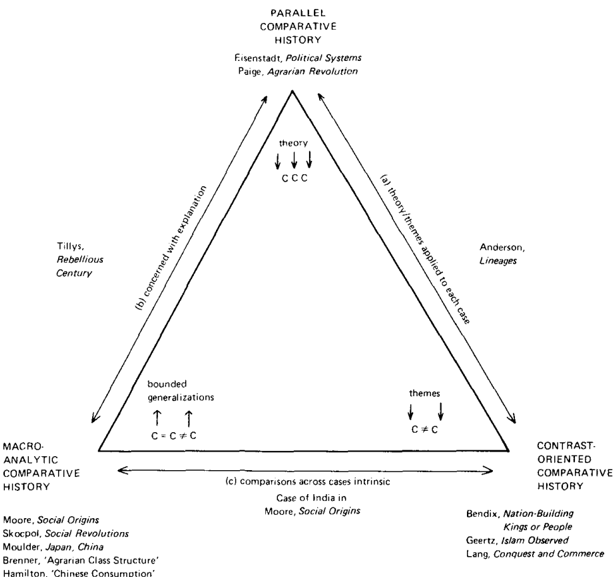
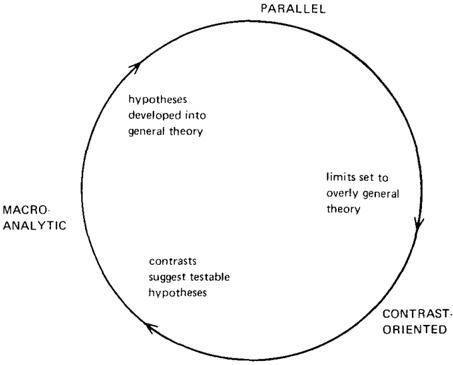
The paper argues that comparative history in macrosocial inquiry has at least three distinct logics: parallel demonstration of theory, contrast of contexts, and macro-causal analysis. It shows that these logics have different purposes, case-selection rules, and strengths/limitations, and that some influential works combine two of them in segmented ways.
## Key findings
- The authors identify three major logics of comparative history: Parallel comparative history, Contrast-oriented comparative history, and Macro-analytic comparative history.
- In Parallel comparative history, cases are juxtaposed mainly to show that a theory applies repeatedly across relevant historical trajectories; the paper says this does not validate the theory, because cases are selected by the theory and are used to illustrate and clarify it.
- In Contrast-oriented comparative history, the goal is to highlight the unique features of each case and how context shapes outcomes; the paper says this approach offers rich, holistic, chronological accounts but tends to avoid explicit explanation.
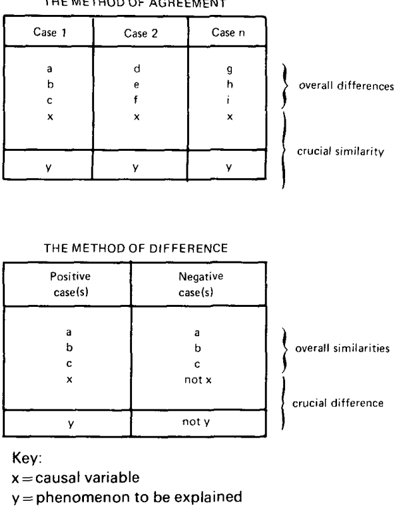
- In Macro-analytic comparative history, scholars use comparisons to make causal inferences about macro-level phenomena, often by approximating John Stuart Mill’s Method of Agreement and Method of Difference; the paper argues this is the best way to attempt validation of causal hypotheses when cases are intrinsically limited.
## Methods
- Conceptual/methodological essay based on comparative analysis of published comparative-historical works; the authors use examples to illustrate each logic rather than providing full methodological dissections.
- The paper’s examples include works by Eisenstadt, Paige, Geertz, Lang, Bendix, Moore, Moulder, Brenner, Hamilton, Anderson, and the Tillys.
- Main analytic frame is a typology/triangle of comparative history, with discussion of how each logic uses cases, theory, chronology, and causal inference.
## Limitations
- The paper states that it does not present full methodological dissections of the works it uses as illustrations, and that many issues about theory and concepts relative to evidence are skirted.
- It explicitly notes that perfectly controlled comparisons are never really feasible in sociohistorical research, because societies cannot be broken apart into manipulable variables and history rarely provides exactly the needed cases.
- Evident from the text: the argument is illustrative rather than systematic empirical testing of the typology itself, since it relies on selected published examples rather than a comprehensive sample.
Model-written summary. Check it against the paper before relying on it.
Integrity signals
Registry
Cites
Statistics
Figures
Verification
Claims the paper makes
0 Valid · 1 Not valid · 49 Not checked · 126 Own results and interpretations
A result the paper states — it cites no source for it, so there is none to check. The quote shows it is in the paper.
In the paper
“The primary mode of demonstrating the theory is something other than comparative history in both books.”
plain- Asserted: passes — The authors put it forward as true.
- Checkable: passes — It can be checked against evidence.
- Load-bearing: passes — The paper’s conclusions depend on it.
- Based: passes — The paper gives a reason why it holds.
A result the paper states — it cites no source for it, so there is none to check. The quote shows it is in the paper.
In the paper
“Eisenstadt relies chiefly upon conceptual elaboration and deduction from structure-functionalist premises”
plain- Asserted: passes — The authors put it forward as true.
- Checkable: passes — It can be checked against evidence.
- Load-bearing: unclear — It is unclear whether the paper’s conclusions depend on it.
- Based: passes — The paper gives a reason why it holds.
A result the paper states — it cites no source for it, so there is none to check. The quote shows it is in the paper.
In the paper
“Despite considerable differences of subject-matter and theoretical approach, both S. N. Eisenstadt's The Political Systems of Empires and Jeffery M. Paige's Agrarian Revolution use comparative history in this way.”
plain- Asserted: passes — The authors put it forward as true.
- Checkable: passes — It can be checked against evidence.
- Load-bearing: passes — The paper’s conclusions depend on it.
- Based: passes — The paper gives a reason why it holds.
A result the paper states — it cites no source for it, so there is none to check. The quote shows it is in the paper.
In the paper
“Nevertheless, in both Eisenstadt's and Paige's books, comparative history serves as an ancillary mode of theoretical demonstration.”
plain- Asserted: passes — The authors put it forward as true.
- Checkable: passes — It can be checked against evidence.
- Load-bearing: passes — The paper’s conclusions depend on it.
- Based: passes — The paper gives a reason why it holds.
A result the paper states — it cites no source for it, so there is none to check. The quote shows it is in the paper.
In the paper
“Within each of his routes, Moore primarily argues along the lines of the Method of Agreement.”
plain- Asserted: passes — The authors put it forward as true.
- Checkable: passes — It can be checked against evidence.
- Load-bearing: unclear — It is unclear whether the paper’s conclusions depend on it.
- Based: passes — The paper gives a reason why it holds.
74 more claims
Create a free account to see all 176 claims and every source verdict.
- Probably not a substantial claim. 82
- It may state two separate claims as one. 36
Citations
Cites
States and Social Revolutions: A Comparative Analysis of France, Russia and China
Skocpol, T. (1979) · Cambridge University Press · doi:10.1017/cbo9780511815805 · Cited by 5,408
Self-citationComparative Politics and the Comparative Method
Lijphart, A. (1971) · American Political Science Review · doi:10.2307/1955513 · Cited by 3,151
Hechter, M., & Wallerstein, I. (1975) · Contemporary Sociology · doi:10.2307/2063180 · Cited by 2,590
Social Origins of Dictatorship and Democracy: Lord and Peasant in the Making of the Modern World.
Ness, G. D., & Moore, B. (1967) · American Sociological Review · doi:10.2307/2092029 · Cited by 2,261
Lineages of the Absolutist State
Rothkrug, L., & Anderson, P. (1976) · The American Historical Review · doi:10.2307/1851205 · Cited by 1,694
The Rise and Future Demise of the World Capitalist System: Concepts for Comparative Analysis
Wallerstein, I. (1974) · Comparative Studies in Society and History · doi:10.1017/s0010417500007520 · Cited by 1,466
AGRARIAN CLASS STRUCTURE AND ECONOMIC DEVELOPMENT IN PRE-INDUSTRIAL EUROPE
Brenner, R. (1976) · Past and Present · doi:10.1093/past/70.1.30 · Cited by 1,193
Appleby, A. B., & Walerstein, I. (1975) · The American Historical Review · doi:10.2307/1852102 · Cited by 1,066
Feld, M. D. (1975) · History: Reviews of New Books · doi:10.1080/03612759.1975.9945059 · Cited by 775
The Rebellious Century: 1830–1930
Tilly, C., Tilly, L., & Tilly, R. (1975) · Harvard University Press eBooks · doi:10.4159/harvard.9780674434004 · Cited by 685
Research works printed but not linked: 8
- 1973, Politics and Society, 4, 10
- Bloch, 1934, Une Étude Régionale: Geographie ou Histoire?, Annales d'Histoire Economique el Sociale, 6, 81
- Mill , “Two Methods,” in Etzioni and Du Bow , eds., Comparative Perspectives, pp. 210–13.
- Anderson, 1967, Land and Work in Medieval Europe: Selected Papers by- Marc Bloch, 44
- 1967, Comparative Sociology: A Codification of Cross-Societal Analysis
- 1977, Poor People's Movements
- Political Systems, he also does a bit of causal analysis using an approximation to controlled comparison. Specifically Eisenstadt uses Macro-analytic comparative history when he argues (pp. 106–7) that some societies had one, but not both, necessary conditions to become bureaucratic empires, contrasting these “failed” cases to “successful” ones.
- Bendix, 1977, Nation-Building and Citizenship, 16
Cited by
Items 401–500 of 1,062
How Constitutional Drafters Use Comparative Evidence
Chernykh, S., & Elkins, Z. (2021) · Journal of Comparative Policy Analysis Research and Practice · doi:10.1080/13876988.2021.1990737 · Cited by 6
“The reform experiences of Brazil and Ukraine provide for a useful and enlightening set of comparisons in the sense that comparativists have come to think of as a parallel demonstration of theory (Skocpol and Somers 1980).”
BackgroundMethodInfluentialAhmed, A. (2022) · Polity · doi:10.1086/721563 · Cited by 11
Beyond disciplinary boundaries: Leveraging complementary perspectives on global labour
Schulze-Cleven, T., Herrigel, G. B., Lichtenstein, N., & Seidman, G. W. (2017) · Journal of Industrial Relations · doi:10.1177/0022185617713042 · Cited by 7
“Using a broader set of observations could simultaneously improve the internal and external validity of analysis, enhancing both the explanatory power and generalizability of findings (Gerring, 2007: 97–98; Ornston and Schulze-Cleven, 2015; Skocpol and Somers, 1980).”
BackgroundReflections in colonial glass? women factory inspectors in Britain and New Zealand 1893-1921
Harrison, B. W., & Nolan, M. (2004) · Women s History Review · doi:10.1080/09612020400200392 · Cited by 6
“[9] Theda Skocpol & Margaret Somers (1980) The Uses of Comparative History in Macrosocial Enquiry, Comparative Studies in Society and History, 22,”
BackgroundSociety, globalization and the comparative method
Axtmann, R. (1993) · History of the Human Sciences · doi:10.1177/095269519300600203 · Cited by 14
Historical Research and Social Movements
Deflem, M., & Dove, A. L. (2013) · The Wiley-Blackwell Encyclopedia of Social and Political Movements · doi:10.1002/9780470674871.wbespm102 · Cited by 6
Renewing the wealth of nations
Pretes, M. (2005) · ANU Open Research (Australian National University) · doi:10.25911/5d7a28258852b · Cited by 6
The Comparative View in Labour History
Eisenberg, C. (1989) · International Review of Social History · doi:10.1017/s0020859000009457 · Cited by 6
Brewer, C. A. (2008) · Texas ScholarWorks (Texas Digital Library) · Cited by 11
Phillimore, J., Block, K., Bradby, H., Darkal, H., Goodson, L., Papoutsi, A., & Vaughan, C. (2025) · Journal of Interpersonal Violence · doi:10.1177/08862605251338785 · Cited by 8
“…because of their diverse histories of forced migration arrival and policy, which enabled us to identify commonalities and differences using comparison as a parallel demonstration of theory, wherein findings have enhanced validity if appearing across multiple contexts (Skocpol & Somers, 1980).”
Extractive Labor: A Lethal Legacy of Racialized Colonial Rule
Scarritt, A. (2023) · Critical Sociology · doi:10.1177/08969205231209884 · Cited by 5
“I principally chose the cases for the illuminating power of their great differences, following the long tradition of building theory through comparing differences and similarities between highly disparate cases (Bernhard and O’Neill, 2021; Skocpol and Somers, 1980).”
BackgroundInfluentialMenggunakan metode historis komparatif dalam penelitian psikologi
Karyanta, N. A., Suryanto, S., & Hendriani, W. (2020) · Jurnal Psikologi Sosial · doi:10.7454/jps.2020.15 · Cited by 7
The politics of anti-austerity protest: South Korea in 1997–1998 and Greece in 2009–2010
Lee, S. K. (2021) · International Journal of Comparative Sociology · doi:10.1177/0020715221988951 · Cited by 6
“This analytical strategy approximates what is often called the “most-similar” comparison (e.g. Collier, 1991; Skocpol and Somers, 1980), a popular method seeking to differentiate cases matched as closely as possible to the extent that they share many important attributes but differ from each other with regard to only…”
MethodTowards a Comparative Subnational Perspective on India
Jacob, S. (2015) · Studies in Indian Politics · doi:10.1177/2321023015601744 · Cited by 7
Wiseman, A. W., & Popov, N. (2015) · Emerald Group Publishing Limited eBooks · doi:10.1108/s1479-367920140000026001 · Cited by 5
Foord, D., & McLaughlin, J. D. (2019) · Energy Research & Social Science · doi:10.1016/j.erss.2019.05.021 · Cited by 5
Introduction: The Promise, Pitfalls, and Practicalities of Comparative Ethnography
Abramson, C. M., & Gong, N. (2020) · Oxford University Press eBooks · doi:10.1093/oso/9780190608484.003.0001 · Cited by 12
The transformation of Industrial Citizenship in the course of European integration
Nachtwey, O., & Seeliger, M. (2020) · British Journal of Sociology · doi:10.1111/1468-4446.12792 · Cited by 8
Themes of diversity, comparison, and contextualisation overCompare’shistory
Davidson, P. M., Dzotsenidze, N., Park, M. F., et al. (2020) · Compare A Journal of Comparative and International Education · doi:10.1080/03057925.2020.1831160 · Cited by 5
Gozillon, A., & Neys, O. H. (2021) · International Journal of Sport Policy and Politics · doi:10.1080/19406940.2021.1898444 · Cited by 5
“It thus authorises the questioning of common characteristics and the assertion of particularisms, through the analysis of contrasts, thus revealing specificities (Skocpol and Somers 1980).”
BackgroundGøtzsche‐Astrup, J. (2022) · Current Sociology · doi:10.1177/00113921221084359 · Cited by 5
“I contrast two cases in the movement (cf. Skocpol and Somers, 1980: 1789).”
Beyond Academic Imperialism in Comparative Studies of the Global South: Methodological Reflections
Phiri, M. Z. (2022) · Journal of Higher Education in Africa · doi:10.57054/jhea.v19i2.2178 · Cited by 11
Posey, B. M. (2023) · Women s Studies International Forum · doi:10.1016/j.wsif.2023.102741 · Cited by 9
Hall, T. D. (2014) · Journal of Globalization Studies · Cited by 7
Directly Elected Mayors and their Parties: The Cases of Genoa and Lausanne
McDonnell, D., & Mazzoleni, O. (2013) · Government and Opposition · doi:10.1017/gov.2013.25 · Cited by 5
“In sum, our qualitative-comparative study is based on a contrast of contexts (Collier 1993: 108; Skocpol and Somers 1980: 170–81), especially with reference to institutional patterns, party legacies and organizations, combined with a common recent electoral system change.”
MethodVergleichende Soziologie, kritischer Realismus und Reflexivität
Steinmetz, G. (2021) · KZfSS Kölner Zeitschrift für Soziologie und Sozialpsychologie · doi:10.1007/s11577-021-00742-2 · Cited by 6
“Gemeinsam mit Margaret Somers veröffentlichte Theda Skocpol 1980 einen Aufsatz, in dem drei unterschiedliche Herangehensweisen an die vergleichende Makrosoziologie vorgestellt wurden.”
BackgroundInfluentialThe ?new history? in sociology
Hamilton, G. G. (1987) · International Journal of Politics Culture and Society · doi:10.1007/bf01384924 · Cited by 5
The New Breed in Japan: Consumer Culture
Anderson, L., & Wadkins, M. (1992) · Canadian Journal of Administrative Sciences / Revue Canadienne des Sciences de l Administration · doi:10.1111/j.1936-4490.1992.tb00588.x · Cited by 7
Kultur und Kontext — Strategien zur Einbeziehung komplexer Umwelten in die Vergleichende Methode
Beichelt, T. (2005) · VS Verlag für Sozialwissenschaften eBooks · doi:10.1007/978-3-322-80441-9_11 · Cited by 5
Törnquist, O. (1993) · Third World Quarterly · doi:10.1080/01436599308420339 · Cited by 5
Aus, J. P. (2005) · RePEc: Research Papers in Economics · Cited by 8
Methods in Governance Research: A Review of Research ApproachesPreprint
Sáez, L. (2014) · SSRN Electronic Journal · doi:10.2139/ssrn.2386619 · Cited by 5
“Historical institutionalism emerged, in large part, as a reaction to the ahistorical nature of rational choice and quantitative approaches in the social sciences (Skocpol & Sommers, 1980; Thelen and Steinmo, 1992; Katznelson, 1997; Hall & Taylor 1996).”
BackgroundCooper, A. (2014) · Oxford University Research Archive (ORA) (University of Oxford) · doi:10.5287/ora-ppdg0kyo9 · Cited by 10
Studying Democracy and Teaching Classics: What Is Happening in the Field of Comparative Politics?
Kurzer, P. (2003) · Perspectives on Politics · doi:10.1017/s1537592703000318 · Cited by 5
Leibler, A. (2008) · eScholarship (California Digital Library) · Cited by 5
Cheon, A. (2023) · Oxford University Press eBooks · doi:10.1093/oso/9780197672884.005.0001 · Cited by 6
Sociological studies of diffusion: is history relevant?
Djelic, M. (2008) · Socio-Economic Review · doi:10.1093/ser/mwn008 · Cited by 63
“They drive middle range theory making (Skocpol and Somers, 1980; Djelic, 1998, p. 14).”
BackgroundCulture, context and East Asian high-performing education systems
Green, A., & Phan, H. (2025) · Research Papers in Education · doi:10.1080/02671522.2025.2567396 · Cited by 12
“The research here builds on the findings of the previous research by adopting a ‘macro-causal’, logical comparative approach to analysing the factors associated with high performance in core skills in the East Asia (Skocpol and Somers 1980).”
Historical Institutionalism in Education and Globalization
Graf, L. (2023) · Oxford University Press eBooks · doi:10.1093/oxfordhb/9780197570685.013.28 · Cited by 8
Reimagining Comparisons in International Relations through Reflexivity
Lai, D. (2024) · International Studies Review · doi:10.1093/isr/viae043 · Cited by 8
Reuter, E., Ueberbacher, F., & Scherer, A. G. (2025) · Administrative Science Quarterly · doi:10.1177/00018392251334366 · Cited by 5
“We bracketed the period after the key events (see Langley, 1999; Skocpol & Somers, 1980) as follows: Episode 1: the UBS case (2008 to 2010) and Episode 2: the Wegelin case (2011 to the end of 2012).”
Harold Innis and Comparative Politics: A Critical Assessment
Athwal, A. (2004) · Canadian Journal of Political Science · doi:10.1017/s0008423904040120 · Cited by 4
El método comparativo en la investigación social y en el análisis histórico.
Reina, D. T. (2021) · Historia Y Espacio · doi:10.25100/hye.v17i17.10117 · Cited by 20
Migrant mineworkers and South Africa’s diplomatic relations with Botswana and Lesotho , 1906-2006
Suping, K. (2022) · Cogent Social Sciences · doi:10.1080/23311886.2022.2146623 · Cited by 4
“Among others, comparative historical research puts emphasis on identifying similarities and differences across different cases, as well as the uniqueness of each case (Skocpol & Somers, 1980).”
BackgroundTheorizing Subdisciplinary Exchange: Historical Sociology, Ethnography, and the Case of SSHA
Mayrl, D., Wilson, N. H., Mahler, M., & Pacewicz, J. (2023) · Social Science History · doi:10.1017/ssh.2023.31 · Cited by 4
“This sense of domination is particularly visible in in-house critiques of attempts by some historical sociologists to develop formal methods akin to those in standard sociology (e.g., Skocpol 1979; Skocpol and Somers 1980; Mahoney and Rueschemeyer 2003).”
Díaz, A. G. (2023) · Election Law Journal Rules Politics and Policy · doi:10.1089/elj.2023.0006 · Cited by 7
“…that these conditions make ‘‘standard actors’’ become ‘‘incapable of coherent collective action.’’ they are understood as critical junctures, or important moments of transition that lead to new opportunities for institutional development and behavioural change (Skocpol and Margaret Somers, 1980).”
Pani, É. (2008) · The Americas A Quarterly Review of Latin American History · doi:10.1353/tam.0.0034 · Cited by 4
Reconceptualizing Integration in Cities of Immigration: A Comparative Study of Berlin and Hong Kong
Chau, K. L.-F. (2013) · The Journal of Comparative Asian Development · doi:10.1080/15339114.2013.797253 · Cited by 4
“One of the essential values of comparison, however, is to discover peculiarity and demand for explanation (Skocpol & Somers, 1980).”
Thiemann, M. (2014) · Business and Politics · doi:10.1515/bap-2012-0011 · Cited by 4
The Retreat to Method: the Aftermath of Elite Concession to Civil Society in India and Mexico
Vithayathil, T., Graizbord, D., & de Leon, C. (2018) · Studies in Comparative International Development · doi:10.1007/s12116-018-9259-0 · Cited by 6
The Nation as Propertied Community: The Emergence of Nationalism in the United States and Norway
Fuglestad, E. M. (2018) · Studies in Ethnicity and Nationalism · doi:10.1111/sena.12281 · Cited by 4
Political opportunities and the quest for political recognition in Tibet, Taiwan, and Palestine
Stokes, D. (2019) · International Review of Sociology · doi:10.1080/03906701.2019.1609751 · Cited by 8
“Mill’s ‘Method of Difference’ further enables the researcher to contrast positive cases in which hypothesized factors are present with negative cases in which the hypothesized factors or outcomes are absent (Skocpol & Somers, 1980).”
BackgroundMethodThe logico-formalist turn in comparative and case study methods: a critical realist critique
Pula, B. (2020) · International Journal of Social Research Methodology · doi:10.1080/13645579.2020.1823063 · Cited by 6
“…analysis required methods such as Mill’s Method of Agreement and of Difference, because these represented ‘the only way to attempt to validate (and invalidate) causal hypotheses about macro-phenomena of which there are intrinsically only limited numbers of cases’ (Skocpol & Somers, 1980, p. 194).”
MethodFormal versus Functional Method in Comparative Constitutional Law
Bignami, F. (2016) · Osgoode Hall law journal · doi:10.60082/2817-5069.2993 · Cited by 4
Rethinking the Methodological Foundation of Historical Political Science
Shi, Q. (2022) · Chinese Political Science Review · doi:10.1007/s41111-021-00200-6 · Cited by 8
“Methodological thinking based on controlled comparison (Przeworski and Teune 1970; Skocpol and Somers 1980; Brady and Collier 2010) has grown to become the mainstay of contemporary small-sample analysis, and has provided powerful analysis tools to 90 Chinese Political Science Review (2022)…”
MethodDombrowski, P. J., & Reich, S. (2019) · Oxford University Press eBooks · doi:10.1093/oso/9780198840848.003.0002 · Cited by 4
Sino–American relations and the ‘new cold war’: A useful analogy for the Middle East?
Friedman, B., & Sela, O. (2022) · Global Policy · doi:10.1111/1758-5899.13134 · Cited by 4
Comparative History in Sociological Writings of Max Weber
Mohanty, R. K. (2022) · Sociological Bulletin · doi:10.1177/00380229221134614 · Cited by 4
“In fact, ‘a genuinely Weberian sociology conceived within comparative and world-historical horizons was oriented towards explaining the uniqueness of the contemporary forms of society’ (Steven, 1984, p. 381; Skocpol & Somers, 1980, pp. 174–196).”
Background"Weltbeziehung": The Study of our Relationship to the World
Hollstein, B., Rosa, H., Rüpke, J., & Verlag, C. (2023) · Campus Verlag eBooks · doi:10.12907/978-3-593-45587-7 · Cited by 9
Comparação dos casos mais contrastantes: método pioneiro central na era da globalização
Giraud, O. (2009) · Sociologias · doi:10.1590/s1517-45222009000200004 · Cited by 4
Political party ambitions and type-2 diabetes policy in Brazil and Mexico
Gómez, E. J. (2018) · Health Economics Policy and Law · doi:10.1017/s1744133118000415 · Cited by 4
“Nevertheless, these nations differed in the key causal variables and outcomes mentioned earlier, in turn highlighting their unique political and institutional contexts (Skocpol and Somers, 1980).”
BackgroundPotiker, S. L. (2021) · Critical Sociology · doi:10.1177/08969205211048547 · Cited by 6
“Despite having similar historical contexts, the two cases have vastly divergent outcomes making them prime candidates for comparative-historical analysis (Skocpol and Somers, 1980).”
BackgroundEXPLAINING DUTCH FERTILITY RATES IN A COMPARATIVE EUROPEAN PERSPECTIVE
Rijken, A. J., & Knijn, T. (2008) · European Societies · doi:10.1080/14616690701744372 · Cited by 5
Infrastructure, Safety, and Environment
Hosek, S. D., Cox, A. G., Ghosh‐Dastidar, B., & Kofner, A. (2005) · Digital Commons - USU (Utah State University) · Cited by 4
Knapp, P. (1990) · Sociological Forum · doi:10.1007/bf01115391 · Cited by 4
“The contrast between hypothesis testing and establishing domain motivates the well-known topologies of Skocpol ( Skocpol and Summers, 1980 ), Tilly (1984), and Kohn (1987).”
Background2005, ‘A unified framework for the social sciences
Gerring, J. (2015) · Cited by 4
Peinert, E. (2017) · Review of International Political Economy · doi:10.1080/09692290.2017.1387586 · Cited by 7
“I propose that endogenous arguments should place a much higher premium on parallel demonstrations of a theory across cases (Skocpol & Somers, 1980), instead of traditional comparative case selection.”
BackgroundIntroduction: Comparing Grand Strategies in the Modern World
Balzacq, T., Dombrowski, P. J., & Reich, S. (2019) · Oxford University Press eBooks · doi:10.1093/oso/9780198840848.003.0001 · Cited by 12
Fair, C. C. (2019) · Oxford University Press eBooks · doi:10.1093/oso/9780198840848.003.0008 · Cited by 5
Kenworthy, L., & Hicks, A. M. (2008) · Palgrave Macmillan UK eBooks · doi:10.1057/9780230594081_1 · Cited by 4
Un estudio de caso de Landnahme: El sector agroexportador en Chile (1973-1990)
Claudia Cerda, B. (2016) · Política Revista de Ciencia Política · doi:10.5354/0719-5338.2016.44773 · Cited by 4
Een Gekke Methodologie? Over de Grenzen van Macrokwantitatief Sociaal-Wetenschappelijk Onderzoek
Kittel, B. (2005) · Sociologie · doi:10.1347/sogi.1.1.5.64114 · Cited by 4
Explaining Postcommunist Economic PerformancePreprint
KING, L. P. (2003) · SSRN Electronic Journal · doi:10.2139/ssrn.404583 · Cited by 6
Access to power : hegemonic party rule in Singapore and Taiwan
Tan, N. (2010) · cIRcle (University of British Columbia) · doi:10.14288/1.0071541 · Cited by 4
“Besides, Smith’s (2005, 427) 7 See Thelen and Steinmo (1992), Skocpol and Somers (1980) and Pierson and Theda (2002).”
Werner, H. P. (2002) · Mspace (University of Manitoba) · Cited by 4
Trampusch, C. (2000) · eDiss (Georg-August-Universität Göttingen) · doi:10.53846/goediss-3071 · Cited by 24
Etchemendy, S. (2019) · REVISTA SAAP · doi:10.46468/rsaap.13.2.a5 · Cited by 3
Visceral Politics and Its Impact on US Foreign Policy Decision-Making
Houghton, D. P., & Méndez, Á. (2022) · Foreign Policy Analysis · doi:10.1093/fpa/orac025 · Cited by 6
Toward a Qualitative Study of the American Voter
Berg, A. L., & Ternullo, S. (2025) · Perspectives on Politics · doi:10.1017/s1537592724002718 · Cited by 13
“…a mixed-methods study) or on existing literature (in a purely qualitative study) to select cases, they retain the fl exibility to choose the case(s) that are best suited to generate new theoretical insights (George and Bennett 2005; Seawright and Gerring 2008; Skocpol and Somers 1980; Small 2009).”
The unpeculiar institution: Patterson’s global perspective on enslavement
Ruef, M. (2025) · Ethnic and Racial Studies · doi:10.1080/01419870.2025.2479143 · Cited by 3
“A second element in contextual comparison is what Skocpol and Somers (1980) refer to as the “ parallel demonstration of theory, ” that is, repeated evidence of a similar pattern across societies, even in cases that (at fi rst glance) appear rather distinctive or di ffi cult.”
InfluentialMODELIZACIÓN DE PROCESOS HISTÓRICOS COMPLEJOS A TRAVÉS DE LA NARRATIVA ANALÍTICA
Levi, M. (2006) · Revista Uruguaya de Ciencia Política · Cited by 3
Eaton, R. M. (2011) · The Medieval History Journal · doi:10.1177/097194581001400101 · Cited by 3
Same context, different political paths: Two Islamic movements in Turkey
Kirdiş, E. (2016) · International Area Studies Review · doi:10.1177/2233865916646561 · Cited by 6
“To understand this simultaneous yet diverse political evolution of the JDP and the GM, this paper will adapt a “method of difference” (Skocpol and Somers, 1980) and ask (1) why two Islamic movements facing the same socio-political context have chosen varying political paths when they were subject…”
Method4 The European Union and National Politics
Schmidt, V. A. (2006) · Oxford University Press eBooks · doi:10.1093/acprof:oso/9780199266975.003.0005 · Cited by 3
Conclusion: The Emerging Sub-field of Comparative Grand Strategy
Ripsman, N. M. (2019) · Oxford University Press eBooks · doi:10.1093/oso/9780198840848.003.0013 · Cited by 3
Hunzeker, M. A., & Harkness, K. A. (2020) · European Journal of International Security · doi:10.1017/eis.2020.17 · Cited by 6
Niaz, L., & Anand, K. (2021) · Education Sciences · doi:10.3390/educsci11110741 · Cited by 3
“Our aim is not to compare the two countries, but rather to use the contrast of contexts [19] approach to understand how the public university spaces are ‘conceived’ as aspects of furthering their national narratives and how this visual culture can potentially be ‘perceived’.”
BackgroundBalzacq, T. (2019) · Oxford University Press eBooks · doi:10.1093/oso/9780198840848.003.0005 · Cited by 6
Rey, M. (2013) · Reforma y democracia. · doi:10.69733/clad.ryd.n55.a845 · Cited by 18
On the Second Wave of Historical Sociology, 1970s–Present
Mahoney, J. (2006) · International Journal of Comparative Sociology · doi:10.1177/0020715206068619 · Cited by 3
Trajectories of emigrant quasi-citizenship: a comparative study of Mexico and Turkey
Yasar, R. (2017) · Comparative Migration Studies · doi:10.1186/s40878-017-0061-3 · Cited by 3
“This implies a typical ‘most similar systems’ design (Lijphart, 1971; Przeworski & Teune, 1970; Skocpol & Somers, 1980), whereby a small number of variables which display differences across cases are inferred to be associated with each other.”
BackgroundVergleichende Fallstudien und Einzelfalldesigns
Siewert, M. Β., & Wagemann, C. (2020) · Springer eBooks · doi:10.1007/978-3-658-16936-7_9 · Cited by 7
din, A. U., Shah, S. M. A., El-Gohary, H. O., Rahman, R. U., Haleem, M., Jehangir, M., Khalil, S. H., & Sayyam (2021) · Sustainability · doi:10.3390/su14010114 · Cited by 11
Saxonberg, S. (2005) · European Societies · doi:10.1080/14616690500083477 · Cited by 3
“This method corresponds basically to ‘the method of difference’ (see, for example, Skocpol and Somers 1980).”
MethodZusman, P. (2010) · LA Referencia (Red Federada de Repositorios Institucionales de Publicaciones Científicas) · doi:10.1234/no.disponible.a.raco.224984 · Cited by 3
Tracking democracies: Italy and Japan in historical perspective
Samuels, R. J. (1997) · Journal of Modern Italian Studies · doi:10.1080/13545719708454955 · Cited by 3
Der Vergleich als Brücke zwischen Wissenschaftsgeschichte und Wissenschaftstheorie
Hentschel, K. (2003) · Journal for General Philosophy of Science · doi:10.1023/b:jgps.0000005167.74373.6f · Cited by 4
Toward a Historical Sociology of Working-Class Formation
Spohn, W. (1990) · Critical Sociology · doi:10.1177/089692059001700307 · Cited by 3
Social structure, history and evolution
Lassman, P. (1984) · Economy and Society · doi:10.1080/03085148400000001 · Cited by 3
Metadata
- Authors
- Skocpol, T., & Somers, M.
- Affiliations
- Harvard University (US)
- Venue
- Comparative Studies in Society and History
- Publisher
- Cambridge University Press (CUP)
- Published
- 1980-04
- Volume
- 22
- Issue
- 2
- Pages
- 174-197
- ISSN
- 0010-4175 (ISSN-L)
- 1475-2999
- OpenAlex
- W2109860650
- Semantic Scholar
- 78dcc4fcfa160854af0a651c0ece23d562212f04
- Cited by
- 1,074
- References
- 36
- Citations by year
- 2026: 20 · 2025: 37 · 2024: 45 · 2023: 45 · 2022: 87 · 2021: 48 · 2020: 52 · 2019: 51 · 2018: 93 · 2017: 23 · 2016: 40 · 2015: 35 · 2014: 38 · 2013: 36 · 2012: 27
- FWCI
- 22.11
- Type
- journal article
- Language
- en
- Open access
- bronze
- doi.org
- Locations
- Comparative Studies in Society and History (publishedVersion)
- Topics
- Social Sciences › Sociology and Political Science › Qualitative Comparative Analysis Research
- Social Sciences › Arts and Humanities › History › Philosophy, History, and Historiography
- Social Sciences › Sociology and Political Science › German Social Sciences and History
- Keywords
- comparative history, social change, historical trajectories, social dynamics, historical sequence, social structure, cultural change
About these checks
Registry, retraction, Cites and statistics results are computed, not judged, with one exception: a printed reference that no index lists is read once by a model before it counts as a citation error. Claims are extracted by a model and kept only when their quote appears verbatim in the text; each cited source is then checked, with a model’s help, for whether it says what the claim relies on. Those verdicts can be wrong — read the claim’s quote and the cited source before relying on one.
A language model drew the claims from the paper on 2026-09-30, under version 3 of the claim definition (model deepseek-v4.1-flash, prompt extract-v3).
A second model labelled each claim on 2026-09-30 (model jev-1.13-20260917, definition revision gold-guideline-v0.2).
Statistics and arithmetic are recomputed, not judged.
Confidence bands are shown only for fields calibrated on our annotated test set. None is calibrated yet, so no band is shown.
What counts as a claim ›How we measure confidence ›How we check this ›
Are you an author, or do you see a problem with this page? Request a review
Data sources
Bibliographic data: Semantic Scholar, OpenAlex, Crossref.
Contains information from the Semantic Scholar Academic Graph Datasets, made available under the ODC Attribution License (ODC-BY 1.0).
Semantic Scholar’s data is described in: Kinney, R., et al. (2023). The Semantic Scholar Open Data Platform. arXiv:2301.10140.
