

The Uses of Comparative History in Macrosocial Inquiry
Open accessThe DOI matches its Crossref record; 35 of the 36 references it cites were found in a registry or an index; none of the 44 sources its claims cite is checked for support yet.
Abstract
Comparative history is not new. As long as people have investigated social life, there has been recurrent fascination with juxtaposing historical patterns from two or more times or places. Part of the appeal comes from the general usefulness of looking at historical trajectories in order to study social change. Indeed, practitioners of comparative history from Alexis de Tocqueville and Max Weber to Marc Bloch, Reinhard Bendix, and Barrington Moore, Jr. have typically been concerned with understanding societal dynamics and epochal transformations of cultures and social structures. Attention to historical sequences is indispensable to such understanding. Obviously, though, not all investigations of social change use explicit juxtapositions of distinct histories. We may wonder, therefore: What motivates the use of comparisons as opposed to focussing on single historical trajectories? What purposes are pursued—and how—through the specific modalities of comparative history?
Overview
CoChat Summary
## TL;DR
The paper argues that comparative history in macrosocial inquiry has at least three distinct logics: parallel demonstration of theory, contrast of contexts, and macro-causal analysis. It shows that these logics have different purposes, case-selection rules, and strengths/limitations, and that some influential works combine two of them in segmented ways.
## Key findings
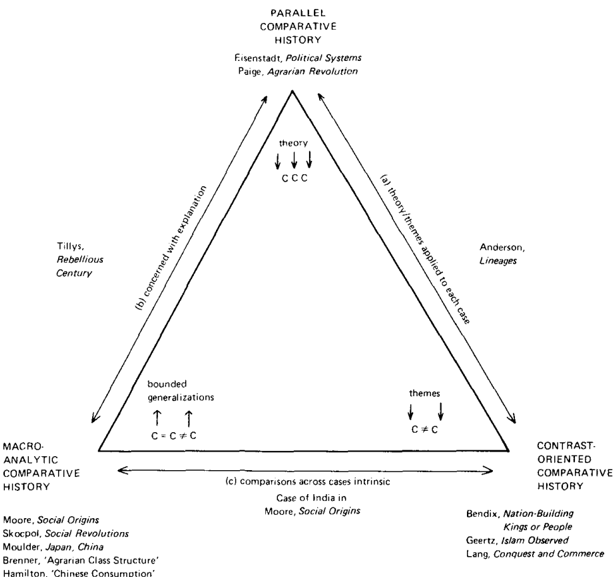
- The authors identify three major logics of comparative history: Parallel comparative history, Contrast-oriented comparative history, and Macro-analytic comparative history.
- In Parallel comparative history, cases are juxtaposed mainly to show that a theory applies repeatedly across relevant historical trajectories; the paper says this does not validate the theory, because cases are selected by the theory and are used to illustrate and clarify it.
- In Contrast-oriented comparative history, the goal is to highlight the unique features of each case and how context shapes outcomes; the paper says this approach offers rich, holistic, chronological accounts but tends to avoid explicit explanation.
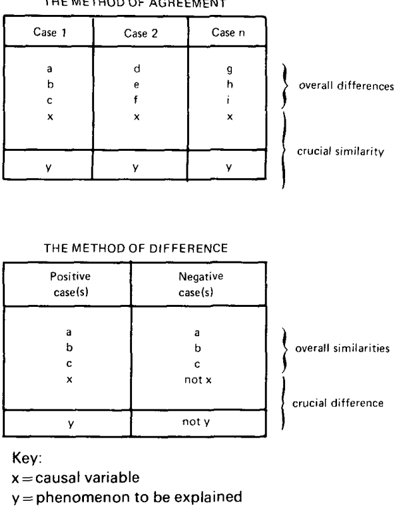
- In Macro-analytic comparative history, scholars use comparisons to make causal inferences about macro-level phenomena, often by approximating John Stuart Mill’s Method of Agreement and Method of Difference; the paper argues this is the best way to attempt validation of causal hypotheses when cases are intrinsically limited.
## Methods
- Conceptual/methodological essay based on comparative analysis of published comparative-historical works; the authors use examples to illustrate each logic rather than providing full methodological dissections.
- The paper’s examples include works by Eisenstadt, Paige, Geertz, Lang, Bendix, Moore, Moulder, Brenner, Hamilton, Anderson, and the Tillys.
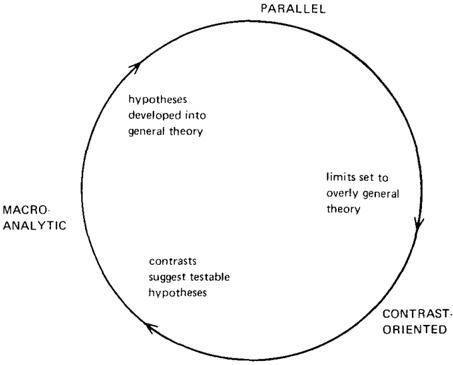
- Main analytic frame is a typology/triangle of comparative history, with discussion of how each logic uses cases, theory, chronology, and causal inference.
## Limitations
- The paper states that it does not present full methodological dissections of the works it uses as illustrations, and that many issues about theory and concepts relative to evidence are skirted.
- It explicitly notes that perfectly controlled comparisons are never really feasible in sociohistorical research, because societies cannot be broken apart into manipulable variables and history rarely provides exactly the needed cases.
- Evident from the text: the argument is illustrative rather than systematic empirical testing of the typology itself, since it relies on selected published examples rather than a comprehensive sample.
Model-written summary. Check it against the paper before relying on it.
Integrity signals
Registry
Cites
Statistics
Figures
Verification
Claims the paper makes
0 Valid · 1 Not valid · 49 Not checked · 126 Own results and interpretations
A result the paper states — it cites no source for it, so there is none to check. The quote shows it is in the paper.
In the paper
“The primary mode of demonstrating the theory is something other than comparative history in both books.”
plain- Asserted: passes — The authors put it forward as true.
- Checkable: passes — It can be checked against evidence.
- Load-bearing: passes — The paper’s conclusions depend on it.
- Based: passes — The paper gives a reason why it holds.
A result the paper states — it cites no source for it, so there is none to check. The quote shows it is in the paper.
In the paper
“Eisenstadt relies chiefly upon conceptual elaboration and deduction from structure-functionalist premises”
plain- Asserted: passes — The authors put it forward as true.
- Checkable: passes — It can be checked against evidence.
- Load-bearing: unclear — It is unclear whether the paper’s conclusions depend on it.
- Based: passes — The paper gives a reason why it holds.
A result the paper states — it cites no source for it, so there is none to check. The quote shows it is in the paper.
In the paper
“Despite considerable differences of subject-matter and theoretical approach, both S. N. Eisenstadt's The Political Systems of Empires and Jeffery M. Paige's Agrarian Revolution use comparative history in this way.”
plain- Asserted: passes — The authors put it forward as true.
- Checkable: passes — It can be checked against evidence.
- Load-bearing: passes — The paper’s conclusions depend on it.
- Based: passes — The paper gives a reason why it holds.
A result the paper states — it cites no source for it, so there is none to check. The quote shows it is in the paper.
In the paper
“Nevertheless, in both Eisenstadt's and Paige's books, comparative history serves as an ancillary mode of theoretical demonstration.”
plain- Asserted: passes — The authors put it forward as true.
- Checkable: passes — It can be checked against evidence.
- Load-bearing: passes — The paper’s conclusions depend on it.
- Based: passes — The paper gives a reason why it holds.
A result the paper states — it cites no source for it, so there is none to check. The quote shows it is in the paper.
In the paper
“Within each of his routes, Moore primarily argues along the lines of the Method of Agreement.”
plain- Asserted: passes — The authors put it forward as true.
- Checkable: passes — It can be checked against evidence.
- Load-bearing: unclear — It is unclear whether the paper’s conclusions depend on it.
- Based: passes — The paper gives a reason why it holds.
74 more claims
Create a free account to see all 176 claims and every source verdict.
- Probably not a substantial claim. 82
- It may state two separate claims as one. 36
Citations
Cites
States and Social Revolutions: A Comparative Analysis of France, Russia and China
Skocpol, T. (1979) · Cambridge University Press · doi:10.1017/cbo9780511815805 · Cited by 5,408
Self-citationComparative Politics and the Comparative Method
Lijphart, A. (1971) · American Political Science Review · doi:10.2307/1955513 · Cited by 3,151
Hechter, M., & Wallerstein, I. (1975) · Contemporary Sociology · doi:10.2307/2063180 · Cited by 2,590
Social Origins of Dictatorship and Democracy: Lord and Peasant in the Making of the Modern World.
Ness, G. D., & Moore, B. (1967) · American Sociological Review · doi:10.2307/2092029 · Cited by 2,261
Lineages of the Absolutist State
Rothkrug, L., & Anderson, P. (1976) · The American Historical Review · doi:10.2307/1851205 · Cited by 1,694
The Rise and Future Demise of the World Capitalist System: Concepts for Comparative Analysis
Wallerstein, I. (1974) · Comparative Studies in Society and History · doi:10.1017/s0010417500007520 · Cited by 1,466
AGRARIAN CLASS STRUCTURE AND ECONOMIC DEVELOPMENT IN PRE-INDUSTRIAL EUROPE
Brenner, R. (1976) · Past and Present · doi:10.1093/past/70.1.30 · Cited by 1,193
Appleby, A. B., & Walerstein, I. (1975) · The American Historical Review · doi:10.2307/1852102 · Cited by 1,066
Feld, M. D. (1975) · History: Reviews of New Books · doi:10.1080/03612759.1975.9945059 · Cited by 775
The Rebellious Century: 1830–1930
Tilly, C., Tilly, L., & Tilly, R. (1975) · Harvard University Press eBooks · doi:10.4159/harvard.9780674434004 · Cited by 685
Research works printed but not linked: 8
- 1973, Politics and Society, 4, 10
- Bloch, 1934, Une Étude Régionale: Geographie ou Histoire?, Annales d'Histoire Economique el Sociale, 6, 81
- Mill , “Two Methods,” in Etzioni and Du Bow , eds., Comparative Perspectives, pp. 210–13.
- Anderson, 1967, Land and Work in Medieval Europe: Selected Papers by- Marc Bloch, 44
- 1967, Comparative Sociology: A Codification of Cross-Societal Analysis
- 1977, Poor People's Movements
- Political Systems, he also does a bit of causal analysis using an approximation to controlled comparison. Specifically Eisenstadt uses Macro-analytic comparative history when he argues (pp. 106–7) that some societies had one, but not both, necessary conditions to become bureaucratic empires, contrasting these “failed” cases to “successful” ones.
- Bendix, 1977, Nation-Building and Citizenship, 16
Cited by
Items 501–600 of 1,062
Mapping Race: Historicizing the History of the Color‐Line
Irwin, R. (2010) · History Compass · doi:10.1111/j.1478-0542.2010.00731.x · Cited by 3
Labor in Transitional Societies: Conflict, Democracy, and Neoliberalism
Cope, Z. (2014) · Journal of Labor and Society · doi:10.1111/wusa.12134 · Cited by 3
Kostantaras, D. (2013) · European Review of History Revue européenne d histoire · doi:10.1080/13507486.2012.745835 · Cited by 3
Vogel, D. (2006) · Cited by 6
The Role Of Iteration In Multi-Method Research
Dunning, T. (2007) · Zenodo (CERN European Organization for Nuclear Research) · doi:10.5281/zenodo.997351 · Cited by 6
Origen de las Universidades Populares
Martín, V. M. M. (2016) · Revista Española de Educación Comparada · doi:10.5944/reec.27.2016.15546 · Cited by 3
A Multidimensional Theory of Early Modern Western Childhood
Johnson, G. D. (1990) · Journal of Comparative Family Studies · doi:10.3138/jcfs.21.1.1 · Cited by 3
Kearns, G. (2013) · Cited by 3
Elites and Collective Protest*
Burton, M. (1983) · Sociological Quarterly · doi:10.1111/j.1533-8525.1983.tb01965.x · Cited by 11
Methoden der Regierungssystemanalyse und des Regierungssystemvergleichs
Pickel, S. (2009) · VS Verlag für Sozialwissenschaften eBooks · doi:10.1007/978-3-531-91955-3_2 · Cited by 3
Li, R. S. K. (2003) · Sociological Inquiry · doi:10.1111/1475-682x.00062 · Cited by 3
Borda, S. P. (2009) · University of Minnesota Digital Conservancy (University of Minnesota) · Cited by 13
Komparation i kritisk realistisk perspektiv
Wad, P. (2006) · Dansk Sociologi · doi:10.22439/dansoc.v11i3.624 · Cited by 2
Does money grow on trees? : the role of climate change finance in South Africa.
Newmarch, J. (2013) · University of the Witwatersrand, Johannesburg Institutional Repository on DSpace (University of the Witwatersrand, Johannesburg) · Cited by 3
Formal Versus Functional Method in Comparative Constitutional LawPreprint
Bignami, F. (2016) · SSRN Electronic Journal · doi:10.2139/ssrn.2835721 · Cited by 3
Gomes, A. M. R. (2008) · Nelson Mandela University Research Repository · Cited by 6
RIFLESSIONI SULLA METODOLOGIA DEGLI STUDI COMPARATI
Smelser, N. J., & Recchi, T. D. E. (1996) · Italian Political Science Review/Rivista Italiana di Scienza Politica · doi:10.1017/s0048840200024023 · Cited by 3
Bread, freedom, human dignity : the political economy of protest mobilization in Egypt and Tunisia
Warkotsch, J. (2015) · Cadmus - EUI Research Repository (European University Institute) · doi:10.2870/728460 · Cited by 7
Graf, L. (2022) · Social Policy and Administration · doi:10.1111/spol.12875 · Cited by 2
Hsueh, R. (2025) · Perspectives on Politics · doi:10.1017/s1537592725101989 · Cited by 8
Everyday forms of resistance in theory and practice
O’Brien, K. J. (2026) · The Journal of Peasant Studies · doi:10.1080/03066150.2026.2630677 · Cited by 5
“In most of his work , Scott was a lumper, not a splitter, a practitioner of universalizing comparisons (Skocpol and Somers 1980; Tilly 1984) rather than a vari-ation-finder.”
Consensus and Historiographic Knowledge
Tucker, A. (2004) · Cambridge University Press eBooks · doi:10.1017/cbo9780511498381.003 · Cited by 2
Archer, R. (2014) · Labour History · doi:10.5263/labourhistory.106.0043 · Cited by 2
Smith, C. M. (2016) · Du Bois Review Social Science Research on Race · doi:10.1017/s1742058x16000308 · Cited by 2
Edling, M. M. (2010) · Cited by 2
Kydyralieva, S. С. (2019) · Journal of Universal History Studies · doi:10.38000/juhis.623305 · Cited by 2
Comparative Area Studies and the Study of the Global South
Sil, R., & Ahram, A. I. (2020) · Vestnik RUDN International Relations · doi:10.22363/2313-0660-2020-20-2-279-287 · Cited by 5
Georgiou, C. (2021) · Comparative European Politics · doi:10.1057/s41295-021-00239-4 · Cited by 2
Middell, M. (2021) · Forum qualitative Sozialforschung · doi:10.17169/fqs-22.2.3734 · Cited by 10
Chouhy, G. (2022) · Social Science History · doi:10.1017/ssh.2021.50 · Cited by 4
Comparative, International, and Transnational Histories of Education
Cowen, R. (2020) · Springer international handbooks of education · doi:10.1007/978-981-10-2362-0_3 · Cited by 2
Marangé, C. (2019) · Oxford University Press eBooks · doi:10.1093/oso/9780198840848.003.0003 · Cited by 3
The Ottoman System of Scripts and the Müteferrika Press
Osborn, J. R. (2022) · De Gruyter eBooks · doi:10.1515/9783110776485-003 · Cited by 2
El método comparativo en América Latina
Pérez‐Liñán, A. (2023) · Revista Ecuatoriana de Ciencia Política · doi:10.59352/recp.v2i1.73 · Cited by 2
Koniewski, M., Krupnik, S., & Skórska, P. (2024) · Evaluation and Program Planning · doi:10.1016/j.evalprogplan.2024.102429 · Cited by 2
The first modern health communication campaign in Europe: explicit and implicit strategic intents
Dahlen, Ø. P. (2024) · Corporate Communications An International Journal · doi:10.1108/ccij-08-2023-0106 · Cited by 2
Rougier, É., Clément, M., Combarnous, F., & Darbon, D. (2025) · Kyklos · doi:10.1111/kykl.70000 · Cited by 3
“Adopting a comparative approach inspired by the historical sociology of dramatic contrasts (Skocpol and Somers 1980), we study four contrasting countries—Brazil, Côte d'Ivoire, Turkey, and Vietnam—without presuming similarity or irreducibility.”
Zhang, J., Zamfirescu-Pereira, J. D., Glassman, E. L., Masson, D., & Arawjo, I. (2026) · CHI Conference on Human Factors in Computing Systems · doi:10.1145/3772318.3790264 · Cited by 2
“We began with a diverse set of notations across five disciplines— music, dance, chemistry, physics, and computer programming—that had prior historical literature to draw upon in our initial analysis.”
“Mecanismos” Sociais e Sociologia Histórica-Comparativa: uma proposta Realista Crítica
Gorski, P. S. (2020) · Teoria e Cultura · doi:10.34019/2318-101x.2019.v14.27893 · Cited by 2
The Rise and Strength of Authoritarian Restoration—Constructing a Comparative Logic for Research
Keim, W. (2021) · BRILL eBooks · doi:10.1163/9789004466609_012 · Cited by 2
“Ultimately, the aim of my study follows the logic of “comparative history as the contrast of contexts” (Skocpol & Somers, 1980, p. 175).”
BackgroundSchröder, M. (2010) · Social Science Open Access Repository (GESIS – Leibniz Institute for the Social Sciences) · Cited by 3
Situational Gamblers: Prospect Theory and the Commonalities of Presidential Campaign Management
O’Connell, D. A. (2011) · Presidential Studies Quarterly · doi:10.1111/j.1741-5705.2010.03831.x · Cited by 2
Gortázar, I. O. (1992) · Studia Historica Historia Contemporánea · Cited by 30
Partidos armados: La lógica oficial y las voces disidentes (Argentina, 1976-1977)
Ollier, M. M. (2008) · Nuevo mundo mundos nuevos · doi:10.4000/nuevomundo.38272 · Cited by 2
Trampusch, C. (2010) · Zeitschrift für Vergleichende Politikwissenschaft · doi:10.1007/s12286-010-0070-1 · Cited by 2
Economic history at the species level
JONES, E. L. (1982) · History of European Ideas · doi:10.1016/0191-6599(82)90055-9 · Cited by 2
Trampusch, C. (2008) · Zeitschrift für Vergleichende Politikwissenschaft · doi:10.1007/s12286-008-0005-2 · Cited by 2
Gender, States, and Social Policies: Skocpol's View
Carruthers, B. G. (1993) · Law & Social Inquiry · doi:10.1111/j.1747-4469.1993.tb00755.x · Cited by 2
Comparative History and the Colonial Encounter: the Great War and the Crisis of the British Empire
Adas, M. (1990) · Itinerario · doi:10.1017/s0165115300009992 · Cited by 2
National Identity and the Informational Welfare State: Turkey and Malaysia Compared
Ignatow, G. (2011) · The Information Society · doi:10.1080/01972243.2011.566751 · Cited by 2
“Using the “method of difference” (Mill 1970) as developed by comparative-historical sociologists (eg, Skocpol and Somers 1980 ), I compare the Turkish and Malaysian states’ investments in public libraries, reading rooms, and community centers, and in public, government-funded Internet access points, which are often lo…”
MethodDjelic, M., & Durand, R. (2010) · Advances in strategic management · doi:10.1108/s0742-3322(2010)0000027013 · Cited by 3
Luzuriaga, M. J., & Bahia, L. (2016) · Cadernos Saúde Coletiva · doi:10.1590/1414-462x201600010201 · Cited by 2
Osinsky, P. (2015) · Cited by 2
Jensen, N. R. (2010) · Sozial Extra · doi:10.1007/s12054-010-0007-6 · Cited by 2
Collaborative Historical Information Analysis
Manning, P. M., François, P., Hoyer, D., & Zadorozhny, V. (2017) · Elsevier eBooks · doi:10.1016/b978-0-12-409548-9.09658-5 · Cited by 3
‘Gender Diversity’ and Nationalisms in Multiple Contexts
Vickers, J. (2018) · Springer eBooks · doi:10.1007/978-3-319-76699-7_17 · Cited by 4
Orban, A., & Trampusch, C. (2019) · Springer eBooks · doi:10.1007/978-3-658-22803-3_19 · Cited by 3
Varieties of Time in Comparative Historical Analysis
Kreuzer, M. (2020) · Oxford University Press eBooks · doi:10.1093/oxfordhb/9780190862084.013.17 · Cited by 3
Der Wandel von Economic Citizenship im Zuge der europäischen Integration
Nachtwey, O., & Seeliger, M. (2019) · Zeitschrift für Soziologie · doi:10.1515/zfsoz-2019-0024 · Cited by 2
“Unser Ansatz befindet sich methodisch damit zwischen einer parallel demonstration of theory und einem contrast of context (Skocpol & Somers 1980).”
BackgroundOstner, I., & Schmitt, C. (2008) · VS Verlag für Sozialwissenschaften eBooks · doi:10.1007/978-3-531-90895-3_1 · Cited by 2
História Global como Rizoma: possibilidades e limites de uma nova abordagem
Gouveia, J. R., & Lemos, L. S. (2022) · Revista Tempo e Argumento · doi:10.5965/2175180314352022e0101 · Cited by 3
Jaster, D., Swed, O., & Frère, B. (2022) · Society · doi:10.1007/s12115-022-00746-4 · Cited by 6
Potiker, S. L., Williams, D. M., & Alimahomed‐Wilson, J. (2022) · Journal of World-Systems Research · doi:10.5195/jwsr.2022.1097 · Cited by 6
Employer Influence in Vocational Education and Training: Germany and Sweden Compared
Busemeyer, M. R., & Thelen, K. (2022) · Oxford University Press eBooks · doi:10.1093/oso/9780192866257.003.0010 · Cited by 8
Business history goes East: An introduction
Unkovski-Korica, V., & Vejzagić, S. (2023) · Business History · doi:10.1080/00076791.2023.2234827 · Cited by 2
“It also speaks of a fairly autonomous and authentic company modernisation, technological experimentation, and a strategically planned market expansion (and flexibility) in a business environment established within one of the twentieth century European socialist projects… enterprises and their…”
The Political Origins of Colonial Land Policy: Evidence From British India and French Algeria
Lawrence, A. K., & Sajid, F. M. (2024) · Comparative Political Studies · doi:10.1177/00104140241252093 · Cited by 4
Towards a ‘Women’s History’ of Social Work in Europe
Hering, S., & Waaldijk, B. (2003) · VS Verlag für Sozialwissenschaften eBooks · doi:10.1007/978-3-322-80895-0_2 · Cited by 2
Sass, K. (2014) · Nordic Journal of Working Life Studies · doi:10.19154/njwls.v4i3.4182 · Cited by 2
Prospects for More Productive Comparative Civilizational Studies
Hewest, G. W. (1981) · Cross-Cultural Research · doi:10.1177/106939718101600109 · Cited by 2
“…reader would not come away with the realization that there are living scholars still pursuing comparative civilizational studies, much less that an obscure learned society actually exists whose members are involved in such studies (Grew 1980; Hill and Hill 1980; Skocpol and Somers 1980).”
BackgroundHochberg, L. J. (2007) · Journal of Classical Sociology · doi:10.1177/1468795x07073951 · Cited by 4
Towards a Cross-Cultural Conceptual Framework for Researching Social and Emotional Education
Loinaz, E. S. (2018) · IAFOR Journal of Education · doi:10.22492/ije.6.3.07 · Cited by 4
“The comparative design used a contrast of contexts method which works best when the cases that it juxtaposes are maximally different (Skocpol & Somers, 1980).”
MethodBeauchamp, C. (2008) · Enterprise & Society · doi:10.1093/es/khn084 · Cited by 2
Corporate Accountability from Below
Payne, L. A., Pereira, G., & Bernal-Bermúdez, L. (2020) · Cambridge University Press eBooks · doi:10.1017/9781108564564.002 · Cited by 2
Balzacq, T., & Ramadan-alban, W. (2019) · Oxford University Press eBooks · doi:10.1093/oso/9780198840848.003.0009 · Cited by 3
Delgadillo, J. M. S. (2012) · Gredos (University of Salamanca) · doi:10.14201/gredos.121237 · Cited by 12
Rudiyanto, A. (2002) · Research Online (University of Wollongong) · Cited by 2
Civilization in Color: The Multicultural City in Three MillenniaPreprint
Briggs, X. D. S. (2003) · SSRN Electronic Journal · doi:10.2139/ssrn.364520 · Cited by 2
Walter, M. (2013) · SSRN Electronic Journal · doi:10.2139/ssrn.2256045 · Cited by 2
Mossmann, J. (2010) · SUNScholar (Stellenbosch University) · Cited by 2
Mapping the Sovereign State: Cartographic Technology, Political Authority, and Systemic Change
Branch, J. (2011) · eScholarship (California Digital Library) · Cited by 9
Cameron, M. A. (1992) · Comparative Political Studies · doi:10.1177/0010414092025002004 · Cited by 2
Muro, D. (2010) · Cadmus - EUI Research Repository (European University Institute) · Cited by 2
Li, Y. (2016) · RePub (Erasmus University Rotterdam) · Cited by 8
Comparative Historical Sociology
Prasad, M. (2011) · Oxford University Press eBooks · doi:10.1093/obo/9780199756384-0009 · Cited by 2
Welborne, B. C. (2011) · CU Scholar (University of Colorado Boulder) · Cited by 2
IL METODO COMPARATO: DUE DECENNI DI MUTAMENTI
Collier, D. A. (1990) · Italian Political Science Review/Rivista Italiana di Scienza Politica · doi:10.1017/s004884020000959x · Cited by 2
Reviving the Region: Endogenous Development in European Rural Regions, 1975-Present
Hoogeboom, B. (2020) · University of Groningen research database (University of Groningen / Centre for Information Technology) · doi:10.33612/diss.129718073 · Cited by 2
Thomas, B. J. (2016) · doi:10.33915/etd.6794 · Cited by 2
Julien, É. (2004) · Hypothèses · doi:10.3917/hyp.041.0191 · Cited by 1
GIACALONE, R. A. (2010) · Investigaciones de Historia Económica · doi:10.1016/s1698-6989(10)70034-5 · Cited by 1
Vanacker, B., & van Deinsen, L. (2022) · Leuven University Press eBooks · doi:10.11116/9789461664532 · Cited by 1
The Social-Political Dichotomy
Beck, C. J., Bukovansky, M., Chenoweth, E., Lawson, G., Nepstad, S. E., & Ritter, D. P. (2022) · Oxford University Press eBooks · doi:10.1093/oso/9780197638354.003.0002 · Cited by 1
CASE STUDY ANALYSİS AND ELITE INTERVIEW IN POLITICAL SCIENCE
Ezikoğlu, Ç. (2022) · Pamukkale University Journal of Social Sciences Institute · doi:10.30794/pausbed.1082089 · Cited by 1
The strange career of Millian methods in comparative social science
Kurzman, C. (2024) · Social Forces · doi:10.1093/sf/soae095 · Cited by 1
Nada sobre nós, sem nós: as pessoas com deficiência nos conselhos municipais
Pessali, H. F., & Chudzij, L. F. (2025) · Sociedade e Estado · doi:10.1590/s0102-6992-20254001e53623 · Cited by 1
Pearce, J. (2025) · Canadian Journal of African Studies / Revue canadienne des études africaines · doi:10.1080/00083968.2025.2490564 · Cited by 1
“I employ here what Skocpol and Somers call “comparative history as the contrast of contexts,” an approach intended “to bring out the unique features of each particular case included in their discussions, and to show how these unique features affect the working-out of putatively general social processes” (1980,…”
Hidayat, A. R., Hospes, O., & Termeer, C. J. A. M. (2026) · Land Use Policy · doi:10.1016/j.landusepol.2026.108061 · Cited by 1
Learning from the Future: Global Tragedy or Global Transformation?
Rivas, J. (2009) · Journal of Critical Realism · doi:10.1558/jocr.v8i1.91 · Cited by 1
Hidalgo, J. A. F. (2009) · Anuario Colombiano de Historia Social y de la Cultura · Cited by 1
Medieval Security in the Modern State
Woods, J. (2010) · Space and Polity · doi:10.1080/13562576.2010.532953 · Cited by 1
“Although the comparative historical approach is more often employed to elucidate social transformations (Skocpol and Somers, 1980 ), it can also reveal continuous or recurrent social developments.”
Background
Metadata
- Authors
- Skocpol, T., & Somers, M.
- Affiliations
- Harvard University (US)
- Venue
- Comparative Studies in Society and History
- Publisher
- Cambridge University Press (CUP)
- Published
- 1980-04
- Volume
- 22
- Issue
- 2
- Pages
- 174-197
- ISSN
- 0010-4175 (ISSN-L)
- 1475-2999
- OpenAlex
- W2109860650
- Semantic Scholar
- 78dcc4fcfa160854af0a651c0ece23d562212f04
- Cited by
- 1,074
- References
- 36
- Citations by year
- 2026: 20 · 2025: 37 · 2024: 45 · 2023: 45 · 2022: 87 · 2021: 48 · 2020: 52 · 2019: 51 · 2018: 93 · 2017: 23 · 2016: 40 · 2015: 35 · 2014: 38 · 2013: 36 · 2012: 27
- FWCI
- 22.11
- Type
- journal article
- Language
- en
- Open access
- bronze
- doi.org
- Locations
- Comparative Studies in Society and History (publishedVersion)
- Topics
- Social Sciences › Sociology and Political Science › Qualitative Comparative Analysis Research
- Social Sciences › Arts and Humanities › History › Philosophy, History, and Historiography
- Social Sciences › Sociology and Political Science › German Social Sciences and History
- Keywords
- comparative history, social change, historical trajectories, social dynamics, historical sequence, social structure, cultural change
About these checks
Registry, retraction, Cites and statistics results are computed, not judged, with one exception: a printed reference that no index lists is read once by a model before it counts as a citation error. Claims are extracted by a model and kept only when their quote appears verbatim in the text; each cited source is then checked, with a model’s help, for whether it says what the claim relies on. Those verdicts can be wrong — read the claim’s quote and the cited source before relying on one.
A language model drew the claims from the paper on 2026-09-30, under version 3 of the claim definition (model deepseek-v4.1-flash, prompt extract-v3).
A second model labelled each claim on 2026-09-30 (model jev-1.13-20260917, definition revision gold-guideline-v0.2).
Statistics and arithmetic are recomputed, not judged.
Confidence bands are shown only for fields calibrated on our annotated test set. None is calibrated yet, so no band is shown.
What counts as a claim ›How we measure confidence ›How we check this ›
Are you an author, or do you see a problem with this page? Request a review
Data sources
Bibliographic data: Semantic Scholar, OpenAlex, Crossref.
Contains information from the Semantic Scholar Academic Graph Datasets, made available under the ODC Attribution License (ODC-BY 1.0).
Semantic Scholar’s data is described in: Kinney, R., et al. (2023). The Semantic Scholar Open Data Platform. arXiv:2301.10140.
