

The Uses of Comparative History in Macrosocial Inquiry
Open accessThe DOI matches its Crossref record; 35 of the 36 references it cites were found in a registry or an index; none of the 44 sources its claims cite is checked for support yet.
Abstract
Comparative history is not new. As long as people have investigated social life, there has been recurrent fascination with juxtaposing historical patterns from two or more times or places. Part of the appeal comes from the general usefulness of looking at historical trajectories in order to study social change. Indeed, practitioners of comparative history from Alexis de Tocqueville and Max Weber to Marc Bloch, Reinhard Bendix, and Barrington Moore, Jr. have typically been concerned with understanding societal dynamics and epochal transformations of cultures and social structures. Attention to historical sequences is indispensable to such understanding. Obviously, though, not all investigations of social change use explicit juxtapositions of distinct histories. We may wonder, therefore: What motivates the use of comparisons as opposed to focussing on single historical trajectories? What purposes are pursued—and how—through the specific modalities of comparative history?
Overview
CoChat Summary
## TL;DR
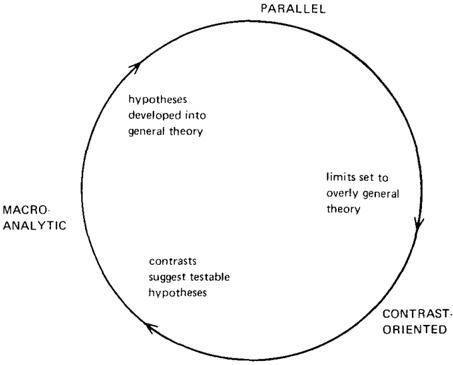
The paper argues that comparative history in macrosocial inquiry has at least three distinct logics: parallel demonstration of theory, contrast of contexts, and macro-causal analysis. It shows that these logics have different purposes, case-selection rules, and strengths/limitations, and that some influential works combine two of them in segmented ways.
## Key findings
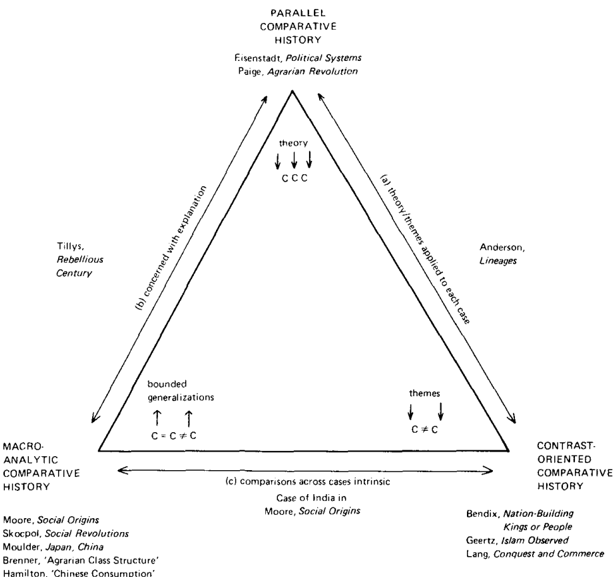
- The authors identify three major logics of comparative history: Parallel comparative history, Contrast-oriented comparative history, and Macro-analytic comparative history.
- In Parallel comparative history, cases are juxtaposed mainly to show that a theory applies repeatedly across relevant historical trajectories; the paper says this does not validate the theory, because cases are selected by the theory and are used to illustrate and clarify it.
- In Contrast-oriented comparative history, the goal is to highlight the unique features of each case and how context shapes outcomes; the paper says this approach offers rich, holistic, chronological accounts but tends to avoid explicit explanation.
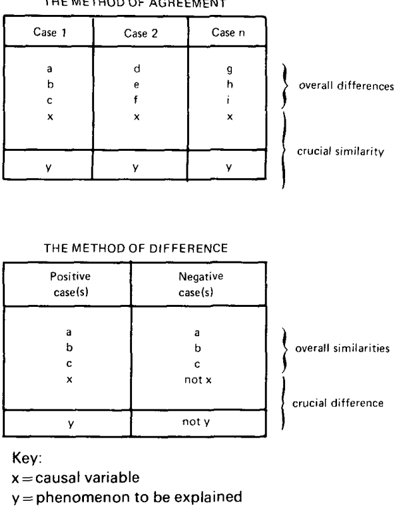
- In Macro-analytic comparative history, scholars use comparisons to make causal inferences about macro-level phenomena, often by approximating John Stuart Mill’s Method of Agreement and Method of Difference; the paper argues this is the best way to attempt validation of causal hypotheses when cases are intrinsically limited.
## Methods
- Conceptual/methodological essay based on comparative analysis of published comparative-historical works; the authors use examples to illustrate each logic rather than providing full methodological dissections.
- The paper’s examples include works by Eisenstadt, Paige, Geertz, Lang, Bendix, Moore, Moulder, Brenner, Hamilton, Anderson, and the Tillys.
- Main analytic frame is a typology/triangle of comparative history, with discussion of how each logic uses cases, theory, chronology, and causal inference.
## Limitations
- The paper states that it does not present full methodological dissections of the works it uses as illustrations, and that many issues about theory and concepts relative to evidence are skirted.
- It explicitly notes that perfectly controlled comparisons are never really feasible in sociohistorical research, because societies cannot be broken apart into manipulable variables and history rarely provides exactly the needed cases.
- Evident from the text: the argument is illustrative rather than systematic empirical testing of the typology itself, since it relies on selected published examples rather than a comprehensive sample.
Model-written summary. Check it against the paper before relying on it.
Integrity signals
Registry
Cites
Statistics
Figures
Verification
Claims the paper makes
0 Valid · 1 Not valid · 49 Not checked · 126 Own results and interpretations
A result the paper states — it cites no source for it, so there is none to check. The quote shows it is in the paper.
In the paper
“The primary mode of demonstrating the theory is something other than comparative history in both books.”
plain- Asserted: passes — The authors put it forward as true.
- Checkable: passes — It can be checked against evidence.
- Load-bearing: passes — The paper’s conclusions depend on it.
- Based: passes — The paper gives a reason why it holds.
A result the paper states — it cites no source for it, so there is none to check. The quote shows it is in the paper.
In the paper
“Eisenstadt relies chiefly upon conceptual elaboration and deduction from structure-functionalist premises”
plain- Asserted: passes — The authors put it forward as true.
- Checkable: passes — It can be checked against evidence.
- Load-bearing: unclear — It is unclear whether the paper’s conclusions depend on it.
- Based: passes — The paper gives a reason why it holds.
A result the paper states — it cites no source for it, so there is none to check. The quote shows it is in the paper.
In the paper
“Despite considerable differences of subject-matter and theoretical approach, both S. N. Eisenstadt's The Political Systems of Empires and Jeffery M. Paige's Agrarian Revolution use comparative history in this way.”
plain- Asserted: passes — The authors put it forward as true.
- Checkable: passes — It can be checked against evidence.
- Load-bearing: passes — The paper’s conclusions depend on it.
- Based: passes — The paper gives a reason why it holds.
A result the paper states — it cites no source for it, so there is none to check. The quote shows it is in the paper.
In the paper
“Nevertheless, in both Eisenstadt's and Paige's books, comparative history serves as an ancillary mode of theoretical demonstration.”
plain- Asserted: passes — The authors put it forward as true.
- Checkable: passes — It can be checked against evidence.
- Load-bearing: passes — The paper’s conclusions depend on it.
- Based: passes — The paper gives a reason why it holds.
A result the paper states — it cites no source for it, so there is none to check. The quote shows it is in the paper.
In the paper
“Within each of his routes, Moore primarily argues along the lines of the Method of Agreement.”
plain- Asserted: passes — The authors put it forward as true.
- Checkable: passes — It can be checked against evidence.
- Load-bearing: unclear — It is unclear whether the paper’s conclusions depend on it.
- Based: passes — The paper gives a reason why it holds.
74 more claims
Create a free account to see all 176 claims and every source verdict.
- Probably not a substantial claim. 82
- It may state two separate claims as one. 36
Citations
Cites
States and Social Revolutions: A Comparative Analysis of France, Russia and China
Skocpol, T. (1979) · Cambridge University Press · doi:10.1017/cbo9780511815805 · Cited by 5,408
Self-citationComparative Politics and the Comparative Method
Lijphart, A. (1971) · American Political Science Review · doi:10.2307/1955513 · Cited by 3,151
Hechter, M., & Wallerstein, I. (1975) · Contemporary Sociology · doi:10.2307/2063180 · Cited by 2,590
Social Origins of Dictatorship and Democracy: Lord and Peasant in the Making of the Modern World.
Ness, G. D., & Moore, B. (1967) · American Sociological Review · doi:10.2307/2092029 · Cited by 2,261
Lineages of the Absolutist State
Rothkrug, L., & Anderson, P. (1976) · The American Historical Review · doi:10.2307/1851205 · Cited by 1,694
The Rise and Future Demise of the World Capitalist System: Concepts for Comparative Analysis
Wallerstein, I. (1974) · Comparative Studies in Society and History · doi:10.1017/s0010417500007520 · Cited by 1,466
AGRARIAN CLASS STRUCTURE AND ECONOMIC DEVELOPMENT IN PRE-INDUSTRIAL EUROPE
Brenner, R. (1976) · Past and Present · doi:10.1093/past/70.1.30 · Cited by 1,193
Appleby, A. B., & Walerstein, I. (1975) · The American Historical Review · doi:10.2307/1852102 · Cited by 1,066
Feld, M. D. (1975) · History: Reviews of New Books · doi:10.1080/03612759.1975.9945059 · Cited by 775
The Rebellious Century: 1830–1930
Tilly, C., Tilly, L., & Tilly, R. (1975) · Harvard University Press eBooks · doi:10.4159/harvard.9780674434004 · Cited by 685
Research works printed but not linked: 8
- 1973, Politics and Society, 4, 10
- Bloch, 1934, Une Étude Régionale: Geographie ou Histoire?, Annales d'Histoire Economique el Sociale, 6, 81
- Mill , “Two Methods,” in Etzioni and Du Bow , eds., Comparative Perspectives, pp. 210–13.
- Anderson, 1967, Land and Work in Medieval Europe: Selected Papers by- Marc Bloch, 44
- 1967, Comparative Sociology: A Codification of Cross-Societal Analysis
- 1977, Poor People's Movements
- Political Systems, he also does a bit of causal analysis using an approximation to controlled comparison. Specifically Eisenstadt uses Macro-analytic comparative history when he argues (pp. 106–7) that some societies had one, but not both, necessary conditions to become bureaucratic empires, contrasting these “failed” cases to “successful” ones.
- Bendix, 1977, Nation-Building and Citizenship, 16
Cited by
Case Selection Techniques in Case Study Research: A Menu of Qualitative and Quantitative Options
Seawright, J., & Gerring, J. (2008) · Political Research Quarterly · doi:10.1177/1065912907313077 · Cited by 3,827
Common Property Institutions and Sustainable Governance of Resources
Agrawal, A. (2001) · World Development · doi:10.1016/s0305-750x(01)00063-8 · Cited by 2,025
(1992) · Choice Reviews Online · doi:10.5860/choice.29-5337 · Cited by 886
Counterfactuals and Hypothesis Testing in Political Science
Fearon, J. D. (1991) · World Politics · doi:10.2307/2010470 · Cited by 729
Hoffman, A. J., & Ocasio, W. (2001) · Organization Science · doi:10.1287/orsc.12.4.414.10639 · Cited by 683
“This research uses historical comparisons primarily for the purpose of making causal inferences about macro-level structures and processes (Skocpol and Somers, 1980: 181).”
BackgroundMethodInfluentialRightful resistance in rural China
(2007) · Choice Reviews Online · doi:10.5860/choice.44-3516 · Cited by 648
Democracy in Europe: The EU and National Polities
Schmidt, V. A. (2006) · doi:10.1093/acprof:oso/9780199266975.001.0001 · Cited by 619
From Poverty to Perversity: Ideas, Markets, and Institutions over 200 Years of Welfare Debate
Somers, M. R., & Block, F. (2005) · American Sociological Review · doi:10.1177/000312240507000204 · Cited by 591
Self-citationALIGNING ONTOLOGY AND METHODOLOGY IN COMPARATIVE POLITICS
Hall, P. A. (2003) · Comparative Historical Analysis in the Social Sciences · doi:10.1017/cbo9780511803963.012 · Cited by 530
Abend, G. (2008) · Sociological Theory · doi:10.1111/j.1467-9558.2008.00324.x · Cited by 503
“…Adams, Clemens, and Orloff 2005; Calhoun 1998; Goldstone 1998; Kiser and Hechter 1991, 1998; Lieberson 1991, 1992; Mahoney 2004; Mahoney and Rueschemeyer 2003; Paige 1999; Quadagno and Knapp 1992; Skocpol and Somers 1980; Somers 1998. and evaluative questions than it was 50 or 60 years ago.”
BackgroundWhy dominant parties lose: Mexico's democratization in comparative perspective
(2008) · Choice Reviews Online · doi:10.5860/choice.45-6403 · Cited by 479
The Endurance of National Constitutions
Ginsburg, T., Elkins, Z., & Melton, J. (2009) · SSRN Electronic Journal · doi:10.2139/ssrn.2190476 · Cited by 453
Htun, M. (2003) · Cambridge University Press eBooks · doi:10.1017/cbo9780511615627 · Cited by 456
Case Selection for Case‐Study Analysis: Qualitative and Quantitative Techniques
Gerring, J. (2009) · The Oxford Handbook of Political Methodology · doi:10.1093/oxfordhb/9780199286546.003.0028 · Cited by 414
Race and Regionalism in the Politics of Taxation in Brazil and South Africa
Lieberman, E. S. (2003) · Cambridge University Press eBooks · doi:10.1017/cbo9780511615658 · Cited by 402
The Historical Turn in Democratization Studies: A New Research Agenda for Europe and Beyond
Capoccia, G., & Ziblatt, D. (2010) · Comparative Political Studies · doi:10.1177/0010414010370431 · Cited by 403
Koppenjan, J. (. F. M. (2005) · Public Administration · doi:10.1111/j.0033-3298.2005.00441.x · Cited by 336
The Enduring Indispensability of the Controlled Comparison
Slater, D., & Ziblatt, D. (2013) · Comparative Political Studies · doi:10.1177/0010414012472469 · Cited by 332
“Nearly all graduate courses on comparative politics commence with a discussion of Mill’s (1843/2002) classic methods of “difference” and “agreement” as well as their further elaboration by Lijphart (1975) and Skocpol and Somers (1980) on the comparative method.”
MethodThe Role of General Theory in Comparative-Historical Sociology
Kiser, E., & Hechter, M. (1991) · American Journal of Sociology · doi:10.1086/229738 · Cited by 330
Qualitative Methodology and Comparative Politics
Mahoney, J. (2007) · Comparative Political Studies · doi:10.1177/0010414006296345 · Cited by 320
“Early discussions of cross-case techniques usually focused on Mill’s methods of agreement and difference (e.g., Skocpol & Somers, 1980) and Przeworski and Teune’s (1970) most similar and most different research designs.”
MethodOdious Comparisons: Incommensurability, the Case Study, and “Small N's” in Sociology
Steinmetz, G. (2004) · Sociological Theory · doi:10.1111/j.0735-2751.2004.00225.x · Cited by 320
“The authors endorse macro-causal analysis, as defined by Skocpol and Somers (1980) , a position that defines explanation as involving constant relations of dependence between (clusters of) determining causal factors and specific outcomes (see also King, Keohane, and Verba 1994; Orloff and Skocpol 1984).”
BackgroundAmott, T. L., Baker, P., Fraser, N., Gordon, L., Jenson, J., Mink, G., Nelson, B. J., Pearce, D., Piven, F. F., Sapiro, V., et al. (2012) · University of Wisconsin Press eBooks · doi:10.2307/jj.36075908 · Cited by 315
Initial Conditions, General Laws, Path Dependence, and Explanation in Historical Sociology
Goldstone, J. A. (1998) · American Journal of Sociology · doi:10.1086/210088 · Cited by 304
Strategies of Causal Inference in Small-N Analysis
MAHONEY, J. (2000) · Sociological Methods & Research · doi:10.1177/0049124100028004001 · Cited by 302
Selecting Cases for Intensive Analysis: A Diversity of Goals and Methods
Gerring, J., & Cojocaru, L. (2016) · Sociological Methods & Research · doi:10.1177/0049124116631692 · Cited by 298
“In what follows, we outline each case selection technique, offer one or few examples, and suggest ways in which the case might be chosen algorithmically from a large population of potential cases.”
How Terrorist Groups End: Lessons for Countering al Qa'ida
(2008) · RAND Corporation eBooks · doi:10.7249/mg741-1 · Cited by 291
Peck, J. (2015) · Regional Studies · doi:10.1080/00343404.2014.980801 · Cited by 290
“…cities – remains a promising and indisputably necessary one, and one that might, in principle, be married to a range of complementary approaches derived from, for instance, macro-historical sociology and heterodox political economy (SKOCPOL and SOMERS, 1980; MCMICHAEL, 1990; PECK, 2012b, 2013b).”
BackgroundBomberg, E., & McEwen, N. (2012) · Energy Policy · doi:10.1016/j.enpol.2012.08.045 · Cited by 277
Nominal, Ordinal, and Narrative Appraisal in Macrocausal Analysis
Mahoney, J. (1999) · American Journal of Sociology · doi:10.1086/210139 · Cited by 269
COMPARATIVE HISTORICAL ANALYSIS: ACHIEVEMENTS AND AGENDAS
Mahoney, J., & Rueschemeyer, D. (2003) · Comparative Historical Analysis in the Social Sciences · doi:10.1017/cbo9780511803963.002 · Cited by 262
Strategies of Causal Assessment in Comparative Historical Analysis
Mahoney, J. (2003) · Comparative Historical Analysis in the Social Sciences · doi:10.1017/cbo9780511803963.011 · Cited by 260
Bridging the Quantitative-Qualitative Divide in Political Science
Tarrow, S. (1995) · American Political Science Review · doi:10.2307/2082444 · Cited by 238
Gerring, J. (2017) · Annual Review of Political Science · doi:10.1146/annurev-polisci-092415-024158 · Cited by 225
Somers, M. R. (1998) · American Journal of Sociology · doi:10.1086/210085 · Cited by 217
Self-citationCOMMUNITY ORGANIZING OR ORGANIZING COMMUNITY?: Gender and the Crafts of Empowerment
STALL, S., & STOECKER, R. (1998) · Gender & Society · doi:10.1177/089124398012006008 · Cited by 216
Our Knowledge of the Past: A Philosophy of Historiography
Tucker, A. (2004) · Cambridge University Press eBooks · doi:10.1017/cbo9780511498381 · Cited by 214
Temporality, Events, and Explanation in Historical Sociology: An Introduction
GRIFFIN, L. J. (1992) · Sociological Methods & Research · doi:10.1177/0049124192020004001 · Cited by 207
Culture Clash: Assessing the Importance of Ideas in Security Studies
Desch, M. C. (1998) · International Security · doi:10.1162/isec.23.1.141 · Cited by 229
Selecting Appropriate Cases When Tracing Causal Mechanisms
Beach, D., & Pedersen, R. B. (2018) · Sociological Methods & Research · doi:10.1177/0049124115622510 · Cited by 198
“…the single case are present in other similar cases is that we can justify that the set of cases we are working with is causally homogeneous by mapping the population using comparative methods (Collier and Mahoney 1996; George and Bennett 2005:164; Ragin 1987; Skocpol and Somers 1980; Tarrow 2010).”
BackgroundMethodStudying the State through State Formation
Vu, T. (2010) · World Politics · doi:10.1017/s0043887109990244 · Cited by 199
“91 Skocpol 1985; Skocpol and Somers 1980. adams, Julia.”
BackgroundCausation: A Unified Framework for the Social Sciences
Gerring, J. (2005) · Journal of Theoretical Politics · doi:10.1177/0951629805050859 · Cited by 189
“…under many names – e.g. ‘thick description’ (Geertz, 1973), ‘configurative analysis’ (Heckscher, 1957: 46– 51, 85–107; Katznelson, 1997), ‘contrast of contexts’ (Skocpol and Somers 1980), and ‘holistic analysis’ (Ragin 1987).8 In statistical terms, it is the variation explained by a given model.”
Toward a Historicized Sociology: Theorizing Events, Processes, and Emergence
Clemens, E. S. (2007) · Annual Review of Sociology · doi:10.1146/annurev.soc.33.040406.131700 · Cited by 183
A Crazy Methodology?: On the Limits of Macro-Quantitative Social Science Research
Kittel, B. (2006) · International Sociology · doi:10.1177/0268580906067835 · Cited by 178
“This problem has yet to be solved in the recently intensified methodological debate in comparative historical analysis (see Skocpol and Somers 1980; Goldthorpe 2000b; Mahoney 2004).”
BackgroundNational revivals and violence
Laitin, D. D. (1995) · European Journal of Sociology · doi:10.1017/s0003975600007098 · Cited by 175
“This paper will employ the tools of game theory and the comparative method in political science (Lijphart, 1971; Skocpol and Somers, 1980; Collier, 1991) to address the question: why are some nationalist movements peaceful in strategy and outcome while others create carnage?”
MethodChaisty, P., Cheeseman, N., & Power, T. (2014) · Democratization · doi:10.1080/13510347.2012.710604 · Cited by 174
The Politics of Electoral Reform: Changing the Rules of Democracy
Renwick, A. (2010) · Cited by 166
On Time and Comparative Research
Bartolini, S. (1993) · Journal of Theoretical Politics · doi:10.1177/0951692893005002001 · Cited by 187
Harding, D. J., Fox, C., & Mehta, J. D. (2002) · Sociological Methods & Research · doi:10.1177/0049124102031002003 · Cited by 194
A Realist Philosophy of Social Science: Explanation and Understanding
Manicas, P. T. (2006) · Cited by 144
The Art of Being Indispensable: Noncharismatic Personalism in Contemporary Political Parties
Ansell, C., & Fish, M. S. (1999) · Comparative Political Studies · doi:10.1177/0010414099032003001 · Cited by 144
How Places Shape Identity: The Origins of Distinctive LBQ Identities in Four Small U.S. Cities
Brown‐Saracino, J. (2015) · American Journal of Sociology · doi:10.1086/682066 · Cited by 162
“…process closely mirrors the elimination of “a limited set of alternative causal statements” recommended byMill ðSavolainen 1994, p. 1218; see also Skocpol and Somers 1980; Skocpol 1984Þ and utilized most prominently in recent decades by Skocpol 5 American Journal of Sociology ognition of…”
BackgroundHistorical sociology, international relations and connected histories
Bhambra, G. K. (2010) · Cambridge Review of International Affairs · doi:10.1080/09557570903433639 · Cited by 147
“For, as Bonnell continues, comparative study is the primary way of establishing that ‘a theoretical proposition applicable to one case sustains its explanatory power when applied to additional cases’ (160; see also Skocpol and Somers 1980 ).”
BackgroundKING, L. P., & Lee, A. S. (2006) · American Journal of Sociology · doi:10.1086/507851 · Cited by 161
“This type of ownership was present in none of the 15 firms in which some amount (no matter how small) of interfirm ownership and/ or some amount of direct or indirect state ownership continued to exist.”
BackgroundRoman Artisans and the Urban Economy
Hawkins, C. (2016) · Cambridge University Press eBooks · doi:10.1017/cbo9781316335888 · Cited by 136
Potentials and Limitations of Comparative Method in Social Science
Azarian, R. (2011) · Cited by 175
We're No Angels: Realism, Rational Choice, and Relationality in Social Science
Somers, M. R. (1997) · Deep Blue (University of Michigan) · Cited by 131
Self-citationAlbertus, M., Fenner, S., & Slater, D. (2018) · Cambridge University Press eBooks · doi:10.1017/9781108644334 · Cited by 150
The Importance of Research Design in Political Science
King, G., Keohane, R. O., & Verba, S. (1995) · American Political Science Review · doi:10.2307/2082445 · Cited by 185
Riley, D. (2005) · American Sociological Review · doi:10.1177/000312240507000205 · Cited by 125
“in Interwar Europe:”
Amenta, E. (2003) · Cambridge University Press eBooks · doi:10.1017/cbo9780511803963.004 · Cited by 186
Introduction: change and continuity in recent family policies
Mätzke, M., & Ostner, I. (2010) · Journal of European Social Policy · doi:10.1177/0958928710380476 · Cited by 124
“The idea is to take one theme common to a series of cases sufficiently similar to be comparable, and to interrogate its manifestations in the different countries.5 The comparative setup is akin to the contrast of contexts agenda of macrocomparative research, as outlined by Skocpol and Somers (1980).”
BackgroundThe Moderation Theory Revisited: The Case of Islamic Political Actors
Tezcür, G. M. (2009) · Party Politics · doi:10.1177/1354068809339536 · Cited by 149
“Comparing between Muslim reformers in these two countries follows the logic of the method of agreement (Lijphart, 1971; Skocpol and Somers, 1980).”
BackgroundExplanation in Historical Sociology: Narrative, General Theory, and Historically Specific Theory
Calhoun, C. J. (1998) · American Journal of Sociology · doi:10.1086/210089 · Cited by 143
Translating Quantitative Methods for Qualitative Researchers: The Case of Selection Bias
Collier, D. (1995) · American Political Science Review · doi:10.2307/2082442 · Cited by 169
“See Geertz 1973; Przeworski and Teune 1970; Ragin 1987; and Skocpol and Somers 1980; see also Walker and Cohen's (1985) discussion of "scope statements."”
BackgroundThe promise and pitfalls of comparative research design in the study of migration
Bloemraad, I. (2013) · Migration Studies · doi:10.1093/migration/mns035 · Cited by 157
“This in turn influenced analytical strategies of causal inference using Mill’s method of difference and agreement (Skocpol and Somers 1980).”
MethodThe Most Silent Women of Greece and Rome: Rural Labour and Women's Life in the Ancient World (I)
Schidel, W. (1995) · Greece and Rome · doi:10.1017/s001738350002564x · Cited by 111
Tracing the Progress of Process Tracing
Hall, P. A. (2012) · European Political Science · doi:10.1057/eps.2012.6 · Cited by 140
“In an important early contribution to such debates, Skocpol and Somers (1980) make similar points.”
BackgroundCartel Parties in Western Europe?
Detterbeck, K. (2005) · Party Politics · doi:10.1177/1354068805049738 · Cited by 111
“In testing the accuracy of the Katz and Mair framework, we employ the method of indirect difference (Skocpol and Somers, 1980).”
MethodPractising Comparison: Logics, Relations, Collaborations
(2016) · Mattering Press eBooks · doi:10.28938/9780993144950 · Cited by 105
Women and States: Norms and Hierarchies in International Society
Towns, A. E. (2010) · Cited by 104
Historical Research Approaches to the Analysis of Internationalisation
Buckley, P. J. (2016) · Management International Review · doi:10.1007/s11575-016-0300-0 · Cited by 115
“8 For a full discussion of varieties of comparative history, see Skocpol and Somers (1980).”
BackgroundHistory and Sociology: The Lost Synthesis
Abbott, A. J. (1991) · Social Science History · doi:10.1017/s014555320002109x · Cited by 117
Macrocomparative Research Methods
Bollen, K. A., Entwisle, B., & Alderson, A. S. (1993) · Annual Review of Sociology · doi:10.1146/annurev.so.19.080193.001541 · Cited by 121
The Role of Theory and Anomaly in Social-Scientific Inference
Rogowski, R. L. (1995) · American Political Science Review · doi:10.2307/2082443 · Cited by 106
Owen, C. (2020) · Review of International Studies · doi:10.1017/s0260210520000248 · Cited by 126
Canons of research design in qualitative analysis
Munck, G. L. (1998) · Studies in Comparative International Development · doi:10.1007/bf02687490 · Cited by 114
Our Knowledge of the Past: A Philosophy of Historiography
Tucker, A. (2004) · Research Portal (Queen's University Belfast) · Cited by 104
Comparative urban analysis and assumptions about causality
Pickvance, C. G. (1986) · International Journal of Urban and Regional Research · doi:10.1111/j.1468-2427.1986.tb00010.x · Cited by 88
New Contributions to the Philosophy of History
Little, D. (2010) · Springer eBooks · doi:10.1007/978-90-481-9410-0 · Cited by 102
Disciplining Political Science
Laitin, D. D. (1995) · American Political Science Review · doi:10.1017/s0003055400096453 · Cited by 116
Policy styles and political trust in Europe’s national responses to the COVID-19 crisis
Zahariadis, N., Petridou, E., Exadaktylos, T., & Sparf, J. (2021) · Policy Studies · doi:10.1080/01442872.2021.2019211 · Cited by 106
War Pictures: The Grotesque as a Mobilizing Tactic
Halfmann, D., & Young, M. (2010) · Mobilization An International Quarterly · doi:10.17813/maiq.15.1.y561981851788672 · Cited by 108
“The method aims to demonstrate “how key concepts and variables are operationalized and how the theory works ‘on the ground’” (Skocpol and Somers 1980: 191).”
BackgroundMethodInfluentialEtchemendy, S. (2019) · Comparative Political Studies · doi:10.1177/0010414019830729 · Cited by 82
Peace among Democratic and Oligarchic Republics
Weart, S. R. (1994) · Journal of Peace Research · doi:10.1177/0022343394031003005 · Cited by 80
Single-Outcome Studies: A Methodological Primer
Gerring, J. (2006) · International Sociology · doi:10.1177/0268580906067837 · Cited by 127
“For later treatments see Cohen and Nagel (1934), Eggan (1954), Gerring (2001: Ch. 9), Lijphart (1971, 1975), Meckstroth (1975), Przeworski and Teune (1970) and Skocpol and Somers (1980).”
BackgroundThe Structure of Comparison in the Study of Revolution
Beck, C. J. (2018) · Sociological Theory · doi:10.1177/0735275118777004 · Cited by 84
“Here, cases are used to highlight their unique features and show how their uniqueness affects the theoretical propositions, with comparison usually controlling for geography or era (Skocpol and Somers 1980).”
BackgroundMethodInfluentialZahariadis, N., Petridou, E., & Öztığ, L. İ. (2020) · European Policy Analysis · doi:10.1002/epa2.1089 · Cited by 76
Realizing Solidarity: Sources of Interracial Unionism During the Great Depression
BRUEGGEMANN, J., & BOSWELL, T. (1998) · Work and Occupations · doi:10.1177/0730888498025004003 · Cited by 74
Kill a Leader, Murder a Movement? Leadership and Assassination in Social Movements
Bob, C., & Nepstad, S. E. (2007) · American Behavioral Scientist · doi:10.1177/0002764207300162 · Cited by 113
“This underlying causal homogeneity (Munck, 2004; Skocpol & Somers, 1980) convinced us of the validity and utility of comparing the movements.”
BackgroundClass, Culture, and Campaigns against Vice in Three American Cities, 1872- 1892
Beisel, N. (1990) · American Sociological Review · doi:10.2307/2095702 · Cited by 75
The Dark Side of the Protestant Ethic: A Comparative Analysis of Welfare Reform
Hudson, K., & Coukos, A. (2005) · Sociological Theory · doi:10.1111/j.0735-2751.2005.00240.x · Cited by 93
“Our analysis of thesematerials employs a comparative historical method and approach similar to those articulated by Ragin (1987; see also Ragin and Zaret 1983) and others (Skocpol and Somers 1980; Zelditch 1971).”
MethodParticipation in a Gendered Environment: The Case of Community Forestry in India
Gupte, M. (2004) · Human Ecology · doi:10.1023/b:huec.0000028086.63366.3d · Cited by 71
“The states were selected based on Mill’s method of difference, and a combination of the method of difference and method of agreement was used for the villages (Skocpol and Somers, 1980).”
Political economy, the Agrarian question and the comparative method
Byres, T. J. (1995) · The Journal of Peasant Studies · doi:10.1080/03066159508438589 · Cited by 71
The rise of work-based academic education in Austria, Germany and Switzerland
Graf, L. (2015) · Journal of Vocational Education and Training · doi:10.1080/13636820.2015.1107749 · Cited by 70
Comparative Politics: An Overview
Mair, P. (1998) · Oxford University Press eBooks · doi:10.1093/0198294719.003.0012 · Cited by 79
McDermott, R. (2023) · The Leadership Quarterly · doi:10.1016/j.leaqua.2023.101675 · Cited by 123
Comparative Grand Strategy: A Framework and Cases
Balzacq, T., Dombrowski, P. J., & Reich, S. (2019) · doi:10.1093/oso/9780198840848.001.0001 · Cited by 88
Narrative Analysis and the New Historical Sociology
Gotham, K. F., & Staples, W. G. (1996) · Sociological Quarterly · doi:10.1111/j.1533-8525.1996.tb00750.x · Cited by 93
Case Study Research: Putting the Quant Into the Qual
Elman, C., Gerring, J., & Mahoney, J. (2016) · Sociological Methods & Research · doi:10.1177/0049124116644273 · Cited by 169
An Institutional Account of China's HIV/AIDS Policy Process from 1985 to 2010
Knutsen, W. L. (2012) · Politics & Policy · doi:10.1111/j.1747-1346.2011.00339.x · Cited by 68
Metadata
- Authors
- Skocpol, T., & Somers, M.
- Affiliations
- Harvard University (US)
- Venue
- Comparative Studies in Society and History
- Publisher
- Cambridge University Press (CUP)
- Published
- 1980-04
- Volume
- 22
- Issue
- 2
- Pages
- 174-197
- ISSN
- 0010-4175 (ISSN-L)
- 1475-2999
- OpenAlex
- W2109860650
- Semantic Scholar
- 78dcc4fcfa160854af0a651c0ece23d562212f04
- Cited by
- 1,074
- References
- 36
- Citations by year
- 2026: 20 · 2025: 37 · 2024: 45 · 2023: 45 · 2022: 87 · 2021: 48 · 2020: 52 · 2019: 51 · 2018: 93 · 2017: 23 · 2016: 40 · 2015: 35 · 2014: 38 · 2013: 36 · 2012: 27
- FWCI
- 22.11
- Type
- journal article
- Language
- en
- Open access
- bronze
- doi.org
- Locations
- Comparative Studies in Society and History (publishedVersion)
- Topics
- Social Sciences › Sociology and Political Science › Qualitative Comparative Analysis Research
- Social Sciences › Arts and Humanities › History › Philosophy, History, and Historiography
- Social Sciences › Sociology and Political Science › German Social Sciences and History
- Keywords
- comparative history, social change, historical trajectories, social dynamics, historical sequence, social structure, cultural change
About these checks
Registry, retraction, Cites and statistics results are computed, not judged, with one exception: a printed reference that no index lists is read once by a model before it counts as a citation error. Claims are extracted by a model and kept only when their quote appears verbatim in the text; each cited source is then checked, with a model’s help, for whether it says what the claim relies on. Those verdicts can be wrong — read the claim’s quote and the cited source before relying on one.
A language model drew the claims from the paper on 2026-09-30, under version 3 of the claim definition (model deepseek-v4.1-flash, prompt extract-v3).
A second model labelled each claim on 2026-09-30 (model jev-1.13-20260917, definition revision gold-guideline-v0.2).
Statistics and arithmetic are recomputed, not judged.
Confidence bands are shown only for fields calibrated on our annotated test set. None is calibrated yet, so no band is shown.
What counts as a claim ›How we measure confidence ›How we check this ›
Are you an author, or do you see a problem with this page? Request a review
Data sources
Bibliographic data: Semantic Scholar, OpenAlex, Crossref.
Contains information from the Semantic Scholar Academic Graph Datasets, made available under the ODC Attribution License (ODC-BY 1.0).
Semantic Scholar’s data is described in: Kinney, R., et al. (2023). The Semantic Scholar Open Data Platform. arXiv:2301.10140.
