

The Uses of Comparative History in Macrosocial Inquiry
Open accessThe DOI matches its Crossref record; 35 of the 36 references it cites were found in a registry or an index; none of the 44 sources its claims cite is checked for support yet.
Abstract
Comparative history is not new. As long as people have investigated social life, there has been recurrent fascination with juxtaposing historical patterns from two or more times or places. Part of the appeal comes from the general usefulness of looking at historical trajectories in order to study social change. Indeed, practitioners of comparative history from Alexis de Tocqueville and Max Weber to Marc Bloch, Reinhard Bendix, and Barrington Moore, Jr. have typically been concerned with understanding societal dynamics and epochal transformations of cultures and social structures. Attention to historical sequences is indispensable to such understanding. Obviously, though, not all investigations of social change use explicit juxtapositions of distinct histories. We may wonder, therefore: What motivates the use of comparisons as opposed to focussing on single historical trajectories? What purposes are pursued—and how—through the specific modalities of comparative history?
Overview
CoChat Summary
## TL;DR
The paper argues that comparative history in macrosocial inquiry has at least three distinct logics: parallel demonstration of theory, contrast of contexts, and macro-causal analysis. It shows that these logics have different purposes, case-selection rules, and strengths/limitations, and that some influential works combine two of them in segmented ways.
## Key findings
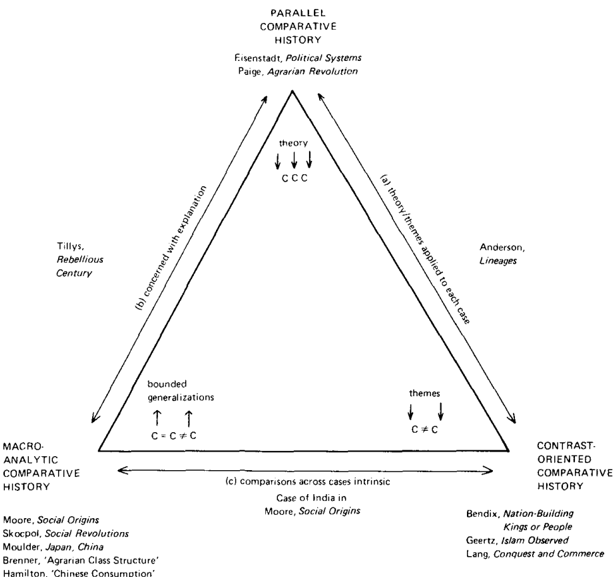
- The authors identify three major logics of comparative history: Parallel comparative history, Contrast-oriented comparative history, and Macro-analytic comparative history.
- In Parallel comparative history, cases are juxtaposed mainly to show that a theory applies repeatedly across relevant historical trajectories; the paper says this does not validate the theory, because cases are selected by the theory and are used to illustrate and clarify it.
- In Contrast-oriented comparative history, the goal is to highlight the unique features of each case and how context shapes outcomes; the paper says this approach offers rich, holistic, chronological accounts but tends to avoid explicit explanation.
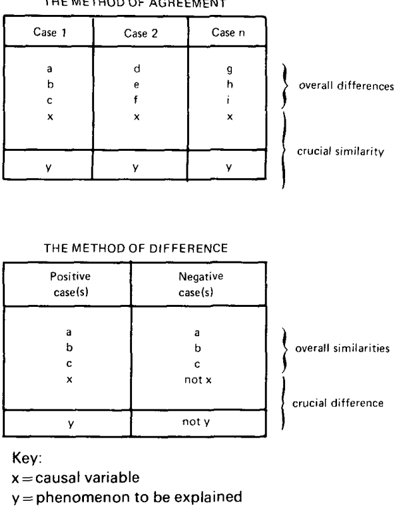
- In Macro-analytic comparative history, scholars use comparisons to make causal inferences about macro-level phenomena, often by approximating John Stuart Mill’s Method of Agreement and Method of Difference; the paper argues this is the best way to attempt validation of causal hypotheses when cases are intrinsically limited.
## Methods
- Conceptual/methodological essay based on comparative analysis of published comparative-historical works; the authors use examples to illustrate each logic rather than providing full methodological dissections.
- The paper’s examples include works by Eisenstadt, Paige, Geertz, Lang, Bendix, Moore, Moulder, Brenner, Hamilton, Anderson, and the Tillys.
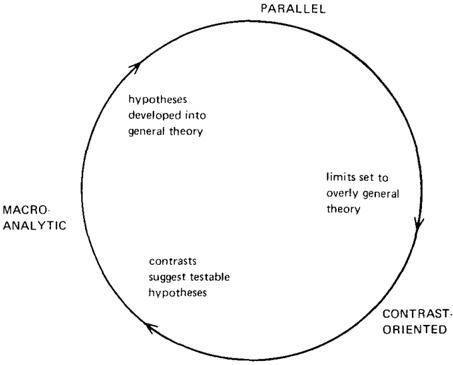
- Main analytic frame is a typology/triangle of comparative history, with discussion of how each logic uses cases, theory, chronology, and causal inference.
## Limitations
- The paper states that it does not present full methodological dissections of the works it uses as illustrations, and that many issues about theory and concepts relative to evidence are skirted.
- It explicitly notes that perfectly controlled comparisons are never really feasible in sociohistorical research, because societies cannot be broken apart into manipulable variables and history rarely provides exactly the needed cases.
- Evident from the text: the argument is illustrative rather than systematic empirical testing of the typology itself, since it relies on selected published examples rather than a comprehensive sample.
Model-written summary. Check it against the paper before relying on it.
Integrity signals
Registry
Cites
Statistics
Figures
Verification
Claims the paper makes
0 Valid · 1 Not valid · 49 Not checked · 126 Own results and interpretations
A result the paper states — it cites no source for it, so there is none to check. The quote shows it is in the paper.
In the paper
“The primary mode of demonstrating the theory is something other than comparative history in both books.”
plain- Asserted: passes — The authors put it forward as true.
- Checkable: passes — It can be checked against evidence.
- Load-bearing: passes — The paper’s conclusions depend on it.
- Based: passes — The paper gives a reason why it holds.
A result the paper states — it cites no source for it, so there is none to check. The quote shows it is in the paper.
In the paper
“Eisenstadt relies chiefly upon conceptual elaboration and deduction from structure-functionalist premises”
plain- Asserted: passes — The authors put it forward as true.
- Checkable: passes — It can be checked against evidence.
- Load-bearing: unclear — It is unclear whether the paper’s conclusions depend on it.
- Based: passes — The paper gives a reason why it holds.
A result the paper states — it cites no source for it, so there is none to check. The quote shows it is in the paper.
In the paper
“Despite considerable differences of subject-matter and theoretical approach, both S. N. Eisenstadt's The Political Systems of Empires and Jeffery M. Paige's Agrarian Revolution use comparative history in this way.”
plain- Asserted: passes — The authors put it forward as true.
- Checkable: passes — It can be checked against evidence.
- Load-bearing: passes — The paper’s conclusions depend on it.
- Based: passes — The paper gives a reason why it holds.
A result the paper states — it cites no source for it, so there is none to check. The quote shows it is in the paper.
In the paper
“Nevertheless, in both Eisenstadt's and Paige's books, comparative history serves as an ancillary mode of theoretical demonstration.”
plain- Asserted: passes — The authors put it forward as true.
- Checkable: passes — It can be checked against evidence.
- Load-bearing: passes — The paper’s conclusions depend on it.
- Based: passes — The paper gives a reason why it holds.
A result the paper states — it cites no source for it, so there is none to check. The quote shows it is in the paper.
In the paper
“Within each of his routes, Moore primarily argues along the lines of the Method of Agreement.”
plain- Asserted: passes — The authors put it forward as true.
- Checkable: passes — It can be checked against evidence.
- Load-bearing: unclear — It is unclear whether the paper’s conclusions depend on it.
- Based: passes — The paper gives a reason why it holds.
74 more claims
Create a free account to see all 176 claims and every source verdict.
- Probably not a substantial claim. 82
- It may state two separate claims as one. 36
Citations
Cites
States and Social Revolutions: A Comparative Analysis of France, Russia and China
Skocpol, T. (1979) · Cambridge University Press · doi:10.1017/cbo9780511815805 · Cited by 5,408
Self-citationComparative Politics and the Comparative Method
Lijphart, A. (1971) · American Political Science Review · doi:10.2307/1955513 · Cited by 3,151
Hechter, M., & Wallerstein, I. (1975) · Contemporary Sociology · doi:10.2307/2063180 · Cited by 2,590
Social Origins of Dictatorship and Democracy: Lord and Peasant in the Making of the Modern World.
Ness, G. D., & Moore, B. (1967) · American Sociological Review · doi:10.2307/2092029 · Cited by 2,261
Lineages of the Absolutist State
Rothkrug, L., & Anderson, P. (1976) · The American Historical Review · doi:10.2307/1851205 · Cited by 1,694
The Rise and Future Demise of the World Capitalist System: Concepts for Comparative Analysis
Wallerstein, I. (1974) · Comparative Studies in Society and History · doi:10.1017/s0010417500007520 · Cited by 1,466
AGRARIAN CLASS STRUCTURE AND ECONOMIC DEVELOPMENT IN PRE-INDUSTRIAL EUROPE
Brenner, R. (1976) · Past and Present · doi:10.1093/past/70.1.30 · Cited by 1,193
Appleby, A. B., & Walerstein, I. (1975) · The American Historical Review · doi:10.2307/1852102 · Cited by 1,066
Feld, M. D. (1975) · History: Reviews of New Books · doi:10.1080/03612759.1975.9945059 · Cited by 775
The Rebellious Century: 1830–1930
Tilly, C., Tilly, L., & Tilly, R. (1975) · Harvard University Press eBooks · doi:10.4159/harvard.9780674434004 · Cited by 685
Research works printed but not linked: 8
- 1973, Politics and Society, 4, 10
- Bloch, 1934, Une Étude Régionale: Geographie ou Histoire?, Annales d'Histoire Economique el Sociale, 6, 81
- Mill , “Two Methods,” in Etzioni and Du Bow , eds., Comparative Perspectives, pp. 210–13.
- Anderson, 1967, Land and Work in Medieval Europe: Selected Papers by- Marc Bloch, 44
- 1967, Comparative Sociology: A Codification of Cross-Societal Analysis
- 1977, Poor People's Movements
- Political Systems, he also does a bit of causal analysis using an approximation to controlled comparison. Specifically Eisenstadt uses Macro-analytic comparative history when he argues (pp. 106–7) that some societies had one, but not both, necessary conditions to become bureaucratic empires, contrasting these “failed” cases to “successful” ones.
- Bendix, 1977, Nation-Building and Citizenship, 16
Cited by
Items 601–700 of 1,062
Noisy Regimes, Causal Processes, and Democratic Consolidation: The Case of Costa Rica
Bowman, K., & Baker, S. (2008) · The Latin Americanist · doi:10.1111/j.1557-203x.2007.tb00054.x · Cited by 1
History strikes back: The state of international relations theory
Richardson, J. L. (1994) · Australian Journal of Political Science · doi:10.1080/00323269408402287 · Cited by 1
Rosa, A. D. (2012) · Anabases · doi:10.4000/anabases.3710 · Cited by 1
Response to Ledford and Sperber
Kreuzer, M. (2003) · Central European History · doi:10.1163/156916103771006061 · Cited by 1
If Similarity is the Challenge – Congruence Analysis Should be Part of the Answer
Haverland, M. (2010) · European Political Science · doi:10.1057/eps.2009.47 · Cited by 10
“In my reading of this design, the value of the key independent variable does not vary across cases (see for instance Freindreis, 1983: 261; Landman, 2000: 30; Skocpol and Somers, 1980: 184).”
BackgroundTheda Skocpol: “Probing the Institutional Roots of Politics”
Weir, M. (2002) · PS Political Science & Politics · doi:10.1017/s1049096502001373 · Cited by 1
Human Rights Policy: The Cases of Capital Punishment in Kyrgyzstan and South Korea
Kim, A. (2014) · International Journal of Social Science and Humanity · doi:10.7763/ijssh.2015.v5.481 · Cited by 1
“The method of contrasting cases is adopted since it applies comparisons among equivalent units to identify independent variables which may uncover any patterns of social phenomenon either in common or in contrast [11], [12].”
MethodInstitutions of Information Access and Constraint
Relly, J. E. (2011) · IGI Global eBooks · doi:10.4018/978-1-60960-753-1.ch013 · Cited by 1
2 The European Union and National Institutions
Schmidt, V. A. (2006) · Oxford University Press eBooks · doi:10.1093/acprof:oso/9780199266975.003.0003 · Cited by 1
Conceptions and construction of contemporary Australian Bachelor of Arts programs
Gannaway, D. (2015) · Cited by 1
Chapter 9: Three Models of Comparative Analysis: Time, Space, and Education
Aguilar, L. E. (2018) · International perspectives on education and society · doi:10.1108/s1479-367920180000034011 · Cited by 1
Governança em cenários de escassez hídrica
de Queiroz, F. A., & Tibúrcio, J. A. P. (2018) · Political Observer | Revista Portuguesa de Ciência Política (Portuguese Journal of Political Science) · doi:10.33167/2184-2078.rpcp2018.9/pp.111-137 · Cited by 1
The specialization curse: How economic specialization shapes public goods provision
Barber, B., & Mazaheri, N. (2019) · Business and Politics · doi:10.1017/bap.2018.33 · Cited by 1
“Our selection of these two cases is intended to demonstrate the applicability of our theory in diverse federal contexts, in line with what Skocpol and Somers (1980) describe as “parallel demonstration” of a theory (176–78).”
Case Analysis: Planning and Development Process of HSR Stations
Wang, L., & Gu, H. (2019) · Springer eBooks · doi:10.1007/978-981-13-6916-2_4 · Cited by 1
Lima, F. C. (2019) · Conjuntura Austral · doi:10.22456/2178-8839.91753 · Cited by 1
Transitional Justice and Corporate Accountability
Payne, L. A., Pereira, G., & Bernal-Bermúdez, L. (2020) · Cambridge University Press eBooks · doi:10.1017/9781108564564.001 · Cited by 1
Tucker, A. (2004) · Cambridge University Press eBooks · doi:10.1017/cbo9780511498381.007 · Cited by 1
Fiott, D., & Simón, L. (2019) · Oxford University Press eBooks · doi:10.1093/oso/9780198840848.003.0012 · Cited by 4
ENTRE AFINIDADES E DIFERENÇAS: FERNANDO HENRIQUE CARDOSO E A SOCIOLOGIA HISTÓRICA
Helayel, K. A. (2022) · Sociologia & Antropologia · doi:10.1590/2238-38752022v1236 · Cited by 1
Álvarez, J., & Menéndez, M. D. L. M. (2022) · Palgrave studies in economic history · doi:10.1007/978-3-031-09198-8_7 · Cited by 1
Teaching India–Pakistan Relations
Anand, K. (2023) · UCL Press eBooks · doi:10.2307/j.ctv2tsxmk4 · Cited by 3
From multiculturalism to antisemitism? Revisiting the Jewish question in America
Голдберг, Ч. А. (2023) · American Journal of Cultural Sociology · doi:10.1057/s41290-023-00185-6 · Cited by 1
“The degree to which antisemitism reshapes the relation of Jews to the civil sphere ultimately depends on the balance of forces between those 13 This “parallel demonstration of theory” (Skocpol and Somers 1980, pp. 176–178) could likely be extended with additional cases if space permitted.”
BackgroundShaffer, P. (2023) · Journal of African Economies · doi:10.1093/jae/ejac054 · Cited by 2
Riart, J. G. G. (2023) · CIAN-Revista de Historia de las Universidades · doi:10.20318/cian.2023.8206 · Cited by 1
Mustafa İslamoğlu, Adam Smith’de Rasyonalite, Filiz Kitabevi, 2021, 372 s.
Dündar, O. (2023) · Journal of Humanity and Society (insan & toplum) · doi:10.12658/d0358 · Cited by 1
Kreuzer, M. (2024) · Politics · doi:10.1177/02633957241245893 · Cited by 5
“(Cited in Munck and Snyder, 2008: 678–679; see also Skocpol, 2023) Skocpol and Somers recognised that comparing plays a central role for turning these explorations into discoveries.”
InfluentialComparative Historical Analysis in Political Theory
Maynard, J. L. (2024) · Res Publica · doi:10.1007/s11158-024-09685-9 · Cited by 3
Quantitative Verfahren der Transformationsforschung
Pickel, G., & Pickel, S. (2014) · Springer eBooks · doi:10.1007/978-3-658-05348-2_19 · Cited by 1
Comparative politics in Argentina, Brazil, Colombia and Mexico
Lucca, J. B. (2014) · Revista Uruguaya de Ciencia Política · Cited by 6
Komparativní přístup v historiografii a transnacionální historická problematika
Scholz, M. (2009) · Sociální studia / Social Studies · doi:10.5817/soc2009-1-69 · Cited by 1
(De-)Familialization in Social Policy in East Asia
Wang, H. S. (2017) · Springer eBooks · doi:10.1007/978-3-319-58712-7_3 · Cited by 1
Introduction: Comparing Globalizations—Historical and World-Systems Approaches
Hall, T. D. (2017) · World-systems evolution and global futures · doi:10.1007/978-3-319-68219-8_1 · Cited by 1
La crítica como proyecto intelectual. Hilvanes continuistas del pensamiento social latinoamericano
Giordano, V. (2018) · Revista Temas Sociológicos · doi:10.29344/07196458.21.1095 · Cited by 1
de Queiroz, F. A., & Tibúrcio, J. A. P. (2018) · Economics Law and Policy · doi:10.22158/elp.v1n1p17 · Cited by 1
Buckley, P. J. (2018) · Edward Elgar Publishing eBooks · doi:10.4337/9781786431332.00015 · Cited by 1
Old Ideas for New Times: Radical History in International Political Economy
Williams, G. P. (2018) · Perspectives on Global Development and Technology · doi:10.1163/15691497-12341487 · Cited by 1
Sheffield, R. S., & Riseman, N. (2018) · Research Bank (Australian Catholic University) · Cited by 1
Cauchi, F. (2017) · Routledge eBooks · doi:10.4324/9781315109220-2 · Cited by 1
Entre controvérsia e hegemonia: os transgênicos na Argentina e no Brasil
Motta, R. (2018) · Editora FIOCRUZ eBooks · doi:10.7476/9786557082980 · Cited by 8
Marrying and Divorcing in Postwar Europe: Ideological Struggles Across the Iron Curtain
Bernini, S. (2020) · Studi di storia · doi:10.30687/978-88-6969-394-6 · Cited by 3
Refining the Adaptive Capacity Framework for World Heritage Management
Unakul, M. H. (2019) · Nakhara Journal of Environmental Design and Planning · doi:10.54028/nj2019172542 · Cited by 1
Decentering Comparative Analysis in a Globalizing World
Giraud, O., & Lallement, M. (2021) · BRILL eBooks · doi:10.1163/9789004466609 · Cited by 1
(2018) · BRILL eBooks · doi:10.1163/9789004315716_010 · Cited by 1
The British Transatlantic Slave Trade
Law, R. (2021) · Routledge eBooks · doi:10.4324/9781003113393 · Cited by 1
Convoking Voters and Establishing Electoral Viability
Muñoz, P. (2018) · Buying Audiences · doi:10.1017/9781108525015.004
Tucker, A. (2004) · Cambridge University Press eBooks · doi:10.1017/cbo9780511498381.001 · Cited by 1
Milani, C. R. S., & Nery, T. (2019) · Oxford University Press eBooks · doi:10.1093/oso/9780198840848.003.0007 · Cited by 1
Hetou, G. (2019) · Oxford University Press eBooks · doi:10.1093/oso/9780198840848.003.0011 · Cited by 2
Johnson, E. R. (2019) · Oxford University Press eBooks · doi:10.1093/oso/9780198840848.003.0006 · Cited by 2
Shamir, E. (2019) · Oxford University Press eBooks · doi:10.1093/oso/9780198840848.003.0010 · Cited by 1
From Minority to Maturity: The Evolution of Later Lollardy
Stansfield-Cudworth, R. E. (2021) · Socio-Historical Examination of Religion and Ministry · doi:10.33929/sherm.2021.vol3.no2.07 · Cited by 1
Issues In Research on the Communist Memory Politics in the Countries of East-Central Europe
Malczewska-Pawelec, D., & Pawelec, T. (2022) · Historyka Studia Metodologiczne · doi:10.24425/hsm.2021.138891 · Cited by 1
The Persistence of Exceptionalism: Class Formation and the Comparative Method
Halpern, R., & Morris, J. (1997) · Palgrave Macmillan UK eBooks · doi:10.1007/978-1-349-25584-9_1 · Cited by 1
Estudo da avaliação ambiental estratégica no Brasil em perspectiva comparada
Oppermann, P. D. A. (2012) · doi:10.11606/d.18.2012.tde-29032012-111619 · Cited by 1
Castillo, J. L. (2011) · Digital Commons - University of South Florida (University of South Florida) · Cited by 4
Comparing Comparisons: Ancient East and WestPreprint
Scheidel, W. (2013) · SSRN Electronic Journal · doi:10.2139/ssrn.2242307 · Cited by 1
Lavallée, L.-P. (2011) · Archipel (Université du Québec à Montréal) · Cited by 2
Kehoe, G. (2014) · ProQuest Demo Repository · Cited by 1
Interpretive Methods: Macromethods
Stryker, R. (2015) · Elsevier eBooks · doi:10.1016/b978-0-08-097086-8.44034-1 · Cited by 1
El materialismo histórico como programa de investigación.
Paramio, L. (1998) · DIGITAL.CSIC (Spanish National Research Council (CSIC)) · Cited by 1
Denmark, the Netherlands and European Agricultural Integration, 1945-1960
Sorensen, A. T. (2008) · Cadmus - EUI Research Repository (European University Institute) · doi:10.2870/18842 · Cited by 1
RESHAPING STATE-SOCIETY RELATIONS: DEMOCRATIZATION IN SOUTHERN AND EASTERN EUROPE
Muñoz, R. D. (2000) · Cited by 1
Craig, C. J. (2010) · Rutgers University Community Repository (Rutgers University) · doi:10.7282/t33778t5 · Cited by 1
“For this reason my analysis conforms to the approach Skocpol and Somers (1980) call the ―comparative history as the contrast of contexts.”
BackgroundMethodThe restructuring of intergovernmental transfers: a case study of Mogale City Local Municipality
Dlamini, A. N. (2012) · University of the Witwatersrand, Johannesburg Institutional Repository on DSpace (University of the Witwatersrand, Johannesburg) · Cited by 1
SHADOWS OF THE PAST: TAX REFORM IN AN ERA OF GLOBALIZATION AND DEMOCRATIZATION
Lieberman, E. S. (2003) · Cambridge University Press eBooks · doi:10.1017/cbo9780511615658.005 · Cited by 1
The Limits of Historiographic Knowledge
Tucker, A. (2004) · Cambridge University Press eBooks · doi:10.1017/cbo9780511498381.008 · Cited by 1
The Comparative Method in Practice: Case Selection and the Social Science of RevolutionPreprint
Beck, C. J. (2016) · SocArXiv (OSF Preprints) · doi:10.31235/osf.io/ybmu5 · Cited by 1
Tverrnasjonal komparativ barneforskning: Muligheter og utfordringer
Backe‐Hansen, E. (2002) · NOVA-rapport · doi:10.7577/nova/rapporter/2002/17 · Cited by 3
Colonial Modernity in Historical SociologyPreprint
Hammer, R., & Itzigsohn, J. (2021) · SocArXiv (OSF Preprints) · doi:10.31235/osf.io/pgce4 · Cited by 2
Roux, T. R. (2018) · Cambridge University Press eBooks · doi:10.1017/9781108340977.008 · Cited by 1
Crompton, R., Carter, B. S., Klikauer, T., et al. (2002) · Work Employment and Society · doi:10.1177/095001702400426893 · Cited by 1
“Goldthorpe (following Leiberson, 1994) criticizes and rejects case-oriented research (including comparative macrosociology as practised, for example, by Skocpol and Somers, 1980) for its supposed reliance on J.S. Mill’s logical rather than probabilistic statistical thinking.”
BackgroundIn Search Of American Labor's Syndicalist Heritage
Isaac, L. W. (2002) · Labor Studies Journal · doi:10.1177/0160449x0202700203 · Cited by 1
Study of Generic Settlement Pattern in the Bengal DeltaPreprint
Rashid, M. U. (2023) · SSRN Electronic Journal · doi:10.2139/ssrn.4595188 · Cited by 4
The British Transatlantic Slave Trade
Morgan, K. W. (2021) · Routledge eBooks · doi:10.4324/9781003113409 · Cited by 1
What Social Theory Needs from History Now: Culture and Action as Problems for Historical Sociology
Calhoun, C. J. (1990) · Deep Blue (University of Michigan) · Cited by 1
Les comparaisons internationales
Desmarez, P. (2015) · International Review of Community Development · doi:10.7202/1033921ar · Cited by 1
Kreysing, M. (2003) · eDiss (Georg-August-Universität Göttingen) · doi:10.53846/goediss-3091 · Cited by 7
Sheinheit, I. (2015) · Elsevier eBooks · doi:10.1016/b978-0-08-097086-8.61287-4
Tucker, A. (2004) · Cambridge University Press eBooks · doi:10.1017/cbo9780511498381.006
Rafalovich, A., & Adams, C. (2016)
Strukturierung - ein neues gesellschaftstheoretisches Paradigma?
Sigmund, S. (2007) · edoc Publication server (Humboldt University of Berlin) · doi:10.18452/15665
John, R. R. (2000) · The Journal of Interdisciplinary History · doi:10.1162/jinh.2000.30.3.490
Lieberman, E. S. (2003) · Cambridge University Press eBooks · doi:10.1017/cbo9780511615658.001
Jones, D. (2011) · FIU - Digital Commons (Florida International University) · doi:10.25148/etd.fi11051003
US foreign policy on transitional justice: case studies on Cambodia, Liberia and Colombia
Bird, A. R. (2012) · London School of Economics and Political Science Theses Online (London School of Economics and Political Science)
Sánchez, L. E. (2013) · El Servicio de Difusión de la Creación Intelectual (National University of La Plata) · doi:10.35537/10915/34310 · Cited by 13
Why Hasn't Abortion Been Decriminalized in Latin America?
Htun, M. (2003) · Cambridge University Press eBooks · doi:10.1017/cbo9780511615627.007 · Cited by 3
Dependência de trajetória e mudança institucional
Fernandes, A. S. A. (2013) · LA Referencia (Red Federada de Repositorios Institucionales de Publicaciones Científicas)
Doyle, D. A. (2009) · Dublin City University Open Access Institutional Repository (Dublin City University)
The relationship between Public Opinion, Migration and Care Regimes: a Six Country Study
Radicioni, S. (2012) · Utrecht University Repository (Utrecht University)
Htun, M. (2003) · Cambridge University Press eBooks · doi:10.1017/cbo9780511615627.008
Hamm, P. (2012) · Digital Access to Scholarship at Harvard (DASH) (Harvard University) · Cited by 2
Park, S. (2014) · Research Explorer (The University of Manchester) · doi:10.13140/rg.2.2.18672.12801 · Cited by 1
POLITICAL COMMUNITY AND TAXATION BEYOND BRAZIL AND SOUTH AFRICA
Lieberman, E. S. (2003) · Cambridge University Press eBooks · doi:10.1017/cbo9780511615658.006
Mocca, E. (2015) · Brunel University Research Archive (BURA) (Brunel University London) · Cited by 5
Theories of revolution: the third generation after the eighties
Seegers, A. (1992) · Politikon · doi:10.1080/02589349208704965
Grant, W. (2005) · The British Journal of Politics and International Relations · doi:10.1111/j.1467-856x.2005.00185.x
Metadata
- Authors
- Skocpol, T., & Somers, M.
- Affiliations
- Harvard University (US)
- Venue
- Comparative Studies in Society and History
- Publisher
- Cambridge University Press (CUP)
- Published
- 1980-04
- Volume
- 22
- Issue
- 2
- Pages
- 174-197
- ISSN
- 0010-4175 (ISSN-L)
- 1475-2999
- OpenAlex
- W2109860650
- Semantic Scholar
- 78dcc4fcfa160854af0a651c0ece23d562212f04
- Cited by
- 1,074
- References
- 36
- Citations by year
- 2026: 20 · 2025: 37 · 2024: 45 · 2023: 45 · 2022: 87 · 2021: 48 · 2020: 52 · 2019: 51 · 2018: 93 · 2017: 23 · 2016: 40 · 2015: 35 · 2014: 38 · 2013: 36 · 2012: 27
- FWCI
- 22.11
- Type
- journal article
- Language
- en
- Open access
- bronze
- doi.org
- Locations
- Comparative Studies in Society and History (publishedVersion)
- Topics
- Social Sciences › Sociology and Political Science › Qualitative Comparative Analysis Research
- Social Sciences › Arts and Humanities › History › Philosophy, History, and Historiography
- Social Sciences › Sociology and Political Science › German Social Sciences and History
- Keywords
- comparative history, social change, historical trajectories, social dynamics, historical sequence, social structure, cultural change
About these checks
Registry, retraction, Cites and statistics results are computed, not judged, with one exception: a printed reference that no index lists is read once by a model before it counts as a citation error. Claims are extracted by a model and kept only when their quote appears verbatim in the text; each cited source is then checked, with a model’s help, for whether it says what the claim relies on. Those verdicts can be wrong — read the claim’s quote and the cited source before relying on one.
A language model drew the claims from the paper on 2026-09-30, under version 3 of the claim definition (model deepseek-v4.1-flash, prompt extract-v3).
A second model labelled each claim on 2026-09-30 (model jev-1.13-20260917, definition revision gold-guideline-v0.2).
Statistics and arithmetic are recomputed, not judged.
Confidence bands are shown only for fields calibrated on our annotated test set. None is calibrated yet, so no band is shown.
What counts as a claim ›How we measure confidence ›How we check this ›
Are you an author, or do you see a problem with this page? Request a review
Data sources
Bibliographic data: Semantic Scholar, OpenAlex, Crossref.
Contains information from the Semantic Scholar Academic Graph Datasets, made available under the ODC Attribution License (ODC-BY 1.0).
Semantic Scholar’s data is described in: Kinney, R., et al. (2023). The Semantic Scholar Open Data Platform. arXiv:2301.10140.
