

The Uses of Comparative History in Macrosocial Inquiry
Open accessThe DOI matches its Crossref record; 35 of the 36 references it cites were found in a registry or an index; none of the 44 sources its claims cite is checked for support yet.
Abstract
Comparative history is not new. As long as people have investigated social life, there has been recurrent fascination with juxtaposing historical patterns from two or more times or places. Part of the appeal comes from the general usefulness of looking at historical trajectories in order to study social change. Indeed, practitioners of comparative history from Alexis de Tocqueville and Max Weber to Marc Bloch, Reinhard Bendix, and Barrington Moore, Jr. have typically been concerned with understanding societal dynamics and epochal transformations of cultures and social structures. Attention to historical sequences is indispensable to such understanding. Obviously, though, not all investigations of social change use explicit juxtapositions of distinct histories. We may wonder, therefore: What motivates the use of comparisons as opposed to focussing on single historical trajectories? What purposes are pursued—and how—through the specific modalities of comparative history?
Overview
CoChat Summary
## TL;DR
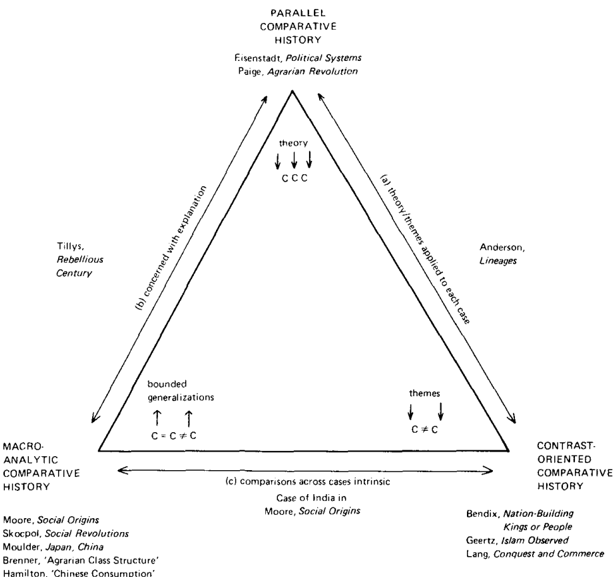
The paper argues that comparative history in macrosocial inquiry has at least three distinct logics: parallel demonstration of theory, contrast of contexts, and macro-causal analysis. It shows that these logics have different purposes, case-selection rules, and strengths/limitations, and that some influential works combine two of them in segmented ways.
## Key findings
- The authors identify three major logics of comparative history: Parallel comparative history, Contrast-oriented comparative history, and Macro-analytic comparative history.
- In Parallel comparative history, cases are juxtaposed mainly to show that a theory applies repeatedly across relevant historical trajectories; the paper says this does not validate the theory, because cases are selected by the theory and are used to illustrate and clarify it.
- In Contrast-oriented comparative history, the goal is to highlight the unique features of each case and how context shapes outcomes; the paper says this approach offers rich, holistic, chronological accounts but tends to avoid explicit explanation.
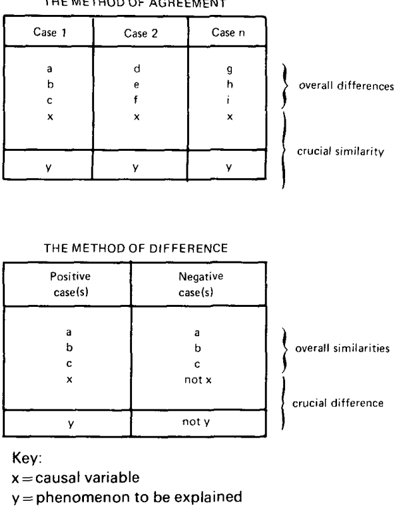
- In Macro-analytic comparative history, scholars use comparisons to make causal inferences about macro-level phenomena, often by approximating John Stuart Mill’s Method of Agreement and Method of Difference; the paper argues this is the best way to attempt validation of causal hypotheses when cases are intrinsically limited.
## Methods
- Conceptual/methodological essay based on comparative analysis of published comparative-historical works; the authors use examples to illustrate each logic rather than providing full methodological dissections.
- The paper’s examples include works by Eisenstadt, Paige, Geertz, Lang, Bendix, Moore, Moulder, Brenner, Hamilton, Anderson, and the Tillys.
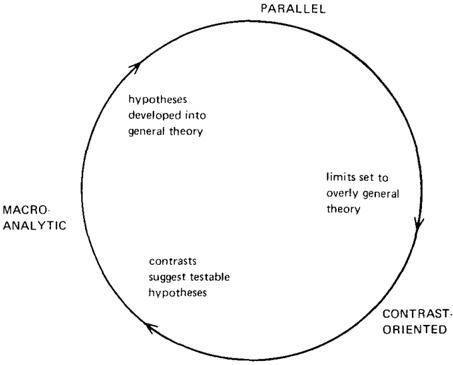
- Main analytic frame is a typology/triangle of comparative history, with discussion of how each logic uses cases, theory, chronology, and causal inference.
## Limitations
- The paper states that it does not present full methodological dissections of the works it uses as illustrations, and that many issues about theory and concepts relative to evidence are skirted.
- It explicitly notes that perfectly controlled comparisons are never really feasible in sociohistorical research, because societies cannot be broken apart into manipulable variables and history rarely provides exactly the needed cases.
- Evident from the text: the argument is illustrative rather than systematic empirical testing of the typology itself, since it relies on selected published examples rather than a comprehensive sample.
Model-written summary. Check it against the paper before relying on it.
Integrity signals
Registry
Cites
Statistics
Figures
Verification
Claims the paper makes
0 Valid · 1 Not valid · 49 Not checked · 126 Own results and interpretations
A result the paper states — it cites no source for it, so there is none to check. The quote shows it is in the paper.
In the paper
“The primary mode of demonstrating the theory is something other than comparative history in both books.”
plain- Asserted: passes — The authors put it forward as true.
- Checkable: passes — It can be checked against evidence.
- Load-bearing: passes — The paper’s conclusions depend on it.
- Based: passes — The paper gives a reason why it holds.
A result the paper states — it cites no source for it, so there is none to check. The quote shows it is in the paper.
In the paper
“Eisenstadt relies chiefly upon conceptual elaboration and deduction from structure-functionalist premises”
plain- Asserted: passes — The authors put it forward as true.
- Checkable: passes — It can be checked against evidence.
- Load-bearing: unclear — It is unclear whether the paper’s conclusions depend on it.
- Based: passes — The paper gives a reason why it holds.
A result the paper states — it cites no source for it, so there is none to check. The quote shows it is in the paper.
In the paper
“Despite considerable differences of subject-matter and theoretical approach, both S. N. Eisenstadt's The Political Systems of Empires and Jeffery M. Paige's Agrarian Revolution use comparative history in this way.”
plain- Asserted: passes — The authors put it forward as true.
- Checkable: passes — It can be checked against evidence.
- Load-bearing: passes — The paper’s conclusions depend on it.
- Based: passes — The paper gives a reason why it holds.
A result the paper states — it cites no source for it, so there is none to check. The quote shows it is in the paper.
In the paper
“Nevertheless, in both Eisenstadt's and Paige's books, comparative history serves as an ancillary mode of theoretical demonstration.”
plain- Asserted: passes — The authors put it forward as true.
- Checkable: passes — It can be checked against evidence.
- Load-bearing: passes — The paper’s conclusions depend on it.
- Based: passes — The paper gives a reason why it holds.
A result the paper states — it cites no source for it, so there is none to check. The quote shows it is in the paper.
In the paper
“Within each of his routes, Moore primarily argues along the lines of the Method of Agreement.”
plain- Asserted: passes — The authors put it forward as true.
- Checkable: passes — It can be checked against evidence.
- Load-bearing: unclear — It is unclear whether the paper’s conclusions depend on it.
- Based: passes — The paper gives a reason why it holds.
74 more claims
Create a free account to see all 176 claims and every source verdict.
- Probably not a substantial claim. 82
- It may state two separate claims as one. 36
Citations
Cites
States and Social Revolutions: A Comparative Analysis of France, Russia and China
Skocpol, T. (1979) · Cambridge University Press · doi:10.1017/cbo9780511815805 · Cited by 5,408
Self-citationComparative Politics and the Comparative Method
Lijphart, A. (1971) · American Political Science Review · doi:10.2307/1955513 · Cited by 3,151
Hechter, M., & Wallerstein, I. (1975) · Contemporary Sociology · doi:10.2307/2063180 · Cited by 2,590
Social Origins of Dictatorship and Democracy: Lord and Peasant in the Making of the Modern World.
Ness, G. D., & Moore, B. (1967) · American Sociological Review · doi:10.2307/2092029 · Cited by 2,261
Lineages of the Absolutist State
Rothkrug, L., & Anderson, P. (1976) · The American Historical Review · doi:10.2307/1851205 · Cited by 1,694
The Rise and Future Demise of the World Capitalist System: Concepts for Comparative Analysis
Wallerstein, I. (1974) · Comparative Studies in Society and History · doi:10.1017/s0010417500007520 · Cited by 1,466
AGRARIAN CLASS STRUCTURE AND ECONOMIC DEVELOPMENT IN PRE-INDUSTRIAL EUROPE
Brenner, R. (1976) · Past and Present · doi:10.1093/past/70.1.30 · Cited by 1,193
Appleby, A. B., & Walerstein, I. (1975) · The American Historical Review · doi:10.2307/1852102 · Cited by 1,066
Feld, M. D. (1975) · History: Reviews of New Books · doi:10.1080/03612759.1975.9945059 · Cited by 775
The Rebellious Century: 1830–1930
Tilly, C., Tilly, L., & Tilly, R. (1975) · Harvard University Press eBooks · doi:10.4159/harvard.9780674434004 · Cited by 685
Research works printed but not linked: 8
- 1973, Politics and Society, 4, 10
- Bloch, 1934, Une Étude Régionale: Geographie ou Histoire?, Annales d'Histoire Economique el Sociale, 6, 81
- Mill , “Two Methods,” in Etzioni and Du Bow , eds., Comparative Perspectives, pp. 210–13.
- Anderson, 1967, Land and Work in Medieval Europe: Selected Papers by- Marc Bloch, 44
- 1967, Comparative Sociology: A Codification of Cross-Societal Analysis
- 1977, Poor People's Movements
- Political Systems, he also does a bit of causal analysis using an approximation to controlled comparison. Specifically Eisenstadt uses Macro-analytic comparative history when he argues (pp. 106–7) that some societies had one, but not both, necessary conditions to become bureaucratic empires, contrasting these “failed” cases to “successful” ones.
- Bendix, 1977, Nation-Building and Citizenship, 16
Cited by
Items 101–200 of 1,062
From Within to Between Nations: Subnational Comparison across Borders
Sellers, J. M. (2019) · Perspectives on Politics · doi:10.1017/s1537592718002104 · Cited by 76
“101 Skocpol and Somers 1980, Lieberman 2016.”
Civil Compliance and “Political Luddism”
Pappas, T. S., & O’Malley, E. (2014) · American Behavioral Scientist · doi:10.1177/0002764214534663 · Cited by 62
“By comparing these two countries, we use the most similar case selection, commonly known as “method of difference” after John Stuart Mill (1843/1872; Gerring, 2007, pp. 131-139; see also Skocpol & Somers, 1980, pp. 183-184).”
MethodRedistributing the Poor: Jails, Hospitals, and the Crisis of Law and Fiscal Austerity
Lara‐Millán, A. (2021) · doi:10.1093/oso/9780197507896.001.0001 · Cited by 112
Marano, V., Tallman, S., & Teegen, H. J. (2020) · Global Strategy Journal · doi:10.1002/gsj.1366 · Cited by 76
“…addressing these gaps, we relied on an exploratory investigation based on the comparative case approach as exemplified by Hoffman and Ocasio (2001) and Miles and Huberman (1994) for the “purpose of making causal inferences about macrolevel structures and processes” (Skocpol & Somers, 1980, p. 181).”
MethodEconomic and Political Reactions to the World Economic Crisis of the 1930s in Six European Countries
Zimmermann, E., & Saalfeld, T. (1988) · International Studies Quarterly · doi:10.2307/2600445 · Cited by 62
Vannoni, M. (2014) · Cross-Cultural Research · doi:10.1177/1069397114555844 · Cited by 127
“The major reason being the comparability of cases, namely, that the possibility of finding two most similar or different cases in social reality is arguably really low (Mill, 1888; Skocpol & Somers, 1980).”
BackgroundContributions of Survey Research to Political Science
Brady, H. E. (2000) · PS Political Science & Politics · doi:10.2307/420775 · Cited by 88
“…methods used to understand politics such as case studies (Campbell 1975; Eckstein 1975; George 1979), the comparative method (Collier 1993; Skocpol and Somers 1980), experiments (Kinder and Palfrey 1993), aggregate data (Achen and Shively 1995; Jackman 1985; King 1997), and in-depth…”
MethodComparative Sociology and the Comparative Method
Ragin, C. C. (1981) · Comparative Sociology · doi:10.1163/156854281x00073 · Cited by 59
Orchestrators of coordination: Towards a new role of the state in coordinated capitalism?
Busemeyer, M. R., Carstensen, M. B., & Emmenegger, P. (2022) · European Journal of Industrial Relations · doi:10.1177/09596801211062556 · Cited by 74
“Methodologically, our case studies provide a parallel demonstration of theory (Skocpol and Somers, 1980).”
BackgroundEvolutionary theory in sociology: An examination of current thinking
Dietz, T. M., Burns, T. R., & Buttel, F. H. (1990) · Sociological Forum · doi:10.1007/bf01112590 · Cited by 57
On Revolutions: Unruly Politics in the Contemporary World
Beck, C. J., Bukovansky, M., Chenoweth, E., Lawson, G., Nepstad, S. E., & Ritter, D. P. (2022) · Oxford University Press eBooks · doi:10.1093/oso/9780197638354.001.0001 · Cited by 99
The British Trans-Atlantic Slave Trade 1650-1775
Bean, R. N. (1972) · The Journal of Economic History · doi:10.1017/s0022050700111520 · Cited by 58
Ideology and Mass Killing: The Radicalized Security Politics of Genocides and Deadly Atrocities
Maynard, J. L. (2022) · doi:10.1093/oso/9780198776796.001.0001 · Cited by 68
Trampusch, C. (2007) · Social Policy and Administration · doi:10.1111/j.1467-9515.2007.00551.x · Cited by 68
Pacewicz, J. (2020) · Sociological Methods & Research · doi:10.1177/0049124119901213 · Cited by 69
“…interested in deterministic rather than probabilistic causes or in variables that are “bigger,” “more complex,” or more likely to cluster into “combinations” than the sorts of variables that interest survey researchers (see, e.g., Lieberson 1994; Mahoney 2000; Sewell 2005; Skocpol and Somers 1980).”
BackgroundResultInfluentialPost-Soviet Transitions and Democratization: Towards Theory-Building
Гельман, В. (2003) · Democratization · doi:10.1080/714000120 · Cited by 77
West Indian Identity in the Diaspora
Foner, N. (1998) · Latin American Perspectives · doi:10.1177/0094582x9802500309 · Cited by 53
Mihret, D. G. (2014) · Critical Perspectives on Accounting · doi:10.1016/j.cpa.2014.01.003 · Cited by 85
Global health in foreign policy--and foreign policy in health? Evidence from the BRICS
Watt, N. F., Gómez, E. J., & McKee, M. (2013) · Health Policy and Planning · doi:10.1093/heapol/czt063 · Cited by 67
“By comparing a small group of countries with differing historical, institutional and policy characteristics it is possible to make what Skocpol and Somers (1980) refer to as a contrast of contexts, where the goal is to highlight and learn from unique features of historical case studies.”
BackgroundEmployment and Caring in British and Norwegian Banking: An Exploration through Individual Careers
Crompton, R., & Birkelund, G. E. (2000) · Work Employment and Society · doi:10.1177/09500170022118437 · Cited by 75
Education, Globalisation and the Role of Comparative Research
Green, A. (2003) · London Review of Education · doi:10.1080/1474846032000098464 · Cited by 101
Constructing Expertise: Terrorist Recruitment and “Talent Spotting” in the PIRA, Al Qaeda, and ISIS
Bloom, M. M. (2016) · Studies in Conflict and Terrorism · doi:10.1080/1057610x.2016.1237219 · Cited by 80
Interests, Institutions and Industrial Relations
Wailes, N., Ramia, G., & Lansbury, R. D. (2003) · British Journal of Industrial Relations · doi:10.1046/j.1467-8543.2003.00291.x · Cited by 58
The Schools of Thought Problem in International Relations
Grieco, J. M. (2018) · International Studies Review · doi:10.1093/isr/viy005 · Cited by 49
The rise and domestication of historical sociology
Calhoun, C. J. (1996) · London School of Economics and Political Science Research Online (London School of Economics and Political Science) · Cited by 86
The Uses of History in Sociology: A Reply
Goldthorpe, J. H. (1994) · British Journal of Sociology · doi:10.2307/591525 · Cited by 49
“…has observed, such an attitude is also powerfully promoted by the strategies of 'analytic induction' which Skocpol, for example, has represented as a key resource for comparative macrosociology (Skocpol 1979: 36-7; 1984: 378-8 1 ; Skocpol and Somers 1980: 183-4; cf. also Rueschemeyer 1991: 32-4).”
BackgroundThe Politico-Legal Dynamics of Judicial Review: A Comparative Analysis
Roux, T. R. (2018) · Cambridge University Press eBooks · doi:10.1017/9781108340977 · Cited by 85
Lainer‐Vos, D. (2013) · Organization Studies · doi:10.1177/0170840612467159 · Cited by 51
“In these works, “context” is typically a list of macro-sociological variables that the researcher considers to be important (Mahoney & Rueschemeyer, 2003; Skocpol & Somers, 1980).”
BackgroundComparing the trajectories of educational change and policy transfer in developing countries
Johnson, D. (2006) · Oxford Review of Education · doi:10.1080/03054980600976411 · Cited by 49
“Comparative history as a method of enquiry Comparative history, which broadly involves looking at historical trajectories as a means to study social change (Skocpol & Somers, 1980), is a long-standing and very attractive method of enquiry in the Social Sciences.”
BackgroundMethodResultInfluentialParadigms lost: integrating history and organization studies
Decker, S. (2016) · Management & Organizational History · doi:10.1080/17449359.2016.1263214 · Cited by 60
“Comparative Historical Analysis, such as work by Charles Tilly and Theda Skocpol, is largely unthinkable without a degree of analytical equivalence of categories across space and time (Skocpol 1979; Skocpol and Somers 1980; Tilly 1984).”
MethodPettit, M. (2016) · History of Psychology · doi:10.1037/hop0000023 · Cited by 55
“Nevertheless, historical psychology can be informed by the comparative methods championed by political scientists (Skocpol & Somers, 1980) and longstanding interpretive practices among historians for evaluating the provenance and audience for historical texts (Jordanova, 2000).”
BackgroundCivil Society and Its Institutional Context in CEE
Meyer, M., Moder, C. M., Neumayr, M., & Vandor, P. (2020) · VOLUNTAS International Journal of Voluntary and Nonprofit Organizations · doi:10.1007/s11266-019-00106-7 · Cited by 64
Historical Enquiry and Comparative Politics
Mahoney, J., & Villegas, C. M. (2009) · Oxford University Press eBooks · doi:10.1093/oxfordhb/9780199566020.003.0003 · Cited by 64
The Ulysses Principle: A Criterial Framework for Reducing Bias When Enlisting the Work of Historians
Møller, J. Ø., & Skaaning, S. (2018) · Sociological Methods & Research · doi:10.1177/0049124118769107 · Cited by 55
Transitional Justice and Corporate Accountability from Below: Deploying Archimedes' Lever
Payne, L. A., Pereira, G., & Bernal-Bermúdez, L. (2020) · Cambridge University Press eBooks · doi:10.1017/9781108564564 · Cited by 118
Notes From A Leisure Son: Expanding An Understanding of Whiteness in Leisure
Mowatt, R. A. (2009) · Journal of Leisure Research · doi:10.1080/00222216.2009.11950188 · Cited by 46
“Historical analysis, mainly comparative historical analysis, examines the past in context of contemporary viewpoints (Collier & Adcock, 1999; Mahoney & Rueschemeyer, 2003; Skocpol & Somers, 1980).”
BackgroundHealth inequalities: Political problematizations in Denmark and Sweden
Vallgårda, S. (2007) · Critical Public Health · doi:10.1080/09581590601071705 · Cited by 46
“The primary purpose of this comparative approach is, however, to identify traits of each country’s policies, i.e. to make the description richer (Skocpol & Somers, 1980).”
BackgroundGeddes, A. (2005) · The British Journal of Politics and International Relations · doi:10.1111/j.1467-856x.2005.00192.x · Cited by 46
The Rationality of Drawing Big Conclusions Based on Small Samples: In Defense of Mill's Methods
Savolainen, J. (1994) · Social Forces · doi:10.1093/sf/72.4.1217 · Cited by 65
Education, Globalisation and the Role of Comparative Research
Green, A. (2003) · London Review of Education · doi:10.1080/14748460306686 · Cited by 46
“between three primary types of comparative ‘logics-in-use’ (Skocpol and Somers, 1980).”
BackgroundRepensando a história comparada da América Latina
Prado, M. L. C. (2005) · Revista de História · doi:10.11606/issn.2316-9141.v0i153p11-33 · Cited by 201
Comparisons: colonial or cosmopolitan?
Robinson, J. (2011) · Singapore Journal of Tropical Geography · doi:10.1111/j.1467-9493.2011.00423.x · Cited by 54
U.S. technological enthusiasm and British technological skepticism in the age of the analog brain
Bowles, M. D. (1996) · IEEE Annals of the History of Computing · doi:10.1109/85.539911 · Cited by 44
Research Design, Falsification, and the Qualitative–Quantitative Divide
Caporaso, J. A. (1995) · American Political Science Review · doi:10.2307/2082441 · Cited by 54
Conjunctural causation in comparative case-oriented research
Aus, J. P. (2007) · Quality & Quantity · doi:10.1007/s11135-007-9104-4 · Cited by 47
Academic Entrepreneurship: Gendered Discourses and Ghettos
Fältholm, Y., Abrahamsson, L., & Källhammer, E. (2010) · Journal of technology management & innovation · doi:10.4067/s0718-27242010000100004 · Cited by 53
EL INSTITUCIONALISMO HISTÓRICO EN LA CIENCIA POLÍTICA CONTEMPORÁNEA
Pierson, P., & Skocpol, T. R. (2008) · LA Referencia (Red Federada de Repositorios Institucionales de Publicaciones Científicas) · Cited by 211
Self-citationAn analytic narrative approach to puzzles and problems
Levi, M. (2004) · Cambridge University Press eBooks · doi:10.1017/cbo9780511492174.010 · Cited by 58
Toward a Platinum Standard for Evidence‐Based Assessment by 2020
Khagram, S., & Thomas, C. W. (2010) · Public Administration Review · doi:10.1111/j.1540-6210.2010.02251.x · Cited by 48
Mesnel, B. (2017) · Gouvernement et action publique · doi:10.3917/gap.171.0033 · Cited by 74
Kalberg, S. (1996) · Sociological Theory · doi:10.2307/202152 · Cited by 42
Haq, H. U., Drogendijk, R. H., & Holm, D. B. (2016) · Journal of World Business · doi:10.1016/j.jwb.2016.10.001 · Cited by 47
The Comparative Method and the History of the Modern Humanities
Griffiths, D. (2017) · History of Humanities · doi:10.1086/693325 · Cited by 65
Muñoz, P. (2018) · Cambridge University Press eBooks · doi:10.1017/9781108525015 · Cited by 42
Transnational Discursive Opportunities and Social Movement Risk Frames Opposing GMOs
Motta, R. (2014) · Social movement studies · doi:10.1080/14742837.2014.947253 · Cited by 48
“The research draws on traditions of methods that conduct small-N macro-analytical qualitative comparisons (Rihoux & Ragin, 2009; Skocpol & Somers, 1980).”
MethodKremer, M. (2007) · Cited by 39
Corporate Complicity in International Human Rights Violations
Payne, L. A., & Pereira, G. (2016) · Annual Review of Law and Social Science · doi:10.1146/annurev-lawsocsci-110615-085100 · Cited by 43
“10 See, for example, Block 1984; Lindblom 1977; Miliband 1969; Mills 1956; Offe & Wiesenthal 1980; Poulantzas 1968; Skocpol & Somers 1980; Vogel 1978, 1983.”
Boghossian, J., & Marques, J. C. (2019) · Organization Studies · doi:10.1177/0170840618815928 · Cited by 43
Urban Poverty, Segregation and Social Networks in São Paulo and Salvador, Brazil
Marques, E. C. L. (2015) · International Journal of Urban and Regional Research · doi:10.1111/1468-2427.12300 · Cited by 41
Lieberman, E. S. (2009) · Annual Review of Political Science · doi:10.1146/annurev.polisci.12.041007.155222 · Cited by 52
“Such analyses are analogous to what qualitative researchers have long referred to as “macrocomparative” or “comparative-historical” analysis (Skocpol & Somers 1980, Mahoney & Rueschemeyer 2003) in that they seek to generate causal inferences about the determinants of large-scale political phenomena…”
ResultCasula, M. (2022) · European Planning Studies · doi:10.1080/09654313.2021.2025345 · Cited by 46
“…institutional framework for innovation has traditionally been present; and then bring out the unique features of each particular case analyzed (Skocpol and Somers 1980) and, based on the path dependence hypothesis previously advanced, ‘discover whether similar mechanisms and processes drive…”
BackgroundSavage, J. D. (2010) · European Journal of International Relations · doi:10.1177/1354066110364287 · Cited by 41
“Combined, the cases of China, the Ottoman Empire and Egypt allow a rough approximation of the method of difference with the method of agreement, which in combination provide a stronger basis for causal inference than either individually (Mahoney, 2003; Skocpol and Somers, 1980).”
MethodNanthagopan, Y., Williams, N. L., & Page, S. J. (2016) · International Journal of Project Management · doi:10.1016/j.ijproman.2016.09.003 · Cited by 50
“The most similar setting employs a minimum of two cases (Skocpol and Somers, 1980).”
BackgroundKuyucu, T. (2020) · Urban Affairs Review · doi:10.1177/1078087420957736 · Cited by 43
“While allowing for a parallel demonstration of my theory (Skocpol and Somers 1980) and (at least partial) generalizability, such a strategy of “theoretical sampling” (Small 2009) introduces two (potential) problems into the analysis: selection bias (King et al. 1994) and difficulty of identifying…”
BackgroundThe State, the Labor Process, and the Diffusion of Managerial Models
Kalev, A., Shenhav, Y. A., & VRIES, D. D. (2008) · Administrative Science Quarterly · doi:10.2189/asqu.53.1.1 · Cited by 44
“|. in relation to a particular explanatory problem” (Skocpol and Somers, 1980: 182).”
BackgroundMethodL'Histoire Comparative et le Champ des Études Migratoires
Green, N. L. (1990) · Annales Histoire Sciences Sociales · doi:10.3406/ahess.1990.278911 · Cited by 35
Theorizing with Archives: Contingency, Mistakes, and Plausible Alternatives
Lara‐Millán, A., Sargent, B., & Kim, S. (2020) · Qualitative Sociology · doi:10.1007/s11133-020-09461-0 · Cited by 41
Disciplining Political Science
Laitin, D. D. (1995) · American Political Science Review · doi:10.2307/2082440 · Cited by 35
GENDER, COMPARATIVE RESEARCH AND BIOGRAPHICAL MATCHING
Crompton, R. (2001) · European Societies · doi:10.1080/14616690120054311 · Cited by 51
“We may describe Esping-Andersen’s approach as being a ‘contrast of contexts’ (Skocpol and Somers 1980).”
BackgroundMethodTransitional Justice and Corporate Accountability from Below: Deploying Archimedes' Lever
Payne, L. A., Pereira, G., & Bernal-Bermúdez, L. (2020) · Cited by 34
The Qualitative Foundations of Political Science Methodology
THOMAS, G. M. (2005) · Perspectives on Politics · doi:10.1017/s1537592705050486 · Cited by 46
Raadschelders, J. C. N. (2009) · The American Review of Public Administration · doi:10.1177/0275074009341663 · Cited by 41
“…• l’art pour l’art (Schlesinger, 1992, p. 136-137) • Generalization (Caldwell, 1955, p. 454), Grand theory (Nash, 1969, p. 63), macro-causal analysis (Skocpol & Somers, 1980, pp. 175-180), path-dependency (Thelen & Steinmo, 1992) • Uncovering facts instead of perpetuating fiction (Skocpol,…”
A Qualitative Comparative Approach to Latin American Revolutions
Wickham‐Crowley, T. P. (1991) · International Journal of Comparative Sociology · doi:10.1163/002071591x00050 · Cited by 34
Trampusch, C. (2013) · European Journal of Industrial Relations · doi:10.1177/0959680112474882 · Cited by 36
“It contrasts the cases with each other to ‘contextualize’ and to reveal trajectories of preference formation, with the aim not of generating ‘causal generalizations across cases’ but of presenting ‘particular features of individual cases’ (Skocpol and Somers, 1980: 190).”
MethodThe Comparative Method in Practice: Case Selection and the Social Science of Revolution
Beck, C. J. (2017) · Social Science History · doi:10.1017/ssh.2017.15 · Cited by 35
Practising Comparison Logics, Relations, Collaborations
Sahin, O. (2016) · Mattering Press eBooks · doi:10.1353/book.81380 · Cited by 136
Wendt, M. (2019) · International Journal of Social Research Methodology · doi:10.1080/13645579.2019.1669927 · Cited by 40
“Discussions of qualitative comparative methodology have often focused on historically oriented approaches in which specific historical processes and developmental trajectories are at the heart of the analysis (Della Porta, 2008; Mahoney & Rueschemeyer, 2003; cf. Skocpol & Somers, 1980).”
BackgroundGarcía-Villegas, M. (2006) · Law & Social Inquiry · doi:10.1111/j.1747-4469.2006.00014.x · Cited by 33
“As argued explicitly by Theda Skocpol (1979; see also Skocpol and Somers 1980), the preeminent American sociologist in this tradition, the methodological underpinnings of this approach to comparative social science are to be found in the method of disagreement and the method of similarities…”
MethodEl control presidencial de la agenda legislativa en América Latina
Santos, M. L., Pérez‐Liñán, A., & Montero, M. G. (2014) · Revista de ciencia política · doi:10.4067/s0718-090x2014000300001 · Cited by 91
Safford, S. C. (2004) · Cited by 46
Administrative History: Contents, Meaning and Usefulness
Raadschelders, J. C. N. (1994) · International Review of Administrative Sciences · doi:10.1177/002085239406000107 · Cited by 33
Interactivity and policy cycle within Electronic Participatory Budgeting: a comparative analysis
Iasulaitis, S., Nebot, C. P., da Silva, E. C., & Sampaio, R. C. (2019) · Revista de Administração Pública · doi:10.1590/0034-761220180272x · Cited by 32
Accrediting Culture: An Analysis of Tribal and Historically Black College Curricula
Cole, W. M. (2006) · Sociology of Education · doi:10.1177/003804070607900404 · Cited by 37
Pedriana, N. (2005) · Sociological Methods & Research · doi:10.1177/0049124104265996 · Cited by 55
Racialised norms in apprenticeship systems in England and Germany
Chadderton, C., & Wischmann, A. (2014) · Journal of Vocational Education and Training · doi:10.1080/13636820.2014.917693 · Cited by 35
“Whereas 67.5% of male Germans from 18 to 21 and 45.9% of female Germans had an apprenticeship in 2006, only 28.8% of males from migrant backgrounds and 23.8% of females of the same cohort did (Siegert 2009).”
BackgroundInfluentialA framework for medical power in two case studies of health policymaking in India and Niger
Dalglish, S. L., Sriram, V. M., Scott, K., & Rodríguez, D. (2018) · Global Public Health · doi:10.1080/17441692.2018.1457705 · Cited by 32
“…forms of medicine emerging more recently as politically ascendant (Lakshmi et al., 2015) design in seeking to distinguish between contextual particularities not impinging on questions of theory and unique aspects of cases bringing out features of the theory in development (Skocpol & Somers, 1980).”
BackgroundPhillimore, J., Block, K., Bradby, H., Özçürümez, S., & Papoutsi, A. (2022) · Journal of International Migration and Integration / Revue de l integration et de la migration internationale · doi:10.1007/s12134-022-00970-1 · Cited by 48
“…of forced migration arrival, transit, resettlement and policy (see Appendix 1) which enabled us to identify commonalities and differences using comparison as a parallel demonstration of theory wherein findings have validity if appearing across multiple, different, contexts (Skocpal & Somers, 1980).”
MethodReclaiming a Lost Legacy: The Historical Humanist Vision in Comparative Education
Kazamias, A. Μ. (2009) · Springer eBooks · doi:10.1007/978-1-4020-6403-6_78 · Cited by 30
“[I]t is characteristic of all works of parallel comparative history to elaborate theoretical models and hypotheses before turning to historical case illustrations ( Skocpol & Somers, 1980 ).”
BackgroundComparative Historical Analysis
Ritter, D. P. (2014) · Oxford University Press eBooks · doi:10.1093/acprof:oso/9780198719571.003.0005 · Cited by 43
Methodological pluralism in international comparative research
Hantrais, L. (2014) · International Journal of Social Research Methodology · doi:10.1080/13645579.2014.892656 · Cited by 52
“The result of ‘mixed type’ work in comparative history, when two or more logics are applied to the same units of analysis, may be an ambiguous message, unless the different logics are kept relatively separate (Skocpol & Somers, 1980, p. 190).”
BackgroundPolitical repression, civil society and the politics of responding to AIDS in the BRICS nations
Gómez, E. J., & Harris, J. A. (2015) · Health Policy and Planning · doi:10.1093/heapol/czv021 · Cited by 30
Hatakenaka, S., Westnes, P., Gjelsvik, M., & Lester, R. K. (2011) · International Journal of Innovation and Regional Development · doi:10.1504/ijird.2011.040528 · Cited by 33
“The main benefit of comparison in this study, however, was not so much to strengthen the generaliseability of the findings, but rather to inject rigor into the qualitative understanding of each of the cases by drawing contrasts between them (Skocpol and Somers, 1980).”
BackgroundMethodInfluentialBusemeyer, M. R., & Trampusch, C. (2013) · Zeitschrift für Sozialreform · doi:10.1515/zsr-2013-0303 · Cited by 29
Negretto, G. L., & Visconti, G. (2018) · Latin American Politics and Society · doi:10.1017/lap.2017.5 · Cited by 34
“At the same time, these cases will be used to account for the differences across the three paths to reform (Skocpol and Somers 1980).”
BackgroundGoerres, A., Siewert, M. Β., & Wagemann, C. (2019) · KZfSS Kölner Zeitschrift für Soziologie und Sozialpsychologie · doi:10.1007/s11577-019-00600-2 · Cited by 39
The Politics of Foreign Direct Investment in Authoritarian Regimes
Bastiaens, I. (2016) · International Interactions · doi:10.1080/03050629.2015.1065699 · Cited by 29
Ignatow, G., Webb, S. M., Poulin, M., Parajuli, R., Fleming, P., Batra, S., & Neupane, D. (2012) · Libri · doi:10.1515/libri-2012-0005 · Cited by 29
“First, we employ methods of comparative historical sociology (Skocpol and Somers 1980) to analyze the chronology (Büthe 2002) of the development of each country’s national public library system in relation to changes in regime type.”
MethodWhat Do Historical Sociologists Do All Day? Analytic Architectures in Historical Sociology
Mayrl, D., & Wilson, N. H. (2020) · American Journal of Sociology · doi:10.1086/709017 · Cited by 37
Kumlin, J. (2006) · European Sociological Review · doi:10.1093/esr/jcl029 · Cited by 28
Institute of Governmental Studies
Sides, J. C. (1999) · Cited by 29
Metadata
- Authors
- Skocpol, T., & Somers, M.
- Affiliations
- Harvard University (US)
- Venue
- Comparative Studies in Society and History
- Publisher
- Cambridge University Press (CUP)
- Published
- 1980-04
- Volume
- 22
- Issue
- 2
- Pages
- 174-197
- ISSN
- 0010-4175 (ISSN-L)
- 1475-2999
- OpenAlex
- W2109860650
- Semantic Scholar
- 78dcc4fcfa160854af0a651c0ece23d562212f04
- Cited by
- 1,074
- References
- 36
- Citations by year
- 2026: 20 · 2025: 37 · 2024: 45 · 2023: 45 · 2022: 87 · 2021: 48 · 2020: 52 · 2019: 51 · 2018: 93 · 2017: 23 · 2016: 40 · 2015: 35 · 2014: 38 · 2013: 36 · 2012: 27
- FWCI
- 22.11
- Type
- journal article
- Language
- en
- Open access
- bronze
- doi.org
- Locations
- Comparative Studies in Society and History (publishedVersion)
- Topics
- Social Sciences › Sociology and Political Science › Qualitative Comparative Analysis Research
- Social Sciences › Arts and Humanities › History › Philosophy, History, and Historiography
- Social Sciences › Sociology and Political Science › German Social Sciences and History
- Keywords
- comparative history, social change, historical trajectories, social dynamics, historical sequence, social structure, cultural change
About these checks
Registry, retraction, Cites and statistics results are computed, not judged, with one exception: a printed reference that no index lists is read once by a model before it counts as a citation error. Claims are extracted by a model and kept only when their quote appears verbatim in the text; each cited source is then checked, with a model’s help, for whether it says what the claim relies on. Those verdicts can be wrong — read the claim’s quote and the cited source before relying on one.
A language model drew the claims from the paper on 2026-09-30, under version 3 of the claim definition (model deepseek-v4.1-flash, prompt extract-v3).
A second model labelled each claim on 2026-09-30 (model jev-1.13-20260917, definition revision gold-guideline-v0.2).
Statistics and arithmetic are recomputed, not judged.
Confidence bands are shown only for fields calibrated on our annotated test set. None is calibrated yet, so no band is shown.
What counts as a claim ›How we measure confidence ›How we check this ›
Are you an author, or do you see a problem with this page? Request a review
Data sources
Bibliographic data: Semantic Scholar, OpenAlex, Crossref.
Contains information from the Semantic Scholar Academic Graph Datasets, made available under the ODC Attribution License (ODC-BY 1.0).
Semantic Scholar’s data is described in: Kinney, R., et al. (2023). The Semantic Scholar Open Data Platform. arXiv:2301.10140.
