

The Uses of Comparative History in Macrosocial Inquiry
Open accessThe DOI matches its Crossref record; 35 of the 36 references it cites were found in a registry or an index; none of the 44 sources its claims cite is checked for support yet.
Abstract
Comparative history is not new. As long as people have investigated social life, there has been recurrent fascination with juxtaposing historical patterns from two or more times or places. Part of the appeal comes from the general usefulness of looking at historical trajectories in order to study social change. Indeed, practitioners of comparative history from Alexis de Tocqueville and Max Weber to Marc Bloch, Reinhard Bendix, and Barrington Moore, Jr. have typically been concerned with understanding societal dynamics and epochal transformations of cultures and social structures. Attention to historical sequences is indispensable to such understanding. Obviously, though, not all investigations of social change use explicit juxtapositions of distinct histories. We may wonder, therefore: What motivates the use of comparisons as opposed to focussing on single historical trajectories? What purposes are pursued—and how—through the specific modalities of comparative history?
Overview
CoChat Summary
## TL;DR
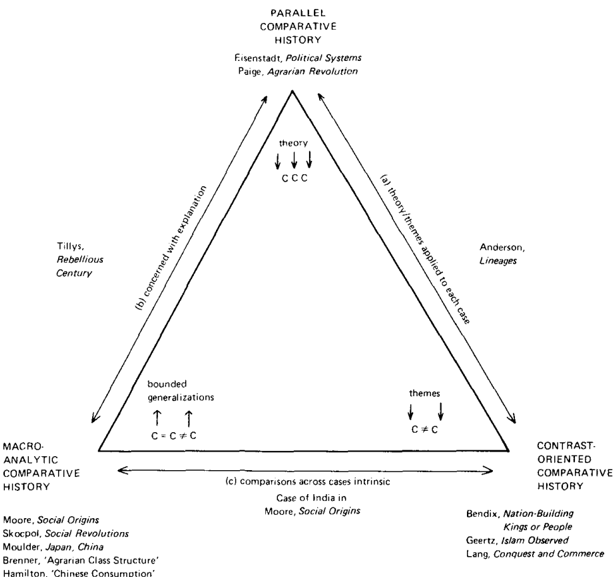
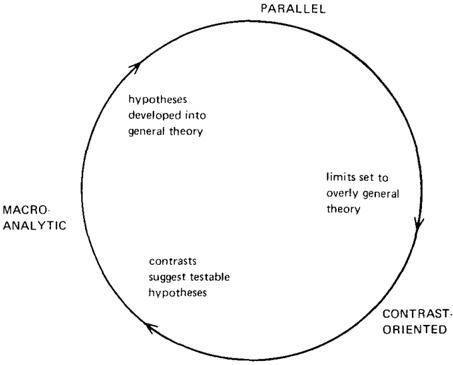
The paper argues that comparative history in macrosocial inquiry has at least three distinct logics: parallel demonstration of theory, contrast of contexts, and macro-causal analysis. It shows that these logics have different purposes, case-selection rules, and strengths/limitations, and that some influential works combine two of them in segmented ways.
## Key findings
- The authors identify three major logics of comparative history: Parallel comparative history, Contrast-oriented comparative history, and Macro-analytic comparative history.
- In Parallel comparative history, cases are juxtaposed mainly to show that a theory applies repeatedly across relevant historical trajectories; the paper says this does not validate the theory, because cases are selected by the theory and are used to illustrate and clarify it.
- In Contrast-oriented comparative history, the goal is to highlight the unique features of each case and how context shapes outcomes; the paper says this approach offers rich, holistic, chronological accounts but tends to avoid explicit explanation.
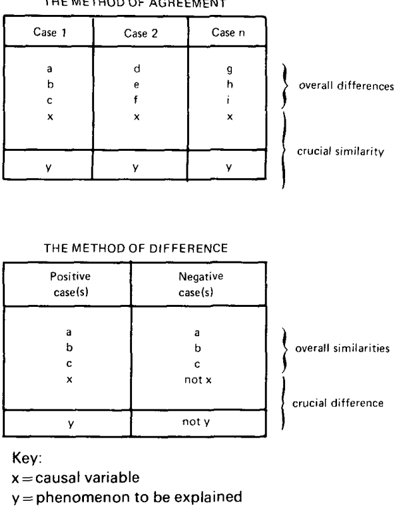
- In Macro-analytic comparative history, scholars use comparisons to make causal inferences about macro-level phenomena, often by approximating John Stuart Mill’s Method of Agreement and Method of Difference; the paper argues this is the best way to attempt validation of causal hypotheses when cases are intrinsically limited.
## Methods
- Conceptual/methodological essay based on comparative analysis of published comparative-historical works; the authors use examples to illustrate each logic rather than providing full methodological dissections.
- The paper’s examples include works by Eisenstadt, Paige, Geertz, Lang, Bendix, Moore, Moulder, Brenner, Hamilton, Anderson, and the Tillys.
- Main analytic frame is a typology/triangle of comparative history, with discussion of how each logic uses cases, theory, chronology, and causal inference.
## Limitations
- The paper states that it does not present full methodological dissections of the works it uses as illustrations, and that many issues about theory and concepts relative to evidence are skirted.
- It explicitly notes that perfectly controlled comparisons are never really feasible in sociohistorical research, because societies cannot be broken apart into manipulable variables and history rarely provides exactly the needed cases.
- Evident from the text: the argument is illustrative rather than systematic empirical testing of the typology itself, since it relies on selected published examples rather than a comprehensive sample.
Model-written summary. Check it against the paper before relying on it.
Integrity signals
Registry
Cites
Statistics
Figures
Verification
Claims the paper makes
0 Valid · 1 Not valid · 49 Not checked · 126 Own results and interpretations
A result the paper states — it cites no source for it, so there is none to check. The quote shows it is in the paper.
In the paper
“The primary mode of demonstrating the theory is something other than comparative history in both books.”
plain- Asserted: passes — The authors put it forward as true.
- Checkable: passes — It can be checked against evidence.
- Load-bearing: passes — The paper’s conclusions depend on it.
- Based: passes — The paper gives a reason why it holds.
A result the paper states — it cites no source for it, so there is none to check. The quote shows it is in the paper.
In the paper
“Eisenstadt relies chiefly upon conceptual elaboration and deduction from structure-functionalist premises”
plain- Asserted: passes — The authors put it forward as true.
- Checkable: passes — It can be checked against evidence.
- Load-bearing: unclear — It is unclear whether the paper’s conclusions depend on it.
- Based: passes — The paper gives a reason why it holds.
A result the paper states — it cites no source for it, so there is none to check. The quote shows it is in the paper.
In the paper
“Despite considerable differences of subject-matter and theoretical approach, both S. N. Eisenstadt's The Political Systems of Empires and Jeffery M. Paige's Agrarian Revolution use comparative history in this way.”
plain- Asserted: passes — The authors put it forward as true.
- Checkable: passes — It can be checked against evidence.
- Load-bearing: passes — The paper’s conclusions depend on it.
- Based: passes — The paper gives a reason why it holds.
A result the paper states — it cites no source for it, so there is none to check. The quote shows it is in the paper.
In the paper
“Nevertheless, in both Eisenstadt's and Paige's books, comparative history serves as an ancillary mode of theoretical demonstration.”
plain- Asserted: passes — The authors put it forward as true.
- Checkable: passes — It can be checked against evidence.
- Load-bearing: passes — The paper’s conclusions depend on it.
- Based: passes — The paper gives a reason why it holds.
A result the paper states — it cites no source for it, so there is none to check. The quote shows it is in the paper.
In the paper
“Within each of his routes, Moore primarily argues along the lines of the Method of Agreement.”
plain- Asserted: passes — The authors put it forward as true.
- Checkable: passes — It can be checked against evidence.
- Load-bearing: unclear — It is unclear whether the paper’s conclusions depend on it.
- Based: passes — The paper gives a reason why it holds.
74 more claims
Create a free account to see all 176 claims and every source verdict.
- Probably not a substantial claim. 82
- It may state two separate claims as one. 36
Citations
Cites
States and Social Revolutions: A Comparative Analysis of France, Russia and China
Skocpol, T. (1979) · Cambridge University Press · doi:10.1017/cbo9780511815805 · Cited by 5,408
Self-citationComparative Politics and the Comparative Method
Lijphart, A. (1971) · American Political Science Review · doi:10.2307/1955513 · Cited by 3,151
Hechter, M., & Wallerstein, I. (1975) · Contemporary Sociology · doi:10.2307/2063180 · Cited by 2,590
Social Origins of Dictatorship and Democracy: Lord and Peasant in the Making of the Modern World.
Ness, G. D., & Moore, B. (1967) · American Sociological Review · doi:10.2307/2092029 · Cited by 2,261
Lineages of the Absolutist State
Rothkrug, L., & Anderson, P. (1976) · The American Historical Review · doi:10.2307/1851205 · Cited by 1,694
The Rise and Future Demise of the World Capitalist System: Concepts for Comparative Analysis
Wallerstein, I. (1974) · Comparative Studies in Society and History · doi:10.1017/s0010417500007520 · Cited by 1,466
AGRARIAN CLASS STRUCTURE AND ECONOMIC DEVELOPMENT IN PRE-INDUSTRIAL EUROPE
Brenner, R. (1976) · Past and Present · doi:10.1093/past/70.1.30 · Cited by 1,193
Appleby, A. B., & Walerstein, I. (1975) · The American Historical Review · doi:10.2307/1852102 · Cited by 1,066
Feld, M. D. (1975) · History: Reviews of New Books · doi:10.1080/03612759.1975.9945059 · Cited by 775
The Rebellious Century: 1830–1930
Tilly, C., Tilly, L., & Tilly, R. (1975) · Harvard University Press eBooks · doi:10.4159/harvard.9780674434004 · Cited by 685
Research works printed but not linked: 8
- 1973, Politics and Society, 4, 10
- Bloch, 1934, Une Étude Régionale: Geographie ou Histoire?, Annales d'Histoire Economique el Sociale, 6, 81
- Mill , “Two Methods,” in Etzioni and Du Bow , eds., Comparative Perspectives, pp. 210–13.
- Anderson, 1967, Land and Work in Medieval Europe: Selected Papers by- Marc Bloch, 44
- 1967, Comparative Sociology: A Codification of Cross-Societal Analysis
- 1977, Poor People's Movements
- Political Systems, he also does a bit of causal analysis using an approximation to controlled comparison. Specifically Eisenstadt uses Macro-analytic comparative history when he argues (pp. 106–7) that some societies had one, but not both, necessary conditions to become bureaucratic empires, contrasting these “failed” cases to “successful” ones.
- Bendix, 1977, Nation-Building and Citizenship, 16
Cited by
Items 301–400 of 1,062
No fear of comparisons or context: on the foundations of historical sociology
Mjøset, L. (2006) · Comparative Education · doi:10.1080/03050060600875584 · Cited by 21
“In the early 1980s, Theda Skocpol published two essays, in which she aimed to codify the principles of comparative historical sociology (Skocpol & Somers, 1980; Skocpol, 1984).”
BackgroundFrom Peril to Partnership: US Security Assistance and the Bid to Stabilize Colombia and Mexico
Angelo, P. J. (2024) · doi:10.1093/oso/9780197688106.001.0001 · Cited by 15
Glencross, A. R. (2007) · Cited by 14
Bogliaccini, J. A., & Madariaga, A. (2024) · Competition & Change · doi:10.1177/10245294241237366 · Cited by 12
“For the descriptive account of each case, we adapt the “ contrast of contexts ” method (Skocpol and Somers, 1980), seeking to underline precisely the historical limits of generalized accounts of structural determinants.”
Møller, J. Ø. (2016) · Sociological Methods & Research · doi:10.1177/0049124115578031 · Cited by 16
Assessing the effects of calculated inaction on national responses to the COVID‐19 crisis
Zahariadis, N., Ceccoli, S. J., & Petridou, E. (2021) · Risk Hazards & Crisis in Public Policy · doi:10.1002/rhc3.12230 · Cited by 15
Manuscript and Print in the Islamic Tradition
Reese, S. S., & The (2022) · De Gruyter eBooks · doi:10.1515/9783110776485 · Cited by 15
Trampusch, C. (2019) · European Journal of Industrial Relations · doi:10.1177/0959680119840574 · Cited by 12
“…case histories… to persuade the reader that a given, explicitly delineated hypothesis or theory can repeatedly demonstrate its fruitfulness’ (Skocpol and Somers, 1980), and proposes that the multi-layered structure of employers’ associations, trade unions and the collective bargaining…”
BackgroundGómez, E. J. (2021) · Health Policy and Planning · doi:10.1093/heapol/czab100 · Cited by 17
“The author employed the method of ‘contrasts of contexts’, which uses empirical qualitative data to compare nations in order to illustrate their contextual and causal uniqueness, in turn providing more depth to the interpretation of how causal factors and outcomes emerged differently between countries (Skocpol and Som…”
MethodClass formation and capitalism. A second look at a classic
Somers, M. R. (1996) · European Journal of Sociology · doi:10.1017/s000397560000802x · Cited by 12
Self-citationFeminist comparative policy: A new field of study
Mazur, A. G. (1999) · European Journal of Political Research · doi:10.1111/1475-6765.00457 · Cited by 12
Comparing Across Political Systems: Towards Positive Theory Development
Keman, H. (2005) · VS Verlag für Sozialwissenschaften eBooks · doi:10.1007/978-3-322-80441-9_10 · Cited by 14
Стиль жизни в отношении здоровья: имеет ли значение социальное неравенство?
Roshchina, Y. M. (2016) · Journal of Economic Sociology · doi:10.17323/1726-3247-2016-3-13-36 · Cited by 30
Problemas textuales y metodológicos de la sociología histórica
Torre, R. R. (1993) · Revista Española de Investigaciones Sociológicas · doi:10.2307/40183647 · Cited by 29
Is America Becoming More Exceptional?: How Public Policy Corporatized Social Citizenship
Dobbin, F. R. (2002) · Palgrave Macmillan US eBooks · doi:10.1007/978-0-230-10924-7_3 · Cited by 15
I metodi della comparazione : alcuni area studies e una rilettura del dibattito
Grancelli, B. (2002) · Unitn Eprints Research (Università Degli Studi di Trento) · Cited by 34
Families, Firms, and Philanthropy: Shareholder Foundation Responses to Competing Goals
Bothello, J., Gautier, A., & Pache, A.-C. (2019) · Nonprofit and civil society studies · doi:10.1007/978-3-030-25759-0_4 · Cited by 11
Interactivity and policy cycle within Electronic Participatory Budgeting: a comparative analysis
Iasulaitis, S., Nebot, C. P., da Silva, E. C., & Sampaio, R. C. (2019) · Revista de Administração Pública · doi:10.1590/0034-761220180272 · Cited by 65
A Century of Differential Evolution of Housing Co-operatives in Mumbai and Chennai
Ganapati, S. (2008) · Housing Studies · doi:10.1080/02673030802029982 · Cited by 11
“Skocpol & Somers ( 1994 ) argue for ‘contrast of contexts’, where the focus is on contextual particularities.”
BackgroundMøller, J. Ø. (2020) · PS Political Science & Politics · doi:10.1017/s104909652000092x · Cited by 12
“Since the 1980s, the discipline has seen a number of highly productive methodological debates about how to do historical analysis (Bartolini 1993; Capoccia and Ziblatt 2010; Coppedge 2012, ch. 5; Kreuzer 2010; Lustick 1996;Møller and Skaaning 2018; Sewell 1996; Skocpol and Somers 1980; Tilly 1984).”
BackgroundPerrin, N., & Agrawal, A. (2009) · Cited by 10
Marantz, E. A., Kalev, A., & Lewìn-Epstein, N. (2014) · Social Forces · doi:10.1093/sf/sou085 · Cited by 13
Bringing the bureaucrats back in: neo-liberal tax reform in New Zealand
Christensen, J. (2012) · Journal of Public Policy · doi:10.1017/s0143814x12000050 · Cited by 11
“The goal is not theory-testing in a strict sense, but rather to employ and develop theory to illuminate empirical cases (cf. Skocpol and Somers, 1980), that is, to understand two instances of neo-liberal tax reform in New Zealand.”
BackgroundHistory and Sociology in Britain. A Review Article
Calhoun, C. J. (1987) · Comparative Studies in Society and History · doi:10.1017/s0010417500014766 · Cited by 11
“Provincializing” Sociology: The Case of a Premature Postcolonial Sociologist
Goswami, M. (2013) · Political power and social theory · doi:10.1108/s0198-8719(2013)0000024012 · Cited by 11
Burton, M. (1984) · Sociological Quarterly · doi:10.1111/j.1533-8525.1984.tb02238.x · Cited by 11
Comparative History and the Challenge of the Grand Narrative
Adas, M. (2012) · doi:10.1002/9781118305492.ch15 · Cited by 11
SOME GEOGRAPHICAL IMPLICATIONS OF FOREIGN INVESTMENT IN THE SEMIPERIPHERY: THE CASE OF AUSTRALIA
Taylor, M. J., & Thrift, N. J. (1981) · Tijdschrift voor Economische en Sociale Geografie · doi:10.1111/j.1467-9663.1981.tb00938.x · Cited by 11
Erickson, A. S. (2019) · Oxford University Press eBooks · doi:10.1093/oso/9780198840848.003.0004 · Cited by 12
Castiglioni, R. (2016) · Journal of Comparative Policy Analysis Research and Practice · doi:10.1080/13876988.2016.1227526 · Cited by 13
“…which the phenomenon to be studied and the hypothesized causes are present ‒ to another case or cases in which the phenomenon and the causes are absent, despite being as similar as possible to the “positive” case or cases in other respects (Skocpol and Somers 1980, p. 183; Ragin 1987, pp. 35–41).”
ResultState Mediation in Market Emergence: Socially Responsible Investing in China
Yan, S., & Ferraro, F. (2016) · Emerald Group Publishing Limited eBooks · doi:10.1108/s0733-558x201600048b005 · Cited by 12
“Comparative historical analysis is particularly useful for showing how well-accepted theories may fail to explain variations across time and space, leading to the generation of novel theories (Skocpol & Somers, 1980).”
BackgroundBrockmann, M. (2020) · Journal of Vocational Education and Training · doi:10.1080/13636820.2020.1734061 · Cited by 10
Graf, L. (2021) · Comparative Education · doi:10.1080/03050068.2021.1961354 · Cited by 15
“The concrete cases studied are the genesis and institutionalisation of the vocational baccalaureate in Switzerland and the dual-study programmes in Germany.4 Regarding the comparative method, the article applies the method of parallel demonstration of theory (Skocpol and Somers 1980; Beck 2018).”
MethodGoldstone, J. Α. (2006) · Cambridge University Press eBooks · doi:10.1017/cbo9780511488993.012 · Cited by 15
Sass, K. (2015) · European Educational Research Journal · doi:10.1177/1474904115590055 · Cited by 10
“Wiborg’s (2009) aim is to make use of the comparative-historical method advocated by Ragin (1987) and Skocpol and Somers (1980), in order to explain why radically comprehensive schooling with mixed-ability classes from grades 1 to 9/10 developed in the three Scandinavian countries of Denmark,…”
MethodInfluentialPizzolato, N. (2004) · Labor History · doi:10.1080/0023656042000292234 · Cited by 10
Apocalypse in the Long Run: Reflections on Huge Comparisons in the Study of Modernity
Hall, J. R. (2009) · Sociological Research Online · doi:10.5153/sro.2022 · Cited by 14
Police Scholarship for the Future: Resisting the Pull of the Policy Audience
Leo, R. A. (1996) · Law & Society Review · doi:10.2307/3054121 · Cited by 9
Safford, S. C. (2004) · Industry Studies Working Papers (University of Pittsburgh) · Cited by 13
Zartman, I. W. (2011) · The Encyclopedia of Peace Psychology · doi:10.1002/9780470672532.wbepp043 · Cited by 10
Velásquez, D., & Ayala, J. M. (2023) · Environment and Planning E Nature and Space · doi:10.1177/25148486231192091 · Cited by 12
“The methodology used in this research corresponds to the comparative method (Ragin, 2014; Skocpol and Somers, 1980).”
MethodGriffin, L. J., Caplinger, C., Lively, K. J., Malcom, N. L., McDaniel, D. C., & Nelsen, C. (1997) · Historical Methods A Journal of Quantitative and Interdisciplinary History · doi:10.1080/01615449709601172 · Cited by 9
Slavery, archaeology and the politics of analogy
Webster, J. (2008) · Archaeological Dialogues · doi:10.1017/s138020380800264x · Cited by 15
Views into the Fragments: An Approach from a Microhistorical Perspective
Magnússon, S. G. (2015) · International Journal of Historical Archaeology · doi:10.1007/s10761-015-0323-4 · Cited by 18
Historical Comparison Re-considered
Azarian, R., & Petrusenko, N. (2011) · Asian Social Science · doi:10.5539/ass.v7n8p35 · Cited by 15
Unequal geographies of urban mining: E-waste management in London, Sao Paulo and Accra
dos Santos, K. L. (2022) · Environment and Planning E Nature and Space · doi:10.1177/25148486221128154 · Cited by 9
Comparação, história e interpretação: por uma ciência política histórico-interpretativa
Perissinotto, R. M. (2013) · Revista Brasileira de Ciências Sociais · doi:10.1590/s0102-69092013000300010 · Cited by 43
Why Aren't Kurds Like the Scots and the Turks Like the Brits?
Somer, M. (2008) · Cooperation and Conflict · doi:10.1177/0010836708089083 · Cited by 9
“The purpose of this exercise is to clarify concepts in light of a different historical-institutional context and theory-building, not hypothesis-testing (Skocpol and Somers, 1980; Brady and Collier, 2004).”
BackgroundIdrovo, Á. J., Albavera-Hernández, C., & Rodríguez, J. M. (2011) · Cadernos de Saúde Pública · doi:10.1590/s0102-311x2011000700014 · Cited by 9
La sociología de Norbert Elias: Las cadenas del miedo
Béjar, H. (1991) · Revista Española de Investigaciones Sociológicas · doi:10.2307/40199494 · Cited by 9
Paying for War and Building States: The Coalitional Politics of Debt Servicing and Tax Institutions
Saylor, R., & Wheeler, N. C. (2017) · World Politics · doi:10.1017/s0043887116000319 · Cited by 20
Traditional historical narrative and action-oriented (or ethnographic) history
Philipp, J. (1983) · Australian Historical Studies · doi:10.1080/10314618308682932 · Cited by 9
Lin, K., & Carroll, E. (2006) · European Journal of Political Research · doi:10.1111/j.1475-6765.2006.00301.x · Cited by 14
State Crises and Nationalities Conflict in Sri Lanka and Yugoslavia
Bose, S. (1995) · Comparative Political Studies · doi:10.1177/0010414095028001006 · Cited by 9
Qualitative methods and the commercial determinants of health: Insights from the social sciences
Gómez, E. J. (2025) · Social Science & Medicine · doi:10.1016/j.socscimed.2025.118168 · Cited by 9
Guo, W., & Liu, Q. T. (2025) · Ethnic and Racial Studies · doi:10.1080/01419870.2025.2519807 · Cited by 9
Culture-related aspects of intellectual property rights: A cross-cultural analysis of copyright
Mun, S.-H. (2008) · Texas ScholarWorks (Texas Digital Library) · Cited by 9
Our actions define who we are: pragmatic praxis and tactical tastes
Jaster, D., & Young, M. (2019) · Social movement studies · doi:10.1080/14742837.2019.1573363 · Cited by 11
“This parallel demonstration of theory highlights how certain theoretical processes work in the live-world, illustrating how they help us understand deeper processes and meanings behind what ostensibly appear to be unrelated, highly incongruous events and actions (Skocpol & Somers, 1980, p. 176).”
BackgroundWang, R. (2017) · Journal for the Scientific Study of Religion · doi:10.1111/jssr.12366 · Cited by 8
Family patterns and the politicization of consumption relations
Blee, K. M. (1985) · Sociological Spectrum · doi:10.1080/02732173.1985.9981761 · Cited by 8
Comparing Turkey and Iran in Political Science and Historical Sociology: A Critical Review
Hazır, A. (2015) · Van Yüzüncü Yıl University Academic Data Management System · Cited by 8
Rigorous Morality: Norms, Values, and the Comparative Politics of Human Rights
Landman, T. (2016) · Human Rights Quarterly · doi:10.1353/hrq.2016.0014 · Cited by 8
Granato, L., Lopes, F. T., & da Costa, A. D. S. M. (2020) · Organizações & Sociedade · doi:10.1590/1984-9270946 · Cited by 9
A HISTÓRIA COMPARADA E O DESAFIO DA TRANSNACIONALIDADE
Purdy, S. (2012) · Revista de História Comparada · Cited by 8
L'Histoire Comparative et le Champ des Études Migratoires
Green, N. L. (1990) · Annales Histoire Sciences Sociales · doi:10.1017/s0395264900071705 · Cited by 8
Armstrong, C., & Nelles, H. V. (1983) · Journal of Canadian Studies · doi:10.3138/jcs.18.1.5 · Cited by 8
The Structure of Comparison in the Study of RevolutionPreprint
Beck, C. J. (2017) · SocArXiv (OSF Preprints) · doi:10.31235/osf.io/x8bf7 · Cited by 8
The Comparative History of A Tale of Two Cities
Griffiths, D. (2013) · ELH · doi:10.1353/elh.2013.0028 · Cited by 7
Suh, D. (2012) · Sociological Research Online · doi:10.5153/sro.2757 · Cited by 19
Comparer le Québec : approches, enjeux, spécificités
Fourot, A.-C., Sarrasin, R., & Holly, G. (2011) · Politique et Sociétés · doi:10.7202/1006056ar · Cited by 7
COMPARISON AND TRANSFER – A FRUITFUL APPROACH TO NATIONAL HISTORY?
Jönsson, P., & Neunsinger, S. (2007) · Scandinavian Journal of History · doi:10.1080/03468750701284837 · Cited by 7
Étienne, J. (2007) · Safety Science · doi:10.1016/j.ssci.2007.10.002 · Cited by 7
Increasing Inferential Leverage in the Comparative Method
Glynn, A., & Ichino, N. (2014) · Sociological Methods & Research · doi:10.1177/0049124114528879 · Cited by 7
“sciously tried to form its administration according to a neo-Confucian interpretation of ancient Chinese works and had more continual and stronger Chinese influence on the shape of the state than did Japan” [Sorensen, 1984, 306].16 The overall relationship of the landed upper classes to the state in Korea was more lik…”
BackgroundInfluentialГеймификация — мотивационная практика или механизм тотального контролянад трудовым процессом?
Tcyplakova, E. (2016) · Journal of Economic Sociology · doi:10.17323/1726-3247-2016-3-82-109 · Cited by 19
Hincapié, S., & Pacheco, J. A. L. (2018) · Ciencia Política · doi:10.15446/cp.v13n26.70224 · Cited by 7
Halimatusa’diyah, I. (2020) · Asian Politics & Policy · doi:10.1111/aspp.12555 · Cited by 9
Oomkens, R., Hoogenboom, M., & Knijn, T. (2013) · Administration & Society · doi:10.1177/0095399713503462 · Cited by 7
“The contrast-oriented, “most different cases approach” (Skocpol & Somers, 1980) analysis is based on the contrast in knowledge domain, corporate power and sources of autonomy of the two health care sectors in the pre-reform period, and enables us to challenge traditional overly generalized theories…”
BackgroundVu, T. (2006) · Theory and Society · doi:10.1007/s11186-006-9011-z · Cited by 9
“…critique of Western capitalist society (Adams et al., 2005), do not figure in their analyses as much as for the other genres.31 While CH works refrain from grand theorizing, most frame their arguments in terms broad enough to facilitate comparisons and generalizations (Skocpol & Somers, 1980, 19).”
BackgroundMethodCounterfactuals and the Study of the American Presidency
Chwieroth, J. M. (2002) · Presidential Studies Quarterly · doi:10.1111/j.0360-4918.2002.00222.x · Cited by 7
Mirror Images: Political Structure and Early Railroad Policy in the United States and Prussia
Dunlavy, C. A. (1991) · Studies in American Political Development · doi:10.1017/s0898588x00000158 · Cited by 7
Sociology and Rural History: Summary and Critique
Buttel, F. H., & McMichael, P. (1988) · Social Science History · doi:10.1017/s0145553200016072 · Cited by 13
“9 Comparative and causal analyses may be either quantitative or qualitative (Ragin, 1987; Skocpol and Somers, 1980).”
BackgroundBartolini, S. (1990) · Italian Political Science Review/Rivista Italiana di Scienza Politica · doi:10.1017/s0048840200009618 · Cited by 9
Hillbom, E. (2007) · Lund University Publications (Lund University) · Cited by 7
Comparative and Historical Analysis
Deflem, M., & Silva, D. M. D. (2021) · The Encyclopedia of Research Methods in Criminology and Criminal Justice · doi:10.1002/9781119111931.ch73 · Cited by 7
Madi, S. (2024) · Mediterranean Politics · doi:10.1080/13629395.2024.2379739 · Cited by 5
“This strategy exposes each case’s distinctive features (Skocpol & Somers, 1980).”
METHOD AND PRACTICE IN COMPARATIVE HISTORY
Gül, S. (2010) · doi:10.17782/ka.75800 · Cited by 6
The rural development trilemma
Vik, J., Johnsen, J. P., & Sønvisen, S. A. (2024) · Journal of Rural Studies · doi:10.1016/j.jrurstud.2024.103504 · Cited by 20
Securing Racial Borders: A Comparative Study of Settler‐Racial Ideology and State Border Violence
Chubin, F., & Ramirez, M. A. (2020) · Sociological Inquiry · doi:10.1111/soin.12389 · Cited by 7
Indigenous Peoples and the Second World War
Sheffield, R. S., & Riseman, N. (2018) · Wiley eBooks · doi:10.1002/9781394208647.ch48 · Cited by 7
The Organizational Roots of State Capacity
Chan, K. (2022) · Asian Survey · doi:10.1525/as.2022.1720395 · Cited by 6
Comment faire des typologies en politique comparée ?
Chevalier, T. (2023) · Revue internationale de politique comparée · doi:10.3917/ripc.294.0105 · Cited by 11
Chadderton, C., & Wischmann, A. (2023) · Race Ethnicity and Education · doi:10.1080/13613324.2023.2255830 · Cited by 11
“In order to focus on structural issues, we take a comparative approach which broadly combines a parallel demonstration of theory and contrasting perspective of contexts (Skocpol and Somers 1980).”
History Teachers Imagining the Nation
Faden, L. Y. (2014) · SensePublishers eBooks · doi:10.1007/978-94-6209-656-1_10 · Cited by 9
Beauchamp, C. (2008) · Enterprise & Society · doi:10.1017/s1467222700007539 · Cited by 6
The Old Social History and the New Social Sciences
Klein, H. S. (2006) · Journal of Social History · doi:10.1353/jsh.2006.0006 · Cited by 6
Caldwell, R. (2002) · History of the Human Sciences · doi:10.1177/0952695102015003166 · Cited by 7
Madra, A. (2015) · Journal for the Scientific Study of Religion · doi:10.1111/jssr.12192 · Cited by 6
Interrogating National Security, Surveillance, and Terror in Canada and Australia
Walby, K., Lippert, R. K., Warren, I., & Palmer, D. (2016) · Springer eBooks · doi:10.1007/978-3-319-43243-4_1 · Cited by 5
The Politico-Legal Dynamics of Judicial Review: A Comparative Analysis
Roux, T. R. (2018) · Cited by 6
Estudiar la desigualdad: contribuciones de historia
Klein, H. S. (2021) · Historia Mexicana · doi:10.24201/hm.v70i3.4188 · Cited by 7
Metadata
- Authors
- Skocpol, T., & Somers, M.
- Affiliations
- Harvard University (US)
- Venue
- Comparative Studies in Society and History
- Publisher
- Cambridge University Press (CUP)
- Published
- 1980-04
- Volume
- 22
- Issue
- 2
- Pages
- 174-197
- ISSN
- 0010-4175 (ISSN-L)
- 1475-2999
- OpenAlex
- W2109860650
- Semantic Scholar
- 78dcc4fcfa160854af0a651c0ece23d562212f04
- Cited by
- 1,074
- References
- 36
- Citations by year
- 2026: 20 · 2025: 37 · 2024: 45 · 2023: 45 · 2022: 87 · 2021: 48 · 2020: 52 · 2019: 51 · 2018: 93 · 2017: 23 · 2016: 40 · 2015: 35 · 2014: 38 · 2013: 36 · 2012: 27
- FWCI
- 22.11
- Type
- journal article
- Language
- en
- Open access
- bronze
- doi.org
- Locations
- Comparative Studies in Society and History (publishedVersion)
- Topics
- Social Sciences › Sociology and Political Science › Qualitative Comparative Analysis Research
- Social Sciences › Arts and Humanities › History › Philosophy, History, and Historiography
- Social Sciences › Sociology and Political Science › German Social Sciences and History
- Keywords
- comparative history, social change, historical trajectories, social dynamics, historical sequence, social structure, cultural change
About these checks
Registry, retraction, Cites and statistics results are computed, not judged, with one exception: a printed reference that no index lists is read once by a model before it counts as a citation error. Claims are extracted by a model and kept only when their quote appears verbatim in the text; each cited source is then checked, with a model’s help, for whether it says what the claim relies on. Those verdicts can be wrong — read the claim’s quote and the cited source before relying on one.
A language model drew the claims from the paper on 2026-09-30, under version 3 of the claim definition (model deepseek-v4.1-flash, prompt extract-v3).
A second model labelled each claim on 2026-09-30 (model jev-1.13-20260917, definition revision gold-guideline-v0.2).
Statistics and arithmetic are recomputed, not judged.
Confidence bands are shown only for fields calibrated on our annotated test set. None is calibrated yet, so no band is shown.
What counts as a claim ›How we measure confidence ›How we check this ›
Are you an author, or do you see a problem with this page? Request a review
Data sources
Bibliographic data: Semantic Scholar, OpenAlex, Crossref.
Contains information from the Semantic Scholar Academic Graph Datasets, made available under the ODC Attribution License (ODC-BY 1.0).
Semantic Scholar’s data is described in: Kinney, R., et al. (2023). The Semantic Scholar Open Data Platform. arXiv:2301.10140.
