

Understanding the interplay between food structure, intestinal bacterial fermentation and appetite control
Open accessThe DOI matches its Crossref record; 214 of the 215 references it cites were found in a registry or an index.
Abstract
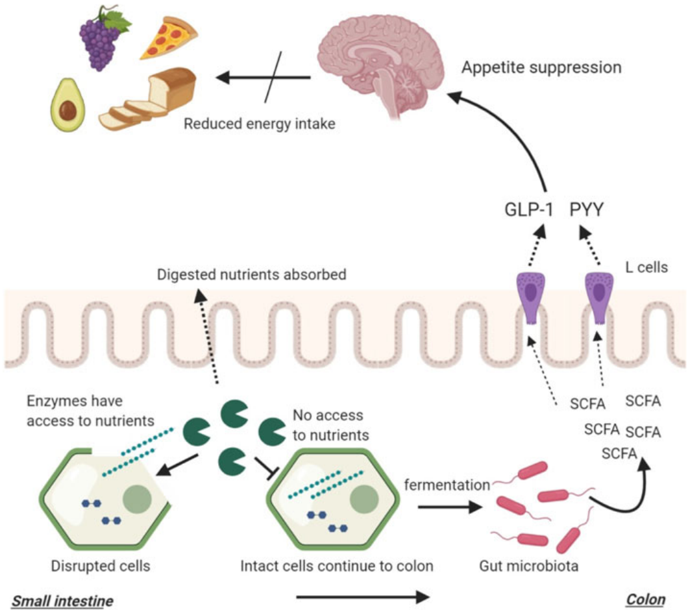
Epidemiological and clinical evidence highlight the benefit of dietary fibre consumption on body weight. This benefit is partly attributed to the interaction of dietary fibre with the gut microbiota. Dietary fibre possesses a complex food structure which resists digestion in the upper gut and therefore reaches the distal gut where it becomes available for bacterial fermentation. This process yields SCFA which stimulate the release of appetite-suppressing hormones glucagon-like peptide-1 and peptide YY. Food structures can further enhance the delivery of fermentable substrates to the distal gut by protecting the intracellular nutrients during upper gastrointestinal digestion. Domestic and industrial processing can disturb these food structures that act like barriers towards digestive enzymes. This leads to more digestible products that are better absorbed in the upper gut. As a result, less resistant material (fibre) and intracellular nutrients may reach the distal gut, thus reducing substrates for bacterial fermentation and its subsequent benefits on the host metabolism including appetite suppression. Understanding this link is essential for the design of diets and food products that can promote appetite suppression and act as a successful strategy towards obesity management. This article reviews the current evidence in the interplay between food structure, bacterial fermentation and appetite control.
Overview
The claims and statistics of this paper haven’t been checked yet.
Free: it reads the open-access text and checks the first 5 claims that cite a source we can check. Create a free account to check every claim.
Integrity signals
Registry
Cites
Statistics
Figures
Verification
Claims the paper makes
The claims and statistics of this paper haven’t been checked yet.
Free: it reads the open-access text and checks the first 5 claims that cite a source we can check. Create a free account to check every claim.
Claims other papers make about this one
Each is checked against this paper’s own text: does it say what the citing paper says it does?
In the citing paper
“SCFAs may act as substrates in several tissues for GPCRs, stimulating GLP-1 and PYY release, delaying gastric emptying and reducing appetite and food intake [227,232,233].”
From Impact of Protein Intake in Older Adults with Sarcopenia and Obesity: A Gut Microbiota Perspective (2020) · cites this paper as [232]
Self-check
Percentages, sums and reported differences re-computed from the paper’s own numbers.
The self-check needs the paper’s full text.
Citations
Cites
An obesity-associated gut microbiome with increased capacity for energy harvest
Turnbaugh, P. J., Ley, R. E., Mahowald, M. A., Magrini, V., Mardis, E. R., & Gordon, J. I. (2006) · Nature · doi:10.1038/nature05414 · Cited by 12,444 · cited 2×
“40 chews) resulted in higher postprandial GLP-1 concentrations and reduced ad libitum energy intake in obese and lean subjects((148)).”
A human gut microbial gene catalogue established by metagenomic sequencing
MetaHIT Consortium, Qin, J., Li, R., Raes, J., Arumugam, M., Burgdorf, K. S., Manichanh, C., Nielsen, T., Pons, N., Levenez, F., et al. (2010) · Nature · doi:10.1038/nature08821 · Cited by 11,624 · cited 3×
“Although shared by a number of phyla, Bacteroidetes dominates the propionate producers((137,144,149)).”
Diet rapidly and reproducibly alters the human gut microbiome
David, L. A., Maurice, C. F., Carmody, R. N., Gootenberg, D. B., Button, J. E., Wolfe, B. E., Ling, A. V., Devlin, A. S., Varma, Y., Fischbach, M. A., et al. (2014) · Nature · doi:10.1038/nature12820 · Cited by 10,100 · cited 5×
“High-fi bre diets increase SCFA production and increase gut microbiota diversity (155, 157 – 161) .”
InfluentialHuman gut microbes associated with obesity
Ley, R. E., Turnbaugh, P. J., Klein, S., & Gordon, J. I. (2006) · Nature · doi:10.1038/4441022a · Cited by 8,785
Enterotypes of the human gut microbiome
MetaHIT Consortium (additional members), Arumugam, M., Raes, J., Pelletier, E., Le Paslier, D., Yamada, T., Mende, D. R., Fernandes, G. R., Tap, J., Bruls, T., et al. (2011) · Nature · doi:10.1038/nature09944 · Cited by 7,548 · cited 1×
“The human gut microbiota is dominated by six bacterial phyla: Bacteroidetes , Firmicutes , Proteobacteria , Verrucomicrobia , Fusobacteria and Actinobacteria , with the Bacteroidetes and Firmicutes making up about 90 % of the whole community (136,137) .”
Linking long-term dietary patterns with gut microbial enterotypes
Wu, G. D., Chen, J., Hoffmann, C., Bittinger, K., Chen, Y.-Y., Keilbaugh, S. A., Bewtra, M., Knights, D., Walters, W. A., Knight, R., et al. (2011) · Science · doi:10.1126/science.1208344 · Cited by 6,513 · cited 2×
“Conversely, western-style low-fi bre, high-protein/fat diets lowered bacterial fermentation, reduced bacterial diversity and increased the numbers of Bacteroidetes (154,155,161,166) .”
Central nervous system control of food intake
Schwartz, M. W., Woods, S. C., Porte, D., Seeley, R. J., & Baskin, D. G. (2000) · Nature · doi:10.1038/35007534 · Cited by 6,451 · cited 2×
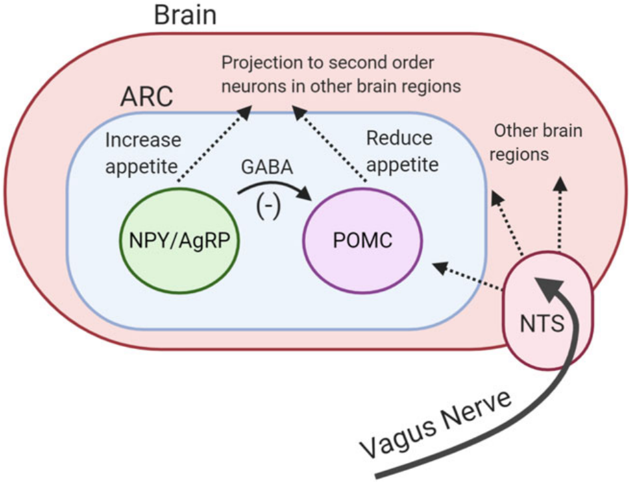
“The ARC contains two functionally opposing types of neurones involved in the regulation of energy balance: anor-exigenic pro-opiomelanocortin (POMC) neurones and orexigenic neuropeptide Y (NPY)/agouti-related peptide (AgRP) neurones (44) .”
Obesity alters gut microbial ecology
Ley, R. E., Bäckhed, F., Turnbaugh, P., Lozupone, C. A., Knight, R. D., & Gordon, J. I. (2005) · Proceedings of the National Academy of Sciences · doi:10.1073/pnas.0504978102 · Cited by 6,176 · cited 1×
“Differences have been observed between the gut microbial composition of lean and obese subjects, highlighting the potential impact of gut microbiota on body weight (167 – 169) .”
Revised Estimates for the Number of Human and Bacteria Cells in the Body
Sender, R., Fuchs, S., & Milo, R. (2016) · PLOS Biology · doi:10.1371/journal.pbio.1002533 · Cited by 5,425 · cited 8×
“PYY (1-36) is released from L-cells and cleaved by dipeptidyl peptidase IV to form PYY (3-36).”
InfluentialEffects of Bariatric Surgery on Mortality in Swedish Obese Subjects
Sjöström, L., Narbro, K., Sjöström, C. D., Karason, K., Larsson, B., Wedel, H., Lystig, T., Sullivan, M., Bouchard, C., Carlsson, B., et al. (2007) · New England Journal of Medicine · doi:10.1056/nejmoa066254 · Cited by 4,668 · cited 9×
“The most effective weight loss strategy remains as bariatric surgery, which is an invasive procedure that may lead to undesirable side effects such as dumping syndrome and nutritional deficiencies((8,13,14)).”
Influential
Research works printed but not linked: 3
- Institute of Medicine (US) Panel on the Definition of Dietary Fiber and the Standing Committee on the Scientific Evaluation of Dietary Reference Intakes (2001) Dietary Reference Intakes Proposed Definition of Dietary Fiber, pp. 2-12. Washington (DC): National Academies Press (US).
- Standards ANZF. Labelling Review Recommendation 14 -Supporting Document 1. Available at: https://www.food standards.gov.au/consumer/labelling/review/Documents/ Labelling%20review%20recommendation%2014%20-% 20supporting%20document%201.pdf (accessed February 2020).
- Berg, 2002, Biochemistry
Cited by
Hamano, S., Sawada, M., Aihara, M., Sakurai, Y., Sekine, R., Usami, S., Kubota, N., & Yamauchi, T. (2024) · Diabetes, Obesity and Metabolism · doi:10.1111/dom.15922 · Cited by 124
“31 However, there is limited scientific evidence confirming a relationship between consumption of UPFs and the blood levels of appetite-related hormones, and further research is warranted to support this contention.”
Impact of Protein Intake in Older Adults with Sarcopenia and Obesity: A Gut Microbiota Perspective
Prokopidis, K., Cervo, M. M., Gandham, A., & Scott, D. (2020) · Nutrients · doi:10.3390/nu12082285 · Cited by 99
“SCFAs may act as substrates in several tissues for GPCRs, stimulating GLP-1 and PYY release, delaying gastric emptying and reducing appetite and food intake [227,232,233].”
BackgroundDissecting ultra-processed foods and drinks: Do they have a potential to impact the brain?
Contreras‐Rodríguez, O., Solanas, M., & Escorihuela, R. M. (2022) · Reviews in Endocrine and Metabolic Disorders · doi:10.1007/s11154-022-09711-2 · Cited by 83
“Oral signals derived from the taste and texture properties of foods play a role in early, pre-absorptive phases of food ingestion and feedback the brain, modulating satiety and, consequently, food intake [47, 48].”
BackgroundZhang, Y., Li, Y., Xia, Q., Liu, L., Wu, Z., & Pan, D. (2021) · Critical Reviews in Food Science and Nutrition · doi:10.1080/10408398.2021.1995842 · Cited by 78
Cai, M., Dou, B., Pugh, J. E., Lett, A. M., & Frost, G. S. (2021) · The American Journal of Clinical Nutrition · doi:10.1093/ajcn/nqab098 · Cited by 72
“Food structure and appetite regulation It has been suggested that food structure can affect appetite control (16).”
BackgroundInfluentialSelf-citationDietary polyphenols regulate appetite mechanism via gut-brain axis and gut homeostasis
Liu, H., Guo, X., Jiang, K., Shi, B., Liu, L., Hou, R., Chen, G., Farag, M. A., Yan, N., & Liu, L. (2024) · Food Chemistry · doi:10.1016/j.foodchem.2024.138739 · Cited by 60
Bajka, B. H., Pinto, A. M., Pérez‐Moral, N., Saha, S., Ryden, P., Ahn‐Jarvis, J. H., van der Schoot, A., Bland, C., Berry, S. E., Ellis, P. R., et al. (2022) · American Journal of Clinical Nutrition · doi:10.1016/j.ajcnut.2022.12.008 · Cited by 53
Kiosia, A., Dagbasi, A., Berkley, J. A., Wilding, J. P. H., Prendergast, A. J., Li, J. V., Swann, J., Mathers, J. C., Kerac, M., Morrison, D., et al. (2024) · Nutrition Bulletin · doi:10.1111/nbu.12670 · Cited by 43
“Accordingly, diets high in fibre that increase fermentation and SCFA production have been associated with lower bodyweights (Dagbasi et al., 2020).”
Self-citationNutrient sensing of gut luminal environment
Moran, A. W., Daly, K., Al-Rammahi, M. A., & Shirazi‐Beechey, S. P. (2020) · Proceedings of The Nutrition Society · doi:10.1017/s0029665120007120 · Cited by 45
Dietary fiber during gestation improves lactational feed intake of sows by modulating gut microbiota
Li, S., Zheng, J., He, J., Liu, H., Huang, Y., Huang, L., Wang, K., Zhao, X., Feng, B., Che, L., et al. (2023) · Journal of Animal Science and Biotechnology/Journal of animal science and biotechnology · doi:10.1186/s40104-023-00870-z · Cited by 45
“The growth and proliferation of the gut microbiota depend on the feed intake of the host as a source of energy [9].”
BackgroundPälchen, K., Bredie, W. L. P., Duijsens, D., Castillo, A. I. A., Hendrickx, M., Loey, A. M. V., Raben, A., & Grauwet, T. (2022) · Food Research International · doi:10.1016/j.foodres.2022.111245 · Cited by 40
Diotallevi, C., Fava, F., Gobbetti, M., & Tuohy, K. M. (2020) · Current Opinion in Clinical Nutrition & Metabolic Care · doi:10.1097/mco.0000000000000697 · Cited by 43
Fardet, A., & Rock, E. (2020) · Critical Reviews in Food Science and Nutrition · doi:10.1080/10408398.2020.1858751 · Cited by 41
“Thirdly, industrial processing, through disturbing food structures, may also lead to both higher nutrient absorption and less substrates for bacterial fermentation, with potentially reduced “subsequent benefits on the host metabolism including appetite suppression” (Dagbasi et al. 2020).”
BackgroundCai, M., Tejpal, S., Tashkova, M., Ryden, P., Pérez‐Moral, N., Saha, S., García‐Pérez, I., Serrano-Contreras, J. I., Wist, J., Holmes, E. C., et al. (2025) · Nature Metabolism · doi:10.1038/s42255-025-01309-7 · Cited by 36
“Food structure has been hypothesized to impact gut hormone secretion through modulating the amount of nutrients arriving in the distal intestine 5 .”
Self-citationAres, G., Alcaire, F., Gugliucci, V., Machín, L., de León, C., Natero, V., & Otterbring, T. (2023) · European Journal of Marketing · doi:10.1108/ejm-12-2022-0899 · Cited by 32
Gugliucci, V., Machín, L., Alcaire, F., Otterbring, T., de León, C., Natero, V., & Ares, G. (2022) · Appetite · doi:10.1016/j.appet.2022.106393 · Cited by 26
Suthar, P., Kumar, S., Kumar, V., Sharma, V., & Dhiman, A. (2023) · Critical Reviews in Food Science and Nutrition · doi:10.1080/10408398.2023.2289646 · Cited by 26
“…that the administration of SCFAs is effective in the gut barrier integrity, energy intake and energy use, regulation of blood pressure, mediate immune system and modulate glucose and lipid metabolism (Nogal, Valdes, and Menni 2021; Kaczmarczyk et al. 2021; Dagbasi et al. 2020; Parekh et al. 2014).”
Zhang, F., Zhou, G., Schewe, M., Kulling, S. E., Ding, Y., Mozaffarian, D., & Zuo, T. (2025) · Cell Metabolism · doi:10.1016/j.cmet.2025.09.013 · Cited by 24
Diet shapes the metabolite profile in the intact human ileum, which affects PYY release
Dagbasi, A., Byrne, C., Blunt, D. M., Serrano-Contreras, J. I., Becker, G. F., Blanco, J. M., Camuzeaux, S., Chambers, E. S., Danckert, N. P., Edwards, C. H., et al. (2024) · Science Translational Medicine · doi:10.1126/scitranslmed.adm8132 · Cited by 21
“It may therefore be an important determinant of appetite control ( 5 ).”
BackgroundSelf-citationPuhlmann, M.-L., Jokela, R., van Dongen, K. C. W., Bui, T. P. N., Hangelbroek, R., Smidt, H., de Vos, W. M., & Feskens, E. J. M. (2022) · Gut Microbiome · doi:10.1017/gmb.2022.4 · Cited by 20
“Therefore, we hypothesise that dried chicory root fermentation was shifted towards a more distal location leading to a higher recovery of faecal SCFA as compared to purified ITF (Dagbasi et al., 2020; Hansen and Sams, 2018).”
BackgroundAlcaire, F., Giménez, A., & Ares, G. (2024) · Food Research International · doi:10.1016/j.foodres.2024.114721 · Cited by 21
Effect of Nuts on Gastrointestinal Health
Mandalari, G., Gervasi, T., Rosenberg, D. W., Lapsley, K. G., & Baer, D. J. (2023) · Nutrients · doi:10.3390/nu15071733 · Cited by 22
“Since nuts resist digestion in the upper GI tract, their cellular structure retains intact lipids and polymerized polyphenols and plays a key role in how they are metabolized by gut microbiota in the colon to form bioactive molecules which could benefit human health [3].”
BackgroundAguilera, J. M. (2024) · Trends in Food Science & Technology · doi:10.1016/j.tifs.2024.104459 · Cited by 18
Qi, R., Zhang, B., Qiu, X., Liu, X., Bao, S., Wang, J., Wang, Q., Yang, Y., Yang, H., & Liu, Z. (2024) · The FASEB Journal · doi:10.1096/fj.202401360r · Cited by 16
“23 The results of our study demonstrated that ABX treatment resulted in the elimination of over 90% of the gut microbiota, with only a minor bacterial population remaining.”
Stefura, T., Zapała, B., Gosiewski, T., Krzysztofik, M., Skomarovska, O., & Major, P. (2021) · Surgery for Obesity and Related Diseases · doi:10.1016/j.soard.2021.01.011 · Cited by 16
Duodenal Mucosa: A New Target for the Treatment of Type 2 Diabetes
Nie, L., Yan, Q., Zhang, S., Cao, Y., & Zhou, X. (2022) · Endocrine Practice · doi:10.1016/j.eprac.2022.10.177 · Cited by 12
How important is food structure when cats eat mice?
D’Hooghe, S. M.-T. J., Bosch, G., Sun, M., Cools, A., Hendriks, W. H., Becker, A. A. M. J., & Janssens, G. P. J. (2024) · British Journal of Nutrition · doi:10.1017/s0007114523002039 · Cited by 9
“Original count data were used after filtering rows with fewer than five counts over the entire row and using the parametric Wald test in DESeq2 with alpha = 0 · 01. propionic acid production resulting from carbohydrate and protein fermentation is comparable, but total SCFA, acetic acid and butyric acid production is l…”
BackgroundInfluentialDagbasi, A., Cai, M., Hirdaramani, A., Hanyaloglu, A. C., Morrison, D. J., & Frost, G. S. (2026) · Nature Metabolism · doi:10.1038/s42255-026-01579-9 · Cited by 11
“The ileum contains a modest and dynamic microbiota, partly of oral origin, capable of producing SCFAs in both fasted and fed states 36 .”
InfluentialSelf-citationSarcopenic Obesity: The Underlying Molecular Pathophysiology and Prospect Therapies
Meiliana, A., Dewi, N. M., Defi, I. R., Rosdianto, A. M., Qiantori, A. A., & Wijaya, A. (2024) · The Indonesian Biomedical Journal · doi:10.18585/inabj.v16i4.3176 · Cited by 7
“( 161,166,167) Propionate, on the other hand, has been demonstrated to reduce reward-based eating through striatal pathways.”
BackgroundDeterminantes fisiológicos y ambientales de la regulación del control de la ingesta de alimentos
Bogotá, M. A. F., & Leguizamón, M. G. (2021) · Revista de Nutrición Clínica y Metabolismo · doi:10.35454/rncm.v4n1.170 · Cited by 12
“Una de estas características es la regulación hormonal a través del consumo de fibra dietética, al favorecer la producción de ácidos grasos de cadena media, los cuales estimulan la producción de hormonas supresoras del apetito, como el GLP 1 y el PYY (38) .”
InfluentialKumar, P. P., Wang, Y., & Yao, T. (2026) · Discover Endocrinology and Metabolism · doi:10.1007/s44417-026-00021-8 · Cited by 4
Yakubu, A. H., Platts, K., Sorsby, A. C., Clegg, M., & Paxman, J. R. (2023) · Journal of Functional Foods · doi:10.1016/j.jff.2023.105471 · Cited by 4
Malamatenios, O., Campbell, J. L., Schofield, G., & Zinn, C. (2024) · Nutrients · doi:10.3390/nu16040536 · Cited by 5
Venable, E. M., & Carmody, R. N. (2024) · Frontiers in Food Science and Technology · doi:10.3389/frfst.2024.1469470 · Cited by 4
Dietary fiber: Physiological effects and health outcomes
Johnson, I. T. (2021) · Elsevier eBooks · doi:10.1016/b978-0-12-821848-8.00038-x · Cited by 4
Li, S., Zheng, J., Yang, Z., He, J., Liu, H., Zhong, W., Huang, Y., Li, Z., Yang, M., Zhao, X., et al. (2025) · Animal nutrition · doi:10.1016/j.aninu.2025.03.021 · Cited by 3
“The growth and reproduction of the gut microbiota depend on the host's dietary intake as a source of energy (Dagbasi et al., 2020).”
Ares, G., Alcaire, F., Natero, V., Curutchet, M. R., & Giménez, A. (2025) · Food Research International · doi:10.1016/j.foodres.2025.117417 · Cited by 3
From Skin to Gut: Understanding Microbial Diversity in Rana amurensis and R. dybowskii
Yang, M., Liu, H., Wang, H., Lu, Z.-N., Han, X.-Y., Luo, Z., Wu, L., & Tong, Q. (2024) · Current Microbiology · doi:10.1007/s00284-024-03868-6 · Cited by 3
“The structure and function of the digestive system (e.g., the length and conditions of the gut) influence the fermentation time and environment for bacteria [15].”
Hernandez, M. G. R., Beauséjour, M., Wolodko, J., & Gänzle, M. G. (2026) · Advances in food and nutrition research · doi:10.1016/bs.afnr.2026.04.002 · Cited by 2
A Method to Include Animal Fibre in Dietary Fibre Analysis
D'Hooghe, S. M. J., Saravia, A. M., Cools, A., Cuyper, A. D., Vanhauteghem, D., Hendriks, W. H., Bosch, G., & Janssens, G. (2025) · Journal of Animal Physiology and Animal Nutrition · doi:10.1111/jpn.70020 · Cited by 1
Zulfiqar, Z., Asif, M. A., Al-Mitib, L., Ashiq, N., Wang, H. B., Cui, Y., Liu, B., Huang, S., & Shi, Y. (2026) · Animal Research and One Health · doi:10.1002/aro2.70081 · Cited by 1
Zhao, Y., Wang, Y., Zhang, D., Wang, Z., Tan, B., Wei, X., & Wan, X. (2026) · Food Bioscience · doi:10.1016/j.fbio.2026.109301 · Cited by 1
刘, 晓. (2025) · Advances in Clinical Medicine · doi:10.12677/acm.2025.15102849
Impact of ultra-processed food consumption on diet quality and risk of overweight
Fedde, S. (2025) · MACAU: Open Access Repository of Kiel University (University Library Kiel)
Anais do VI Congresso Internacional em Ciências da Saúde Única - Resumos Expandidos
Fernandes, A. P., Barbosa, F. P. D. S., & de Fontes-Junior, A. A. (2026) · doi:10.62642/tec-978-65-83199-39-3
Pereira, F. (2023) · Tuwhera (Auckland University of Technology)
Metadata
- Authors
- Dagbasi, A., Lett, A. M., Murphy, K., & Frost, G.
- Affiliations
- Hammersmith Hospital (GB)
- Corresponding author
- Dagbasi, A.
- Venue
- Proceedings of the Nutrition Society
- Publisher
- Cambridge University Press (CUP)
- Published
- 2020-05-08
- Volume
- 79
- Issue
- 4
- Pages
- 514-530
- ISSN
- 0029-6651 (ISSN-L)
- 1475-2719
- OpenAlex
- W3020966734
- Cited by
- 44
- References
- 215
- Citations by year
- 2026: 5 · 2025: 6 · 2024: 11 · 2023: 6 · 2022: 6 · 2021: 6 · 2020: 4
- FWCI
- 3.48
- Type
- journal article
- Language
- en
- Open access
- hybrid
- doi.org
- Locations
- Proceedings of The Nutrition Society (publishedVersion, cc-by)
- PubMed (publishedVersion)
- Spiral (Imperial College London) (submittedVersion, cc-by)
- Funders
- National Institute for Health and Care Research (NF-SI-0508-10112)
- Imperial College London
- Imperial College Healthcare NHS Trust
- Nestec
- Directorate for Biological Sciences
- Medical Research Council
- Biotechnology and Biological Sciences Research Council (BBS/E/F/000PR10346, BB/H004971/1, BB/N016947/1, BBS/E/F/000PR10345)
- Topics
- Health Sciences › Nursing › Nutrition and Dietetics › Food composition and properties
- Life Sciences › Biochemistry, Genetics and Molecular Biology › Molecular Biology › Gut microbiota and health
- Health Sciences › Nursing › Nutrition and Dietetics › Microbial Metabolites in Food Biotechnology
- Keywords
- dietary fiber, food structure, gut microbiota, bacterial fermentation, short-chain fatty acids, appetite regulation, glucagon-like peptide-1, peptide YY, obesity treatment, food processing, body weight
About these checks
Registry, retraction, Cites and statistics results are computed, not judged, with one exception: a printed reference that no index lists is read once by a model before it counts as a citation error. Claims are extracted by a model and kept only when their quote appears verbatim in the text; each cited source is then checked, with a model’s help, for whether it says what the claim relies on. Those verdicts can be wrong — read the claim’s quote and the cited source before relying on one.
Statistics and arithmetic are recomputed, not judged.
Confidence bands are shown only for fields calibrated on our annotated test set. None is calibrated yet, so no band is shown.
What counts as a claim ›How we measure confidence ›How we check this ›
Are you an author, or do you see a problem with this page? Request a review
Data sources
Bibliographic data: Semantic Scholar, OpenAlex, Crossref.
Contains information from the Semantic Scholar Academic Graph Datasets, made available under the ODC Attribution License (ODC-BY 1.0).
Semantic Scholar’s data is described in: Kinney, R., et al. (2023). The Semantic Scholar Open Data Platform. arXiv:2301.10140.
