

The DOI matches its Crossref record; 53 of the 55 references it cites were found in a registry or an index.
Internet-based cognitive behaviour therapy for obsessive–compulsive disorder: a randomized controlled trial
Open accessAbstract
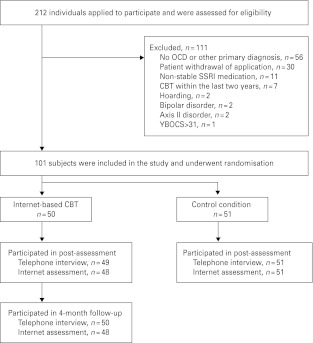
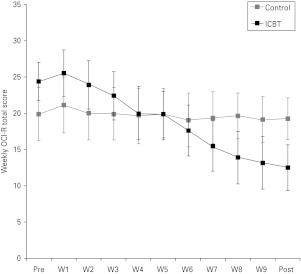
Background: Cognitive behaviour therapy (CBT) is an effective treatment for obsessive–compulsive disorder (OCD) but access to CBT is limited. Internet-based CBT (ICBT) with therapist support is potentially a more accessible treatment. There are no randomized controlled trials testing ICBT for OCD. The aim of this study was to investigate the efficacy of ICBT for OCD in a randomized controlled trial. Method: Participants (n=101) diagnosed with OCD were randomized to either 10 weeks of ICBT or to an attention control condition, consisting of online supportive therapy. The primary outcome measure was the Yale–Brown Obsessive Compulsive Scale (YBOCS) administered by blinded assessors. Results: Both treatments lead to significant improvements in OCD symptoms, but ICBT resulted in larger improvements than the control condition on the YBOCS, with a significant between-group effect size (Cohen's d) of 1.12 (95% CI 0.69–1.53) at post-treatment. The proportion of participants showing clinically significant improvement was 60% (95% CI 46–72) in the ICBT group compared to 6% (95% CI 1–17) in the control condition. The results were sustained at follow-up. Conclusions: ICBT is an efficacious treatment for OCD that could substantially increase access to CBT for OCD patients. Replication studies are warranted.
Overview
The claims and statistics of this paper haven’t been checked yet.
Run the check — free, no account needed. It reads the open-access text and checks the sources it cites.
Integrity signals
Registry
Cites
Statistics
Figures
Verification
Claims the paper makes
The claims and statistics of this paper haven’t been checked yet.
Run the check — free, no account needed. It reads the open-access text and checks the sources it cites.
Claims other papers make about this one
Each is checked against this paper’s own text: does it say what the citing paper says it does?
The source backs part of the claim, not all of it — or backs it for a different population, condition or comparison.
In the citing paper
“The iCBT condition was associated with a significant reduction in OCD symptoms (d = 1.55) as measured by the Yale Brown Obsessive Compulsive Scale (YBOCS; [44]), compared to a medium within-group effect size (d = 0.47) for the Control Group.”
From Study protocol for a randomised controlled trial of internet-based cognitive-behavioural therapy for obsessive-compulsive disorder (2014) · cites this paper as [43]
Experimental — accuracy not yet measuredThe cited source says what the claim attributes to it.
In the citing paper
“Different studies found that internet-based delivery of exposure with response prevention leads to a clinical significant decrease in symptoms [11–13].”
The cited source says what the claim attributes to it.
In the citing paper
“in-person treatment protocols for other psychiatric disorders have previously been translated to therapist-guided digital formats and successfully been evaluated in several trials (Carlbring et al., 2005; Andersson et al., 2012)”
From Internet-delivered acceptance-based behavior therapy for trichotillomania and skin-picking disorder in a psychiatric setting: A feasibility trial (2022) · cites this paper as Andersson et al., 2012
The cited source says what the claim attributes to it.
In the citing paper
“Additionally, there was a large between between-group effect size (d = 1.12) on the YBOCS, and only 6% participants in the control condition met criteria for clinically significant change, compared with 60% in iCBT.”
From Study protocol for a randomised controlled trial of internet-based cognitive-behavioural therapy for obsessive-compulsive disorder (2014) · cites this paper as [43]
The cited source says what the claim attributes to it.
In the citing paper
“Although therapist contact in the control group was significantly lower than iCBT (129 minutes versus 17 minutes for iCBT and control, respectively), the between groups difference remained significant after therapist contact was statistically controlled.”
From Study protocol for a randomised controlled trial of internet-based cognitive-behavioural therapy for obsessive-compulsive disorder (2014) · cites this paper as [43]
The cited source says what the claim attributes to it.
In the citing paper
“The results of iCBT were maintained at 4-month follow up.”
From Study protocol for a randomised controlled trial of internet-based cognitive-behavioural therapy for obsessive-compulsive disorder (2014) · cites this paper as [43]
The cited source says what the claim attributes to it.
In the citing paper
“Nevertheless the specific effect of iCBT is unclear, as the control condition did not provide intervention elements that were experienced as similar to the active treatment (e.g., online self-help information, downloadable audio files, worksheets and homework).”
From Study protocol for a randomised controlled trial of internet-based cognitive-behavioural therapy for obsessive-compulsive disorder (2014) · cites this paper as [43]
Self-check
Percentages, sums and reported differences re-computed from the paper’s own numbers.
The self-check needs the paper’s full text.
Citations
Cites
(1998) · The Journal of Clinical Psychiatry · Cited by 19,139
SAUNDERS, J. B., AASLAND, O. G., BABOR, T. F., DE LA FUENTE, J. R., & GRANT, M. (1993) · Addiction · doi:10.1111/j.1360-0443.1993.tb02093.x · Cited by 13,597 · cited 1×
“2002), Montgomery–Åsberg Depression Rating Scale – Self-report (MADRS-S ; Svanborg & Åsberg, 1994), Alcohol Use Disorders Identification Test (AUDIT; Saunders et al. 1993), and the Drug Use Disorders Identification Test (DUDIT; Berman et al.”
Kessler, R. C., Chiu, W. T., Demler, O., & Walters, E. E. (2005) · Archives of General Psychiatry · doi:10.1001/archpsyc.62.6.617 · Cited by 12,052
(1998) · PubMed · Cited by 10,216
Jacobson, N. S., & Truax, P. (1991) · Journal of Consulting and Clinical Psychology · doi:10.1037/0022-006x.59.1.12 · Cited by 7,770
The Yale-Brown Obsessive Compulsive Scale: I. Development, Use, and Reliability
Goodman, W. K. (1989) · Archives of General Psychiatry · doi:10.1001/archpsyc.1989.01810110048007 · Cited by 7,712
The mini international neuropsychiatric interview
Lecrubier, Y., Sheehan, D. V., Hergueta, T., & Weiller, E. (1998) · European Psychiatry · doi:10.1016/s0924-9338(99)80239-9 · Cited by 5,899
Diagnostic and Statistical Manual of Mental Disorders ( DSM ‐ IV ‐ TR )
Segal, D. L. (2010) · Wiley eBooks · doi:10.1002/9780470479216.corpsy0271 · Cited by 4,687
The Obsessive-Compulsive Inventory: Development and validation of a short version.
Foa, E. B., Huppert, J. D., Leiberg, S., Langner, R., Kichic, R., Hajcak, G., & Salkovskis, P. M. (2002) · Psychological Assessment · doi:10.1037/1040-3590.14.4.485 · Cited by 2,959
Guy, W. L. (2025) · Springer Reference Medizin · doi:10.1007/978-3-662-65186-5_300379 · Cited by 1,441
Research works printed but not linked: 1
- First, 1999, Structured Clinical Interview for DSM-IV Axis I Disorders (SCID-I) (Swedish Version)
Cited by
Sorted by citations
Items 101–200 of 274
Gershkovich, M., Middleton, R., Hezel, D. M., Grimaldi, S. J., Renna, M. E., Basaraba, C. N., Patel, S. R., & Simpson, H. B. (2020) · Behavior Therapy · doi:10.1016/j.beth.2020.05.001 · Cited by 27
Internet administration of the Dimensional Obsessive-Compulsive Scale: a psychometric evaluation
Enander, J., Andersson, E., Kaldo, V., Lindefors, N., Andersson, G., & Rück, C. (2012) · Journal of Obsessive-Compulsive and Related Disorders · doi:10.1016/j.jocrd.2012.07.008 · Cited by 27
Self-citationManagement of Treatment-Resistant Obsessive-Compulsive Disorder
Gershkovich, M., Wheaton, M. G., & Simpson, H. B. (2017) · Current Treatment Options in Psychiatry · doi:10.1007/s40501-017-0127-8 · Cited by 29
Innovations in the delivery of exposure and response prevention for obsessive-compulsive disorder
Patel, S. R., Comer, J., & Simpson, H. B. (2021) · Current Topics in Behavioral Neurosciences · doi:10.1007/7854_2020_202 · Cited by 24
McDonald, S., Melkonian, M., Karin, E., Dear, B. F., Titov, N., & Wootton, B. M. (2023) · Behavioural and Cognitive Psychotherapy · doi:10.1017/s1352465823000103 · Cited by 28
Wheaton, M. G., Patel, S. R., Andersson, E., Rück, C., & Simpson, H. B. (2020) · Behavior Therapy · doi:10.1016/j.beth.2020.02.003 · Cited by 25
Self-citationMataix‐Cols, D., Andersson, E., Aspvall, K., Boberg, J., Crowley, J. J., de Schipper, E. J., de la Cruz, L. F., Flygare, O., Ivanova, E., Lenhard, F., et al. (2022) · Psychotherapy and Psychosomatics · doi:10.1159/000527115 · Cited by 26
Self-citationAdvances in the Cognitive Behavioural Treatment of Obsessive Compulsive Disorder
Shafran, R., Radomsky, A. S., Coughtrey, A. E., & Rachman, S. (2013) · Cognitive Behaviour Therapy · doi:10.1080/16506073.2013.773061 · Cited by 26
Asplund, M., Lenhard, F., Andersson, E., & Ivanov, V. Z. (2022) · Internet Interventions · doi:10.1016/j.invent.2022.100573 · Cited by 25
Self-citationLuu, J., Millard, M., Newby, J. M., Haskelberg, H., Hobbs, M. J., & Mahoney, A. (2020) · Journal of Obsessive-Compulsive and Related Disorders · doi:10.1016/j.jocrd.2020.100561 · Cited by 27
Wootton, B. M., Karin, E., Dear, B. F., Staples, L., Nielssen, O. B., Kayrouz, R., & Titov, N. (2021) · Journal of Anxiety Disorders · doi:10.1016/j.janxdis.2021.102444 · Cited by 27
Matsumoto, K., Hamatani, S., Makino, T., Takahashi, J., Suzuki, F., Ida, T., Hamamura, S., Takiguchi, S., Tomoda, A., Omori, I. M., et al. (2022) · Internet Interventions · doi:10.1016/j.invent.2022.100515 · Cited by 26
Jalal, B., Chamberlain, S. R., Robbins, T. W., & Sahakian, B. J. (2022) · CNS Spectrums · doi:10.1017/s1092852920001947 · Cited by 24
Emerging drugs to treat obsessive–compulsive disorder
Pallanti, S., Grassi, G., & Cantisani, A. (2013) · Expert Opinion on Emerging Drugs · doi:10.1517/14728214.2014.875157 · Cited by 23
Launes, G., Hagen, K., Öst, L., Solem, S., Hansen, B. K. A., & Kvale, G. (2020) · Frontiers in Psychology · doi:10.3389/fpsyg.2020.00982 · Cited by 24
Internet-Based Cognitive Behavior Therapy
Andersson, G., Carlbring, P., & Hadjistavropoulos, H. D. (2017) · Elsevier eBooks · doi:10.1016/b978-0-12-803457-6.00021-0 · Cited by 26
Self-citationAspvall, K., Lenhard, F., Melin, K., Krebs, G., Norlin, L., Näsström, K., Jassi, A. D., Turner, C. M., Knoetze, E., Serlachius, E., et al. (2020) · Internet Interventions · doi:10.1016/j.invent.2020.100308 · Cited by 23
Self-citationGellatly, J. L., Pedley, R., Molloy, C., Butler, J. A., Lovell, K., & Bee, P. (2017) · BMC Psychiatry · doi:10.1186/s12888-017-1238-x · Cited by 24
Hiranandani, S., Ipek, S. I., Wilhelm, S., & Greenberg, J. L. (2023) · Journal of Obsessive-Compulsive and Related Disorders · doi:10.1016/j.jocrd.2022.100765 · Cited by 24
Polak, M., & Tanzer, N. K. (2024) · Clinical Psychology & Psychotherapy · doi:10.1002/cpp.2989 · Cited by 22
Zhang, W., Yang, W., Ruan, H., Gao, J. P., & Wang, Z. (2023) · Journal of Psychiatric Research · doi:10.1016/j.jpsychires.2023.10.025 · Cited by 21
Pozza, A., Andersson, G., Antonelli, P., & Dèttore, D. (2014) · Cognitive Behaviour Therapy · doi:10.1017/s1754470x1400021x · Cited by 20
Self-citationThe impact of phone calls on follow-up rates in an online depression prevention study
Muñoz, R. F., Leykin, Y., Barrera, A. Z., Brown, C. H., & Bunge, E. L. (2017) · Internet Interventions · doi:10.1016/j.invent.2017.02.001 · Cited by 20
Moritz, S., Hauschildt, M., Murray, S. C., Pedersen, A., Krausz, M., & Jelinek, L. (2018) · Journal of Obsessive-Compulsive and Related Disorders · doi:10.1016/j.jocrd.2017.12.009 · Cited by 18
Internet- und Mobilebasierte Interventionen in der Psychotherapie
Lin, J., & Baumeister, H. (2015) · Public Health Forum · doi:10.1515/pubhef-2015-0063 · Cited by 19
Wu, Y., Li, X., Zhou, Y., Gao, R., Wang, K., Ye, H., Lyu, N., Wang, C., Zhang, N., Wang, Z., et al. (2023) · Journal of Medical Internet Research · doi:10.2196/41283 · Cited by 20
New Methods of Service Delivery for Children's Mental Health Care
Comer, J. S., Elkins, R. M., Chan, P. T., & Jones, D. J. (2014) · Wiley eBooks · doi:10.1002/9781394259359.ch5 · Cited by 18
Vernmark, K., Buhrman, M., Carlbring, P., Hedman‐Lagerlöf, E., Kaldo, V., & Andersson, G. (2024) · Digital Health · doi:10.1177/20552076241287059 · Cited by 19
Self-citationLi, I., Millard, M., Haskelberg, H., Hobbs, M. J., Luu, J., & Mahoney, A. (2021) · Behavioural and Cognitive Psychotherapy · doi:10.1017/s1352465821000448 · Cited by 17
Kheirkhah, F., Faramarzi, M., Shafierizi, S., Chehrazi, M., & Basirat, Z. (2023) · Heliyon · doi:10.1016/j.heliyon.2023.e15760 · Cited by 17
Jagayat, J., Kumar, A., Shao, Y., Pannu, A., Patel, C. B., Shirazi, A., Omrani, M., & Alavi, N. (2023) · JMIR Mental Health · doi:10.2196/51704 · Cited by 15
Internet Interventions in Clinical Psychology
Andersson, G., & Carlbring, P. (2021) · Elsevier eBooks · doi:10.1016/b978-0-12-818697-8.00211-9 · Cited by 18
Self-citationPatel, S. R., Galfalvy, H., Kimeldorf, M. B., Dixon, L. B., & Simpson, H. B. (2016) · Psychiatric Services · doi:10.1176/appi.ps.201600092 · Cited by 18
Internet- und mobilebasierte Intervention bei psychischen Störungen
Paganini, S., Lin, J., Ebert, D. D., & Baumeister, H. (2016) · NeuroTransmitter · doi:10.1007/s15016-016-5393-y · Cited by 15
Castle, D. J., Feusner, J. D., Laposa, J. M., Richter, P. M. A., Hossain, R., Lusicic, A., & Drummond, L. M. (2022) · Comprehensive Psychiatry · doi:10.1016/j.comppsych.2022.152357 · Cited by 20
Jelinek, L., Schröder, J., Bücker, L., Miegel, F., Baumeister, A., Moritz, S., Sibilis, A., & Schultz, J. (2023) · Journal of Affective Disorders · doi:10.1016/j.jad.2023.06.038 · Cited by 13
Franklin, M. E., Engelmann, J. M., Bulkes, N. Z., Horvath, G., Piacsek, K., Osterlund, E., Freeman, J. B., Schwartz, R. A., Himle, M. B., & Riemann, B. C. (2023) · JAACAP Open · doi:10.1016/j.jaacop.2023.09.007 · Cited by 15
Flygare, O., Lundström, L., Andersson, E., Mataix‐Cols, D., & Rück, C. (2022) · British Journal of Clinical Psychology · doi:10.1111/bjc.12365 · Cited by 15
Self-citationSudden gains in internet-based cognitive behavior therapy for obsessive-compulsive disorder
Hamdeh, A. A., Bjureberg, J., Lenhard, F., Hedman‐Lagerlöf, E., Flygare, O., Lundström, L., Ljótsson, B., Mataix‐Cols, D., Rück, C., & Andersson, E. (2018) · Journal of Obsessive-Compulsive and Related Disorders · doi:10.1016/j.jocrd.2018.12.005 · Cited by 15
Self-citationMoritz, S., Irshaid, S., Beiner, A., Hauschildt, M., & Miegel, F. (2019) · Journal of Experimental Psychopathology · doi:10.1177/2043808718820683 · Cited by 13
Mental health burden of empty nose syndrome compared to chronic rhinosinusitis and chronic rhinitis
Lamb, M., Bacon, D. R., Zeatoun, A. L., Onourah, P., Thorp, B. D., Abramowitz, J. S., Ebert, C. S., Kimple, A. J., & Senior, B. A. (2022) · International Forum of Allergy & Rhinology · doi:10.1002/alr.22997 · Cited by 16
Sasseville, M., LeBlanc, A., Tchuente, J., Boucher, M., Dugas, M., Mbemba, G. I. C., Barony, R., Chouinard, M., Beaulieu, M., Beaudet, N., et al. (2023) · Systematic Reviews · doi:10.1186/s13643-023-02241-1 · Cited by 16
La psicoterapia on-line ante los retos y peligros de la intervención psicológica a distancia
Macías, J., & Aguayo, L. V. (2018) · APUNTES DE PSICOLOGÍA · doi:10.55414/ap.v36i1-2.717 · Cited by 16
Titov, N., Dear, B. F., Johnston, L., & Terides, M. (2012) · Revista de Psicopatología y Psicología Clínica · doi:10.5944/rppc.vol.17.num.3.2012.11842 · Cited by 13
Katzman, M. A., Bleau, P., Blier, P., Chokka, P. R., Kjernisted, K. D., & Ameringen, M. V. (2021) · doi:10.32920/14638581 · Cited by 13
Kyrios, M., Nedeljkovic, M., Moulding, R., Klein, B., Austin, D., Meyer, D., & Ahern, C. (2014) · BMC Psychiatry · doi:10.1186/1471-244x-14-209 · Cited by 12
“Given previous research showing large effects for online CBT for OCD [43,45], we expect a large effect for iCBT (i.”
BackgroundMoritz, S., Dietl, C., Kersten, J. F., Aardema, F., & O’Connor, K. P. (2015) · Journal of Cognitive Psychotherapy · doi:10.1891/0889-8391.29.4.315 · Cited by 12
Lenhard, F., Andersson, E., Mataix‐Cols, D., Rück, C., Aspvall, K., & Serlachius, E. (2020) · npj Digital Medicine · doi:10.1038/s41746-020-00327-x · Cited by 12
Self-citationConzelmann, A., Hollmann, K., Haigis, A., Lautenbacher, H., Bizu, V., App, R., Nickola, M., Wewetzer, G., Wewetzer, C., Ivarsson, T., et al. (2022) · Trials · doi:10.1186/s13063-022-06062-w · Cited by 11
Wang, D., Lin, B., Xiong, F., Deng, Y., & Zhang, L. (2023) · Journal of Affective Disorders · doi:10.1016/j.jad.2023.08.125 · Cited by 14
Veale, D. M., Lim, L. F., Tunkel, S. L., & Gledhill, L. J. (2016) · Journal of Obsessive-Compulsive and Related Disorders · doi:10.1016/j.jocrd.2016.02.001 · Cited by 12
Andersson, E., Ljótsson, B., Hedman‐Lagerlöf, E., Hesser, H., Enander, J., Kaldo, V., Andersson, G., Lindefors, N., & Rück, C. (2014) · Clinical Psychology & Psychotherapy · doi:10.1002/cpp.1931 · Cited by 12
Self-citationObsessive-compulsive disorder – A state-of-the-art review
Endres, D., Schiele, M. A., von Zedtwitz, K., Dressle, R. J., Maier, A., Hohagen, F., Baldermann, J. C., Coenen, V. A., Jelinek, L., Domschke, K., et al. (2025) · Neuroscience & Biobehavioral Reviews · doi:10.1016/j.neubiorev.2025.106320 · Cited by 11
Ramakrishnan, D. S., Farhat, L. C., Vattimo, E. F. D. Q., Levine, J. L. S., Johnson, J. A., Artukoglu, B. B., Landeros‐Weisenberger, A., Zangen, A., Pélissolo, A., Pereira, C. A. D. B., et al. (2024) · Journal of Psychiatric Research · doi:10.1016/j.jpsychires.2024.03.044 · Cited by 16
Self-citationDhiman, A., Mehan, S., Khan, Z., Tiwari, A., Gupta, G. D., & Narula, A. S. (2024) · Current Gene Therapy · doi:10.2174/0115665232316708240828063527 · Cited by 11
Ramzan, N., Dixey, R., & Morris, A. (2022) · The Cognitive Behaviour Therapist · doi:10.1017/s1754470x22000460 · Cited by 13
Online computer-aided vicarious exposure for OCD symptoms: A pilot study
Matthews, A. J., Maunder, R., Scanlan, J. D., & Kirkby, K. C. (2016) · Journal of Behavior Therapy and Experimental Psychiatry · doi:10.1016/j.jbtep.2016.06.002 · Cited by 11
Rück, C., Lundström, L., Flygare, O., Enander, J., Bottai, M., Mataix‐Cols, D., & Andersson, E. (2018) · BMJ Open · doi:10.1136/bmjopen-2018-022254 · Cited by 13
Self-citationAndersson, E., Ljótsson, B., Hedman‐Lagerlöf, E., Mattson, S., Enander, J., Andersson, G., Kaldo, V., Lindefors, N., & Rück, C. (2014) · Journal of Obsessive-Compulsive and Related Disorders · doi:10.1016/j.jocrd.2014.10.002 · Cited by 11
Self-citationWang, D., Lin, B., Zhang, S., Xu, W., & Liu, X. (2024) · Journal of Medical Internet Research · doi:10.2196/50664 · Cited by 10
“Notably, ACT-based, internet-delivered treatments have been developed for health anxiety [51,52] and internet-based cognitive behavioral therapy has been used for OCD treatment [53].”
Lisi, D., Hawley, L. L., McCabe, R. E., Rowa, K., Cameron, D. H., Richter, M. A., & Rector, N. A. (2023) · Clinical Psychology & Psychotherapy · doi:10.1002/cpp.2908 · Cited by 13
Bernstein, E. E., Jaroszewski, A. C., Jacoby, R. J., Bailen, N. H., Ragan, J. D., Usmani, A., & Wilhelm, S. (2025) · Behavior Therapy · doi:10.1016/j.beth.2025.02.005 · Cited by 10
Do Exposure Therapy Processes Impact the Efficacy of Deep Tms for Obsessive-Compulsive Disorder?
Guzick, A. G., Schweissing, E. J., Tendler, A., Sheth, S. A., Goodman, W. K., & Storch, E. A. (2022) · Journal of Obsessive-Compulsive and Related Disorders · doi:10.1016/j.jocrd.2022.100756 · Cited by 10
Balon, R. (2013) · Psychotherapy and Psychosomatics · doi:10.1159/000351327 · Cited by 10
Internet‐Delivered Treatments for Social Anxiety Disorder
Andersson, G., Carlbring, P., & Furmark, T. (2014) · Wiley eBooks · doi:10.1002/9781118653920.ch26 · Cited by 10
Self-citationWaks, S., Moses, K., & Wootton, B. M. (2024) · British Journal of Clinical Psychology · doi:10.1111/bjc.12462 · Cited by 9
Ameringen, M. V., Fineberg, N. A., Ravindran, A. V., Arnold, P. D., Beaulieu, S., Brakoulias, V., Brietzke, E. M., Dowlati, Y., Drummond, L. M., Ferretti, C. J., et al. (2026) · Journal of Psychiatric Research · doi:10.1016/j.jpsychires.2025.12.039 · Cited by 12
The Impact of the Internet in Twenty-First Century Addictions
Bisen, S. S., & Deshpande, Y. (2017) · Advances in human and social aspects of technology book series · doi:10.4018/978-1-5225-3477-8.ch001 · Cited by 10
Ciuca, A., Berger, T., Crişan, L. G., & Miclea, M. (2016) · BMC Psychiatry · doi:10.1186/s12888-016-0709-9 · Cited by 9
Siegmund, G., de Nonohay, R. G., & Gauer, G. (2016) · Temas em Psicologia · doi:10.9788/tp2016.1-18 · Cited by 8
Moritz, S., Bernardini, J., & Lion, D. (2020) · European Archives of Psychiatry and Clinical Neuroscience · doi:10.1007/s00406-019-01080-3 · Cited by 7
Wang, Y., Miguel, C., Ciharova, M., Amarnath, A., Lin, J., Zhao, R., Toffolo, M. B. J., Harrer, M., Struijs, S., de Wit, L. D., et al. (2025) · British Journal of Psychiatry · doi:10.1192/bjp.2024.197 · Cited by 6
Matsumoto, K., Hamatani, S., Makino, T., Uemura, T., Suzuki, F., Shinno, S., Ikai, T., Hayashi, H., Sutoh, C., & Shimizu, E. (2020) · JMIR Research Protocols · doi:10.2196/18216 · Cited by 7
Wheaton, M. G., Schwartz, M. R., Pascucci, O., & Simpson, H. B. (2015) · Psychiatric Annals · doi:10.3928/00485713-20150602-05 · Cited by 7
Psychotherapeutische Verfahren
Voderholzer, U., Rubart, A., Kathmann, N., Staniloiu, A., Kordon, A., & Zurowski, B. (2024) · Springer eBooks · doi:10.1007/978-3-662-67878-7_4 · Cited by 7
Ciuca, A., Berger, T., & Miclea, M. (2017) · Pragmatic Case Studies in Psychotherapy · doi:10.14713/pcsp.v13i3.2011 · Cited by 7
Sewell, M. T., Wignall, N. D., & Richards, B. C. (2018) · Springer eBooks · doi:10.1007/978-3-319-70539-2_25 · Cited by 6
Wootton, B. M., McDonald, S., Karin, E., Titov, N., & Dear, B. F. (2024) · Journal of Clinical Psychology · doi:10.1002/jclp.23710 · Cited by 6
Les nouvelles thérapies par Internet
Bergström, J. (2013) · RESET · doi:10.4000/reset.124 · Cited by 6
Self-citationCognitive and Behavioral Therapies
Friedman, E. S., Koenig, A. M., & Thase, M. E. (2016) · Springer eBooks · doi:10.1007/978-1-4939-2528-5_35 · Cited by 7
Bertuzzi, V., Semonella, M., Andersson, G., Manzoni, G. M., Castelnuovo, G., Molinari, E., & Pietrabissa, G. (2022) · Trials · doi:10.1186/s13063-022-06714-x · Cited by 5
Self-citationCognitive behavioural therapy embedding smoking cessation program using smart phone Technologies
Alsharif, A. H., & Philip, N. Y. (2015) · World Congress on Information and Communication Technologies · doi:10.1109/wict.2015.7489660 · Cited by 6
Gentili, C., Zetterqvist, V., Rickardsson, J., Holmström, L., Ljótsson, B., & Wicksell, R. (2023) · Cognitive Behaviour Therapy · doi:10.1080/16506073.2023.2191826 · Cited by 5
Mukai, K., Yamanishi, K., Ogino, S., Hosoi, Y., Hayashida, K., & Matsunaga, H. (2025) · Frontiers in Psychiatry · doi:10.3389/fpsyt.2025.1593384 · Cited by 6
Asplund, M., Lenhard, F., Rück, C., Andersson, E., Grimlund, T., Nilsson, M., Sarachu-Nilsson, M., Sundh, L., & Ivanov, V. Z. (2024) · Behavior Therapy · doi:10.1016/j.beth.2024.04.006 · Cited by 10
Self-citationInternet-Delivered Psychotherapy for Anxiety Disorders and Depression
Titov, N., Dear, B. F., & Andersson, G. (2014) · Focus · doi:10.1176/appi.focus.12.3.299 · Cited by 5
Self-citationRezaee, R., Parsa, Z., Ahmadzadeh, L., Ahmadian, L., Avazzadeh, S., & Marzaleh, M. A. (2023) · Health Science Reports · doi:10.1002/hsr2.1577 · Cited by 4
Matsumoto, K., Hamatani, S., & Shimizu, E. (2024) · Internet Interventions · doi:10.1016/j.invent.2024.100725 · Cited by 5
Hobbs, L. J. (2016) · UCL Discovery (University College London) · Cited by 5
Flygare, O., Wallert, J., Chen, L. L., de la Cruz, L. F., Lundström, L., Mataix‐Cols, D., Rück, C., & Andersson, E. (2022) · Behavior Therapy · doi:10.1016/j.beth.2022.06.009 · Cited by 4
Self-citationObsesif Kompulsif Bozuklukta Bilişsel Yanlılık Değişimi
DERİN, S., & Yorulmaz, O. (2020) · Psikiyatride Guncel Yaklasimlar - Current Approaches in Psychiatry · doi:10.18863/pgy.620707 · Cited by 4
Townsend, A. N., Hertz, A. G., D’Souza, J. M., & Wiese, A. D. (2022) · Advances in Psychiatry and Behavioral Health · doi:10.1016/j.ypsc.2022.05.003 · Cited by 4
Information Systems and Technology
Bunge, E. L., Jones, M. K., Dickter, B., Perales, R., & Spear, A. (2016) · Springer eBooks · doi:10.1007/978-3-319-24693-2_7 · Cited by 4
Schubert, C., Voderholzer, U., Wolstein, J. R., Külz, A. K., & Schwartz, C. (2018) · Verhaltenstherapie · doi:10.1159/000471809 · Cited by 4
Lin, T., Godorecci, K., Zhang, C., Mackey, B., Mattoni, M., Garner, L. E., Brown, L. A., Guzick, A. G., & Tyler, J. (2026) · Cognitive Behaviour Therapy · doi:10.1080/16506073.2026.2630174 · Cited by 2
Bäckman, J., Kravchenko, O., Halvorsen, M., de Schipper, E. J., Ivanova, E. N., Kaldo, V., Isacsson, N. H., Eide, T. O., Höffler, K. D., Mattheisen, M., et al. (2026) · American Journal of Medical Genetics Part B Neuropsychiatric Genetics · doi:10.1002/ajmg.b.70015 · Cited by 3
Self-citationStephenson, C., Malakouti, N., Nashed, J. Y., Salomons, T. V., Cook, D. J., Milev, R. V., & Alavi, N. (2021) · JMIR Research Protocols · doi:10.2196/30726 · Cited by 3
Telehealth and Applied Behavior Analysis: An Overview and Examples of Application
Pollard, J. S., Quigley, S. P., O’Brien, M. J., Peterson, S. M. P., & Casey, S. T. (2023) · Autism and child psychopathology series · doi:10.1007/978-3-031-19964-6_40 · Cited by 3
Online Cognitive Bias Modification of Interpretation for Children With Obsessive-Compulsive Disorder
Nasiry, S., Ameli, Z., & Pezeshki, P. (2020) · Practice in Clinical Psychology · doi:10.32598/jpcp.8.4.739.1 · Cited by 3
Baumeister, H., Lin, J., & Ebert, D. D. (2017) · Bundesgesundheitsblatt - Gesundheitsforschung - Gesundheitsschutz · Cited by 3
Metadata
- Authors
- Andersson, E., Enander, J., Andrén, P., Hedman, E., Ljótsson, B., Hursti, T., Bergström, J., Kaldo, V., Lindefors, N., Andersson, G., & Rück, C.
- Affiliations
- Karolinska Institutet (SE)
- Uppsala University (SE)
- Stockholm University (SE)
- Linköping University (SE)
- Corresponding author
- Andersson, E.
- ORCID
- Venue
- Psychological Medicine
- Publisher
- Cambridge University Press (CUP)
- Published
- 2012-02-21
- Volume
- 42
- Issue
- 10
- Pages
- 2193-2203
- ISSN
- 0033-2917 (ISSN-L)
- 1469-8978
- PMC
- PMC3435873
- OpenAlex
- W2099538769
- Cited by
- 274
- References
- 55
- Citations by year
- 2026: 10 · 2025: 12 · 2024: 21 · 2023: 29 · 2022: 21 · 2021: 22 · 2020: 18 · 2019: 9 · 2018: 15 · 2017: 26 · 2016: 19 · 2015: 24 · 2014: 28 · 2013: 14 · 2012: 6
- FWCI
- 32.27
- Type
- journal article
- Language
- en
- Open access
- hybrid
- doi.org
- Licence
- cc-by-nc-sa
- www.cambridge.org/core/terms (unspecified)
- Locations
- Psychological Medicine (publishedVersion, cc-by-nc-sa)
- PubMed Central (publishedVersion, cc-by-nc-sa)
- PubMed (publishedVersion)
- Funders
- Karolinska Institutet
- Stockholms Läns Landsting
- Vetenskapsrådet
- Svenska Läkaresällskapet
- Topics
- Social Sciences › Psychology › Applied Psychology › Digital Mental Health Interventions
- Social Sciences › Psychology › Clinical Psychology › Obsessive-Compulsive Spectrum Disorders
- Social Sciences › Psychology › Experimental and Cognitive Psychology › Anxiety, Depression, Psychometrics, Treatment, Cognitive Processes
- Keywords
- internet-based cognitive behavioral therapy, obsessive-compulsive disorder, therapist support, treatment efficacy, access to mental health care, Yale-Brown Obsessive Compulsive Scale, symptom remission
- MeSH terms
- Adolescent, Adult, Aged, Female, Follow-Up Studies, Humans, Male, Middle Aged, Obsessive-Compulsive Disorder, Psychiatric Status Rating Scales, Sweden, Therapy, Computer-Assisted, Observer Variation, Cognitive Behavioral Therapy, Treatment Outcome, Internet, Young Adult
About these checks
Registry, retraction, Cites and statistics results are computed, not judged, with one exception: a printed reference that no index lists is read once by a model before it counts as a citation error. Claims are extracted by a model and kept only when their quote appears verbatim in the text; each cited source is then checked, with a model’s help, for whether it says what the claim relies on. Those verdicts can be wrong — read the claim’s quote and the cited source before relying on one.
Statistics and arithmetic are recomputed, not judged.
Confidence bands are shown only for fields calibrated on our annotated test set. None is calibrated yet, so no band is shown.
What counts as a claim ›How we measure confidence ›How we check this ›
Are you an author, or do you see a problem with this page? Request a review
