

A novel resting-state functional magnetic resonance imaging signature of resilience to recurrent depression
Open accessPublished version of a preprint
The DOI matches its Crossref record; 42 of the 43 references it cites were found in a registry or an index; 8 of the 21 sources its claims cite were checked for support.
Abstract
Background: A high proportion of patients with remitted major depressive disorder (MDD) will experience recurring episodes, whilst some develop resilience and remain in recovery. The neural basis of resilience to recurrence is elusive. Abnormal resting-state connectivity of the subgenual cingulate cortex (sgACC) was previously found in cross-sectional studies of MDD, suggesting its potential pathophysiological importance. The current study aimed to investigate whether resting-state connectivity to a left sgACC seed region distinguishes resilient patients from those developing recurring episodes. Method: A total of 47 medication-free remitted MDD patients and 38 healthy controls underwent resting-state functional magnetic resonance imaging (fMRI) at baseline. Over 14 months, 30 patients remained resilient whilst 17 experienced a recurring episode. Results: Attenuated interhemispheric left-to-right sgACC connectivity distinguished the resilient from the recurring-episode and control groups and was not correlated with residual depressive symptoms. Conclusions: The current study revealed a neural signature of resilience to recurrence in MDD and thereby elucidates the role of compensatory adaptation in sgACC networks.
Overview
CoChat Summary
TL;DR
In medication-free remitted MDD patients, attenuated resting-state interhemispheric left-to-right anterior subgenual cingulate cortex (sgACC) connectivity distinguished those who remained resilient over 14 months from those who had a recurrent major depressive episode and from healthy controls. This connectivity pattern was not explained by residual depressive symptoms or number of previous episodes.
Key findings
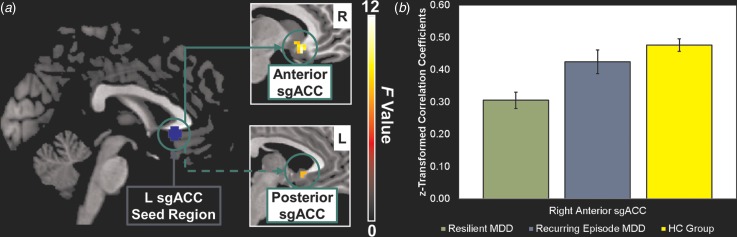
- A main effect of group was found for left anterior sgACC seed connectivity with the right anterior sgACC (F2,82 = 14.0, p < 0.0001) and left posterior sgACC (F2,82 = 8.7, p < 0.0004).
- Resilient MDD patients had lower connectivity to the right anterior sgACC (mean = 0.31, s.d. = 0.14) than both healthy controls (mean = 0.48, s.d. = 0.12, p < 0.001, d = 1.30) and recurring-episode MDD patients (mean = 0.42, s.d. = 0.15, p = 0.01, d = 0.76); recurring-episode MDD patients did not differ from controls (p = 0.55).
- For the left posterior sgACC, resilient MDD patients showed lower connectivity than controls (mean = 0.61 vs 0.81, p < 0.003, d = 1.00), but did not differ from recurring-episode MDD patients (p = 0.29), and recurring-episode MDD patients did not differ from controls (p = 0.26).
- Connectivity between left and right anterior sgACCs was not associated with BDI scores (rs = −0.11, p = 0.47) or number of previous MDEs (rs = 0.13, p = 0.39), and group differences remained after controlling for BDI scores (t44 = 3.44, p = 0.001) and number of previous MDEs (t44 = 2.61, p = 0.01).
Methods
- Prospective longitudinal study: medication-free remitted MDD patients in stable remission (≥6 months) and healthy controls underwent baseline resting-state fMRI; patients were followed at 3, 6, and 14 months with the LIFE-IV. Analyzed groups were resilient MDD (n = 30), recurring-episode MDD (n = 17), and healthy controls (n = 38); a subthreshold symptom group (n = 10) was excluded.
- Seed-based resting-state functional connectivity used a left anterior sgACC seed (MNI coordinates −4, 23, −5; 6 mm sphere). Preprocessing used SPM8, DPARSF, and ART; voxel-wise ANOVA compared groups in SPM12 with an uncorrected voxel-level threshold of p < 0.001 and cluster-level FWE-corrected p < 0.05 across whole brain and seven a priori ROIs, followed by post-hoc Bonferroni pairwise comparisons.
- MRI data were acquired on a 3 T Philips Achieva scanner with a resting-state EPI sequence (240 volumes; TR = 2000 ms; TE = 22 ms; 3 mm voxels) and a T1-weighted MPRAGE structural image.
Limitations
- The paper states that the seed-based approach constrained results to an a priori ROI, so further functional connectivity investigations are needed to determine whether other resting-state networks are associated with resilience to recurrent MDEs.
- The paper states that most enrolled patients had previously responded to treatment, so it is unclear whether the interhemispheric sgACC connectivity pattern generalizes to remitted patients with treatment-resistant histories; future validation across treatment-response histories is needed.
- The paper states that resting-state fMRI cannot control psychological processes during scanning, and that additional studies are needed to examine psychological mechanisms and to replicate/predict findings in vulnerable populations without a history of MDD. The text also makes evident that the recurring-episode group was small (n = 17) and that post-hoc power to detect resilient vs recurring-episode differences in left posterior sgACC connectivity was only 34.79%.
Model-written summary. Check it against the paper before relying on it.
Integrity signals
Registry
Cites
Statistics
Figures
Verification
Claims the paper makes
7 Valid · 0 Not valid · 11 Not checked · 46 Own results and interpretations
Every source the paper cites for this claim was checked and supports it.
In the paper
“Furthermore, damage to the ventromedial prefrontal cortex has been associated with emotional deficits including diminished guilt (Koenigs & Grafman, 2009)”
§ A novel resting-state functional magnetic resonance imaging signature of resilience to recurrent depression > Discussion > Main findings and interpretation
What the sources say
- Supportedcites Koenigs & Grafman, 2009 matched to “The functional neuroanatomy of depression: Distinct roles for ventromedial and dorsolateral prefrontal cortex” (2009) source
The Discussion (roles of dlPFC and vmPFC in depression) associates vmPFC damage with a marked reduction in negative emotions, explicitly including guilt. It also reports low levels of guilt among patients with bilateral vmPFC lesions. (LLM, conf=0.94)
plainstates an association- Asserted: passes — The authors put it forward as true.
- Checkable: passes — It can be checked against evidence.
- Load-bearing: passes — The paper’s conclusions depend on it.
- Based: passes — The paper gives a reason why it holds.
- Supported
Every source the paper cites for this claim was checked and supports it.
In the paper
“A tractography study conducted in healthy volunteers with a seed placed in the subcaudate tractotomy lesion site revealed fibre tracts spanning the left and right sgACCs (Schoene-Bake et al. 2010)”
§ A novel resting-state functional magnetic resonance imaging signature of resilience to recurrent depression > Discussion > Main findings and interpretation
What the sources say
- Supportedcites Schoene-Bake et al. 2010 matched to “Tractographic Analysis of Historical Lesion Surgery for Depression” (2010) source
The Simulation of Lesions section describes bilateral seeds at the subcaudate tractotomy site. The Results report that tracts from that site included area Cg25, and the Discussion describes bilateral frontal connectivity and white matter connecting to the subcallosal cortex. These passages support the paraphrase's description of tracts reaching the left and right subgenual cingulate regions; page numbers are unavailable in our copy. (LLM, conf=0.86)
plain- Asserted: passes — The authors put it forward as true.
- Checkable: passes — It can be checked against evidence.
- Load-bearing: passes — The paper’s conclusions depend on it.
- Based: passes — The paper gives a reason why it holds.
- Supported
Every source the paper cites for this claim was checked and supports it.
In the paper
“In a cross-sectional activation fMRI study, our group reported lower functional connectivity between an anterior temporal lobe (ATL) seed region and the sgACC during the experience of guilt (self-blame) relative to indignation (other-blame) in remitted MDD (rMDD) patients compared with a healthy control (HC) group (Green et al. 2012).”
§ A novel resting-state functional magnetic resonance imaging signature of resilience to recurrent depression > Introduction
What the sources say
- Supportedcites Green et al. 2012 matched to “Guilt-Selective Functional Disconnection of Anterior Temporal and Subgenual Cortices in Major Depressive Disorder” (2012) source
Split into 2 atoms — 2 confirmed, 0 partially supported, 0 disputed, 0 misattributed, 0 unverifiable. Expand the claim to see per-atom verdicts.
plainstates an association- Asserted: passes — The authors put it forward as true.
- Checkable: passes — It can be checked against evidence.
- Load-bearing: passes — The paper’s conclusions depend on it.
- Based: passes — The paper gives a reason why it holds.
- Supported
The sources with a verdict support this claim; the rest weren’t checked yet, have no full text we could read, or their verdicts aren’t rated yet.
In the paper
“Abnormal resting-state connectivity of the subgenual cingulate cortex (sgACC) was previously found in cross-sectional studies of MDD, suggesting its potential pathophysiological importance.”
- Also stated in: § Introduction · boosted
“Abnormal functional connectivity within subgenual cingulate cortex (sgACC) networks has been demonstrated repeatedly in cross-sectional studies of MDD (Greicius et al. 2007; Sheline et al. 2010; Gaffrey et al. 2012; Herringa et al. 2013; Dutta et al. 2014)”
§ A novel resting-state functional magnetic resonance imaging signature of resilience to recurrent depression > Abstract > Background
What the sources say
- Not checked — no full text of the sourcecites Greicius et al. 2007 matched to “Resting-State Functional Connectivity in Major Depression: Abnormally Increased Contributions from Subgenual Cingulate Cortex and Thalamus” (2007) source
- Supportedcites Sheline et al. 2010 matched to “Resting-state functional MRI in depression unmasks increased connectivity between networks via the dorsal nexus” (2010) source
The Results report significantly different resting-state connectivity in depressed versus control participants using a subgenual ACC seed. The Hypothesis Testing section specifies that connectivity from this seed to the dorsal nexus was significantly increased in depressed participants. The supplied copy gives section labels but no page numbers. (LLM, conf=0.92)
- Supportedcites Gaffrey et al. 2012 matched to “Default mode network connectivity in children with a history of preschool onset depression” (2012) source
The Abstract Methods describe a resting-state connectivity study of children with a history of preschool-onset MDD. The Abstract Results and Results (‘Differences Between Healthy and PO-MDD’) report increased connectivity between the posterior cingulate and subgenual cingulate in those children compared with healthy peers. The subgenual finding was no longer significant after some covariate adjustments, but the claim only says abnormal connectivity was found. (LLM, conf=0.88)
boostedstates an association- Asserted: passes — The authors put it forward as true.
- Checkable: passes — It can be checked against evidence.
- Load-bearing: passes — The paper’s conclusions depend on it.
- Based: passes — The paper gives a reason why it holds.
- Also stated in: § Introduction · boosted
A result the paper reports from its own data — it cites no other source for it, so there is none to check. The quote shows it is in the paper.
In the paper
“Attenuated interhemispheric left-to-right sgACC connectivity distinguished the resilient from the recurring-episode and control groups and was not correlated with residual depressive symptoms.”
§ A novel resting-state functional magnetic resonance imaging signature of resilience to recurrent depression > Abstract > Results
plain- Asserted: passes — The authors put it forward as true.
- Checkable: passes — It can be checked against evidence.
- Load-bearing: passes — The paper’s conclusions depend on it.
- Based: passes — The paper gives a reason why it holds.
36 more claims
Create a free account to see all 64 claims and to verify the 1 reference still open.
- Probably not a substantial claim. 12
- It may state two separate claims as one. 12
- The quote only partly states this claim. 1
Claims other papers make about this one
Each is checked against this paper’s own text: does it say what the citing paper says it does?
The source backs part of the claim, not all of it — or backs it for a different population, condition or comparison.
In the citing paper
“The absence of differences in RSFC between patients who went on to relapse and patients who remained well after ADM discontinuation is similarly surprising, given that relapse and resilience independent of discontinuation have been reported to be associated with abnormal RSFC of the sgACC26,27.”
From The relationship between resting-state functional connectivity, antidepressant discontinuation and depression relapse (2020) · cites this paper as [26]
Experimental — accuracy not yet measuredThe cited source says what the claim attributes to it.
In the citing paper
“the subgenual anterior cingulate cortex (sgACC) appears to have a particularly central role in relation to treatment response, remitted depression and relapse.”
From The relationship between resting-state functional connectivity, antidepressant discontinuation and depression relapse (2020) · cites this paper as [26]
The cited source says what the claim attributes to it.
In the citing paper
“decreased interhemispheric sgACC connectivity from the left to the right has been suggested as a marker of resilience to relapse in patients off medication26”
From The relationship between resting-state functional connectivity, antidepressant discontinuation and depression relapse (2020) · cites this paper as [26]
In the citing paper
“Differences in subgenual ACC and MFG connectivity were also found in various regions of these networks during rest [71,101].”
From Prospective biomarkers of major depressive disorder: A systematic review and meta-analysis (2020) · cites this paper as [101]
Self-check
Percentages, sums and reported differences re-computed from the paper’s own numbers.
Each contradiction between two passages listed here was confirmed by an independent check.
Rated minor: it would not touch a result — a value no result rests on, a p-value that stays on the same side of the significance level, or a conflict that is clerical, resolved elsewhere in the paper, or outside its own findings.
In the paper
§ A novel resting-state functional magnetic resonance imaging signature of resilience to recurrent depression > Method > Resting-state fMRI analysis
“seven bilateral a priori regions of interest (ROIs)”
§ A novel resting-state functional magnetic resonance imaging signature of resilience to recurrent depression > Method > Resting-state fMRI analysis
“the ventromedial prefrontal cortex, anterior temporal cortex, amygdala, hippocampus, septal region, and hypothalamus.”
Citations
Cites
Diagnostic and Statistical Manual of Mental Disorders
Williams, J. B. W., & First, M. (2013) · Encyclopedia of Social Work · doi:10.1093/acrefore/9780199975839.013.104 · Cited by 109,519
The Measurement of Observer Agreement for Categorical Data
Landis, J. R., & Koch, G. G. (1977) · Biometrics · doi:10.2307/2529310 · Cited by 81,148
Hirono, N., Mori, E., Ikejiri, Y., Imamura, T., Shimomura, T., Hashimoto, M., Yamashita, H., & Ikeda, M. (1997) · Brain and nerve · Cited by 21,039
A new depression scale designed to be sensitive to change
Montgomery, S. A., & Åsberg, M. (1979) · British Journal of Psychiatry · doi:10.1192/bjp.134.4.382 · Cited by 13,962 · cited 1×
“…the Global Assessment of Functioning scale (American Psychiatric Association, 2000), a Montgomery–Åsberg Depression Rating Scale (MADRS) score >10 (Montgomery & Åsberg, 1979; Zimmerman et al. 2004), history of neurological or medical disorders affecting brain functioning, developmental disorders…”
BackgroundPsychometric properties of the Beck Depression Inventory: Twenty-five years of evaluation
Beck, A. T., Steer, R. A., & Carbin, M. G. (1988) · Clinical Psychology Review · doi:10.1016/0272-7358(88)90050-5 · Cited by 11,696 · cited 1×
“Nevertheless, average BDI scores for all groups were below 10, suggesting the presence of only minimal subthreshold depressive symptoms (Beck et al. 1988).”
BackgroundBeck, A. T., Steer, R. A., & Brown, G. (2011) · PsycTESTS Dataset · doi:10.1037/t00742-000 · Cited by 7,535
Power, J. D., Barnes, K. A., Snyder, A. Z., Schlaggar, B. L., & Petersen, S. E. (2012) · NeuroImage · doi:10.1016/j.neuroimage.2011.10.018 · Cited by 7,429 · cited 1×
“Importantly, no group differences were observed in frame-wise displacement, a metric of relative head displacement between volumes (Power et al. 2012), suggesting the groups were well-matched for head motion (Table 2).”
BackgroundSpontaneous fluctuations in brain activity observed with functional magnetic resonance imaging
Fox, M. D., & Raichle, M. E. (2007) · Nature Reviews Neuroscience · doi:10.1038/nrn2201 · Cited by 6,700 · cited 1×
“…functional magnetic resonance imaging (fMRI), frequently used to measure low-frequency fluctuations in blood oxygen-level dependent (BOLD) signals (Fox & Raichle, 2007), is particularly promising for understanding the neural basis of resilience from the perspective of network models of MDD…”
Deep Brain Stimulation for Treatment-Resistant Depression
Mayberg, H. S., Lozano, A. M., Voon, V., McNeely, H. E., Seminowicz, D., Hamani, C., Schwalb, J. M., & Kennedy, S. H. (2005) · Neuron · doi:10.1016/j.neuron.2005.02.014 · Cited by 4,059 · cited 2×
“Although the exact mechanism by which DBS works has yet to be elucidated, the leading explanation is that inhibition occurs at the sites of stimulation (Mayberg et al. 2005).”
BackgroundMovement‐Related effects in fMRI time‐series
Friston, K. J., Williams, S., Howard, R., Frackowiak, R. S. J., & Turner, R. (1996) · Magnetic Resonance in Medicine · doi:10.1002/mrm.1910350312 · Cited by 3,774 · cited 2×
“…co-registered to the EPIs and segmented, then linear detrending and nuisance covariates regression were performed on the EPIs [24 motion parameters (Friston et al. 1996), white matter and cerebrospinal fluid signal, ART regressors], and then the EPIs were normalized with parameters derived during…”
MethodDPARSF: a MATLAB toolbox for “pipeline” data analysis of resting-state fMRI
Yan (2010) · Frontiers in System Neuroscience · doi:10.3389/fnsys.2010.00013 · Cited by 3,475 · cited 2×
“Briefly, pre-processing was performed using SPM8 (http://www.fil.ion.ucl.ac.uk/spm/) for compatibility with the DPARSF Advanced Edition (Chao-Gan & Yu-Feng, 2010; http://rfmri.org/DPARSF) and Artifact Detection Tools (ART; http://web.mit.edu/ swg/software.htm) MATLAB (MathWorks) toolboxes used in subsequent steps.”
MethodPsychophysiological and Modulatory Interactions in Neuroimaging
Friston, K. J., Buechel, C., Fink, G. R., Morris, J., Rolls, E., & Dolan, R. J. (1997) · NeuroImage · doi:10.1006/nimg.1997.0291 · Cited by 3,097 · cited 1×
“This is because for activation fMRIbased connectivity models, the selection of seed regions that show different levels of average activation during the psychological conditions of interest are problematic because of confounding co-activation and connectivity (Friston et al. 1997).”
Greicius, M. D., Flores, B. H., Menon, V., Glover, G. H., Solvason, H. B., Kenna, H., Reiss, A. L., & Schatzberg, A. F. (2007) · Biological Psychiatry · doi:10.1016/j.biopsych.2006.09.020 · Cited by 2,214 · cited 2×
“…functional connectivity within subgenual cingulate cortex (sgACC) networks has been demonstrated repeatedly in cross-sectional studies of MDD (Greicius et al. 2007; Sheline et al. 2010; Gaffrey et al. 2012; Herringa et al. 2013; Dutta et al. 2014) and this region is thought to play a central…”
BackgroundMioshi, E., Dawson, K., Mitchell, J., Arnold, R., & Hodges, J. R. (2006) · International Journal of Geriatric Psychiatry · doi:10.1002/gps.1610 · Cited by 2,016 · cited 2×
“…et al. 2004), history of neurological or medical disorders affecting brain functioning, developmental disorders or learning disabilities, an Addenbrooke’s Cognitive Examination score <88 (conducted in participants aged over 50 years; Mioshi et al. 2006), and contraindications for MRI scanning.”
BackgroundKeller, M. B. (1987) · Archives of General Psychiatry · doi:10.1001/archpsyc.1987.01800180050009 · Cited by 1,643 · cited 3×
“The rMDD patients completed follow-up interviews via telephone or in person at 3, 6 and 14 months after enrollment using the MDD module and psychosocial functioning assessment from the Longitudinal Interval Follow-up Evaluation interview for DSM-IV (LIFE-IV; Keller et al. 1987).”
MethodNeurocircuitry of Mood Disorders
Price, J. L., & Drevets, W. C. (2010) · Neuropsychopharmacology · doi:10.1038/npp.2009.104 · Cited by 1,606 · cited 1×
“…frequently used to measure low-frequency fluctuations in blood oxygen-level dependent (BOLD) signals (Fox & Raichle, 2007), is particularly promising for understanding the neural basis of resilience from the perspective of network models of MDD (Seminowicz et al. 2004; Price & Drevets, 2010).”
BackgroundSheline, Y. I., Price, J. L., Yan, Z., & Mintun, M. A. (2010) · Proceedings of the National Academy of Sciences · doi:10.1073/pnas.1000446107 · Cited by 1,196 · cited 2×
“…within subgenual cingulate cortex (sgACC) networks has been demonstrated repeatedly in cross-sectional studies of MDD (Greicius et al. 2007; Sheline et al. 2010; Gaffrey et al. 2012; Herringa et al. 2013; Dutta et al. 2014) and this region is thought to play a central role in the…”
BackgroundRisk for recurrence in depression
Burcusa, S. L., & Iacono, W. G. (2007) · Clinical Psychology Review · doi:10.1016/j.cpr.2007.02.005 · Cited by 1,023 · cited 1×
“Furthermore, the recurring-episode MDD patients had more previous MDEs than the resilient patients, as would be predicted by scar theories of depression vulnerability (Burcusa & Iacono, 2007), but number of MDEs was not associated with interhemispheric sgACC connectivity.”
ResultKoenigs, M., & Grafman, J. (2009) · Behavioural Brain Research · doi:10.1016/j.bbr.2009.03.004 · Cited by 956 · cited 2×
“Furthermore, damage to the ventromedial prefrontal cortex has been associated with emotional deficits including diminished guilt (Koenigs & Grafman, 2009), which may be excessive or overgeneralized in current MDD patients (American Psychiatric Association, 2000).”
BackgroundThe neural basis of human moral cognition
Moll, J., Zahn, R., de Oliveira-Souza, R., Krueger, F., & Grafman, J. (2005) · Nature Reviews Neuroscience · doi:10.1038/nrn1768 · Cited by 930 · cited 1×
“…et al. 2008) and which have been implicated in MDD (Elliott et al. 2011; Green et al. 2012) or social emotional and/or motivational processing (Moll et al. 2005; Zahn et al. 2009b; Elliott et al. 2011): the ventromedial prefrontal cortex, anterior temporal cortex, amygdala, hippocampus,…”
BackgroundSelf-citationCingulate cortex of the rhesus monkey: II. Cortical afferents
Vogt, B. A., & Pandya, D. N. (1987) · Journal of Comparative Neurology · doi:10.1002/cne.902620208 · Cited by 854 · cited 1×
“We also used seven bilateral a priori regions of interest (ROIs) with known structural or functional connections to the sgACC (Vogt & Pandya, 1987; Carmichael & Price, 1996; Kondo et al. 2003; Johansen-Berg et al. 2008) and which have been implicated in MDD (Elliott et al. 2011; Green et al. 2012)…”
MethodMultiple recurrences of major depressive disorder
Solomon, D. A., Keller, M. B., Leon, A. C., Mueller, T. I., Lavori, P. W., Shea, M. T., Coryell, W., Warshaw, M., Turvey, C., Maser, J. D., et al. (2000) · American Journal of Psychiatry · doi:10.1176/appi.ajp.157.2.229 · Cited by 835 · cited 1×
“The risk for experiencing a recurrent MDE is elevated during the first 6 months following remission from the depressed state (Solomon et al. 2000).”
BackgroundLimbic-frontal circuitry in major depression: a path modeling metanalysis
Seminowicz, D. A., Mayberg, H. S., McIntosh, A. R., Goldapple, K., Kennedy, S., Segal, Z., & Rafi-Tari, S. (2004) · NeuroImage · doi:10.1016/j.neuroimage.2004.01.015 · Cited by 710 · cited 2×
“…frequently used to measure low-frequency fluctuations in blood oxygen-level dependent (BOLD) signals (Fox & Raichle, 2007), is particularly promising for understanding the neural basis of resilience from the perspective of network models of MDD (Seminowicz et al. 2004; Price & Drevets, 2010).”
BackgroundMethodJohansen-Berg, H., Gutman, D. A., Behrens, T. E. J., Matthews, P. M., Rushworth, M. F. S., Katz, E., Lozano, A. M., & Mayberg, H. S. (2008) · Cerebral Cortex · doi:10.1093/cercor/bhm167 · Cited by 561 · cited 2×
“We also used seven bilateral a priori regions of interest (ROIs) with known structural or functional connections to the sgACC (Vogt & Pandya, 1987; Carmichael & Price, 1996; Kondo et al. 2003; Johansen-Berg et al. 2008) and which have been implicated in MDD (Elliott et al.”
BackgroundMethodHerringa, R. J., Birn, R. M., Ruttle, P. L., Burghy, C. A., Stodola, D. E., Davidson, R. J., & Essex, M. J. (2013) · Proceedings of the National Academy of Sciences · doi:10.1073/pnas.1310766110 · Cited by 426 · cited 7×
“(2012) and was chosen for its close proximity to subgenual regions implicated in vulnerability to MDD (Green et al. 2012; Herringa et al. 2013; Workman et al. 2016).”
BackgroundMethodInfluentialDichter, G. S., Gibbs, D., & Smoski, M. J. (2015) · Journal of Affective Disorders · doi:10.1016/j.jad.2014.09.028 · Cited by 375 · cited 3×
“The lower interhemispheric sgACC connectivity we observed in the resilient MDD patients may appear to contradict studies which report normalization of resting-state sgACC functional connectivity and cerebral glucose metabolism with treatment (Dichter et al. 2014; Dunlop & Mayberg, 2014).”
BackgroundResultAffective Cognition and its Disruption in Mood Disorders
Elliott, R., Zahn, R., Deakin, J. F. W., & Anderson, I. M. (2011) · Neuropsychopharmacology · doi:10.1038/npp.2010.77 · Cited by 330 · cited 4×
“2012) or social emotional and/or motivational processing (Moll et al. 2005; Zahn et al. 2009b; Elliott et al. 2011): the ventromedial prefrontal cortex, anterior temporal cortex, amygdala, hippocampus, septal region, and hypothalamus.”
BackgroundSelf-citationThe Neural Basis of Human Social Values: Evidence from Functional MRI
Zahn, R., Moll, J., Paiva, M., Garrido, G., Krueger, F., Huey, E. D., & Grafman, J. (2009) · Cerebral Cortex · doi:10.1093/cercor/bhn080 · Cited by 328 · cited 4×
“Since the sgACC region displays higher activation in guiltprone individuals during self-blame relative to otherblame (Zahn et al. 2009a, b; Green et al. 2012), it could not be used as a seed region in our previous activation fMRI-based connectivity studies.”
BackgroundInfluentialSelf-citationDeep brain stimulation for treatment-resistant depression
Mayberg, H. (2008) · Journal of Affective Disorders · doi:10.1016/j.jad.2007.12.153 · Cited by 234
Zimmerman, M., Posternak, M. A., & Chelminski, I. (2004) · Journal of Psychiatric Research · doi:10.1016/j.jpsychires.2004.03.007 · Cited by 229 · cited 2×
“…Functioning scale (American Psychiatric Association, 2000), a Montgomery–Åsberg Depression Rating Scale (MADRS) score >10 (Montgomery & Åsberg, 1979; Zimmerman et al. 2004), history of neurological or medical disorders affecting brain functioning, developmental disorders or learning disabilities,…”
MethodResting state networks in major depressive disorder
Dutta, A., McKie, S., & Deakin, J. F. W. (2014) · Psychiatry Research: Neuroimaging · doi:10.1016/j.pscychresns.2014.10.003 · Cited by 218 · cited 6×
“…(sgACC) networks has been demonstrated repeatedly in cross-sectional studies of MDD (Greicius et al. 2007; Sheline et al. 2010; Gaffrey et al. 2012; Herringa et al. 2013; Dutta et al. 2014) and this region is thought to play a central role in the pathophysiology of MDD (Dunlop & Mayberg, 2014).”
BackgroundResultInfluentialSelf-citationKondo, H., Saleem, K. S., & Price, J. L. (2003) · Journal of Comparative Neurology · doi:10.1002/cne.10842 · Cited by 217 · cited 1×
“…a priori regions of interest (ROIs) with known structural or functional connections to the sgACC (Vogt & Pandya, 1987; Carmichael & Price, 1996; Kondo et al. 2003; Johansen-Berg et al. 2008) and which have been implicated in MDD (Elliott et al. 2011; Green et al. 2012) or social emotional…”
BackgroundNeuroimaging-based biomarkers for treatment selection in major depressive disorder
Dunlop, B. W., & Mayberg, H. S. (2014) · Dialogues in Clinical Neuroscience · doi:10.31887/dcns.2014.16.4/bdunlop · Cited by 127 · cited 2×
“The lower interhemispheric sgACC connectivity we observed in the resilient MDD patients may appear to contradict studies which report normalization of resting-state sgACC functional connectivity and cerebral glucose metabolism with treatment (Dichter et al. 2014; Dunlop & Mayberg, 2014).”
BackgroundResultGreen, S., Lambon Ralph, M. A., Moll, J., Deakin, J. F. W., & Zahn, R. (2012) · Archives of General Psychiatry · doi:10.1001/archgenpsychiatry.2012.135 · Cited by 98 · cited 11×
“(2012) and was chosen for its close proximity to subgenual regions implicated in vulnerability to MDD (Green et al. 2012; Herringa et al. 2013; Workman et al. 2016).”
BackgroundMethodResultInfluentialSelf-citationLythe, K. E., Moll, J., Gethin, J. A., Workman, C. I., Green, S., Lambon Ralph, M. A., Deakin, J. F. W., & Zahn, R. (2015) · JAMA Psychiatry · doi:10.1001/jamapsychiatry.2015.1813 · Cited by 91 · cited 9×
“Taken together, this led to the hypothesis that the lower self-blame-selective ATL connectivity in rMDD patients seen in the first study (Green et al. 2012) reflected a signature of resilience rather than vulnerability as was initially thought (Lythe et al. 2015).”
BackgroundMethodResultInfluentialSelf-citationTractographic Analysis of Historical Lesion Surgery for Depression
Schoene-Bake, J.-C., Parpaley, Y., Weber, B., Panksepp, J., Hurwitz, T. A., & Coenen, V. A. (2010) · Neuropsychopharmacology · doi:10.1038/npp.2010.132 · Cited by 85 · cited 3×
“…study conducted in healthy volunteers with a seed placed in the subcaudate tractotomy lesion site revealed fibre tracts spanning the left and right sgACCs (Schoene-Bake et al. 2010), suggesting that disruption of these tracts may be related to clinical improvement in current MDD patients.”
BackgroundMethodInfluentialSubgenual cingulate activity reflects individual differences in empathic concern
Zahn, R., de Oliveira‐Souza, R., Bramati, I. E., Garrido, G. J., & Moll, J. (2009) · Neuroscience Letters · doi:10.1016/j.neulet.2009.03.090 · Cited by 82 · cited 3×
“Since the sgACC region displays higher activation in guiltprone individuals during self-blame relative to otherblame (Zahn et al. 2009a, b; Green et al. 2012), it could not be used as a seed region in our previous activation fMRI-based connectivity studies.”
BackgroundSelf-citationDefault mode network connectivity in children with a history of preschool onset depression
Gaffrey, M. S., Luby, J. L., Botteron, K., Repovš, G., & Barch, D. M. (2012) · Journal of Child Psychology and Psychiatry · doi:10.1111/j.1469-7610.2012.02552.x · Cited by 78 · cited 4×
“Abnormal functional connectivity within subgenual cingulate cortex (sgACC) networks has been demonstrated repeatedly in cross-sectional studies of MDD (Greicius et al. 2007; Sheline et al. 2010; Gaffrey et al. 2012; Herringa et al. 2013; Dutta et al. 2014) and this region is thought to play a central role in the patho…”
BackgroundInfluentialNegative emotions towards others are diminished in remitted major depression
Zahn, R., Lythe, K. E., Gethin, J. A., Green, S., Deakin, J. F. W., Workman, C., & Moll, J. (2015) · European Psychiatry · doi:10.1016/j.eurpsy.2015.02.005 · Cited by 44 · cited 2×
“Participants were recruited with online and print advertisements and received compensation for their time and travel expenses as part of the UK Medical Research Council (MRC)-funded ‘Development of Cognitive and Imaging Biomarkers Predicting Risk of Self-Blaming Bias and Recurrence in Major Depression’ project (Lythe…”
BackgroundMethodSelf-citationFunctional activation studies of word processing in the recovery from aphasia
Zahn, R., Schwarz, M., & Huber, W. (2006) · Journal of Physiology-Paris · doi:10.1016/j.jphysparis.2006.03.013 · Cited by 27 · cited 1×
“Our findings suggest that abnormally low resting-state functional connectivity of the anterior sgACC may reflect a compensatory process in those patients who remain resilient to MDEs, similar to functional compensation mechanisms found in patients with brain lesions (Zahn et al. 2006).”
ResultSelf-citationSubgenual Cingulate–Amygdala Functional Disconnection and Vulnerability to Melancholic Depression
Workman, C. I., Lythe, K. E., McKie, S., Moll, J., Gethin, J. A., Deakin, J. F., Elliott, R., & Zahn, R. (2016) · Neuropsychopharmacology · doi:10.1038/npp.2016.8 · Cited by 26 · cited 7×
“(2012) and was chosen for its close proximity to subgenual regions implicated in vulnerability to MDD (Green et al. 2012; Herringa et al. 2013; Workman et al. 2016).”
BackgroundMethodResultSelf-citationConnectional networks within the orbital and medial prefrontal cortex of macaque monkeys
Carmichael, S. T., & Price, J. L. (1996) · Journal of Comparative Neurology · doi:10.1002/(sici)1096-9861(19960722)371:2<179::aid-cne1>3.0.co;2-#
Research works printed but not linked: 2
- First MB, Spitzer RL, Gibbon M, Williams JBW (2002). Structured Clinical Interview for DSM-IV-TR Axis I Disorders, Research Version, Patient edn. (SCID-I/P). Biometrics Research, New York State Psychiatric Institute: New York.
- World Health Organization (1992). The ICD-10 Classification of Mental and Behavioural Disorders: Clinical Descriptions and Diagnostic Guidelines. World Health Organization: Geneva.
Cited by
Prospective biomarkers of major depressive disorder: A systematic review and meta-analysis
Kennis, M., Gerritsen, L., van Dalen, M., Williams, A., Cuijpers, P., & Bockting, C. (2020) · Molecular Psychiatry · doi:10.1038/s41380-019-0585-z · Cited by 435
“Differences in subgenual ACC and MFG connectivity were also found in various regions of these networks during rest [71, 101].”
BackgroundRole of inflammation in depression relapse
Liu, C.-H., Zhang, G.-Z., Li, B., Li, M., Woelfer, M., Walter, M., & Wang, L. (2019) · Journal of Neuroinflammation · doi:10.1186/s12974-019-1475-7 · Cited by 162
“(2016) [85] 30 MDD without relapse and 17 MDD with relapse 47 35 Left sgACC, right sgACC Functional connectivity”
Liu, J., Fan, Y., Zeng, L., Liu, B., Ju, Y., Wang, M., Dong, Q., Lu, X., Sun, J., Zhang, L., et al. (2021) · Translational Psychiatry · doi:10.1038/s41398-021-01227-8 · Cited by 61
“R—Posterior-medial prefrontal cortex (6, 28, 33) R—anterior Cingulate cortex (5, 19, 23) 0.”
Disruption of Neural Homeostasis as a Model of Relapse and Recurrence in Late-Life Depression
Andreescu, C., Ajilore, O., Aizenstein, H. J., Albert, K., Butters, M. A., Landman, B. A., Karim, H. T., Krafty, R., & Taylor, W. D. (2019) · The American Journal of Geriatric Psychiatry · doi:10.1016/j.jagp.2019.07.016 · Cited by 56
Yang, Z., Jian, L., Qiu, H., Zhang, C., Cheng, S., Ji, J., Li, T., Wang, Y., Li, J., & Li, K. (2021) · Translational Psychiatry · doi:10.1038/s41398-021-01646-7 · Cited by 60
Metadata
- Authors
- Workman, C. I., Lythe, K. E., McKie, S., Moll, J., Gethin, J. A., Deakin, J. F. W., Elliott, R., & Zahn, R.
- Affiliations
- Manchester Academic Health Science Centre (GB)
- D’Or Institute for Research and Education (BR)
- King's College London (GB)
- Corresponding author
- Zahn, R.
- Venue
- Psychological Medicine
- Publisher
- Cambridge University Press (CUP)
- Published
- 2016-11-08
- Volume
- 47
- Issue
- 4
- Pages
- 597-607
- ISSN
- 0033-2917 (ISSN-L)
- 1469-8978
- PMC
- PMC5426313
- OpenAlex
- W2552589017
- Semantic Scholar
- f4d95395a667363bba141801a3fdb942ef4b2690
- Cited by
- 26
- References
- 43
- Citations by year
- 2026: 3 · 2025: 2 · 2023: 2 · 2022: 7 · 2021: 2 · 2020: 1 · 2019: 5 · 2018: 3 · 2017: 1
- FWCI
- 1.90
- Type
- journal article
- Language
- en
- Open access
- hybrid
- doi.org
- Locations
- Psychological Medicine (publishedVersion, cc-by)
- PubMed Central (publishedVersion, cc-by)
- PubMed (publishedVersion)
- Research Explorer (The University of Manchester) (submittedVersion, cc-by)
- PsyArXiv (OSF Preprints) (submittedVersion, cc-by)
- PsyArXiv (OSF Preprints) (submittedVersion)
- Funders
- Medical Research Council (G0902304)
- Engineering and Physical Sciences Research Council
- Topics
- Life Sciences › Neuroscience › Cognitive Neuroscience › Functional Brain Connectivity Studies
- Health Sciences › Medicine › Pharmacology (medical) › Treatment of Major Depression
- Life Sciences › Neuroscience › Cognitive Neuroscience › Neural and Behavioral Psychology Studies
- Keywords
- major depressive disorder, recurrent depression, subgenual anterior cingulate cortex, resting-state functional connectivity, interhemispheric connectivity, remitted depression
- MeSH terms
- Adult, Major Depressive Disorder, Disease Susceptibility, Female, Follow-Up Studies, Gyrus Cinguli, Humans, Magnetic Resonance Imaging, Male, Middle Aged, Recurrence, Remission Induction, Young Adult, Connectome
About these checks
Registry, retraction, Cites and statistics results are computed, not judged, with one exception: a printed reference that no index lists is read once by a model before it counts as a citation error. Claims are extracted by a model and kept only when their quote appears verbatim in the text; each cited source is then checked, with a model’s help, for whether it says what the claim relies on. Those verdicts can be wrong — read the claim’s quote and the cited source before relying on one.
The claim verdicts this report counts are experimental: their accuracy is not yet measured.
A language model drew the claims from the paper on 2026-10-10, under version 3 of the claim definition (model deepseek-v4.1-flash, prompt extract-v3).
A second model labelled each claim on 2026-10-10 (model jev-1.13-20260917, definition revision gold-guideline-v0.2).
Cited sources are checked with a language model’s help (gpt-6-sol and qwen3.8-omni-flash).
Statistics and arithmetic are recomputed, not judged.
Confidence bands are shown only for fields calibrated on our annotated test set. None is calibrated yet, so no band is shown.
What counts as a claim ›How we measure confidence ›How we check this ›
Are you an author, or do you see a problem with this page? Request a review
Data sources
Bibliographic data: Semantic Scholar, OpenAlex, Crossref.
Contains information from the Semantic Scholar Academic Graph Datasets, made available under the ODC Attribution License (ODC-BY 1.0).
Semantic Scholar’s data is described in: Kinney, R., et al. (2023). The Semantic Scholar Open Data Platform. arXiv:2301.10140.
