

Mamma Mia – A randomized controlled trial of an internet-based intervention for perinatal depression
Open accessThe DOI matches its Crossref record; 57 of the 57 references it cites were found in a registry or an index.
Abstract
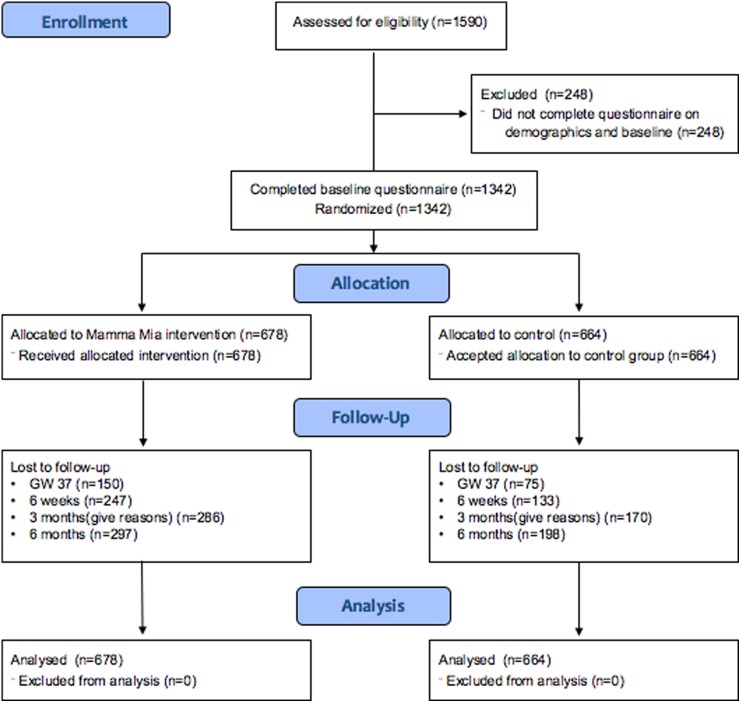
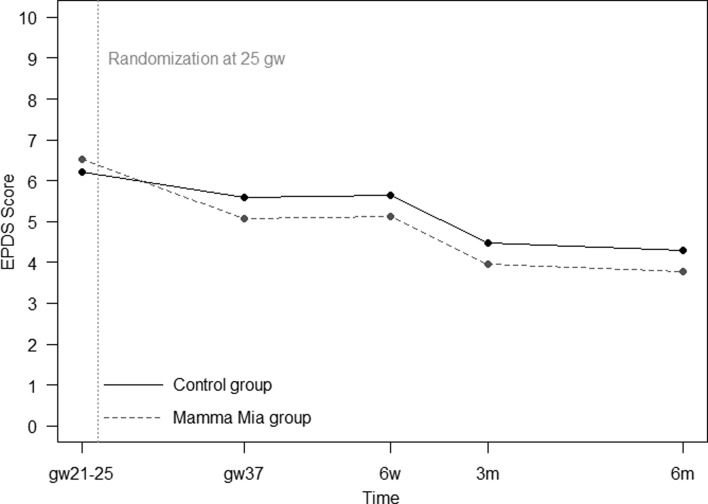
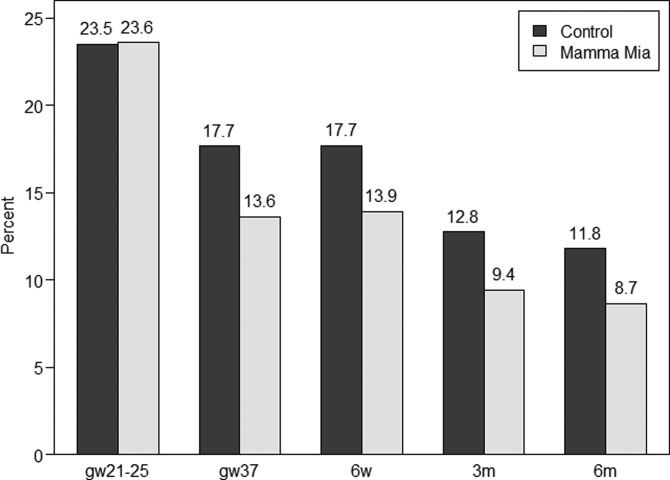
Background: Studies suggest that 10–15% of perinatal women experience depressive symptoms. Due to the risks, problems with detection, and barriers to treatment, effective universal preventive interventions are needed. The aim of this study was to assess the effectiveness of an automated internet intervention (‘Mamma Mia’) on perinatal depressive symptoms. Mamma Mia is tailored specifically to the perinatal phase and targets risk and protective factors for perinatal depressive symptoms. Methods: A total of 1342 pregnant women were randomized to an intervention (‘Mamma Mia’) and control group. Data were collected at gestational week (gw) 21–25, gw37, 6 weeks after birth, and 3 and 6 months after birth. We investigated whether (1) the intervention group displayed lower levels of depressive symptoms compared with the control group, (2) the effect of Mamma Mia changed over time, (3) the effect on depressive symptoms was moderated by baseline depressive symptoms, previous depression, and parity, and (4) this moderation changed by time. Finally, we examined if the prevalence of mothers with possible depression [i.e. Edinburgh Postnatal Depression Scale (EPDS)-score ⩾10] differed between the intervention and control group. Results: Participants in the Mamma Mia group displayed less depressive symptoms than participants in the control group during follow-up [ F (1) = 7.03, p = 0.008]. There were indications that the effect of Mamma Mia was moderated by EPDS score at baseline. The prevalence of women with EPDS-score ⩾10 was lower in the Mamma Mia group at all follow-up measurements. Conclusions: The study demonstrated the effects of the automated web-based universal intervention Mamma Mia on perinatal depressive symptoms.
Overview
The claims and statistics of this paper haven’t been checked yet.
Free: it reads the open-access text and checks the first 5 claims that cite a source we can check. Create a free account to check every claim.
Integrity signals
Registry
Cites
Statistics
Figures
Verification
Claims the paper makes
The claims and statistics of this paper haven’t been checked yet.
Free: it reads the open-access text and checks the first 5 claims that cite a source we can check. Create a free account to check every claim.
Claims other papers make about this one
Each is checked against this paper’s own text: does it say what the citing paper says it does?
The source backs part of the claim, not all of it — or backs it for a different population, condition or comparison.
In the citing paper
“This extensive intervention consisted of 44 online 10-min sessions and incorporated a mix of elements of cognitive-behavioural therapy, mindfulness, psychoeducation, meta-cognitive therapy, acceptance and commitment therapy, and positive psychology.”
From Effectiveness of a psycho-educational intervention for expecting parents to prevent postpartum parenting stress, depression and anxiety: A randomized controlled trial. (2020) · cites this paper as [102]
Experimental — accuracy not yet measuredThe cited source says what the claim attributes to it.
In the citing paper
“while studies on universal prevention of peripartum depression have produced both no effects and significant effects (Barrera et al., 2015; Haga et al., 2019; Nishi et al., 2022).”
From PandaMom – Feasibility and acceptability of an internet- and mobile-based intervention to enhance peripartum mental well-being and to prevent postpartum depression (2024) · cites this paper as Haga et al., 2019
The cited source says what the claim attributes to it.
In the citing paper
“When compared to PandaMom, prevention studies offering intervention content during pregnancy from the second trimester onwards reported a higher number of provided and completed modules (Duffecy et al., 2019; Haga et al., 2019).”
From PandaMom – Feasibility and acceptability of an internet- and mobile-based intervention to enhance peripartum mental well-being and to prevent postpartum depression (2024) · cites this paper as Haga et al., 2019
The cited source says what the claim attributes to it.
In the citing paper
“Differences between pre- and post-treatment effects were not considered as evidence for the success of the telemedicine intervention because several studies showed that the participants in control groups also improved over time [20, 35–41], especially with regard to postnatal depression.”
From Mental health-related telemedicine interventions for pregnant women and new mothers: a systematic literature review (2023) · cites this paper as [37]
The cited source says what the claim attributes to it.
In the citing paper
“The feasibility of the intervention was deemed good by n = 16 articles [37, 39, 41, 42, 46, 49, 52, 54, 55, 59, 61, 63, 65, 68, 70, 71].”
From Mental health-related telemedicine interventions for pregnant women and new mothers: a systematic literature review (2023) · cites this paper as [37]
2 more claims about this paper
Create a free account to see every claim other papers make about this one.
Self-check
Percentages, sums and reported differences re-computed from the paper’s own numbers.
The self-check needs the paper’s full text.
Citations
Cites
Detection of Postnatal Depression: Development of the 10-item Edinburgh Postnatal Depression Scale
Cox, J. L., Holden, J. M., & Sagovsky, R. (1987) · British Journal of Psychiatry · doi:10.1192/bjp.150.6.782 · Cited by 14,183 · cited 3×
“Our main hypothesis was that the Mamma Mia group would display lower levels of depressive symptoms compared with the control group as measured by the Edinburgh Postnatal Depression Scale (EPDS) (Cox et al., 1987).”
BackgroundMethodThe ASA Statement on p -Values: Context, Process, and Purpose
Wasserstein, R. L., & Lazar, N. A. (2016) · The American Statistician · doi:10.1080/00031305.2016.1154108 · Cited by 6,306
Perinatal Depression: A Systematic Review of Prevalence and Incidence
Gavin, N. I., Gaynes, B. N., Lohr, K. N., Meltzer-Brody, S., Gartlehner, G., & Swinson, T. (2005) · Obstetrics & Gynecology · doi:10.1097/01.aog.0000183597.31630.db · Cited by 3,282 · cited 1×
“The perinatal period represents a time signified bymuch emotional turmoil for women, and studies suggest that 10–15% ofwomen experiencemoderate to high levels of depressive symptoms during this period (O’Hara and Swain, 1996; Eberhard-Gran et al., 2004; Gavin et al., 2005).”
BackgroundRates and risk of postpartum depression – a meta-analysis
O'hara, M. W., & Swain, A. M. (1996) · International Review of Psychiatry · doi:10.3109/09540269609037816 · Cited by 3,116
Maternal depression and parenting behavior
Lovejoy, M. C., Graczyk, P. A., O'Hare, E., & Neuman, G. (2000) · Clinical Psychology Review · doi:10.1016/s0272-7358(98)00100-7 · Cited by 2,667 · cited 1×
“Perinatal depression carries a high personal cost for both thewoman and her family (Lovestone and Kumar, 1993; Lovejoy et al., 2000; Goodman et al., 2011) while all too often escaping detection and treatment (Bågedahl-Strindlund and Monsen Børjesson, 1998).”
BackgroundMaternal Depression and Child Psychopathology: A Meta-Analytic Review
Goodman, S. H., Rouse, M. H., Connell, A. M., Broth, M. R., Hall, C. M., & Heyward, D. (2011) · Clinical Child and Family Psychology Review · doi:10.1007/s10567-010-0080-1 · Cited by 2,621 · cited 1×
“Perinatal depression carries a high personal cost for both thewoman and her family (Lovestone and Kumar, 1993; Lovejoy et al., 2000; Goodman et al., 2011) while all too often escaping detection and treatment (Bågedahl-Strindlund and Monsen Børjesson, 1998).”
BackgroundPredictors of Postpartum Depression: An Update
Beck, C. T. (2001) · Nursing Research · doi:10.1097/00006199-200109000-00004 · Cited by 1,915
Antenatal risk factors for postpartum depression: a synthesis of recent literature
Robertson, E., Grace, S., Wallington, T., & Stewart, D. E. (2004) · General Hospital Psychiatry · doi:10.1016/j.genhosppsych.2004.02.006 · Cited by 1,886
Postpartum depression: current status and future directions
O'Hara, M. W., & McCabe, J. E. (2013) · Annual Review of Clinical Psychology · doi:10.1146/annurev-clinpsy-050212-185612 · Cited by 1,750
Treatment gap in mental health care.
Abramowitz, M. Z., Greenberg, D., & Levav, I. (2008) · PubMed · Cited by 1,484
The treatment gap in mental health care.
(2004) · Europe PMC (PubMed Central) · Cited by 1,419
Risk factors for depressive symptoms during pregnancy: a systematic review
Lancaster, C. A., Gold, K. J., Flynn, H. A., Yoo, H., Marcus, S. M., & Davis, M. M. (2010) · American Journal of Obstetrics and Gynecology · doi:10.1016/j.ajog.2009.09.007 · Cited by 1,208 · cited 1×
“Factors associated with increased risk of perinatal depression include a history of depression, stressful life events, young age and other demographic variables (Robertson et al., 2004; Vesga-López et al., 2008; Lancaster et al., 2010; Silverman et al., 2017).”
BackgroundApproximations to the Log-Likelihood Function in the Nonlinear Mixed-Effects Model
Pinheiro, J. C., & Bates, D. M. (1995) · Journal of Computational and Graphical Statistics · doi:10.1080/10618600.1995.10474663 · Cited by 1,188
The course of anxiety and depression through pregnancy and the postpartum in a community sample
Heron, J., O'Connor, T. G., Evans, J., Golding, J., & Glover, V. (2004) · Journal of Affective Disorders · doi:10.1016/j.jad.2003.08.004 · Cited by 1,151 · cited 1×
“, 2006), and typically remits over time (Heron et al., 2004), it is not surprising that Mamma Mia was most effective during the third trimester and early postpartum period.”
BackgroundAdherence in Internet Interventions for Anxiety and Depression
Christensen, H., Griffiths, K. M., & Farrer, L. (2009) · Journal of Medical Internet Research · doi:10.2196/jmir.1194 · Cited by 1,133 · cited 1×
“Current drop-out rates fall within the typical range reported on internet-based interventions (Christensen et al., 2009), but is nevertheless a limitation in this study.”
BackgroundPsychiatric Disorders in Pregnant and Postpartum Women in the United States
Vesga-López, O., Blanco, C., Keyes, K., Olfson, M., Grant, B. F., & Hasin, D. S. (2008) · Archives of General Psychiatry · doi:10.1001/archpsyc.65.7.805 · Cited by 1,065 · cited 1×
“Factors associated with increased risk of perinatal depression include a history of depression, stressful life events, young age and other demographic variables (Robertson et al., 2004; Vesga-López et al., 2008; Lancaster et al., 2010; Silverman et al., 2017).”
BackgroundDennis, C., & Chung‐Lee, L. (2006) · Birth · doi:10.1111/j.1523-536x.2006.00130.x · Cited by 881 · cited 2×
“Internet interventions allow anonymity, which reduces a sense of stigma and patients’ fear of seeking help (Dennis and Chung-Lee, 2006).”
BackgroundCuijpers, P., Donker, T., van Straten, A., Li, J., & Andersson, G. (2010) · Psychological Medicine · doi:10.1017/s0033291710000772 · Cited by 832 · cited 1×
“Recent research shows that internet-based programs in combination with guidance from health personnel for treating perinatal depression may produce effects equivalent to those of face-to-face interventions (Cuijpers et al., 2010).”
BackgroundA Controlled Study of the Onset, Duration and Prevalence of Postnatal Depression
Cox, J. L., Murray, D., & Chapman, G. (1993) · British Journal of Psychiatry · doi:10.1192/bjp.163.1.27 · Cited by 765 · cited 2×
“As symptom severity is at its highest towards the end of pregnancy and early postpartum period (Cox et al., 1993; Eberhard-Gran et al., 2003; Gaynes et al., 2005; Munk-Olsen et al., 2006), and typically remits over time (Heron et al.”
BackgroundNew Parents and Mental Disorders: A Population-Based Register Study
Munk-Olsen, T., Laursen, T. M., Pedersen, C. B., Mors, O., & Mortensen, P. B. (2006) · JAMA · doi:10.1001/jama.296.21.2582 · Cited by 727
Validation of the Edinburgh Depression Scale during pregnancy
Bergink, V., Kooistra, L., Lambregtse-van den Berg, M. P., Wijnen, H., Bunevicius, R., van Baar, A., & Pop, V. (2011) · Journal of Psychosomatic Research · doi:10.1016/j.jpsychores.2010.07.008 · Cited by 601 · cited 1×
“It has been validated for use during pregnancy (Bunevicius et al., 2009; Bergink et al., 2011), and postpartum (Eberhard-Gran et al.”
MethodWomen’s Attitudes, Preferences, and Perceived Barriers to Treatment for Perinatal Depression
Goodman, J. H. (2009) · Birth · doi:10.1111/j.1523-536x.2008.00296.x · Cited by 526 · cited 2×
“Additionally, many women are reluctant to seek treatment due to a perceived stigma (Beck, 2001; O’Mahen and Flynn, 2008; Goodman, 2009).”
BackgroundReview of validation studies of the Edinburgh Postnatal Depression Scale
Eberhard‐Gran, M., Eskild, A., Tambs, K., Opjordsmoen, S., & Samuelsen, S. O. (2001) · Acta Psychiatrica Scandinavica · doi:10.1034/j.1600-0447.2001.00187.x · Cited by 491
Implications of Timing of Maternal Depressive Symptoms for Early Cognitive and Language Development
Sohr-Preston, S. L., & Scaramella, L. V. (2006) · Clinical Child and Family Psychology Review · doi:10.1007/s10567-006-0004-2 · Cited by 450
The risk factors for postpartum depression: A population-based study: S ilverman et al.
Silverman, M. E., Reichenberg, A., Savitz, D. A., Cnattingius, S., Lichtenstein, P., Hultman, C. M., Larsson, H., & Sandin, S. (2017) · Depression and Anxiety · doi:10.1002/da.22597 · Cited by 425 · cited 1×
“Factors associated with increased risk of perinatal depression include a history of depression, stressful life events, young age and other demographic variables (Robertson et al., 2004; Vesga-López et al., 2008; Lancaster et al., 2010; Silverman et al., 2017).”
BackgroundSleep and depression in postpartum women: a population-based study
Dørheim, S. K., Bondevik, G. T., Eberhard-Gran, M., & Bjorvatn, B. (2009) · SLEEP · doi:10.1093/sleep/32.7.847 · Cited by 331 · cited 12×
“This may indicate that the level of education was substantially higher than the 8.7% of women with higher education in the general population (Statistics Norway, 2017a), although the level of education among pregnant women in Norway is unknown.”
ResultInfluentialDepressive Disorders During Pregnancy: Prevalence and Risk Factors in a Large Urban Sample
Melville, J. L., Gavin, A., Guo, Y., Fan, M.-Y., & Katon, W. J. (2010) · Obstetrics & Gynecology · doi:10.1097/aog.0b013e3181f60b0a · Cited by 329
Dennis, C.-L. (2005) · BMJ · doi:10.1136/bmj.331.7507.15 · Cited by 320 · cited 1×
“This finding is clinically meaningful as people with higher levels of distress have greater potential for improvement (Dennis, 2005).”
BackgroundMacArthur, C., Winter, H., Bick, D., Knowles, H., Lilford, R., Henderson, C., Lancashire, R., Braunholtz, D., & Gee, H. (2002) · The Lancet · doi:10.1016/s0140-6736(02)07596-7 · Cited by 285 · cited 1×
“Moreover, perinatal care that is tailored to the woman’s needs has been found to reduce the prevalence rate of perinatal depression (MacArthur et al., 2002).”
BackgroundPreferences and perceived barriers to treatment for depression during the perinatal period
O'Mahen, H. A., & Flynn, H. A. (2008) · Journal of Women s Health · doi:10.1089/jwh.2007.0631 · Cited by 277
Depression in postpartum and non‐postpartum women: prevalence and risk factors
Eberhard‐Gran, M., Eskild, A., Tambs, K., Samuelsen, S. O., & Opjordsmoen, S. (2002) · Acta Psychiatrica Scandinavica · doi:10.1034/j.1600-0447.2002.02408.x · Cited by 184
The Edinburgh Postnatal Depression Scale: Validation in a Norwegian community sample
Eberhard-Gran, M., Eskild, A., Tambs, K., Schei, B., & Opjordsmoen, S. (2001) · Nordic Journal of Psychiatry · doi:10.1080/08039480151108525 · Cited by 176
Perinatal Depression: An Update and Overview
Stuart-Parrigon, K., & Stuart, S. (2014) · Current Psychiatry Reports · doi:10.1007/s11920-014-0468-6 · Cited by 175
Haga, S. M., Ulleberg, P., Slinning, K., Kraft, P., Steen, T. B., & Staff, A. (2012) · Archives of Women's Mental Health · doi:10.1007/s00737-012-0274-2 · Cited by 169
Self-citationComputer- or web-based interventions for perinatal mental health: a systematic review
Ashford, M. T., Olander, E. K., & Ayers, S. (2016) · Journal of Affective Disorders · doi:10.1016/j.jad.2016.02.057 · Cited by 166
Postnatal Psychiatric Illness: the Impact on Partners
Lovestone, S., & Kumar, R. (1993) · British Journal of Psychiatry · doi:10.1192/bjp.163.2.210 · Cited by 151 · cited 1×
“Perinatal depression carries a high personal cost for both thewoman and her family (Lovestone and Kumar, 1993; Lovejoy et al., 2000; Goodman et al., 2011) while all too often escaping detection and treatment (Bågedahl-Strindlund and Monsen Børjesson, 1998).”
BackgroundLee, E. W., Denison, F. C., Hor, K., & Reynolds, R. M. (2016) · BMC Pregnancy and Childbirth · doi:10.1186/s12884-016-0831-1 · Cited by 143 · cited 2×
“Findings from two recent systematic reviews on web-based interventions for perinatal mental health are encouraging and suggest they may be effective in reducing perinatal depression (Ashford et al., 2016; Lee et al., 2016).”
BackgroundScreening for antenatal depression with the Edinburgh Depression Scale
Bunevicius, A., Kusminskas, L., Pop, V. J., Pedersen, C. A., & Bunevicius, R. (2009) · Journal of Psychosomatic Obstetrics & Gynecology · doi:10.3109/01674820903230708 · Cited by 139 · cited 1×
“It has been validated for use during pregnancy (Bunevicius et al., 2009; Bergink et al., 2011), and postpartum (Eberhard-Gran et al.”
MethodAnderson, J., Huppert, F., & Rose, G. (1993) · Psychological Medicine · doi:10.1017/s0033291700028567 · Cited by 113 · cited 1×
“In a population, the mean level of symptoms is related to the prevalence of a disorder (Anderson et al., 1993; Whittington and Huppert, 1996).”
BackgroundStephens, S., Ford, E., Paudyal, P., & Smith, H. (2016) · The Annals of Family Medicine · doi:10.1370/afm.1967 · Cited by 109
Depression during pregnancy and after delivery: a repeated measurement study
Eberhard-Gran, M., Tambs, K., Opjordsmoen, S., Skrondal, A., & Eskild, A. (2004) · Journal of Psychosomatic Obstetrics & Gynecology · doi:10.1080/01674820410001737405 · Cited by 88
Haga, S. M., Drozd, F., Brendryen, H., & Slinning, K. (2013) · JMIR Research Protocols · doi:10.2196/resprot.2659 · Cited by 84 · cited 2×
“A recent study demonstrates the feasibility and acceptability of Mamma Mia (Haga et al., 2013).”
BackgroundSelf-citationPostnatal depression: a hidden illness
Bågedahl‐Strindlund, M., & Börjesson, K. M. (1998) · Acta Psychiatrica Scandinavica · doi:10.1111/j.1600-0447.1998.tb10083.x · Cited by 84
Modifying CBT for perinatal depression: what do women want?
O'Mahen, H., Fedock, G., Henshaw, E., Himle, J. A., Forman, J., & Flynn, H. A. (2012) · Cognitive and Behavioral Practice · doi:10.1016/j.cbpra.2011.05.005 · Cited by 83
Glavin, K., Smith, L., Sørum, R., & Ellefsen, B. (2010) · Journal of Clinical Nursing · doi:10.1111/j.1365-2702.2010.03332.x · Cited by 80 · cited 13×
“This may indicate that the level of education was substantially higher than the 8.7% of women with higher education in the general population (Statistics Norway, 2017a), although the level of education among pregnant women in Norway is unknown.”
ResultInfluentialMaloni, J. A., Przeworski, A., & Damato, E. G. (2013) · Archives of Psychiatric Nursing · doi:10.1016/j.apnu.2012.12.001 · Cited by 80 · cited 1×
“Indeed, many women with perinatal depression express an interest in internet interventions and report that they would use the internet to learn coping strategies for depressive symptoms (Maloni et al., 2013).”
BackgroundA comparison of anxiety and depressive symptomatology in postpartum and non-postpartum mothers
Eberhard‐Gran, M., Tambs, K., Opjordsmoen, S., Skrondal, A., & Eskild, A. (2003) · Social Psychiatry and Psychiatric Epidemiology · doi:10.1007/s00127-003-0679-3 · Cited by 74 · cited 1×
“As symptom severity is at its highest towards the end of pregnancy and early postpartum period (Cox et al., 1993; Eberhard-Gran et al., 2003; Gaynes et al., 2005; Munk-Olsen et al., 2006), and typically remits over time (Heron et al., 2004), it is not surprising that Mamma Mia was most effective…”
BackgroundDanaher, B. G., Milgrom, J., Seeley, J. R., Stuart, S., Schembri, C., Tyler, M. S., Ericksen, J., Lester, W., Gemmill, A. W., & Lewinsohn, P. (2012) · JMIR Research Protocols · doi:10.2196/resprot.2329 · Cited by 67 · cited 1×
“Recent studies have demonstrated the acceptability and feasibility of internet interventions for perinatal depression (Danaher et al., 2012; Haga et al., 2013; Salonen, 2014; Logsdon et al., 2014).”
BackgroundSalonen, A. H., Pridham, K. F., Brown, R., & Kaunonen, M. (2013) · Midwifery · doi:10.1016/j.midw.2013.02.009 · Cited by 61
Drozd, F., Haga, S. M., Brendryen, H., & Slinning, K. (2015) · JMIR Research Protocols · doi:10.2196/resprot.4858 · Cited by 52
Self-citationWhittington, J. E., & Huppert, F. A. (1996) · Psychological Medicine · doi:10.1017/s0033291700035972 · Cited by 46 · cited 1×
“In a population, the mean level of symptoms is related to the prevalence of a disorder (Anderson et al., 1993; Whittington and Huppert, 1996).”
BackgroundLogsdon, M. C., Bennett, G., Crutzen, R., Martin, L., Eckert, D., Robertson, A., Myers, J. A., Tomasulo, R., Gregg, J., Barone, M. J., et al. (2014) · Journal of Child and Adolescent Psychiatric Nursing · doi:10.1111/jcap.12083 · Cited by 42 · cited 1×
“Recent studies have demonstrated the acceptability and feasibility of internet interventions for perinatal depression (Danaher et al., 2012; Haga et al., 2013; Salonen, 2014; Logsdon et al., 2014).”
BackgroundUndertreatment Before the Award of a Disability Pension for Mental Illness: The HUNT Study
Overland, S., Glozier, N., Krokstad, S., & Mykletun, A. (2007) · Psychiatric Services · doi:10.1176/appi.ps.58.11.1479 · Cited by 33
Haga, S. M., Lisøy, C., Drozd, F., Valla, L., & Slinning, K. (2017) · Archives of Women s Mental Health · doi:10.1007/s00737-017-0792-z · Cited by 32 · cited 2×
“This is a higher proportion than what recent studies have found in Norway (Eberhard-Gran et al., 2002; Dørheim et al., 2009; Glavin et al., 2010; Haga et al., 2012, 2017), indicating that perhaps women with higher levels of depressive symptoms than the rest of the perinatal population have signed…”
ResultSelf-citationPayne, K., & Myhr, G. (2010) · Healthcare Policy | Politiques de Santé · doi:10.12927/hcpol.2013.21647 · Cited by 28
Drozd, F., Haga, S. M., & Slinning, K. (2017) · Advances in psychology, mental health, and behavioral studies (APMHBS) book series · doi:10.4018/978-1-5225-3241-5.ch004 · Cited by 3
Self-citationWeb-Based Behavioral Therapies for Mental Disorders
Langrial, S. U. (2017) · Advances in psychology, mental health, and behavioral studies (APMHBS) book series · doi:10.4018/978-1-5225-3241-5 · Cited by 1 · cited 1×
“with added guidance) and implementation in well-baby clinics have been developed (Drozd et al., 2017), designed to fit with existing national guidelines for pre- and postnatal care for well-baby clinics (Norwegian Directorate of Health, 2005, 2013).”
Method
Research works printed but not linked: 4
- 55. Rose G (2008) Rose's Strategy of Preventive Medicine. Oxford University Press, Oxford.
- 3. Silje Marie Haga et al. https://doi.org/10.1017/S0033291718002544 Published online by Cambridge University Press
- 31. Green JM (2005) What is the EPDS measuring and how should we use it in research? In Henshaw C and Elliott S (eds), Screening for Perinatal Depression. London: Jessica Kingsley Publishers, pp. 141-147.
- 1. American Psychiatric Association (2013) Diagnostic and Statistical Manual of Mental Disorders, 5th Edn. Arlington, VA: American Psychiatric Publishing.
Cited by
Wu, Y., Zhang, C., Liu, H., Duan, C., Li, C., Fan, J., Li, H., Chen, L., Xu, H., Li, X., et al. (2020) · American Journal of Obstetrics and Gynecology · doi:10.1016/j.ajog.2020.05.009 · Cited by 674
Heller, H. M., Hoogendoorn, A. W., Honig, A., Broekman, B. F. P., & van Straten, A. (2020) · Journal of Medical Internet Research · doi:10.2196/15172 · Cited by 82
“They had less severe depressive symptoms than those in the studies on Web-based interventions that showed greater effects [26,27].”
BackgroundFonseca, A., Alves, S., Monteiro, F., Gorayeb, R., & Canavarro, M. C. (2020) · Behavior Therapy · doi:10.1016/j.beth.2019.09.007 · Cited by 82
Lewkowitz, A. K., Whelan, A. R., Ayala, N. K., Hardi, A., Stoll, C., Battle, C. L., Tuuli, M. G., Ranney, M. L., & Miller, E. S. (2024) · American Journal of Obstetrics and Gynecology · doi:10.1016/j.ajog.2023.06.028 · Cited by 84
Sin, J., Galeazzi, G., McGregor, E., Collom, J., Taylor, A., Barrett, B., Lawrence, V., & Henderson, C. (2020) · Journal of Medical Internet Research · doi:10.2196/20581 · Cited by 79
“Outcomes with validated measures Comparisons (n), gender distributionc (%F/M/other), and age Intervention approach (n)b, gender distri- butionc (%F/M/other), and age Targeted CMDaReference; country AHSQe, PHQ-9f, GHSQg, AQoL-4Dh No tailored feedback, just generic advice (n=1431, US) Web-based assessment with tailored…”
BackgroundMethodInfluential
Metadata
- Authors
- Haga, S. M., Drozd, F., Lisøy, C., Wentzel-Larsen, T., & Slinning, K.
- Affiliations
- Center for Child and Adolescent Mental Health, Eastern and Southern Norway (NO)
- University of Oslo (NO)
- Corresponding author
- Haga, Silje Marie
- Venue
- Psychological Medicine
- Publisher
- Cambridge University Press (CUP)
- Published
- 2018-09-07
- Volume
- 49
- Issue
- 11
- Pages
- 1850-1858
- ISSN
- 0033-2917 (ISSN-L)
- 1469-8978
- PMC
- PMC6650775
- OpenAlex
- W2891989723
- Cited by
- 99
- References
- 57
- Citations by year
- 2026: 17 · 2025: 10 · 2024: 15 · 2023: 19 · 2022: 11 · 2021: 12 · 2020: 10 · 2019: 4 · 2018: 1
- FWCI
- 6.44
- Type
- journal article
- Language
- en
- Open access
- hybrid
- doi.org
- Locations
- Psychological Medicine (publishedVersion, cc-by)
- Europe PMC (PubMed Central) (publishedVersion, cc-by)
- PubMed Central (publishedVersion, cc-by)
- PubMed (publishedVersion)
- NORA - Norwegian Open Research Archives (submittedVersion, other-oa)
- Funders
- Norges Forskningsråd (213737)
- Norske Kvinners Sanitetsforening
- Topics
- Health Sciences › Medicine › Public Health, Environmental and Occupational Health › Maternal Mental Health During Pregnancy and Postpartum
- Social Sciences › Psychology › Applied Psychology › Digital Mental Health Interventions
- Social Sciences › Psychology › Clinical Psychology › Personality Disorders and Psychopathology
- Keywords
- perinatal depression, online intervention, universal prevention, pregnant women, postpartum depression, Edinburgh Postnatal Depression Scale, risk and protective factors, parity, Mamma Mia!
- MeSH terms
- Internet-Based Intervention, Adult, Depressive Disorder, Female, Follow-Up Studies, Humans, Pregnancy, Pregnancy Complications, Psychotherapy, Outcome Assessment, Health Care
About these checks
Registry, retraction, Cites and statistics results are computed, not judged, with one exception: a printed reference that no index lists is read once by a model before it counts as a citation error. Claims are extracted by a model and kept only when their quote appears verbatim in the text; each cited source is then checked, with a model’s help, for whether it says what the claim relies on. Those verdicts can be wrong — read the claim’s quote and the cited source before relying on one.
Statistics and arithmetic are recomputed, not judged.
Confidence bands are shown only for fields calibrated on our annotated test set. None is calibrated yet, so no band is shown.
What counts as a claim ›How we measure confidence ›How we check this ›
Are you an author, or do you see a problem with this page? Request a review
Data sources
Bibliographic data: Semantic Scholar, OpenAlex, Crossref.
Contains information from the Semantic Scholar Academic Graph Datasets, made available under the ODC Attribution License (ODC-BY 1.0).
Semantic Scholar’s data is described in: Kinney, R., et al. (2023). The Semantic Scholar Open Data Platform. arXiv:2301.10140.
