

Childhood maltreatment and adult suicidality: a comprehensive systematic review with meta-analysis
Open accessThe DOI matches its Crossref record; 100 of the 102 references it cites were found in a registry or an index; none of the 16 sources its claims cite is checked for support yet.
Abstract
This comprehensive systematic review and meta-analysis aims to quantify the association between different types of childhood maltreatment and suicidality. We searched five bibliographic databases, including Medline, PsychINFO, Embase, Web of Science and CINAHL, until January 2018. Random-effects meta-analysis was employed followed by univariable and multivariable meta-regressions. Heterogeneity was quantified using the I2 statistic and formal publication bias tests were undertaken. The methodological quality of the studies was critically appraised and accounted in the meta-regression analyses. Data from 68 studies based on n = 261.660 adults were pooled. All different types of childhood maltreatment including sexual abuse [odds ratio (OR) 3.17, 95% confidence interval (CI) 2.76-3.64], physical abuse (OR 2.52, 95% CI 2.09-3.04) and emotional abuse (OR 2.49, 95% CI 1.64-3.77) were associated with two- to three-fold increased risk for suicide attempts. Similar results were found for the association between childhood maltreatment and suicidal ideation. Complex childhood abuse was associated with a particularly high risk for suicide attempts in adults (OR 5.18, 95% CI 2.52-10.63). Variations across the studies in terms of demographic and clinical characteristics of the participants and other core methodological factors did not affect the findings of the main analyses. We conclude that there is solid evidence that childhood maltreatment is associated with increased odds for suicidality in adults. The main outstanding challenge is to better understand the mechanisms which underpin the development of suicidality in people exposed to childhood maltreatment because current evidence is scarce.
Overview
CoChat Summary
## TL;DR
This systematic review and meta-analysis found that childhood maltreatment is associated with substantially higher odds of adult suicidality, including both suicide attempts and suicidal ideation. Across 68 studies and 261,660 adults, sexual, physical, emotional abuse, and neglect were generally linked to about two- to three-fold increased risk, with complex abuse showing the strongest association.
## Key findings
- Across 68 studies including 261,660 adults, all main maltreatment types were associated with increased odds of suicide attempts: sexual abuse (OR 3.17, 95% CI 2.76–3.64; k = 36), physical abuse (OR 2.52, 95% CI 2.09–3.04; k = 30), emotional abuse (OR 2.49, 95% CI 1.64–3.77; k = 12), emotional neglect (OR 2.29, 95% CI 1.79–2.94; k = 6), and any child abuse (OR 2.09, 95% CI 1.67–2.60; k = 16).
- Complex abuse in childhood had the strongest association with adult suicide attempts (OR 5.18, 95% CI 2.52–10.63; k = 7).
- For suicidal ideation, all maltreatment types were also associated with increased odds: sexual abuse (OR 2.15, 95% CI 1.77–2.62; k = 12), emotional abuse (OR 2.10, 95% CI 1.51–2.94; k = 5), physical abuse (OR 2.43, 95% CI 1.85–3.18; k = 11), any child abuse (OR 2.66, 95% CI 1.93–3.68; k = 7), emotional neglect (OR 1.40, 95% CI 1.02–1.93; k = 4), and physical neglect (OR 1.44, 95% CI 1.06–1.95; k = 4).
- In meta-regression, age moderated the association between physical abuse and suicide attempts (older participants showed a stronger association), and population appeared to matter for sexual abuse and suicide attempts but did not reach significance in the multivariable model.
## Methods
- Systematic review and meta-analysis following PRISMA and MOOSE, searching Medline, PsycINFO, Embase, Web of Science, and CINAHL up to 25 January 2018, plus reference checking and author contact.
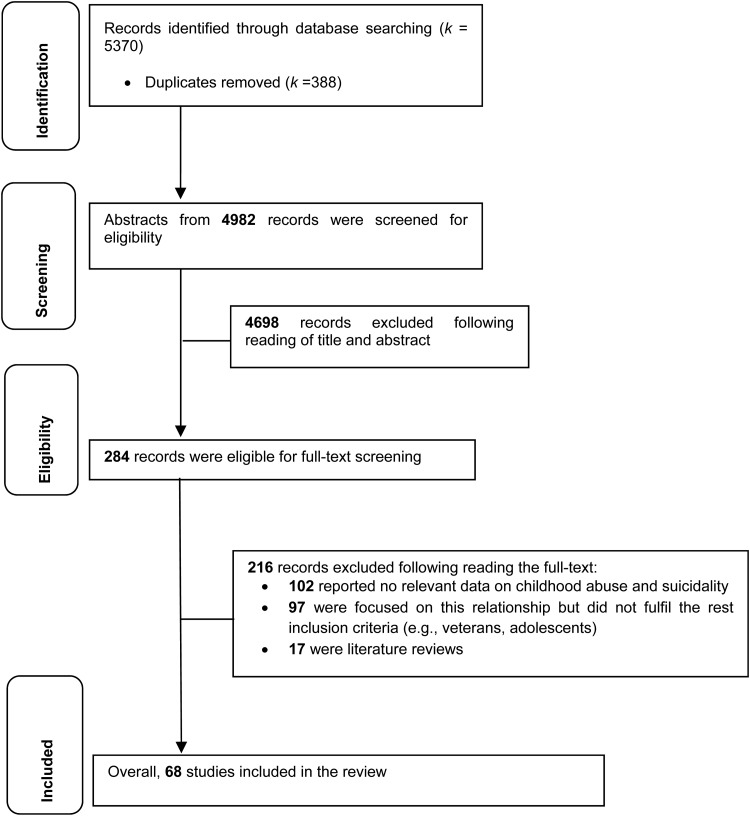
- Included observational quantitative studies in English, peer-reviewed journals, with adults aged 18+ exposed to childhood maltreatment (abuse or neglect) and reporting suicidality outcomes; 68 independent studies were included.
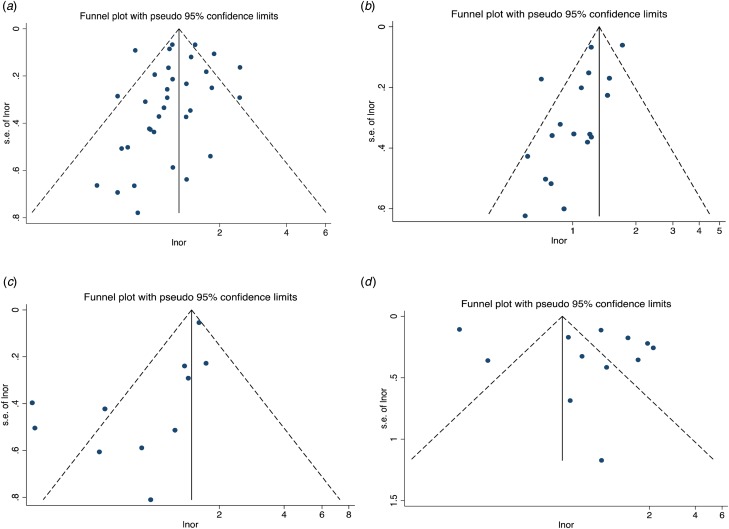
- Used random-effects meta-analysis with odds ratios as the effect size, assessed heterogeneity with I², tested publication bias with funnel plots/Egger’s test, and conducted univariable and multivariable meta-regressions on study-level moderators.
## Limitations
- The paper states that heterogeneity was significant across most analyses, despite use of random-effects models and meta-regression.
- The paper states that findings were derived from English-language peer-reviewed papers only, and one analysis (emotional abuse and suicide attempts) showed possible publication bias, so that result should be interpreted with caution.
- The paper states that many included studies were cross-sectional, limiting causal inference; the text also makes evident that some analyses were based on small numbers of studies, especially neglect outcomes, and that evidence on suicide deaths was sparse.
Model-written summary. Check it against the paper before relying on it.
Integrity signals
Registry
Cites
Statistics
Figures
Verification
Claims the paper makes
0 Valid · 0 Not valid · 9 Not checked · 29 Own results and interpretations
A result the paper reports from its own data — it cites no other source for it, so there is none to check. The quote shows it is in the paper.
In the paper
“emotional abuse (OR 2.49, 95% CI 1.64–3.77)”
- Also stated in: § Main meta-analyses: associations between types of childhood maltreatment and suicide attempts in adults · plain
“physical and emotional abuse were associated with a 2.5-fold increased risk for suicide attempts (k = 30, OR 2.52, 95% CI 2.09–3.04, I2 = 74.3% and k = 12, OR 2.49, 95% CI 1.64–3.77, I2 = 93.2%, respectively)”
§ Childhood maltreatment and adult suicidality: a comprehensive systematic review with meta-analysis > Abstract
plainstates an association- Asserted: passes — The authors put it forward as true.
- Checkable: passes — It can be checked against evidence.
- Load-bearing: passes — The paper’s conclusions depend on it.
- Based: passes — The paper gives a reason why it holds.
- Also stated in: § Main meta-analyses: associations between types of childhood maltreatment and suicide attempts in adults · plain
A result the paper reports from its own data — it cites no other source for it, so there is none to check. The quote shows it is in the paper.
In the paper
“Sexual abuse and emotional abuse were associated with a two-fold increased risk for suicidal ideation (k = 12, OR 2.15, 95% CI 1.77–2.62, I2 = 53.8% and k = 5, OR 2.10, 95% CI 1.51–2.94, I2 = 54.4%, respectively)”
§ Childhood maltreatment and adult suicidality: a comprehensive systematic review with meta-analysis > Results > Secondary meta-analyses: associations between types of childhood maltreatment and suicidal ideation in adults
plainstates an association- Asserted: passes — The authors put it forward as true.
- Checkable: passes — It can be checked against evidence.
- Load-bearing: passes — The paper’s conclusions depend on it.
- Based: passes — The paper gives a reason why it holds.
A result the paper reports from its own data — it cites no other source for it, so there is none to check. The quote shows it is in the paper.
In the paper
“The pooled effects of the main analyses indicate that all types of childhood maltreatment (except for physical neglect which is only based on four studies) were associated with significantly increased odds for suicide attempts in adults (Table 2).”
§ Childhood maltreatment and adult suicidality: a comprehensive systematic review with meta-analysis > Results > Main meta-analyses: associations between types of childhood maltreatment and suicide attempts in adults
hedgedstates an association- Asserted: passes — The authors put it forward as true.
- Checkable: passes — It can be checked against evidence.
- Load-bearing: passes — The paper’s conclusions depend on it.
- Based: passes — The paper gives a reason why it holds.
A result the paper reports from its own data — it cites no other source for it, so there is none to check. The quote shows it is in the paper.
In the paper
“whereas physical and any child abuse were associated with a 2.5-fold increased risk for suicidal ideation (k = 11, OR 2.43, 95% CI 1.85–3.18, I2 = 64.6% and k = 7, OR 2.66, 95% CI 1.93–3.68, I2 = 81.4%, respectively).”
§ Childhood maltreatment and adult suicidality: a comprehensive systematic review with meta-analysis > Results > Secondary meta-analyses: associations between types of childhood maltreatment and suicidal ideation in adults
plainstates an association- Asserted: passes — The authors put it forward as true.
- Checkable: passes — It can be checked against evidence.
- Load-bearing: passes — The paper’s conclusions depend on it.
- Based: passes — The paper gives a reason why it holds.
A result the paper reports from its own data — it cites no other source for it, so there is none to check. The quote shows it is in the paper.
In the paper
“Emotional and physical neglect were associated with 1.5-fold increased risk for suicidal ideation (k = 4, OR 1.40, 95% CI 1.02–1.93, I2 = 80.3% and k = 4, OR 1.44, 95% CI 1.06–1.95, I2 = 70.3%, respectively).”
§ Childhood maltreatment and adult suicidality: a comprehensive systematic review with meta-analysis > Results > Secondary meta-analyses: associations between types of childhood maltreatment and suicidal ideation in adults
plainstates an association- Asserted: passes — The authors put it forward as true.
- Checkable: passes — It can be checked against evidence.
- Load-bearing: passes — The paper’s conclusions depend on it.
- Based: passes — The paper gives a reason why it holds.
24 more claims
Create a free account to see all 38 claims and every source verdict.
- Probably not a substantial claim. 4
- It may state two separate claims as one. 6
Claims other papers make about this one
Each is checked against this paper’s own text: does it say what the citing paper says it does?
The source backs part of the claim, not all of it — or backs it for a different population, condition or comparison.
In the citing paper
“Victims of interpersonal violence, intimate partner violence, sexual violence, and childhood trauma have a substantial increase in likelihood of suicidality.14, 15, 16, 17”
From Global, regional, and national burden of suicide, 1990–2021: a systematic analysis for the Global Burden of Disease Study 2021 (2025) · cites this paper as [15]
Experimental — accuracy not yet measuredThe source backs part of the claim, not all of it — or backs it for a different population, condition or comparison.
In the citing paper
“Exposure to ACEs is associated with a higher risk of mental health disorders and suicidal behaviors in adulthood [6, 7], with a likely cumulative effect [8].”
From Association between adverse childhood experiences and suicidal behavior in affective disorders: A systematic review and meta-analysis (2025) · cites this paper as [6]
Experimental — accuracy not yet measured
Statistics that don’t add up
Each reported p-value recomputed from its test statistic and degrees of freedom, each partial η² from its F, and each ratio, mean difference or B printed with a p checked against its own confidence interval.
Rated major: it would touch a result — a value a result rests on, reported and recomputed p-values on opposite sides of the significance level, two passages that conflict with no sign which is right, or a cited work retracted before this paper was published.
In the paper
“χ2(3) = 3.99, p = 0.02”
§ Childhood maltreatment and adult suicidality: a comprehensive systematic review with meta-analysis > Results > Meta-regressions exploring the variance in the association between childhood maltreatment and suicide attempts
Reported p = .02 · recomputed p = .263
Rated major: it would touch a result — a value a result rests on, reported and recomputed p-values on opposite sides of the significance level, two passages that conflict with no sign which is right, or a cited work retracted before this paper was published.
In the paper
“χ2(3) = 3.11, p = 0.04”
§ Childhood maltreatment and adult suicidality: a comprehensive systematic review with meta-analysis > Results > Meta-regressions exploring the variance in the association between childhood maltreatment and suicide attempts
Reported p = .04 · recomputed p = .375
Statistics recomputed
Every reported test result, recomputed from its test statistic and degrees of freedom. A result shows as not adding up only once an independent check has confirmed it.
- Doesn’t add upχ²(3) = 3.11reported p = .04 · recomputed p = .375The two fall on opposite sides of .05
“χ2(3) = 3.11, p = .04”
- Doesn’t add upχ²(3) = 3.99reported p = .02 · recomputed p = .263The two fall on opposite sides of .05
“χ2(3) = 3.99, p = .02”
Self-check
Percentages, sums and reported differences re-computed from the paper’s own numbers.
Self-check results appear here once an independent check has confirmed them.
Citations
Cites
Preferred Reporting Items for Systematic Reviews and Meta-Analyses: the PRISMA statement
Moher, D., Liberati, A., Tetzlaff, J., Altman, D. G., & for the PRISMA Group (2009) · BMJ · doi:10.1136/bmj.b2535 · Cited by 83,823
Preferred Reporting Items for Systematic Reviews and Meta-Analyses: The PRISMA Statement
Moher, D., Liberati, A., Tetzlaff, J., Altman, D. G., & The PRISMA Group (2009) · PLoS Medicine · doi:10.1371/journal.pmed.1000097 · Cited by 64,042 · cited 2×
“This systematic review and meta-analysis is aligned with the Preferred Reporting Items for Systematic Reviews and MetaAnalyses (PRISMA) statement (Moher et al., 2009) and the Meta-Analysis of Observational Studies in Epidemiology (MOOSE; Stroup et al.”
Measuring inconsistency in meta-analyses
Higgins, J. P. T., Thompson, S. G., Deeks, J. J., & Altman, D. G. (2003) · BMJ · doi:10.1136/bmj.327.7414.557 · Cited by 63,139 · cited 1×
“Analyses were primarily conducted using a random effects model because we anticipated substantial heterogeneity, which was assessed with the I(2) statistic (Higgins et al., 2003).”
MethodBias in meta-analysis detected by a simple, graphical test
Egger, M., Smith, G. D., Schneider, M., & Minder, C. (1997) · BMJ · doi:10.1136/bmj.315.7109.629 · Cited by 56,722
Preferred reporting items for systematic reviews and meta-analyses: the PRISMA Statement.
(2009) · PubMed Central · Cited by 44,859
Dermyshi, E., Wang, Y., Yan, C., Hong, W., Qiu, G., Gong, X., & Zhang, T. (2017) · Neonatology · doi:10.1159/000454668 · Cited by 24,451
Meta-analysis of Observational Studies in Epidemiology<SUBTITLE>A Proposal for Reporting</SUBTITLE>
Stroup, D. F. (2000) · JAMA · doi:10.1001/jama.283.15.2008 · Cited by 20,623
Felitti, V. J., Anda, R. F., Nordenberg, D., Williamson, D. F., Spitz, A. M., Edwards, V., Koss, M. P., & Marks, J. S. (1998) · American Journal of Preventive Medicine · doi:10.1016/s0749-3797(98)00017-8 · Cited by 18,943 · cited 1×
“8% n/r Range = 18–64 5/6 Felitti et al. (1998) United States Crosssectional Questions from published surveys were used to construct the ACE Study questionnaire including the Conflicts Tactics Scale (CTS) and Wyatt (1985) Childhood physical, sexual and psychological abuse Behavioral Risk Factor…”
MethodWang, G., Ma, R., Qiao, G., Wada, K., Aizawa, Y., & Satoh, T. (2015) · Integrative Medicine International · doi:10.1159/000368408 · Cited by 18,657
Duval, S., & Tweedie, R. (2000) · Biometrics · doi:10.1111/j.0006-341x.2000.00455.x · Cited by 14,099 · cited 1×
“In case of possible publication bias, we used the Duval and Tweedie’s trim-and-fill method, which corrects the estimated effect size by yielding an estimate of the number of the missing studies (Duval and Tweedie, 2000).”
Method
Research works printed but not linked: 7
- 2013, Depression and Anxiety, 30, 924
- 2004, Social Psychiatry and Psychiatric Epidemiology, 39, 655
- 2016, Psychological Medicine, 47, 327
- 1991, Psychological Medicine, 121, 713
- 2015, Asia-Pacific Psychiatry, 8, 136
- 2015, Psychiatria Danubina, 27, 236
- 2013, American Journal of Public Health, 103, e69
Cited by
Items 301–400 of 461
Alberdi‐Páramo, Í., Morales-Ríos, H., Tejedor, M. N., Vizoso, J. E. I., Carrasco‐Perera, J. L., & Díaz‐Marsá, M. (2026) · Journal of Affective Disorders · doi:10.1016/j.jad.2026.121340 · Cited by 1
Fiedler, M., Otten, D., Jud, A., Brähler, E., Fegert, J. M., & Clemens, V. (2026) · Child and Adolescent Psychiatry and Mental Health · doi:10.1186/s13034-026-01049-w · Cited by 2
“The model was significant, χ² [9] = 905.4, p .001, indicating that the predictors improved model fit compared to the null model.”
InfluentialLahav, Y., Cloître, M., Shevlin, M. E., Ben‐Ezra, M., & Karatzias, T. (2026) · European Journal of Psychotraumatology · doi:10.1080/20008066.2026.2629213 · Cited by 1
“…dissociation, substance use disorders, eating disorders, nonsuicidal self-injury, sexual dysfunction, suicidality, and trauma-related conditions (Angelakis et al., 2019; Ford & Gómez, 2015; Gewirtz-Meydan & Lahav, 2020a, 2020b; Lindert et al., 2014; Mess-man-Moore & Bhuptani, 2017; Nelson et…”
Xu, W., Li, S., & Pu, Y. (2026) · Archives of Sexual Behavior · doi:10.1007/s10508-025-03401-1 · Cited by 2
“Systematic reviews and meta-analyses have consistently shown a significant association between childhood abuse and suicidal behavior among general population (Angelakis et al., 2019; Liu et al., 2017; Miller et al., 2013).”
Bayrak, N. G., Uzun, S., & Aydoğdu, H. İ. (2026) · Archives of Psychiatric Nursing · doi:10.1016/j.apnu.2026.152118 · Cited by 1
Sui, T., Yeung, J. W. K., & Ma, M. (2026) · Child Abuse & Neglect · doi:10.1016/j.chiabu.2026.108027 · Cited by 1
Long-term consequences of childhood sexual abuse: An umbrella review of diagnostic meta-analyses
Thomas, P., Fauquert, B., Kacenelenbogen, N., Briganti, G., Kornreich, C., & Goderis, G. (2026) · L Encéphale · doi:10.1016/j.encep.2026.02.007 · Cited by 1
Kokaby, P., Akhlaghi, F., & Abed, N. (2026) · OMEGA - Journal of Death and Dying · doi:10.1177/00302228261433119 · Cited by 1
Baglivio, M. T., Jackowski, K., Neupaver, B., Black, G., Perry, B., & Wolff, K. T. (2026) · Journal of Crime and Justice · doi:10.1080/0735648x.2026.2673907 · Cited by 1
Liao, Y.-A., Ni, S.-Y., Chiu, T., & Liu, C. C. (2026) · Frontiers in Psychiatry · doi:10.3389/fpsyt.2026.1857155 · Cited by 1
How Much More Data Do We Need? Making the Case for Investing in Our Children
Berger, R. P., Dalton, E., & Miller, E. P. (2020) · PEDIATRICS · doi:10.1542/peds.2020-031963 · Cited by 1
Suicidality among Youth Exposed to Complex Trauma
Wamser‐Nanney, R. A., & Campbell, C. L. (2022) · Journal of Aggression Maltreatment & Trauma · doi:10.1080/10926771.2022.2068394 · Cited by 2
“…in how aspects of the traumatic event, including the type, age of onset, and duration, relate to risk for suicidality among older adolescents and adults (Angelakis et al., 2020, 2019; Beristianos et al., 2016; Lopez-Castroman et al., 2013), yet, complex trauma exposure has not been investigated.”
BackgroundResultInfluentialYates, K., Lång, U., Peters, E. M., Wigman, J. T. W., Boyda, D., McNicholas, F., Cannon, M. D., Alderson‐Day, B., Bloomfield, M., Ramsay, H., et al. (2022) · Psychological Medicine · doi:10.1017/s0033291722001532 · Cited by 3
“Individuals with a history of sexual assault are at elevated risk of attempted and death by suicide (Angelakis, Gillespie, & Panagioti, 2019; Dworkin et al., 2020; Zatti et al., 2017) but there is a lack of data on risk markers that might identify particularly vulnerable individuals amongst this…”
Mohan, N., Zhu, G., Hassett, A. L., Fatabhoy, M. G., & Pierce, J. M. (2022) · Regional Anesthesia & Pain Medicine · doi:10.1136/rapm-2022-103647 · Cited by 1
Qualitative Study on Experiences of Suicidal Ideation and Behavior among College Students
Jeong, D., & Shim, E. (2022) · Korean Journal of Stress Research · doi:10.17547/kjsr.2022.30.4.204 · Cited by 4
“도, 외상 경험 [7,9,14]이나 자해나 자살시도 경험[9], 혹 은 주변인의 자살경험[10]과 같은 과거력 요인 역시 이 후 자살위험에 영향을 미칠 수 있다.”
Venckute, M. S., Korneeva, Y. A., & Ивановна, Ш. Л. (2023) · Психология и Психотехника · doi:10.7256/2454-0722.2023.4.43594 · Cited by 2
Psychological Approaches to the Acute Patient in PICUs
Kingsley, M. (2024) · Cambridge University Press eBooks · doi:10.1017/9781108976770.019 · Cited by 1
Wang, W., Li, C., Sun, G., Qiu, C., Mao, Z., Wu, Z., Fan, J., Jin, Y., Liu, K., Sun, P. G., et al. (2025) · BMC Public Health · doi:10.1186/s12889-025-22926-7 · Cited by 1
“A recent meta-analysis suggests that childhood trauma experiences can increase the risk of adults attempting suicide by 2–3 times [32].”
Watkeys, O. J., Laurens, K. R., Tzoumakis, S., Dean, K., Harris, F., Cheung, M. M. Y., Carr, V. J., & Green, M. J. (2025) · Australian & New Zealand Journal of Psychiatry · doi:10.1177/00048674251369628 · Cited by 1
“…ideation/self-harm include child maltreatment and contact with the criminal justice system, in addition to familial factors such as parental death, mental illness, criminal offending and welfare recip-ience (Angelakis et al., 2019; Kisely et al., 2024; Thompson et al., 2019; Watkeys et al., 2024).”
Yang, L., Liu, L., Wu, X., & Wang, W. (2025) · Journal of Happiness Studies · doi:10.1007/s10902-025-00983-4 · Cited by 2
“The adverse effects of childhood maltreatment are enduring, often extending into adulthood and leading to various negative outcomes, such as posttraumatic stress symptoms (PTSS), substance abuse, and suicide (Angelakis et al., 2019; Pratchett & Yehuda, 2011; Puetz & McCrory, 2015).”
Suicidality and Interpersonal Violence
Levittan, M. (2020) · Springer eBooks · doi:10.1007/978-3-319-62122-7_330-1 · Cited by 1
Kealy, D., Spidel, A., & Sandhu, S. (2021) · Women & Health · doi:10.1080/03630242.2021.1968097 · Cited by 3
Salciunaite-Nikonove, L., Šmigelskas, K., Žemaitaitytė, M., Sukovienė, G., Šiaulienė, I., Vaišvilė, A., & Žemaitienė, N. (2022) · Child Abuse Review · doi:10.1002/car.2782 · Cited by 2
Effect of Child Abuse on Eating Disorders and Suicidal Behaviors
Lyons, H. (2023) · Themis Research Journal of Justice Studies and Forensic Science · doi:10.55917/2324-6561.1112 · Cited by 1
Hug, J., Prado, A. D. S., Eckert, M., Wundrack, R., Saee, S., Pougin, J., Kohls, E., & Rummel‐Kluge, C. (2025) · SSRN Electronic Journal · doi:10.2139/ssrn.5435595 · Cited by 1
Child Maltreatment: Brief Communication
Macêdo, A. P. D. S., Maia, M. M. L. R., Pereira, I. D. S., Figueiredo, T. M. R., & Neto, M. L. R. (2019) · Amadeus International Multidisciplinary Journal · doi:10.14295/aimj.v4i7.83
Piccole farfalle: abuso sexual na infância e adolescência, suicídio e intervenção
Ribeiro, J. H. D. S. (2019) · International Journal of Developmental and Educational Psychology Revista INFAD de psicología · doi:10.17060/ijodaep.2019.n2.v1.1691 · Cited by 1
Khanjani, M. S., Mosavat, S., Bahmani, B., & Bakhshi, E. (2021) · Iranian Journal of Psychiatry and Clinical Psychology · doi:10.32598/ijpcp.27.1.3187.1
Hemady, C. L., Wong, S. C., Thurston, C., Fry, D. A., Murray, A. L., & Meinck, F. (2021) · Research Square · doi:10.21203/rs.3.rs-457143/v1
“ACEs associations with poor health outcomes across the life course include: anxiety/depressive symptoms, post-traumatic stress disorder, borderline personality disorder, suicidality (Angelakis et al., 2019; Dube et al., 2003; Grasso et al., 2016; Herzog & Schmahl, 2018; Kessler et al., 2005; Widom et al., 2006); obesi…”
BackgroundSuicide as a Systemic Disorder
Lengvenytė, A., Olié, É., & Courtet, P. (2021) · Springer eBooks · doi:10.1007/978-3-030-71229-7_19
Watanabe, M. (2020) · Cited by 1
NYIRIMANA, V., RUTAKAYILE, B., Mudenge, C., Musafili, A., Cassady, C., & Yubahwe, J. (2021) · Research Square · doi:10.21203/rs.3.rs-701678/v1
“However, male individuals with history of sexual abuse are more likely to develop psychopathology such as mood disorders and suicidal behaviours than their counterparts (Angelakis et al., 2019; A. B. Miller et al., 2013).”
BackgroundPries, L.-K., T. TwinssCan investigators, Rutten, B. P. F., van Os, J., & Gülöksüz, S. (2021) · European Neuropsychopharmacology · doi:10.1016/j.euroneuro.2021.10.728
The statistical logic of suicide terrorismPreprint
Varaine, S. (2020) · doi:10.31234/osf.io/sgfje
Hemady, C. L., Wong, S. C., Thurston, C., Fry, D. A., Murray, A. L., & Meinck, F. (2021) · Research Square · doi:10.21203/rs.3.rs-457143/v2
Santo, M. A. D. S., & Dell’Aglio, D. D. (2022) · Aletheia · doi:10.29327/226091.55.1-1 · Cited by 1
Aggression und Gewalt in der Familie
Krahé, B. (2022) · Springer eBooks · doi:10.1007/978-3-658-35215-8_20-1
Suicidal Risk Across the Life Span: A Developmental Perspective
Orri, M., Turecki, G., & Geoffroy, M. (2022) · Springer eBooks · doi:10.1007/978-3-030-41319-4_97-1
Xiao, Z., Obsuth, I., Meinck, F., & Murray, A. L. (2022) · doi:10.31234/osf.io/t4hr3
PTSD increases suicide risk in the community especially for young women from deprived communities
Angelakis, I., & Panagioti, M. (2022) · Evidence-Based Nursing · doi:10.1136/ebnurs-2022-103531
Self-citationCollins, N. J., Campbell, T. S., Donoghue, K. M., Ghosh, U., Smith, J. N., O’Shea, M. C., Nelson, C. M., Bigham, O. K., & Roth, T. L. (2022) · Molecular Psychology Brain Behavior and Society · doi:10.12688/molpsychol.17482.1 · Cited by 6
“, 2009), suicidal ideation or attempts (Angelakis et al., 2019; Sekowski et al., 2020), and a perpetuation of abuse and neglect into the next generation (Greene et al.”
BackgroundSuicide in Context: What Places Students at Risk
Granello, D. H., Granello, P. F., & Juhnke, G. A. (2022) · Oxford University Press eBooks · doi:10.1093/oso/9780190059842.003.0003
Suicidal Risk Across the Life Span: A Developmental Perspective
Orri, M., Turecki, G., & Geoffroy, M. (2022) · Springer eBooks · doi:10.1007/978-3-030-42003-1_97
Folgeprobleme nach frühen traumatischen Erlebnissen
Straub, R. H. (2022) · Springer eBooks · doi:10.1007/978-3-662-65238-1_3
Consequences of Early Traumatic Experiences
Straub, R. H. (2023) · Springer eBooks · doi:10.1007/978-3-662-66751-4_3
Scardera, S., Langevin, R., Collin-Vézina, D., Cabana, M. C., Pereira, S. P. P., Côté, S., Ouellet-Morin, I., & Geoffroy, M. (2023) · medRxiv · doi:10.1101/2023.04.05.23288127
“Additionally, most research on child maltreatment and later outcomes has focused on physical and sexual abuse (Angelakis et al., 2019; Baldwin et al., 2019; Norman et al., 2012).”
BackgroundFogarty, A., Savopoulos, P., Jones, A., McMahon, G., Evans, K., O’Brien, J., O'Dea, L., Clout, P., & Giallo, R. (2023) · Child & Family Social Work · doi:10.1111/cfs.13036
Kang, J., Qu, J., & Zhou, Z. (2023) · Lecture Notes in Education Psychology and Public Media · doi:10.54254/2753-7048/6/20220667
Moraes, S. M., Júnior, A. D. C. P., dos Santos, L. N., Lima, K. H. M., Vedana, K. G. G., & Tucci, A. M. (2023) · Research Society and Development · doi:10.33448/rsd-v12i5.41495 · Cited by 1
Violence against children and its psychological consequences during their development
LIRA, A. L. F., Santana, S. S., & Deininger, L. D. S. C. (2023) · doi:10.56238/seveniiimulti2023-205
زيد, أ. م. ج. ا. أ. (2023) · مجلة الإرشاد النفسی · doi:10.21608/cpc.2023.316493
Childhood trauma: Unfolding the lifelong impact on mental health
Kuzminskaite, E. (2023) · doi:10.5463/thesis.371 · Cited by 5
The complexity of mental healthcare and its consequences for doing good
Smit, E. H. (2023) · Utrecht University Repository (Utrecht University) · doi:10.33540/1907
Risk Factors for Revictimization
Fereidooni, F. (2023) · University of Groningen research database (University of Groningen / Centre for Information Technology) · doi:10.33612/diss.816092202
Neighborhood Informal Social Control in Preventing Child Maltreatment: Focusing on AdolescentsPreprint
Jeon, J., Kim, J. Y., Emery, C. R., & Hwang, S. G. (2024) · SSRN Electronic Journal · doi:10.2139/ssrn.4664175
Oer, DEVELOPING HER VOICE: A Heroine’s Journey to Literary Individuation through Speculative Fiction
Rose, H. (2024) · Cronfa (Swansea University) · doi:10.23889/suthesis.65402
Upstream Approaches for Suicide Prevention Using Search-Based Advertising: A Pilot StudyPreprint
Ono, S., Sueki, H., Nakahara, T., et al. (2024) · doi:10.31234/osf.io/49rhz
Gunnarsdottir, E., Sigurdardottir, S. L., & Jónsdóttir, Þ. (2022) · Journal of Yoga and Physiotherapy · doi:10.19080/jyp.2022.09.555763
The Impact Child Abuse Has on Well-Being Throughout the Life Course
Haug, S. M. (2024) · Advances in early childhood and K-12 education · doi:10.4018/979-8-3693-1451-7.ch013
Emergence of Abnormal Psychology Following Different Forms of Abuse and Neglect
Bennett, M. R. (2024) · Springer eBooks · doi:10.1007/978-981-97-2803-9_2
Tang, M., Rodriguez, V. J., Stanton, A. M., Trichtinger, L. A., Yung, A., & Liu, Q. (2024) · PsyArXiv (OSF Preprints) · doi:10.31234/osf.io/usw4v
Childhood maltreatment and anger expression in adulthood: A systematic review and meta-analysisPreprint
Lynch, M., Curtis, A., Ahern, E., et al. (2024) · doi:10.31234/osf.io/em62u
Doi, S. K., Nawa, N., Yamaoka, Y., Nishimura, H., Koyama, Y., Kuramochi, J., & Fujiwara, T. (2024) · Journal of Public Mental Health · doi:10.1108/jpmh-06-2024-0067
Angelakis, I. (2024) · Evidence-Based Nursing · doi:10.1136/ebnurs-2024-104133
Self-citationVictimization of children through verbal abuse
Stevanović, N., & Suknović, M. S. (2024) · Bezbednost Beograd · doi:10.5937/bezbednost2403157s · Cited by 1
Association Between Adolescent Violence Exposure and the Risk of Suicide: A 15-Year Study in Taiwan
Sung, C., Chung, C., Sun, C., Tsao, C., Ng, D. Y., Weng, T., Fann, L.-Y., Lin, F., & Chien, W. (2024) · Children · doi:10.3390/children12010010 · Cited by 3
“The Schematic Appraisals Model for Suicide posits that negative childhood experiences can foster a growing sense of self-defeat, ultimately leading individuals to perceive suicidality as an escape mechanism [28,29].”
Angelakis, I. (2025) · Evidence-Based Nursing · doi:10.1136/ebnurs-2024-104087
Self-citationDurbha, S., Moore, J. X., Kashyap, N., Brown, S., & Pandey, A. (2025) · Child Protection and Practice · doi:10.1016/j.chipro.2025.100117
Fernández, A. G., Brenlla, M. E., Caro‐Cañizares, I., Esteban, A. C., & Carballo, J. J. (2025) · Early Intervention in Psychiatry · doi:10.1111/eip.70022
“On the other hand, certain socio-demographic risk factors, such as age, gender or the experience of stressful life events [SLEs] (Angelakis et al. 2019; Liu and Miller 2014; Serafini et al. 2015), are closely related to suicidal risk.”
Javakhishvili, M., & Widom, C. S. (2025) · Journal of Studies on Alcohol and Drugs · doi:10.15288/jsad.24-00266
Predictors of Suicide Attempts and Reattempts in a Sample of Chilean Adolescents
Escobedo-Aedo, P. J., Méndez-Bustos, P., Álvarez-García, R., Baca‐García, E., & Porras‐Segovia, A. (2025) · Early Intervention in Psychiatry · doi:10.1111/eip.70024 · Cited by 3
Exploring Childhood Challenges and Male Suicide Risk: Findings From a Global Survey
Bennett, S., Robb, K. A., Adán-González, R., Zortea, T. C., & O’Connor, R. C. (2025) · The Journal of Men s Studies · doi:10.1177/10608265251329358 · Cited by 2
“A recent systematic review and meta-analysis of mixed-gender studies exploring different types of childhood neglect and abuse found every type of adversity increased the risk of suicidal thoughts and attempts, irrespective of gender (Angelakis et al., 2019).”
InfluentialLee, W.-Y., Liu, G.-H., Fang, J., Chen, N., Wu, K.-Y., Lin, C., Huang, C., Chen, P.-J., Lee, T. M. C., & Lee, S. (2025) · American Journal of Geriatric Psychiatry · doi:10.1016/j.jagp.2025.03.011
War Trauma and Suicidal Behaviour
Mirza, S. A., Melhem, N., Leckman, J. F., & Khan, M. M. (2025) · Springer eBooks · doi:10.1007/978-981-96-4028-7_7
Emotional and Physical Pain Responses in Children Who Suffer Verbal Abuse
Xu, Y. (2025) · Communications in Humanities Research · doi:10.54254/2753-7064/2024.23316
Adverse Childhood Experiences and Suicidal Ideation Among Korean Unwed Mothers
Kang, H., & Lee, J. O. (2025) · The Family Journal · doi:10.1177/10664807251343895
Petersdorfer, K., & Mantl, G. (2025) · Psychotherapie Forum · doi:10.1007/s00729-025-00284-4
Iverson, G. L. (2025) · Scandinavian Journal of Medicine and Science in Sports · doi:10.1111/sms.70086
Adverse childhood experiences: terms, concepts, and study methods
Shumskaia, D. S., Trusova, A. V., & Kibitov, A. O. (2025) · V M BEKHTEREV REVIEW OF PSYCHIATRY AND MEDICAL PSYCHOLOGY · doi:10.31363/2313-7053-2025-3-1058 · Cited by 1
Association of family dysfunction childhood adversities and lifetime attempts in men and women
Husky, M. M., Léon, C., & Vasiliadis, H. (2025) · Journal of Affective Disorders · doi:10.1016/j.jad.2025.120012
Shen, A., Huang, Y., Zou, H., Zhai, Q., Gong, W., Wang, Y., Shi, K., Song, M., Xia, Q., Yao, Z., et al. (2025) · Progress in Neuro-Psychopharmacology and Biological Psychiatry · doi:10.1016/j.pnpbp.2025.111488
Hoekstra, S., Lommen, M. J. J., Warrens, M. J., Visser, E., Doornbos, B., & Cath, D. C. (2025) · BMC Psychiatry · doi:10.1186/s12888-025-07346-6 · Cited by 1
“Meta-analyses have shown associations with adolescence and adult psychiatric disorders, including depression [3], anxiety disorders [4], suicidality and suicidal ideation [5], non-suicidal self-injury [6] and substance use disorder [7].”
Barathie, J. A., Wakim, M.-L. T., Allabaky, J., Osman, R., & Karam, E. G. (2025) · International Journal of Public Health · doi:10.3389/ijph.2025.1608725
“This aligns with literature identifying emotional neglect as a powerful risk factor [82, 92, 93], potentially due to its lasting impact on emotional development and self-perception [80].”
Trauma-Informed Approaches to Suicide Prevention: A Scoping Review
Ferguson, M. S., Loughhead, M., McIntyre, H., & Procter, N. G. (2025) · Crisis · doi:10.1027/0227-5910/a001031
Liu, Q., Ma, H., Li, J., Chen, M., Zhang, Y., Tang, Z., Du, X., & Ye, G. (2025) · BMC Psychiatry · doi:10.1186/s12888-025-07674-7
Peñuelas‐Calvo, I., Taracena-Cuerda, M., Moreno, M., Cabrera-Redondo, S., Álvarez-González, V., Puente-García, R., Quintana-Saiz, B., Bidón, A. J., & Porras‐Segovia, A. (2025) · Journal of Clinical Medicine · doi:10.3390/jcm14248705
“One of the most studied of these is childhood trauma, which affects up to 30% of the general population [6,7].”
More focus is needed on childhood sexual abuse to combat Australia’s suicide problem
Wyles, P., O’Leary, P., & Wilde, T. (2025) · doi:10.64628/aa.7apvqj67j
Halim, M. R. T. A., Nor, S. A. M., Hassan, H., Ibrahim, N., & Idris, F. (2025) · Multidisciplinary Reviews · doi:10.31893/multirev.2026288
Childhood maltreatment and suicidal behaviors among heterosexual and sexual minority youth in China
Zhang, C., Zhang, N., Xu, Z., Hu, J., Guan, M., Zhang, L., Dai, Y., An, W., Yin, Z., Zhang, Y., et al. (2025) · Child Abuse & Neglect · doi:10.1016/j.chiabu.2025.107867
Early stress, impulsivity and suicidal behavior in users of psychoactive substances
Júnior, E. B. C. (2020) · LA Referencia (Red Federada de Repositorios Institucionales de Publicaciones Científicas)
Komura, Y., Ema, S., Nomura, N., Kodama, K., Takabatake, S., Misawa, F., & Takeuchi, H. (2026) · Journal of Psychiatric Research · doi:10.1016/j.jpsychires.2026.01.025
Belbèze, J., Silva, J., Corcos, M., & Robin, M. (2026) · Child Abuse & Neglect · doi:10.1016/j.chiabu.2025.107871
Prado, A. D. S., Hug, J., Eckert, M., Wundrack, R., Saee, S., Pougin, J., Kohls, E., & Rummel‐Kluge, C. (2026) · Child Abuse & Neglect · doi:10.1016/j.chiabu.2026.107924
Hong, K., Alvarez-Rodriguez, R., & Villodas, M. T. (2026) · Clinical Child and Family Psychology Review · doi:10.1007/s10567-026-00556-8
Soh, C. P., Szuhany, K. L., & Zainal, N. H. (2026) · Clinical Psychology & Psychotherapy · doi:10.1002/cpp.70232 · Cited by 1
“Meta-analyses indicated that exposure to childhood sexual, emotional or physical abuse conferred two to three times higher odds of adult suicide attempts (Angelakis et al. 2019) and small to medium associations with adulthood anxiety, depression and suicidal ideation (Xiao et al. 2023).”
Tan, J., Ziobrowski, H. N., & Zainal, N. H. (2026) · Child Abuse & Neglect · doi:10.1016/j.chiabu.2026.107926
“…more parent-perpetrated child abuse encounters are associated with elevated risks of suicidality, as shown in a meta-analysis of 68 cross-sectional studies, which reported increased odds of suicidal thoughts and behaviors in adulthood among those with histories of abuse (Angelakis et al., 2019).”
Child Maltreatment and Development
Sullivan, J. A., Frost-Helms, C. V., Basting, E. J., Kwak, J. E., Poole, E. J., Jensen, M. C., Son, S. W. J., Medenblik, A. M., & Stuart, G. L. (2026) · Springer eBooks · doi:10.1007/978-3-030-85493-5_1857-1
Miola, A., Tondo, L., & Baldessarini, R. J. (2026) · Journal of Psychiatric Research · doi:10.1016/j.jpsychires.2026.03.006 · Cited by 4
Prevalence of Adverse Childhood Experiences and Suicidal Ideation Among Bhutanese Adolescents
Dorji, T., Nima, P., & Dema, T. (2026) · Journal of Child & Adolescent Trauma · doi:10.1007/s40653-026-00821-6
Bae, H., Yim, M., Kim, G., & Hur, J. (2026) · BMC Psychology · doi:10.1186/s40359-026-04075-7 · Cited by 2
“The long-term psychological sequelae are pervasive, including elevated risks for depression and anxiety [7], post-traumatic stress disorder (PTSD) [8], suicidal ideation [9], and suicide attempts [10], all contributing significantly to the global burden of disease [11].”
Metadata
- Authors
- Angelakis, I., Gillespie, E. L., & Panagioti, M.
- Affiliations
- University of South Wales (GB)
- Manchester Academic Health Science Centre (GB)
- Corresponding author
- Angelakis, Ioannis
- Venue
- Psychological Medicine
- Publisher
- Cambridge University Press (CUP)
- Published
- 2019-01-04
- Volume
- 49
- Issue
- 07
- Pages
- 1057-1078
- ISSN
- 0033-2917 (ISSN-L)
- 1469-8978
- PMC
- PMC6498789
- OpenAlex
- W2908364980
- Cited by
- 479
- References
- 102
- Citations by year
- 2026: 94 · 2025: 86 · 2024: 64 · 2023: 68 · 2022: 60 · 2021: 55 · 2020: 37 · 2019: 14
- FWCI
- 6.54
- Type
- journal article
- Language
- en
- Open access
- hybrid
- doi.org
- Locations
- Psychological Medicine (publishedVersion, cc-by)
- PubMed Central (publishedVersion, cc-by)
- PubMed (publishedVersion)
- Research Explorer (The University of Manchester) (publishedVersion, cc-by)
- Topics
- Social Sciences › Psychology › Clinical Psychology › Child Abuse and Trauma
- Social Sciences › Psychology › Clinical Psychology › Suicide and Self-Harm Studies
- Social Sciences › Sociology and Political Science › Homicide, Infanticide, and Child Abuse
- Keywords
- child abuse, suicidality, suicide attempts, suicidal ideation, sexual abuse, physical abuse, emotional abuse, adult mental health
- MeSH terms
- Adverse Childhood Experiences, Correlation of Data, Adolescent, Adult, Child, Child Abuse, Child Abuse, Sexual, Female, Humans, Male, Middle Aged, Prisoners, Risk, Suicide, Suicide, Attempted, Prevalence, Odds Ratio, Young Adult, Suicidal Ideation
About these checks
Registry, retraction, Cites and statistics results are computed, not judged, with one exception: a printed reference that no index lists is read once by a model before it counts as a citation error. Claims are extracted by a model and kept only when their quote appears verbatim in the text; each cited source is then checked, with a model’s help, for whether it says what the claim relies on. Those verdicts can be wrong — read the claim’s quote and the cited source before relying on one.
A language model drew the claims from the paper on 2026-10-09, under version 3 of the claim definition (model deepseek-v4.1-flash, prompt extract-v3).
A second model labelled each claim on 2026-10-09 (model jev-1.13-20260917, definition revision gold-guideline-v0.2).
Statistics and arithmetic are recomputed, not judged.
Confidence bands are shown only for fields calibrated on our annotated test set. None is calibrated yet, so no band is shown.
What counts as a claim ›How we measure confidence ›How we check this ›
Are you an author, or do you see a problem with this page? Request a review
Data sources
Bibliographic data: Semantic Scholar, OpenAlex, Crossref.
Contains information from the Semantic Scholar Academic Graph Datasets, made available under the ODC Attribution License (ODC-BY 1.0).
Semantic Scholar’s data is described in: Kinney, R., et al. (2023). The Semantic Scholar Open Data Platform. arXiv:2301.10140.
