

Childhood maltreatment and adult suicidality: a comprehensive systematic review with meta-analysis
Open accessThe DOI matches its Crossref record; 100 of the 102 references it cites were found in a registry or an index; none of the 16 sources its claims cite is checked for support yet.
Abstract
This comprehensive systematic review and meta-analysis aims to quantify the association between different types of childhood maltreatment and suicidality. We searched five bibliographic databases, including Medline, PsychINFO, Embase, Web of Science and CINAHL, until January 2018. Random-effects meta-analysis was employed followed by univariable and multivariable meta-regressions. Heterogeneity was quantified using the I2 statistic and formal publication bias tests were undertaken. The methodological quality of the studies was critically appraised and accounted in the meta-regression analyses. Data from 68 studies based on n = 261.660 adults were pooled. All different types of childhood maltreatment including sexual abuse [odds ratio (OR) 3.17, 95% confidence interval (CI) 2.76-3.64], physical abuse (OR 2.52, 95% CI 2.09-3.04) and emotional abuse (OR 2.49, 95% CI 1.64-3.77) were associated with two- to three-fold increased risk for suicide attempts. Similar results were found for the association between childhood maltreatment and suicidal ideation. Complex childhood abuse was associated with a particularly high risk for suicide attempts in adults (OR 5.18, 95% CI 2.52-10.63). Variations across the studies in terms of demographic and clinical characteristics of the participants and other core methodological factors did not affect the findings of the main analyses. We conclude that there is solid evidence that childhood maltreatment is associated with increased odds for suicidality in adults. The main outstanding challenge is to better understand the mechanisms which underpin the development of suicidality in people exposed to childhood maltreatment because current evidence is scarce.
Overview
CoChat Summary
## TL;DR
This systematic review and meta-analysis found that childhood maltreatment is associated with substantially higher odds of adult suicidality, including both suicide attempts and suicidal ideation. Across 68 studies and 261,660 adults, sexual, physical, emotional abuse, and neglect were generally linked to about two- to three-fold increased risk, with complex abuse showing the strongest association.
## Key findings
- Across 68 studies including 261,660 adults, all main maltreatment types were associated with increased odds of suicide attempts: sexual abuse (OR 3.17, 95% CI 2.76–3.64; k = 36), physical abuse (OR 2.52, 95% CI 2.09–3.04; k = 30), emotional abuse (OR 2.49, 95% CI 1.64–3.77; k = 12), emotional neglect (OR 2.29, 95% CI 1.79–2.94; k = 6), and any child abuse (OR 2.09, 95% CI 1.67–2.60; k = 16).
- Complex abuse in childhood had the strongest association with adult suicide attempts (OR 5.18, 95% CI 2.52–10.63; k = 7).
- For suicidal ideation, all maltreatment types were also associated with increased odds: sexual abuse (OR 2.15, 95% CI 1.77–2.62; k = 12), emotional abuse (OR 2.10, 95% CI 1.51–2.94; k = 5), physical abuse (OR 2.43, 95% CI 1.85–3.18; k = 11), any child abuse (OR 2.66, 95% CI 1.93–3.68; k = 7), emotional neglect (OR 1.40, 95% CI 1.02–1.93; k = 4), and physical neglect (OR 1.44, 95% CI 1.06–1.95; k = 4).
- In meta-regression, age moderated the association between physical abuse and suicide attempts (older participants showed a stronger association), and population appeared to matter for sexual abuse and suicide attempts but did not reach significance in the multivariable model.
## Methods
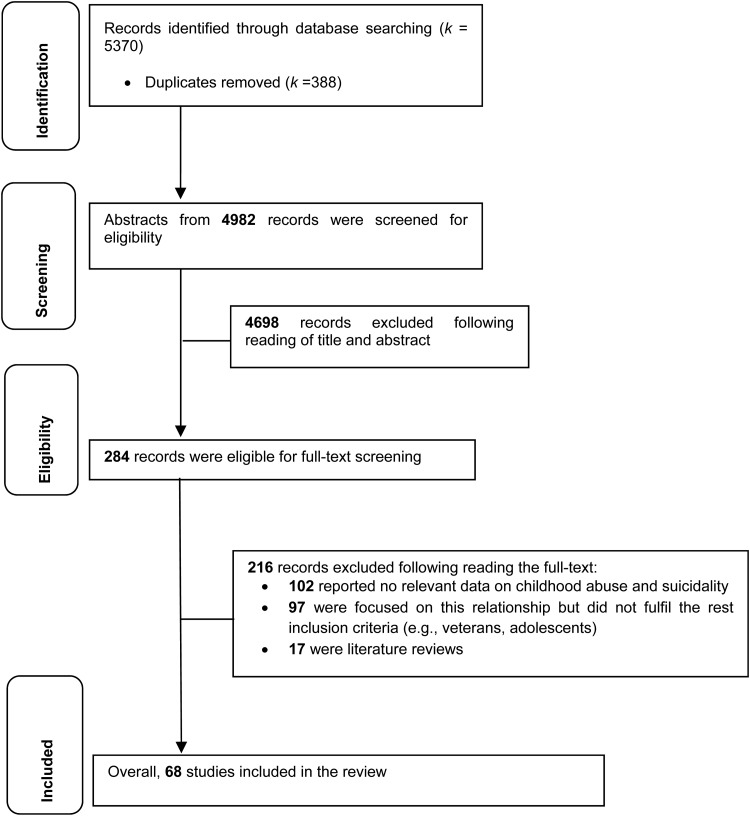
- Systematic review and meta-analysis following PRISMA and MOOSE, searching Medline, PsycINFO, Embase, Web of Science, and CINAHL up to 25 January 2018, plus reference checking and author contact.
- Included observational quantitative studies in English, peer-reviewed journals, with adults aged 18+ exposed to childhood maltreatment (abuse or neglect) and reporting suicidality outcomes; 68 independent studies were included.
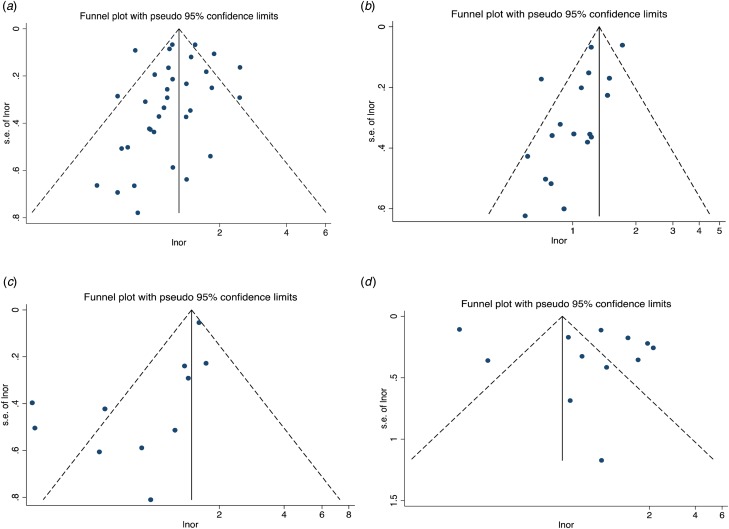
- Used random-effects meta-analysis with odds ratios as the effect size, assessed heterogeneity with I², tested publication bias with funnel plots/Egger’s test, and conducted univariable and multivariable meta-regressions on study-level moderators.
## Limitations
- The paper states that heterogeneity was significant across most analyses, despite use of random-effects models and meta-regression.
- The paper states that findings were derived from English-language peer-reviewed papers only, and one analysis (emotional abuse and suicide attempts) showed possible publication bias, so that result should be interpreted with caution.
- The paper states that many included studies were cross-sectional, limiting causal inference; the text also makes evident that some analyses were based on small numbers of studies, especially neglect outcomes, and that evidence on suicide deaths was sparse.
Model-written summary. Check it against the paper before relying on it.
Integrity signals
Registry
Cites
Statistics
Figures
Verification
Claims the paper makes
0 Valid · 0 Not valid · 9 Not checked · 29 Own results and interpretations
A result the paper reports from its own data — it cites no other source for it, so there is none to check. The quote shows it is in the paper.
In the paper
“emotional abuse (OR 2.49, 95% CI 1.64–3.77)”
- Also stated in: § Main meta-analyses: associations between types of childhood maltreatment and suicide attempts in adults · plain
“physical and emotional abuse were associated with a 2.5-fold increased risk for suicide attempts (k = 30, OR 2.52, 95% CI 2.09–3.04, I2 = 74.3% and k = 12, OR 2.49, 95% CI 1.64–3.77, I2 = 93.2%, respectively)”
§ Childhood maltreatment and adult suicidality: a comprehensive systematic review with meta-analysis > Abstract
plainstates an association- Asserted: passes — The authors put it forward as true.
- Checkable: passes — It can be checked against evidence.
- Load-bearing: passes — The paper’s conclusions depend on it.
- Based: passes — The paper gives a reason why it holds.
- Also stated in: § Main meta-analyses: associations between types of childhood maltreatment and suicide attempts in adults · plain
A result the paper reports from its own data — it cites no other source for it, so there is none to check. The quote shows it is in the paper.
In the paper
“Sexual abuse and emotional abuse were associated with a two-fold increased risk for suicidal ideation (k = 12, OR 2.15, 95% CI 1.77–2.62, I2 = 53.8% and k = 5, OR 2.10, 95% CI 1.51–2.94, I2 = 54.4%, respectively)”
§ Childhood maltreatment and adult suicidality: a comprehensive systematic review with meta-analysis > Results > Secondary meta-analyses: associations between types of childhood maltreatment and suicidal ideation in adults
plainstates an association- Asserted: passes — The authors put it forward as true.
- Checkable: passes — It can be checked against evidence.
- Load-bearing: passes — The paper’s conclusions depend on it.
- Based: passes — The paper gives a reason why it holds.
A result the paper reports from its own data — it cites no other source for it, so there is none to check. The quote shows it is in the paper.
In the paper
“The pooled effects of the main analyses indicate that all types of childhood maltreatment (except for physical neglect which is only based on four studies) were associated with significantly increased odds for suicide attempts in adults (Table 2).”
§ Childhood maltreatment and adult suicidality: a comprehensive systematic review with meta-analysis > Results > Main meta-analyses: associations between types of childhood maltreatment and suicide attempts in adults
hedgedstates an association- Asserted: passes — The authors put it forward as true.
- Checkable: passes — It can be checked against evidence.
- Load-bearing: passes — The paper’s conclusions depend on it.
- Based: passes — The paper gives a reason why it holds.
A result the paper reports from its own data — it cites no other source for it, so there is none to check. The quote shows it is in the paper.
In the paper
“whereas physical and any child abuse were associated with a 2.5-fold increased risk for suicidal ideation (k = 11, OR 2.43, 95% CI 1.85–3.18, I2 = 64.6% and k = 7, OR 2.66, 95% CI 1.93–3.68, I2 = 81.4%, respectively).”
§ Childhood maltreatment and adult suicidality: a comprehensive systematic review with meta-analysis > Results > Secondary meta-analyses: associations between types of childhood maltreatment and suicidal ideation in adults
plainstates an association- Asserted: passes — The authors put it forward as true.
- Checkable: passes — It can be checked against evidence.
- Load-bearing: passes — The paper’s conclusions depend on it.
- Based: passes — The paper gives a reason why it holds.
A result the paper reports from its own data — it cites no other source for it, so there is none to check. The quote shows it is in the paper.
In the paper
“Emotional and physical neglect were associated with 1.5-fold increased risk for suicidal ideation (k = 4, OR 1.40, 95% CI 1.02–1.93, I2 = 80.3% and k = 4, OR 1.44, 95% CI 1.06–1.95, I2 = 70.3%, respectively).”
§ Childhood maltreatment and adult suicidality: a comprehensive systematic review with meta-analysis > Results > Secondary meta-analyses: associations between types of childhood maltreatment and suicidal ideation in adults
plainstates an association- Asserted: passes — The authors put it forward as true.
- Checkable: passes — It can be checked against evidence.
- Load-bearing: passes — The paper’s conclusions depend on it.
- Based: passes — The paper gives a reason why it holds.
24 more claims
Create a free account to see all 38 claims and every source verdict.
- Probably not a substantial claim. 4
- It may state two separate claims as one. 6
Claims other papers make about this one
Each is checked against this paper’s own text: does it say what the citing paper says it does?
The source backs part of the claim, not all of it — or backs it for a different population, condition or comparison.
In the citing paper
“Victims of interpersonal violence, intimate partner violence, sexual violence, and childhood trauma have a substantial increase in likelihood of suicidality.14, 15, 16, 17”
From Global, regional, and national burden of suicide, 1990–2021: a systematic analysis for the Global Burden of Disease Study 2021 (2025) · cites this paper as [15]
Experimental — accuracy not yet measuredThe source backs part of the claim, not all of it — or backs it for a different population, condition or comparison.
In the citing paper
“Exposure to ACEs is associated with a higher risk of mental health disorders and suicidal behaviors in adulthood [6, 7], with a likely cumulative effect [8].”
From Association between adverse childhood experiences and suicidal behavior in affective disorders: A systematic review and meta-analysis (2025) · cites this paper as [6]
Experimental — accuracy not yet measured
Statistics that don’t add up
Each reported p-value recomputed from its test statistic and degrees of freedom, each partial η² from its F, and each ratio, mean difference or B printed with a p checked against its own confidence interval.
Rated major: it would touch a result — a value a result rests on, reported and recomputed p-values on opposite sides of the significance level, two passages that conflict with no sign which is right, or a cited work retracted before this paper was published.
In the paper
“χ2(3) = 3.99, p = 0.02”
§ Childhood maltreatment and adult suicidality: a comprehensive systematic review with meta-analysis > Results > Meta-regressions exploring the variance in the association between childhood maltreatment and suicide attempts
Reported p = .02 · recomputed p = .263
Rated major: it would touch a result — a value a result rests on, reported and recomputed p-values on opposite sides of the significance level, two passages that conflict with no sign which is right, or a cited work retracted before this paper was published.
In the paper
“χ2(3) = 3.11, p = 0.04”
§ Childhood maltreatment and adult suicidality: a comprehensive systematic review with meta-analysis > Results > Meta-regressions exploring the variance in the association between childhood maltreatment and suicide attempts
Reported p = .04 · recomputed p = .375
Statistics recomputed
Every reported test result, recomputed from its test statistic and degrees of freedom. A result shows as not adding up only once an independent check has confirmed it.
- Doesn’t add upχ²(3) = 3.11reported p = .04 · recomputed p = .375The two fall on opposite sides of .05
“χ2(3) = 3.11, p = .04”
- Doesn’t add upχ²(3) = 3.99reported p = .02 · recomputed p = .263The two fall on opposite sides of .05
“χ2(3) = 3.99, p = .02”
Self-check
Percentages, sums and reported differences re-computed from the paper’s own numbers.
Self-check results appear here once an independent check has confirmed them.
Citations
Cites
Preferred Reporting Items for Systematic Reviews and Meta-Analyses: the PRISMA statement
Moher, D., Liberati, A., Tetzlaff, J., Altman, D. G., & for the PRISMA Group (2009) · BMJ · doi:10.1136/bmj.b2535 · Cited by 83,823
Preferred Reporting Items for Systematic Reviews and Meta-Analyses: The PRISMA Statement
Moher, D., Liberati, A., Tetzlaff, J., Altman, D. G., & The PRISMA Group (2009) · PLoS Medicine · doi:10.1371/journal.pmed.1000097 · Cited by 64,042 · cited 2×
“This systematic review and meta-analysis is aligned with the Preferred Reporting Items for Systematic Reviews and MetaAnalyses (PRISMA) statement (Moher et al., 2009) and the Meta-Analysis of Observational Studies in Epidemiology (MOOSE; Stroup et al.”
Measuring inconsistency in meta-analyses
Higgins, J. P. T., Thompson, S. G., Deeks, J. J., & Altman, D. G. (2003) · BMJ · doi:10.1136/bmj.327.7414.557 · Cited by 63,139 · cited 1×
“Analyses were primarily conducted using a random effects model because we anticipated substantial heterogeneity, which was assessed with the I(2) statistic (Higgins et al., 2003).”
MethodBias in meta-analysis detected by a simple, graphical test
Egger, M., Smith, G. D., Schneider, M., & Minder, C. (1997) · BMJ · doi:10.1136/bmj.315.7109.629 · Cited by 56,722
Preferred reporting items for systematic reviews and meta-analyses: the PRISMA Statement.
(2009) · PubMed Central · Cited by 44,859
Dermyshi, E., Wang, Y., Yan, C., Hong, W., Qiu, G., Gong, X., & Zhang, T. (2017) · Neonatology · doi:10.1159/000454668 · Cited by 24,451
Meta-analysis of Observational Studies in Epidemiology<SUBTITLE>A Proposal for Reporting</SUBTITLE>
Stroup, D. F. (2000) · JAMA · doi:10.1001/jama.283.15.2008 · Cited by 20,623
Felitti, V. J., Anda, R. F., Nordenberg, D., Williamson, D. F., Spitz, A. M., Edwards, V., Koss, M. P., & Marks, J. S. (1998) · American Journal of Preventive Medicine · doi:10.1016/s0749-3797(98)00017-8 · Cited by 18,943 · cited 1×
“8% n/r Range = 18–64 5/6 Felitti et al. (1998) United States Crosssectional Questions from published surveys were used to construct the ACE Study questionnaire including the Conflicts Tactics Scale (CTS) and Wyatt (1985) Childhood physical, sexual and psychological abuse Behavioral Risk Factor…”
MethodWang, G., Ma, R., Qiao, G., Wada, K., Aizawa, Y., & Satoh, T. (2015) · Integrative Medicine International · doi:10.1159/000368408 · Cited by 18,657
Duval, S., & Tweedie, R. (2000) · Biometrics · doi:10.1111/j.0006-341x.2000.00455.x · Cited by 14,099 · cited 1×
“In case of possible publication bias, we used the Duval and Tweedie’s trim-and-fill method, which corrects the estimated effect size by yielding an estimate of the number of the missing studies (Duval and Tweedie, 2000).”
Method
Research works printed but not linked: 7
- 2013, Depression and Anxiety, 30, 924
- 2004, Social Psychiatry and Psychiatric Epidemiology, 39, 655
- 2016, Psychological Medicine, 47, 327
- 1991, Psychological Medicine, 121, 713
- 2015, Asia-Pacific Psychiatry, 8, 136
- 2015, Psychiatria Danubina, 27, 236
- 2013, American Journal of Public Health, 103, e69
Cited by
Items 401–461 of 461
Does child abuse influence the persistence of suicidal ideation in patients with high suicide risk?
Serebriakova, J., Forkmann, T., Eimen, J., Omlor, S., Spahn, C., Abilgaard, P., Frings, M., Kudling, R., Kuhn, J., Schaefer, M., et al. (2026) · European Journal of Psychotraumatology · doi:10.1080/20008066.2026.2639279 · Cited by 1
“This study also found that the lack of remission of passive SI after a treatment is associated with factors like lifetime STB and insomnia, which are more prevalent in people with a history of CA (Angelakis et al., 2019; Reffi et al., 2022).”
Özmen, M. (2026) · Emerging Adulthood · doi:10.1177/21676968261435669
“Previous fi ndings show that psychological maltreatment may be a signi fi cant risk factor for suicide (Angelakis et al., 2019; Johnstone et al., 2016; Miller et al., 2013; Sun et al., 2016; Xu et al., 2022; Zelazny et al., 2019).”
McDonald, S. E., Tomlinson, C. A., Freedenthal, S. L., Bright, C. L., Malone, A., Nicotera, N., Kogan, L. R., Buiten, H. V., & Ford, J. D. (2026) · Frontiers in Psychiatry · doi:10.3389/fpsyt.2026.1771930
“This could potentially drive some portion of the association between class membership and suicidality, given that sexual abuse speci fi cally has been linked to suicide attempts (11, 76, 77).”
Norman, L., Bright, K. S., Pintson, K., Hews‐Girard, J., D’Silva, A., Habina, C., Pricop, D. F., Henry, G., Daniel, S., Volcko, L., et al. (2026) · JMIR Human Factors · doi:10.2196/81505 · Cited by 2
“Experiences of child maltreatment [16-18], witnessing intimate partner violence [3], gender-based violence [5,18], and other trauma also contribute to psychosocial stress and potential self-harm.”
Bennett, S., Robb, K. A., Zortea, T. C., & O’Connor, R. C. (2026) · Child Abuse & Neglect · doi:10.1016/j.chiabu.2026.108024 · Cited by 1
“A deeper understanding of these processes could help us identify key psychological targets for early intervention (Angelakis et al., 2019).”
The compass of violence : prosperity, decline and the ideological orientation of radical movements
Varaine, S. (2020) · theses.fr (ABES) · doi:10.70675/8ceb37b7z9258z4bd0zaad8z7f4d647d69d7 · Cited by 1
Examining Factors Involved in Suicide Deaths in the National Violent Death Reporting System
Cain, S. M., Cacace, S. C., & Cramer, R. J. (2026) · Archives of Suicide Research · doi:10.1080/13811118.2026.2653017
Twenty-five soundings about child sexual abuse and the arts: considering the opera Festen
Best, C., & Debney, P. (2026) · Medical Humanities · doi:10.1136/medhum-2025-013465
Sunshine, C. (2026) · Journal of School Choice · doi:10.1080/15582159.2026.2664325
Benevolent Childhood Experiences, Child Maltreatment, Adult Well-Being and Resilience
Urbano, L. R., Magalhães, E., & Silva, C. A. (2026) · Journal of Aggression Maltreatment & Trauma · doi:10.1080/10926771.2026.2667200
“There is also a heightened risk of suicide (Angelakis et al., 2019), self-harm (Liu et al., 2018) and illicit substance abuse (Halpern et al., 2018) among adults who were victims of child maltreatment.”
Song, M., Yan, L., Song, X., & Peng, Y. (2026) · Archives of Suicide Research · doi:10.1080/13811118.2026.2666410 · Cited by 1
Jeon, J., Kim, J., Emery, C. R., Lim, J. H., & Kobulsky, J. M. (2026) · International Journal on Child Maltreatment Research Policy and Practice · doi:10.1007/s42448-026-00267-1
“…to a wide range of mental health problems, including internalizing and externalizing behavior problems (Baldwin et al., 2023; Duprey et al., 2023; Lindert et al., 2014), and serves as a mediator increasing the risk of suicidal ideation and attempts (Angelakis et al., 2019; Duprey et al., 2020).”
Crisis, Trauma, Coping, and Suicide in Bangladesh
Mozumder, M. K. (2026) · Springer eBooks · doi:10.1007/978-981-95-8321-8_7
Ma, Y., Liao, W., Ma, S., Lu, L., & Wang, H. (2026) · Frontiers in Psychology · doi:10.3389/fpsyg.2026.1852256
“For individuals with childhood maltreatment, these features may be especially relevant, given disruptions in attachment, trust, perceived support, and sensitivity to social threat (Angelakis et al., 2019; Liu et al., 2025; Pan et al., 2024).”
Criteria for measuring adverse childhood experiences: prospects for scale development and validation
Roerich, E. S., Gorbunova, A. P., Рукавишников, Г. В., & Mazo, G. E. (2026) · V M BEKHTEREV REVIEW OF PSYCHIATRY AND MEDICAL PSYCHOLOGY · doi:10.31363/2313-7053-2026-2-1152
Effects of childhood trauma on indicators of daily suicide risk: The role of stress and sleep
Wang, L., Keyworth, C., & O'Connor, D. B. (2026) · Child Abuse & Neglect · doi:10.1016/j.chiabu.2026.108142 · Cited by 2
Weedage, D., d’Huart, D., Bürgin, D., Seker, S., In‐Albon, T., Vermeiren, R. R. J. M., Boonmann, C., & Schmid, M. (2026) · Psychiatry Research · doi:10.1016/j.psychres.2026.117261
Women’s Reports of Suicidality as a Result of Intimate Partner Violence
Renner, L. M. (2026) · Journal of Interpersonal Violence · doi:10.1177/08862605261432553 · Cited by 1
Höfels, S., Frost, E., Prestwich, A., & O'Connor, D. B. (2026) · Neuroscience & Biobehavioral Reviews · doi:10.1016/j.neubiorev.2026.106818 · Cited by 2
Fares‐Otero, N. E., Iversen, A. E., Gutiérrez‐Zotes, A., Petersen, J. Z., Jiménez, E., Sánchez‐Moreno, J., Pomarol‐Clotet, E., Vieta, E., Kjærstad, H. L., Vilella, E., et al. (2026) · Translational Psychiatry · doi:10.1038/s41398-026-04177-1 · Cited by 1
“Meta-analyses including more than half a million youth and adults indicate that all core CM types signi fi cantly increase the risk of suicide attempts (ORs = 1.79 - 3.41 in youth; 2.49 - 3.17 in adults), with sexual abuse showing the strongest effects [15, 16].”
InfluentialDifferentiating suicidal thoughts, plans, and attempts in U.S. military veterans
Fischer, I. C., Nichter, B., Hill, M. L., Na, P. J., O’Connor, R. C., & Pietrzak, R. H. (2026) · Journal of Affective Disorders · doi:10.1016/j.jad.2026.122154
Zhou, J., Sun, Y. W., Zhao, G., Sun, J., Lu, Z., Kang, Z., Zhu, Y., Yuan, R., Guo, J., Zhang, Y., et al. (2026) · Psychological Medicine · doi:10.1017/s0033291726104796
Owasoyo, O. D., Le, J. V., Muzorewa, T., Makhani, R., & Onwuameze, O. E. (2026) · Cureus · doi:10.7759/cureus.111439
Damiano, R. F., Low, D. M., Ito, L. T., Santoro, M. L., Belangero, S. I., Pan, P. M., Casella, C., Schäfer, J., Uher, R., Szatmári, P., et al. (2026) · The Lancet Regional Health - Americas · doi:10.1016/j.lana.2026.101531 · Cited by 2
“5 Given that bullying is among the most prevalent modifiable risk factors for mental health disorders in youth 67 and that our cohort was recruited from state-funded schools, these findings have direct relevance to Brazil’s public education system.”
Metts, A. V., Creech, S. K., Leri, J., Dodd, C. G., Newport, D. J., Shahidullah, J. D., Rousseau, J. F., Foshee, K. L., Richmond, R., Garrett, A. S., et al. (2026) · Journal of Affective Disorders · doi:10.1016/j.jad.2026.122170
Child Maltreatment Consequences: Essentials for Pediatric Nurse Practitioners
Hornor, G. (2026) · Journal of Pediatric Health Care · doi:10.1016/j.pedhc.2025.11.016
Wolf, J., Goerigk, S. A., Burkhardt, G., Eder, J., Kunz, J. I., Falkai, P., Bertsch, K., Ehring, T. W., Jobst, A., Reinhard, M. A., et al. (2026) · Scientific Reports · doi:10.1038/s41598-026-60185-7 · Cited by 1
Kang, N., Xie, R., Sun, H., Wu, R., Chen, D., Lai, W., & You, J. (2026) · Child Abuse & Neglect · doi:10.1016/j.chiabu.2026.108210
Douglass, T., & Speed, E. (2026) · SSM - Qualitative Research in Health · doi:10.1016/j.ssmqr.2026.100823
Childhood Sexual Abuse and Rates of Loneliness in Adulthood
Akinyemi, O. A., Fasokun, M., Ogunyankin, F., Singleton, D., Ogunsakin, A., Eze, O., Khalil, S., Gordon, K., Michael, M. B., Hughes, K., et al. (2026) · JAMA Network Open · doi:10.1001/jamanetworkopen.2026.22180
Childhood maltreatment and suicidal behavior among Moroccan university students
Benhaddouch, Y., Bousgheïri, F., Sammoud, K., Echater, S., Lemrabett, S., Senhaji, M., Najdi, A., & Ammouri, A. E. (2026) · Neuropsychiatrie de l Enfance et de l Adolescence · doi:10.1016/j.neurenf.2026.06.004
Szeifert, N. M., Fábián, B., & Gonda, X. (2026) · European Journal of Psychotraumatology · doi:10.1080/20008066.2026.2697561
“It under-mines the sense of safety, self-worth, and trust in care-givers, leading to chronic impairments in attachment and stress regulation (Angelakis et al., 2019; Felitti et al., 1998).”
InfluentialJeyagurunathan, A., Abdin, E., Archana, S., Tan, Y. W. B., Sambasivam, R., Shahwan, S., Liu, J., Hariram, J., Chandwani, N., Lee, S. Y. L., et al. (2026) · Frontiers in Psychiatry · doi:10.3389/fpsyt.2026.1783251
“Emotional and physical abuse during early developmental stages have been shown to disrupt emotional regulation, cognitive appraisal, and interpersonal functioning-factors that are central to suicidal risk (8, 70).”
Suicidal Thoughts, Behaviors, and Mental Health Treatment Use in US Military Veterans
Fischer, I. C., Nichter, B., Na, P. J., Hill, M. L., Krystal, J. H., & Pietrzak, R. H. (2026) · JAMA Network Open · doi:10.1001/jamanetworkopen.2026.24114 · Cited by 1
Aftersun: Illuminating the Biopsychosocial Model of Suicide Through Film
Fischer, I. C. (2026) · Psychiatry · doi:10.1080/00332747.2026.2694306
Not all risk factors are equal: Personality functioning and self-injury in adolescent suicidality
Gander, M., Goth, K., Fritz, J., & Sevecke, K. (2026) · Journal of Affective Disorders · doi:10.1016/j.jad.2026.122316
Childhood Maltreatment and Suicide Ideation in Youth with Depression
Derin, S., Genç, İ., & Selman, S. B. (2026) · Istanbul University Journal of Health Sciences Research · doi:10.26650/iujhsr2026-1849405
KÖSKÜN, T. (2026) · Frontiers in Psychology · doi:10.3389/fpsyg.2026.1923772
Adverse Childhood Experiences and Suicidal Acts in Adolescents: A Systematic Literature Review
Zibaia, B. F., Campos, R. C., & Holden, R. R. (2026) · Journal of Clinical Psychology · doi:10.1002/jclp.70206
Quand l’adversité précoce et les événements de vie mènent aux conduites suicidaires
Pastre, M., & López‐Castromán, J. (2025) · Elsevier eBooks · doi:10.1016/b978-2-294-78794-2.00004-x
Wen, X., & Hu, C.-C. (2026) · Research Square · doi:10.21203/rs.3.rs-10612032/v1
Arce-Huamani, M. A., Velapatiño, S. C. P., & García-Borjas, C. N. (2026) · Frontiers in Psychiatry · doi:10.3389/fpsyt.2026.1915734
“It also aligns with the meta-analysis by Angelakis et al. (24), which pooled data from 68 studies and found that complex childhood abuse was associated with a markedly increased risk of suicide attempts in adulthood (OR = 5.18; 95% CI, 2.52 – 10.63).”
InfluentialLühr, M., Großmann, T., Bayer, N., Fegert, J. M., Gindele, V., Köster, S., Müller, S., Rassenhofer, M., Rauschenberg, C., Reininghaus, U., et al. (2026) · Journal of Affective Disorders · doi:10.1016/j.jad.2026.122392
Kim, S., Lee, C., Kim, B., Jo, H., Park, J., Kim, H., & Kang, H. S. (2026) · Journal of Family Violence · doi:10.1007/s10896-026-01164-4
Sözer, Ö. T. (2026) · Psychology and Psychotherapy Theory Research and Practice · doi:10.1111/papt.70104
Wiebenga, J. X. M., Lokhorst, L., Hoogendoorn, A. W., Heering, H. D., Eikelenboom, M., Giltay, E. J., van Oppen, P., & Penninx, B. W. J. H. (2026) · Journal of Affective Disorders · doi:10.1016/j.jad.2026.122414
Essadek, A., Guénoun, T., Mathieu, J., Lanctôt, N., Shadili, G., & Robin, M. (2026) · Child Abuse & Neglect · doi:10.1016/j.chiabu.2026.108289
Creupelandt, C., Verkest, E., D’Hondt, F., et al. (2026) · Santé Publique · doi:10.3917/spub.hs1.2026.0225
Psychiatric Severity and Resilience in Outpatients Seeking Treatment for Cocaine Use Disorder
Bochereau, J., Karsinti, E., Bloch, V., Zerdazi, E., Belforte, B., Moisan, D., Deschenau, A., Cottencin, O., Gay, A., Lack, P., et al. (2026) · Journal of Dual Diagnosis · doi:10.1080/15504263.2026.2726791
Childhood sexual abuse in pediatric-onset anorexia Nervosa: a systematic review
Bozzola, E., Cirillo, F., Spina, G., & Marchili, M. R. (2026) · Frontiers in Pediatrics · doi:10.3389/fped.2026.1886855
McKenzie, E. F., Watkeys, O. J., Cheung, M. M. Y., Dean, K., Zulumovski, K., Butler, M., Carr, V. J., Green, M. J., & Tzoumakis, S. (2026) · Child Abuse & Neglect · doi:10.1016/j.chiabu.2026.108303 · Cited by 1
Matakhov, D., Shah, S., Rizwanullah, U., Villarson, C., Ferdous, S., Yassa, M. A., Eze, C., Rahming, N., Wallace, L. L., Masood, A., et al. (2026) · Cureus · doi:10.7759/cureus.115899
“For suicidality specifically, Angelakis et al. [7] pooled data across the lifespan and found that childhood maltreatment roughly doubled to tripled the odds of suicide attempts, though their synthesis was dominated by adult samples.”
Sazzed, S. (2026) · JMIR Infodemiology · doi:10.2196/90340 · Cited by 1
Kaçar‐Başaran, S., & Keklik, E. (2026) · Child Abuse Review · doi:10.1002/car.70171
Wang, J.-Y., Qin, P., Wang, J.-N., Jia, X., Liu, C., Hu, W., Tian, G., Feng, T.-J., Ma, Y., Zheng, Z.-A., et al. (2026) · Healthcare and Rehabilitation · doi:10.1016/j.hcr.2026.100097
Childhood adversities and depressive symptoms in women: a population-based cross-sectional study
Oliveira, T. M., & Leite, F. M. C. (2026) · Revista da Escola de Enfermagem da USP · doi:10.1590/1980-220x-reeusp-2026-0138en
“It should be noted that this association is particularly strong in cases of atypical depression (hypersomnia and weight gain) and is linked to feelings of entrapment and habituation to pain, leading to risks of depressive behaviors (34) .”
Adversidades na infância e sintomas depressivos em mulheres: estudo transversal de base populacional
Oliveira, T. M., & Leite, F. M. C. (2026) · Revista da Escola de Enfermagem da USP · doi:10.1590/1980-220x-reeusp-2026-0138pt
Oliveira, T. M., & Leite, F. M. C. (2026) · Revista da Escola de Enfermagem da USP · doi:10.1590/1980-220x-reeusp-2026-0138es
d’Huart, D., Frey, S., Mazreku, G., Hauri, I., Bentz, D., & Birkhölzer, M. (2026) · European Journal of Psychotraumatology · doi:10.1080/20008066.2026.2699494
“…for instance, have linked childhood maltreatment to adult mental health disorders, including depression and anxiety (Li et al., 2016), suicidality (Angelakis et al., 2019), substance abuse (Halpern et al., 2018; Zhu et al., 2023) and borderline personality disorder (Porter et al., 2020).”
Metadata
- Authors
- Angelakis, I., Gillespie, E. L., & Panagioti, M.
- Affiliations
- University of South Wales (GB)
- Manchester Academic Health Science Centre (GB)
- Corresponding author
- Angelakis, Ioannis
- Venue
- Psychological Medicine
- Publisher
- Cambridge University Press (CUP)
- Published
- 2019-01-04
- Volume
- 49
- Issue
- 07
- Pages
- 1057-1078
- ISSN
- 0033-2917 (ISSN-L)
- 1469-8978
- PMC
- PMC6498789
- OpenAlex
- W2908364980
- Cited by
- 479
- References
- 102
- Citations by year
- 2026: 94 · 2025: 86 · 2024: 64 · 2023: 68 · 2022: 60 · 2021: 55 · 2020: 37 · 2019: 14
- FWCI
- 6.54
- Type
- journal article
- Language
- en
- Open access
- hybrid
- doi.org
- Locations
- Psychological Medicine (publishedVersion, cc-by)
- PubMed Central (publishedVersion, cc-by)
- PubMed (publishedVersion)
- Research Explorer (The University of Manchester) (publishedVersion, cc-by)
- Topics
- Social Sciences › Psychology › Clinical Psychology › Child Abuse and Trauma
- Social Sciences › Psychology › Clinical Psychology › Suicide and Self-Harm Studies
- Social Sciences › Sociology and Political Science › Homicide, Infanticide, and Child Abuse
- Keywords
- child abuse, suicidality, suicide attempts, suicidal ideation, sexual abuse, physical abuse, emotional abuse, adult mental health
- MeSH terms
- Adverse Childhood Experiences, Correlation of Data, Adolescent, Adult, Child, Child Abuse, Child Abuse, Sexual, Female, Humans, Male, Middle Aged, Prisoners, Risk, Suicide, Suicide, Attempted, Prevalence, Odds Ratio, Young Adult, Suicidal Ideation
About these checks
Registry, retraction, Cites and statistics results are computed, not judged, with one exception: a printed reference that no index lists is read once by a model before it counts as a citation error. Claims are extracted by a model and kept only when their quote appears verbatim in the text; each cited source is then checked, with a model’s help, for whether it says what the claim relies on. Those verdicts can be wrong — read the claim’s quote and the cited source before relying on one.
A language model drew the claims from the paper on 2026-10-09, under version 3 of the claim definition (model deepseek-v4.1-flash, prompt extract-v3).
A second model labelled each claim on 2026-10-09 (model jev-1.13-20260917, definition revision gold-guideline-v0.2).
Statistics and arithmetic are recomputed, not judged.
Confidence bands are shown only for fields calibrated on our annotated test set. None is calibrated yet, so no band is shown.
What counts as a claim ›How we measure confidence ›How we check this ›
Are you an author, or do you see a problem with this page? Request a review
Data sources
Bibliographic data: Semantic Scholar, OpenAlex, Crossref.
Contains information from the Semantic Scholar Academic Graph Datasets, made available under the ODC Attribution License (ODC-BY 1.0).
Semantic Scholar’s data is described in: Kinney, R., et al. (2023). The Semantic Scholar Open Data Platform. arXiv:2301.10140.
