

The DOI matches its Crossref record; 20 of the 20 references it cites were found in a registry or an index.
Effects of psychological treatment for depression among people not actively seeking help: a meta-analysis
Abstract
Although psychological treatments have been found to be effective for depression in adults, many individuals with depression do not actively seek help. It is currently unclear whether psychological treatments are effective among those not actively seeking help. Besides, little is known about the proportion of patients who completed a screening questionnaire who end up in a clinical trial. Therefore, we conducted a meta-analysis of 52 randomized trials comparing psychotherapies for adults with a diagnosis or elevated symptoms of depression against control conditions (care-as-usual, waiting list, and other inactive treatment). Only studies recruiting participants who do not actively seek help (participants who have been recruited through screening instead of advertisements and clinical referrals) were included. To obtain an overall effect estimate of psychotherapy, we pooled all post-test differences with a random-effects model. We found that psychological treatments had a moderate to high effect on reducing depressive symptoms compared to control groups [g = 0.55; 95% confidence interval (CI) 0.41–0.69]. Heterogeneity was high (I2 = 75%; 95% CI 68–80). At 12 months' follow-up, the effects were small but significant (6–8 months: g = 0.33; 95% CI 0.14–0.52; 9–12 months: g = 0.24; 95% CI 0.11–0.37). As a secondary outcome, we found that 13% of patients who completed a screening questionnaire met the inclusion criteria for depression and agreed to be randomized in the trial. Based on the current evidence, psychological treatments for depression might be effective for depressed patients who are not actively seeking help.
Overview
The claims and statistics of this paper haven’t been checked yet.
Run the check — free, no account needed. It reads the open-access text and checks the sources it cites.
Integrity signals
Registry
Cites
Statistics
Figures
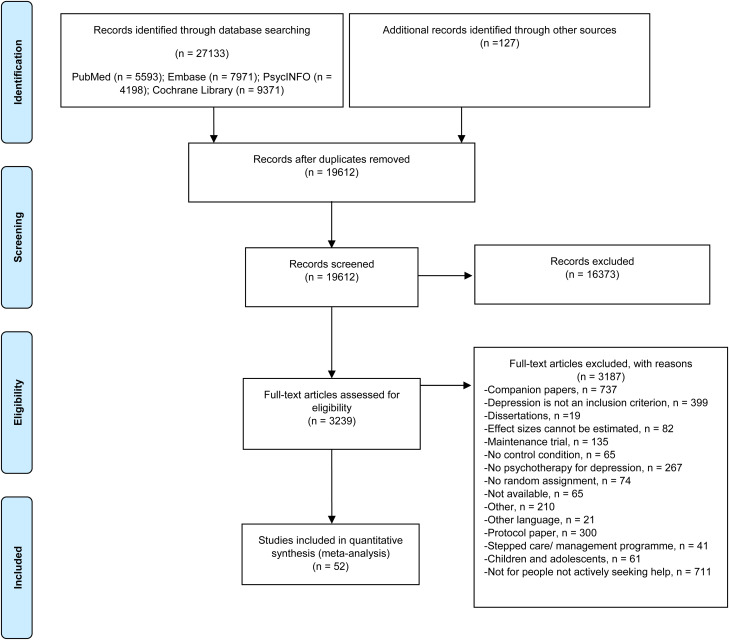
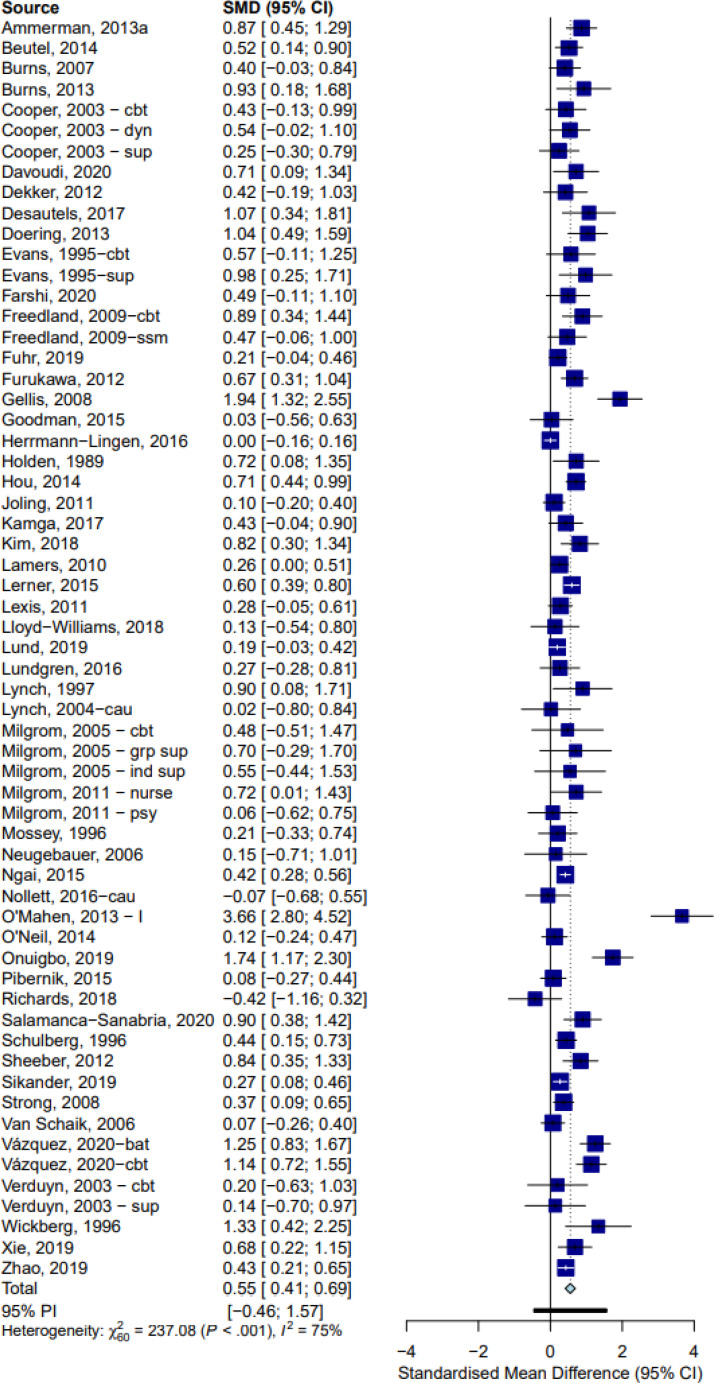
Verification
Claims the paper makes
The claims and statistics of this paper haven’t been checked yet.
Run the check — free, no account needed. It reads the open-access text and checks the sources it cites.
Claims other papers make about this one
Each is checked against this paper’s own text: does it say what the citing paper says it does?
In the citing paper
“This high degree of heterogeneity is consistent with findings from previous meta‐analyses of proportions (Winsper et al., 2020; Zhao, Amarnath, Karyotaki, Struijs, & Cuijpers, 2022).”
From Research Review: Help‐seeking intentions, behaviors, and barriers in college students – a systematic review and meta‐analysis (2025) · cites this paper as Zhao, Amarnath, Karyotaki, Struijs, & Cuijpers, 2022
Self-check
Percentages, sums and reported differences re-computed from the paper’s own numbers.
The self-check needs the paper’s full text.
Citations
Cites
Barriers to mental health treatment: results from the WHO World Mental Health surveys
Andrade, L. H., Alonso, J., Mneimneh, Z., Wells, J. E., Al-Hamzawi, A., Borges, G., Bromet, E., Bruffaerts, R., de Girolamo, G., de Graaf, R., et al. (2014) · Psychological Medicine · doi:10.1017/s0033291713001943 · Cited by 1,289
Schnyder, N., Panczak, R., Groth, N., & Schultze-Lutter, F. (2017) · British Journal of Psychiatry · doi:10.1192/bjp.bp.116.189464 · Cited by 716
Cuijpers, P., Vogelzangs, N., Twisk, J., Kleiboer, A., Li, J., & Penninx, B. W. (2014) · American Journal of Psychiatry · doi:10.1176/appi.ajp.2013.13030325 · Cited by 677
Self-citationSheldon, E., Simmonds-Buckley, M., Bone, C., Mascarenhas, T., Chan, N., Wincott, M., Gleeson, H., Sow, K., Hind, D., & Barkham, M. (2021) · Journal of Affective Disorders · doi:10.1016/j.jad.2021.03.054 · Cited by 644
Cuijpers, P., Karyotaki, E., Weitz, E., Andersson, G., Hollon, S. D., & van Straten, A. (2014) · Journal of Affective Disorders · doi:10.1016/j.jad.2014.02.026 · Cited by 586
Self-citationCuijpers, P., Quero, S., Noma, H., Ciharova, M., Miguel, C., Karyotaki, E., Cipriani, A., Cristea, I. A., & Furukawa, T. A. (2021) · World Psychiatry · doi:10.1002/wps.20860 · Cited by 388
Self-citationPsychological Treatment of Depression in Primary Care: Recent Developments
Cuijpers, P., Quero, S., Dowrick, C., & Arroll, B. (2019) · Current Psychiatry Reports · doi:10.1007/s11920-019-1117-x · Cited by 296
Self-citationThe effects of fifteen evidence-supported therapies for adult depression: A meta-analytic review
Cuijpers, P., Karyotaki, E., de Wit, L., & Ebert, D. D. (2020) · Psychotherapy Research · doi:10.1080/10503307.2019.1649732 · Cited by 276
Self-citationXu, Z., Huang, F., Kösters, M., Staiger, T., Becker, T., Thornicroft, G., & Rüsch, N. (2018) · Psychological Medicine · doi:10.1017/s0033291718001265 · Cited by 252
Cuijpers, P. (2017) · Canadian Psychology / Psychologie canadienne · doi:10.1037/cap0000096 · Cited by 231
Self-citation
Research works printed but not linked: 38
- Olkin, 1985, Statistical methods for meta-analysis
- 10.3399/bjgp09X395139 · DOI
- 10.4172/2376-127X.1000301 · DOI
- Thomas, 1992, A survey of links between mental health professionals and general practice in six district health authorities, The British Journal of General Practice: The Journal of the Royal College of General Practitioners, 42, 358
- 10.1016/S0006-3223(03)00639-5 · DOI
- Thombs, 2021, Does depression screening in primary care improve mental health outcomes?, BMJ, 374, 1
- 10.1089/jwh.2020.8862 · DOI · Paper page
- 10.1136/bmj.d5928 · DOI · Paper page
- 10.1038/s41598-018-21243-x · DOI · Paper page
- 10.1136/bmj.315.7109.629 · DOI · Paper page
- 10.1016/S0140-6736(09)60879-5 · DOI · Paper page
- 10.1371/journal.pone.0052654 · DOI
- 10.1002/1099-176X(200003)3:1<3::AID-MHP68>3.0.CO;2-H · DOI
- 10.1002/wps.20900 · DOI · Paper page
- 10.1016/0163-8343(96)00065-5 · DOI
- 10.1001/archfami.4.2.99 · DOI
- 10.1503/cmaj.111035 · DOI
- 10.1176/ps.2009.60.3.297 · DOI
- 10.1371/journal.pmed.1000097 · DOI · Paper page
- Pratt, 2014, Depression in the U.S. household population, 2009–2012, NCHS Data Brief 2014,, 172, 1
- 10.1016/j.jpsychores.2006.09.014 · DOI
- 10.1001/jama.2015.18392 · DOI · Paper page
- 10.18637/jss.v036.i03 · DOI · Paper page
- 10.1016/j.genhosppsych.2008.04.001 · DOI · Paper page
- Harrer, 2022, Doing meta-analysis with R: A hands-on guide
- 2017, Depression and other common mental disorders: Global health estimates
- 10.7326/0003-4819-136-10-200205210-00013 · DOI · Paper page
- 10.1136/ebmental-2019-300117 · DOI · Paper page
- 10.1002/jclp.20432 · DOI
- 10.1111/acps.13335 · DOI · Paper page
- 10.1016/S0140-6736(16)31678-6 · DOI · Paper page
- 10.1136/bmj.327.7414.557 · DOI · Paper page
- 10.1111/j.0006-341X.2000.00455.x · DOI · Paper page
- 10.9778/cmajo.20130030 · DOI
- 10.1016/S0163-8343(96)00062-X · DOI
- 10.1186/1741-7015-8-38 · DOI · Paper page
- 10.1016/j.jpsychores.2013.01.012 · DOI
- Friedrich, 2017, Depression is the leading cause of disability around the world, JAMA, 317, 1517
Cited by
Sorted by citations
Zhao, R., Amanvermez, Y., Pei, J., Castro‐Ramirez, F., Rapsey, C., Garcia, C., Ebert, D. D., Haro, J. M., Fodor, L. A., David, O. A., et al. (2025) · Journal of Child Psychology and Psychiatry · doi:10.1111/jcpp.14145 · Cited by 110
Self-citation
Metadata
- Authors
- Zhao, R., Amarnath, A., Karyotaki, E., Struijs, S. Y., & Cuijpers, P.
- Venue
- Psychological Medicine
- Publisher
- Cambridge University Press (CUP)
- Published
- 2022-11-21
- Pages
- 1-12
- ISSN
- 0033-2917
- 1469-8978
- PMC
- PMC9899569
- Cited by
- 5
- References
- 20
- Language
- en
About these checks
Registry, retraction, Cites and statistics results are computed, not judged, with one exception: a printed reference that no index lists is read once by a model before it counts as a citation error. Claims are extracted by a model and kept only when their quote appears verbatim in the text; each cited source is then checked, with a model’s help, for whether it says what the claim relies on. Those verdicts can be wrong — read the claim’s quote and the cited source before relying on one.
Statistics and arithmetic are recomputed, not judged.
Confidence bands are shown only for fields calibrated on our annotated test set. None is calibrated yet, so no band is shown.
What counts as a claim ›How we measure confidence ›How we check this ›
Are you an author, or do you see a problem with this page? Request a review
