

Disentangling the causal role of motivation, enjoyment, and anxiety in second language speech learning: A final report
Open accessThe DOI matches its Crossref record; 71 of the 71 references it cites were found in a registry or an index; none of the 50 sources its claims cite is checked for support yet.
Abstract
While our earlier report focused on the initial four months of the dataset (Saito et al., 2018, Language Learning ), this study investigates the relationship between individual differences in motivation (Ideal Self and Ought–to Self), emotions (Enjoyment and Anxiety), and L2 speech learning among 121 Japanese English–as–a–Foreign–Language high school students over 1.5–years. Participants’ L2 speech proficiency consistently improved at each testing point (6 months, 10 months, and 1.5 years), while their motivation and emotions, measured through questionnaires, remained relatively stable. The results of structural equation modeling suggest that the relationship between motivation, emotions, and acquisition may evolve. Within the first 6-10 months, data indicated a correlational relationship, highlighting a mutual influence among motivation, emotions, and acquisition. However, as the study progressed beyond one year, after students had fully adapted to their educational settings, a clearer causal relationship emerged: Enhanced motivation and more positive emotions were linked to increased classroom practice, leading to significant gains in L2 speech proficiency. The predictive roles of Anxiety remained unclear in this longitudinal dataset.
Overview
CoChat Summary
TL;DR
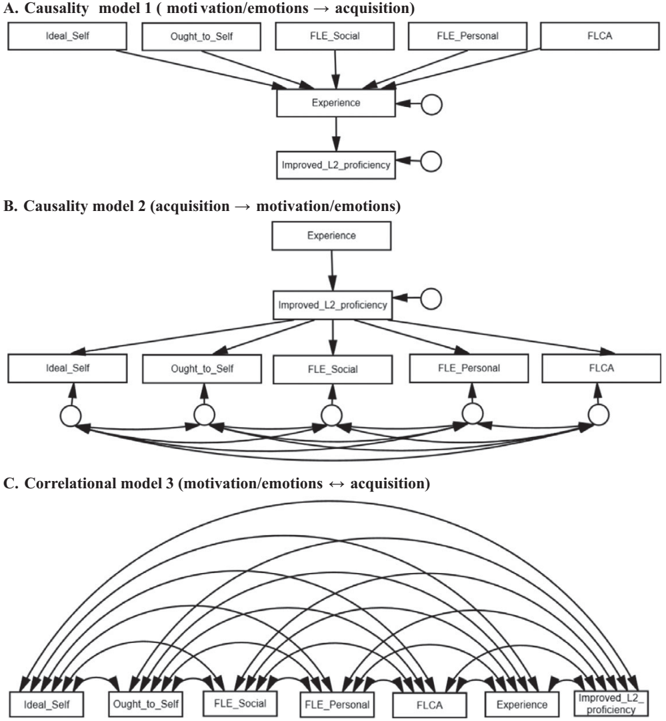
In 121 Japanese EFL high school students tracked over 1.5 years, L2 speech proficiency improved significantly while motivation and emotions remained stable. SEM showed the motivation/emotions→acquisition model best fit long-term (1.5 years), whereas short-term (6 months) fit acquisition→motivation/emotions and mid-term (10 months) fit a correlational model.
Key findings
- L2 speech proficiency increased significantly over time, \(F(2, 202) = 41.127, p < .001, \eta^2 = .272\); TSST raw scores rose from 3.41 at T1 to 3.61 at T2, 3.79 at T3, and 4.12 at T4. Motivation and emotions showed no significant change: Ideal L2 Self \(F(2, 202) = .763, p = .468, \eta^2 = .022\); Ought-to L2 Self \(F(2, 202) = 2.803, p = .063, \eta^2 = .027\); FLE Social \(F(2, 202) = .463, p = .630, \eta^2 = .004\); FLE Personal \(F(2, 202) = 1.922, p = .149, \eta^2 = .018\); FLCA \(F(2, 202) = .050, p = .951, \eta^2 = .001\).
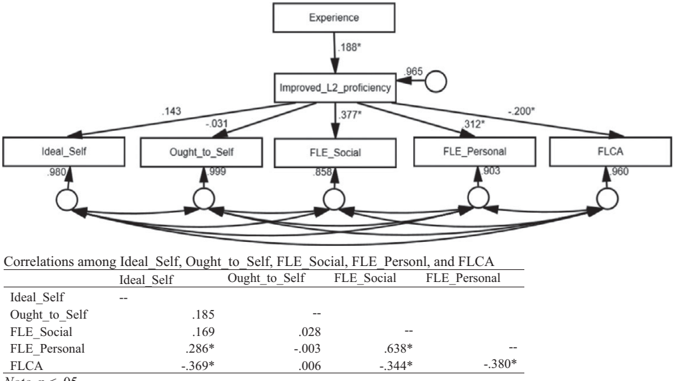
- At 6 months (T2), Model 2 (acquisition→motivation/emotions) fit best (CFI = .997, RMSEA = .024 [.000, .133], SRMR = .046; AIC = 1902.773, BIC = 1980.588): classroom experience predicted L2 gains (\(\beta = .188, p = .026\)), and gains predicted higher FLE Social (\(\beta = .377, p < .001\)), higher FLE Personal (\(\beta = .312, p < .001\)), and lower FLCA (\(\beta = -.200, p = .006\)).
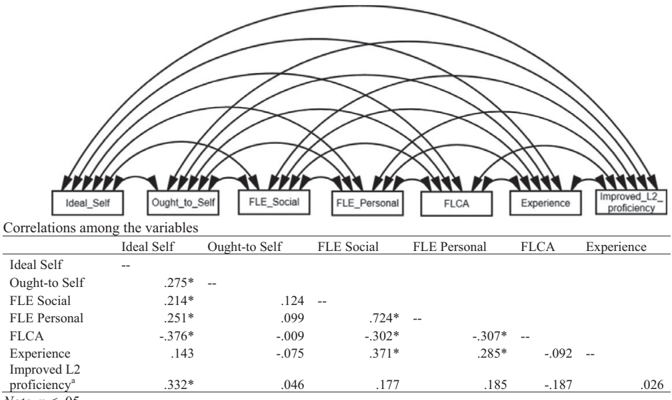
- At 10 months (T3), neither causal model fit well; the correlational Model 3 was supported. Correlations included FLE Social with in-class experience (\(r = .371, p < .001\)), FLE Personal with in-class experience (\(r = .285, p < .001\)), and Ideal L2 Self with improved L2 proficiency (\(r = .332, p = .001\)).
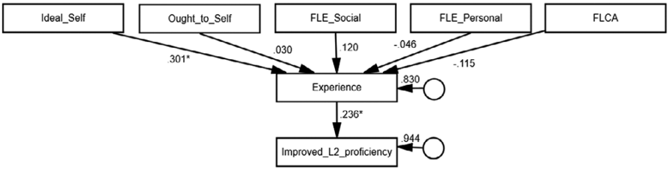
- At 1.5 years (T4), Model 1 (motivation/emotions→acquisition) fit best (CFI = 1.000, RMSEA = .000 [.000, .061], SRMR = .021; AIC = 508.963, BIC = 536.237): Ideal L2 Self predicted more classroom experience (\(\beta = .301, p = .017\)), which predicted L2 speech gains (\(\beta = .236, p = .018\)). FLCA was not a significant predictor of practice or development at any point; the only suggested FLCA pathway was improved L2 proficiency reducing FLCA within the first 6 months.
Methods
- Longitudinal design over 1.5 years with 121 first-year Japanese high school EFL students (ages 15–16; 50 male, 71 female) in northern Japan. L2 speech proficiency was assessed at T1 (Summer 2016), T2 (6 months), T3 (10 months), and T4 (1.5 years) using the automated Telephone Standard Speaking Test (TSST); motivation and emotion questionnaires were administered at T2–T4.
- Questionnaires measured Ideal L2 Self and Ought-to L2 Self (8 motivation items) and FLE Social, FLE Personal, and FLCA (18 emotion items) on 6-point scales. In-class L2 experience was self-reported as the percentage of time using English during English classes.
- Analyses used one-way repeated-measures ANOVAs for change over time and structural equation modeling (SEM) with lavaan in R (MLR estimator) to compare three models at each time point. Residual T2/T3/T4 L2 proficiency scores controlled for T1; model fit was evaluated with CFI, RMSEA, SRMR, AIC, and BIC, and measurement invariance was tested.
Limitations
- Stated: only a limited number of motivation dimensions and learner emotions were considered; future work could include more self-system dimensions and a wider range of positive/negative emotions (e.g., Boredom, Peace of Mind).
- Stated: L2 use was operationalized through self-reports, which may not capture the multifaceted nature of EFL experience (“questionnaire curse”); outside-classroom experience was excluded, and the sample size (\(n = 121\)) was rather small for SEM. FLCA failed to reach configural measurement invariance, so longitudinal FLCA findings should be interpreted cautiously; L2 speech proficiency was measured with one test (TSST), which may not capture subdimensions such as fluency versus segmental accuracy.
- Evident from the text: motivation and emotions were measured only at T2–T4, not at T1, so no baseline motivation/emotion profile was available; group-level questionnaire averages may mask dynamic, time-sensitive fluctuations in motivation and emotions.
Model-written summary. Check it against the paper before relying on it.
Integrity signals
Registry
Cites
Statistics
Figures
Verification
Claims the paper makes
0 Valid · 3 Not valid · 33 Not checked · 62 Own results and interpretations
A result the paper reports from its own data — it cites no other source for it, so there is none to check. The quote shows it is in the paper.
In the paper
“The predictive roles of Anxiety remained unclear in this longitudinal dataset.”
§ Disentangling the causal role of motivation, enjoyment, and anxiety in second language speech learning: A final report > Abstract
plain- Asserted: passes — The authors put it forward as true.
- Checkable: passes — It can be checked against evidence.
- Load-bearing: passes — The paper’s conclusions depend on it.
- Based: passes — The paper gives a reason why it holds.
A result the paper reports from its own data — it cites no other source for it, so there is none to check. The quote shows it is in the paper.
In the paper
“Within the first 6-10 months, data indicated a correlational relationship, highlighting a mutual influence among motivation, emotions, and acquisition.”
§ Disentangling the causal role of motivation, enjoyment, and anxiety in second language speech learning: A final report > Abstract
hedgedstates an association- Asserted: passes — The authors put it forward as true.
- Checkable: passes — It can be checked against evidence.
- Load-bearing: passes — The paper’s conclusions depend on it.
- Based: passes — The paper gives a reason why it holds.
- Rests on an assumption not shown here.
A result the paper reports from its own data — it cites no other source for it, so there is none to check. The quote shows it is in the paper.
In the paper
“Participants' L2 speech proficiency consistently improved at each testing point (6 months, 10 months, and 1.5 years), while their motivation and emotions, measured through questionnaires, remained relatively stable.”
§ Disentangling the causal role of motivation, enjoyment, and anxiety in second language speech learning: A final report > Abstract
plain- Asserted: passes — The authors put it forward as true.
- Checkable: passes — It can be checked against evidence.
- Load-bearing: passes — The paper’s conclusions depend on it.
- Based: passes — The paper gives a reason why it holds.
A result the paper reports from its own data — it cites no other source for it, so there is none to check. The quote shows it is in the paper.
In the paper
“while their motivation and emotions, measured through questionnaires, remained relatively stable.”
§ Disentangling the causal role of motivation, enjoyment, and anxiety in second language speech learning: A final report > Abstract
plain- Asserted: passes — The authors put it forward as true.
- Checkable: passes — It can be checked against evidence.
- Load-bearing: passes — The paper’s conclusions depend on it.
- Based: passes — The paper gives a reason why it holds.
A result the paper reports from its own data — it cites no other source for it, so there is none to check. The quote shows it is in the paper.
In the paper
“The results indicated no significant development in terms of Ideal L2 Self, F(2, 202) = .763,p = .468,η² = .022”
§ Disentangling the causal role of motivation, enjoyment, and anxiety in second language speech learning: A final report > Motivation, emotions, and L2 speech development
hedged- Asserted: passes — The authors put it forward as true.
- Checkable: passes — It can be checked against evidence.
- Load-bearing: unclear — It is unclear whether the paper’s conclusions depend on it.
- Based: passes — The paper gives a reason why it holds.
45 more claims
Create a free account to see all 98 claims and to verify the 33 references still open.
- It may state two separate claims as one. 39
- Probably not a substantial claim. 19
- The quote only partly states this claim. 1
Statistics recomputed
Every reported test result, recomputed from its test statistic and degrees of freedom. A result shows as not adding up only once an independent check has confirmed it.
- ConsistentF(2, 202) = 0.763reported p = .468 · recomputed p = .468
“F(2, 202) = .763,p = .468”
- ConsistentF(2, 202) = 2.803reported p = .063 · recomputed p = .063
“F(2, 202) = 2.803, p = .063”
- ConsistentF(2, 202) = 0.463reported p = .63 · recomputed p = .630
“F (2, 202) = .463,p = .630”
- ConsistentF(2, 202) = 1.922reported p = .149 · recomputed p = .149
“F(2, 202) = 1.922, p = .149”
- ConsistentF(2, 202) = 0.05reported p = .951 · recomputed p = .951
“F(2, 202) = .050,p = .951”
1 more recomputed test
Create a free account to see every test the Stats check recomputed.
Self-check
Percentages, sums and reported differences re-computed from the paper’s own numbers.
Each contradiction between two passages listed here was confirmed by an independent check.
Rated minor: it would not touch a result — a value no result rests on, a p-value that stays on the same side of the significance level, or a conflict that is clerical, resolved elsewhere in the paper, or outside its own findings.
In the paper
§ Disentangling the causal role of motivation, enjoyment, and anxiety in second language speech learning: A final report > Measurement invariances
“For example, for Ideal L2 Self Item 1, these values were 3.21 and 1.55 at Time 2, 3.34 and .53 at Time 3, and 3.19 and 1.57 at Time 4.”
§ Disentangling the causal role of motivation, enjoyment, and anxiety in second language speech learning: A final report > Conclusion
“Ideal L2 Self Item 1 | 3.21 | 1.55 | 3.34 | 1.53 | 3.19 | 1.57 |”
Rated minor: it would not touch a result — a value no result rests on, a p-value that stays on the same side of the significance level, or a conflict that is clerical, resolved elsewhere in the paper, or outside its own findings.
In the paper
§ Disentangling the causal role of motivation, enjoyment, and anxiety in second language speech learning: A final report > Conclusion
“Ought-to L2 Self | - | --2.99 1.18 .85 2.83 | 1.17 .88 3.02 1.14 .86”
§ Disentangling the causal role of motivation, enjoyment, and anxiety in second language speech learning: A final report > Conclusion
“Ought-to L2 Self Items 1-4 a | 2.83 | 1.17 | 2.99 | 1.18 | 3.02 | 1.14 |”
Rated minor: it would not touch a result — a value no result rests on, a p-value that stays on the same side of the significance level, or a conflict that is clerical, resolved elsewhere in the paper, or outside its own findings.
In the paper
§ Disentangling the causal role of motivation, enjoyment, and anxiety in second language speech learning: A final report > Model comparisons
“Comparatively, Model 1 showed lower AIC and BIC values (1652.377and 1728.743,respectively) than Model 3 (1969.708and 2065.166,respectively).”
§ Disentangling the causal role of motivation, enjoyment, and anxiety in second language speech learning: A final report > Additional information
“Model 1 | 1.581 (5) .904 1.000 .000 [.000, .061] .021 508.963 536.237 x | x |”
Rated minor: it would not touch a result — a value no result rests on, a p-value that stays on the same side of the significance level, or a conflict that is clerical, resolved elsewhere in the paper, or outside its own findings.
In the paper
§ Disentangling the causal role of motivation, enjoyment, and anxiety in second language speech learning: A final report > Conclusion
“FLE Personal | - | --4.49 | .84 .82 4.49 | .81 .87 4.39 | .84 .81”
§ Disentangling the causal role of motivation, enjoyment, and anxiety in second language speech learning: A final report > Conclusion
“FLE Personal Items 1-5 a | 4.49 | .84 | 4.52 | .81 | 4.39 | .84 |”
Rated minor: it would not touch a result — a value no result rests on, a p-value that stays on the same side of the significance level, or a conflict that is clerical, resolved elsewhere in the paper, or outside its own findings.
In the paper
§ Disentangling the causal role of motivation, enjoyment, and anxiety in second language speech learning: A final report > Conclusion
“Configural a | 134.256 72 .000 .920 .091 (.063, .117) .086 Yes | - | Yes”
§ Disentangling the causal role of motivation, enjoyment, and anxiety in second language speech learning: A final report > Conclusion
“Fit criteria | - | -> .05 .90 | < .08 | < .08 - | > .05 | - |”
1 more finding
Create a free account to see every finding of this check.
Citations
Cites
Principles and Practice of Structural Equation Modeling
Tabri, N., & Elliott, C. M. (2012) · Canadian Graduate Journal of Sociology and Criminology · doi:10.15353/cgjsc-rcessc.v1i1.25 · Cited by 38,891
lavaan : An R Package for Structural Equation Modeling
Rosseel, Y. (2012) · Journal of Statistical Software · doi:10.18637/jss.v048.i02 · Cited by 27,955
Testing Structural Equation Models.
Mueller, C. W., Bollen, K. A., & Long, J. S. (1994) · Contemporary Sociology · doi:10.2307/2074955 · Cited by 14,120
Foreign Language Classroom Anxiety
HORWITZ, E. K., HORWITZ, M. B., & COPE, J. (1986) · The Modern Language Journal · doi:10.1111/j.1540-4781.1986.tb05256.x · Cited by 9,773 · cited 1×
“The traditional exclusive focus on negative emotions (i.e., Foreign Language Classroom Anxiety [FLCA]; Horwitz et al., 1986) has been replaced by a more holistic perspective that includes both negative and positive emotions (i.e., Foreign Language Enjoyment [FLE]; Dewaele & MacIntyre, 2014).”
Vandenberg, R. J., & Lance, C. E. (2000) · Organizational Research Methods · doi:10.1177/109442810031002 · Cited by 7,997
2. The L2 Motivational Self System
Dörnyei, Z. (2009) · Motivation, Language Identity and the L2 Self · doi:10.21832/9781847691293-003 · Cited by 2,636
The two faces of Janus? Anxiety and enjoyment in the foreign language classroom
Dewaele, J.-M., & MacIntyre, P. D. (2014) · Studies in Second Language Learning and Teaching · doi:10.14746/ssllt.2014.4.2.5 · Cited by 1,757
Self-citationForeign language enjoyment and anxiety: The effect of teacher and learner variables
Dewaele, J.-M., Witney, J., Saito, K., & Dewaele, L. (2018) · Language Teaching Research · doi:10.1177/1362168817692161 · Cited by 780 · cited 2×
“Researchers have become aware that learner emotions do not emerge in isolation but are part of a highly dynamic system including interacting linguistic, social, and psychological factors (Dewaele et al., 2018).”
Self-citationThe Psychology of the Language Learner
Dörnyei, Z. (2014) · doi:10.4324/9781410613349 · Cited by 700
SECOND LANGUAGE ANXIETY AND ACHIEVEMENT: A META-ANALYSIS
Teimouri, Y., Goetze, J., & Plonsky, L. (2019) · Studies in Second Language Acquisition · doi:10.1017/s0272263118000311 · Cited by 611
Motivation, Language Identity and the L2 Self
(2009) · Multilingual Matters eBooks · doi:10.2307/jj.30945943 · Cited by 581
Dörnyei, Z., & Chan, L. (2013) · Language Learning · doi:10.1111/lang.12005 · Cited by 484 · cited 1×
“…(measured via general proficiency test scores) and achievement (operationalized via in – house exam results), in contrast to the motivation profiles associated with the Ought – to L2 Self (Dörnyei & Chan, 2013; Papi & Khajavy, 2021; Lamb, 2012; Moskovsky et al., 2016; Papi & Teimouri, 2014).”
The Revised Speech Learning Model (SLM-r)
Flege, J. E., & Bohn, O.-S. (2021) · Second Language Speech Learning · doi:10.1017/9781108886901.002 · Cited by 429
Saito, K., Dewaele, J., Abe, M., & In'nami, Y. (2018) · Language Learning · doi:10.1111/lang.12297 · Cited by 422
Self-citationLamb, M. (2012) · Language Learning · doi:10.1111/j.1467-9922.2012.00719.x · Cited by 394
The L2 motivational self system: A meta-analysis
Al-Hoorie, A. H. (2018) · Studies in Second Language Learning and Teaching · doi:10.14746/ssllt.2018.8.4.2 · Cited by 351
Botes, E., Dewaele, J.-M., & Greiff, S. (2020) · Journal for the Psychology of Language Learning · doi:10.52598/jpll/2/1/3 · Cited by 333 · cited 10×
“As visually summarized in Figure 3, the correlational analysis within Model 3 revealed Information Criterion; BIC = Bayesian Information Criterion. a Model 3 is a saturated model — a type of a model that fits the data perfectly, making it impossible to test the model-data fit (e.g., Kline, 2023). significant associati…”
InfluentialSelf-citationRecasts, language anxiety, modified output, and L2 learning
Sheen, Y. (2008) · Language Learning · doi:10.1111/j.1467-9922.2008.00480.x · Cited by 330 · cited 1×
“…the relationship between emotions and L2 learning gains, there are short – term intervention studies (1-2 hours) suggesting that individuals experiencing greater negative emotions (anxiety), tend to show less learning gain when receiving instruction (e.g., Sheen, 2008; Miller & Godfroid, 2020).”
Li, C., & Wei, L. (2023) · Studies in Second Language Acquisition · doi:10.1017/s0272263122000031 · Cited by 317 · cited 8×
“…and cooperation; Li, Huang et al., 2021), teaching methods (e.g., more communicative vs. traditional/language – focused methods; Dewaele et al., 2024), teacher characteristics (e.g., the use of humor; Dewaele et al., 2022), and long – term development behaviors (Li & Wei, 2023; Saito et al., 2018).”
InfluentialWaninge, F., Dörnyei, Z., & De Bot, K. (2014) · The Modern Language Journal · doi:10.1111/j.1540-4781.2014.12118.x · Cited by 275
Innovations and Challenges in Language Learning Motivation
Dörnyei, Z. (2020) · Routledge eBooks · doi:10.4324/9780429485893 · Cited by 271
Taking stock: A meta-analysis of the effects of foreign language enjoyment
Botes, E., Dewaele, J.-M., & Greiff, S. (2022) · Studies in Second Language Learning and Teaching · doi:10.14746/ssllt.2022.12.2.3 · Cited by 266
Self-citationDewaele, J.-M., & MacIntyre, P. D. (2019) · Evidence-Based Second Language Pedagogy · doi:10.4324/9781351190558-12 · Cited by 250 · cited 3×
“In contrast, FLCA is more strongly related to a learner ’ s personality traits such as neuroticism (Dewaele & MacIntyre, 2019).”
Self-citationA Guide to Doing Statistics in Second Language Research Using SPSS and R
Larson-Hall, J. (2015) · Routledge eBooks · doi:10.4324/9781315775661 · Cited by 249
Li, C., Huang, J., & Li, B. (2021) · System · doi:10.1016/j.system.2020.102393 · Cited by 219
The L2 Motivational Self System and L2 Achievement: A Study of Saudi EFL Learners
MOSKOVSKY, C., ASSULAIMANI, T., RACHEVA, S., & HARKINS, J. (2016) · The Modern Language Journal · doi:10.1111/modl.12340 · Cited by 202
Larson-Hall, J. (2008) · Second Language Research · doi:10.1177/0267658307082981 · Cited by 192
RETHINKING L2 MOTIVATION RESEARCH: THE 2 × 2 MODEL OF L2 SELF-GUIDES
Papi, M., Bondarenko, A. V., Mansouri, S., Feng, L., & Jiang, C. (2019) · Studies in Second Language Acquisition · doi:10.1017/s0272263118000153 · Cited by 189
Jaekel, N., Schurig, M., Florian, M., & Ritter, M. (2017) · Language Learning · doi:10.1111/lang.12242 · Cited by 185
Language Learner Motivational Types: A Cluster Analysis Study
Papi, M., & Teimouri, Y. (2014) · Language Learning · doi:10.1111/lang.12065 · Cited by 183
Validating the Short-form Foreign Language Classroom Anxiety Scale
Botes, E., van der Westhuizen, L., Dewaele, J.-M., MacIntyre, P., & Greiff, S. (2022) · Applied Linguistics · doi:10.1093/applin/amac018 · Cited by 182
Self-citationDewaele, J.-M., & Pavelescu, L. M. (2021) · Innovation in Language Learning and Teaching · doi:10.1080/17501229.2019.1675667 · Cited by 180
Self-citationElahi Shirvan, M., & Taherian, T. (2021) · International Journal of Bilingual Education and Bilingualism · doi:10.1080/13670050.2018.1441804 · Cited by 171
New Insights into Language Anxiety: Theory, Research and Educational Implications
Liu, H. (2019) · ELT Journal · doi:10.1093/elt/ccy042 · Cited by 170
Contrasting Effects of Starting Age and Input on the Oral Performance of Foreign Language Learners
Munoz, C. (2014) · Applied Linguistics · doi:10.1093/applin/amu024 · Cited by 168
Motivational Mechanisms Underlying Second Language Achievement: A Regulatory Focus Perspective
Papi, M., & Khajavy, G. H. (2021) · Language Learning · doi:10.1111/lang.12443 · Cited by 167
Li, C., Dewaele, J.-M., Pawlak, M., & Kruk, M. (2025) · Language Teaching Research · doi:10.1177/13621688221111623 · Cited by 163
Self-citationMotivation and second foreign language proficiency: The mediating role of foreign language enjoyment
Zhang, H., Dai, Y., & Wang, Y. (2020) · Sustainability · doi:10.3390/su12041302 · Cited by 148
Saito, K. (2021) · TESOL Quarterly · doi:10.1002/tesq.3027 · Cited by 142
Self-citationMoyer, A. (2014) · Applied Linguistics · doi:10.1093/applin/amu012 · Cited by 131 · cited 3×
“The framework proposed here relates to cross – sectional evidence indicating that among highly experienced L2 learners in classroom settings, those with highly advanced L2 speech proficiency often exhibit strong professional motivation (Moyer, 2014).”
How Foreign Language Enjoyment Acts as a Buoy for Sagging Motivation: A Longitudinal Investigation
Dewaele, J.-M., Saito, K., & Halimi, F. (2023) · Applied Linguistics · doi:10.1093/applin/amac033 · Cited by 117
Self-citationDynamics and mechanisms of foreign language enjoyment contagion
Talebzadeh, N., Shirvan, M. E., & Khajavy, G. H. (2019) · Innovation in Language Learning and Teaching · doi:10.1080/17501229.2019.1614184 · Cited by 102
Heydarnejad, T., Tagavipour, F., Patra, I., & Khafaga, A. F. (2022) · Language Testing in Asia · doi:10.1186/s40468-022-00202-4 · Cited by 86
Arndt, H. L., Granfeldt, J., & Gullberg, M. (2022) · Language Learning · doi:10.1111/lang.12555 · Cited by 86
MOTIVATION AS QUALITY: REGULATORY FIT EFFECTS ON INCIDENTAL VOCABULARY LEARNING
Papi, M. (2018) · Studies in Second Language Acquisition · doi:10.1017/s027226311700033x · Cited by 82
Kachlicka, M., Saito, K., & Tierney, A. (2019) · Brain and Language · doi:10.1016/j.bandl.2019.02.004 · Cited by 78
Self-citationDewaele, J., Guedat‐Bittighoffer, D., & Dat, M. (2024) · International Journal of Applied Linguistics · doi:10.1111/ijal.12607 · Cited by 73
Self-citationBaumert, J., Fleckenstein, J., Leucht, M., Köller, O., & Møller, J. (2020) · Language Learning · doi:10.1111/lang.12414 · Cited by 70
Proactive Language Learning Theory
Papi, M., & Hiver, P. (2025) · Language Learning · doi:10.1111/lang.12644 · Cited by 69
NAGLE, C. (2018) · The Modern Language Journal · doi:10.1111/modl.12461 · Cited by 67
Saito, K., Suzukida, Y., & Sun, H. (2019) · Studies in Second Language Acquisition · doi:10.1017/s0272263117000432 · Cited by 64
Self-citationThe Role of Inhibitory Control in Second Language Phonological Processing
Darcy, I., Mora, J. C., & Daidone, D. (2016) · Language Learning · doi:10.1111/lang.12161 · Cited by 64
SAITO, K., & HANZAWA, K. (2016) · Applied Psycholinguistics · doi:10.1017/s0142716415000259 · Cited by 58
Self-citationSaito, K. (2018) · Second language Research · doi:10.1177/0267658318768342 · Cited by 54
Self-citationDewaele, J., & Meftah, R. (2024) · Learning and Motivation · doi:10.1016/j.lmot.2024.101962 · Cited by 51
Self-citationSaito, K., Suzuki, S., Oyama, T., & Akiyama, Y. (2019) · Second language Research · doi:10.1177/0267658319884981 · Cited by 50
Self-citationStrawbridge, T. (2023) · Studies in Second Language Acquisition · doi:10.1017/s0272263123000049 · Cited by 47
Jiang, Y., & Dewaele, J. (2015) · IRAL - International Review of Applied Linguistics in Language Teaching · doi:10.1515/iral-2015-0015 · Cited by 38
Self-citationSaito, K., Dewaele, J.-M., & Hanzawa, K. (2017) · Language and Speech · doi:10.1177/0023830916687793 · Cited by 36
Self-citationMacIntyre, P. D., Ross, J., & Clément, R. (2019) · The Palgrave Handbook of Motivation for Language Learning · doi:10.1007/978-3-030-28380-3_9 · Cited by 32
EMOTIONS IN INCIDENTAL LANGUAGE LEARNING: AN INDIVIDUAL DIFFERENCES APPROACH
Miller, Z. F., & Godfroid, A. (2019) · Studies in Second Language Acquisition · doi:10.1017/s027226311900041x · Cited by 32
Nagle, C. (2022) · Research Methods in Applied Linguistics · doi:10.1016/j.rmal.2022.100033 · Cited by 26
Sun, H., Saito, K., & Dewaele, J. (2023) · Language Learning · doi:10.1111/lang.12561 · Cited by 22
Self-citationZhou, Y., & Papi, M. (2023) · System · doi:10.1016/j.system.2023.103156 · Cited by 21
Tools for Second Language Speech Research and Teaching
re3data.org (2022) · Registry of Research Repositories · doi:10.17616/r31njnax · Cited by 21
Huensch, A., & Nagle, C. (2022) · Studies in Second Language Acquisition · doi:10.1017/s0272263122000213 · Cited by 20
Variables Affecting L2 Pronunciation Development
Trofimovich, P., Kennedy, S., & Ann Foote, J. (2015) · The Handbook of English Pronunciation · doi:10.1002/9781118346952.ch20 · Cited by 19
Aptitude and Individual Differences
Mora, J. C. (2022) · The Routledge Handbook of Second Language Acquisition and Speaking · doi:10.4324/9781003022497-7 · Cited by 15
(2017) · EngagedScholarship @ Cleveland State University (Cleveland State University) · Cited by 14
Guedat‐Bittighoffer, D., & Dewaele, J. (2023) · Language Interaction and Acquisition · doi:10.1075/lia.22025.gue · Cited by 13
Self-citationKoizumi, R. (2021) · Validity Argument in Language Testing · doi:10.1017/9781108669849.010 · Cited by 3
Research works printed but not linked: 2
- Dewaele, J.-M., Saito, K.& Halim, F. (2022). How teacher behaviour shapes Foreign Language learners' Enjoyment, Anxiety and Attitudes/Motivation: A mixed modelling longitudinal investigation. Language Teaching Research. https://doi.org/10.1177/13621688221089 · doi:10.1177/13621688221089
- Dörnyei, Z., & A. Henry (2022). Accounting for long-term motivation and sustained motivated learning: Motivational currents, self-concordant vision, and persistence in language learning. In A. Elliot (Ed.), Advances in motivation science (pp. 1-46). Elsevier.
Cited by
Dewaele, J., & Botes, E. (2025) · International Journal of Applied Linguistics · doi:10.1111/ijal.12749 · Cited by 38
Self-citationIs foreign language anxiety malleable? A systematic review of longitudinal observation studies
Sun, Q., Alhowail, A. M., & Beckmann, N. (2025) · System · doi:10.1016/j.system.2025.103782 · Cited by 25
Derakhshan, A., & MacIntyre, P. D. (2025) · Journal of Multilingual and Multicultural Development · doi:10.1080/01434632.2025.2501157 · Cited by 23
Budiman, A., & Liu, X. (2025) · Frontiers in Psychology · doi:10.3389/fpsyg.2025.1611630 · Cited by 17
Kirkpatrick, R., Derakhshan, A., Wang, Y., Taghizadeh, M. S., & Almuhanna, M. A. (2025) · Applied Linguistics Review · doi:10.1515/applirev-2025-0313 · Cited by 16
Metadata
- Authors
- Saito, K., Dewaele, J.-M., In’nami, Y., & Abe, M.
- Affiliations
- Tohoku University (JP)
- University of London (GB)
- Chuo University (JP)
- Okayama University (JP)
- Corresponding author
- Saito, Kazuya
- Venue
- Studies in Second Language Acquisition
- Publisher
- Cambridge University Press (CUP)
- Published
- 2025-02-11
- Volume
- 47
- Issue
- 2
- Pages
- 461-487
- ISSN
- 0272-2631 (ISSN-L)
- 1470-1545
- OpenAlex
- W4407383220
- Cited by
- 43
- References
- 71
- Citations by year
- 2026: 30 · 2025: 13
- FWCI
- 47.47
- Type
- journal article
- Language
- en
- Update notices
- correction (2025-02-11)
- Open access
- hybrid
- doi.org
- Locations
- Studies in Second Language Acquisition (publishedVersion, cc-by)
- Funders
- Leverhulme Trust (RPG-2019-039)
- Japan Society for the Promotion of Science (16H03455)
- Topics
- Social Sciences › Arts and Humanities › Language and Linguistics › EFL/ESL Teaching and Learning
- Social Sciences › Psychology › Developmental and Educational Psychology › Second Language Acquisition and Learning
- Social Sciences › Psychology › Developmental and Educational Psychology › Education, Achievement, and Giftedness
- Keywords
- second language speech learning, motivation, enjoyment, anxiety, ideal self, ought self, individual differences, teaching practice, Japanese EFL learners, longitudinal development
About these checks
Registry, retraction, Cites and statistics results are computed, not judged, with one exception: a printed reference that no index lists is read once by a model before it counts as a citation error. Claims are extracted by a model and kept only when their quote appears verbatim in the text; each cited source is then checked, with a model’s help, for whether it says what the claim relies on. Those verdicts can be wrong — read the claim’s quote and the cited source before relying on one.
A language model drew the claims from the paper on 2026-11-24, under version 3 of the claim definition (model deepseek-v4.1-flash, prompt extract-v3).
A second model labelled each claim on 2026-11-24 (model jev-1.13-20260917, definition revision gold-guideline-v0.2).
Statistics and arithmetic are recomputed, not judged.
Confidence bands are shown only for fields calibrated on our annotated test set. None is calibrated yet, so no band is shown.
What counts as a claim ›How we measure confidence ›How we check this ›
Are you an author, or do you see a problem with this page? Request a review
Data sources
Bibliographic data: Semantic Scholar, OpenAlex, Crossref.
Contains information from the Semantic Scholar Academic Graph Datasets, made available under the ODC Attribution License (ODC-BY 1.0).
Semantic Scholar’s data is described in: Kinney, R., et al. (2023). The Semantic Scholar Open Data Platform. arXiv:2301.10140.
