

The effects of audiovisual input on second language learning: A meta-analysis
Open accessThe DOI matches its Crossref record; 64 of the 65 references it cites were found in a registry or an index; none of the 56 sources its claims cite is checked for support yet.
Abstract
This meta-analysis investigates the contributions of viewing audiovisual input on second language (L2) learning. We calculated 75 effect sizes from 56 experiments ( n = 1954) and assessed the effects of audiovisual input on language learning using a within-group (pre-post) meta-analytic approach. Fifteen moderator variables were included in the analysis. Results showed that a) there was a small effect of audiovisual input on L2 learning ( g = .89); b) no differences were found between the effects of viewing audiovisual input on different areas of L2 learning (vocabulary, grammar, pronunciation, speaking, listening proficiency); and c) video category had a significant impact on L2 learning with entertainment-focused videos (e.g., TV series, movies, and mixed videos) yielding lower effects than educational videos (e.g., TED Talks, documentaries, and language-focused).
Overview
CoChat Summary
TL;DR
This meta-analysis of 75 effect sizes from 56 experiments (n = 1,954) found that viewing unenhanced audiovisual input produced a small overall gain in L2 learning (g = .89). Video category moderated outcomes, with educational videos (TED Talks, documentaries) yielding larger effects than entertainment-focused videos (movies, TV series), while learning target did not significantly moderate effects.
Key findings
- Audiovisual input had a significant overall effect on L2 learning, g = 0.89 (95% CI [.69, 1.09]), with high heterogeneity (I² = 86.8%).
- No significant differences were found between learning targets (Q = 8.18, p = .23): single words g = 1.07, listening g = .93, speaking g = .47, grammar g = .64, multiword items g = .59, pronunciation g = .65.
- Video category significantly moderated learning (Q = 25.28, p = .00): documentaries g = 1.21 and TED Talks g = 1.23 had medium effects, while movies g = .53 and TV series g = .51 showed no effect. Language-focused videos had a large effect (g = 1.61) versus non-language-focused videos (g = .83), but this difference was not significant (Q = 2.60, p = .11).
- Other moderators were largely non-significant: age (Q = .33, p = .57), proficiency (Q = 6.04, p = .11), target language (Q = 1.21, p = .27), single vs. multiple sessions (Q = .04, p = .84), viewing time (Q = 2.98, p = .23), viewing plus (Q = 2.32, p = .13), and test type (written/aural Q = .93, p = .63; receptive/productive Q = 2.87, p = .24); L1 was significant (Q = 17.38, p = .02).
Methods
- Systematic search of PsycINFO, ERIC, Linguistics and Language Behavior Abstracts, Google Scholar, and ProQuest Global Dissertations; inclusion required unenhanced audiovisual input, pre- and post-tests, and sufficient statistics to calculate effect sizes, yielding 75 effect sizes from 56 experiments (n = 1,954).
- Within-group (pre-post) meta-analysis using Hedges’ g; random-effects model with DerSimonian-Laird τ² and Knapp-Hartung adjustment; moderator analyses used mixed-effects models in R packages meta and metafor; 15 moderator variables were coded.
- Coding reliability was checked by double-coding 10 studies (18% of primary studies, 23% of effect sizes); initial agreement was 94%, and disagreements were resolved after discussion.
Limitations
- Paper-stated: pre-post contrasts tend to positively bias effect sizes; meta-analysis depends on available studies, with needs for more research on grammar, pronunciation, speaking, younger/older learners, cognitive abilities, and L1; few studies had true control groups; averaging effect sizes reduced the number contributing to pooled estimates and caused data loss; high heterogeneity was observed.
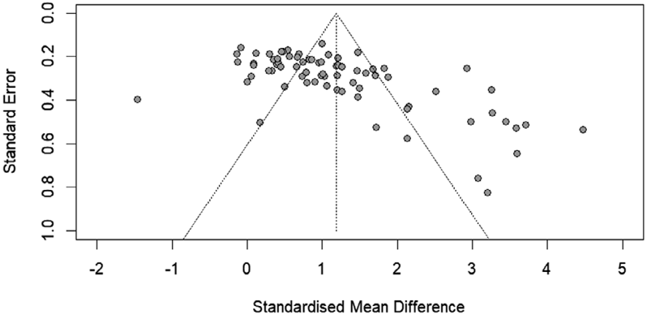
- Paper-stated: Egger’s test indicated significant funnel-plot asymmetry (intercept = 5.421, 95% CI [3.69, 7.15], t = 6.14, p < .00), which may reflect publication bias or real heterogeneity; publication status itself was not a significant moderator (p = .66).
- Evident from the text: the sample was heavily skewed toward adult learners (k = 69) versus young learners (k = 6) and toward English as the target language (71 of 75 effect sizes); several subgroups were small with wide confidence intervals spanning zero (e.g., pronunciation k = 3, grammar k = 6, multiword k = 8; beginner proficiency 95% CI [−1.00, 3.48]).
Model-written summary. Check it against the paper before relying on it.
Integrity signals
Registry
Cites
Statistics
Figures
Verification
Claims the paper makes
0 Valid · 2 Not valid · 44 Not checked · 116 Own results and interpretations
A result the paper reports from its own data — it cites no other source for it, so there is none to check. The quote shows it is in the paper.
In the paper
“Results showed that a) there was a small effect of audiovisual input on L2 learning ( g = .89);”
§ The effects of audiovisual input on second language learning A meta-analysis > Abstract
plainstates a causen = 1,954- Asserted: passes — The authors put it forward as true.
- Checkable: passes — It can be checked against evidence.
- Load-bearing: passes — The paper’s conclusions depend on it.
- Based: passes — The paper gives a reason why it holds.
- Rests on 2 assumptions not shown here.
A result the paper reports from its own data — it cites no other source for it, so there is none to check. The quote shows it is in the paper.
In the paper
“c) video category had a significant impact on L2 learning with entertainment-focused videos (e.g., TV series, movies, and mixed videos) yielding lower effects than educational videos (e.g., TED Talks, documentaries, and language-focused).”
§ The effects of audiovisual input on second language learning A meta-analysis > Abstract
plainstates a causen = 1,954- Asserted: passes — The authors put it forward as true.
- Checkable: passes — It can be checked against evidence.
- Load-bearing: passes — The paper’s conclusions depend on it.
- Based: passes — The paper gives a reason why it holds.
- Rests on 2 assumptions not shown here.
A result the paper reports from its own data — it cites no other source for it, so there is none to check. The quote shows it is in the paper.
In the paper
“b) no differences were found between the effects of viewing audiovisual input on different areas of L2 learning (vocabulary, grammar, pronunciation, speaking, listening proficiency);”
§ The effects of audiovisual input on second language learning A meta-analysis > Abstract
plainn = 1,954- Asserted: passes — The authors put it forward as true.
- Checkable: passes — It can be checked against evidence.
- Load-bearing: passes — The paper’s conclusions depend on it.
- Based: passes — The paper gives a reason why it holds.
- Rests on 2 assumptions not shown here.
A result the paper reports from its own data — it cites no other source for it, so there is none to check. The quote shows it is in the paper.
In the paper
“There was a significant difference between the effects of different types of audiovisual input (Q = 25.28,p = .00).”
§ The effects of audiovisual input on second language learning A meta-analysis > Audiovisual input type
plainstates an association- Asserted: passes — The authors put it forward as true.
- Checkable: passes — It can be checked against evidence.
- Load-bearing: passes — The paper’s conclusions depend on it.
- Based: passes — The paper gives a reason why it holds.
A result the paper reports from its own data — it cites no other source for it, so there is none to check. The quote shows it is in the paper.
In the paper
“The effect of non-language-focused audiovisual input was small but had a much smaller confidence interval ( g = .83,95% CI [.63, 1.04]).”
§ The effects of audiovisual input on second language learning A meta-analysis > Language-focused video
plainstates a cause- Asserted: passes — The authors put it forward as true.
- Checkable: passes — It can be checked against evidence.
- Load-bearing: passes — The paper’s conclusions depend on it.
- Based: passes — The paper gives a reason why it holds.
63 more claims
Create a free account to see all 162 claims and to verify the 50 references still open.
- It may state two separate claims as one. 57
- The quote only partly states this claim. 1
- Probably not a substantial claim. 49
Self-check
Percentages, sums and reported differences re-computed from the paper’s own numbers.
Each contradiction between two passages listed here was confirmed by an independent check.
Rated major: it would touch a result — a value a result rests on, reported and recomputed p-values on opposite sides of the significance level, two passages that conflict with no sign which is right, or a cited work retracted before this paper was published.
In the paper
§ The effects of audiovisual input on second language learning A meta-analysis > Discussion
“The effect sizes between the intermediate ( g = 1.19, 95% CI [.63, 1.75]) and advanced ( g = 1.11, 95% CI [.74, 1.39]) groups are similar with confidence intervals that closely align.”
§ The effects of audiovisual input on second language learning A meta-analysis > Language proficiency
“For intermediate learners ( g = .99,95% CI [.53, 1.44]) and advanced learners ( g = .93,95% CI [.69, 1.17]) there was a small effect, bordering on medium.”
Rated minor: it would not touch a result — a value no result rests on, a p-value that stays on the same side of the significance level, or a conflict that is clerical, resolved elsewhere in the paper, or outside its own findings.
In the paper
§ The effects of audiovisual input on second language learning A meta-analysis > Conclusion
“| Language-focused | 5 | 1.61 | .30 | 2.93 | .00 | .84 | | |”
§ The effects of audiovisual input on second language learning A meta-analysis > Conclusion
“| Language-focused | 5 | 1.61 | .30 | 2.93 | .03 | .95 | | |”
Rated minor: it would not touch a result — a value no result rests on, a p-value that stays on the same side of the significance level, or a conflict that is clerical, resolved elsewhere in the paper, or outside its own findings.
In the paper
§ The effects of audiovisual input on second language learning A meta-analysis > Language proficiency
“However, there was no effect for intermediate-advanced learners ( g = .52,95% CI [.17, .80]).”
§ The effects of audiovisual input on second language learning A meta-analysis > Conclusion
“| Intermediate-Advanced | 8 | .52 | .17 | .88 | .01 | .70 | | |”
Rated minor: it would not touch a result — a value no result rests on, a p-value that stays on the same side of the significance level, or a conflict that is clerical, resolved elsewhere in the paper, or outside its own findings.
In the paper
§ The effects of audiovisual input on second language learning A meta-analysis > Abstract
“Fifteen moderator variables were included in the analysis.”
§ The effects of audiovisual input on second language learning A meta-analysis > Coding
“Moderator variables were coded as follows: learner-related variables (L1, L2, age, language proficiency), methodological variables (learning target, video type, languagefocused video, video length, viewing plus, number of sessions, receptive or productive test, and written or aural test), and study-related variables (publication type and region).”
Rated minor: it would not touch a result — a value no result rests on, a p-value that stays on the same side of the significance level, or a conflict that is clerical, resolved elsewhere in the paper, or outside its own findings.
In the paper
§ The effects of audiovisual input on second language learning A meta-analysis > Introduction
“Muñoz et al. (2021) found an increase of 18.86% in L2 Spanish grammar knowledge after five weeks of watching an American TV show.”
§ The effects of audiovisual input on second language learning A meta-analysis > Multiple versus single viewing sessions
“Pattemore and Muñoz (2020) examined the effects of viewing audiovisual input over 8 weeks, whereas Muñoz et al. (2021) investigated learning over 8 months.”
Citations
Cites
The PRISMA 2020 statement: An updated guideline for reporting systematic reviews
Page, M. J., McKenzie, J. E., Bossuyt, P. M., Boutron, I., Hoffmann, T. C., Mulrow, C. D., Shamseer, L., Tetzlaff, J. M., Akl, E. A., Brennan, S. E., et al. (2021) · BMJ · doi:10.1136/bmj.n71 · Cited by 108,283
Bias in meta-analysis detected by a simple, graphical test
Egger, M., Smith, G. D., Schneider, M., & Minder, C. (1997) · BMJ · doi:10.1136/bmj.315.7109.629 · Cited by 56,722
Meta-analysis in clinical trials
DerSimonian, R., & Laird, N. (1986) · Controlled Clinical Trials · doi:10.1016/0197-2456(86)90046-2 · Cited by 39,552
Statistical Power Analysis for the Behavioral Sciences
Cohen, J. (2013) · doi:10.4324/9780203771587 · Cited by 25,373
Borenstein, M., Hedges, L. V., Higgins, J. P. T., & Rothstein, H. R. (2009) · doi:10.1002/9780470743386 · Cited by 14,225
The file drawer problem and tolerance for null results.
Rosenthal, R. (1979) · Psychological Bulletin · doi:10.1037/0033-2909.86.3.638 · Cited by 9,068
The PRISMA 2020 statement: An updated guideline for reporting systematic reviews
Page, M. J., McKenzie, J. E., Bossuyt, P. M., Boutron, I., Hoffmann, T. C., Mulrow, C. D., Shamseer, L., Tetzlaff, J. M., Akl, E. A., Brennan, S. E., et al. (2021) · Journal of Clinical Epidemiology · doi:10.1016/j.jclinepi.2021.03.001 · Cited by 4,265
Levels of processing versus transfer appropriate processing
Morris, C. D., Bransford, J. D., & Franks, J. J. (1977) · Journal of Verbal Learning and Verbal Behavior · doi:10.1016/s0022-5371(77)80016-9 · Cited by 2,296
Improved tests for a random effects meta‐regression with a single covariate
Knapp, G., & Hartung, J. (2003) · Statistics in Medicine · doi:10.1002/sim.1482 · Cited by 2,075
Cognitive Theory of Multimedia Learning
Mayer, R. E. (2014) · The Cambridge Handbook of Multimedia Learning · doi:10.1017/cbo9781139547369.005 · Cited by 1,976
How Big Is “Big”? Interpreting Effect Sizes in L2 Research
Plonsky, L., & Oswald, F. L. (2014) · Language Learning · doi:10.1111/lang.12079 · Cited by 1,960
Doing Meta-Analysis with R: A Hands-On Guide
Harrer, M., Cuijpers, P., Furukawa, T. A., & Ebert, D. D. (2021) · doi:10.1201/9781003107347 · Cited by 1,850
Metacognition: Knowing about Knowing
(1994) · The MIT Press eBooks · doi:10.7551/mitpress/4561.001.0001 · Cited by 1,720
Mayer, R. E., & Moreno, R. (1998) · Journal of Educational Psychology · doi:10.1037/0022-0663.90.2.312 · Cited by 1,315 · cited 1×
“Since working memory utilizes the cognitive system ’ s dual processing channels (Mayer & Moreno, 1998) and has limited capacity, a longer video may overload working memory, impairing learning (Low & Sweller, 2014).”
Memory and Metamemory Considerations in the Training of Human Beings
Bjork, R. A. (1994) · Metacognition · doi:10.7551/mitpress/4561.003.0011 · Cited by 1,084
Vocabulary Demands of Television Programs
Webb, S., & Rodgers, M. P. H. (2009) · Language Learning · doi:10.1111/j.1467-9922.2009.00509.x · Cited by 447 · cited 1×
“However, researchers have repeatedly advocated the value and use of audiovisual input with and without captions for L2 learning (e.g., Peters & Webb, 2018; Rodgers & Webb, 2011; Webb, 2015; Webb & Nation, 2017; Webb & Rodgers, 2009a, 2009b).”
Self-citationINCIDENTAL VOCABULARY ACQUISITION THROUGH VIEWING L2 TELEVISION AND FACTORS THAT AFFECT LEARNING
Peters, E., & Webb, S. (2018) · Studies in Second Language Acquisition · doi:10.1017/s0272263117000407 · Cited by 423
Self-citationOdlin, T. (2003) · The Handbook of Second Language Acquisition · doi:10.1002/9780470756492.ch15 · Cited by 352
Captioned video for L2 listening and vocabulary learning: A meta-analysis
Montero Perez, M., Van Den Noortgate, W., & Desmet, P. (2013) · System · doi:10.1016/j.system.2013.07.013 · Cited by 347 · cited 4×
“In Montero Perez et al. (2013) unenhanced audiovisual input served as the control group which means that their meta-analysis was only able to tell us that captions benefited learners more than audiovisual input alone.”
InfluentialLanguage Learning Beyond the Classroom
(2015) · Routledge eBooks · doi:10.4324/9781315883472 · Cited by 314
Uchihara, T., Webb, S., & Yanagisawa, A. (2019) · Language Learning · doi:10.1111/lang.12343 · Cited by 300
Self-citationButcher, K. R. (2014) · The Cambridge Handbook of Multimedia Learning · doi:10.1017/cbo9781139547369.010 · Cited by 291
THE CONSTRUCT VALIDITY OF LANGUAGE APTITUDE: A Meta-Analysis
Li, S. (2016) · Studies in Second Language Acquisition · doi:10.1017/s027226311500042x · Cited by 251
Modality of input and vocabulary acquisition
Syodorenko, T. (2010) · Language Learning & Technology · doi:10.64152/10125/44214 · Cited by 250
LEARNING VOCABULARY THROUGH READING, LISTENING, AND VIEWING: WHICH MODE OF INPUT IS MOST EFFECTIVE?
Feng, Y., & Webb, S. (2019) · Studies in Second Language Acquisition · doi:10.1017/s0272263119000494 · Cited by 232
Self-citationVocabulary learning through viewing video: the effect of two enhancement techniques
Montero Perez, M., Peters, E., & Desmet, P. (2018) · Computer Assisted Language Learning · doi:10.1080/09588221.2017.1375960 · Cited by 230
Webb, S., & Chang, A. C.-S. (2015) · Language Teaching Research · doi:10.1177/1362168814559800 · Cited by 224
Self-citationThe Effect of Authentic Video on Communicative Competence
Weyers, J. R. (1999) · Modern Language Journal · doi:10.1111/0026-7902.00026 · Cited by 199
Learning vocabulary through audiovisual input: The differential effect of L1 subtitles and captions
Peters, E., Heynen, E., & Puimège, E. (2016) · System · doi:10.1016/j.system.2016.10.002 · Cited by 198
The Lexical Coverage of Movies
Webb, S., & Rodgers, M. P. H. (2009) · Applied Linguistics · doi:10.1093/applin/amp010 · Cited by 193
Self-citationNarrow Viewing: The Vocabulary in Related Television Programs
RODGERS, M. P. H., & WEBB, S. (2011) · TESOL Quarterly · doi:10.5054/tq.2011.268062 · Cited by 174
Self-citationPeters, E. (2019) · TESOL Quarterly · doi:10.1002/tesq.531 · Cited by 171
The Effect of Content Retelling on Vocabulary Uptake From a TED Talk
Nguyen, C., & Boers, F. (2018) · TESOL Quarterly · doi:10.1002/tesq.441 · Cited by 158
The effect of out-of-class exposure to English language media on learners’ vocabulary knowledge
Peters, E. (2018) · ITL - International Journal of Applied Linguistics · doi:10.1075/itl.00010.pet · Cited by 155
The Effects of Captions on EFL Learners’ Comprehension of English-Language Television Programs
Rodgers, M., & Webb, S. (2017) · CALICO Journal · doi:10.1558/cj.29522 · Cited by 132
Self-citationThe Effects of Spaced Practice on Second Language Learning: A Meta‐Analysis
Kim, S. K., & Webb, S. (2022) · Language Learning · doi:10.1111/lang.12479 · Cited by 119 · cited 2×
“Investigating single and multiple sessions may provide some insight into whether the amount of exposure to L2 input (Webb & Chang, 2015) and spacing of input (Kim & Webb, 2022) affect L2 learning through viewing audiovisual input.”
Self-citationEFFECT SIZES FOR META-ANALYSIS
Borenstein, M., & Hedges, L. V. (2019) · Russell Sage Foundation eBooks · doi:10.7758/9781610448864.14 · Cited by 119
A Meta‐Analysis and Meta‐Regression of Incidental Second Language Word Learning from Spoken Input
de Vos, J. F., Schriefers, H., Nivard, M. G., & Lemhöfer, K. (2018) · Language Learning · doi:10.1111/lang.12296 · Cited by 110
Montero Perez, M. (2022) · Language Teaching · doi:10.1017/s0261444821000501 · Cited by 105
Dual coding theory and the mental lexicon
Paivio, A. (2010) · The Mental Lexicon · doi:10.1075/ml.5.2.04pai · Cited by 104
INCIDENTAL LEARNING OF SINGLE WORDS AND COLLOCATIONS THROUGH VIEWING AN ACADEMIC LECTURE
Dang, T. N. Y., Lu, C., & Webb, S. (2021) · Studies in Second Language Acquisition · doi:10.1017/s0272263121000474 · Cited by 89
Self-citationAudio-visual input for learning L2 vocabulary and grammatical constructions
Muñoz, C., Pujadas, G., & Pattemore, A. (2021) · Second language Research · doi:10.1177/02676583211015797 · Cited by 86
Annotations in captioned animation: Effects on vocabulary learning and listening skills
Aldera, A. S., & Mohsen, M. A. (2013) · Computers & Education · doi:10.1016/j.compedu.2013.04.018 · Cited by 84
Puimège, E., & Peters, E. (2019) · The Language Learning Journal · doi:10.1080/09571736.2019.1638630 · Cited by 83
STOCHASTICALLY DEPENDENT EFFECT SIZES
HEDGES, L. V. (2019) · The Handbook of Research Synthesis and Meta-Analysis · doi:10.7758/9781610448864.16 · Cited by 82
The Modality Principle in Multimedia Learning
Low, R., & Sweller, J. (2014) · The Cambridge Handbook of Multimedia Learning · doi:10.1017/cbo9781139547369.012 · Cited by 78
Pattemore, A., & Muñoz, C. (2020) · System · doi:10.1016/j.system.2020.102303 · Cited by 55
Leveridge, A. N., & Yang, J. C. (2013) · ReCALL · doi:10.1017/s0958344013000074 · Cited by 50
CAN CAPTIONED VIDEO BENEFIT SECOND LANGUAGE PRONUNCIATION?
Wisniewska, N., & Mora, J. C. (2020) · Studies in Second Language Acquisition · doi:10.1017/s0272263120000029 · Cited by 49
Kam, E. F., Liu, Y., & Tseng, W. (2020) · ReCALL · doi:10.1017/s0958344020000014 · Cited by 40
Incidental Learning of Collocations in an Academic Lecture Through Different Input Modes
Dang, T. N. Y., Lu, C., & Webb, S. (2022) · Language Learning · doi:10.1111/lang.12499 · Cited by 40
Self-citationMultimodal reading and second language learning
Pellicer‐Sánchez, A. (2022) · ITL Review of Applied Linguistics · doi:10.1075/itl.21039.pel · Cited by 35
Comprehensible Input for Intermediate Foreign Language Students Via Video
Utami, P. D., Kurnia, W., Wiryakusuma, M. T., Adiwinoto, R. P., Sukmana, J., Fitri, N. N., & Pramesti, A. P. (1993) · Tropical Journal of Natural Product Research · doi:10.17161/iallt.v26i2.9499 · Cited by 33
Mohsen, M. A., & Mahdi, H. S. (2021) · Journal of Computing in Higher Education · doi:10.1007/s12528-021-09276-0 · Cited by 27
INVESTIGATING TEXTUAL ENHANCEMENT AND CAPTIONS IN L2 GRAMMAR AND VOCABULARY: AN EXPERIMENTAL STUDY
Cintrón-Valentín, M. C., & García-Amaya, L. (2021) · Studies in Second Language Acquisition · doi:10.1017/s0272263120000492 · Cited by 23
Ayand, F. K., & Shafiee, S. (2016) · International Journal of Applied Linguistics & English Literature · doi:10.7575/aiac.ijalel.v.5n.3p.133 · Cited by 18
Captions and learnability factors in learning grammar from audio-visual input
Pattemore, A., & Muñoz, C. (2022) · The JALT CALL Journal · doi:10.29140/jaltcall.v18n1.564 · Cited by 17
Incidental Vocabulary Acquisition Through Captioned Viewing: A Meta‐Analysis
Kurokawa, S., Hein, A. M., & Uchihara, T. (2025) · Language Learning · doi:10.1111/lang.12697 · Cited by 16
Meta-analysis of second language research with complex research designs
Norouzian, R., & Bui, G. (2023) · Studies in Second Language Acquisition · doi:10.1017/s0272263123000311 · Cited by 15
Hedges, L. V. (2019) · Russell Sage Foundation eBooks · doi:10.7758/9781610448864.6 · Cited by 14
Tsai, F.-H. (2010) · ProQuest LLC eBooks · Cited by 10
Majuddin, E. (2020) · Open Access Victoria University of Wellington | Te Herenga Waka (Figshare) · doi:10.26686/wgtn.17148293 · Cited by 6
Multilingual television supply and language shift in Brussels
Beardsmore, H. B., & BEECK, H. V. (1984) · International Journal of the Sociology of Language · doi:10.1515/ijsl.1984.48.65 · Cited by 5
Examining incidental vocabulary acquisition from captioned video: Does test modality matter?
Jelani, N. A. M., & Boers, F. (2020) · Benjamins Current Topics · doi:10.1075/bct.109.itl.00011.jel · Cited by 4
Effects of captioned video on L2 speech perception in intermediate L2 learners of Spanish
Montero Perez, M., Simon, E., Goethals, P., & Pattemore, A. (2022) · Ghent University Academic Bibliography (Ghent University) · Cited by 1
Research works printed but not linked: 5
- Webb, S., & Nation, I.S.P. (2017). How vocabulary is learned. Oxford: Oxford University Press.
- Shen, C. D. (1991). The effects of captioning on listening comprehension of English as a second language in a computer-based interactive videodisc system [Doctoral dissertation, University of Northern Colorado]. ProQuest Dissertations & Theses.
- Charles, T. J., & Trenkic, D. (2015). Speech in a second language: The role of bi-modal input. In Y. Gambier, A. Caimi, & C. Mariotti (Eds.), Subtitles and language learning: Principles, strategies and practical experiences (pp. 173-198).
- Covidence systematic review software. (n.d.). [Computer software]. Veritas Health Innovation. www.covidence.org
- Pattemore, 2022, Learning of Spanish subjunctive through original version audio-visual input
Cited by
Авазович, У. А. (2026) · Ta limda Istiqbolli Izlanishlar xalqaro ilmiy metodik jurnal · doi:10.67547/fanistiqbollari.2026.542 · Cited by 1
The effects of audiovisual input on second language learning: A meta-analysis – ERRATUM
Sutton, D., & Webb, S. (2026) · Studies in Second Language Acquisition · doi:10.1017/s0272263126101673
Self-citationComprehending foreign films: Decoding semiotics of meaning through visual codes
(2026) · International Journal of Language English Studies Translation and Communication Research (IJLESTCR) · doi:10.63498/ijlestcr11
Learning through conducting meta-analyses: Supervisor and student reflections
Webb, S., & Kim, S. K. (2026) · Research methods in applied linguistics · doi:10.1075/rmal.17.08web
Self-citationResearch Synthesis Methodologies in Applied Linguistics
Chong, S. W. (2026) · Research methods in applied linguistics · doi:10.1075/rmal.17 · Cited by 1
Metadata
- Authors
- Sutton, D., & Webb, S.
- Affiliations
- Western University (CA)
- Corresponding author
- Sutton, Dru
- Venue
- Studies in Second Language Acquisition
- Publisher
- Cambridge University Press (CUP)
- Published
- 2026-02-18
- Volume
- 48
- Issue
- 2
- Pages
- 571-595
- ISSN
- 0272-2631 (ISSN-L)
- 1470-1545
- OpenAlex
- W7130346327
- Semantic Scholar
- d0e89a16b5ab1f451c312295a2604f8e78c039f0
- Cited by
- 16
- References
- 60
- Citations by year
- 2026: 16
- FWCI
- 19.51
- Type
- journal article
- Language
- en
- Update notices
- correction (2026-02-18)
- Open access
- hybrid
- doi.org
- Locations
- Studies in Second Language Acquisition (publishedVersion, cc-by)
- Funders
- Social Sciences and Humanities Research Council of Canada
- Topics
- Social Sciences › Arts and Humanities › Language and Linguistics › Subtitles and Audiovisual Media
- Social Sciences › Arts and Humanities › Language and Linguistics › EFL/ESL Teaching and Learning
- Social Sciences › Psychology › Developmental and Educational Psychology › Second Language Acquisition and Learning
- Keywords
- audiovisual input, second language acquisition, video-based language learning, educational videos, entertainment videos, vocabulary acquisition, grammar learning, pronunciation, speaking proficiency, listening proficiency
About these checks
Registry, retraction, Cites and statistics results are computed, not judged, with one exception: a printed reference that no index lists is read once by a model before it counts as a citation error. Claims are extracted by a model and kept only when their quote appears verbatim in the text; each cited source is then checked, with a model’s help, for whether it says what the claim relies on. Those verdicts can be wrong — read the claim’s quote and the cited source before relying on one.
A language model drew the claims from the paper on 2026-11-19, under version 3 of the claim definition (model deepseek-v4.1-flash, prompt extract-v3).
A second model labelled each claim on 2026-11-19 (model jev-1.13-20260917, definition revision gold-guideline-v0.2).
Statistics and arithmetic are recomputed, not judged.
Confidence bands are shown only for fields calibrated on our annotated test set. None is calibrated yet, so no band is shown.
What counts as a claim ›How we measure confidence ›How we check this ›
Are you an author, or do you see a problem with this page? Request a review
Data sources
Bibliographic data: Semantic Scholar, OpenAlex, Crossref.
Contains information from the Semantic Scholar Academic Graph Datasets, made available under the ODC Attribution License (ODC-BY 1.0).
Semantic Scholar’s data is described in: Kinney, R., et al. (2023). The Semantic Scholar Open Data Platform. arXiv:2301.10140.
