

Measuring Democratic Backsliding
Open accessThe DOI matches its Crossref record; 49 of the 49 references it cites were found in a registry or an index; 3 of the 26 sources its claims cite were checked for support.
Abstract
Despite the general narrative that the world is in a period of democratic decline, there have been surprisingly few empirical studies that assess whether this is systematically true. Most existing studies of global backsliding are based largely if not entirely on subjective indicators that rely on expert coder judgment. Our study surveys objective indicators of democracy (e.g., incumbent performance in elections) and finds little evidence of global democratic decline during the past decade. To explain the discrepancy in trends between expert-coded and objective indicators, we consider the role of coder bias and leaders strategically using more subtle undemocratic action. Although we cannot rule out the possibility that the world is becoming less democratic exclusively in ways that require subjective judgment to detect, this claim is not justified by existing evidence.
Overview
CoChat Summary
TL;DR
The paper argues that common claims of global democratic decline are not clearly supported by objective indicators, which show little backsliding over the past decade, while expert-coded measures show only modest decline. It attributes the discrepancy partly to possible time-varying coder bias and strategic subtle backsliding, concluding that existing evidence does not justify alarmist claims.
Key findings
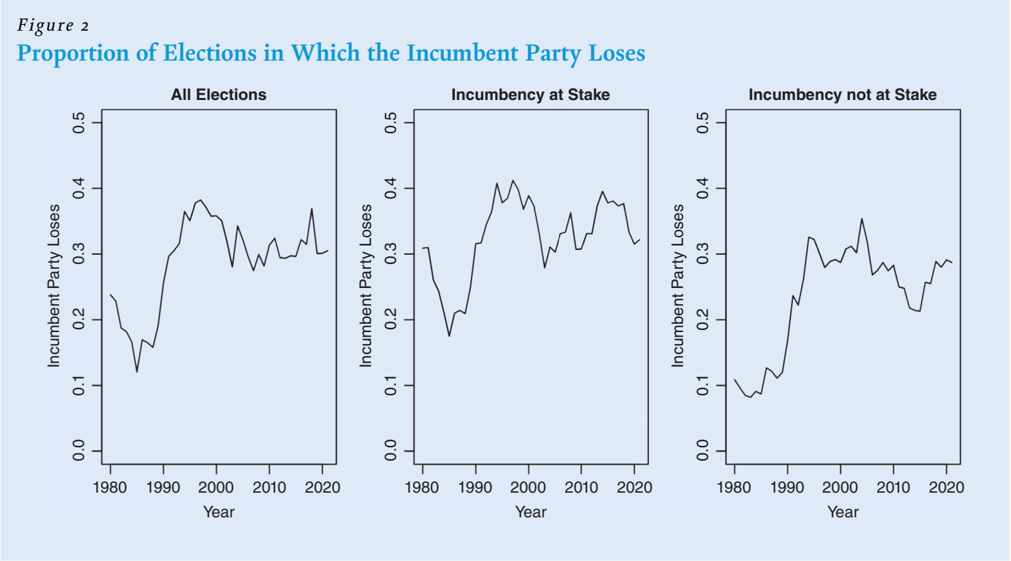
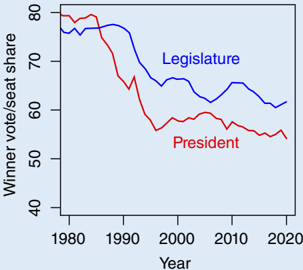
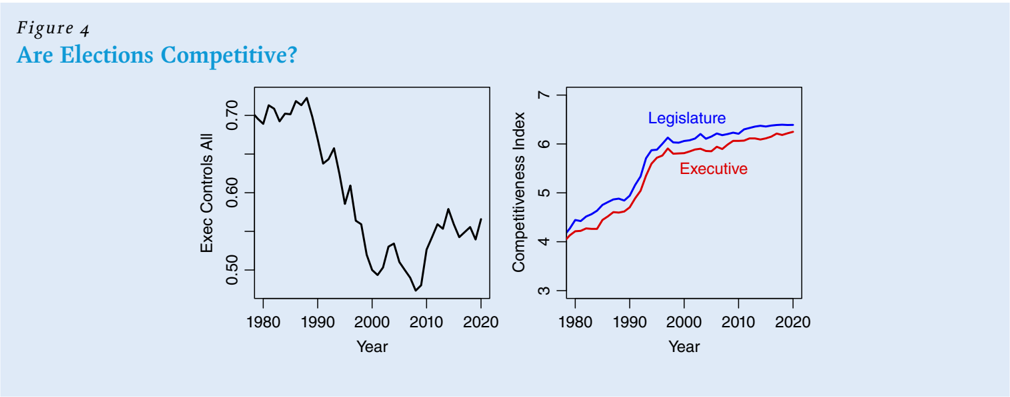
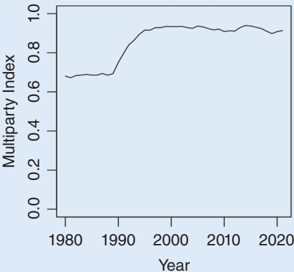
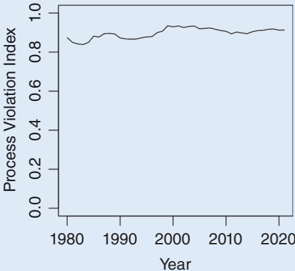
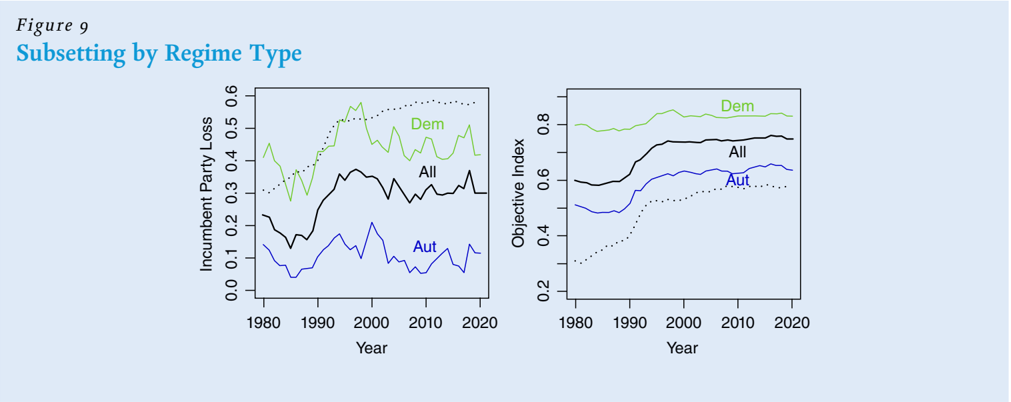
- On objective indicators, there is little evidence of global backsliding: incumbent-party loss rates remained fairly constant since the late 1990s; winner vote shares and winning-party legislative seat shares generally declined; the multiparty index rose from around 0.7 to 0.95 in the 1990s and then was stable; and the process-violations index was rare and stable for the past 20 years.
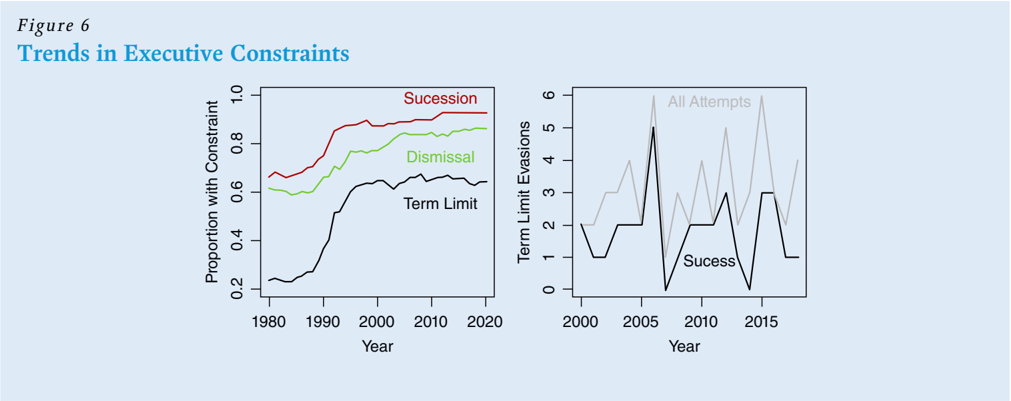
- Executive constraints show term limits flat, dismissal and succession rules slightly upward since the Cold War, and no clear trend in term-limit evasion. In Versteeg et al.’s data, there were 234 instances from 2000 to 2018 in which an incumbent reached the end of a term and was ineligible due to term limits; 60 were serious evasion attempts (26%), all from authoritarian or hybrid regimes, and 34 succeeded.
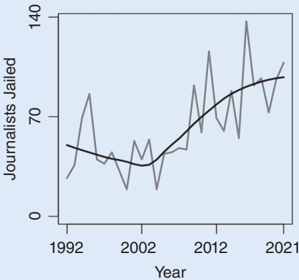
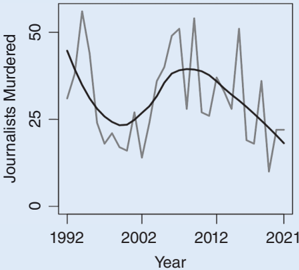
- Press freedom is mixed: journalists jailed increased beginning in the early 2000s, while journalists murdered decreased steadily since around 2008.
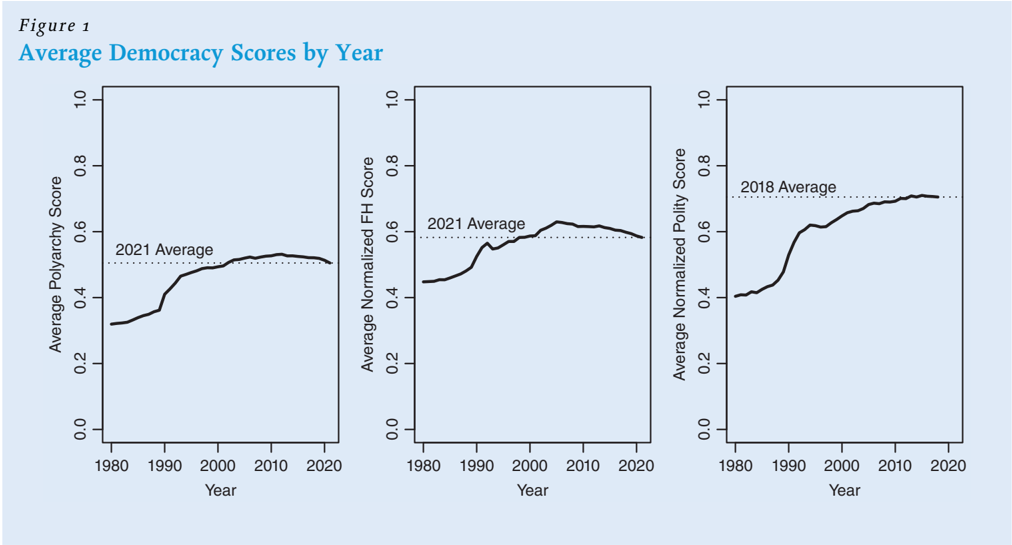
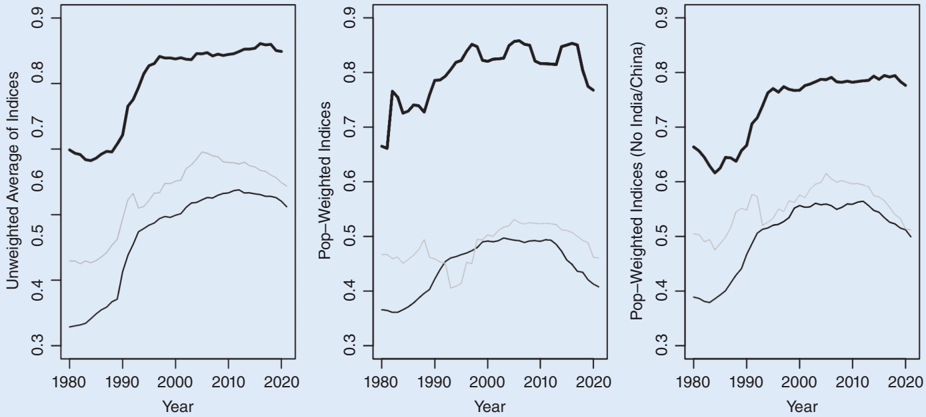
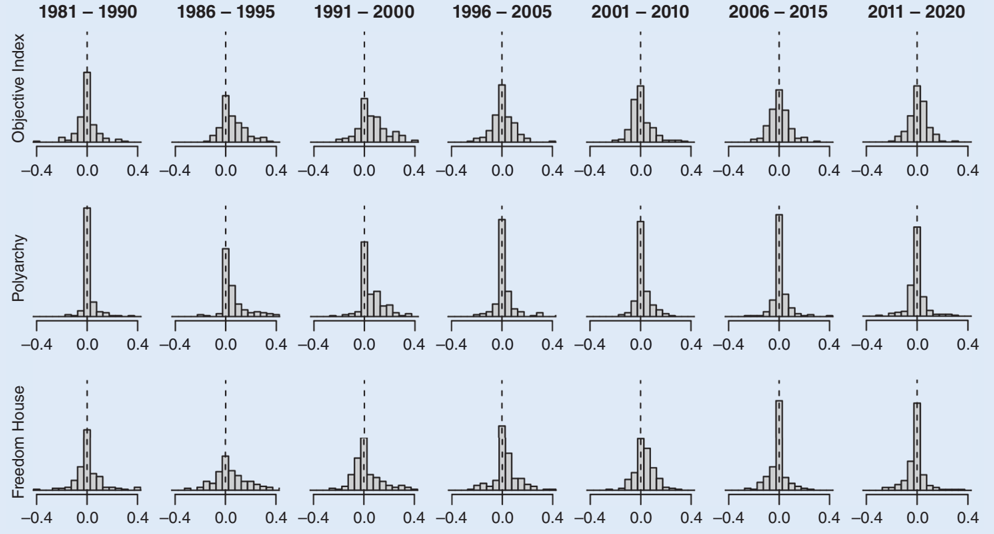
- The aggregate objective index generally continued to increase since 2000 and in 2020 was almost as high as it has ever been, whereas V-Dem and Freedom House scores modestly declined. Population weighting produces a notable decrease beginning around 2018 but a more volatile trend, sensitive to India and China.
Methods
- Design: The authors adopt a “quasi-minimalist” conception of democracy centered on free and fair elections in which losers accept results, and they survey objective indicators of electoral competitiveness, executive constraints, and media freedom, comparing them with expert-coded measures.
- Data: NELDA (1945–2020), the World Bank’s Database of Political Institutions, original executive-constraints data expanding Meng (2020), Versteeg et al. (2020) on term-limit evasion, and Committee to Protect Journalists data; the main graphs use a 1980–2021 window subject to availability and mostly unweighted country averages.
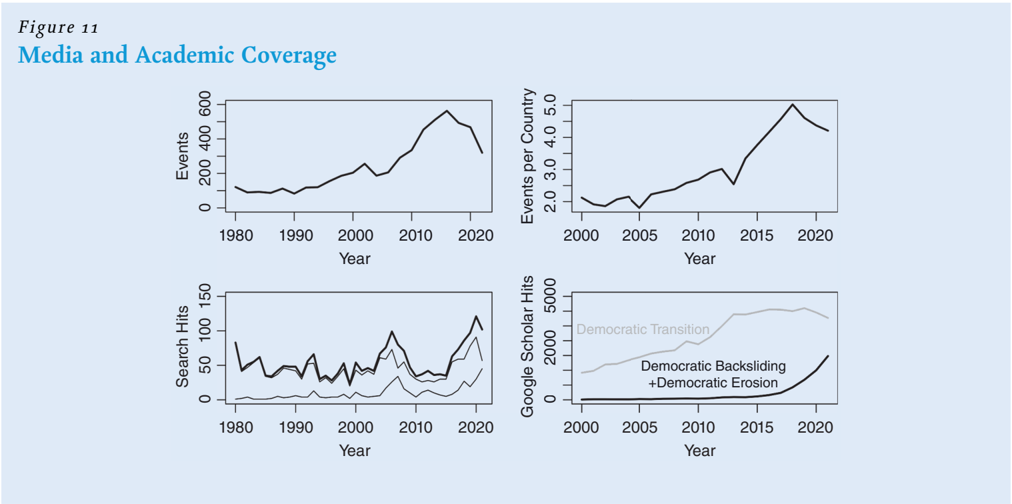
- Analysis: Trend comparisons and a simple aggregate objective index that normalizes individual variables between 0 and 1 and averages them by country-year; online appendix formal models examine coder bias and strategic attacks, and media-coverage trends are shown using Gottlieb et al. (2022), New York Times article counts, and Google Scholar hits.
Limitations
- The paper states that it cannot rule out the possibility that the world is becoming less democratic exclusively in ways that require subjective judgment to detect; it is not asserting that backsliding is not happening anywhere; objective measures focus on electoral institutions and outcomes and omit civil liberties; and the aggregate objective index is not an appropriate substitute for existing country-year democracy indices, with no clear substantive interpretation of its magnitude.
- The paper states that coder bias likely explains at least some of the discrepancy but is not definitively established; media coverage may reflect actual frequency of backsliding; and future research is needed on mechanisms.
- Evident from the text: several figures, tables, and online appendices are referenced but not included in the provided text, so some numerical trends cannot be verified from the excerpt alone.
Model-written summary. Check it against the paper before relying on it.
Integrity signals
Registry
Cites
Statistics
Figures
Verification
Claims the paper makes
3 Valid · 8 Not valid · 21 Not checked · 96 Own results and interpretations
The sources with a verdict support this claim; the rest weren’t checked yet, have no full text we could read, or their verdicts aren’t rated yet.
In the paper
“Even the types of subtle actions that many fear are the dominant mode of contemporary authoritarianism and backsliding (Guriev and Treisman 2020; Luo and Przeworski 2019; Przeworski 2019) typically are reflected in election results.”
What the sources say
- Supportedcites Guriev and Treisman 2020 matched to “A theory of informational autocracy” (2020) source
The Conclusions (section 5; page unavailable) say that most of today’s non-democratic leaders rely on information manipulation rather than mass repression. The Introduction (section 1; page unavailable) describes leaders removing constraints on their power while pretending to be democratic. The citation follows the description of contemporary authoritarian tactics; the statement about election results is the citing authors’ subsequent point. (LLM, conf=0.88)
- Not checked — no full text of the sourcecites Luo and Przeworski 2019 matched to “Democracy and Its Vulnerabilities: Dynamics of Backsliding” (2019) source
- Not checked — no full text of the sourcecites Przeworski 2019 matched to “Crises of Democracy” (2019) source
plainstates an association- Asserted: passes — The authors put it forward as true.
- Checkable: passes — It can be checked against evidence.
- Load-bearing: passes — The paper’s conclusions depend on it.
- Based: passes — The paper gives a reason why it holds.
- Supported
The cited sources support only part of this claim — read each source’s verdict below.
In the paper
“Unfortunately, fully adjusting for biases is a challenge even for extremely well-informed and sophisticated thinkers.”
What the sources say
- Not checked — no full text of the sourcecites Enke 2020 matched to “What You See Is All There Is*” (2020) source
- Partly supportedcites Brundage, Little, and You 2022 matched to “Selection Neglect and Political Beliefs” (2022) sourceExperimental — accuracy not yet measured
Section 4, “Experimental Work on the Mechanism” (page unavailable), says people often fail to adjust for biased samples and that making the bias more obvious reduces but does not eliminate the error. The paper also mentions errors by people with statistical expertise, but does not establish that extremely well-informed and sophisticated thinkers struggle to fully adjust for the selection biases at issue. (LLM, conf=0.82)
plain- Asserted: passes — The authors put it forward as true.
- Checkable: unclear — It is unclear whether it could be checked against evidence.
- Load-bearing: passes — The paper’s conclusions depend on it.
- Based: passes — The paper gives a reason why it holds.
The sources with a verdict support this claim; the rest weren’t checked yet, have no full text we could read, or their verdicts aren’t rated yet.
In the paper
“There is strong evidence across a variety of topics and subject pools that people make substantial errors when faced with selection problems in the samples that they observe (see Enke 2020 for a prominent recent example and Brundage, Little, and You 2022 for a review).”
What the sources say
- Not checked — no full text of the sourcecites Enke 2020 matched to “What You See Is All There Is*” (2020) source
- Supportedcites Brundage, Little, and You 2022 matched to “Selection Neglect and Political Beliefs” (2022) source
Section 4, “Experimental Work on the Mechanism” (page not available), describes experimental evidence of large, consistent deviations from rational benchmarks when people interpret selected samples as representative. It reviews examples involving numerical estimates, startup bets, and investment decisions, supporting the claim’s breadth. The paper is a review, as the citation indicates. (LLM, conf=0.88)
boosted- Asserted: passes — The authors put it forward as true.
- Checkable: passes — It can be checked against evidence.
- Load-bearing: passes — The paper’s conclusions depend on it.
- Based: passes — The paper gives a reason why it holds.
The paper states this without a source or data behind it here, so there is nothing to check it against. The quote shows it is in the paper.
In the paper
“despite recent prominent cases, there has been no uptick in the rate of leaders evading term limits.”
plain- Asserted: passes — The authors put it forward as true.
- Checkable: passes — It can be checked against evidence.
- Load-bearing: unclear — It is unclear whether the paper’s conclusions depend on it.
- Based: unclear — It is unclear why the paper says it holds.
The paper states this without a source or data behind it here, so there is nothing to check it against. The quote shows it is in the paper.
In the paper
“Constitutional rules that limit executive power have been fairly constant if not slightly increasing since the end of the Cold War.”
plain- Asserted: passes — The authors put it forward as true.
- Checkable: passes — It can be checked against evidence.
- Load-bearing: passes — The paper’s conclusions depend on it.
- Based: unclear — It is unclear why the paper says it holds.
54 more claims
Create a free account to see all 128 claims and to verify the 4 references still open.
- It may state two separate claims as one. 36
- The quote only partly states this claim. 1
- Probably not a substantial claim. 41
Self-check
Percentages, sums and reported differences re-computed from the paper’s own numbers.
Each contradiction between two passages listed here was confirmed by an independent check.
Rated minor: it would not touch a result — a value no result rests on, a p-value that stays on the same side of the significance level, or a conflict that is clerical, resolved elsewhere in the paper, or outside its own findings.
In the paper
§ Additional Measures of Winning/Incumbent Party Dominance · p. 6
“averaging the three variables gives a ' (lack of ) process violation ' index with three levels ranging from 0 to 1.”
§ Are Elections Competitive? · p. 6
“The second index captures various other electoral-process violations and includes the following variables: (1) were previous elections suspended, (2) had the current incumbent violated a term limit, and (3) did an opposition party boycott the election. In each case, we coded 1 for answering ' no ' and 0 otherwise;”
Citations
Cites
Democracy and the Market: Political and Economic Reforms in Eastern Europe and Latin America
Przeworski, A. (1991) · doi:10.1017/cbo9781139172493 · Cited by 3,494
Democracy and Development: Political Institutions and Well-Being in the World, 1950–1990
Przeworski, A., Alvarez, M. E., Cheibub, J. A., & Limongi, F. (2000) · doi:10.1017/cbo9780511804946 · Cited by 2,845
Democracy and dictatorship revisited
Cheibub, J. A., Gandhi, J., & Vreeland, J. R. (2010) · Public Choice · doi:10.1007/s11127-009-9491-2 · Cited by 2,481 · cited 2×
“This is a notoriously difficult problem (see, e.g., Boix, Miller, and Rosato 2013; Cheibub, Gandhi, and Vreeland 2010; Przeworski et al. 2000).”
BackgroundBermeo, N. (2016) · Journal of Democracy · doi:10.1353/jod.2016.0012 · Cited by 2,331
A third wave of autocratization is here: what is new about it?
Lührmann, A., & Lindberg, S. I. (2019) · Democratization · doi:10.1080/13510347.2019.1582029 · Cited by 1,528 · cited 2×
“Similarly, Lührmann and Lindberg (2019) contend that any country can “ autocratize, ” regardless of regime type.”
BackgroundFacing Up to the Democratic Recession
Diamond, L. (2015) · Journal of Democracy · doi:10.1353/jod.2015.0009 · Cited by 1,107 · cited 2×
“A substantial uptick in academic papers on democratic backsliding has emerged in recent years, which often raise alarm in the title: “ Democratic Regress in the Contemporary World ” (Haggard and Kaufman 2021) necessitates “ Facing up to the Democratic Recession ” (Diamond 2015) because “ A Third Wave of Autocratiza-ti…”
BackgroundA Complete Data Set of Political Regimes, 1800–2007
Boix, C., Miller, M., & Rosato, S. (2013) · Comparative Political Studies · doi:10.1177/0010414012463905 · Cited by 1,072
Unwelcome Change: Coming to Terms with Democratic Backsliding
Waldner, D., & Lust, E. (2018) · Annual Review of Political Science · doi:10.1146/annurev-polisci-050517-114628 · Cited by 889
Respect for Human Rights has Improved Over Time: Modeling the Changing Standard of Accountability
FARISS, C. J. (2014) · American Political Science Review · doi:10.1017/s0003055414000070 · Cited by 706
Hyde, S. D., & Marinov, N. (2012) · Political Analysis · doi:10.1093/pan/mpr040 · Cited by 643 · cited 1×
“Our data on elections and freedom of association are from the National Elections Across Democracy and Autocracy (NELDA) dataset, which contains several objective variables about all elections from 1945 to 2020 (Hyde and Marinov 2012).”
Method
Research works printed but not linked: 3
- Weitzel, Daniel, John Gerring, Dan Pemstein, and Svend-Erik Skaaning. 2023. ' Electoral Democracy: Global, Historical Measures Based on Observables. ' Working Paper . Aurora: Colorado State University.
- Anderson, Ashley, Jason Brownlee, and Killian Clarke. 2021. ' Autocracy: A Substantive Approach . ' Stanford University: Center on Democracy, Development and the Rule of Law.
- Chiopris, Caterina, Monika Nalepa, and Georg Vanberg. 2021. ' A Wolf in Sheep ' s Clothing: Citizen Uncertainty and Democratic Backsliding. ' Working Paper . Chicago: University of Chicago.
Cited by
Megastudy testing 25 treatments to reduce antidemocratic attitudes and partisan animosity
Voelkel, J. G., Stagnaro, M. N., Chu, J. Y., Pink, S. L., Mernyk, J. S., Redekopp, C., Ghezae, I., Cashman, M., Adjodah, D., Allen, L. G., et al. (2024) · Science · doi:10.1126/science.adh4764 · Cited by 174
“INTRODUCTION: Scholars, practitioners, and politicians have raised concerns about deepening partisan divisions and the health of American democracy.”
Megastudy testing 25 treatments to reduce antidemocratic attitudes and partisan animosity
Voelkel, J. G., Stagnaro, M., Chu, J., Pink, S. L., Mernyk, J. S., Redekopp, C., Ghezae, I., Cashman, M., Adjodah, D., Allen, L., et al. (2023) · doi:10.31219/osf.io/y79u5 · Cited by 174
Conceptualizing and Measuring Support for Democracy: A New Approach
Claassen, C., Ackermann, K., Bertsou, E., Borba, L., Carlin, R. E., Cavari, A., Dahlum, S., Gherghina, S., Hawkins, D. G., Lelkes, Y., et al. (2024) · Comparative Political Studies · doi:10.1177/00104140241259458 · Cited by 107
Income inequality and the erosion of democracy in the twenty-first century
Rau, E. G., & Stokes, S. C. (2024) · Proceedings of the National Academy of Sciences · doi:10.1073/pnas.2422543121 · Cited by 93
Pathways of Democratic Backsliding, Resistance, and (Partial) Recoveries
Riedl, R. B., McCoy, J., Roberts, K., & Somer, M. (2024) · The Annals of the American Academy of Political and Social Science · doi:10.1177/00027162251319909 · Cited by 32
Mini-Publics, (Lack of) Representativeness, and Legitimacy Beliefs
Germann, M. (2025) · British Journal of Political Science · doi:10.1017/s0007123424000322 · Cited by 35
Croissant, A., & Pelke, L. (2025) · Political Studies · doi:10.1177/00323217251345779 · Cited by 52
“However, relying solely or mainly on “more objective data” (Little and Meng, 2024) is insufficient to capture the complexities that characterize the concepts of democratic quality and democratic resilience.”
Why masses support democratic backsliding
Gidron, N., Margalit, Y. M., Sheffer, L., & Yakir, I. (2025) · American Journal of Political Science · doi:10.1111/ajps.12958 · Cited by 52
Ali, S. A. M. (2025) · Policy Studies · doi:10.1080/01442872.2025.2538846 · Cited by 20
“While databases of this nature have weaknesses, especially with regard to the conceptualisation and measurement of variables (Little and Meng 2024), V-Dem is a widely respected source of data on democracy.”
Countering the Wave of Democratic Backsliding and the Crisis of Democracy in West Africa
Arthur, P. (2025) · Insight on Africa · doi:10.1177/09750878241312188 · Cited by 19
Social Progress Index 1990–2020: measuring societal wellbeing over 31 years
Krylová, P., Harmáček, J., & Htitich, M. (2025) · International Journal of Social Research Methodology · doi:10.1080/13645579.2025.2486264 · Cited by 9
“While these biases have been highlighted recently (Little & Meng, 2024), we are confident that they have only a minimal effect on the conceptual validity of the measurement and are still a meaningful assessment of social progress, especially when aggregated with other metrics.”
Electoral autocracies, hybrid regimes, and multiparty autocracies: same, same but different?
Schmid, J. W. (2025) · Democratization · doi:10.1080/13510347.2025.2476183 · Cited by 15
Pentz, B., Sanyal, P., Simek, Z., & Loring, P. (2025) · Environmental Science & Policy · doi:10.1016/j.envsci.2025.104151 · Cited by 9
The promise and peril of interpersonal political communication
Settle, J. E. (2024) · Political Psychology · doi:10.1111/pops.12990 · Cited by 14
“…of the field moving forward, the more pertinent 23 While most scholars of American politics are concerned about democratic backsliding in the United States, there is some debate in the comparative politics community about the extent to which this is a problem (Little & Meng, 2024; Weyland, 2020).”
Quality Assessment of the Academic Freedom Index: Strengths, Weaknesses, and How Best to Use It
Lott, L., & Spannagel, J. (2025) · Perspectives on Politics · doi:10.1017/s1537592724001968 · Cited by 21
Public opinion alone won’t save democracy
Nyhan, B. J., & Titiunik, R. (2024) · Science · doi:10.1126/science.ads7371 · Cited by 10
Anti‐Democratic Influence: The Effect of Citizens United on State Democratic Performance
Fordham, R. F. (2024) · Legislative Studies Quarterly · doi:10.1111/lsq.12447 · Cited by 8
Strategic responses to autocratization in international democracy promotion
Leininger, J., Mroß, K., & Wolff, J. (2025) · Democratization · doi:10.1080/13510347.2025.2465876 · Cited by 7
Aina, F., Afolabi, B., & Fayemi, J. '. (2025) · Society · doi:10.1007/s12115-025-01154-0 · Cited by 13
Ganohariti, R. (2026) · Journal of Ethnic and Migration Studies · doi:10.1080/1369183x.2026.2631871 · Cited by 5
National Identity and Democracy Ratings
Bush, S. S., & Izama, M. P. (2024) · Comparative Political Studies · doi:10.1177/00104140241259457 · Cited by 5
“Moreover, it may be that some of the questions, such as those on electoral process, involve less subjectivity or coder judgment and are therefore less likely to exhibit national bias (Little & Meng, 2024, p. 153).”
Bol, D., & Bono, P.-H. (2025) · Research & Politics · doi:10.1177/20531680251335653 · Cited by 5
“…a wide range of experts would in principle minimize this risk (Knutsen et al., 2024), it is not impossible that these experts share the same biases, given that political scientists as a group tend to have similar socio-demographic characteristics and political preferences (Little and Meng, 2024).”
Chasing the authoritarian spectre: Detecting authoritarian discourse with large language models
Mochťak, M. (2025) · European Journal of Political Research · doi:10.1111/1475-6765.12740 · Cited by 11
Derogations, democratic backsliding, and international human rights during the COVID-19 pandemic
Comstock, A. L., Heiss, A., & Chaudhry, S. (2025) · Journal of Human Rights · doi:10.1080/14754835.2024.2446854 · Cited by 6
“Some scholars claim that backsliding can only occur in existing democracies, whereas others argue that it can happen in any state, regardless of regime type (Little & Meng, 2024).”
The ethics of responding to democratic backsliding abroad
Pattison, J. W. (2025) · American Journal of Political Science · doi:10.1111/ajps.12974 · Cited by 5
Defining and Measuring Democratic Norms
Helmke, G., & Rath, J. (2025) · Annual Review of Political Science · doi:10.1146/annurev-polisci-041322-040610 · Cited by 11
Caught in the crossfire: Children’s rights under backsliding and backlash
Kahn‐Nisser, S. (2025) · Journal of Human Rights · doi:10.1080/14754835.2024.2443974 · Cited by 3
Selk, V., & Klüh, N. (2025) · Frontiers in Political Science · doi:10.3389/fpos.2025.1418880 · Cited by 5
Beacken, G. D., Trauthig, I. K., & Woolley, S. (2026) · Big Data & Society · doi:10.1177/20539517251410064 · Cited by 7
“Democratic backsliding is tied to the waning of democratic institutions such as a non-partisan judiciary, independence of the press, or the liberal political participation in free and fair elections (Carothers and Press, 2022; Little and Meng, 2024).”
Legislative Capture and Democratic Careening in Poland
Tworzecki, H. (2024) · The Annals of the American Academy of Political and Social Science · doi:10.1177/00027162241307748 · Cited by 4
Democratic backsliding and the populist challenge for public administration
Schiffers, M. (2025) · Zeitschrift für Politikwissenschaft · doi:10.1007/s41358-025-00432-x · Cited by 7
Chu, J., Williamson, S., & Yeung, E. S. F. (2025) · Comparative Political Studies · doi:10.1177/00104140251392539 · Cited by 9
“The extent of this decline continues to be debated (Little & Meng, 2024).”
Explanation, formal models, and rational choice
Ashworth, S. (2024) · Journal of Theoretical Politics · doi:10.1177/09516298241270965 · Cited by 4
Revisiting citizen preferences for who should govern and how. the case of cross-national surveys
del Río, A. (2024) · Journal of Elections Public Opinion and Parties · doi:10.1080/17457289.2024.2409641 · Cited by 3
Barberia, L., Piazza, K. S., & Avelino, G. (2025) · Journal of Politics in Latin America · doi:10.1177/1866802x241306119 · Cited by 3
“There has been a long-standing interest in comparative politics with political regimes, yet their measurement remains a point of considerable debate (Knutsen et al., 2024; Little and Meng, 2024).”
Why Resistance to the Executive Power Grab in Tunisia Is Failing
Blackman, A. D. (2024) · The Annals of the American Academy of Political and Social Science · doi:10.1177/00027162241310157 · Cited by 5
Democratic Backsliding and the Politicization of Public Employment
Cayton, F., & Rosenfeld, B. R. M. (2025) · Cambridge University Press eBooks · doi:10.1017/9781009602570.006 · Cited by 4
The would-be autocrats’ toolkit: what do incumbents do when they undermine democracy?
van Lit, J., & van Ham, C. (2025) · European Political Science Review · doi:10.1017/s1755773925100106 · Cited by 10
Does Descriptive Representation Increase Acceptance of Judicial Decisions?
Krehbiel, J. (2025) · Political Research Quarterly · doi:10.1177/10659129251381786 · Cited by 3
Democratic backsliding in Honduras and MACCIH’s effects (2016–2021)
Gomis, M. (2026) · Policy Studies · doi:10.1080/01442872.2025.2602248 · Cited by 2
“…of democracy fuel conceptual heterogeneity, complicating measurement and generating misalignment between indicators and expert assessments (Little and Meng 2024), while patrimonial dynamics challenge DB analyses of fundamental rights (Wolkenstein 2023) Latin American scholarship on…”
Does Hard Propaganda (Also) Work in Democracies? Evidence from the United States
Lutscher, P. M., & Donnay, K. (2025) · Perspectives on Politics · doi:10.1017/s153759272400272x · Cited by 4
Yoo, S. H. (2025) · Socio-Economic Review · doi:10.1093/ser/mwaf016 · Cited by 4
Global Challenges to Democracy: Backsliding, Resiliency, and Democratic Theory
Roberts, K. M., Bunce, V. J., Pepinsky, T. B., & Riedl, R. B. (2025) · Cambridge University Press eBooks · doi:10.1017/9781009602570.002 · Cited by 8
Autocratização e resiliência democrática no Brasil (2019-2023)
Gaspardo, M., & de Oliveira, A. R. S. M. (2025) · Revista Direito GV · doi:10.1590/2317-6172202515 · Cited by 4
Measuring electoral democracy with observables
Weitzel, D., Gerring, J., Pemstein, D., & Skaaning, S. (2025) · American Journal of Political Science · doi:10.1111/ajps.12968 · Cited by 6
The exhaustion of democratic theory
Selk, V. (2025) · European Journal of Social Theory · doi:10.1177/13684310251330592 · Cited by 4
“It has recently been argued that this mechanism is still intact as the number of electoral changes has not decreased and the empirical evidence for the argument that former consolidated democracies are “ backsliding ” towards autocracy is therefore missing (Little & Meng, 2024).”
Norris, P. (2025) · Oxford University Press eBooks · doi:10.1093/oxfordhb/9780197777497.013.0034 · Cited by 1
Measuring Media Criticism with ALC Word Embeddings
Barrie, C., Ketchley, N., Siegel, A. A., & Bagdouri, M. (2025) · Political Analysis · doi:10.1017/pan.2025.10012 · Cited by 5
The public vs. experts on democracy: perception gaps and the causes of citizens’ evaluations
Myftari, J. (2025) · European Politics and Society · doi:10.1080/23745118.2025.2550750 · Cited by 1
“As mentioned, Little and Meng (2023) pointed out that studies on democratic decline are based largely or entirely on subjective indicators that rely on expert judgments.”
InfluentialCovid and the constitution: unlawful states of emergency during the pandemic
Bjørnskov, C., & Voigt, S. (2025) · European Journal of Law and Economics · doi:10.1007/s10657-025-09855-x · Cited by 1
Bas, M. A., & Stone, R. W. (2025) · International Studies Quarterly · doi:10.1093/isq/sqaf067 · Cited by 1
Representation and the legislative enterprise: an expanded view of staff representation
Rutherford, A., & Wu, J. (2025) · Politics Groups and Identities · doi:10.1080/21565503.2025.2564133 · Cited by 1
Countering Illiberalism in Liberal Democracies: Information, Legacies, Temporalities
Capoccia, G. (2026) · Comparative Political Studies · doi:10.1177/00104140261418663 · Cited by 2
Satisfaction with democracy predicts democratic behaviors
Vargas, A. S., Seira, E., & Simpser, A. (2026) · Proceedings of the National Academy of Sciences · doi:10.1073/pnas.2517671123 · Cited by 1
“Studies that use expert assessments to measure the health of democracy face the issue that such assessments tend to echo expert biases, rather than actual democratic behaviors or realities on the ground (17–20).”
Monjane, B. (2026) · Globalizations · doi:10.1080/14747731.2026.2669413 · Cited by 2
Kirchner, D. (2026) · Zeitschrift für Vergleichende Politikwissenschaft · doi:10.1007/s12286-026-00661-6 · Cited by 1
Croissant, A., Hengge, A., & Wintergerst, C. (2024) · Asian international studies review · doi:10.1163/2667078x-bja10032 · Cited by 6
Dimensions of State Capacity and Modes of Democratic Breakdown
Andersen, D. D. E., Knutsen, C. H., & Skaaning, S. (2025) · Political Studies · doi:10.1177/00323217251344758 · Cited by 10
“However, the coding is based on subjective evaluations, which can be prone to various biases (see Knutsen et al., 2024; Little and Meng, 2024).”
Populism's Original Sin: Short-Term Populist Penalties and Uncertainty TrapsPreprint
Woo-Mora, L. G. (2024) · SSRN Electronic Journal · doi:10.2139/ssrn.4893646 · Cited by 1
Megastudy testing 25 treatments to reduce antidemocratic attitudes and partisan animosityPreprint
Strand, P. J., Voelkel, J. G., Stagnaro, M. N., Chu, J., Willer, R., & Kopell, M. (2025) · SSRN Electronic Journal · doi:10.2139/ssrn.5034911 · Cited by 2
Populismo de izquierda y democracia en América Latina: un estudio comparativo
Robles, A. D. J. L. (2024) · Revista Temas Sociológicos · doi:10.29344/07196458.34.3800
Re-examining the Effects of Western Sanctions on Democracy and Human Rights in the 21st CenturyPreprint
Peez, A. (2024) · OSF Preprints (OSF Preprints) · doi:10.31219/osf.io/ge7at · Cited by 1
Senegal: Between Political Instability and Democratic ConsolidationPreprint
Ngom, A. W., & Ricart‐Huguet, J. (2024) · SSRN Electronic Journal · doi:10.2139/ssrn.4971730
Calha, A. (2024) · European Public & Social Innovation Review · doi:10.31637/epsir-2024-1635
The great convergence: post-Cold War transitions to hybrid regimes across waves and ebbs
Cassani, A. (2024) · Italian Political Science Review/Rivista Italiana di Scienza Politica · doi:10.1017/ipo.2024.15 · Cited by 1
Índice de Elecciones Democráticas: 30 indicadores vinculantes
Electoral, P. D. I., & Otaola, M. A. L. (2024) · Revista Elecciones · doi:10.53557/elecciones.2024.v23n28.08
Natasha Piano, Democratic Elitism: The Founding Myth of American Political Science
Kogelmann, B. (2025) · Philosophy & Public Affairs · doi:10.1111/papa.70000
Large Language Models Are Democracy Coders with Attitudes
Weidmann, N. B., Faulborn, M., & García, D. (2025) · PS Political Science & Politics · doi:10.1017/s1049096525101248 · Cited by 5
“…on V-Dem, the largest collection of democracy data, the argument is that expert ratings in this dataset could be affected by psychological biases ( little2024measuring ; treisman2024psychological ) and lead to skewed assessments of democratic quality that are not supported by more factual…”
The Evolving “Importance” of Social and Governance Measures Over Time
Htitich, M., Harmáček, J., & Krylová, P. (2025) · Global Policy · doi:10.1111/1758-5899.70066
Introduction: Defining Electoral Integrity
James, T. S., & Garnett, H. A. (2025) · Oxford University Press eBooks · doi:10.1093/oxfordhb/9780197777497.013.0035 · Cited by 1
Coalition Management and Governance Outcomes in Multiparty Presidential Regimes
Chaisty, P., & Power, T. J. (2025) · Political Studies · doi:10.1177/00323217251371949
Expertocracy as thin-centered ideology: theoretical concepts and empirical illustrations
Selk, V. (2025) · Political Research Exchange · doi:10.1080/2474736x.2025.2575772 · Cited by 1
“…pointed out that there has by no means been a decline in the number of changes of government and that political competition has not decreased (Little and Meng 2024), a decline in the binding effect of democratic procedures can be observed, as these no longer generate the degree of legitimacy…”
Opposition’s paradox of victory: electoral success and authoritarian retrenchment in Turkey
Özpek, B. B., Öztürk, A. E., Dagi, I. D., & Erkoç, T. E. (2025) · Journal of Southeast European and Black Sea Studies · doi:10.1080/14683857.2025.2580014
Vaccaro, A. (2025) · Elsevier eBooks · doi:10.1016/b978-0-443-26629-4.00162-3
Institutional and conceptual flipsiding: illiberal subversion of “democracy”
Karolewski, I. P. (2025) · Social Semiotics · doi:10.1080/10350330.2025.2601616 · Cited by 2
Government performance and support for democracy in Spain
Hawkins, D. G., Gubler, J. R., Beesley, C., Ingles, T., & Chatterley, J. (2025) · Research & Politics · doi:10.1177/20531680251409938
Babones, S. (2025) · Journal of World Affairs Voice of the Global South · doi:10.1177/29769442251406936
Election management institutions as catalysts for autocratic transformation
Higashijima, M., & Wilson, M. (2026) · Democratization · doi:10.1080/13510347.2025.2592082 · Cited by 1
Democracy and Legitimacy: Comparing South Africa, Turkey, and Poland
van Beek, U., Esmer, Y. R., & Markowski, R. (2026) · Journal of Asian and African Studies · doi:10.1177/00219096251380762
“…measures of quality of democracy and democratic backsliding such as V-Dem, The Economist Intelligence Unit, or Freedom House (see, for example, Little and Meng, 2024), there is universal consensus on the democratic decline—or one might call it free fall—in the case of Turkey, no matter how it…”
Understanding and Defining Autocratization
Vangelov, O. (2026) · New perspectives on South-East Europe · doi:10.1007/978-3-032-14114-9_3
Midiendo la democracia: una propuesta de Índice Multidimensional de Cambio Democrático (IMCD)
Freidenberg, F. D., & Gilas, K. M. (2026) · doi:10.22201/iis.rld.2026.2.16
La democracia en América Latina: Apuntes para una discusión
Munck, G. L. (2026) · doi:10.22201/iis.rld.2026.2.15 · Cited by 1
QUALIDADE DA CLASSE POLÍTICA: UMA DISCUSSÃO COM A LITERATURA E UMA PROPOSTA DE DEFINIÇÃO
Perissinotto, R. M., & Codato, A. (2025) · Lua Nova Revista de Cultura e Política · doi:10.1590/0102-040rp
Effects of political polarization on non-electoral participation
Kołczyńska, M. (2026) · Comparative European Politics · doi:10.1057/s41295-026-00471-w
Künstliche Superintelligenz und das Ende der Demokratie
Mannino, A., & Althaus, N. (2026) · Springer eBooks · doi:10.1007/978-3-658-50335-2_12
The Underreported Death Toll of Wars: A Probabilistic Reassessment From a Survey with UCDP Coders
Vesco, P., Randahl, D., Hegre, H., Högbladh, S., & Yilmaz, M. C. (2026) · Journal of Conflict Resolution · doi:10.1177/00220027261423826 · Cited by 3
Measuring Changes in Corruption Over Time
Dalton, M., & Esarey, J. (2026) · Political Studies · doi:10.1177/00323217261431905
Are “Thick” Democracy Indices Like V-Dem Biased Against the Global South?
Babones, S. (2026) · Journal of World Affairs Voice of the Global South · doi:10.1177/29769442261448680
“For example, Little and Meng (2024) have examined simple electoral turnover, measuring the vote share and seats won by incumbent governments.”
The multiple fronts of democratic backsliding: evidence from Israel, Hungary, and India
Lavi, L., Shomer, Y., & Talshir, G. (2026) · Contemporary Politics · doi:10.1080/13569775.2026.2675024
Why some elected autocrats fail: democratic vulnerability in Latin America
Negretto, G. L., Melo, M. A., & Pereira, C. (2026) · Democratization · doi:10.1080/13510347.2026.2663025 · Cited by 2
Órganos electorales y rendición de cuentas horizontal: Revisión crítica del caso panameño
Gamboa, N. V. V. (2026) · Revista Gobierno y Sociedad · doi:10.61311/2805-1912.214
Democratic discontent? Interpreting public attitudes in Hungary through expert narratives
Myftari, J., & Rusta, L. (2026) · Journal of Contemporary European Studies · doi:10.1080/14782804.2026.2709147
Kan, M. E., & Bilgili, M. S. (2026) · SAGE Open · doi:10.1177/21582440261466072
Executive constraints and incumbent takeovers
Djuve, V. L. (2026) · Journal of Peace Research · doi:10.1093/jopres/xjag065
Mapping Global Digital Political Inequality
Lane, D. S., Gagrčin, E., & Pan, Y. Q. (2026) · Cambridge University Press eBooks · doi:10.1017/9781009514187
Authoritarian cultures in the shadow of democracy
Wippell, J. G. R. (2026) · Current Sociology · doi:10.1177/00113921261463423
Mthombeni, Z. M. (2026) · African Studies · doi:10.1080/00020184.2026.2696308
“Despite global anxieties over democratic backsliding, coalition politics in South Africa remains an important mechanism for power-sharing and democratic resilience (Little & Meng 2024; Rakner 2021).”
Ibáñez, D., & Bello-Gómez, R. A. (2026) · Public Administration Review · doi:10.1111/puar.70185 · Cited by 1
Metadata
- Authors
- Little, A. T., & Meng, A.
- Affiliations
- University of California, Berkeley (US)
- University of Virginia (US)
- Venue
- PS: Political Science & Politics
- Publisher
- Cambridge University Press (CUP)
- Published
- 2024-01-11
- Volume
- 57
- Issue
- 2
- Pages
- 149-161
- ISSN
- 0030-8269 (ISSN-L)
- 1049-0965
- 1537-5935
- OpenAlex
- W4390746191
- Cited by
- 121
- References
- 42
- Citations by year
- 2026: 40 · 2025: 56 · 2024: 24
- FWCI
- 85.79
- Type
- journal article
- Language
- en
- Open access
- hybrid
- doi.org
- Locations
- PS Political Science & Politics (publishedVersion, cc-by)
- Topics
- Social Sciences › Sociology and Political Science › Political Conflict and Governance
- Social Sciences › Political Science and International Relations › Political Theory and Democracy
- Social Sciences › Political Science and International Relations › Electoral Systems and Political Participation
- Keywords
- democratic backsliding, subjective indicators
About these checks
Registry, retraction, Cites and statistics results are computed, not judged, with one exception: a printed reference that no index lists is read once by a model before it counts as a citation error. Claims are extracted by a model and kept only when their quote appears verbatim in the text; each cited source is then checked, with a model’s help, for whether it says what the claim relies on. Those verdicts can be wrong — read the claim’s quote and the cited source before relying on one.
The claim verdicts this report counts are experimental: their accuracy is not yet measured.
A language model drew the claims from the paper on 2026-10-10, under version 3 of the claim definition (model deepseek-v4.1-flash, prompt extract-v3).
A second model labelled each claim on 2026-10-10 (model jev-1.13-20260917, definition revision gold-guideline-v0.2).
Cited sources are checked with a language model’s help (gpt-6-sol).
Statistics and arithmetic are recomputed, not judged.
Confidence bands are shown only for fields calibrated on our annotated test set. None is calibrated yet, so no band is shown.
What counts as a claim ›How we measure confidence ›How we check this ›
Are you an author, or do you see a problem with this page? Request a review
Data sources
Bibliographic data: Semantic Scholar, OpenAlex, Crossref.
Contains information from the Semantic Scholar Academic Graph Datasets, made available under the ODC Attribution License (ODC-BY 1.0).
Semantic Scholar’s data is described in: Kinney, R., et al. (2023). The Semantic Scholar Open Data Platform. arXiv:2301.10140.
