

Measuring Democratic Backsliding
Open accessThe DOI matches its Crossref record; 49 of the 49 references it cites were found in a registry or an index; 3 of the 26 sources its claims cite were checked for support.
Abstract
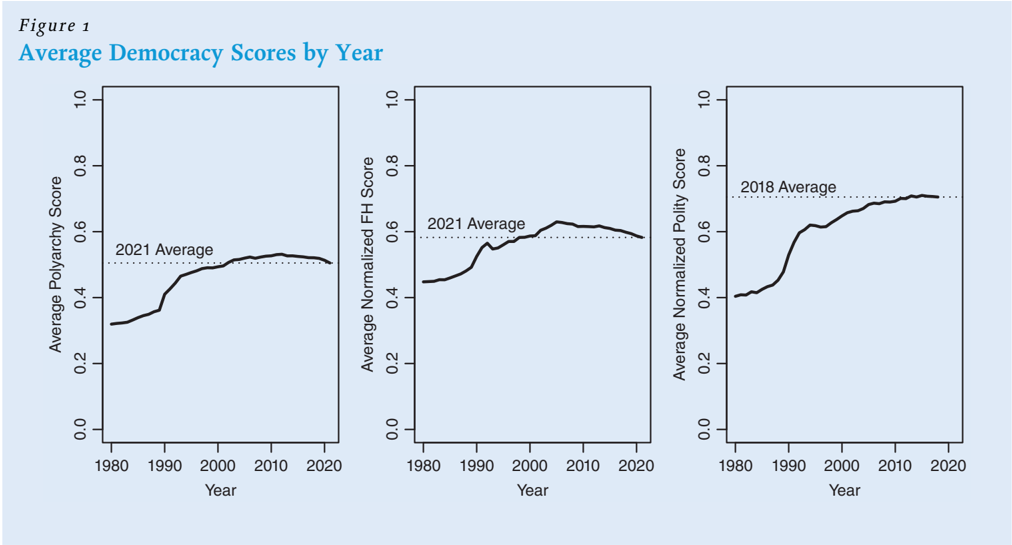
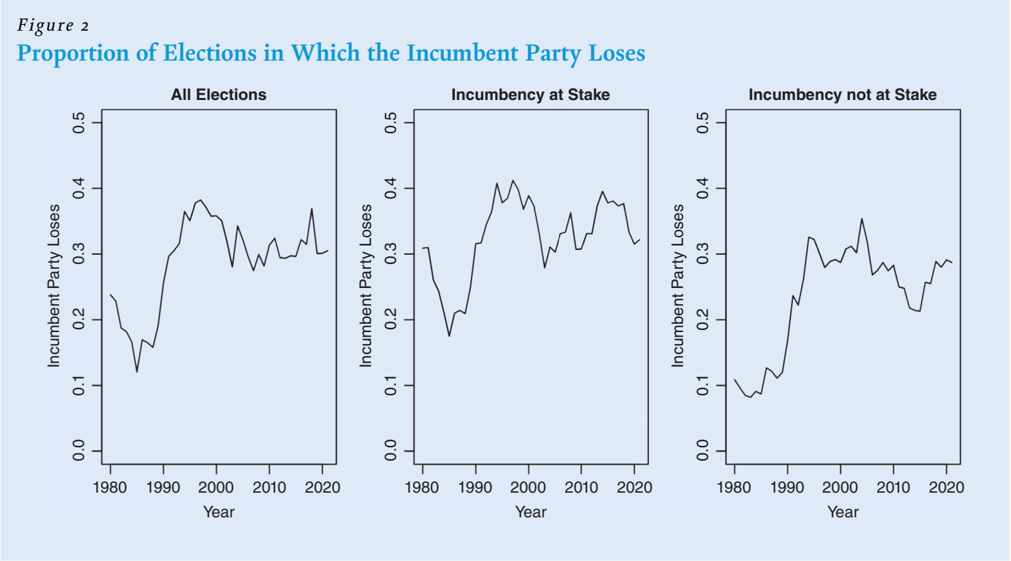
Despite the general narrative that the world is in a period of democratic decline, there have been surprisingly few empirical studies that assess whether this is systematically true. Most existing studies of global backsliding are based largely if not entirely on subjective indicators that rely on expert coder judgment. Our study surveys objective indicators of democracy (e.g., incumbent performance in elections) and finds little evidence of global democratic decline during the past decade. To explain the discrepancy in trends between expert-coded and objective indicators, we consider the role of coder bias and leaders strategically using more subtle undemocratic action. Although we cannot rule out the possibility that the world is becoming less democratic exclusively in ways that require subjective judgment to detect, this claim is not justified by existing evidence.
Overview
CoChat Summary
TL;DR
The paper argues that common claims of global democratic decline are not clearly supported by objective indicators, which show little backsliding over the past decade, while expert-coded measures show only modest decline. It attributes the discrepancy partly to possible time-varying coder bias and strategic subtle backsliding, concluding that existing evidence does not justify alarmist claims.
Key findings
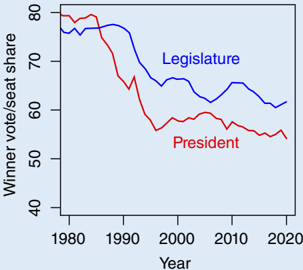
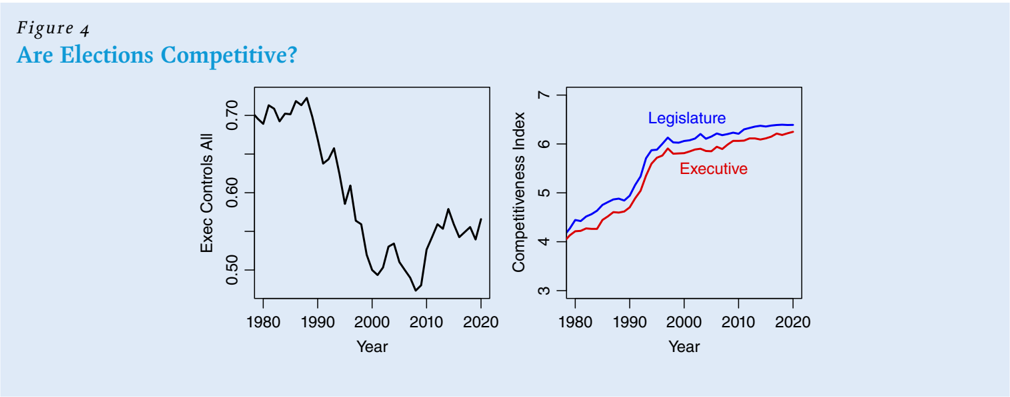
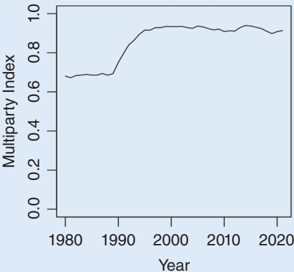
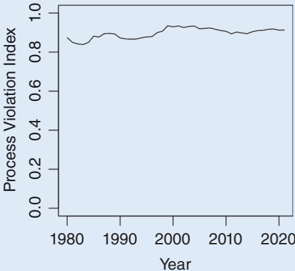
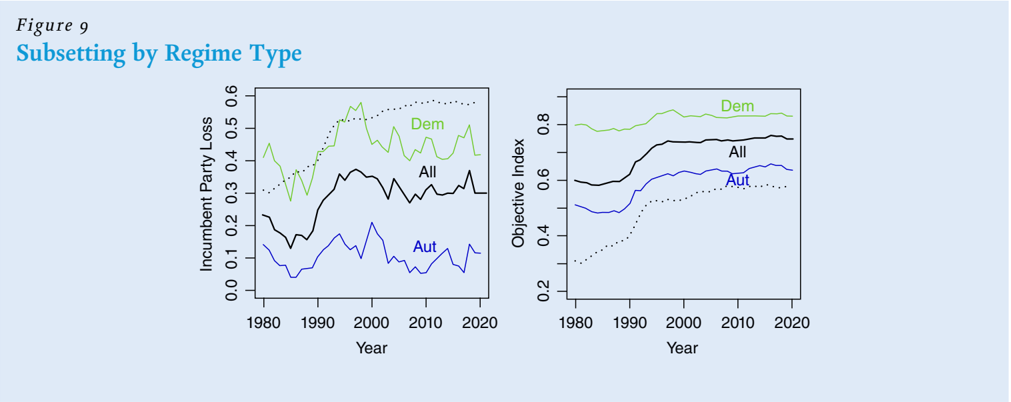
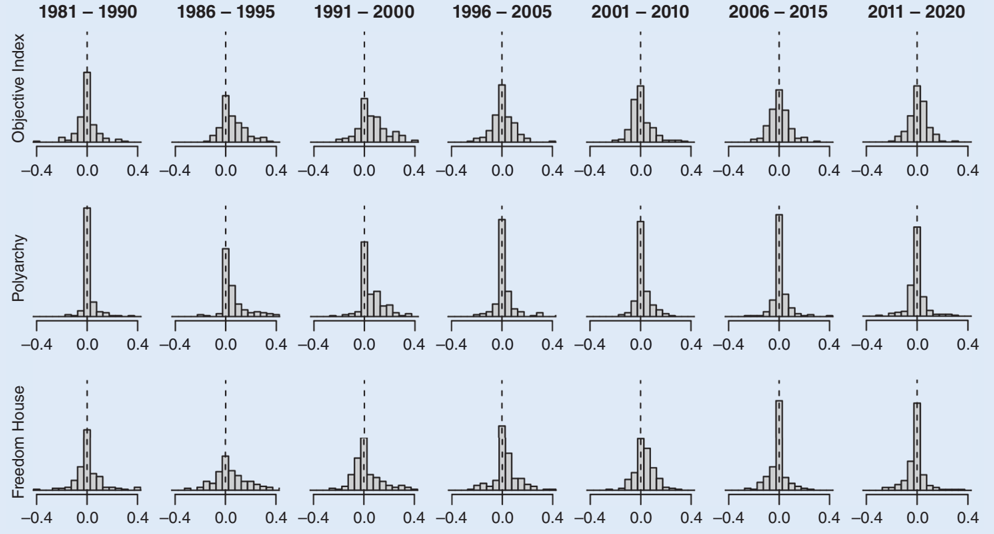
- On objective indicators, there is little evidence of global backsliding: incumbent-party loss rates remained fairly constant since the late 1990s; winner vote shares and winning-party legislative seat shares generally declined; the multiparty index rose from around 0.7 to 0.95 in the 1990s and then was stable; and the process-violations index was rare and stable for the past 20 years.
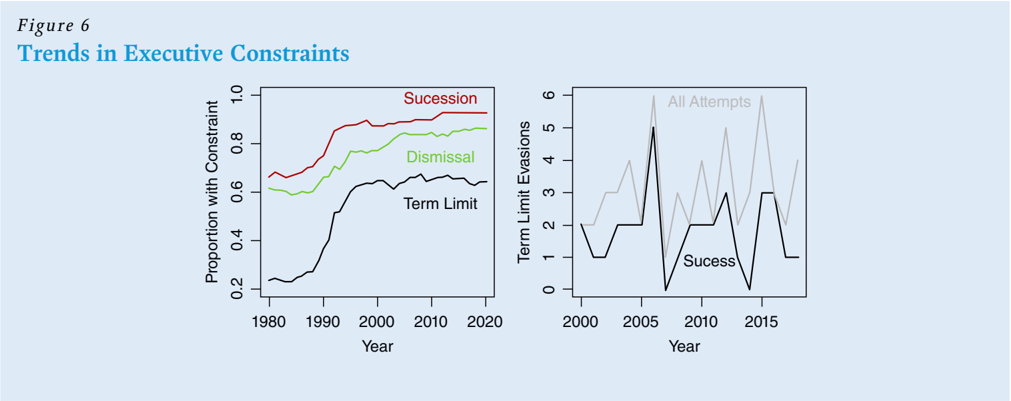
- Executive constraints show term limits flat, dismissal and succession rules slightly upward since the Cold War, and no clear trend in term-limit evasion. In Versteeg et al.’s data, there were 234 instances from 2000 to 2018 in which an incumbent reached the end of a term and was ineligible due to term limits; 60 were serious evasion attempts (26%), all from authoritarian or hybrid regimes, and 34 succeeded.
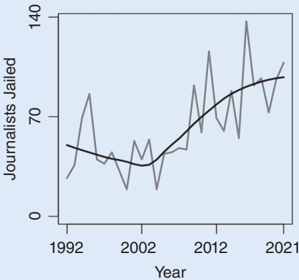
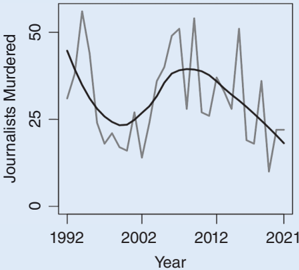
- Press freedom is mixed: journalists jailed increased beginning in the early 2000s, while journalists murdered decreased steadily since around 2008.
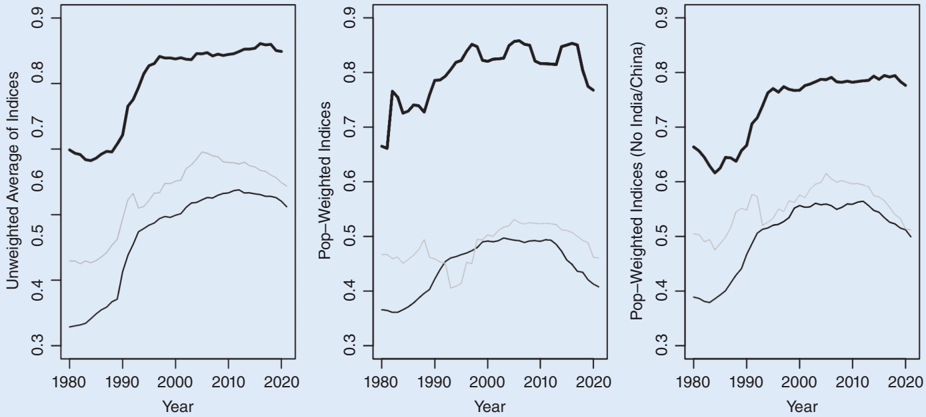
- The aggregate objective index generally continued to increase since 2000 and in 2020 was almost as high as it has ever been, whereas V-Dem and Freedom House scores modestly declined. Population weighting produces a notable decrease beginning around 2018 but a more volatile trend, sensitive to India and China.
Methods
- Design: The authors adopt a “quasi-minimalist” conception of democracy centered on free and fair elections in which losers accept results, and they survey objective indicators of electoral competitiveness, executive constraints, and media freedom, comparing them with expert-coded measures.
- Data: NELDA (1945–2020), the World Bank’s Database of Political Institutions, original executive-constraints data expanding Meng (2020), Versteeg et al. (2020) on term-limit evasion, and Committee to Protect Journalists data; the main graphs use a 1980–2021 window subject to availability and mostly unweighted country averages.
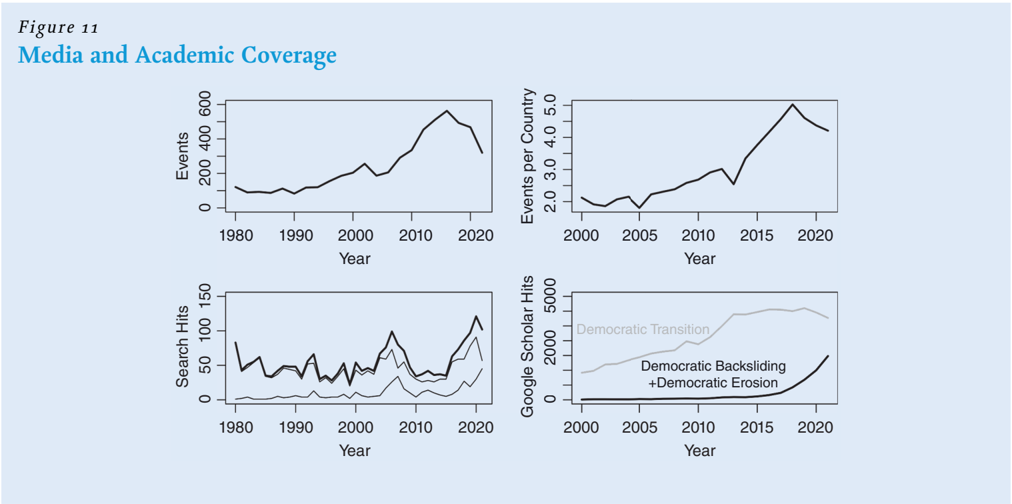
- Analysis: Trend comparisons and a simple aggregate objective index that normalizes individual variables between 0 and 1 and averages them by country-year; online appendix formal models examine coder bias and strategic attacks, and media-coverage trends are shown using Gottlieb et al. (2022), New York Times article counts, and Google Scholar hits.
Limitations
- The paper states that it cannot rule out the possibility that the world is becoming less democratic exclusively in ways that require subjective judgment to detect; it is not asserting that backsliding is not happening anywhere; objective measures focus on electoral institutions and outcomes and omit civil liberties; and the aggregate objective index is not an appropriate substitute for existing country-year democracy indices, with no clear substantive interpretation of its magnitude.
- The paper states that coder bias likely explains at least some of the discrepancy but is not definitively established; media coverage may reflect actual frequency of backsliding; and future research is needed on mechanisms.
- Evident from the text: several figures, tables, and online appendices are referenced but not included in the provided text, so some numerical trends cannot be verified from the excerpt alone.
Model-written summary. Check it against the paper before relying on it.
Integrity signals
Registry
Cites
Statistics
Figures
Verification
Claims the paper makes
3 Valid · 8 Not valid · 21 Not checked · 96 Own results and interpretations
The sources with a verdict support this claim; the rest weren’t checked yet, have no full text we could read, or their verdicts aren’t rated yet.
In the paper
“Even the types of subtle actions that many fear are the dominant mode of contemporary authoritarianism and backsliding (Guriev and Treisman 2020; Luo and Przeworski 2019; Przeworski 2019) typically are reflected in election results.”
What the sources say
- Supportedcites Guriev and Treisman 2020 matched to “A theory of informational autocracy” (2020) source
The Conclusions (section 5; page unavailable) say that most of today’s non-democratic leaders rely on information manipulation rather than mass repression. The Introduction (section 1; page unavailable) describes leaders removing constraints on their power while pretending to be democratic. The citation follows the description of contemporary authoritarian tactics; the statement about election results is the citing authors’ subsequent point. (LLM, conf=0.88)
- Not checked — no full text of the sourcecites Luo and Przeworski 2019 matched to “Democracy and Its Vulnerabilities: Dynamics of Backsliding” (2019) source
- Not checked — no full text of the sourcecites Przeworski 2019 matched to “Crises of Democracy” (2019) source
plainstates an association- Asserted: passes — The authors put it forward as true.
- Checkable: passes — It can be checked against evidence.
- Load-bearing: passes — The paper’s conclusions depend on it.
- Based: passes — The paper gives a reason why it holds.
- Supported
The cited sources support only part of this claim — read each source’s verdict below.
In the paper
“Unfortunately, fully adjusting for biases is a challenge even for extremely well-informed and sophisticated thinkers.”
What the sources say
- Not checked — no full text of the sourcecites Enke 2020 matched to “What You See Is All There Is*” (2020) source
- Partly supportedcites Brundage, Little, and You 2022 matched to “Selection Neglect and Political Beliefs” (2022) sourceExperimental — accuracy not yet measured
Section 4, “Experimental Work on the Mechanism” (page unavailable), says people often fail to adjust for biased samples and that making the bias more obvious reduces but does not eliminate the error. The paper also mentions errors by people with statistical expertise, but does not establish that extremely well-informed and sophisticated thinkers struggle to fully adjust for the selection biases at issue. (LLM, conf=0.82)
plain- Asserted: passes — The authors put it forward as true.
- Checkable: unclear — It is unclear whether it could be checked against evidence.
- Load-bearing: passes — The paper’s conclusions depend on it.
- Based: passes — The paper gives a reason why it holds.
The sources with a verdict support this claim; the rest weren’t checked yet, have no full text we could read, or their verdicts aren’t rated yet.
In the paper
“There is strong evidence across a variety of topics and subject pools that people make substantial errors when faced with selection problems in the samples that they observe (see Enke 2020 for a prominent recent example and Brundage, Little, and You 2022 for a review).”
What the sources say
- Not checked — no full text of the sourcecites Enke 2020 matched to “What You See Is All There Is*” (2020) source
- Supportedcites Brundage, Little, and You 2022 matched to “Selection Neglect and Political Beliefs” (2022) source
Section 4, “Experimental Work on the Mechanism” (page not available), describes experimental evidence of large, consistent deviations from rational benchmarks when people interpret selected samples as representative. It reviews examples involving numerical estimates, startup bets, and investment decisions, supporting the claim’s breadth. The paper is a review, as the citation indicates. (LLM, conf=0.88)
boosted- Asserted: passes — The authors put it forward as true.
- Checkable: passes — It can be checked against evidence.
- Load-bearing: passes — The paper’s conclusions depend on it.
- Based: passes — The paper gives a reason why it holds.
The paper states this without a source or data behind it here, so there is nothing to check it against. The quote shows it is in the paper.
In the paper
“despite recent prominent cases, there has been no uptick in the rate of leaders evading term limits.”
plain- Asserted: passes — The authors put it forward as true.
- Checkable: passes — It can be checked against evidence.
- Load-bearing: unclear — It is unclear whether the paper’s conclusions depend on it.
- Based: unclear — It is unclear why the paper says it holds.
The paper states this without a source or data behind it here, so there is nothing to check it against. The quote shows it is in the paper.
In the paper
“Constitutional rules that limit executive power have been fairly constant if not slightly increasing since the end of the Cold War.”
plain- Asserted: passes — The authors put it forward as true.
- Checkable: passes — It can be checked against evidence.
- Load-bearing: passes — The paper’s conclusions depend on it.
- Based: unclear — It is unclear why the paper says it holds.
54 more claims
Create a free account to see all 128 claims and to verify the 2 references still open.
- It may state two separate claims as one. 36
- The quote only partly states this claim. 1
- Probably not a substantial claim. 41
Self-check
Percentages, sums and reported differences re-computed from the paper’s own numbers.
Each contradiction between two passages listed here was confirmed by an independent check.
Rated minor: it would not touch a result — a value no result rests on, a p-value that stays on the same side of the significance level, or a conflict that is clerical, resolved elsewhere in the paper, or outside its own findings.
In the paper
§ Additional Measures of Winning/Incumbent Party Dominance · p. 6
“averaging the three variables gives a ' (lack of ) process violation ' index with three levels ranging from 0 to 1.”
§ Are Elections Competitive? · p. 6
“The second index captures various other electoral-process violations and includes the following variables: (1) were previous elections suspended, (2) had the current incumbent violated a term limit, and (3) did an opposition party boycott the election. In each case, we coded 1 for answering ' no ' and 0 otherwise;”
Citations
Cites
Democracy and the Market: Political and Economic Reforms in Eastern Europe and Latin America
Przeworski, A. (1991) · doi:10.1017/cbo9781139172493 · Cited by 3,494
Democracy and Development: Political Institutions and Well-Being in the World, 1950–1990
Przeworski, A., Alvarez, M. E., Cheibub, J. A., & Limongi, F. (2000) · doi:10.1017/cbo9780511804946 · Cited by 2,845
Democracy and dictatorship revisited
Cheibub, J. A., Gandhi, J., & Vreeland, J. R. (2010) · Public Choice · doi:10.1007/s11127-009-9491-2 · Cited by 2,481 · cited 2×
“This is a notoriously difficult problem (see, e.g., Boix, Miller, and Rosato 2013; Cheibub, Gandhi, and Vreeland 2010; Przeworski et al. 2000).”
BackgroundBermeo, N. (2016) · Journal of Democracy · doi:10.1353/jod.2016.0012 · Cited by 2,331
A third wave of autocratization is here: what is new about it?
Lührmann, A., & Lindberg, S. I. (2019) · Democratization · doi:10.1080/13510347.2019.1582029 · Cited by 1,528 · cited 2×
“Similarly, Lührmann and Lindberg (2019) contend that any country can “ autocratize, ” regardless of regime type.”
BackgroundFacing Up to the Democratic Recession
Diamond, L. (2015) · Journal of Democracy · doi:10.1353/jod.2015.0009 · Cited by 1,107 · cited 2×
“A substantial uptick in academic papers on democratic backsliding has emerged in recent years, which often raise alarm in the title: “ Democratic Regress in the Contemporary World ” (Haggard and Kaufman 2021) necessitates “ Facing up to the Democratic Recession ” (Diamond 2015) because “ A Third Wave of Autocratiza-ti…”
BackgroundA Complete Data Set of Political Regimes, 1800–2007
Boix, C., Miller, M., & Rosato, S. (2013) · Comparative Political Studies · doi:10.1177/0010414012463905 · Cited by 1,072
Unwelcome Change: Coming to Terms with Democratic Backsliding
Waldner, D., & Lust, E. (2018) · Annual Review of Political Science · doi:10.1146/annurev-polisci-050517-114628 · Cited by 889
Respect for Human Rights has Improved Over Time: Modeling the Changing Standard of Accountability
FARISS, C. J. (2014) · American Political Science Review · doi:10.1017/s0003055414000070 · Cited by 706
Hyde, S. D., & Marinov, N. (2012) · Political Analysis · doi:10.1093/pan/mpr040 · Cited by 643 · cited 1×
“Our data on elections and freedom of association are from the National Elections Across Democracy and Autocracy (NELDA) dataset, which contains several objective variables about all elections from 1945 to 2020 (Hyde and Marinov 2012).”
MethodSvolik, M. W. (2019) · Journal of Democracy · doi:10.1353/jod.2019.0039 · Cited by 607 · cited 1×
“For example, Svolik (2019) finds that the share of democratic breakdowns driven by executive takeovers rather than military coups increased from approximately 50% in the 1970s to approximately 90% more recently.”
BackgroundPrzeworski, A. (2019) · doi:10.1017/9781108671019 · Cited by 599 · cited 1×
“Even the types of subtle actions that many fear are the dominant mode of contemporary authoritarianism and backslid-ing (Guriev and Treisman 2020; Luo and Przeworski 2019; Prze-worski 2019) typically are reflected in election results.”
BackgroundBacksliding: Democratic Regress in the Contemporary World
Haggard, S., & Kaufman, R. (2021) · doi:10.1017/9781108957809 · Cited by 464 · cited 2×
“…papers on democratic backsliding has emerged in recent years, which often raise alarm in the title: “ Democratic Regress in the Contemporary World ” (Haggard and Kaufman 2021) necessitates “ Facing up to the Democratic Recession ” (Diamond 2015) because “ A Third Wave of Autocratiza-tion Is…”
BackgroundSvolik, M. W. (2020) · Quarterly Journal of Political Science · doi:10.1561/100.00018132 · Cited by 340
The Myth of Democratic Recession
Levitsky, S., & Way, L. (2015) · Journal of Democracy · doi:10.1353/jod.2015.0007 · Cited by 305 · cited 1×
“3 In fact, Levitsky and Way (2015) noted that many studies raised concerns about democratic decline before there was any evidence in the data.”
BackgroundPemstein, D., Marquardt, K. L., Tzelgov, E., Wang, Y.-T., Medzihorsky, J., Krusell, J., Miri, F., & Roemer, J. (2019) · SSRN Electronic Journal · doi:10.2139/ssrn.3395892 · Cited by 275
Constraining Dictatorship: From Personalized Rule to Institutionalized Regimes
Meng, A. (2020) · doi:10.1017/9781108877497 · Cited by 215 · cited 1×
“The only original data we present are about executive constraints, which we collected by expanding the data from Meng (2020) on de jure rules that limit executive power.”
Self-citationA theory of informational autocracy
Guriev, S., & Treisman, D. (2020) · Journal of Public Economics · doi:10.1016/j.jpubeco.2020.104158 · Cited by 205
Enke, B. (2020) · The Quarterly Journal of Economics · doi:10.1093/qje/qjaa012 · Cited by 186
A theory of informational autocracyPreprint
Guriev, S., & Treisman, D. (2020) · Journal of Public Economics · doi:10.2139/ssrn.3426238 · Cited by 159
The Database of Political Institutions 2020 (DPI2020)
Scartascini, C., Cruz, C., & Keefer, P. (2021) · IDB Datasets · doi:10.18235/0003049 · Cited by 158 · cited 2×
“Next we present data from the Database of Political Institutions (DPI) to assess when the winning leaders and parties — whether incumbent or challenger — were dominating elections.”
BackgroundPemstein, D., Marquardt, K. L., Tzelgov, E., Wang, Y.-T., Krusell, J., & Miri, F. (2018) · doi:10.2139/ssrn.3167764 · Cited by 132
Autocratization Changing Nature?
Alizada, N., Boese, V. A., Lundstedt, M., Morrison, K., Natsika, N., Sato, Y., Tai, H., & Lindberg, S. I. (2022) · SSRN Electronic Journal · doi:10.2139/ssrn.4052548 · Cited by 130
The meaning of it all: thoughts of a citizen scientist
(1998) · Choice Reviews Online · doi:10.5860/choice.36-0286 · Cited by 125 · cited 1×
“Parsing what we do and do not know about a topic is a first step for making scientific progress (Feynman 2009).”
Acquiring the Habit of Changing Governments Through Elections
Przeworski, A. (2014) · Comparative Political Studies · doi:10.1177/0010414014543614 · Cited by 121 · cited 1×
“Indeed, rates of incumbent loss have changed dramatically over the long term, from virtually never in the early-nineteenth century to about a third of the time in the 2000s (Przeworski 2015).”
BackgroundReference Points and Democratic Backsliding
Grillo, E., & Prato, C. (2023) · American Journal of Political Science · doi:10.1111/ajps.12672 · Cited by 113
Democracy’s backsliding in the international environment
Hyde, S. D. (2020) · Science · doi:10.1126/science.abb2434 · Cited by 108 · cited 1×
“There also is scant evidence of increasing penalties; if anything, Hyde (2020) suggests that international promotion of democracy has waned in recent years.”
BackgroundState of the world 2022: defiance in the face of autocratization
Wiebrecht, F., Sato, Y., Nord, M., Lundstedt, M., Angiolillo, F., & Lindberg, S. I. (2023) · Democratization · doi:10.1080/13510347.2023.2199452 · Cited by 95
Waves of autocratization and democratization: a critical note on conceptualization and measurement
Skaaning, S.-E. (2020) · Democratization · doi:10.1080/13510347.2020.1799194 · Cited by 92 · cited 1×
“However, as Skaaning (2020, 1539, emphasis added) noted, “ This drop is minuscule and clearly within the boundaries of the statistical confidence levels offered by V-Dem in order to account for potential measurement error.”
BackgroundA Republic, If You Can Keep It: Breakdown and Erosion in Modern Democracies
Miller, M. K. (2020) · The Journal of Politics · doi:10.1086/709146 · Cited by 77 · cited 1×
“…important to understand where backslid-ing is happening, how it happens (Chiopris, Nalepa, and Vanberg 2021; Cinar and Nalepa 2022; Grillo and Prato 2020; Helmke, Kroeger, and Paine 2022; Svolik 2018), and when it leads to democratic breakdown (Brownlee and Miao 2022; Miller 2021; Treisman 2022).”
BackgroundMeasuring Democratic BackslidingPreprint
Little, A. T., & Meng, A. (2023) · SSRN Electronic Journal · doi:10.2139/ssrn.4327307 · Cited by 69
Self-citationThe Law and Politics of Presidential Term Limit EvasionPreprint
Versteeg, M., Horley, T., Meng, A., et al. (2019) · SSRN Electronic Journal · Cited by 65
Self-citationHow Great is the Current Danger to Democracy? Assessing the Risk With Historical Data
Treisman, D. (2023) · Comparative Political Studies · doi:10.1177/00104140231168363 · Cited by 63 · cited 2×
“…important to understand where backslid-ing is happening, how it happens (Chiopris, Nalepa, and Vanberg 2021; Cinar and Nalepa 2022; Grillo and Prato 2020; Helmke, Kroeger, and Paine 2022; Svolik 2018), and when it leads to democratic breakdown (Brownlee and Miao 2022; Miller 2021; Treisman 2022).”
BackgroundBrownlee, J., & Miao, K. (2022) · Journal of Democracy · doi:10.1353/jod.2022.0052 · Cited by 55 · cited 2×
“Readers may begin to believe that these outlier countries represent the norm rather than the exception (Brownlee and Miao 2022).”
BackgroundSubversion by Stealth: Dynamics of Democratic BackslidingPreprint
Luo, Z., & Przeworski, A. (2019) · SSRN Electronic Journal · doi:10.2139/ssrn.3469373 · Cited by 54
Multiple Measurements, Elusive Agreement, and Unstable Outcomes in the Study of Regime Change
Lueders, H., & Lust, E. (2018) · The Journal of Politics · doi:10.1086/696864 · Cited by 48 · cited 1×
“Although these three types of backsliding are all relatively different, the literature has not always made clear distinctions among them; as a result, the discussion often is muddied by conceptual confusion (Lueders and Lust 2018).”
BackgroundMultiple Measurements, Elusive Agreement, and Unstable Outcomes in the Study of Regime Change
Lueders, H., & Lust, E. (2017) · SSRN Electronic Journal · doi:10.2139/ssrn.3042470 · Cited by 48
Democracy by Deterrence: Norms, Constitutions, and Electoral Tilting
Helmke, G., Kroeger, M., & Paine, J. (2022) · American Journal of Political Science · doi:10.1111/ajps.12668 · Cited by 45 · cited 1×
“…important to understand where backslid-ing is happening, how it happens (Chiopris, Nalepa, and Vanberg 2021; Cinar and Nalepa 2022; Grillo and Prato 2020; Helmke, Kroeger, and Paine 2022; Svolik 2018), and when it leads to democratic breakdown (Brownlee and Miao 2022; Miller 2021; Treisman 2022).”
BackgroundÇınar, İ., & Nalepa, M. (2022) · Journal of Political Institutions and Political Economy · doi:10.1561/113.00000067 · Cited by 39 · cited 1×
“…a key first step, it is arguably more important to understand where backslid-ing is happening, how it happens (Chiopris, Nalepa, and Vanberg 2021; Cinar and Nalepa 2022; Grillo and Prato 2020; Helmke, Kroeger, and Paine 2022; Svolik 2018), and when it leads to democratic breakdown (Brownlee and…”
BackgroundDemocratic Backsliding in Africa?
(2022) · Oxford University Press · doi:10.1093/oso/9780192867322.001.0001 · Cited by 39
Democracy and Its Vulnerabilities: Dynamics of Backsliding
Luo, Z., & Przeworski, A. (2019) · doi:10.31235/osf.io/4yw98 · Cited by 26 · cited 1×
“Even the types of subtle actions that many fear are the dominant mode of contemporary authoritarianism and backslid-ing (Guriev and Treisman 2020; Luo and Przeworski 2019; Prze-worski 2019) typically are reflected in election results.”
Recent Events and the Coding of Cross-National Indicators
Weidmann, N. B. (2023) · Comparative Political Studies · doi:10.1177/00104140231193006 · Cited by 24 · cited 1×
“” Even well-informed coders can disagree widely about the definitions of “ fundamentally flawed ” and “ largely unintentional ” (Weidmann 2022).”
BackgroundDemocratic Backsliding in Africa?: Autocratization, Resilience, and Contention
Arriola, L. R., Rakner, L., & van de Walle, N. (2022) · Democratic Backsliding in Africa? · doi:10.1093/oso/9780192867322.003.0001 · Cited by 17
What You See is All There IsPreprint
Enke, B. (2020) · SSRN Electronic Journal · doi:10.2139/ssrn.3548363 · Cited by 12
Selection Neglect and Political Beliefs
Brundage, M., Little, A. T., & You, S. (2022) · doi:10.31219/osf.io/p49at · Cited by 7
Self-citationReplication Data for: Measuring Democratic Backsliding
Little, A. T. (2023) · Harvard Dataverse · doi:10.7910/dvn/g2sq6y · Cited by 5
Self-citationFariss, C. J. (2014) · Harvard Dataverse · doi:10.7910/dvn/25830
Lueders, H., & Lust, E. (2017) · Harvard Dataverse · doi:10.7910/dvn/61jji3
Reference Points and Democratic Backsliding
Grillo, E., & Prato, C. (2019) · doi:10.2139/ssrn.3475705
Research works printed but not linked: 3
- Weitzel, Daniel, John Gerring, Dan Pemstein, and Svend-Erik Skaaning. 2023. ' Electoral Democracy: Global, Historical Measures Based on Observables. ' Working Paper . Aurora: Colorado State University.
- Anderson, Ashley, Jason Brownlee, and Killian Clarke. 2021. ' Autocracy: A Substantive Approach . ' Stanford University: Center on Democracy, Development and the Rule of Law.
- Chiopris, Caterina, Monika Nalepa, and Georg Vanberg. 2021. ' A Wolf in Sheep ' s Clothing: Citizen Uncertainty and Democratic Backsliding. ' Working Paper . Chicago: University of Chicago.
Cited by
Megastudy testing 25 treatments to reduce antidemocratic attitudes and partisan animosity
Voelkel, J. G., Stagnaro, M. N., Chu, J. Y., Pink, S. L., Mernyk, J. S., Redekopp, C., Ghezae, I., Cashman, M., Adjodah, D., Allen, L. G., et al. (2024) · Science · doi:10.1126/science.adh4764 · Cited by 174
“INTRODUCTION: Scholars, practitioners, and politicians have raised concerns about deepening partisan divisions and the health of American democracy.”
Megastudy testing 25 treatments to reduce antidemocratic attitudes and partisan animosity
Voelkel, J. G., Stagnaro, M., Chu, J., Pink, S. L., Mernyk, J. S., Redekopp, C., Ghezae, I., Cashman, M., Adjodah, D., Allen, L., et al. (2023) · doi:10.31219/osf.io/y79u5 · Cited by 174
Conceptualizing and Measuring Support for Democracy: A New Approach
Claassen, C., Ackermann, K., Bertsou, E., Borba, L., Carlin, R. E., Cavari, A., Dahlum, S., Gherghina, S., Hawkins, D. G., Lelkes, Y., et al. (2024) · Comparative Political Studies · doi:10.1177/00104140241259458 · Cited by 107
Income inequality and the erosion of democracy in the twenty-first century
Rau, E. G., & Stokes, S. C. (2024) · Proceedings of the National Academy of Sciences · doi:10.1073/pnas.2422543121 · Cited by 93
Pathways of Democratic Backsliding, Resistance, and (Partial) Recoveries
Riedl, R. B., McCoy, J., Roberts, K., & Somer, M. (2024) · The Annals of the American Academy of Political and Social Science · doi:10.1177/00027162251319909 · Cited by 32
Metadata
- Authors
- Little, A. T., & Meng, A.
- Affiliations
- University of California, Berkeley (US)
- University of Virginia (US)
- Venue
- PS: Political Science & Politics
- Publisher
- Cambridge University Press (CUP)
- Published
- 2024-01-11
- Volume
- 57
- Issue
- 2
- Pages
- 149-161
- ISSN
- 0030-8269 (ISSN-L)
- 1049-0965
- 1537-5935
- OpenAlex
- W4390746191
- Cited by
- 121
- References
- 42
- Citations by year
- 2026: 40 · 2025: 56 · 2024: 24
- FWCI
- 85.79
- Type
- journal article
- Language
- en
- Open access
- hybrid
- doi.org
- Locations
- PS Political Science & Politics (publishedVersion, cc-by)
- Topics
- Social Sciences › Sociology and Political Science › Political Conflict and Governance
- Social Sciences › Political Science and International Relations › Political Theory and Democracy
- Social Sciences › Political Science and International Relations › Electoral Systems and Political Participation
- Keywords
- democratic backsliding, subjective indicators
About these checks
Registry, retraction, Cites and statistics results are computed, not judged, with one exception: a printed reference that no index lists is read once by a model before it counts as a citation error. Claims are extracted by a model and kept only when their quote appears verbatim in the text; each cited source is then checked, with a model’s help, for whether it says what the claim relies on. Those verdicts can be wrong — read the claim’s quote and the cited source before relying on one.
The claim verdicts this report counts are experimental: their accuracy is not yet measured.
A language model drew the claims from the paper on 2026-10-10, under version 3 of the claim definition (model deepseek-v4.1-flash, prompt extract-v3).
A second model labelled each claim on 2026-10-10 (model jev-1.13-20260917, definition revision gold-guideline-v0.2).
Cited sources are checked with a language model’s help (gpt-6-sol).
Statistics and arithmetic are recomputed, not judged.
Confidence bands are shown only for fields calibrated on our annotated test set. None is calibrated yet, so no band is shown.
What counts as a claim ›How we measure confidence ›How we check this ›
Are you an author, or do you see a problem with this page? Request a review
Data sources
Bibliographic data: Semantic Scholar, OpenAlex, Crossref.
Contains information from the Semantic Scholar Academic Graph Datasets, made available under the ODC Attribution License (ODC-BY 1.0).
Semantic Scholar’s data is described in: Kinney, R., et al. (2023). The Semantic Scholar Open Data Platform. arXiv:2301.10140.
