

Translating the Intention to Seek Treatment into Action: Does Symptom Monitoring Make a Difference? Results from a Randomized Controlled Trial
Open accessThe DOI matches its Crossref record; 39 of the 45 references it cites were found in a registry or an index; 10 of the 37 sources its claims cite were checked for support.
Abstract
Background: Most people with common mental health problems do not seek evidence-based psychological interventions. Aims: The aim of this study was to investigate whether monitoring symptoms of depression and anxiety using an app increased treatment-seeking. Method: Three hundred and six people with significant levels of anxiety and depression, none of whom were currently receiving treatment, were randomly allocated to receive either (a) information about local psychological services only, (b) information plus regular symptom monitoring (every 6 days), or (c) information plus open symptom monitoring (monitoring when they felt like it). An app was used to provide information and monitor mood. Results: The proportion of participants who reported receiving treatment after starting the study was 7.2% (10/138) in the information only group, 8.1% (9/111) in the information plus regular monitoring group and 15.8% (9/57) in the information plus open monitoring group. There was a trend for participants who were able to monitor whenever they wished to be more likely to report receiving treatment than people who were only given information about their local treatment services. The impact of the intervention was greatest among participants who intended to seek treatment before taking part. Limitations were that only a small minority of those who downloaded the app completed the study and that the study relied on self-reported measures of treatment-seeking. Conclusions: Symptom monitoring can increase actual treatment-seeking in those with an intention to seek treatment. Copyright © British Association for Behavioural and Cognitive Psychotherapies 2018Â.
Overview
CoChat Summary
## TL;DR
This randomized field trial tested whether an iPhone app that combined service information with symptom monitoring increased reported treatment receipt among 306 adults in England with anxiety/depression symptoms who were not currently in treatment. Open symptom monitoring showed the strongest effect, but the overall model was weak and the study relied on self-reported treatment receipt with high attrition.
## Key findings
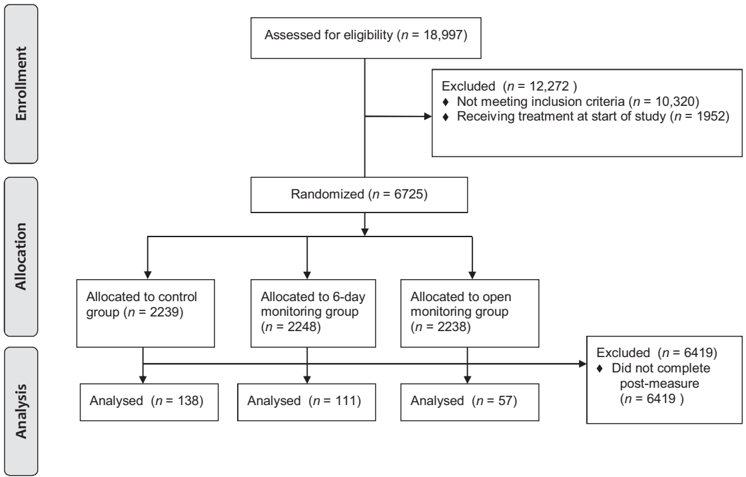
- Of the 306 participants analyzed, reported treatment receipt over 30 days was 7.2% (10/138) in the information-only control group, 8.1% (9/111) in the 6-day monitoring group, and 15.8% (9/57) in the open monitoring group.
- In the primary analysis, there was no significant difference between control and 6-day monitoring (OR = 1.13, p = .799, 95% CI 0.44 to 2.88) and only a trend for open monitoring vs control (OR = 2.40, p = .074, 95% CI 0.92 to 6.27); the model explained 2.4% of the variance in treatment receipt and was not significantly better than a constant-only model (χ²(2) = 3.33, p = .189).
- In the post-hoc analysis split by baseline intention to seek treatment, open monitoring was significantly associated with treatment receipt among those with high intention (OR = 3.82, p = .030, 95% CI 1.14 to 12.84), while the low-intention subgroup showed no significant effects and only 0.7% of variance explained (χ²(2) = 0.35, p = .839).
- Among the 28 participants who reported treatment, 75.0% (21/28) received it from a general practitioner; 42.9% (12/28) reported psychological treatment and 32.1% (9/28) reported medication.
## Methods
- Randomized controlled trial delivered through the Mood Mate iPhone app; participants were automatically randomized to information only, information + 6-day symptom monitoring, or information + open symptom monitoring.
- Eligibility required being 18+, living in England, having an iOS device, English proficiency, and scoring above threshold on PHQ-4 and/or Mini SPIN; 8997 were randomized, but 306 completed the post-measure and were included in the completer analysis.
- Primary outcome was self-reported receipt of treatment in the 30 days after starting the study; analyses used logistic regression, with baseline group comparisons via Kruskal-Wallis and chi-squared tests and a Bonferroni correction for multiple tests.
## Limitations
- The paper explicitly states that only a small minority of those who downloaded the app completed the study and that the study relied on self-reported measures of treatment-seeking.
- The paper states that the high drop-out rate made the analyses less powerful than predicted and limited generalizability; it also notes that differential completion could still reflect unmeasured biases.
- The text makes evident that the main result is based on a completer analysis rather than intent-to-treat, and that treatment receipt was self-reported and not verified; the authors also note that suicidality was not assessed for ethical reasons and that the 30-day monitoring window was relatively arbitrary.
Model-written summary. Check it against the paper before relying on it.
Integrity signals
Registry
Cites
Statistics
Figures
Verification
Claims the paper makes
6 Valid · 3 Not valid · 16 Not checked · 59 Own results and interpretations
At least one cited source doesn’t support this claim or points to a different paper, and none confirmed it — see the verdicts below.
In the paper
“However, most interventions that have previously attempted to increase treatment receipt have only increased people's intention to seek treatment, rather than their behaviour (Gulliver et al., 2012).”
What the sources say
- Disputedcites Gulliver et al., 2012 matched to “A systematic review of help-seeking interventions for depression, anxiety and general psychological distress” (2012) sourceExperimental — accuracy not yet measured
The Results (Trial outcomes) say that five trials found improvements in attitudes, willingness, or beliefs, but the only study measuring help-seeking intentions found no significant intervention effect. One of three studies measuring behaviour found an improvement. The review therefore does not support the claim that most interventions increased intentions rather than behaviour. (LLM, conf=0.89)
Checked by a reasoning model — may be wrong.
plainstates a cause- Asserted: passes — The authors put it forward as true.
- Checkable: passes — It can be checked against evidence.
- Load-bearing: passes — The paper’s conclusions depend on it.
- Based: passes — The paper gives a reason why it holds.
- Disputed
The cited sources support only part of this claim — read each source’s verdict below.
In the paper
“Delaying treatment can lead to negative consequences for those with anxiety and depression (Brenes, 2007; Hawton and van Heeringen, 2009).”
What the sources say
- Partly supportedcites Brenes, 2007 matched to “Anxiety, Depression, and Quality of Life in Primary Care Patients” (2007) sourceExperimental — accuracy not yet measured
The Discussion (page unavailable) links anxiety and depressive symptoms to impaired functioning and calls for better assessment and treatment. It does not show that delaying treatment causes negative consequences; the authors explicitly say their cross-sectional design precludes causal inferences. (LLM, conf=0.84)
- Not checked — no full text of the sourcecites Hawton and van Heeringen, 2009 matched to “Suicide” (2009) source
plainstates a cause- Asserted: passes — The authors put it forward as true.
- Checkable: passes — It can be checked against evidence.
- Load-bearing: passes — The paper’s conclusions depend on it.
- Based: passes — The paper gives a reason why it holds.
- Partly supported
A result the paper reports from its own data — it cites no other source for it, so there is none to check. The quote shows it is in the paper.
In the paper
“There was a trend for participants who were able to monitor whenever they wished to be more likely to report receiving treatment than people who were only given information about their local treatment services.”
hedgedstates an association- Asserted: passes — The authors put it forward as true.
- Checkable: passes — It can be checked against evidence.
- Load-bearing: passes — The paper’s conclusions depend on it.
- Based: passes — The paper gives a reason why it holds.
A result the paper reports from its own data — it cites no other source for it, so there is none to check. The quote shows it is in the paper.
In the paper
“Theproportion of participants who reported receiving treatment after starting the study was 7.2% (10/138) in the information only group, 8.1% (9/111) in the information plus regular monitoring group and 15.8% (9/57) in the information plus open monitoring group.”
plain- Asserted: passes — The authors put it forward as true.
- Checkable: passes — It can be checked against evidence.
- Load-bearing: passes — The paper’s conclusions depend on it.
- Based: passes — The paper gives a reason why it holds.
A result the paper reports from its own data — it cites no other source for it, so there is none to check. The quote shows it is in the paper.
In the paper
“Among participants who stated that their intention to seek treatment was above or equal to the median score, people in the 6-day monitoring group were no more likely to report treatment receipt than the control group (OR = 1.41, p = .564, 95% lower CI = 0.44, upper CI = 4.46).”
plain- Asserted: passes — The authors put it forward as true.
- Checkable: passes — It can be checked against evidence.
- Load-bearing: unclear — It is unclear whether the paper’s conclusions depend on it.
- Based: passes — The paper gives a reason why it holds.
27 more claims
Create a free account to see all 84 claims and to verify the 2 references still open.
- Probably not a substantial claim. 43
- It may state two separate claims as one. 23
Statistics recomputed
Every reported test result, recomputed from its test statistic and degrees of freedom. A result shows as not adding up only once an independent check has confirmed it.
- Consistentχ²(11) = 9.79reported p = .55 · recomputed p = .549
“χ 2 (11) = 9.79, p = .550”
- Consistentχ²(2) = 3.33reported p = .189 · recomputed p = .189
“χ 2 (2) = 3.33, p = .189”
- Consistentχ²(2) = 0.35reported p = .839 · recomputed p = .839
“χ 2 (2) = 0.35, p = .839”
- Consistentχ²(2) = 4.78reported p = .092 · recomputed p = .092
“χ 2 (2) = 4.78, p = .092”
Self-check
Percentages, sums and reported differences re-computed from the paper’s own numbers.
Self-check results appear here once an independent check has confirmed them.
Citations
Cites
The theory of planned behavior
Ajzen, I. (1991) · Organizational Behavior and Human Decision Processes · doi:10.1016/0749-5978(91)90020-t · Cited by 90,587
Faul, F., Erdfelder, E., Lang, A.-G., & Buchner, A. (2007) · Behavior Research Methods · doi:10.3758/bf03193146 · Cited by 65,971
The PHQ-9: Validity of a brief depression severity measure
Kroenke, K., Spitzer, R. L., & Williams, J. B. W. (2001) · Journal of General Internal Medicine · doi:10.1046/j.1525-1497.2001.016009606.x · Cited by 44,910
A Brief Measure for Assessing Generalized Anxiety Disorder: The GAD-7
Spitzer, R. L., Kroenke, K., Williams, J. B. W., & Löwe, B. (2006) · Archives of Internal Medicine · doi:10.1001/archinte.166.10.1092 · Cited by 31,765
Anxiety disorders in primary care: prevalence, impairment, comorbidity, and detection
Kroenke, K., Spitzer, R. L., Williams, J. B. W., Monahan, P. O., & Löwe, B. (2007) · Annals of Internal Medicine · doi:10.7326/0003-4819-146-5-200703060-00004 · Cited by 4,741 · cited 1×
“(Kroenke et al., 2007).”
An Ultra-Brief Screening Scale for Anxiety and Depression: The PHQ–4
Kroenke, K., Spitzer, R. L., Williams, J. B. W., & Löwe, B. (2009) · Psychosomatics · doi:10.1016/s0033-3182(09)70864-3 · Cited by 4,261
Transtheoretical therapy: Toward a more integrative model of change.
Prochaska, J. O., & DiClemente, C. C. (1982) · Psychotherapy: Theory, Research & Practice · doi:10.1037/h0088437 · Cited by 3,922
Gulliver, A., Griffiths, K. M., & Christensen, H. (2010) · BMC Psychiatry · doi:10.1186/1471-244x-10-113 · Cited by 3,292
Wang, P. S., Lane, M., Olfson, M., Pincus, H. A., Wells, K. B., & Kessler, R. C. (2005) · Archives of General Psychiatry · doi:10.1001/archpsyc.62.6.629 · Cited by 2,695 · cited 2×
“The thresholds were set at 3 on either the anxiety or depression components of the PHQ-4 and 3 on the Mini SPIN, indicating that they were likely to have an anxiety or mood disorder (Kroenke et al., 2009; Weeks et al., 2007).”
BackgroundMethodEysenbach, G. (2005) · Journal of Medical Internet Research · doi:10.2196/jmir.7.1.e11 · Cited by 2,524 · cited 1×
“High drop-out rates are common in eHealth trials – even up to 99.5% (see Eysenbach, 2005) – and thus the rate observed in this trial is not considered anomalous.”
BackgroundInfluentialLöwe, B., Wahl, I., Rose, M., Spitzer, C., Glaesmer, H., Wingenfeld, K., Schneider, A., & Brähler, E. (2010) · Journal of Affective Disorders · doi:10.1016/j.jad.2009.06.019 · Cited by 2,473
Does tailoring matter? Meta-analytic review of tailored print health behavior change interventions
Noar, S. M., Benac, C. N., & Harris, M. S. (2007) · Psychological Bulletin · doi:10.1037/0033-2909.133.4.673 · Cited by 2,136
A REVIEW OF GOODNESS OF FIT STATISTICS FOR USE IN THE DEVELOPMENT OF LOGISTIC REGRESSION MODELS1
LEMESHOW, S., & HOSMER, D. W. (1982) · American Journal of Epidemiology · doi:10.1093/oxfordjournals.aje.a113284 · Cited by 1,947
Hawton, K., & van Heeringen, K. (2009) · The Lancet · doi:10.1016/s0140-6736(09)60372-x · Cited by 1,671
Wang, P. S., Berglund, P., Olfson, M., Pincus, H. A., Wells, K. B., & Kessler, R. C. (2005) · Archives of General Psychiatry · doi:10.1001/archpsyc.62.6.603 · Cited by 1,325
Adult psychiatric morbidity in England, 2007: Results of a household survey
Mcmanus, S., Meltzer, H., Brugha, T., Bebbington, P., & Jenkins, R. (2009) · Unpublished · doi:10.13140/2.1.1563.5205 · Cited by 814
McHugh, R. K., Whitton, S. W., Peckham, A. D., Welge, J. A., & Otto, M. W. (2013) · The Journal of Clinical Psychiatry · doi:10.4088/jcp.12r07757 · Cited by 800 · cited 1×
“This is despite the fact that people presenting with common mental health disorders prefer psychological treatments to medication (Kwan et al., 2010; McHugh et al., 2013) and prefer psychological treatments that have more empirical support than those that do not (Tarrier et al., 2006).”
Background(2007) · PubMed Central · Cited by 623
Is it time for clinicians to routinely track patient outcome? A meta-analysis
Lambert, M. J., Whipple, J. L., Hawkins, E. J., Vermeersch, D. A., Nielsen, S. L., & Smart, D. W. (2003) · Clinical Psychology: Science and Practice · doi:10.1093/clipsy.bpg025 · Cited by 608
Mind the gap: improving the dissemination of CBT
Shafran, R., Clark, D. M., Fairburn, C. G., Arntz, A., Barlow, D. H., Ehlers, A., Freeston, M., Garety, P. A., Hollon, S. D., Ost, L. G., et al. (2009) · Behaviour Research and Therapy · doi:10.1016/j.brat.2009.07.003 · Cited by 569 · cited 1×
“When psychological therapy is received, it is often after long delays, is frequently suboptimal and is not evidence-based (Shafran et al., 2009; Wang et al., 2005, 2007).”
BackgroundSelf-citationMini-SPIN: A brief screening assessment for generalized social anxiety disorder
Connor, K. M., Kobak, K. A., Churchill, L. E., Katzelnick, D., & Davidson, J. R. T. (2001) · Depression and Anxiety · doi:10.1002/da.1055 · Cited by 537 · cited 1×
“The Mini Social Phobia Inventory (Mini SPIN; Connor et al., 2001).”
MethodLambert, M. (2007) · Psychotherapy Research · doi:10.1080/10503300601032506 · Cited by 461 · cited 1×
“…and colleagues would suggest that participants who received psychotherapy and monitored their symptoms would have better outcomes than participants who received psychotherapy and do not monitor their symptoms (Kordy et al., 2001; Lambert, 2007, 2013; Lambert et al., 2003; Lutz et al., 2006).”
BackgroundGulliver, A., Griffiths, K. M., Christensen, H., & Brewer, J. L. (2012) · BMC Psychiatry · doi:10.1186/1471-244x-12-81 · Cited by 342
Outcome in psychotherapy: The past and important advances.
Lambert, M. J. (2013) · Psychotherapy · doi:10.1037/a0030682 · Cited by 286 · cited 1×
“…and colleagues would suggest that participants who received psychotherapy and monitored their symptoms would have better outcomes than participants who received psychotherapy and do not monitor their symptoms (Kordy et al., 2001; Lambert, 2007, 2013; Lambert et al., 2003; Lutz et al., 2006).”
BackgroundAnxiety, Depression, and Quality of Life in Primary Care Patients
Brenes, G. A. (2007) · The Primary Care Companion to The Journal of Clinical Psychiatry · doi:10.4088/pcc.v09n0606 · Cited by 243 · cited 2×
“Delaying treatment can lead to negative 332 consequences for those with anxiety and depression (Brenes, 2007; Hawton and van Heeringen, 333 2009).”
BackgroundKwan, B. M., Dimidjian, S., & Rizvi, S. L. (2010) · Behaviour Research and Therapy · doi:10.1016/j.brat.2010.04.003 · Cited by 214
Primary Rat Embryo Cells Transformed by One or Two Oncogenes Show Different Metastatic Potentials
Pozzatti, R., Muschel, R., Williams, J., Padmanabhan, R., Howard, B., Liotta, L., & Khoury, G. (1986) · Science · doi:10.1126/science.3456644 · Cited by 196
Mobile Persuasion: 20 Perspectives on the Future of Behavior Change
Fogg, B. J., & Eckles, D. (2007) · Medical Entomology and Zoology · Cited by 194
Uncontrolled: the surprising payoff of trial-and-error for business, politics, and society
(2012) · Choice Reviews Online · doi:10.5860/choice.50-2137 · Cited by 179
Schomerus, G., Matschinger, H., & Angermeyer, M. C. (2009) · Psychological Medicine · doi:10.1017/s0033291709005832 · Cited by 144
The acceptability and preference for the psychological treatment of PTSD
Tarrier, N., Liversidge, T., & Gregg, L. (2006) · Behaviour Research and Therapy · doi:10.1016/j.brat.2005.11.012 · Cited by 134 · cited 1×
“This is despite the fact that people presenting with common mental health disorders prefer psychological treatments to medication (Kwan et al., 2010; McHugh et al., 2013) and prefer psychological treatments that have more empirical support than those that do not (Tarrier et al., 2006).”
BackgroundWeeks, J. W., Spokas, M. E., & Heimberg, R. G. (2007) · Depression and Anxiety · doi:10.1002/da.20250 · Cited by 106
Lutz, W., Lambert, M. J., Harmon, S. C., Tschitsaz, A., Schürch, E., & Stulz, N. (2006) · Clinical Psychology & Psychotherapy · doi:10.1002/cpp.496 · Cited by 103
Christensen, H., Leach, L. S., Barney, L., Mackinnon, A. J., & Griffiths, K. M. (2006) · BMC Psychiatry · doi:10.1186/1471-244x-6-13 · Cited by 85
Kordy, H., Hannöver, W., & Richard, M. (2001) · Journal of Consulting and Clinical Psychology · doi:10.1037//0022-006x.69.2.173 · Cited by 83
The WHO World Mental Health Surveys
de Graaf, R., Ormel, J., ten Have, M., Burger, H., & Bouwman, M. B. (2008) · Cited by 70
Psychometric Properties of the Mini-Social Phobia Inventory
Seeley-Wait, E., Abbott, M. J., & Rapee, R. M. (2009) · The Primary Care Companion to The Journal of Clinical Psychiatry · doi:10.4088/pcc.07m00576 · Cited by 69
Assessing your mood online: acceptability and use of Moodscope
Drake, G., Csipke, E., & Wykes, T. (2013) · Psychological Medicine · doi:10.1017/s0033291712002280 · Cited by 41
Colonnello, V., Leonardi, G., Farinelli, M., Bertoletti, E., & Russo, P. M. (2023) · Psychological Medicine · doi:10.1017/s0033291720005012 · Cited by 38
Methods of the World Mental Health Surveys
Kessler, R. C., Heeringa, S. G., Pennell, B., & Zaslavsky, A. M. (2018) · Cambridge University Press eBooks · doi:10.1017/9781107445130.003 · Cited by 19
Research works printed but not linked: 1
- Kordy, H., Hannöver, W. and Richard, M. (2001). Computer-assisted feedback-driven quality 453 management for psychotherapy: the Stuttgart-Heidelberg Model. Journal of Consulting and Clinical 454 Psychology , 69 , 173-183. doi: 10.1037//0022-006X.69.2.173 455 456 457 458 · DOI · Paper page
Cited by
Patient and physician perspectives of a smartphone application for depression: a qualitative study
Patoz, M.-C., Hidalgo‐Mazzei, D., Blanc, O., Verdolini, N., Pacchiarotti, I., Murru, A., Zukerwar, L., Vieta, E., Llorca, P., & Samalin, L. (2021) · BMC Psychiatry · doi:10.1186/s12888-021-03064-x · Cited by 41
“A study on untreated patients with symptoms of depression and anxiety also showed that access to daily self-monitoring helped them to translate their intention to seek treatment into actual treatment-seeking behaviour [55].”
BackgroundWhite, K. M., Williamson, C., Bergou, N., Oetzmann, C., de Angel, V., Matcham, F., Henderson, C., & Hotopf, M. H. (2022) · npj Digital Medicine · doi:10.1038/s41746-022-00624-7 · Cited by 32
The mere-measurement effect of patient-reported outcomes: a systematic review and meta-analysis
Long, P. A., Huberts, A. S., di Torrero, A. N., Otto, L. R., Rogge, A. A., Ritschl, V., & Stamm, T. (2025) · Quality of Life Research · doi:10.1007/s11136-025-03909-y · Cited by 24
“%) articles were conducted in the United Kingdom [27–32], the other three were conducted in either The Netherlands [33], Poland [34] or the United States [35].”
Can mental health apps be effective for depression, anxiety, and stress during a pandemic?
Longyear, R. L., & Kushlev, K. (2021) · Practice Innovations · doi:10.1037/pri0000142 · Cited by 26
Andrews, R., Hale, G. E., John, B., & Lancastle, D. (2021) · Frontiers in Global Women s Health · doi:10.3389/fgwh.2021.757706 · Cited by 24
Metadata
- Authors
- Shafran, R., Gyani, A., Rostron, J., Allen, S., Myles-Hooton, P., Allcott-Watson, H., & Rose, S.
- Affiliations
- University College London (GB)
- University of Reading (GB)
- Berkshire Healthcare NHS Foundation Trust (GB)
- Corresponding author
- Gyani, A.
- Venue
- Behavioural and Cognitive Psychotherapy
- Publisher
- Cambridge University Press (CUP)
- Published
- 2018-08-23
- Volume
- 47
- Issue
- 1
- Pages
- 114-128
- ISSN
- 1352-4658 (ISSN-L)
- 1469-1833
- OpenAlex
- W2888536741
- Cited by
- 10
- References
- 45
- Citations by year
- 2026: 1 · 2025: 3 · 2024: 1 · 2022: 1 · 2021: 4
- FWCI
- 1.16
- Type
- journal article
- Language
- en
- Open access
- bronze
- doi.org
- Locations
- Behavioural and Cognitive Psychotherapy (publishedVersion)
- PubMed (publishedVersion)
- CentAUR (University of Reading) (submittedVersion)
- UCL Discovery (University College London) (submittedVersion)
- Funders
- Great Ormond Street Institute of Child Health
- NIHR Great Ormond Street Hospital Biomedical Research Centre
- Topics
- Social Sciences › Psychology › Applied Psychology › Digital Mental Health Interventions
- Health Sciences › Medicine › Psychiatry and Mental health › Mental Health Treatment and Access
- Social Sciences › Psychology › Experimental and Cognitive Psychology › Anxiety, Depression, Psychometrics, Treatment, Cognitive Processes
- Keywords
- treatment seeking, depression, anxiety, symptom monitoring, mobile health apps, help-seeking barriers, psychological intervention, self-monitoring, common mental disorders
- MeSH terms
- Adult, Anxiety, Anxiety Disorders, Depression, Depressive Disorder, Emotions, Female, Humans, Male, Patient Acceptance of Health Care, Intention, Self Report, Mobile Applications
About these checks
Registry, retraction, Cites and statistics results are computed, not judged, with one exception: a printed reference that no index lists is read once by a model before it counts as a citation error. Claims are extracted by a model and kept only when their quote appears verbatim in the text; each cited source is then checked, with a model’s help, for whether it says what the claim relies on. Those verdicts can be wrong — read the claim’s quote and the cited source before relying on one.
The claim verdicts this report counts are experimental: their accuracy is not yet measured.
A language model drew the claims from the paper on 2026-10-11, under version 3 of the claim definition (model deepseek-v4.1-flash, prompt extract-v3).
A second model labelled each claim on 2026-10-11 (model jev-1.13-20260917, definition revision gold-guideline-v0.2).
Cited sources are checked with a language model’s help (gpt-6-sol).
Statistics and arithmetic are recomputed, not judged.
Confidence bands are shown only for fields calibrated on our annotated test set. None is calibrated yet, so no band is shown.
What counts as a claim ›How we measure confidence ›How we check this ›
Are you an author, or do you see a problem with this page? Request a review
Data sources
Bibliographic data: Semantic Scholar, OpenAlex, Crossref.
Contains information from the Semantic Scholar Academic Graph Datasets, made available under the ODC Attribution License (ODC-BY 1.0).
Semantic Scholar’s data is described in: Kinney, R., et al. (2023). The Semantic Scholar Open Data Platform. arXiv:2301.10140.
