

Transcranial direct current stimulation for major depression: an updated systematic review and meta-analysis
Open accessThe DOI matches its Crossref record; 31 of the 31 references it cites were found in a registry or an index.
Abstract
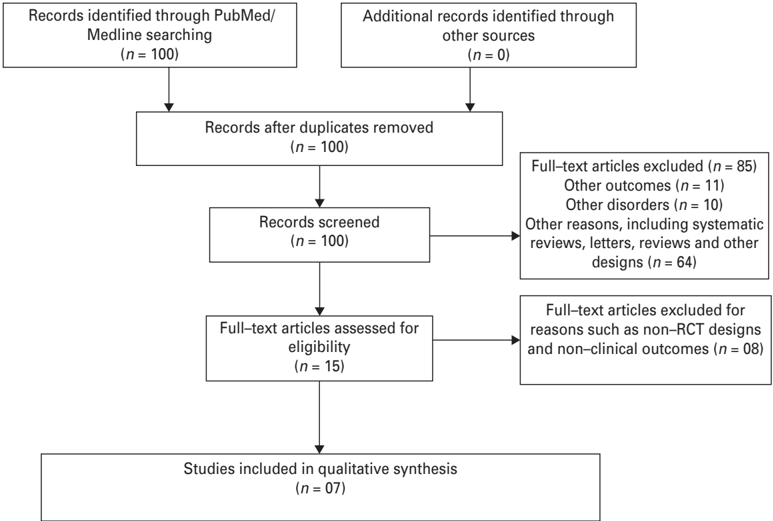
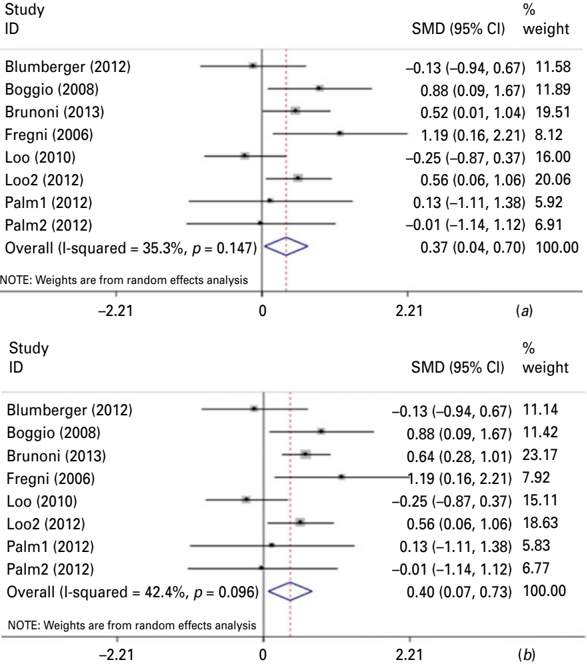
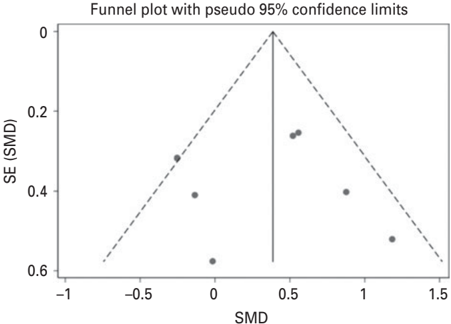
Transcranial direct cranial stimulation (tDCS) is a promising non-pharmacological intervention for treating major depressive disorder (MDD). However, results from randomized controlled trials (RCTs) and meta-analyses are mixed. Our aim was to assess the efficacy of tDCS as a treatment for MDD. We performed a systematic review in Medline and other databases from the first RCT available until January 2014. The main outcome was the Hedges' g for continuous scores; secondary outcomes were the odds ratio (ORs) to achieve response and remission. We used a random-effects model. Seven RCTs (n = 259) were included, most with small sample sizes that assessed tDCS as either a monotherapy or as an add-on therapy. Active vs. sham tDCS was significantly superior for all outcomes (g = 0.37; 95% CI 0.04-0.7; ORs for response and remission were, respectively, 1.63; 95% CI = 1.26-2.12 and 2.50; 95% CI = 1.26-2.49). Risk of publication bias was low. No predictors of response were identified, possibly owing to low statistical power. In summary, active tDCS was statistically superior to sham tDCS for the acute depression treatment, although its role as a clinical intervention is still unclear owing to the mixed findings and heterogeneity of the reviewed studies. Further RCTs with larger sample sizes and assessing tDCS efficacy beyond the acute depressive episode are warranted.
Overview
The claims and statistics of this paper haven’t been checked yet.
Free: it reads the open-access text and checks the first 5 claims that cite a source we can check. Create a free account to check every claim.
Integrity signals
Registry
Cites
Statistics
Figures
Verification
Claims the paper makes
The claims and statistics of this paper haven’t been checked yet.
Free: it reads the open-access text and checks the first 5 claims that cite a source we can check. Create a free account to check every claim.
Claims other papers make about this one
Each is checked against this paper’s own text: does it say what the citing paper says it does?
The source backs part of the claim, not all of it — or backs it for a different population, condition or comparison.
In the citing paper
“Novel therapeutic approaches that exert a neuromodulatory effect on the brain through the application of a magnetic or electric current via the scalp (Shiozawa et al. 2014) —respectively, transcranial magnetic stimulation (TMS) and transcranial direct current stimulation (tDCS)—have been shown to affect emotional processing.”
From Cognitive neuropsychological theory of antidepressant action: a modern-day approach to depression and its treatment (2021) · cites this paper as Shiozawa et al. 2014
Experimental — accuracy not yet measured
Self-check
Percentages, sums and reported differences re-computed from the paper’s own numbers.
The self-check needs the paper’s full text.
Citations
Cites
Liberati, A., Altman, D. G., Tetzlaff, J., Mulrow, C., Gøtzsche, P. C., Ioannidis, J. P. A., Clarke, M., Devereaux, P. J., Kleijnen, J., & Moher, D. (2009) · PLoS Medicine · doi:10.1371/journal.pmed.1000100 · Cited by 28,164 · cited 1×
“A systematic review and meta-analysis according to the recommendations of the Cochrane group was conducted, and the present report follows PRISMA guidelines (Liberati et al., 2009).”
MethodCochrane Handbook for Systematic Reviews of Interventions Version 5.0.1. The Cochrane Collaboration
Higgins, J. P. T., Green, S. R., & Higgins, J. P. T. (2008) · Cited by 7,259
Transcranial direct current stimulation: State of the art 2008
Nitsche, M. A., Cohen, L. G., Wassermann, E. M., Priori, A., Lang, N., Antal, A., Paulus, W., Hummel, F., Boggio, P. S., Fregni, F., et al. (2008) · Brain Stimulation · doi:10.1016/j.brs.2008.06.004 · Cited by 3,057 · cited 1×
“…stimulation (tDCS) is a novel technique based on the application of a weak electrical current over the scalp through two electrodes – the anode, which facilitates neuronal depolarization, and the cathode, which leads to neuronal hyper-polarization (Nitsche et al., 2008; Brunoni et al., 2012b).”
MethodSelf-citationImproved tests for a random effects meta‐regression with a single covariate
Knapp, G., & Hartung, J. (2003) · Statistics in Medicine · doi:10.1002/sim.1482 · Cited by 2,075 · cited 1×
“Meta-regression was performed using the random-effects model modified by Knapp and Hartung (2003) method, using only one variable at a time.”
MethodPhysiological basis of transcranial direct current stimulation
Stagg, C. J., & Nitsche, M. A. (2011) · The Neuroscientist · doi:10.1177/1073858410386614 · Cited by 1,719 · cited 1×
“…we should take into account the several studies assessing the impact of pharmacotherapy in tDCS-elicited cortical excitability (for a review see Stagg and Nitsche (2011)) – for instance, anodal tDCS effects are enhanced with the acute administration of citalopram (Nitsche et al., 2009), and…”
BackgroundBrunoni, A. R., Nitsche, M. A., Bolognini, N., Bikson, M., Wagner, T., Merabet, L., Edwards, D. J., Valero-Cabre, A., Rotenberg, A., Pascual-Leone, A., et al. (2012) · Brain stimulation · doi:10.1016/j.brs.2011.03.002 · Cited by 1,445 · cited 2×
“…stimulation (tDCS) is a novel technique based on the application of a weak electrical current over the scalp through two electrodes – the anode, which facilitates neuronal depolarization, and the cathode, which leads to neuronal hyper-polarization (Nitsche et al., 2008; Brunoni et al., 2012b).”
BackgroundMethodSelf-citationBrunoni, A. R., Amadera, J., Berbel, B., Volz, M. S., Rizzerio, B. G., & Fregni, F. (2011) · International Journal of Neuropsychopharmacology · doi:10.1017/s1461145710001690 · Cited by 1,234 · cited 2×
“This metaanalysis is relevant considering the burden and importance of MDD, which is one of the most disabling conditions worldwide (Eaton et al., 1997) and the potential benefits of tDCS as a non-invasive, affordable, simple intervention with a low rate of adverse effects (Brunoni et al., 2011).”
BackgroundSelf-citationMedication Augmentation after the Failure of SSRIs for Depression
Trivedi, M. H., Fava, M., Wisniewski, S. R., Thase, M. E., Quitkin, F., Warden, D., Ritz, L., Nierenberg, A. A., Lebowitz, B. D., Biggs, M. M., et al. (2006) · New England Journal of Medicine · doi:10.1056/nejmoa052964 · Cited by 1,002 · cited 2×
“…depression was not identified as a predictor of response, in contrast with studies showing that interventions, such as pharmacotherapy (Trivedi et al., 2006), rTMS (Fregni et al., 2006d; Lisanby et al., 2009) and ECT (Sackeim et al., 2000) performed poorer in treatment-resistant…”
ResultSackeim, H. A., Prudic, J., Devanand, D. P., Nobler, M. S., Lisanby, S. H., Peyser, S., Fitzsimons, L., Moody, B. J., & Clark, J. (2000) · Archives of General Psychiatry · doi:10.1001/archpsyc.57.5.425 · Cited by 804 · cited 2×
“Treatment-resistant depression was not identified as a predictor of response, in contrast with studies showing that interventions, such as pharmacotherapy (Trivedi et al., 2006), rTMS (Fregni et al., 2006d; Lisanby et al., 2009) and ECT (Sackeim et al., 2000) performed poorer in treatment-resistant samples.”
ResultBrunoni, A. R., Valiengo, L., Baccaro, A., Zanão, T. A., de Oliveira, J. F., Goulart, A., Boggio, P. S., Lotufo, P. A., Benseñor, I. M., & Fregni, F. (2013) · JAMA Psychiatry · doi:10.1001/2013.jamapsychiatry.32 · Cited by 601 · cited 17×
“(Brunoni et al., 2013) and to the best of our knowledge, these results have not been included in tDCS metaanalyses yet.”
BackgroundMethodResultSelf-citation
Cited by
Items 201–280 of 280
Roberts, B. M., Conn, K. M., Hildebrandt, A. M., Connor, K. R., Lange, E., Geddis, A. V., Taylor, A., Ekon, N., Heaton, K. J., Ridgewell, C., et al. (2025) · Neuromodulation Technology at the Neural Interface · doi:10.1016/j.neurom.2025.05.008 · Cited by 2
Recent Developments in Noninvasive Neuromodulation for Mood and Anxiety Disorders
Hu, Y.-P., Rakesh, G., & Lisanby, S. H. (2015) · Current Behavioral Neuroscience Reports · doi:10.1007/s40473-015-0043-4 · Cited by 2
“A recent systematic review and meta-analysis found active tDCS to be superior to sham in the treatment of depression (110).”
Akbari, F., Talebi, M., & Fathi-Ashtiani, A. (2015) · International behavioral sciences/International journal of behavioral sciences · Cited by 6
Non-Invasive Brain Stimulation (TMS/tDCS) and Rehabilitation for Stroke and Parkinson’s
Matsuda, T., Manji, A., Amimoto, K., Inaba, A., & Wada, Y. (2017) · InTech eBooks · doi:10.5772/67908 · Cited by 3
Bornheim, S., Croisier, J. ‐., Leclercq, V., Baude, C., & Kaux, J. (2020) · Science & Sports · doi:10.1016/j.scispo.2020.05.002 · Cited by 2
Transcranial Direct Current Stimulation: a potential novel treatment for alcohol addiction and abuse
Bhandal, A., Sultana, T., & Janjua, K. A. (2018) · Bangladesh Journal of Medical Science · doi:10.3329/bjms.v17i1.35272 · Cited by 3
Mood Disorders: Clinical Results
Moffa, A. H., Brunoni, A. R., & Loo, C. K. A. (2021) · Springer eBooks · doi:10.1007/978-3-030-76136-3_21 · Cited by 1
Self-citationKim, C., Lim, S., Kim, H.-G., Kim, D., Park, Y.-M., Seo, J., & Jang, D. P. (2025) · Biomedical Engineering Letters · doi:10.1007/s13534-025-00518-z · Cited by 1
“Additionally, Shiozawa and colleagues demonstrated that stimulating the orbital branch of the TN for 30 min significantly reduced depressive symp - toms in patients with major depressive disorder [ 8].”
Current Antidepressant Therapy: A Critical Examination
Mori, N., Lockwood, L. E., & McCall, W. V. (2015) · Psychiatric Annals · doi:10.3928/00485713-20150901-04 · Cited by 2
Silva, T. D. S. F., & Galdino, M. K. C. (2017) · Revista Dor · doi:10.5935/1806-0013.20170128 · Cited by 1
Lin, S., & Yang, Y. K. (2019) · Medical Hypotheses · doi:10.1016/j.mehy.2019.02.013 · Cited by 1
“sham tDCS was small to medium for the treatment of depression [12,13].”
Noninvasive Brain Stimulation to Reduce Falls in Older Adults
Manor, B. D., Lo, O., Zhou, J., Dhami, P., & Farzan, F. (2019) · Springer eBooks · doi:10.1007/978-3-030-24233-6_21 · Cited by 1
Brunoni, A. R., & Loo, C. K. A. (2016) · Springer eBooks · doi:10.1007/978-3-319-33967-2_13 · Cited by 1
Self-citationTranscranial Direct Current Stimulation (tDCS) for Major Depressive Disorder
Gersten, M. B., Jamil, A., Cassano, P., & Camprodon, J. A. (2022) · Psychiatric Annals · doi:10.3928/00485713-20221025-01 · Cited by 1
Saeidi, E., Rostami, H. R., Vahedi, M., & Haghgoo, H. A. (2024) · Neurology and Clinical Neuroscience · doi:10.1111/ncn3.12841 · Cited by 1
“24 Present findings, in line with the results of Manenti et al. TABLE 2 Descriptive statistics of dependent variables in study groups.”
Zafarghandi, M. B. S., Arezoomandan, R., & Fayazfeyzi, Y. (2024) · Iranian Journal of Psychiatry and Behavioral Sciences · doi:10.5812/ijpbs-142498 · Cited by 1
Emerging Non-invasive Brain Stimulations for Schizophrenia
Wang, X., Blumberger, D. M., Ismail, P., & Foll, B. L. (2024) · Royal Society of Chemistry eBooks · doi:10.1039/9781837672059-00156 · Cited by 1
The Role of Stimulation Techniques
Schachter, S. C. (2015) · Neuropsychiatric symptoms of neurological disease · doi:10.1007/978-3-319-22159-5_19 · Cited by 1
Poleszczyk, A., & Antosik-Wójcińska, A. Z. (2015) · Family Medicine & Primary Care Review · doi:10.5114/fmpcr/60386 · Cited by 1
Clinical Application of Neurostimulation in Depression
Freire, R. C. R., Cirillo, P., & Nardi, A. E. (2017) · Springer eBooks · doi:10.1007/978-981-10-6577-4_20 · Cited by 2
Methods in cognitive neuroscience: a primer for forensic psychologists
Eisenbarth, H. (2018) · Psychology Crime and Law · doi:10.1080/1068316x.2018.1425409 · Cited by 3
Desenvolvimento de um banco de itens para avaliar o transtorno depressivo maior
Sales, H. F. S., de Andrade, J. M., & Asfora, V. F. O. (2018) · Revista Avaliação Psicológica · doi:10.15689/ap.2018.1704.5.05 · Cited by 1
Transcranial Direct Current Stimulation-Psychiatric Application and Its Current Status
Pyungkyu, K., & Kim, D. (2017) · Saengmul jeongsin euihag/Saengmul jeongsin uihak · doi:10.22857/kjbp.2017.24.4.002 · Cited by 1
Promises and Perils of Neuroenhancement and its Perspectives for Military Ethics
Orzechowski, M., & Steger, F. (2018) · Acta Universitatis Lodziensis Folia Philosophica Ethica-Aesthetica-Practica · doi:10.18778/0208-6107.32.02 · Cited by 1
Dinakaran, D., Parlikar, R. U., Chhabra, H., & Venkatasubramanian, G. (2021) · Minerva Psychiatry · doi:10.23736/s2724-6612.20.02114-7 · Cited by 1
Moffa, A. H. (2016) · Digital Library of Theses and Dissertations (Universidade de São Paulo) · doi:10.11606/d.47.2016.tde-07102016-180727 · Cited by 1
Transcranial Direct Current Stimulation
Fregni, F., & Wagner, T. (2017) · Elsevier eBooks · doi:10.1016/b978-0-12-800454-8.00008-2 · Cited by 1
Self-citationHutchings, F., Thornton, C., Zhang, C., Wang, Y., & Kaiser, M. (2020) · arXiv (Cornell University) · doi:10.48550/arxiv.2001.10414 · Cited by 1
Towards Achieving a Home-based Brain Stimulation System
Mansouri, F. (2019) · TSpace (University of Toronto) · Cited by 1
Increasing propensity of mind wandering using tDCS? A Registered ReportPreprint
Boayue, N. M., Csifcsák, G., Aslaksen, P. M., Turi, Z., Antal, A., Groot, J. M., Hawkins, G. E., Forstmann, B. U., Thielscher, A., Opitz, A., et al. (2018) · PsyArXiv (OSF Preprints) · doi:10.31234/osf.io/dfex3 · Cited by 1
Stimulating human prefrontal cortex increases reward learningPreprint
Overman, M. J., Sarrazin, V., Browning, M. D., & O’Shea, J. (2021) · bioRxiv (Cold Spring Harbor Laboratory) · doi:10.1101/2021.01.27.428488 · Cited by 2
“In clinical trials, transcranial direct current stimulation (tDCS) of DLPFC applied at rest improves depression (Brunoni et al., 2016; Razza et al., 2020; Shiozawa et al., 2014).”
BackgroundKhalil, R., Karim, A. A., & Godde, B. (2023) · doi:10.31234/osf.io/6gv7j · Cited by 1
Feeser, M. (2015) · Universitätsbibliothek der FU Berlin Hochschulschriftenstelle u. Dokumentenserver · doi:10.17169/refubium-7212
Palm, U., Kirsch, V., Kübler, H., Keeser, D., Padberg, F., & Dieterich, M. (2015) · Clinical Neurophysiology · doi:10.1016/j.clinph.2015.04.226
“Transcranial direct current stimulation (tDCS) has been proven to improve depressive symptoms (Mondino et al., 2014; Shiozawa et al., 2014).”
WITHDRAWN: The Outlook for Non-invasive Electrical Brain Stimulation
Bikson, M., Edwards, D. J., & Kappenman, E. S. (2014) · Brain stimulation · doi:10.1016/j.brs.2014.10.009
Neurosurgery to Enhance Brain Function: Ethical Dilemmas for the Neuroscientist and Society
Johnson, R., Ridder, D. D., & Gillett, G. R. (2014) · Advances in human and social aspects of technology book series · doi:10.4018/978-1-4666-6010-6.ch006
Raithel, A. M. (2016) · eDiss (Georg-August-Universität Göttingen) · doi:10.53846/goediss-5773
The Stephen Dawson case: judging the right to survive.
Rozovsky, L. E., & Rozovsky, F. A. (1983) · PubMed
Transcranial direct current stimulation (tDCS): Are we losing energy?
Shiozawa, P., Soares, A. R. A., Taiar, I., Dias, Á. M., & Cordeiro, Q. (2016) · Epilepsy & Behavior · doi:10.1016/j.yebeh.2016.10.011
Self-citationTowards Bidirectional Brain-computer Interfaces that Use fNIRS and tDCS
Hincks, S. W., DeBellis, M., Lee, E. Y., ten Brink, R., Moëll, B., & Jacob, R. (2017) · International Conference on Physiological Computing Systems (PhyCS) · doi:10.5220/0006380500570064
“However, much previous tDCS research, especially experiments aimed at treating depression (Shiozawa et al., 2014), have emphasized longer term effects and longer stimulation periods, because interactivity was not the goal.”
BackgroundThe modulatory effect of sleep on transcranial direct current stimulation-enhanced learning
Ebajemito, J. K. (2018) · University of Surrey Open Research repository
Optimization of Noninvasive Brain Stimulation Clinical Trials
Thibaut, A., French, M. N., Vasquez, A., & Fregni, F. (2018) · Elsevier eBooks · doi:10.1016/b978-0-12-805353-9.00138-8
Self-citationEffects of prefrontal tDCS on dopamine-mediated behavior and psychophysiologyPreprint
Worthy, D. A., Imburgio, M. J., Bernard, J. A., Ballard, H. K., Cornwall, A. C., & Orr, J. M. (2018) · bioRxiv (Cold Spring Harbor Laboratory) · doi:10.17605/osf.io/zhjys
Budzisz, J., & Leśniak, M. (2019) · International Conference on Smart and Sustainable Technologies (SpliTech) · doi:10.23919/splitech.2019.8783144
Transcranial direct current stimulation to remediate myasthenia gravis symptomsPreprint
Kamali, A., Tehrani, M. R. H., Yahyavi, S., Baneshi, S., Saadi, Z. K., Nazeri, M., Poursadeghfard, M., & Nami, M. (2019) · arXiv (Cornell University) · doi:10.48550/arxiv.1911.04420
“It is considered as an effective approach in improving major depression [29] and a promising treatment for generalized anxiety disorder with established effectiveness [30].”
BackgroundGiordana, B., Sauvaget, A., & Attal, J. (2018) · French Journal of Psychiatry · doi:10.1016/s2590-2415(19)30156-4
Danazumi, M. S., Hassan, A., Ishaku, C. M., & Yakasai, A. M. (2020) · Nigerian Journal of Experimental and Clinical Biosciences · doi:10.4103/njecp.njecp_33_19
Stimulating human prefrontal cortex increases reward learningPreprint
Overman, M. J., Sarrazin, V., Browning, M., & O’Shea, J. (2021) · doi:10.17605/osf.io/av9pf
Efeitos da eletroestimulação na função musculoventilatória em humanos: revisão de escopo
Oliveira, M. I. D. S., Pedrosa, R., Onofre, T., Lima, J. H. D. M., Júnior, U. F. E., Andrade, S. M., & França, E. (2021) · Revista Neurociências · doi:10.34024/rnc.2021.v29.12639
La pintura de Pablo Palazuelo: naturaleza, materia, transformación y vida
Queralt, R. (2005) · Arte y parte: revista de arte - España, Portugal y América
Diehl, M. M., Lempert, K. M., Parr, A. C., Ballard, I. C., Steele, V. R., & Smith, D. V. (2018) · PsyArXiv (OSF Preprints) · doi:10.31234/osf.io/yvds9 · Cited by 2
Qin, J. (2021) · Queensland University of Technology · doi:10.5204/thesis.eprints.211438
Non-pharmacological Somatic Treatments for Bipolar Depression
Sackeïm, H. A. (2016) · Milestones in drug therapy · doi:10.1007/978-3-319-31689-5_11
New Research in Obsessive-Compulsive Disorder and Major Depression
Aouizerate, B., & Haffen, É. (2019) · MDPI eBooks · doi:10.3390/books978-3-03921-091-6
Ranjbar-Shayan, H., Tabatabaei, S. M., & Ali, A. P. (2023) · Journal of Research in Urology · doi:10.32592/jru.6.2.67
de Araújo, A. V. L. (2023) · Digital Library of Theses and Dissertations (Universidade de São Paulo) · doi:10.11606/t.5.2023.tde-27032024-142136
Hosseini, S. R., Nooripour, R., & Ghanbari, N. (2024) · Research Square · doi:10.21203/rs.3.rs-5356416/v1
(2019) · American Psychiatric Association Publishing eBooks · doi:10.1176/appi.books.9781615379422.bm01
Chapter 9. Cognitive Effects of ECT
(2019) · American Psychiatric Association Publishing eBooks · doi:10.1176/appi.books.9781615379422.lg09
Chapter 4. The Pre-ECT Medical Workup
(2019) · American Psychiatric Association Publishing eBooks · doi:10.1176/appi.books.9781615379422.lg04
Chapter 2. Patient Selection for ECT
(2019) · American Psychiatric Association Publishing eBooks · doi:10.1176/appi.books.9781615379422.lg02
Chapter 3. Patient Education and Informed Consent for ECT
(2019) · American Psychiatric Association Publishing eBooks · doi:10.1176/appi.books.9781615379422.lg03
Chapter 1. Introduction to ECT
(2019) · American Psychiatric Association Publishing eBooks · doi:10.1176/appi.books.9781615379422.lg01
Chapter 10. ECT Versus Other Neuropsychiatric Treatments
(2019) · American Psychiatric Association Publishing eBooks · doi:10.1176/appi.books.9781615379422.lg10
Chapter 6. ECT Technique, Part I: Managing the Individual Treatment
(2019) · American Psychiatric Association Publishing eBooks · doi:10.1176/appi.books.9781615379422.lg06 · Cited by 1
(2019) · American Psychiatric Association Publishing eBooks · doi:10.1176/appi.books.9781615379422.index
(2019) · American Psychiatric Association Publishing eBooks · doi:10.1176/appi.books.9781615379422.lg05
Chapter 8. Preventing Relapse After ECT: Maintenance ECT and Pharmacotherapy
(2019) · American Psychiatric Association Publishing eBooks · doi:10.1176/appi.books.9781615379422.lg08
Chapter 7. ECT Technique, Part II: Managing the Course of Treatments
(2019) · American Psychiatric Association Publishing eBooks · doi:10.1176/appi.books.9781615379422.lg07
(2019) · American Psychiatric Association Publishing eBooks · doi:10.1176/appi.books.9781615379422.fm01
Hunold, A., Ortega, D., Schellhorn, K., & Haueisen, J. (2020) · Figshare · doi:10.6084/m9.figshare.12503264
Weller, S., Derntl, B., & Plewnia, C. (2024) · Figshare · doi:10.6084/m9.figshare.26635113
Breaking the Negative Symptom Barrier
Gupta, R., Sharma, A., & Goyal, N. (2026) · Journal of Ect · doi:10.1097/yct.0000000000001224
Focal seizure induction using deep brain stimulation via temporally interfering electric fields
Rusina, E. (2021) · theses.fr (ABES) · doi:10.70675/10748384za057z4511z8670z2e30212cdc38
Schlatter, S. (2021) · theses.fr (ABES) · doi:10.70675/e9d0dbb0z6c06z4dbcz9faaz496f16be9da0 · Cited by 2
Haimi, M., Almeida‐Antunes, N., Ferreira, S., & Rocha, N. (2026) · JMIR Mental Health · doi:10.2196/92522
“In depression, the conventional montage places the anode over the left dorsolateral prefrontal cortex (DLPFC) and the cathode over the right DLPFC or right supraorbital area, targeting prefrontal circuitry implicated in mood regulation [10].”
Bambico, F. R., Nicoglou, A., Relente, J., Surget, A., & Belzung, C. (2026) · Molecular Psychiatry · doi:10.1038/s41380-026-03872-1 · Cited by 1
Marchiș, M., Iorga, M., Mihăianu, I.-G., & Apostol, M.-M. (2026) · Brain Sciences · doi:10.3390/brainsci16101004
“[39–41].”
Ayçiçeği-Dinn, A., Göral, F., & Dinn, W. M. (2026) · Substance Use & Misuse · doi:10.1080/10826084.2026.2752116
勝也, 緒., & 飛松省三 (2015) · 計測と制御 · doi:10.11499/sicejl.54.106 · Cited by 6
Metadata
- Authors
- Shiozawa, P., Fregni, F., Benseñor, I. M., Lotufo, P. A., Berlim, M. T., Daskalakis, J. Z., Cordeiro, Q., & Brunoni, A. R.
- Affiliations
- Universidade de São Paulo (BR)
- Harvard University (US)
- McGill University (CA)
- Centre for Addiction and Mental Health (CA)
- Faculdade de Ciências Médicas da Santa Casa de São Paulo (BR)
- ORCID
- Venue
- The International Journal of Neuropsychopharmacology
- Publisher
- Oxford University Press (OUP)
- Published
- 2014-04-08
- Volume
- 17
- Issue
- 09
- Pages
- 1443-1452
- ISSN
- 1461-1457 (ISSN-L)
- 1469-5111
- OpenAlex
- W2109355532
- Cited by
- 282
- References
- 31
- Citations by year
- 2026: 7 · 2025: 9 · 2024: 10 · 2023: 12 · 2022: 11 · 2021: 20 · 2020: 28 · 2019: 39 · 2018: 34 · 2017: 33 · 2016: 33 · 2015: 37 · 2014: 7
- FWCI
- 2.98
- Type
- journal article
- Language
- en
- Open access
- hybrid
- doi.org
- Licence
- cc-by
- Locations
- The International Journal of Neuropsychopharmacology (publishedVersion, cc-by)
- PubMed (publishedVersion)
- Funders
- National Alliance for Research on Schizophrenia and Depression
- Fundação de Amparo à Pesquisa do Estado de São Paulo (20911-5, 20493, 470904)
- Conselho Nacional de Desenvolvimento Científico e Tecnológico (20493, 20911-5, 470904)
- Topics
- Life Sciences › Neuroscience › Neurology › Transcranial Magnetic Stimulation Studies
- Health Sciences › Medicine › Pharmacology (medical) › Treatment of Major Depression
- Health Sciences › Medicine › Psychiatry and Mental health › Electroconvulsive Therapy Studies
- Keywords
- transcranial direct current stimulation, major depressive disorder, non-pharmacological treatment, treatment response and remission, acute depression, adjunctive therapy
- MeSH terms
- Major Depressive Disorder, Humans, Randomized Controlled Trials as Topic, Transcranial Direct Current Stimulation
About these checks
Registry, retraction, Cites and statistics results are computed, not judged, with one exception: a printed reference that no index lists is read once by a model before it counts as a citation error. Claims are extracted by a model and kept only when their quote appears verbatim in the text; each cited source is then checked, with a model’s help, for whether it says what the claim relies on. Those verdicts can be wrong — read the claim’s quote and the cited source before relying on one.
Statistics and arithmetic are recomputed, not judged.
Confidence bands are shown only for fields calibrated on our annotated test set. None is calibrated yet, so no band is shown.
What counts as a claim ›How we measure confidence ›How we check this ›
Are you an author, or do you see a problem with this page? Request a review
Data sources
Bibliographic data: Semantic Scholar, OpenAlex, Crossref.
Contains information from the Semantic Scholar Academic Graph Datasets, made available under the ODC Attribution License (ODC-BY 1.0).
Semantic Scholar’s data is described in: Kinney, R., et al. (2023). The Semantic Scholar Open Data Platform. arXiv:2301.10140.
