

Transcranial direct current stimulation for major depression: an updated systematic review and meta-analysis
Open accessThe DOI matches its Crossref record; 31 of the 31 references it cites were found in a registry or an index.
Abstract
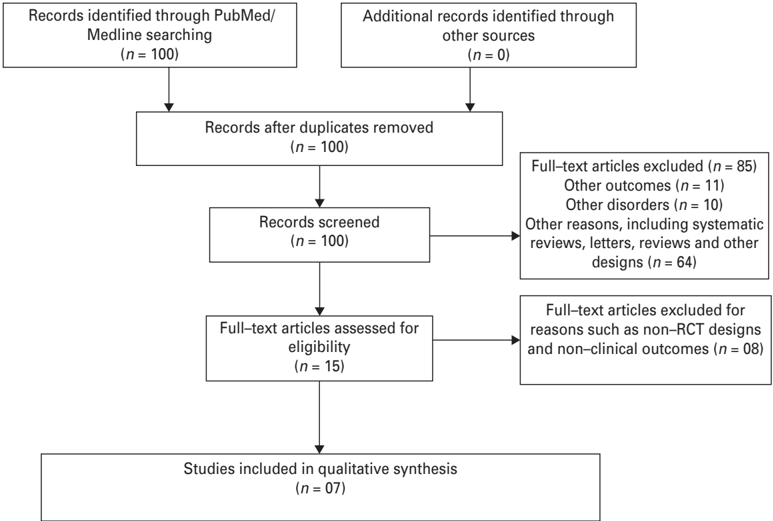
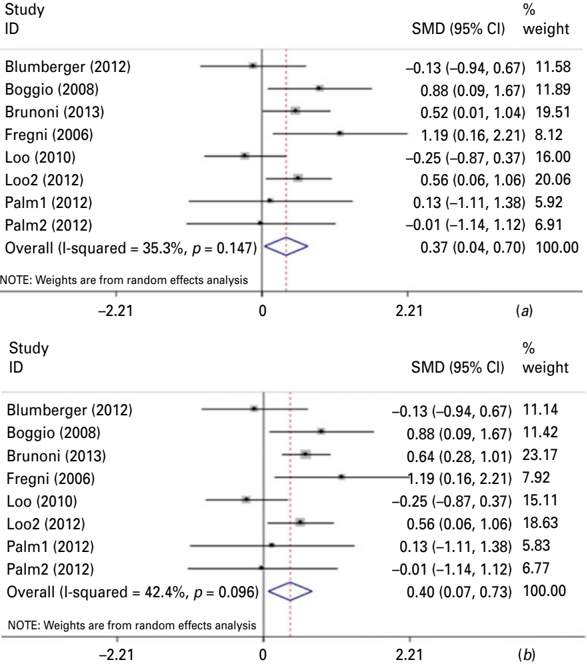
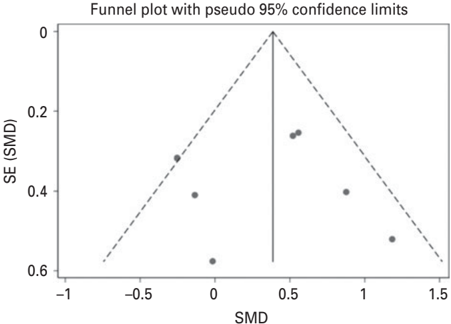
Transcranial direct cranial stimulation (tDCS) is a promising non-pharmacological intervention for treating major depressive disorder (MDD). However, results from randomized controlled trials (RCTs) and meta-analyses are mixed. Our aim was to assess the efficacy of tDCS as a treatment for MDD. We performed a systematic review in Medline and other databases from the first RCT available until January 2014. The main outcome was the Hedges' g for continuous scores; secondary outcomes were the odds ratio (ORs) to achieve response and remission. We used a random-effects model. Seven RCTs (n = 259) were included, most with small sample sizes that assessed tDCS as either a monotherapy or as an add-on therapy. Active vs. sham tDCS was significantly superior for all outcomes (g = 0.37; 95% CI 0.04-0.7; ORs for response and remission were, respectively, 1.63; 95% CI = 1.26-2.12 and 2.50; 95% CI = 1.26-2.49). Risk of publication bias was low. No predictors of response were identified, possibly owing to low statistical power. In summary, active tDCS was statistically superior to sham tDCS for the acute depression treatment, although its role as a clinical intervention is still unclear owing to the mixed findings and heterogeneity of the reviewed studies. Further RCTs with larger sample sizes and assessing tDCS efficacy beyond the acute depressive episode are warranted.
Overview
The claims and statistics of this paper haven’t been checked yet.
Free: it reads the open-access text and checks the first 5 claims that cite a source we can check. Create a free account to check every claim.
Integrity signals
Registry
Cites
Statistics
Figures
Verification
Claims the paper makes
The claims and statistics of this paper haven’t been checked yet.
Free: it reads the open-access text and checks the first 5 claims that cite a source we can check. Create a free account to check every claim.
Claims other papers make about this one
Each is checked against this paper’s own text: does it say what the citing paper says it does?
The source backs part of the claim, not all of it — or backs it for a different population, condition or comparison.
In the citing paper
“Novel therapeutic approaches that exert a neuromodulatory effect on the brain through the application of a magnetic or electric current via the scalp (Shiozawa et al. 2014) —respectively, transcranial magnetic stimulation (TMS) and transcranial direct current stimulation (tDCS)—have been shown to affect emotional processing.”
From Cognitive neuropsychological theory of antidepressant action: a modern-day approach to depression and its treatment (2021) · cites this paper as Shiozawa et al. 2014
Experimental — accuracy not yet measured
Self-check
Percentages, sums and reported differences re-computed from the paper’s own numbers.
The self-check needs the paper’s full text.
Citations
Cites
Liberati, A., Altman, D. G., Tetzlaff, J., Mulrow, C., Gøtzsche, P. C., Ioannidis, J. P. A., Clarke, M., Devereaux, P. J., Kleijnen, J., & Moher, D. (2009) · PLoS Medicine · doi:10.1371/journal.pmed.1000100 · Cited by 28,164 · cited 1×
“A systematic review and meta-analysis according to the recommendations of the Cochrane group was conducted, and the present report follows PRISMA guidelines (Liberati et al., 2009).”
MethodCochrane Handbook for Systematic Reviews of Interventions Version 5.0.1. The Cochrane Collaboration
Higgins, J. P. T., Green, S. R., & Higgins, J. P. T. (2008) · Cited by 7,261
Transcranial direct current stimulation: State of the art 2008
Nitsche, M. A., Cohen, L. G., Wassermann, E. M., Priori, A., Lang, N., Antal, A., Paulus, W., Hummel, F., Boggio, P. S., Fregni, F., et al. (2008) · Brain Stimulation · doi:10.1016/j.brs.2008.06.004 · Cited by 3,057 · cited 1×
“…stimulation (tDCS) is a novel technique based on the application of a weak electrical current over the scalp through two electrodes – the anode, which facilitates neuronal depolarization, and the cathode, which leads to neuronal hyper-polarization (Nitsche et al., 2008; Brunoni et al., 2012b).”
MethodSelf-citationImproved tests for a random effects meta‐regression with a single covariate
Knapp, G., & Hartung, J. (2003) · Statistics in Medicine · doi:10.1002/sim.1482 · Cited by 2,075 · cited 1×
“Meta-regression was performed using the random-effects model modified by Knapp and Hartung (2003) method, using only one variable at a time.”
MethodPhysiological basis of transcranial direct current stimulation
Stagg, C. J., & Nitsche, M. A. (2011) · The Neuroscientist · doi:10.1177/1073858410386614 · Cited by 1,719 · cited 1×
“…we should take into account the several studies assessing the impact of pharmacotherapy in tDCS-elicited cortical excitability (for a review see Stagg and Nitsche (2011)) – for instance, anodal tDCS effects are enhanced with the acute administration of citalopram (Nitsche et al., 2009), and…”
BackgroundBrunoni, A. R., Nitsche, M. A., Bolognini, N., Bikson, M., Wagner, T., Merabet, L., Edwards, D. J., Valero-Cabre, A., Rotenberg, A., Pascual-Leone, A., et al. (2012) · Brain stimulation · doi:10.1016/j.brs.2011.03.002 · Cited by 1,445 · cited 2×
“…stimulation (tDCS) is a novel technique based on the application of a weak electrical current over the scalp through two electrodes – the anode, which facilitates neuronal depolarization, and the cathode, which leads to neuronal hyper-polarization (Nitsche et al., 2008; Brunoni et al., 2012b).”
BackgroundMethodSelf-citationBrunoni, A. R., Amadera, J., Berbel, B., Volz, M. S., Rizzerio, B. G., & Fregni, F. (2011) · International Journal of Neuropsychopharmacology · doi:10.1017/s1461145710001690 · Cited by 1,234 · cited 2×
“This metaanalysis is relevant considering the burden and importance of MDD, which is one of the most disabling conditions worldwide (Eaton et al., 1997) and the potential benefits of tDCS as a non-invasive, affordable, simple intervention with a low rate of adverse effects (Brunoni et al., 2011).”
BackgroundSelf-citationMedication Augmentation after the Failure of SSRIs for Depression
Trivedi, M. H., Fava, M., Wisniewski, S. R., Thase, M. E., Quitkin, F., Warden, D., Ritz, L., Nierenberg, A. A., Lebowitz, B. D., Biggs, M. M., et al. (2006) · New England Journal of Medicine · doi:10.1056/nejmoa052964 · Cited by 1,002 · cited 2×
“…depression was not identified as a predictor of response, in contrast with studies showing that interventions, such as pharmacotherapy (Trivedi et al., 2006), rTMS (Fregni et al., 2006d; Lisanby et al., 2009) and ECT (Sackeim et al., 2000) performed poorer in treatment-resistant…”
ResultSackeim, H. A., Prudic, J., Devanand, D. P., Nobler, M. S., Lisanby, S. H., Peyser, S., Fitzsimons, L., Moody, B. J., & Clark, J. (2000) · Archives of General Psychiatry · doi:10.1001/archpsyc.57.5.425 · Cited by 804 · cited 2×
“Treatment-resistant depression was not identified as a predictor of response, in contrast with studies showing that interventions, such as pharmacotherapy (Trivedi et al., 2006), rTMS (Fregni et al., 2006d; Lisanby et al., 2009) and ECT (Sackeim et al., 2000) performed poorer in treatment-resistant samples.”
ResultBrunoni, A. R., Valiengo, L., Baccaro, A., Zanão, T. A., de Oliveira, J. F., Goulart, A., Boggio, P. S., Lotufo, P. A., Benseñor, I. M., & Fregni, F. (2013) · JAMA Psychiatry · doi:10.1001/2013.jamapsychiatry.32 · Cited by 601 · cited 17×
“(Brunoni et al., 2013) and to the best of our knowledge, these results have not been included in tDCS metaanalyses yet.”
BackgroundMethodResultSelf-citationBoggio, P. S., Rigonatti, S. P., Ribeiro, R. B., Myczkowski, M. L., Nitsche, M. A., Pascual-Leone, A., & Fregni, F. (2008) · International Journal of Neuropsychopharmacology · doi:10.1017/s1461145707007833 · Cited by 564 · cited 11×
“, 2013) and the HAMD 17 items, 21 items, (Boggio et al., 2008; Blumberger et al., 2012; Palm et al., 2012).”
BackgroundMethodResultSelf-citationTreatment of major depression with transcranial direct current stimulation
Fregni, F., Boggio, P. S., Nitsche, M. A., Marcolin, M. A., Rigonatti, S. P., & Pascual‐Leone, A. (2006) · Bipolar Disorders · doi:10.1111/j.1399-5618.2006.00291.x · Cited by 495
Self-citationEaton, W. W. (1997) · Archives of General Psychiatry · doi:10.1001/archpsyc.1997.01830230023003 · Cited by 489 · cited 2×
“This metaanalysis is relevant considering the burden and importance of MDD, which is one of the most disabling conditions worldwide (Eaton et al., 1997) and the potential benefits of tDCS as a non-invasive, affordable, simple intervention with a low rate of adverse effects (Brunoni et al., 2011).”
BackgroundTranscranial direct current stimulation for depression: 3-week, randomised, sham-controlled trial
Loo, C. K., Alonzo, A., Martin, D., Mitchell, P. B., Galvez, V., & Sachdev, P. (2012) · British Journal of Psychiatry · doi:10.1192/bjp.bp.111.097634 · Cited by 455 · cited 6×
“…the definition each study provided: Fregni et al. (2006a) and Palm et al. (2012) did not describe the criteria used; Boggio et al. (2008) and Blumberger et al. (2012) used scores lower than 8 in the HAMD; Loo et al. (2010) and Brunoni et al. (2013) used MADRS410 and Loo et al. (2012) used MADRS<10.”
BackgroundMethodInfluentialNoninvasive cortical stimulation with transcranial direct current stimulation in Parkinson's disease
Fregni, F., Boggio, P. S., Santos, M. C., Lima, M., Vieira, A. L., Rigonatti, S. P., Silva, M. T. A., Barbosa, E. R., Nitsche, M. A., & Pascual‐Leone, A. (2006) · Movement Disorders · doi:10.1002/mds.21012 · Cited by 433
Self-citationLambert, P. C., Sutton, A. J., Abrams, K. R., & Jones, D. R. (2002) · Journal of Clinical Epidemiology · doi:10.1016/s0895-4356(01)00414-0 · Cited by 394 · cited 1×
“Indeed, metaregressions are usually underpowered to identify predictors of response (Lambert et al., 2002), as no individual patient data are assessed.”
BackgroundGABAergic modulation of DC stimulation‐induced motor cortex excitability shifts in humans
Nitsche, M. A., Liebetanz, D., Schlitterlau, A., Henschke, U., Fricke, K., Frommann, K., Lang, N., Henning, S., Paulus, W., & Tergau, F. (2004) · European Journal of Neuroscience · doi:10.1111/j.0953-816x.2004.03398.x · Cited by 371 · cited 2×
“…excitability (for a review see Stagg and Nitsche (2011)) – for instance, anodal tDCS effects are enhanced with the acute administration of citalopram (Nitsche et al., 2009), and initially delayed but later enhanced and longer after the acute administration of lorazepam (Nitsche et al., 2004).”
BackgroundSchutter, D. J. L. G. (2009) · Psychological Medicine · doi:10.1017/s0033291708003462 · Cited by 371 · cited 2×
“The effect size hereby found is comparable to those obtained by a recent repetitive transcranial magnetic stimulation (rTMS) meta-analysis (Schutter, 2009) (0.”
ResultInfluentialLisanby, S. H., Husain, M. M., Rosenquist, P. B., Maixner, D., Gutierrez, R., Krystal, A., Gilmer, W., Marangell, L. B., Aaronson, S., Daskalakis, Z. J., et al. (2009) · Neuropsychopharmacology · doi:10.1038/npp.2008.118 · Cited by 333
Bolognini, N., Vallar, G., Casati, C., Latif, L. A., El-Nazer, R., Williams, J., Banco, E., Macea, D. D., Tesio, L., Chessa, C., et al. (2011) · Neurorehabilitation and Neural Repair · doi:10.1177/1545968311411056 · Cited by 318 · cited 1×
“In this context, there is evidence showing that tDCS has its largest effects when associated with other interventions – for instance, Bolognini et al. (2011) showed that active tDCS associated with constraint-induced movement therapy (CIMT) presented larger behavioral and functional gains (vs. sham…”
BackgroundSelf-citationLoo, C. K., Sachdev, P., Martin, D., Pigot, M., Alonzo, A., Malhi, G. S., Lagopoulos, J., & Mitchell, P. (2010) · The International Journal of Neuropsychopharmacology · doi:10.1017/s1461145709990411 · Cited by 301 · cited 6×
“…Active (S.D.) Sham (S.D.) Active (S.D.) Sham Active Sham Active Boggio et al. (2008) 21.9 (4.8) 21.1 (4.4) 21.2 (5.4) 13.8 (9.2) 20 38.1 0 23.8 Loo et al. (2010) 28.4 (4.4) 29.2 (4.9) 22.5 (8.1) 23.6 (7.7) 20 30 15 25 Loo et al. (2012) 29.5 (5) 30.4 (6) 24.9 (7.6) 20.6 (7.6) 12.9 12.1 3 3…”
MethodInfluentialTranscranial direct current stimulation in the treatment of major depression: a meta-analysis
Kalu, U. G., Sexton, C. E., Loo, C. K., & Ebmeier, K. P. (2012) · Psychological Medicine · doi:10.1017/s0033291711003059 · Cited by 299 · cited 10×
“Previous tDCS meta-analyses (Kalu et al., 2012; Berlim et al., 2013) presented different results on the efficacy of tDCS for MDD, possibly owing to methodological discrepancies in the assessment of the primary outcome –Kalu et al.”
BackgroundMethodResultInfluentialSerotonin Affects Transcranial Direct Current–Induced Neuroplasticity in Humans
Nitsche, M. A., Kuo, M.-F., Karrasch, R., Wächter, B., Liebetanz, D., & Paulus, W. (2009) · Biological Psychiatry · doi:10.1016/j.biopsych.2009.03.022 · Cited by 265 · cited 2×
“…excitability (for a review see Stagg and Nitsche (2011)) – for instance, anodal tDCS effects are enhanced with the acute administration of citalopram (Nitsche et al., 2009), and initially delayed but later enhanced and longer after the acute administration of lorazepam (Nitsche et al., 2004).”
BackgroundFregni, F., Boggio, P. S., Nitsche, M. A., Rigonatti, S. P., & Pascual-Leone, A. (2006) · Depression and Anxiety · doi:10.1002/da.20201 · Cited by 260
Self-citationPredictors of antidepressant response in clinical trials of transcranial magnetic stimulation
Fregni, F., Marcolin, M. A., Myczkowski, M., Amiaz, R., Hasey, G., Rumi, D. O., Rosa, M., Rigonatti, S. P., Camprodon, J., Walpoth, M., et al. (2006) · The International Journal of Neuropsychopharmacology · doi:10.1017/s1461145705006280 · Cited by 255
Self-citationPalm, U., Schiller, C., Fintescu, Z., Obermeier, M., Keeser, D., Reisinger, E., Pogarell, O., Nitsche, M. A., Möller, H.-J., & Padberg, F. (2012) · Brain Stimulation · doi:10.1016/j.brs.2011.08.005 · Cited by 235 · cited 7×
“…Loo et al. (2010) 28.4 (4.4) 29.2 (4.9) 22.5 (8.1) 23.6 (7.7) 20 30 15 25 Loo et al. (2012) 29.5 (5) 30.4 (6) 24.9 (7.6) 20.6 (7.6) 12.9 12.1 3 3 Palm et al. (2012) 34.6 (5.4) 33 (7.3) 28.2 (8.8) 30.2 (7.4) 9 9 9 9 Blumberger et al. (2013) 24.1 (2.9) 24.9 (3.1) 18.1 (5.5) 18.8 (4.8) 9 7.7 9 7.7…”
MethodResultInfluentialBerlim, M. T., Van den Eynde, F., & Daskalakis, Z. J. (2013) · Journal of Psychiatric Research · doi:10.1016/j.jpsychires.2012.09.025 · Cited by 204 · cited 11×
“Previous tDCS meta-analyses (Kalu et al., 2012; Berlim et al., 2013) presented different results on the efficacy of tDCS for MDD, possibly owing to methodological discrepancies in the assessment of the primary outcome –Kalu et al.”
BackgroundMethodResultSelf-citationBlumberger, D. M., Tran, L. C., Fitzgerald, P. B., Hoy, K. E., & Daskalakis, Z. J. (2012) · Frontiers in Psychiatry · doi:10.3389/fpsyt.2012.00074 · Cited by 159 · cited 8×
“…MDD, according to two recent meta-analyses: whereas Kalu et al. (2012) initially observed improvement of depressive symptoms; the meta-analysis of Berlim et al. (2013), which included one additional trial (Blumberger et al., 2012) found no significant difference between active vs. sham response.”
BackgroundMethodResultInfluentialBrunoni, A. R., Ferrucci, R., Fregni, F., Boggio, P. S., & Priori, A. (2012) · Progress in Neuro-Psychopharmacology and Biological Psychiatry · doi:10.1016/j.pnpbp.2012.05.016 · Cited by 159 · cited 2×
“…stimulation (tDCS) is a novel technique based on the application of a weak electrical current over the scalp through two electrodes – the anode, which facilitates neuronal depolarization, and the cathode, which leads to neuronal hyper-polarization (Nitsche et al., 2008; Brunoni et al., 2012b).”
BackgroundMethodSelf-citationBolognini, N., Fregni, F., Casati, C., Olgiati, E., & Vallar, G. (2010) · Brain Research · doi:10.1016/j.brainres.2010.06.053 · Cited by 148 · cited 1×
“…gains (vs. sham tDCS associated with CIMT) in patients with motor impairment after stroke, whereas, in another study with healthy volunteers, Bolognini et al. (2010) showed that active tDCS (vs. sham) over the posterior parietal cortex associated with a multisensory visual field…”
ResultSelf-citationD’Urso, G., Mantovani, A., Micillo, M., Priori, A., & Muscettola, G. (2012) · Brain stimulation · doi:10.1016/j.brs.2012.09.003 · Cited by 55 · cited 1×
“Indeed, in a case report of treatment-resistant depression, D’Urso et al. (2013) reported evidence of synergistic effects between tDCS and cognitive-behavior therapy (CBT).”
Background
Cited by
Evidence-based guidelines on the therapeutic use of transcranial direct current stimulation (tDCS)
Lefaucheur, J.-P., Antal, A., Ayache, S. S., Benninger, D. H., Brunelin, J., Cogiamanian, F., Cotelli, M., De Ridder, D., Ferrucci, R., Langguth, B., et al. (2017) · Clinical Neurophysiology · doi:10.1016/j.clinph.2016.10.087 · Cited by 1,826
“More recent meta-analyses (Shiozawa et al., 2014; Meron et al., 2015) and an analysis of individual patient data (Brunoni et al.”
MethodMalhi, G. S., Bassett, D., Boyce, P., Bryant, R., Fitzgerald, P. B., Fritz, K., Hopwood, M., Lyndon, B., Mulder, R., Murray, G., et al. (2015) · Australian & New Zealand Journal of Psychiatry · doi:10.1177/0004867415617657 · Cited by 842
“Antidepressant effects of tDCS have been supported in recent larger studies (Brunoni et al., 2013; Loo et al., 2012) and a meta-analysis (Shiozawa et al., 2014), but another recent meta-analysis found no difference between active and sham tDCS on clinically relevant endpoints, such as response and…”
ResultFregni, F., El-Hagrassy, M. M., Pacheco-Barrios, K., Carvalho, S., Leite, J., Simis, M., Brunelin, J., Nakamura-Palacios, E. M., Marangolo, P., Venkatasubramanian, G., et al. (2021) · International Journal of Neuropsychopharmacology · doi:10.1093/ijnp/pyaa051 · Cited by 605
Self-citationMilev, R. V., Giacobbe, P., Kennedy, S. H., Blumberger, D. M., Daskalakis, Z. J., Downar, J., Modirrousta, M., Patry, S., Vila-Rodriguez, F., Lam, R. W., et al. (2016) · The Canadian Journal of Psychiatry · doi:10.1177/0706743716660033 · Cited by 586
“The exact frequency and duration of stimulation have not been established, but it seems that a minimum stimulation with 2 milliamperes (mA) for at least 30 minutes per day for 2 weeks is necessary to observe an antidepressant effect.(6) The largest randomized-controlled trial (RCT) to date (N 1⁄4 120 in 4 conditions)…”
BackgroundInfluentialParikh, S. V., Quilty, L. C., Ravitz, P., Rosenbluth, M., Pavlova, B., Grigoriadis, S., Velyvis, V., Kennedy, S. H., Lam, R. W., MacQueen, G. M., et al. (2016) · The Canadian Journal of Psychiatry · doi:10.1177/0706743716659418 · Cited by 562
Metadata
- Authors
- Shiozawa, P., Fregni, F., Benseñor, I. M., Lotufo, P. A., Berlim, M. T., Daskalakis, J. Z., Cordeiro, Q., & Brunoni, A. R.
- Affiliations
- Universidade de São Paulo (BR)
- Harvard University (US)
- McGill University (CA)
- Centre for Addiction and Mental Health (CA)
- Faculdade de Ciências Médicas da Santa Casa de São Paulo (BR)
- ORCID
- Venue
- The International Journal of Neuropsychopharmacology
- Publisher
- Oxford University Press (OUP)
- Published
- 2014-04-08
- Volume
- 17
- Issue
- 09
- Pages
- 1443-1452
- ISSN
- 1461-1457 (ISSN-L)
- 1469-5111
- OpenAlex
- W2109355532
- Cited by
- 282
- References
- 31
- Citations by year
- 2026: 7 · 2025: 9 · 2024: 10 · 2023: 12 · 2022: 11 · 2021: 20 · 2020: 28 · 2019: 39 · 2018: 34 · 2017: 33 · 2016: 33 · 2015: 37 · 2014: 7
- FWCI
- 2.98
- Type
- journal article
- Language
- en
- Open access
- hybrid
- doi.org
- Licence
- cc-by
- Locations
- The International Journal of Neuropsychopharmacology (publishedVersion, cc-by)
- PubMed (publishedVersion)
- Funders
- National Alliance for Research on Schizophrenia and Depression
- Fundação de Amparo à Pesquisa do Estado de São Paulo (20911-5, 20493, 470904)
- Conselho Nacional de Desenvolvimento Científico e Tecnológico (20493, 20911-5, 470904)
- Topics
- Life Sciences › Neuroscience › Neurology › Transcranial Magnetic Stimulation Studies
- Health Sciences › Medicine › Pharmacology (medical) › Treatment of Major Depression
- Health Sciences › Medicine › Psychiatry and Mental health › Electroconvulsive Therapy Studies
- Keywords
- transcranial direct current stimulation, major depressive disorder, non-pharmacological treatment, treatment response and remission, acute depression, adjunctive therapy
- MeSH terms
- Major Depressive Disorder, Humans, Randomized Controlled Trials as Topic, Transcranial Direct Current Stimulation
About these checks
Registry, retraction, Cites and statistics results are computed, not judged, with one exception: a printed reference that no index lists is read once by a model before it counts as a citation error. Claims are extracted by a model and kept only when their quote appears verbatim in the text; each cited source is then checked, with a model’s help, for whether it says what the claim relies on. Those verdicts can be wrong — read the claim’s quote and the cited source before relying on one.
Statistics and arithmetic are recomputed, not judged.
Confidence bands are shown only for fields calibrated on our annotated test set. None is calibrated yet, so no band is shown.
What counts as a claim ›How we measure confidence ›How we check this ›
Are you an author, or do you see a problem with this page? Request a review
Data sources
Bibliographic data: Semantic Scholar, OpenAlex, Crossref.
Contains information from the Semantic Scholar Academic Graph Datasets, made available under the ODC Attribution License (ODC-BY 1.0).
Semantic Scholar’s data is described in: Kinney, R., et al. (2023). The Semantic Scholar Open Data Platform. arXiv:2301.10140.
