

Post-acute withdrawal syndrome (PAWS) after stopping antidepressants: a systematic review with meta-narrative synthesis
Open accessThe DOI matches its Crossref record; 48 of the 54 references it cites were found in a registry or an index; 51 of the 94 sources its claims cite were checked for support.
Abstract
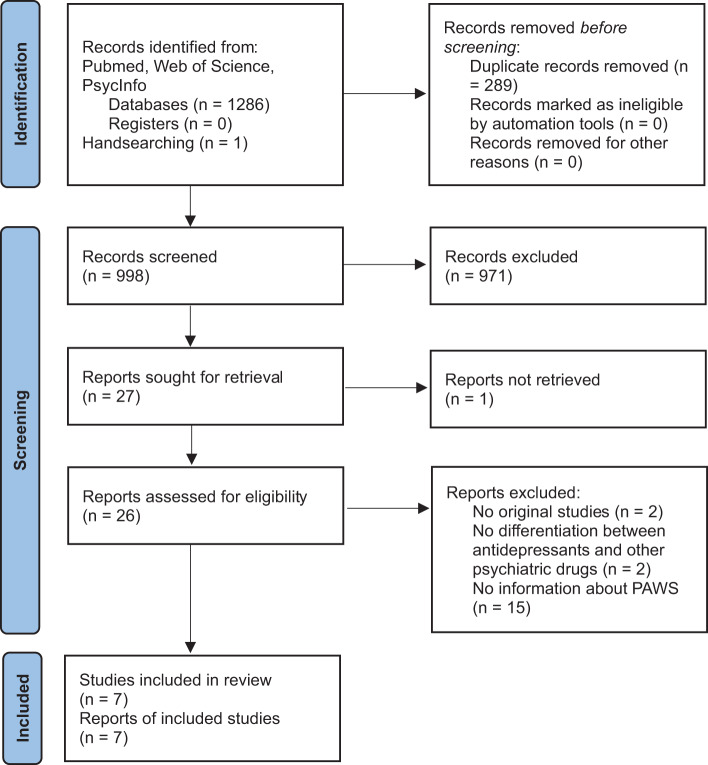
Aims: The literature on persistent antidepressant withdrawal symptoms is sparse. This systematic review is the first to examine the prevalence, duration, severity, risk/protective factors and treatment strategies for post-acute withdrawal syndrome (PAWS) following the discontinuation of antidepressant medications. Methods: We searched PubMed, Web of Science and PsycInfo, focusing on newer-generation antidepressants. The electronic database search was complemented with handsearching reference lists of pivotal studies. We included original studies in adults reporting on PAWS and providing data about epidemiology and clinical management of withdrawal symptoms persisting for at least 6 weeks. Results: The literature search yielded 1286 results, with 26 records assessed for eligibility, and seven studies fulfilled our selection criteria. Prevalence data were sparse, with one small cohort study reporting a 15% prevalence rate for PAWS in patients with panic disorder and agoraphobia. The duration of PAWS varied considerably across studies, ranging from 1.5 to 166 months. Long-term paroxetine use emerged as a potential risk factor for the development of PAWS. There was no reliable evidence to support the effectiveness of various treatment strategies, including the reinstatement of antidepressant medication, the use of benzodiazepines and the provision of cognitive-behavioral therapy. Conclusions: The current evidence on PAWS is sparse and predominantly of low certainty. The presence of withdrawal symptoms, lasting several months and possibly even years in some patients, underscores the need for further research with rigorous methodology. Large prospective cohort studies are needed to assess the epidemiology of PAWS, while randomized controlled trials are quired to test the efficacy of clinical interventions to treat PAWS. PROSPERO registration: CRD42023461793
Overview
CoChat Summary
TL;DR
This systematic review with meta-narrative synthesis found only seven studies on post-acute withdrawal syndrome (PAWS) after stopping newer-generation antidepressants, with sparse and low-certainty evidence. Persistent withdrawal symptoms appear to exist and can last months to years, but prevalence, risk factors, and effective treatments remain poorly established.
Key findings
- Only one included study reported prevalence: 3 of 20 patients (15%) with panic disorder and agoraphobia developed PAWS after slow tapering, all after long-term paroxetine use.
- Duration estimates varied widely, from about 1.5 months to 166 months; one online self-report analysis reported a mean duration of 2.5 years (range 0.1–6 years), and another reported 5–166 months (mean 37, median 26 months).
- In a large RCT of 478 primary care patients, those discontinuing antidepressants reported significantly more withdrawal symptoms than maintained patients at 12 weeks (3.1 vs. 1.3), 26 weeks (1.9 vs. 1.4), and 39 weeks (1.7 vs. 0.8).
- Treatment evidence was unreliable: reinstatement resolved self-reported PAWS in 9 of 19 persons (47%) who attempted it, while other drugs including benzodiazepines, pregabalin, or propranolol gave at least some benefit in only 6 of 33 persons (18%); no intervention was tested in a clinical trial.
Methods
- Systematic review pre-registered on PROSPERO (CRD42023461793), conducted per PRISMA and RAMSES, searching PubMed, Web of Science, and PsycInfo from inception to January 2024, plus handsearching and ClinicalTrials.gov.
- Included original adult studies reporting PAWS or persistent/protracted withdrawal symptoms lasting at least 6 weeks after discontinuation of SSRIs, SNRIs, or other newer-generation monoaminergic antidepressants.
- The search yielded 1286 results; after screening, 7 studies met criteria. Because meta-analysis was not possible, a meta-narrative synthesis was performed, with risk of bias rated using RoB-PrevMH.
Limitations
- The paper states that evidence is sparse and predominantly of low certainty, with most studies rated high risk of bias in at least two of three domains; three studies relied on online self-reports from peer-support groups, and one was a single case report.
- The paper states that the only prevalence estimate came from a small single-clinic cohort of 20 patients with panic disorder and agoraphobia, limiting generalizability, and that the large RCT could not provide prevalence rates because requests for additional data were declined.
- The paper states that no treatment strategy was tested in a clinical trial and observational studies had no control group; evident from the text, the included studies were highly heterogeneous in design, populations, and outcome assessment, preventing formal meta-analysis.
Model-written summary. Check it against the paper before relying on it.
Integrity signals
Registry
Cites
Statistics
Figures
Verification
Claims the paper makes
42 Valid · 1 Not valid · 18 Not checked · 33 Own results and interpretations
The sources with a verdict support this claim; the rest weren’t checked yet, have no full text we could read, or their verdicts aren’t rated yet.
In the paper
“Three studies (Belaise et al., 2012; Hengartner et al., 2020; Stockmann et al., 2018) were based on self-reported information posted online in peer-support groups on the Internet, such as SurvivingAntidepressants.org, by people self-identifying with an antidepressant withdrawal syndrome.”
§ Post-acute withdrawal syndrome (PAWS) after stopping antidepressants: a systematic review with meta-narrative synthesis > Discussion
What the sources say
- Not checked — no full text of the sourcecites Belaise et al., 2012 matched to “Patient Online Report of Selective Serotonin Reuptake Inhibitor-Induced Persistent Postwithdrawal Anxiety and Mood Disorders” (2012) source
- Not matchedcites Hengartner et al., 2020
More than one paper fits this citation.
- Supportedcites Stockmann et al., 2018 matched to “SSRI and SNRI withdrawal symptoms reported on an internet forum” (2018) source
The Method section says the study selected self-reported withdrawal accounts from posts on SurvivingAntidepressants.org, a site offering peer support for tapering and withdrawal. This confirms the description as it applies to Stockmann et al.; the other two studies are not being assessed here. (LLM, conf=0.94)
plain- Asserted: passes — The authors put it forward as true.
- Checkable: passes — It can be checked against evidence.
- Load-bearing: passes — The paper’s conclusions depend on it.
- Based: passes — The paper gives a reason why it holds.
Every source the paper cites for this claim was checked and supports it.
In the paper
“One analysis of online self-reports (Stockmann et al., 2018) further showed that the duration of tapering was positively correlated with the duration of withdrawal symptoms, suggesting that patients experiencing more persistent withdrawal symptoms try to taper more slowly.”
§ Post-acute withdrawal syndrome (PAWS) after stopping antidepressants: a systematic review with meta-narrative synthesis > Results > Risk and protective factors of PAWS
What the sources say
- Supportedcites Stockmann et al., 2018 matched to “SSRI and SNRI withdrawal symptoms reported on an internet forum” (2018) source
The reported analysis (passage [1], labeled Conclusion; page unavailable) states that symptom duration positively correlated with taper length (R²=0.258, p=0.038). The Discussion (passage [2]; page unavailable) also offers the same interpretation: people with protracted withdrawal symptoms may reduce their antidepressants more slowly. (LLM, conf=0.95)
plainstates an association- Asserted: passes — The authors put it forward as true.
- Checkable: passes — It can be checked against evidence.
- Load-bearing: unclear — It is unclear whether the paper’s conclusions depend on it.
- Based: passes — The paper gives a reason why it holds.
- Supported
Every source the paper cites for this claim was checked and supports it.
In the paper
“In this small prospective cohort study (Fava et al., 2007), it was found that 3 out of 20 participants (15%), all of whom had been prescribed the antidepressant paroxetine long-term, developed PAWS after slow drug tapering.”
§ Post-acute withdrawal syndrome (PAWS) after stopping antidepressants: a systematic review with meta-narrative synthesis > Results > Prevalence of PAWS
What the sources say
- Supportedcites Fava et al., 2007 matched to “Effects of gradual discontinuation of selective serotonin reuptake inhibitors in panic disorder with agoraphobia” (2007) source
The Methods (p. 2) say that all 20 patients underwent slow tapering. The Results (p. 3) report that discontinuation symptoms persisted beyond a month in three patients, all of whom had taken paroxetine; that is 3 of 20, or 15%. The paper does not use the term “PAWS,” but its description supports the claim of prolonged withdrawal symptoms. (LLM, conf=0.92)
plain- Asserted: passes — The authors put it forward as true.
- Checkable: passes — It can be checked against evidence.
- Load-bearing: passes — The paper’s conclusions depend on it.
- Based: passes — The paper gives a reason why it holds.
- Supported
Every source the paper cites for this claim was checked and supports it.
In the paper
“The syndromes met the DSM-IV criteria for cyclothymic disorder except for the required duration criterion.”
§ Post-acute withdrawal syndrome (PAWS) after stopping antidepressants: a systematic review with meta-narrative synthesis > Results > Severity of PAWS
What the sources say
- Supportedcites Fava et al., 2007 matched to “Effects of gradual discontinuation of selective serotonin reuptake inhibitors in panic disorder with agoraphobia” (2007) source
The Results (p. 3) explicitly state that three patients with persistent discontinuation syndromes met the DSM-IV criteria for cyclothymic disorder except for duration. The claim accurately reflects that finding. (LLM, conf=0.95)
plainn = 3- Asserted: passes — The authors put it forward as true.
- Checkable: passes — It can be checked against evidence.
- Load-bearing: unclear — It is unclear whether the paper’s conclusions depend on it.
- Based: passes — The paper gives a reason why it holds.
- Supported
Every source the paper cites for this claim was checked and supports it.
In the paper
“Fava et al. (2007) described three patients in whom low-dose clonazepam and/or reinstitution of the original antidepressant medication helped to ameliorate the withdrawal symptoms in two of three patients.”
§ Post-acute withdrawal syndrome (PAWS) after stopping antidepressants: a systematic review with meta-narrative synthesis > Results > Treatment strategies to mitigate PAWS
What the sources say
- Supportedcites Fava et al., 2007 matched to “Effects of gradual discontinuation of selective serotonin reuptake inhibitors in panic disorder with agoraphobia” (2007) source
The Results (p. 3) describe three patients with persistent discontinuation symptoms. Clonazepam considerably improved the first patient, and restarting paroxetine resolved the second patient’s symptoms; the third patient’s symptoms persisted. The Discussion (p. 3) likewise identifies clonazepam and paroxetine reinstitution as effective in one case each. (LLM, conf=0.94)
plainstates a causen = 3- Asserted: passes — The authors put it forward as true.
- Checkable: passes — It can be checked against evidence.
- Load-bearing: unclear — It is unclear whether the paper’s conclusions depend on it.
- Based: passes — The paper gives a reason why it holds.
- Supported
44 more claims · 19 with their cited sources checked
Create a free account to see all 94 claims and to verify the 6 references still open.
- It may state two separate claims as one. 27
- Probably not a substantial claim. 21
Self-check
Percentages, sums and reported differences re-computed from the paper’s own numbers.
Each contradiction between two passages listed here was confirmed by an independent check.
Rated minor: it would not touch a result — a value no result rests on, a p-value that stays on the same side of the significance level, or a conflict that is clerical, resolved elsewhere in the paper, or outside its own findings.
In the paper
§ Post-acute withdrawal syndrome (PAWS) after stopping antidepressants: a systematic review with meta-narrative synthesis > Results > Onset and duration of PAWS
“remission of PAWS was achieved between 3 and 5 months after the patients began treatment with cognitive-behavioural therapy (CBT).”
§ Post-acute withdrawal syndrome (PAWS) after stopping antidepressants: a systematic review with meta-narrative synthesis > Results > Treatment strategies to mitigate PAWS
“one patient achieved remission after 6 months of CBT”
Citations
Cites
Preferred Reporting Items for Systematic Reviews and Meta-Analyses: The PRISMA Statement
Moher, D., Liberati, A., Tetzlaff, J., Altman, D. G., & The PRISMA Group (2009) · PLoS Medicine · doi:10.1371/journal.pmed.1000097 · Cited by 64,042 · cited 1×
“The protocol for this systematic review was pre-registered on PROSPERO (CRD42023461793) and the work was conducted according to PRISMA (Preferred Reporting Items for Systematic reviews and Meta-Analyses) guidelines (Moher et al. , 2009).”
RAMESES publication standards: meta-narrative reviews
Wong, G., Greenhalgh, T., Westhorp, G., Buckingham, J., & Pawson, R. (2013) · BMC Medicine · doi:10.1186/1741-7015-11-20 · Cited by 610
Selective serotonin reuptake inhibitor discontinuation syndrome: a randomized clinical trial
Rosenbaum, J. F., Fava, M., Hoog, S. L., Ascroft, R. C., & Krebs, W. B. (1998) · Biological Psychiatry · doi:10.1016/s0006-3223(98)00126-7 · Cited by 574 · cited 1×
“…case reports (e.g. Bloch et al. , 1995; Kostic et al. , 2024; Kramer et al. , 1961) and were later confirmed in placebo-controlled treatment-interruption trials (e.g. Michelson et al. , 2000; Rosenbaum et al. , 1998), and systematic reviews (e.g. Davies and Read, 2019; Fava et al. , 2015, 2018).”
Fava, G. A., Gatti, A., Belaise, C., Guidi, J., & Offidani, E. (2015) · Psychotherapy and Psychosomatics · doi:10.1159/000370338 · Cited by 436 · cited 4×
“In addition, the reference lists and citations of initially identified articles, including relevant systematic reviews and pivotal studies (e.g., Fava et al. , 2015, 2018), were manually searched to identify further original studies not captured by the electronic literature search.”
InfluentialInfluences on antidepressant prescribing trends in the UK: 1995–2011
Mars, B., Heron, J., Kessler, D., Davies, N. M., Martin, R. M., Thomas, K. H., & Gunnell, D. (2017) · Social Psychiatry and Psychiatric Epidemiology · doi:10.1007/s00127-016-1306-4 · Cited by 419 · cited 1×
“Growing long-term use, often over several years, is a significant reason for the world-wide increase in the consumption of antidepressant medications over the last 2–3 decades (Aarts et al. , 2014; Amrein et al. , 2023; Mars et al. , 2017).”
Davies, J., & Read, J. (2019) · Addictive Behaviors · doi:10.1016/j.addbeh.2018.08.027 · Cited by 387 · cited 4×
“Thusfar,wecanextrapolatefromourreviewthatantidepres-santwithdrawalsymptomsmaylastformanymonthsandeven yearsinsomepatients,aspreviouslynotedintheliterature(Davies andRead,2019;Fava et al. , 2015; Hengartner et al. , 2019).”
InfluentialRAMESES publication standards: meta‐narrative reviews
Wong, G., Greenhalgh, T., Westhorp, G., Buckingham, J., & Pawson, R. (2013) · Journal of Advanced Nursing · doi:10.1111/jan.12092 · Cited by 324
Acute and Persistent Withdrawal Syndromes Following Discontinuation of Psychotropic Medications
Cosci, F., & Chouinard, G. (2020) · Psychotherapy and Psychosomatics · doi:10.1159/000506868 · Cited by 265 · cited 5×
“The prolonged use of antidepressant medications, similar to other psychotropic substances, can lead to sustained neurophysiological adaptations (Ashton, 1991; Cosci and Chouinard, 2020; Fava and Cosci, 2019; Horowitz et al. , 2023; Lerner and Klein, 2019).”
InfluentialCan long-term treatment with antidepressant drugs worsen the course of depression?
Fava, G. A. (2003) · The Journal of Clinical Psychiatry · doi:10.4088/jcp.v64n0204 · Cited by 223 · cited 2×
“Toadvanceour knowledge of the epidemiology and clinical management of PAWS, we call for further exploration and validation through rigorous cohort studies and RCTs.”
Fava, G. A., Benasi, G., Lucente, M., Offidani, E., Cosci, F., & Guidi, J. (2018) · Psychotherapy and Psychosomatics · doi:10.1159/000491524 · Cited by 209 · cited 2×
“In addition, the reference lists and citations of initially identified articles, including relevant systematic reviews and pivotal studies (e.g., Fava et al. , 2015, 2018), were manually searched to identify further original studies not captured by the electronic literature search.”
Maintenance or Discontinuation of Antidepressants in Primary Care
Lewis, G., Marston, L., Duffy, L., Freemantle, N., Gilbody, S., Hunter, R., Kendrick, T., Kessler, D., Mangin, D., King, M., et al. (2021) · New England Journal of Medicine · doi:10.1056/nejmoa2106356 · Cited by 192
Michelson, D., Fava, M., Amsterdam, J., Apter, J., Londborg, P., Tamura, R., & Tepner, R. G. (2000) · British Journal of Psychiatry · doi:10.1192/bjp.176.4.363 · Cited by 181 · cited 1×
“…case reports (e.g. Bloch et al. , 1995; Kostic et al. , 2024; Kramer et al. , 1961) and were later confirmed in placebo-controlled treatment-interruption trials (e.g. Michelson et al. , 2000; Rosenbaum et al. , 1998), and systematic reviews (e.g. Davies and Read, 2019; Fava et al. , 2015, 2018).”
Protracted withdrawal syndromes from benzodiazepines
Ashton, H. (1991) · Journal of Substance Abuse Treatment · doi:10.1016/0740-5472(91)90023-4 · Cited by 170 · cited 1×
“The prolonged use of antidepressant medications, similar to other psychotropic substances, can lead to sustained neurophysiological adaptations (Ashton, 1991; Cosci and Chouinard, 2020; Fava and Cosci, 2019; Horowitz et al. , 2023; Lerner and Klein, 2019).”
New Classification of Selective Serotonin Reuptake Inhibitor Withdrawal
Chouinard, G., & Chouinard, V.-A. (2015) · Psychotherapy and Psychosomatics · doi:10.1159/000371865 · Cited by 164 · cited 4×
“PAWS includes new symptoms as well as original symptoms but with increased intensity, appearing days or weeks, sometimes even months, after treatment discontinuation and lasting from over a month to years (Chouinard and Chouinard, 2015; Hengartner et al. , 2020; Lerner and Klein, 2019).”
InfluentialThe mechanisms of tolerance in antidepressant action
Fava, G. A., & Offidani, E. (2011) · Progress in Neuro-Psychopharmacology and Biological Psychiatry · doi:10.1016/j.pnpbp.2010.07.026 · Cited by 158 · cited 1×
“…model of tolerance by Giovanni Fava, which denotes PAWS as a consequence of the brain’s neurophysiological adaptation to prolonged antidepressant use, resulting in processes that oppose the acute treatment effects when users discontinue their medication (Fava, 2003, 2020; Fava and Offidani, 2011).”
WITHDRAWAL SYMPTOMS FOLLOWING DISCONTINUATION OF IMIPRAMINE THERAPY
KRAMER, J. C., KLEIN, D. F., & FINK, M. (1961) · American Journal of Psychiatry · doi:10.1176/ajp.118.6.549 · Cited by 113 · cited 1×
“Acute withdrawal syndromes have been reported over decades in various case reports (e.g. Bloch et al. , 1995; Kostic et al. , 2024; Kramer et al. , 1961) and were later confirmed in placebo-controlled treatment-interruption trials (e.g. Michelson et al. , 2000; Rosenbaum et al. , 1998), and…”
Recognising and managing antidepressant discontinuation symptoms
Haddad, P. M., & Anderson, I. M. (2007) · Advances in Psychiatric Treatment · doi:10.1192/apt.bp.105.001966 · Cited by 109 · cited 2×
“Withdrawal symptoms can be classified into sensory symptoms, disequilibrium, general somatic symptoms, sleep disturbances, gastrointestinal symptoms and affective symptoms (Haddad and Anderson, 2007).”
Lerner, A., & Klein, M. (2019) · Brain Communications · doi:10.1093/braincomms/fcz025 · Cited by 89 · cited 7×
“PAWS includes new symptoms as well as original symptoms but with increased intensity, appearing days or weeks, sometimes even months, after treatment discontinuation and lasting from over a month to years (Chouinard and Chouinard, 2015; Hengartner et al. , 2020; Lerner and Klein, 2019).”
InfluentialFava, G. A. (2020) · Therapeutic Advances in Psychopharmacology · doi:10.1177/2045125320970325 · Cited by 84 · cited 1×
“…model of tolerance by Giovanni Fava, which denotes PAWS as a consequence of the brain’s neurophysiological adaptation to prolonged antidepressant use, resulting in processes that oppose the acute treatment effects when users discontinue their medication (Fava, 2003, 2020; Fava and Offidani, 2011).”
Fava, G. A., Bernardi, M., Tomba, E., & Rafanelli, C. (2007) · The International Journal of Neuropsychopharmacology · doi:10.1017/s1461145706007462 · Cited by 80
Discontinuing Antidepressant Drugs: Lesson from a Failed Trial and Extensive Clinical Experience
Fava, G. A., & Belaise, C. (2018) · Psychotherapy and Psychosomatics · doi:10.1159/000492693 · Cited by 77 · cited 2×
“Our review’s main finding thus reflects the poor recognition and insufficient consideration of PAWS in both clinical research and practice (Cosci et al. , 2024; Fava and Belaise, 2018;HorowitzandDavies,2025;Read etal.”
Guy, A., Brown, M., Lewis, S., & Horowitz, M. (2020) · Therapeutic Advances in Psychopharmacology · doi:10.1177/2045125320967183 · Cited by 77 · cited 1×
“…misdiagnosed as a relapse of the primary mental health condition (typically depression) or new emergent mental disorders (Cosci et al. , 2024; Guy et al. , 2020; Hengartner and Plöderl, 2021), the latter being specifically embedded in the concept of persistent post-withdrawal disorders…”
Estimating Risk of Antidepressant Withdrawal from a Review of Published Data
Horowitz, M. A., Framer, A., Hengartner, M. P., Sørensen, A., & Taylor, D. (2023) · CNS Drugs · doi:10.1007/s40263-022-00960-y · Cited by 76
Self-citationHengartner, M. P., Schulthess, L., Sorensen, A., & Framer, A. (2020) · Therapeutic Advances in Psychopharmacology · doi:10.1177/2045125320980573 · Cited by 74 · cited 6×
“These issues highlight the need for more awareness and better recognition of the various manifestations of PAWS to ensure adequate patient care (Cosci et al. , 2024; Framer, 2021; Hengartner et al. , 2020; Horowitz and Davies, 2025; Read et al. , 2023).”
InfluentialSelf-citationWhen Discontinuing SSRI Antidepressants Is a Challenge: Management Tips
Jha, M. K., Rush, A. J., & Trivedi, M. H. (2018) · American Journal of Psychiatry · doi:10.1176/appi.ajp.2018.18060692 · Cited by 73 · cited 1×
“The most common symptoms include dizziness, vertigo, tremor, nausea, insomnia, fatigue, mood dysregulation, anxiety, panic, irritability and agitation (Fava et al. , 2015; Haddad and Anderson, 2007; Jha et al. , 2018).”
Framer, A. (2021) · Therapeutic Advances in Psychopharmacology · doi:10.1177/2045125321991274 · Cited by 73 · cited 2×
“…but since reinstatement of the drug quite often does not resolve the syndrome, it has been proposed that it could be caused by neural damage akin to tardive dyskinesia, irreversible pharmacodynamic processes and endocrine disruption (Fava and Cosci, 2019; Framer, 2021; Horowitz et al. , 2023).”
Understanding and Managing Withdrawal Syndromes After Discontinuation of Antidepressant Drugs
Fava, G. A., & Cosci, F. (2019) · The Journal of Clinical Psychiatry · doi:10.4088/jcp.19com12794 · Cited by 69 · cited 5×
“The prolonged use of antidepressant medications, similar to other psychotropic substances, can lead to sustained neurophysiological adaptations (Ashton, 1991; Cosci and Chouinard, 2020; Fava and Cosci, 2019; Horowitz et al. , 2023; Lerner and Klein, 2019).”
InfluentialSSRI and SNRI withdrawal symptoms reported on an internet forum
Stockmann, T., Odegbaro, D., Timimi, S., & Moncrieff, J. (2018) · International Journal of Risk & Safety in Medicine · doi:10.3233/jrs-180018 · Cited by 54 · cited 6×
“…self-reports, duration of PAWS ranged from 5 to 166 months, with a mean of 37 and a median of 26 months according to one study (Hengartner et al. , 2020), and with an average duration of withdrawal symptoms of 90.5 weeks for SSRI and 50.8 weeks for SNRI in the other study (Stockmann et al. , 2018).”
InfluentialAntidepressant withdrawal – the tide is finally turning
Hengartner, M. P., Davies, J., & Read, J. (2020) · Epidemiology and Psychiatric Sciences · doi:10.1017/s2045796019000465 · Cited by 48 · cited 2×
“Thusfar,wecanextrapolatefromourreviewthatantidepres-santwithdrawalsymptomsmaylastformanymonthsandeven yearsinsomepatients,aspreviouslynotedintheliterature(Davies andRead,2019;Fava et al. , 2015; Hengartner et al. , 2019).”
Self-citationSevere psychiatric symptoms associated with paroxetine withdrawal
Bloch, M., Stager, S., Braun, A., & Rubinow, D. (1995) · The Lancet · doi:10.1016/s0140-6736(95)92691-7 · Cited by 45 · cited 2×
“Acute withdrawal syndromes have been reported over decades in various case reports (e.g. Bloch et al. , 1995; Kostic et al. , 2024; Kramer et al. , 1961) and were later confirmed in placebo-controlled treatment-interruption trials (e.g. Michelson et al. , 2000; Rosenbaum et al. , 1998), and…”
Belaise, C., Gatti, A., Chouinard, V.-A., & Chouinard, G. (2012) · Psychotherapy and Psychosomatics · doi:10.1159/000341178 · Cited by 45 · cited 5×
“Belaise et al. (2012) noted that PAWS may last several months when the antidepressant drug is not restarted.”
InfluentialBelaise, C., Gatti, A., Chouinard, V.-A., & Chouinard, G. (2014) · Psychotherapy and Psychosomatics · doi:10.1159/000362317 · Cited by 44 · cited 3×
“A case series of three patients who discontinued paroxetine (Belaise et al. , 2014) reported that remission of PAWS was achieved between 3 and 5 months after the patients began treatment with cognitive-behavioural therapy (CBT).”
Clinical guidelines on antidepressant withdrawal urgently need updating
Davies, J., Read, J., Hengartner, M. P., Cosci, F., Fava, G., Chouinard, G., van Os, J., Nardi, A., Gøtzsche, P., Groot, P., et al. (2019) · BMJ · doi:10.1136/bmj.l2238 · Cited by 44
Self-citationNICE updates antidepressant guidelines to reflect severity and length of withdrawal symptoms
Iacobucci, G. (2019) · BMJ · doi:10.1136/bmj.l6103 · Cited by 42 · cited 1×
“…evidence for these more persistent post-acute withdrawal syndromes led for instance NICE to update their antidepressant treatment guideline (Iacobucci, 2019), and the Royal College of Psychiatrists issued a position statement on discontinuing antide-pressants (Royal College of…”
(2006) · PubMed · Cited by 33
Selective serotonin reuptake inhibitor ‘discontinuation syndrome’ or withdrawal
Massabki, I., & Abi-Jaoude, E. (2021) · The British Journal of Psychiatry · doi:10.1192/bjp.2019.269 · Cited by 33
Aarts, N., Noordam, R., Hofman, A., Tiemeier, H., Stricker, B. H., & Visser, L. E. (2014) · European Psychiatry · doi:10.1016/j.eurpsy.2014.02.001 · Cited by 31 · cited 1×
“Growing long-term use, often over several years, is a significant reason for the world-wide increase in the consumption of antidepressant medications over the last 2–3 decades (Aarts et al. , 2014; Amrein et al. , 2023; Mars et al. , 2017).”
Read, J., Moncrieff, J., & Horowitz, M. A. (2023) · Journal of Psychiatric Research · doi:10.1016/j.jpsychires.2023.03.013 · Cited by 30 · cited 1×
“These issues highlight the need for more awareness and better recognition of the various manifestations of PAWS to ensure adequate patient care (Cosci et al. , 2024; Framer, 2021; Hengartner et al. , 2020; Horowitz and Davies, 2025; Read et al. , 2023).”
Tonia, T., Buitrago-Garcia, D., Peter, N. L., Mesa-Vieira, C., Li, T., Furukawa, T. A., Cipriani, A., Leucht, S., Low, N., & Salanti, G. (2023) · BMJ Mental Health · doi:10.1136/bmjment-2023-300694 · Cited by 26 · cited 1×
“Risk of bias was rated according to the Risk of Bias in studies estimating the Prevalence of Mental Health disorders (RoB-PrevMH) by Tonia et al. (2023).”
Hengartner, M. P., & Plöderl, M. (2021) · Therapeutic Advances in Psychopharmacology · doi:10.1177/20451253211032051 · Cited by 23 · cited 1×
“…as a relapse of the primary mental health condition (typically depression) or new emergent mental disorders (Cosci et al. , 2024; Guy et al. , 2020; Hengartner and Plöderl, 2021), the latter being specifically embedded in the concept of persistent post-withdrawal disorders (Chouinard and…”
Self-citationAmrein, M. A., Hengartner, M. P., Näpflin, M., Farcher, R., & Huber, C. A. (2023) · European Journal of Clinical Pharmacology · doi:10.1007/s00228-023-03559-4 · Cited by 23 · cited 1×
“Growing long-term use, often over several years, is a significant reason for the world-wide increase in the consumption of antidepressant medications over the last 2–3 decades (Aarts et al. , 2014; Amrein et al. , 2023; Mars et al. , 2017).”
Self-citationMoncrieff, J., Read, J., & Horowitz, M. A. (2024) · Journal of Affective Disorders Reports · doi:10.1016/j.jadr.2024.100765 · Cited by 20 · cited 2×
“According to this particular study (Moncrieff et al., 2024), altogether 50% of help-seeking people reported withdrawal symptoms lasting more than a year, 32% more than 2 years, and 11% morethan5years.”
Addiction and physical dependence are not the same thing
Horowitz, M. A., & Taylor, D. (2023) · The Lancet Psychiatry · doi:10.1016/s2215-0366(23)00230-4 · Cited by 16
Boland, M., Higgins, A., Beecher, C., Bracken, P., Burn, W., Cody, A., Framer, A., Gronlund, T., Horowitz, M., Huff, C., et al. (2024) · BMJ Open · doi:10.1136/bmjopen-2024-088266 · Cited by 14 · cited 2×
“This accords with calls made in a recent study, according to which these clinical topics are the most important to key stakeholders such as antidepressant users and healthcare professionals (Boland et al. , 2024).”
Tint, A., Haddad, P. M., & Anderson, I. M. (2008) · Journal of Psychopharmacology · doi:10.1177/0269881107087488 · Cited by 13 · cited 1×
“Serious symptoms may also include suicidal ideation and behaviour (Bloch et al. , 1995; Kostic et al. , 2024; Tint et al. , 2008).”
Cosci, F., Chouinard, V.-A., & Chouinard, G. (2024) · Psychotherapy and Psychosomatics · doi:10.1159/000540031 · Cited by 11
Hidden Costs: The Clinical and Research Pitfalls of Mistaking Antidepressant Withdrawal for Relapse
Horowitz, M. A., & Davies, J. (2024) · Psychotherapy and Psychosomatics · doi:10.1159/000542437 · Cited by 7
Kostic, M., Plöder, M., Hengartner, M., & Buzejic, J. (2024) · The Journal of Clinical Psychiatry · doi:10.4088/jcp.23cr14930 · Cited by 1
Self-citation
Cited by
Hyperbolic tapering of antidepressants: where are we now?
Horowitz, M. A., & Wilcock, M. (2025) · Drug and Therapeutics Bulletin · doi:10.1136/dtb.2024.000065 · Cited by 1
“19 In light of these serious consequences, means to minimise harm from stopping antidepressants are necessary.”
Antidepressant Use and Withdrawal
Cohen, D., Strassle, C. L., & Badre, N. (2025) · Psychiatric Clinics of North America · doi:10.1016/j.psc.2025.10.002 · Cited by 3
Shao, X., Huangfu, M., Wang, N., Zhang, Q., Zhao, M., Xie, W., Zhang, C., & Ma, T. (2026) · Frontiers in Pharmacology · doi:10.3389/fphar.2026.1735895 · Cited by 1
“However, these antidepressants have a limited mode of action, are prone to numerous adverse reactions, are expensive, require long treatment cycles, and have a high relapse rate after discontinuation (Zhang et al., 2024; Henssler et al., 2024; Rennwald and Hengartner, 2025).”
New insights into antidepressant withdrawal symptoms
Greener, M. (2025) · Journal of Prescribing Practice · doi:10.12968/jprp.2025.0127
Themann, A., Calvo, D. E., Frausto, C. A., Rodriguez, M., & Iñiguez, S. D. (2026) · Psychiatry Research · doi:10.1016/j.psychres.2026.117038 · Cited by 2
Metadata
- Authors
- Rennwald, A., & Hengartner, M. P.
- Affiliations
- ZHAW Zurich University of Applied Sciences (CH)
- Kalaidos University of Applied Sciences (CH)
- Corresponding author
- Rennwald, Andri
- Venue
- Epidemiology and Psychiatric Sciences
- Publisher
- Cambridge University Press (CUP)
- Published
- 2025
- Volume
- 34
- Pages
- e29-e29
- ISSN
- 2045-7960 (ISSN-L)
- 2045-7979
- PMC
- PMC12090023
- OpenAlex
- W4410321753
- Cited by
- 8
- References
- 54
- Citations by year
- 2026: 5 · 2025: 3
- FWCI
- 1.07
- Type
- journal article
- Language
- en
- Open access
- gold
- doi.org
- Locations
- Epidemiology and Psychiatric Sciences (publishedVersion, cc-by)
- PubMed Central (publishedVersion, cc-by)
- PubMed (publishedVersion)
- DOAJ (DOAJ: Directory of Open Access Journals) (submittedVersion, cc-by-sa)
- Funders
- Parrotia-Stiftung
- Topics
- Health Sciences › Medicine › Pharmacology (medical) › Treatment of Major Depression
- Health Sciences › Medicine › Psychiatry and Mental health › Electroconvulsive Therapy Studies
- Health Sciences › Medicine › Psychiatry and Mental health › Bipolar Disorder and Treatment
- Keywords
- antidepressant discontinuation, paroxetine, panic disorder, agoraphobia, benzodiazepines, cognitive behavioral therapy, risk factors, prevalence
- MeSH terms
- Antidepressive Agents, Humans, Risk Factors, Substance Withdrawal Syndrome, Prevalence
About these checks
Registry, retraction, Cites and statistics results are computed, not judged, with one exception: a printed reference that no index lists is read once by a model before it counts as a citation error. Claims are extracted by a model and kept only when their quote appears verbatim in the text; each cited source is then checked, with a model’s help, for whether it says what the claim relies on. Those verdicts can be wrong — read the claim’s quote and the cited source before relying on one.
The claim verdicts this report counts are experimental: their accuracy is not yet measured.
A language model drew the claims from the paper on 2026-10-10, under version 3 of the claim definition (model deepseek-v4.1-flash, prompt extract-v3).
A second model labelled each claim on 2026-10-10 (model jev-1.13-20260917, definition revision gold-guideline-v0.2).
Cited sources are checked with a language model’s help (gpt-6-sol).
Statistics and arithmetic are recomputed, not judged.
Confidence bands are shown only for fields calibrated on our annotated test set. None is calibrated yet, so no band is shown.
What counts as a claim ›How we measure confidence ›How we check this ›
Are you an author, or do you see a problem with this page? Request a review
Data sources
Bibliographic data: Semantic Scholar, OpenAlex, Crossref.
Contains information from the Semantic Scholar Academic Graph Datasets, made available under the ODC Attribution License (ODC-BY 1.0).
Semantic Scholar’s data is described in: Kinney, R., et al. (2023). The Semantic Scholar Open Data Platform. arXiv:2301.10140.
