

The DOI matches its Crossref record; 82 of the 82 references it cites were found in a registry or an index.
Insights into the Catalytic Activity of a Metagenome-Derived Urethanase
Open accessPublished version of a preprint
Abstract
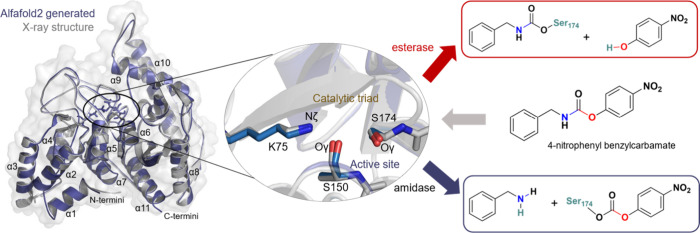
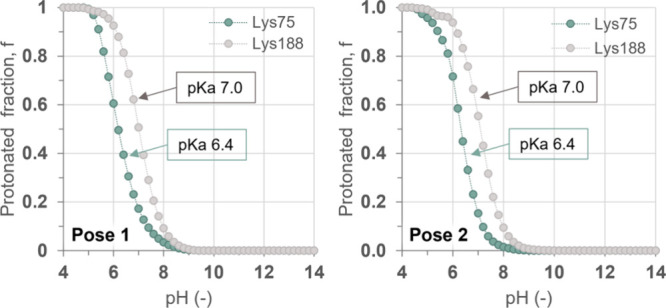
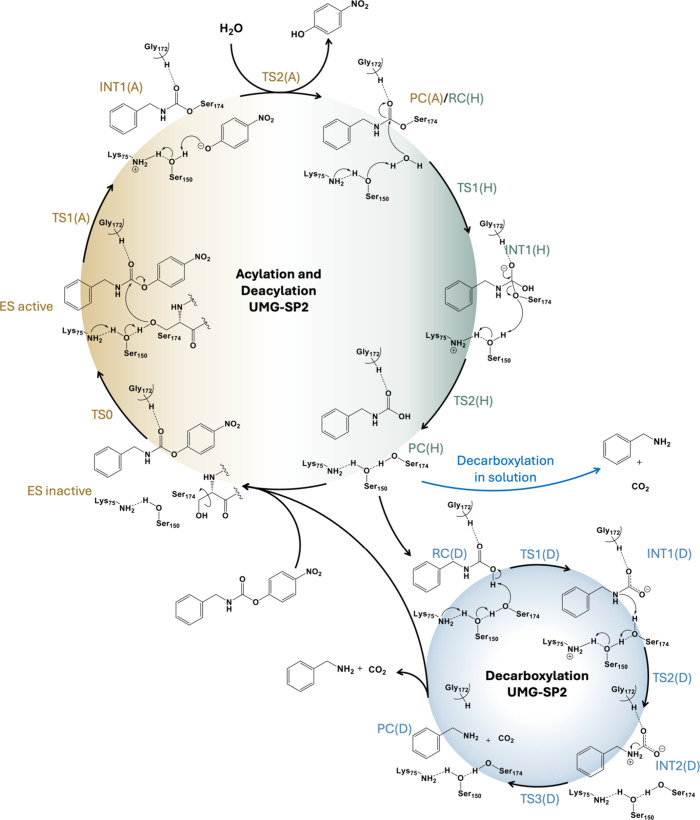
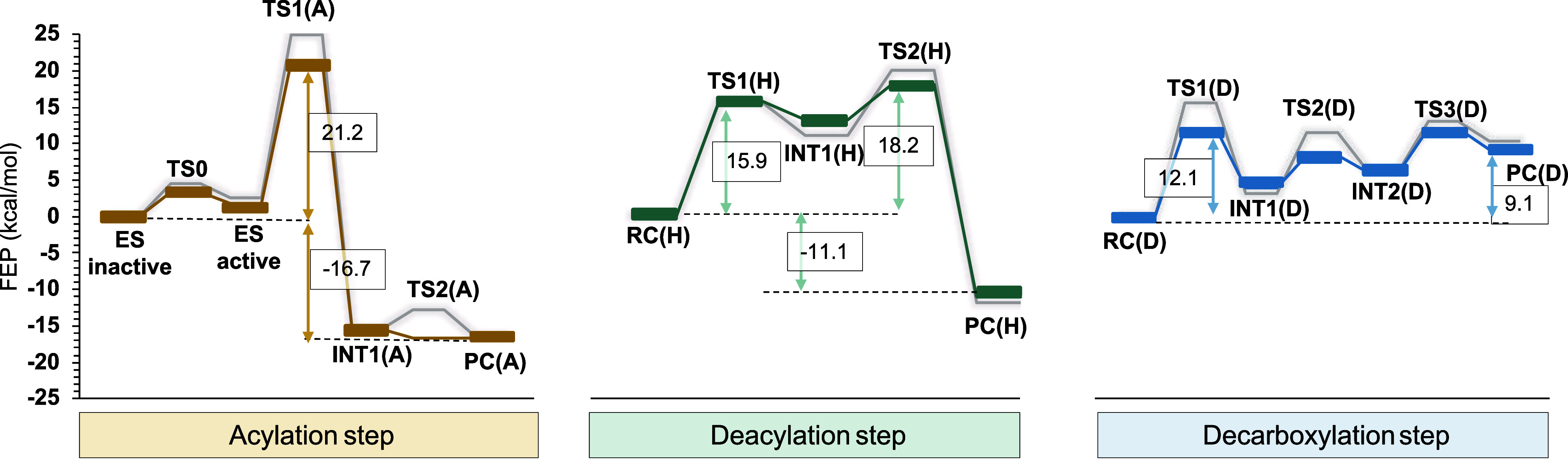
High Resolution Image Download MS PowerPoint Slide The discovery of urethanases shows an opportunity to access the biotechnological recycling of polyurethane-based plastics (PURs), widely used in the manufacture of everyday materials. However, the mechanistic understanding of these enzymes remains under debate. In this work, we report a QM/MM-based mechanistic study of the metagenome-derived urethanase UMG-SP2 catalyzing the degradation of a urethane-like model compound, 4-nitrophenyl benzylcarbamate (pNC). A high-quality structural model generated with AlphaFold2, prior to the availability of the crystal structure, accurately captured the Ser-Ser-Lys catalytic triad characteristic of amidase signature enzymes. Highly accurate constant-pH nonequilibrium molecular dynamics and Monte Carlo (neMD/MC) simulations provided the full titration curve of active site Lys, explaining the need for alkaline media for the enzyme to be active. The generation of the free energy landscape, obtained by means of free energy perturbation methods with the M06-2X DFT functional describing the QM region of the full system, reveals an esterase-like three-step mechanism of UMG-SP2, i.e., acylation, hydrolysis, and decarboxylation, with all steps being kinetically feasible. Our computational results show very good agreement with experimental kinetic data, with a calculated free energy barrier of 21.2 kcal·mol –1 for the rate-determining step compared to 22.9 kcal·mol –1 derived from the experimentally measured turnover frequency (TOF). The present results also open the door for the final decarboxylation occurring in the solution after the release of the product of the hydrolysis step or within the active site. These findings provide an atomistic insight into the urethanase function and establish a robust framework for the future design of biocatalysts targeting polyurethane degradation.
Overview
The claims and statistics of this paper haven’t been checked yet.
Run the check — free, no account needed. It reads the open-access text and checks the sources it cites.
Integrity signals
Registry
Cites
Statistics
Figures
Verification
Claims the paper makes
The claims and statistics of this paper haven’t been checked yet.
Run the check — free, no account needed. It reads the open-access text and checks the sources it cites.
Self-check
Percentages, sums and reported differences re-computed from the paper’s own numbers.
The self-check needs the paper’s full text.
Citations
Cites
Highly accurate protein structure prediction with AlphaFold
Jumper, J., Evans, R., Pritzel, A., Green, T., Figurnov, M., Ronneberger, O., Tunyasuvunakool, K., Bates, R., Žídek, A., Potapenko, A., et al. (2021) · Nature · doi:10.1038/s41586-021-03819-2 · Cited by 43,764
Comparison of simple potential functions for simulating liquid water
Jorgensen, W. L., Chandrasekhar, J., Madura, J. D., Impey, R. W., & Klein, M. L. (1983) · The Journal of Chemical Physics · doi:10.1063/1.445869 · Cited by 41,298
Ryckaert, J.-P., Ciccotti, G., & Berendsen, H. J. C. (1977) · Journal of Computational Physics · doi:10.1016/0021-9991(77)90098-5 · Cited by 21,239
Development and testing of a general amber force field
Wang, J., Wolf, R. M., Caldwell, J. W., Kollman, P. A., & Case, D. A. (2004) · Journal of Computational Chemistry · doi:10.1002/jcc.20035 · Cited by 19,506
Production, use, and fate of all plastics ever made
Geyer, R., Jambeck, J. R., & Law, K. L. (2017) · Science Advances · doi:10.1126/sciadv.1700782 · Cited by 18,606
Scalable molecular dynamics with NAMD
Phillips, J. C., Braun, R., Wang, W., Gumbart, J., Tajkhorshid, E., Villa, E., Chipot, C., Skeel, R. D., Kalé, L., & Schulten, K. (2005) · Journal of Computational Chemistry · doi:10.1002/jcc.20289 · Cited by 16,914
Dewar, M. J., Zoebisch, E., Healy, E. F., & Stewart, J. (1985) · Journal of the American Chemical Society · doi:10.1021/ja00299a024 · Cited by 11,560
PTRAJ and CPPTRAJ: Software for Processing and Analysis of Molecular Dynamics Trajectory Data
Roe, D. R., & Cheatham, T. E. (2013) · Journal of Chemical Theory and Computation · doi:10.1021/ct400341p · Cited by 7,515
The path of chemical reactions - the IRC approach
Fukui, K. (1981) · Accounts of Chemical Research · doi:10.1021/ar00072a001 · Cited by 6,709
Automatic atom type and bond type perception in molecular mechanical calculations
Wang, J., Wang, W., Kollman, P. A., & Case, D. A. (2006) · Journal of Molecular Graphics and Modelling · doi:10.1016/j.jmgm.2005.12.005 · Cited by 5,517
PROPKA3: Consistent Treatment of Internal and Surface Residues in Empirical p K a Predictions
Olsson, M. H. M., Søndergaard, C. R., Rostkowski, M., & Jensen, J. H. (2011) · Journal of Chemical Theory and Computation · doi:10.1021/ct100578z · Cited by 4,425
Duan, Y., Wu, C., Chowdhury, S., Lee, M. C., Xiong, G., Zhang, W., Yang, R., Cieplak, P., Luo, R., Lee, T.-S., et al. (2003) · Journal of Computational Chemistry · doi:10.1002/jcc.10349 · Cited by 4,271
Formulation of the reaction coordinate
Fukui, K. (1970) · The Journal of Physical Chemistry · doi:10.1021/j100717a029 · Cited by 3,567
Jakalian, A., Jack, D. B., & Bayly, C. I. (2002) · Journal of Computational Chemistry · doi:10.1002/jcc.10128 · Cited by 3,426
A bacterium that degrades and assimilates poly(ethylene terephthalate)
Yoshida, S., Hiraga, K., Takehana, T., Taniguchi, I., Yamaji, H., Maeda, Y., Toyohara, K., Miyamoto, K., Kimura, Y., & Oda, K. (2016) · Science · doi:10.1126/science.aad6359 · Cited by 3,367
Applications and societal benefits of plastics
Andrady, A. L., & Neal, M. A. (2009) · Philosophical Transactions of the Royal Society B: Biological Sciences · doi:10.1098/rstb.2008.0304 · Cited by 2,464
An engineered PET depolymerase to break down and recycle plastic bottles
Tournier, V., Topham, C. M., Gilles, A., David, B., Folgoas, C., Moya-Leclair, E., Kamionka, E., Desrousseaux, M.-L., Texier, H., Gavalda, S., et al. (2020) · Nature · doi:10.1038/s41586-020-2149-4 · Cited by 2,176
Ollis, D. L., Cheah, E., Cygler, M., Dijkstra, B., Frolow, F., Franken, S. M., Harel, M., Remington, S. J., Silman, I., Schrag, J., et al. (1992) · "Protein Engineering, Design and Selection" · doi:10.1093/protein/5.3.197 · Cited by 2,120
Søndergaard, C. R., Olsson, M. H. M., Rostkowski, M., & Jensen, J. H. (2011) · Journal of Chemical Theory and Computation · doi:10.1021/ct200133y · Cited by 1,966
Beyond Mechanical Recycling: Giving New Life to Plastic Waste
Vollmer, I., Jenks, M. J. F., Roelands, M. C. P., White, R. J., van Harmelen, T., de Wild, P., van der Laan, G. P., Meirer, F., Keurentjes, J. T. F., & Weckhuysen, B. M. (2020) · Angewandte Chemie International Edition · doi:10.1002/anie.201915651 · Cited by 1,905
Polyurethane types, synthesis and applications – a review
Akindoyo, J. O., Beg, M. D. H., Ghazali, S. B., Islam, M. R., Jeyaratnam, N., & Yuvaraj, A. R. (2016) · RSC Advances · doi:10.1039/c6ra14525f · Cited by 1,843
Hub, J. S., de Groot, B. L., & van der Spoel, D. (2010) · Journal of Chemical Theory and Computation · doi:10.1021/ct100494z · Cited by 1,683
Zhao, Y., & Truhlar, D. G. (2008) · Journal of Chemical Theory and Computation · doi:10.1021/ct800246v · Cited by 1,217
Structure and function of fatty acid amide hydrolase
McKinney, M. K., & Cravatt, B. F. (2005) · Annual Review of Biochemistry · doi:10.1146/annurev.biochem.74.082803.133450 · Cited by 680
Constant pH molecular dynamics in generalized Born implicit solvent
Mongan, J., Case, D. A., & McCammon, J. A. (2004) · Journal of Computational Chemistry · doi:10.1002/jcc.20139 · Cited by 516
Recycling of polyurethanes from laboratory to industry, a journey towards the sustainability
Simón, D., Borreguero, A. M., de Lucas, A., & Rodríguez, J. F. (2018) · Waste Management · doi:10.1016/j.wasman.2018.03.041 · Cited by 405
Field, M. J., Albe, M., Bret, C., Martin, F. P.-D., & Thomas, A. M. (2000) · Journal of Computational Chemistry · Cited by 303
Álvarez-Barragán, J., Domínguez-Malfavón, L., Vargas‐Suárez, M., González-Hernández, R. A., Aguilar‐Osorio, G., & Loza‐Tavera, H. (2016) · Applied and Environmental Microbiology · doi:10.1128/aem.01344-16 · Cited by 297
Mechanism-Based Design of Efficient PET Hydrolases
Wei, R., von Haugwitz, G., Pfaff, L., Mičan, J., Badenhorst, C. P. S., Liu, W., Weber, G., Austin, H. P., Bednář, D., Damborský, J., et al. (2022) · ACS Catalysis · doi:10.1021/acscatal.1c05856 · Cited by 290
Bash, P., Field, M., & Karplus, M. (1987) · Journal of the American Chemical Society · doi:10.1021/ja00260a028 · Cited by 260
Biodegradation and up-cycling of polyurethanes: Progress, challenges, and prospects
Liu, J., He, J., Xue, R., Xu, B., Qian, X., Xin, F., Blank, L. M., Zhou, J., Wei, R., Dong, W., et al. (2021) · Biotechnology Advances · doi:10.1016/j.biotechadv.2021.107730 · Cited by 253
Zhu, F., & Hummer, G. (2011) · Journal of Computational Chemistry · doi:10.1002/jcc.21989 · Cited by 243
Computational design of serine hydrolases
Lauko, A., Pellock, S. J., Sumida, K. H., Anishchenko, I., Juergens, D., Ahern, W., Jeung, J., Shida, A. F., Hunt, A., Kalvet, I., et al. (2025) · Science · doi:10.1126/science.adu2454 · Cited by 235
Recycling of polyurethanes: where we are and where we are going
Rossignolo, G., Malucelli, G., & Lorenzetti, A. (2023) · Green Chemistry · doi:10.1039/d3gc02091f · Cited by 235
Degradation of Polyester Polyurethane by Bacterial Polyester Hydrolases
Schmidt, J., Wei, R., Oeser, T., Silva, L. D. E., Breite, D., Schulze, A., & Zimmermann, W. (2017) · Polymers · doi:10.3390/polym9020065 · Cited by 203
Constant-pH Molecular Dynamics Simulations for Large Biomolecular Systems
Radak, B. K., Chipot, C. J., Suh, D., Jo, S., Jiang, W., Phillips, J. C., Schulten, K. J., & Roux, B. (2017) · Journal of Chemical Theory and Computation · doi:10.1021/acs.jctc.7b00875 · Cited by 196
Analysis of the statistical error in umbrella sampling simulations by umbrella integration
Kästner, J., & Thiel, W. (2006) · The Journal of Chemical Physics · doi:10.1063/1.2206775 · Cited by 187
Nakajima‐Kambe, T., Onuma, F., Kimpara, N., & Nakahara, T. (1995) · FEMS Microbiology Letters · doi:10.1111/j.1574-6968.1995.tb07554.x · Cited by 182
Branson, Y., Söltl, S., Buchmann, C., Wei, R., Schaffert, L., Badenhorst, C. P. S., Reisky, L., Jäger, G., & Bornscheuer, U. T. (2023) · Angewandte Chemie International Edition · doi:10.1002/anie.202216220 · Cited by 175
Benchmarking the Performance of Time-Dependent Density Functional Theory Methods on Biochromophores
Shao, Y., Mei, Y., Sundholm, D., & Kaila, V. R. I. (2019) · Journal of Chemical Theory and Computation · doi:10.1021/acs.jctc.9b00823 · Cited by 165
Ollis, D. L., & Carr, P. D. (2009) · Protein and Peptide Letters · doi:10.2174/092986609789071298 · Cited by 159
QM/MM Study of the Enzymatic Biodegradation Mechanism of Polyethylene Terephthalate
Boneta, S., Arafet, K., & Moliner, V. (2021) · Journal of Chemical Information and Modeling · doi:10.1021/acs.jcim.1c00394 · Cited by 132
Self-citationMartı́, S., Moliner, V., & Tuñón, I. (2005) · Journal of Chemical Theory and Computation · doi:10.1021/ct0501396 · Cited by 126
Self-citationShin, S., Lee, T., Ha, N., Koo, H. M., Kim, S., Lee, H., Kim, Y. S., & Oh, B. (2002) · The EMBO Journal · doi:10.1093/emboj/21.11.2509 · Cited by 124
Turner, A. J., Moliner, V., & Williams, I. H. (1999) · Physical Chemistry Chemical Physics · doi:10.1039/a808364i · Cited by 124
Self-citationWu, Z., Liu, C., Zhang, Z., Zheng, R., & Zheng, Y. (2020) · Biotechnology Advances · doi:10.1016/j.biotechadv.2020.107574 · Cited by 116
Peng, Y.-H., Shih, Y., Lai, Y.-C., Liu, Y.-Z., Liu, Y.-T., & Lin, N. (2014) · Environmental Science and Pollution Research · doi:10.1007/s11356-014-2647-8 · Cited by 115
Smith, A. J. T., Müller, R., Toscano, M. D., Kast, P., Hellinga, H. W., Hilvert, D., & Houk, K. N. (2008) · Journal of the American Chemical Society · doi:10.1021/ja803213p · Cited by 112
Mechanistic studies of a lipase unveil effect of pH on hydrolysis products of small PET modules
Świderek, K., Velasco‐Lozano, S., Galmés, M. À., Olazabal, I., Sardón, H., López‐Gallego, F., & Moliner, V. (2023) · Nature Communications · doi:10.1038/s41467-023-39201-1 · Cited by 108
Self-citationHoward, G. T., Ruiz, C., & Hilliard, N. P. (1999) · International Biodeterioration & Biodegradation · doi:10.1016/s0964-8305(98)00057-2 · Cited by 101
An Alternative Mechanism for Amidase Signature Enzymes
Labahn, J., Neumann, S., Büldt, G., Kula, M., & Granzin, J. (2002) · Journal of Molecular Biology · doi:10.1016/s0022-2836(02)00886-0 · Cited by 97
Akutsu, Y., Adachi, Y., Yamada, C., Toyoshima, K., Nomura, N., Uchiyama, H., & Nakajima‐Kambe, T. (2005) · Applied Microbiology and Biotechnology · doi:10.1007/s00253-005-0071-1 · Cited by 92
The polyester polyurethanase gene (pueA) fromPseudomonas chlororaphisencodes a lipase
Stern, R. V., & Howard, G. T. (2000) · FEMS Microbiology Letters · doi:10.1111/j.1574-6968.2000.tb09056.x · Cited by 91
The need to implement FAIR principles in biomolecular simulations
Amaro, R. E., Åqvist, J., Bahar, İ., et al. (2025) · Nature Methods · doi:10.1038/s41592-025-02635-0 · Cited by 67
Bayer, T., Palm, G. J., Berndt, L., Meinert, H., Branson, Y., Schmidt, L., Cziegler, C., Somvilla, I., Zurr, C., Graf, L. G., et al. (2024) · Angewandte Chemie International Edition · doi:10.1002/anie.202404492 · Cited by 66
Valiña, A. L. B., Mazumder-Shivakumar, D., & Bruice, T. C. (2004) · Biochemistry · doi:10.1021/bi049025r · Cited by 63
Thermokinetic properties and performance evaluation of benzylamine-based solvents for CO2 capture
Richner, G., Puxty, G., Carnal, A., Conway, W., Maeder, M., & Pearson, P. (2014) · Chemical Engineering Journal · doi:10.1016/j.cej.2014.11.067 · Cited by 60
Labow, R. S., Erfle, D. J., & Santerre, J. P. (1996) · Biomaterials · doi:10.1016/s0142-9612(96)00088-9 · Cited by 56
Arabidopsis amidase 1, a member of the amidase signature family
Neu, D., Lehmann, T. J., Elleuche, S., & Pollmann, S. (2007) · FEBS Journal · doi:10.1111/j.1742-4658.2007.05876.x · Cited by 51
Rayne, S., & Kaya Forest, B. (2016) · Computational and Theoretical Chemistry · doi:10.1016/j.comptc.2016.06.018 · Cited by 48
Insights on the Origin of Catalysis on Glycine N -Methyltransferase from Computational Modeling
Świderek, K., Tuñón, I., Williams, I. H., & Moliner, V. (2018) · Journal of the American Chemical Society · doi:10.1021/jacs.7b13655 · Cited by 43
Self-citationKrzemińska, A., Paneth, P., Moliner, V., & Świderek, K. (2014) · The Journal of Physical Chemistry B · doi:10.1021/jp506119h · Cited by 42
Self-citationPaiva, P., Teixeira, L. M. C., Wei, R., Liu, W., Weber, G., Morth, J. P., Westh, P., Petersen, A. R., Johansen, M. B., Sommerfeldt, A., et al. (2024) · Chemical Science · doi:10.1039/d4sc06688j · Cited by 41
Rotilio, L., Bayer, T., Meinert, H., Teixeira, L. M. C., Johansen, M. B., Sommerfeldt, A., Petersen, A. R., Sandahl, A. F., Keller, M. B., Holck, J., et al. (2024) · Angewandte Chemie International Edition · doi:10.1002/anie.202419535 · Cited by 38
Lodola, A., Capoferri, L., Rivara, S., Tarzia, G., Piomelli, D., Mulholland, A. J., & Mor, M. (2013) · Journal of Medicinal Chemistry · doi:10.1021/jm301867x · Cited by 36
Urethane-hydrolyzing enzyme from Citrobacter sp.
Kobashi, K., Takebe, S., & Sakai, T. (1990) · Chemical and Pharmaceutical Bulletin · doi:10.1248/cpb.38.1326 · Cited by 35
Li, Z., Han, X., Cong, L., Singh, P., Paiva, P., Branson, Y., Li, W., Chen, Y., Jaradat, D. M. M., Lennartz, F., et al. (2025) · Advanced Science · doi:10.1002/advs.202416019 · Cited by 34
Kang, T., Lin, J., Yang, L., & Wu, M. (2021) · Journal of Bioscience and Bioengineering · doi:10.1016/j.jbiosc.2021.05.003 · Cited by 33
Walker, E. J., Hamill, C. J., Crean, R., Connolly, M. S., Warrender, A. K., Kraakman, K. L., Prentice, E. J., Steyn‐Ross, D. A., Steyn‐Ross, M. L., Pudney, C. R., et al. (2024) · ACS Catalysis · doi:10.1021/acscatal.3c05584 · Cited by 32
Advances in the Simulations of Enzyme Reactivity in the Dawn of the Artificial Intelligence Age
Świderek, K., Bertrán, J., Zinovjev, K., Tuñón, I., & Moliner, V. (2025) · Wiley Interdisciplinary Reviews Computational Molecular Science · doi:10.1002/wcms.70003 · Cited by 30
Self-citationGalmés, M. À., Nödling, A. R., He, K., Luk, L. Y. P., Świderek, K., & Moliner, V. (2022) · Chemical Science · doi:10.1039/d2sc00778a · Cited by 26
Self-citationÅqvist, J. (2022) · ACS Catalysis · doi:10.1021/acscatal.1c05814 · Cited by 25
Galmés, M. À., Nödling, A. R., Luk, L. Y. P., Świderek, K., & Moliner, V. (2021) · ACS Catalysis · doi:10.1021/acscatal.1c02150 · Cited by 23
Self-citationDiscovery and Engineering of a Urethanase for Enhanced Depolymerization of Polyurethane
Li, Z., Fan, S., Chen, Y., Xia, W., Zhou, H., Zhou, X., Qin, B. Y., Qin, H., Dong, W., Gu, Q., et al. (2025) · ACS Catalysis · doi:10.1021/acscatal.5c01062 · Cited by 18
Features and application potential of microbial urethanases
Masaki, K. (2022) · Applied Microbiology and Biotechnology · doi:10.1007/s00253-022-11953-8 · Cited by 14
Świderek, K., Martı́, S., Arafet, K., et al. (2024) · Faraday Discussions · doi:10.1039/d4fd00022f · Cited by 12
Self-citationStructural basis of the amidase ClbL central to the biosynthesis of the genotoxin colibactin
Tripathi, P., Mousa, J. J., Guntaka, N. S., & Bruner, S. D. (2023) · Acta Crystallographica Section D Structural Biology · doi:10.1107/s2059798323005703 · Cited by 11
Lear, A., Anderson, J. L. R., Hilvert, D., Arcus, V. L., van der Kamp, M. W., Bunzel, H. A., & Mulholland, A. J. (2023) · ACS Catalysis · doi:10.1021/acscatal.3c01906 · Cited by 8
A Reflection on the Use of Molecular Simulation to Respond to SARS-CoV-2 Pandemic Threats
Casalino, L., Ramos‐Guzmán, C. A., Amaro, R. E., Simmerling, C. L., Lodola, A., Mulholland, A. J., Świderek, K., & Moliner, V. (2025) · The Journal of Physical Chemistry Letters · doi:10.1021/acs.jpclett.4c03654 · Cited by 7
Self-citationÅqvist, J. (2023) · ACS Catalysis · doi:10.1021/acscatal.3c02639 · Cited by 5
Tuning Reprocessing Temperature of Aliphatic Polyurethane Networks by Alkoxyamine Selection
Elizalde, F., Pertici, V., Aguirresarobe, R., Ximenis, M., Vozzolo, G., Lezama, L. M., Ruipérez, F., Gigmès, D., & Sardón, H. (2024) · ACS Applied Polymer Materials · doi:10.1021/acsapm.4c00840 · Cited by 5
Moro, R., Grajales‐Hernández, D., Świderek, K., Olazabal, I., Perli, G., Rizzo, A., Armendáriz-Ruiz, M. A., Fernández-Marín, R., Calvo, J., Moliner, V., et al. (2025) · ChemRxiv · doi:10.26434/chemrxiv-2025-ghfmk · Cited by 3
Self-citation
Research works printed but not linked: 5
- The New Plastics Economy: Rethinking the future of plastics
- 2024, BIOVIA Discovery Studio Visualizer
- Case D. A., Amber 2022
- 10.1002/1096-987X(200009)21:12<1088::AID-JCC5>3.0.CO;2-8 · DOI
- Hehre W. J., 1986, Ab Initio Molecular Orbital Theory
Metadata
- Authors
- Świderek, K., Arafet, K., de Sousa Batista, V., Grajales-Hernández, D., López-Gallego, F., & Moliner, V.
- Affiliations
- Universitat Jaume I (ES)
- BioComp Group, Institute of Advanced Materials (INAM)
- Heterogeneous Biocatalysis Laboratory, Center for Cooperative Research in Biomaterials (CIC biomaGUNE)
- Corresponding author
- Świderek, Katarzyna
- Moliner, Vicent
- Venue
- Journal of the American Chemical Society
- Publisher
- American Chemical Society (ACS)
- Published
- 2025-11-05
- Volume
- 147
- Issue
- 46
- Pages
- 42511-42523
- ISSN
- 0002-7863 (ISSN-L)
- 1520-5126
- PMC
- PMC12636025
- OpenAlex
- W4415938173
- Cited by
- 4
- References
- 82
- Citations by year
- 2026: 4
- FWCI
- 1.19
- Type
- journal article
- Language
- en
- Open access
- hybrid
- doi.org
- Licence
- Locations
- Journal of the American Chemical Society (publishedVersion, cc-by)
- ChemRxiv (acceptedVersion, cc-by-nc-nd)
- Europe PMC (PubMed Central) (publishedVersion, cc-by)
- PubMed (publishedVersion)
- Funders
- Generalitat Valenciana (CIPROM/2021/079, SEJI/2020/007)
- Ministerio de Ciencia, Innovaci?n y Universidades (CNS2024-154238, EQC2019-006018-P, MDM-2017-0720, PID2019-107098RJ-I00, PID2021-123332OB-C21, RT-134755-T, TED2021-129852B-C21)
- Ikerbasque, Basque Foundation for Science (019-B1-2023)
- Topics
- Physical Sciences › Chemistry › Organic Chemistry › Physical Organic Chemistry and Reaction Kinetics
- Life Sciences › Biochemistry, Genetics and Molecular Biology › Molecular Biology › Enzyme Catalysis and Immobilization
- Life Sciences › Biochemistry, Genetics and Molecular Biology › Biotechnology › Enzyme Production and Characterization
- Keywords
- polyurethane degradation, enzyme mechanism, amidase, acylation, hydrolysis, decarboxylation, active site titration, free energy landscape, rate-determining step, polyurethane recycling, metagenome-derived enzymes
- MeSH terms
- Amidohydrolases, Catalytic Domain, Metagenome, Biocatalysis, Molecular Dynamics Simulation
About these checks
Registry, retraction, Cites and statistics results are computed, not judged, with one exception: a printed reference that no index lists is read once by a model before it counts as a citation error. Claims are extracted by a model and kept only when their quote appears verbatim in the text; each cited source is then checked, with a model’s help, for whether it says what the claim relies on. Those verdicts can be wrong — read the claim’s quote and the cited source before relying on one.
Statistics and arithmetic are recomputed, not judged.
Confidence bands are shown only for fields calibrated on our annotated test set. None is calibrated yet, so no band is shown.
What counts as a claim ›How we measure confidence ›How we check this ›
Are you an author, or do you see a problem with this page? Request a review
Data sources
Bibliographic data: Semantic Scholar, OpenAlex, Crossref.
Contains information from the Semantic Scholar Academic Graph Datasets, made available under the ODC Attribution License (ODC-BY 1.0).
Semantic Scholar’s data is described in: Kinney, R., et al. (2023). The Semantic Scholar Open Data Platform. arXiv:2301.10140.
