

Algorithm aversion: People erroneously avoid algorithms after seeing them err.
Open accessThe DOI matches its Crossref record; 23 of the 23 references it cites were found in a registry or an index; none of the 22 sources its claims cite is checked for support yet.
Abstract
Research shows that evidence-based algorithms more accurately predict the future than do human forecasters. Yet when forecasters are deciding whether to use a human forecaster or a statistical algorithm, they often choose the human forecaster. This phenomenon, which we call algorithm aversion, is costly, and it is important to understand its causes. We show that people are especially averse to algorithmic forecasters after seeing them perform, even when they see them outperform a human forecaster. This is because people more quickly lose confidence in algorithmic than human forecasters after seeing them make the same mistake. In 5 studies, participants either saw an algorithm make forecasts, a human make forecasts, both, or neither. They then decided whether to tie their incentives to the future predictions of the algorithm or the human. Participants who saw the algorithm perform were less confident in it, and less likely to choose it over an inferior human forecaster. This was true even among those who saw the algorithm outperform the human.
Overview
CoChat Summary
TL;DR
People become less willing to use a statistical algorithm after seeing it perform and make mistakes, even when it outperforms a human forecaster. This “algorithm aversion” is driven partly by people losing confidence in algorithms more quickly than in humans after observing errors.
Key findings
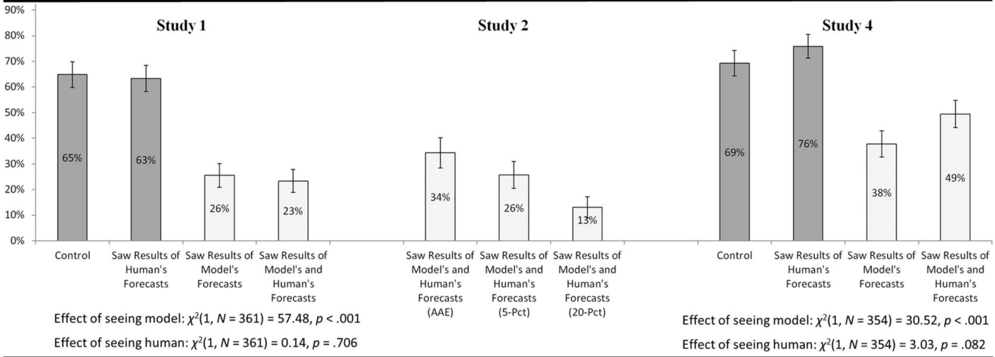
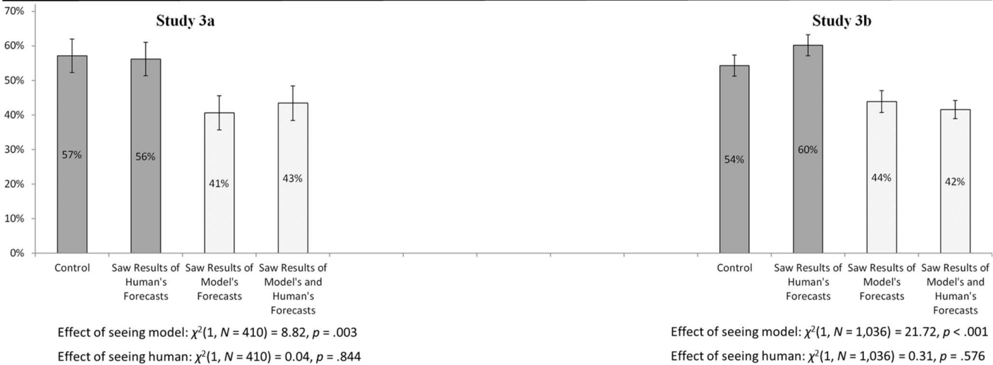
- Across five studies, seeing the algorithm perform reduced participants’ likelihood of choosing it over a human forecaster. In the model-and-human conditions, 610 of 741 participants (83%) saw the model outperform the human, yet these participants were among the least likely to choose the model.
- The model outperformed humans in all five studies. For example, bonuses if choosing model vs. human were Study 1: $1.78 vs. $1.38; Study 2: $1.77 vs. $1.09; Study 3a: $0.48 vs. $0.31; Study 3b: $0.49 vs. $0.30; Study 4: $1.79 vs. $1.38. Human forecasters produced 15–29% more error in the MBA task and 90–97% more error in the airline-passenger task.
- Seeing the model perform significantly decreased confidence in the model’s forecasts in all four studies where this was tested, whereas seeing the human perform significantly decreased confidence in the human only in Study 4. Confidence in the model’s forecasts significantly mediated the effect of seeing the model perform on choosing the model; confidence in the human did not.
- In Study 2, participants paid for forecasts within 20 percentiles were less likely to choose the model than those paid within 5 percentiles, χ²(1, N = 139) = 3.56, p = .059, and those paid by average absolute error, χ²(1, N = 136) = 8.56, p = .003; this effect was mediated by confidence in their own forecasts, not confidence in the model’s forecasts.
Methods
- Five studies had participants forecast real outcomes: MBA student success (Studies 1, 2, and 4) or U.S. state rank in airline passengers (Studies 3a and 3b). Participants were assigned to control, human, model, or model-and-human conditions, then chose whether to tie incentivized bonuses to the model or the human forecaster (themselves in Studies 1–3, another participant in Study 4).
- Final samples were Study 1: 361; Study 2: 206; Study 3a: 410; Study 3b: 1,036; Study 4: 354. Studies 1, 2, and 4 were run in the Wharton Behavioral Lab; Studies 3a and 3b used Amazon Mechanical Turk.
- Main analyses compared forecasting performance and choice rates, measured confidence and beliefs, and used binary mediation analyses with Preacher and Hayes’s bootstrapping procedure.
Limitations
- The paper states it did not explore all boundaries of the effect, including whether it would persist if algorithms were many times more accurate than humans, and whether results depend on features shared by the two forecasting tasks.
- The paper states it did not explore how algorithm variations—complexity, transparency, forecaster involvement in construction, and designer expertise—affect algorithm aversion.
- The paper states algorithm aversion is not entirely driven by seeing algorithms err, and it has little to say about how best to reduce aversion among those who have seen an algorithm err. The text also cautions that cross-experiment comparisons should be made cautiously.
Model-written summary. Check it against the paper before relying on it.
Integrity signals
Registry
Cites
Statistics
Figures
Verification
Claims the paper makes
0 Valid · 2 Not valid · 16 Not checked · 90 Own results and interpretations
A result the paper reports from its own data — it cites no other source for it, so there is none to check. The quote shows it is in the paper.
In the paper
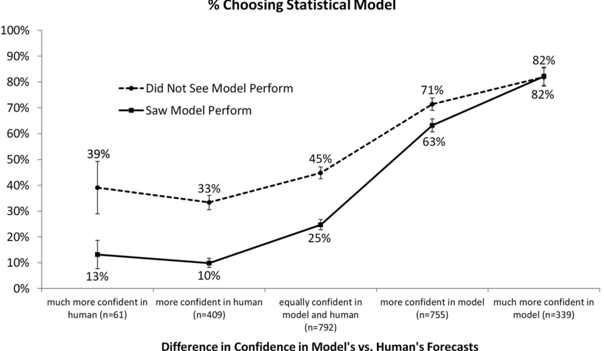
“the majority of people who were equally confident in the model's and human's forecasts chose to tie their bonuses to the human's forecasts, particularly when they had seen the model perform.”
plainstates an association- Asserted: passes — The authors put it forward as true.
- Checkable: passes — It can be checked against evidence.
- Load-bearing: passes — The paper’s conclusions depend on it.
- Based: passes — The paper gives a reason why it holds.
A result the paper reports from its own data — it cites no other source for it, so there is none to check. The quote shows it is in the paper.
In the paper
“Consistent with research on the adoption of decision aids (see Highhouse, 2008), participants thought that the human forecasters were better than the model at getting better with practice, learning from mistakes, and finding underappreciated candidates.”
plain- Asserted: passes — The authors put it forward as true.
- Checkable: passes — It can be checked against evidence.
- Load-bearing: passes — The paper’s conclusions depend on it.
- Based: passes — The paper gives a reason why it holds.
A result the paper reports from its own data — it cites no other source for it, so there is none to check. The quote shows it is in the paper.
In the paper
“Our studies show that this resistance at least partially arises from greater intolerance for error from algorithms than from humans.”
plainstates a possible cause- Asserted: passes — The authors put it forward as true.
- Checkable: passes — It can be checked against evidence.
- Load-bearing: passes — The paper’s conclusions depend on it.
- Based: passes — The paper gives a reason why it holds.
A result the paper reports from its own data — it cites no other source for it, so there is none to check. The quote shows it is in the paper.
In the paper
“Participants rightfully thought that the model was better than human forecasters at avoiding obvious mistakes, appropriately weighing various attributes, and consistently weighing information.”
plain- Asserted: passes — The authors put it forward as true.
- Checkable: passes — It can be checked against evidence.
- Load-bearing: unclear — It is unclear whether the paper’s conclusions depend on it.
- Based: passes — The paper gives a reason why it holds.
A result the paper reports from its own data — it cites no other source for it, so there is none to check. The quote shows it is in the paper.
In the paper
“This effect was evident in two distinct domains of judgment, including one in which the human forecasters produced nearly twice as much error as the algorithm.”
plain- Asserted: passes — The authors put it forward as true.
- Checkable: passes — It can be checked against evidence.
- Load-bearing: unclear — It is unclear whether the paper’s conclusions depend on it.
- Based: passes — The paper gives a reason why it holds.
75 more claims
Create a free account to see all 108 claims and to verify the 12 references still open.
- It may state two separate claims as one. 13
- Probably not a substantial claim. 16
Claims other papers make about this one
Each is checked against this paper’s own text: does it say what the citing paper says it does?
The source backs part of the claim, not all of it — or backs it for a different population, condition or comparison.
In the citing paper
“Traditional theorizing assumes trade-offs between trust and skepticism (Dietvorst et al., 2015), automation and engagement (Freeman et al., 2014), or efficiency and depth (Ishowo-Oloko et al., 2019)”
From Pedagogical partnerships with generative AI in higher education: how dual cognitive pathways paradoxically enable transformative learning (2026) · cites this paper as Dietvorst et al., 2015
Experimental — accuracy not yet measuredThe source backs part of the claim, not all of it — or backs it for a different population, condition or comparison.
In the citing paper
“Existing research typically examines trust versus skepticism in human-AI interactions as binary constructs (Dietvorst et al., 2015; Logg et al., 2019), missing the possibility that partnerships might simultaneously activate both vigilant and offloading behaviors.”
From Pedagogical partnerships with generative AI in higher education: how dual cognitive pathways paradoxically enable transformative learning (2026) · cites this paper as Dietvorst et al., 2015
Experimental — accuracy not yet measuredThe source backs part of the claim, not all of it — or backs it for a different population, condition or comparison.
In the citing paper
“It aligns with the theoretical rationale on algorithm aversion (Dietvorst et al. 2015;Hohensinn et al. 2024) and appreciation (Logg et al. 2019), which suggests that people are more likely to accept and trust AI systems when they produce desirable results but become skeptical when outcomes are unfavorable.”
From Holding AI Accountable Like Herding Cats: The Contingent Impact on the Legitimacy of Algorithmic Bureaucracy (2026) · cites this paper as Dietvorst et al. 2015
Experimental — accuracy not yet measuredThe source backs part of the claim, not all of it — or backs it for a different population, condition or comparison.
In the citing paper
“Research on algorithm appreciation and algorithm aversion further suggests that people may either defer to algorithms or reject them depending on prior experience, perceived expertise, and error visibility (Dietvorst et al., 2015; Logg et al., 2019).”
From College students' metacognitive awareness of generative-AI reliance: an experimental study of decision confidence and attribution bias (2026) · cites this paper as Dietvorst et al., 2015
Experimental — accuracy not yet measuredThe source backs part of the claim, not all of it — or backs it for a different population, condition or comparison.
In the citing paper
“Earlier research has mentioned gender, self-confidence, expertise, and general algorithm aversion or appreciation.15,28”
From Appropriate trust in artificial intelligence for the optical diagnosis of colorectal polyps: the role of human/artificial intelligence interaction (2024) · cites this paper as [28]
Experimental — accuracy not yet measured
22 more claims about this paper
Create a free account to see every claim other papers make about this one.
Statistics recomputed
Every reported test result, recomputed from its test statistic and degrees of freedom. A result shows as not adding up only once an independent check has confirmed it.
- Consistentt(360) = 4.98reported p < .001 · recomputed p < .001
“t (360) = 4.98, p < .001”
- Consistentt(204) = 6.26reported p < .001 · recomputed p < .001
“t (204) = 6.26, p < .001”
- Consistentt(405) = 7.73reported p < .001 · recomputed p < .001
“t (405) = 7.73, p < .001”
- Consistentt(353) = 5.11reported p < .001 · recomputed p < .001
“t (353) = 5.11, p < .001”
- Consistentχ²(1) = 39.94reported p < .001 · recomputed p < .001
“χ 2 (1, N = 271) = 39.94, p < .001”
19 more recomputed tests
Create a free account to see every test the Stats check recomputed.
Self-check
Percentages, sums and reported differences re-computed from the paper’s own numbers.
Self-check results appear here once an independent check has confirmed them.
Citations
Cites
Preacher, K. J., & Hayes, A. F. (2008) · Behavior Research Methods · doi:10.3758/brm.40.3.879 · Cited by 34,117 · cited 1×
“We then used Preacher and Hayes’s (2008) bootstrapping procedure to obtain unbiased 95% confidence intervals around the mediated effects.”
Method(2023) · doi:10.1126/science · Cited by 6,063
The trouble with overconfidence.
Moore, D. A., & Healy, P. J. (2008) · Psychological Review · doi:10.1037/0033-295x.115.2.502 · Cited by 2,358
“Clinical versus Actuarial Judgment.”
Dawes, R. M., Faust, D., & Meehl, P. E. (1989) · Science · doi:10.1126/science.2648573 · Cited by 2,298
The robust beauty of improper linear models in decision making.
Dawes, R. M. (1979) · American Psychologist · doi:10.1037/0003-066x.34.7.571 · Cited by 1,966
Preference and belief: Ambiguity and competence in choice under uncertainty
Heath, C., & Tversky, A. (1991) · Journal of Risk and Uncertainty · doi:10.1007/bf00057884 · Cited by 1,654
Clinical versus mechanical prediction: a meta-analysis
Grove, W. M., Zald, D. H., Lebow, B. S., Snitz, B. E., & Nelson, C. (2000) · Psychological Assessment · doi:10.1037/1040-3590.12.1.19 · Cited by 1,640
Grove, W. M., & Meehl, P. E. (1996) · Psychology, Public Policy, and Law · doi:10.1037/1076-8971.2.2.293 · Cited by 1,457 · cited 4×
“…1996), the notion that algorithms cannot properly consider individual targets (Grove & Meehl, 1996), concerns about the ethicality of relying on algorithms to make important decisions (Dawes, 1979), and the presumed inability of algorithms to incorporate qualitative data (Grove & Meehl, 1996).”
BackgroundMethodInfluential(2007) · Cited by 1,133
Competing on analytics: the new science of winning
(2007) · Choice Reviews Online · doi:10.5860/choice.44-6322 · Cited by 941
Research works printed but not linked: 1
- Clark, D. (2012, November 7). How Nate Silver won the 2012 presidential election. Harvard Business Review Blog . Retrieved from http://blogs .hbr.org/cs/2012/11/how\_nate\_silver\_won\_the\_2012\_p.html
Cited by
Items 3,001–3,100 of 3,918
ИИ как участник команды: трансформация кадровой динамики
Старков, З. С., Афонин, И. А., & Валерьевна, Г. И. (2026) · Социально-гуманитарные исследования: векторы развития науки и образования · doi:10.21202/978-5-8399-0894-9_407-411
Shah, K., & Parashar, A. (2025) · International Journal of Research -GRANTHAALAYAH · doi:10.29121/granthaalayah.v13.i1.2025.6919
Support for AI in Public Administration: A Comparative Study of the United Kingdom and Japan
Pickering, S., Hansen, M. E., & Sunahara, Y. (2026) · International Journal of Public Administration · doi:10.1080/01900692.2026.2667201
İlter, H. K. (2026) · Journal of Computational Science · doi:10.1016/j.jocs.2026.102904
Ergün, K. (2026) · International Scientific Conference Central and Eastern Europe in the Changing Business Environment · doi:10.18267/pr.2026.vol.2587.10
How AI Transform Time-Series Foundation Models to Logistics Business Value in MENA
Alkayid, K., Alzoubi, H. M., Angelova, Y., Khatib, M. M. E., & Slimani, K. (2026) · International Conference on Emerging Technologies and Engineering Systems (ICETES) · doi:10.1109/icetes68504.2026.11518755
Desire without satisfaction: object a, symbolic authority, and human–AI interaction
Hamamra, B. T. (2026) · AI & Society · doi:10.1007/s00146-026-03115-5 · Cited by 1
Wang, R., & Chang, Y. (2026) · Journal of Business Research · doi:10.1016/j.jbusres.2026.116303
Patil, G., Pham, L. Q. T., Nalepka, P., Kallen, R. W., & Richardson, M. J. (2026) · International Journal of Human-Computer Studies · doi:10.1016/j.ijhcs.2026.103838
Mission Driven and Data Averse: How Empathy Fosters Resistance to Algorithms and Hard Data
Ghita, R. S., & Zureich, J. (2026) · Management Science · doi:10.1287/mnsc.2024.07098
Tenderis, A. (2026) · Journal of Social Science and Human Research Studies · doi:10.65150/ep-jsshrs/v2e5/2026-14
Does AI identity disclosure stimulate user responses? An exploration based on meta-analysis
Sun, M., Chen, H., Chen, H., & Jiang, B. (2026) · Information Technology and People · doi:10.1108/itp-06-2025-0813
On the Trust Towards LLMs and Peers as Debate Partners on Socio-Scientific Issues: An Experiment
Kuklick, L., Mayweg-Paus, E., & Höft, L. (2026) · edoc Publication server (Humboldt University of Berlin) · doi:10.18452/36955 · Cited by 1
Der Einsatz von generativer KI entlang des Social-Media-Zyklus
Decker, A., & Gust, B. (2026) · Springer eBooks · doi:10.1007/978-3-658-49493-3_18
Prestini, D. (2026) · International Journal of Business and Management · doi:10.5539/ijbm.v21n3p130
AI as an Epistemic Technology: Navigating Ethics in Practice in Cases of Distributed Decision Making
Maslen, S., & Hayes, J. (2026) · Springer eBooks · doi:10.1007/978-3-032-20002-0_12
Greussing, E., Hendriks, F., Horstmann, A. C., Meier, Y., Nowak, B., & Bromme, R. (2026) · Journal of Science Communication · doi:10.22323/170720260228062648
Is It Fair to be Accurate? Moral-Emotional Responses to Organizations’ AI Orientation Choices
Vromman, F. V., Hericher, C., Kerckhove, C. V., & Raineri, N. (2026) · Business & Society · doi:10.1177/00076503261448488
ESG-Driven Robo-Advisory Systems in Green FinTech
Rashid, A. H. A., Kumar, P. M. A., & Rekha, B. J. (2026) · International Conference on Computing for Sustainable Global Development · doi:10.23919/indiacom70271.2026.11525691
Essays on Artificial Intelligence and Human Behavior in the Marketplace
Zhou, P. (2026) · UA Campus Repository (The University of Arizona)
Leszczyński, G., Gaczek, P., & Mouakher, A. (2026) · Journal of Research in Interactive Marketing · doi:10.1108/jrim-09-2025-0531
Toward trustworthy healthcare AI: designing academic research for translation readiness
Hekler, A., & Buettner, F. (2026) · Molecular Systems Biology · doi:10.1038/s44320-026-00219-4
When does size matter? Divergent effects of recommendation set size in AI versus human recommenders
Zhao, X., Chen, B., & Yang, Z. (2026) · Marketing Letters · doi:10.1007/s11002-026-09826-5
Reported trust varies with graded value alignment in AI-attributed economic–environmental choices
Cui, L., Sun, L., & He, G. (2026) · Scientific Reports · doi:10.1038/s41598-026-55728-x
Henz, P. (2026) · Cambridge University Press eBooks · doi:10.1017/9781108939010.021
Pogrebna, G., & Hills, T. T. (2026) · Cambridge University Press eBooks · doi:10.1017/9781108939010.015
Shabir, G. (2026) · SSRN Electronic Journal · doi:10.2139/ssrn.6845359
The Singular Effect of Expert Short Recommendation Lists
Mejía, V. D., & Guesmi, S. (2026) · Psychology and Marketing · doi:10.1002/mar.70173
Emon, S. A. (2026) · LUTPub (LUT University)
Transitioning toward efficient smart charging of electric vehicles: Challenges and perspectives
Sund, L., Saber, H., Muires, J., Talari, S., & Ketter, W. (2026) · ENGINEERING Management · doi:10.1007/s42524-026-5415-9
Goudhaman, S. (2026) · Journal of Technology Management for Growing Economies · doi:10.15415/jtmge/2025.162007
Veld, B. H. I. '. (2026) · LUTPub (LUT University)
Source Credibility and Chatbots: How Design Factors Impact Chatbot Effectiveness
Schmidt, K. M. (2026) · STARS (University of Central Florida)
Zhu, W., Ouyang, P., & Mei, X. (2026) · International Journal of Management Science Research · doi:10.53469/ijomsr.2026.09(05).01
Song, Y., Hu, Y., Zhou, Z., Bai, Y., Du, X., Liang, Z., Shi, Y., & Deng, W. (2026) · Proceedings of DRS · doi:10.21606/drs.2026.1282
生成AI に対する信頼性認知・リスク認知・利用意志 : 大学教員と学生の比較
Tanaka, K., & Taguchi, S. (2026) · Institutional Repositories DataBase (IRDB) · doi:10.14988/0002001708
The AI Educator: From Disruption to Design: Practical Pathways for AI-Empowered Teaching
de Byl, P. (2026) · CRC Press eBooks · doi:10.1201/9781003624981
A phenomenon of AI-conformity: how algorithms change human moral decision-makingPreprint
Venerina, Y., Koch, D., Meloyan, N., Prutko, G., Lelik, V. P., Taova, V., & Kurpatov, A. (2026) · arXiv (Cornell University) · doi:10.48550/arxiv.2606.00013
Lysdahlgaard, S., Jensen, J., Pedersen, M. R. V., & Kusk, M. W. (2026) · Radiography · doi:10.1016/j.radi.2026.103459
Algorithms and decision making under riskPreprint
Liefooghe, B., Frenkel, N., & Mulder, M. (2026) · SSRN Electronic Journal · doi:10.2139/ssrn.6875448
Cui, Z., Xu, S., Gao, J., Geng, L., & Zhou, Y. (2026) · Buildings · doi:10.3390/buildings16112264
Zhang, R., Xie, Q., & Li, B. (2026) · Journal of Health Communication · doi:10.1080/10810730.2026.2682493 · Cited by 1
Rettagliata, G., Klooster, J. W. J. R. V. '., Hertel, G., & Bondarouk, T. V. (2026) · IGI Global eBooks · doi:10.4018/979-8-3373-9255-4.ch010
The admissibility of AI-generated evidence in criminal courts
Costa, D. M. (2026) · Portuguese National Funding Agency for Science, Research and Technology (RCAAP Project by FCT)
Paik, S., Novozhilova, E., Mays, K. K., Huang, D., & Katz, J. E. (2026) · Journal of Broadcasting & Electronic Media · doi:10.1080/08838151.2026.2683460
Shah, K., & Parashar, A. (2026) · International Journal of Engineering Technologies and Management Research · doi:10.29121/ijetmr.v13.i6.2026.1776
Bridging the Gap: A Hybrid Intelligence Decision Support System for B2B Pricing
Hornbogen, T., Valentin, J., Haskamp, T., & Brocke, J. V. (2026) · Lecture notes in computer science · doi:10.1007/978-3-032-28570-6_36
What Pennsylvania’s AI chatbot lawsuit teaches us about the psychology behind medical trust
Chapman, G. (2026) · The Conversation · doi:10.64628/aai.efda9aaua
Detecting AI Errors: Examining the Impact of Transfer of Training and Reflective PracticePreprint
Fu, X., Ramasubbu, N., & Galletta, D. (2026) · SSRN Electronic Journal · doi:10.2139/ssrn.6890395
Okechukwu, C. C., Mohelská, H., & Drăgoiu, S.-E. (2026) · SSRN Electronic Journal · doi:10.2139/ssrn.6890563
Soma, R. (2026) · Engineering Technology & Applied Science Research · doi:10.48084/etasr.18875
A Review of AI-Driven Innovations in Digital Marketing Platforms and E- Commerce Ecosystem
Jadhav, N., & Sawant, M. (2026) · myresearchgo · doi:10.64448/myresearchgo.vol.2.issue.5.21
Dr. Sirajud Din, D. Z. U. R. (2026) · Journal of Business and Management Research · doi:10.5281/zenodo.20583738
Smeets, M. R. (2026) · AIS Electronic Library (AISeL)
User Influence and Model Vulnerability: Human-Like Cognitive Bias In Conversational AI Systems
Belcheva, V., & Ermakova, T. (2026) · AIS Electronic Library (AISeL)
Explaining and Mitigating Biased Decisions: An Ontological Approach
Peixoto, M., Baião, F., Guizzardi, R. S. S., & Guizzardi, G. (2026) · Lecture notes in computer science · doi:10.1007/978-3-032-28117-3_18
Humans or Generative AI? Influence of recommendation agents on tourists’ decision-making
Li, F. S., & Su, Q. (2026) · Humanities and Social Sciences Communications · doi:10.1057/s41599-026-07899-1 · Cited by 1
The Gap Between Employee Compliance and Trust in Digital HR Across Industries
Bharathi, G. P. S. D. S., Suriya., S. K. J., V, & P, V. K. (2026) · Economic Sciences. · doi:10.69889/28k14n92
When Security Meets Intelligence: Trust in AI, Blockchain Security, and Investor Behavior
Bilal, F., Öörni, A., Mukkamala, R. R., & Alam, B. R. (2026) · Bled eConference · doi:10.18690/um.fov.4.2026.26
What Do People Actually Want From AI? Mapping Preference Plurality
Coelho, J. S., & Hale, S. A. (2026) · ACM Conference on Fairness, Accountability, and Transparency (FAccT) · doi:10.1145/3805689.3812398 · Cited by 5
BENCE, V., HARCI, T., & GÁSPÁR, B. (2026) · Pesci Egyetemi Archivum (University of Pécs) · doi:10.15170/xviippn-tk-ktk-2026-02
Overriding the algorithm: gender, compliance and risk managementPreprint
Montalvo, J. G., & Reynal‐Querol, M. (2026) · SSRN Electronic Journal · doi:10.2139/ssrn.6913450
Ahdadou, M. (2026) · Futures · doi:10.1016/j.futures.2026.103873 · Cited by 1
Mapping a Decade of AI in Human Resource Management (2015–2025): A Bibliometric and Thematic Review
Kirti (2026) · Advances in computational intelligence and robotics book series · doi:10.4018/979-8-3373-6229-8.ch001
False Negatives at Scale: Governing AI-Enabled Applicant Screening Under Digital Transformation
Drew, M. (2026) · RAIS Journal for Social Sciences · doi:10.5281/zenodo.19661186
The Legitimation-Validation Paradox in AI-Driven Talent Acquisition : A Critical Systematic Review
MOUNTASSIR, H., & Benyassine, H. (2026) · International Journal of Accounting, Finance, Auditing, Management and Economics · doi:10.5281/zenodo.20592769
Lin, Y. (2026) · Carolina Digital Repository (University of North Carolina at Chapel Hill) · doi:10.17615/pcwk-f306
Introzzi, L. (n.d.) · BOA (University of Milano-Bicocca)
Applicant attraction in AI recruitment: The roles of warmth and competence
Magni, F., & Gong, Y. (2026) · Computers in Human Behavior Reports · doi:10.1016/j.chbr.2026.101169
Cochrane, K. A., Moore, B. A., Simon, J. N., & Harley, D. (2026) · Designing Interactive Systems Conference · doi:10.1145/3800645.3812987
Pham, V. K., Giao, L. L. P., Huynh, A.-V., & Thi, T. D. P. (2026) · Journal of Decision System · doi:10.1080/12460125.2026.2684000
AI systems are not information systems. Should we care?
Riemer, K., & Peter, S. (2026) · Journal of Information Technology · doi:10.1177/02683962261458374
Scheer, K. (2026) · Publication Server of Kaiserslautern University of Technology (Kaiserslautern University of Technology) · doi:10.26204/kluedo/13209
When Digital Misconduct Becomes Reputational Risk: Evidence from Firms and Stakeholders
Kim, J. (2026) · Journal of the Association for Information Systems
Power Calibration and Delegation in Human–Agentic AI Interaction: Psychological Pathways
Nguyen, L., & Nallaperuma, K. (2026) · AIS Electronic Library (AISeL)
When Errors Cut Both Ways :Error Directionality and Trust Collapse in AI-Assisted Review Detection
SU, C. (2026) · AIS Electronic Library (AISeL)
Backteman, E., & Katende, C. (2026) · Lund University Publications Student Papers (Lund University)
Hamza, M. S., & Khafagy, A. (2026) · The Egyptian Journal of Neurosurgery : the official publication of the Egyptian Society of Neurological Surgeons/Egyptian journal of neurosurgery · doi:10.1186/s41984-026-00607-w
How attitude shapes generative AI adoption intentions among graduate students
Núñez, N. A., Salvador-Marquez, C., & Poma-Chavez, J. (2026) · Computers in Human Behavior Reports · doi:10.1016/j.chbr.2026.101257
Inouzhe, H. (2026) · arXiv (Cornell University) · doi:10.48550/arxiv.2606.13734
Zhao, X., Huang, Y., & Zhang, Y. (2026) · Applied Economics · doi:10.1080/00036846.2026.2688896
On the Establishment of Trust: Rethinking Trust in the Age of Artificial Intelligence
Lipps, C., & Sithungu, S. P. (2026) · European Conference on Cyber Warfare and Security · doi:10.34190/eccws.25.1.4869
FANG, Y., & Huang, M. (2026) · SSRN Electronic Journal · doi:10.2139/ssrn.6960007
Wen, R., Zhao, Z., & Liu, S. (2026) · Computers & Industrial Engineering · doi:10.1016/j.cie.2026.112200
Kim, M. (2026) · SSRN Electronic Journal · doi:10.2139/ssrn.6956677
Chen, S., & Zhou, T. (2026) · Acta Psychologica · doi:10.1016/j.actpsy.2026.107269
Too tired to be judged by humans: Social jetlag increases preference for AI through social anxiety
Zhou, X., Chu, Y., Zhang, L., & Liang, J. (2026) · Computers in Human Behavior · doi:10.1016/j.chb.2026.109082
McGraw, D. (2026) · Digital Commons - George Fox University (George Fox University)
Consumer perception of AI-disclosure labelled advertisements
Saglam, H. B. (2026) · DSpace repository (University of Tartu)
AI as Arbiter? The Role of Artificial Intelligence in Cyberbullying Report Review Process
Lee, S., Kim, W., & Moon, W.-K. (2026) · Cyberpsychology Behavior and Social Networking · doi:10.1177/21522715261460961
Namyslo, N. M., Jung, D., & Sturm, T. (2026) · Electronic Markets · doi:10.1007/s12525-026-00910-2
Etchezahar, E. D., Yepes, T. G., Ungaretti, J., & González, G. D. P. (2026) · International Journal of Human-Computer Interaction · doi:10.1080/10447318.2026.2676766
Lawal, A. R., Koppel, T., & Putans, R. (2026) · Engineering for Rural Development · doi:10.22616/erdev.2026.25.tf124
Syharat, C. M., Zaghi, A. E., & Motaref, S. (2026) · Frontiers in Research Metrics and Analytics · doi:10.3389/frma.2026.1830196 · Cited by 1
Pimentel, R. P. F. D. A., & Meyer, G. J. (2026) · Assessment · doi:10.1177/10731911261455137
AI-Augmented Leadership and Digital Decision-Making Models
Roos, G. (2026) · Advances in computational intelligence and robotics book series · doi:10.4018/979-8-2600-2541-3.ch002
The Psychological Costs of Proactive AI Initiative at Work
Harari, D., & Amir, O. (2026) · Annual Symposium on Human-Computer Interaction for Work (CHIWORK) · doi:10.1145/3808045.3808054
Asif, S., Mathur, A., & Minz, N. K. (2026) · Advances in computational intelligence and robotics book series · doi:10.4018/979-8-3373-7966-1.ch002
Mai, C. H. E. N. (2026) · Singapore Management University Institutional Knowledge (InK) (Singapore Management University)
Metadata
- Authors
- Dietvorst, B. J., Simmons, J. P., & Massey, C.
- Affiliations
- University of Pennsylvania (US)
- Venue
- Journal of Experimental Psychology: General
- Published
- 2015
- Volume
- 144
- Issue
- 1
- Pages
- 114-126
- ISSN
- 0096-3445 (ISSN-L)
- 1939-2222
- OpenAlex
- W3125633690
- Cited by
- 3,232
- References
- 22
- Citations by year
- 2026: 1025 · 2025: 563 · 2024: 445 · 2023: 404 · 2022: 266 · 2021: 216 · 2020: 137 · 2019: 88 · 2018: 41 · 2017: 26 · 2016: 14 · 2015: 5
- FWCI
- 13.96
- Type
- journal article
- Language
- en
- Open access
- green
- doi.org
- Locations
- Journal of Experimental Psychology General (publishedVersion)
- SSRN Electronic Journal (publishedVersion)
- PubMed (publishedVersion)
- ScholarlyCommons (University of Pennsylvania) (submittedVersion)
- Funders
- Wharton Behavioral Laboratory
- Wharton Risk Center Ackoff Doctoral Student Fellowship
- Topics
- Social Sciences › Decision Sciences › General Decision Sciences › Decision-Making and Behavioral Economics
- Social Sciences › Decision Sciences › Management Science and Operations Research › Forecasting Techniques and Applications
- Social Sciences › Human Factors and Ergonomics › Human-Automation Interaction and Safety
- Keywords
- algorithm aversion, trust in algorithms, prediction confidence, evidence-based algorithm, decision-making
- MeSH terms
- Algorithms, Avoidance Learning, Culture, Decision Making, Female, Forecasting, Humans, Male, Motivation, Comprehension, Young Adult
About these checks
Registry, retraction, Cites and statistics results are computed, not judged, with one exception: a printed reference that no index lists is read once by a model before it counts as a citation error. Claims are extracted by a model and kept only when their quote appears verbatim in the text; each cited source is then checked, with a model’s help, for whether it says what the claim relies on. Those verdicts can be wrong — read the claim’s quote and the cited source before relying on one.
A language model drew the claims from the paper on 2026-11-14, under version 3 of the claim definition (model deepseek-v4.1-flash, prompt extract-v3).
A second model labelled each claim on 2026-11-14 (model jev-1.13-20260917, definition revision gold-guideline-v0.2).
Statistics and arithmetic are recomputed, not judged.
Confidence bands are shown only for fields calibrated on our annotated test set. None is calibrated yet, so no band is shown.
What counts as a claim ›How we measure confidence ›How we check this ›
Are you an author, or do you see a problem with this page? Request a review
Data sources
Bibliographic data: Semantic Scholar, OpenAlex, Crossref.
Contains information from the Semantic Scholar Academic Graph Datasets, made available under the ODC Attribution License (ODC-BY 1.0).
Semantic Scholar’s data is described in: Kinney, R., et al. (2023). The Semantic Scholar Open Data Platform. arXiv:2301.10140.
