

Face classification using electronic synapses
Open accessThe DOI matches its Crossref record; 33 of the 34 references it cites were found in a registry or an index.
Abstract
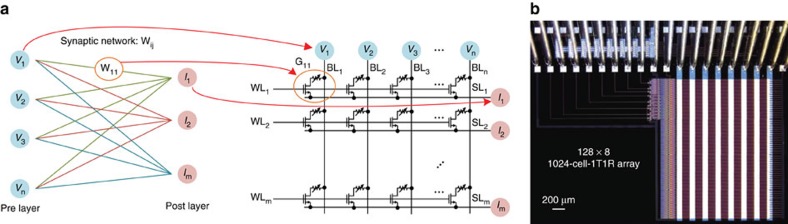
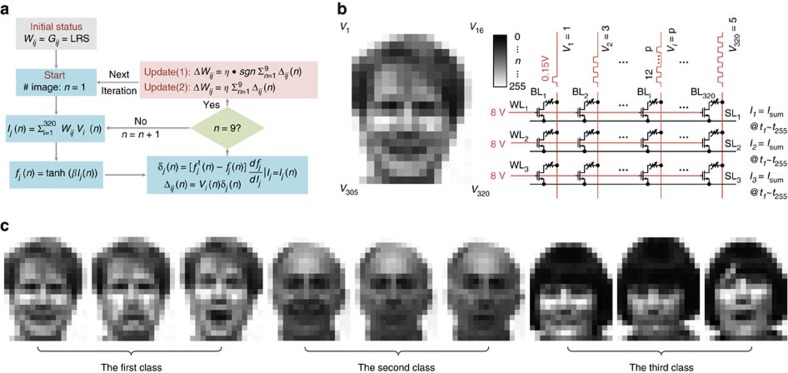
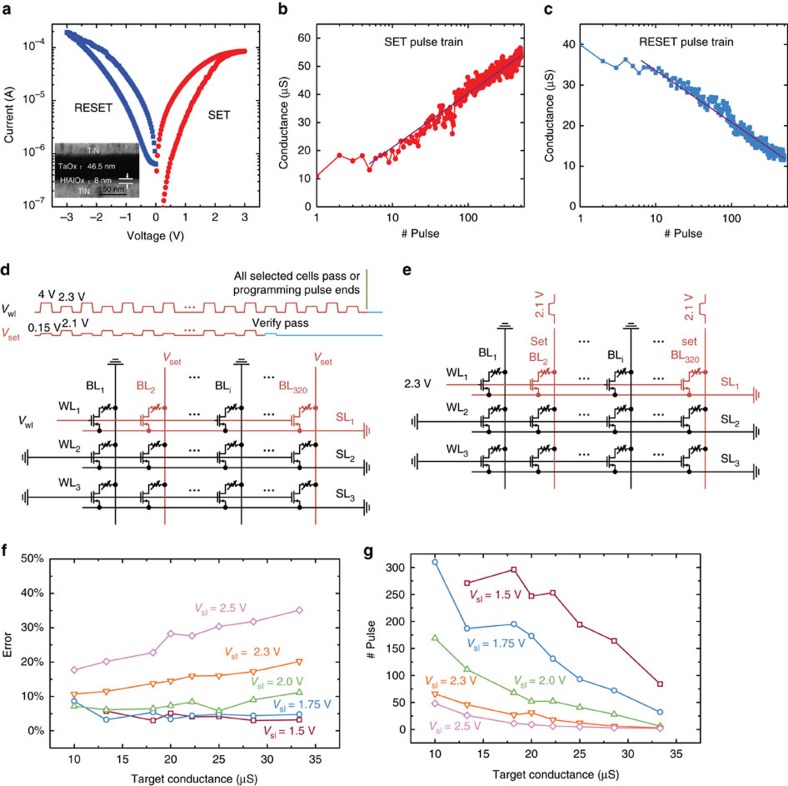
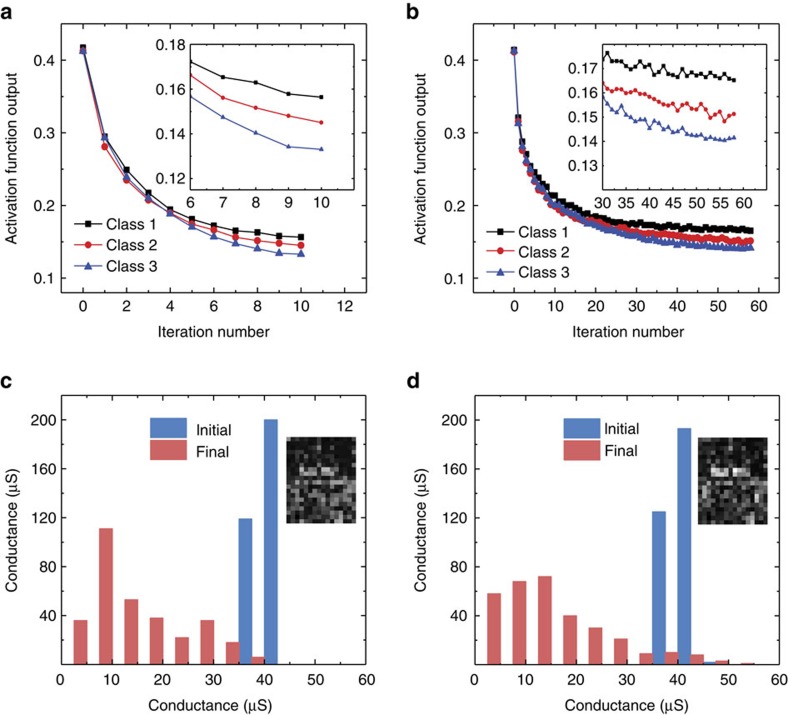
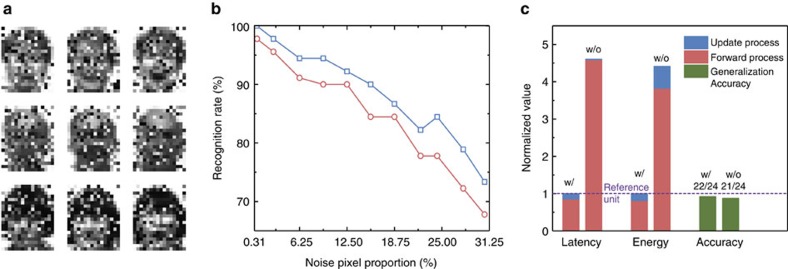
Conventional hardware platforms consume huge amount of energy for cognitive learning due to the data movement between the processor and the off-chip memory. Brain-inspired device technologies using analogue weight storage allow to complete cognitive tasks more efficiently. Here we present an analogue non-volatile resistive memory (an electronic synapse) with foundry friendly materials. The device shows bidirectional continuous weight modulation behaviour. Grey-scale face classification is experimentally demonstrated using an integrated 1024-cell array with parallel online training. The energy consumption within the analogue synapses for each iteration is 1,000 × (20 ×) lower compared to an implementation using Intel Xeon Phi processor with off-chip memory (with hypothetical on-chip digital resistive random access memory). The accuracy on test sets is close to the result using a central processing unit. These experimental results consolidate the feasibility of analogue synaptic array and pave the way toward building an energy efficient and large-scale neuromorphic system.
Overview
The claims and statistics of this paper haven’t been checked yet.
Free: it reads the open-access text and checks the first 5 claims that cite a source we can check. Create a free account to check every claim.
Integrity signals
Registry
Cites
Statistics
Figures
Verification
Claims the paper makes
The claims and statistics of this paper haven’t been checked yet.
Free: it reads the open-access text and checks the first 5 claims that cite a source we can check. Create a free account to check every claim.
Claims other papers make about this one
Each is checked against this paper’s own text: does it say what the citing paper says it does?
The cited source doesn’t support the claim as written.
In the citing paper
“the usual practice reported in the literature for this kind of training has been the use of the so-called Manhattan Update Rule105,194, or the Stochastic Gradient Descent54.”
From Hardware implementation of memristor-based artificial neural networks (2024) · cites this paper as [194]
Checked by a reasoning model — may be wrong.
Experimental — accuracy not yet measuredThe source backs part of the claim, not all of it — or backs it for a different population, condition or comparison.
In the citing paper
“leading to a variety of prototypes in which the circuitry needed for the backpropagation are implemented off-chip, an approach here labelled as partial-in situ. This is the case of refs. 54,105,194.”
From Hardware implementation of memristor-based artificial neural networks (2024) · cites this paper as [194]
Experimental — accuracy not yet measuredThe source backs part of the claim, not all of it — or backs it for a different population, condition or comparison.
In the citing paper
“In all these works the VMM operation required for the forward pass is performed by the memristor crossbar and the digitalized output vectors recorded by an acquisition printed circuit board. Then the output vector is processed by the training algorithm in software to determine how to update the synaptic weight after each training epoch.”
From Hardware implementation of memristor-based artificial neural networks (2024) · cites this paper as [194]
Experimental — accuracy not yet measuredThe source backs part of the claim, not all of it — or backs it for a different population, condition or comparison.
In the citing paper
“The most elementary approach is a sequential (row-by-row) analogue multiplication with binary inputs194, which does not perform an analogue VMM operation because, despite the multiplication operation is done in each memristor, the accumulation is performed by external circuitry.”
From Hardware implementation of memristor-based artificial neural networks (2024) · cites this paper as [194]
Experimental — accuracy not yet measuredThe cited source says what the claim attributes to it.
In the citing paper
“Some groups prefer to incorporate a transistor in series to each MIM cell to obtain a better control over the currents through the device (i.e., improve conductance controllability and minimize sneak path currents)53–55,60,61,102,113,167,194,218–222,).”
From Hardware implementation of memristor-based artificial neural networks (2024) · cites this paper as [194]
Self-check
Percentages, sums and reported differences re-computed from the paper’s own numbers.
The self-check needs the paper’s full text.
Citations
Cites
Gradient-based learning applied to document recognition
Lecun, Y., Bottou, L., Bengio, Y., & Haffner, P. (1998) · Proceedings of the IEEE · doi:10.1109/5.726791 · Cited by 58,805
ImageNet Large Scale Visual Recognition Challenge
Russakovsky, O., Deng, J., Su, H., Krause, J., Satheesh, S., Ma, S., Huang, Z., Karpathy, A., Khosla, A., Bernstein, M., et al. (2015) · International Journal of Computer Vision · doi:10.1007/s11263-015-0816-y · Cited by 39,380
Human-level control through deep reinforcement learning
Mnih, V., Kavukcuoglu, K., Silver, D., Rusu, A. A., Veness, J., Bellemare, M. G., Graves, A., Riedmiller, M., Fidjeland, A. K., Ostrovski, G., et al. (2015) · Nature · doi:10.1038/nature14236 · Cited by 30,357
Reducing the dimensionality of data with neural networks
Hinton, G. E., & Salakhutdinov, R. R. (2006) · Science · doi:10.1126/science.1127647 · Cited by 20,928
The perceptron: A probabilistic model for information storage and organization in the brain.
Rosenblatt, F. (1958) · Psychological Review · doi:10.1037/h0042519 · Cited by 12,280
Eigenfaces vs. Fisherfaces: recognition using class specific linear projection
Belhumeur, P. N., Hespanha, J. P., & Kriegman, D. J. (1997) · IEEE Transactions on Pattern Analysis and Machine Intelligence · doi:10.1109/34.598228 · Cited by 11,707
A million spiking-neuron integrated circuit with a scalable communication network and interface
Merolla, P. A., Arthur, J. V., Alvarez-Icaza, R., Cassidy, A. S., Sawada, J., Akopyan, F., Jackson, B. L., Imam, N., Guo, C., Nakamura, Y., et al. (2014) · Science · doi:10.1126/science.1254642 · Cited by 4,147
Training and operation of an integrated neuromorphic network based on metal-oxide memristors
Prezioso, M., Merrikh-Bayat, F., Hoskins, B. D., Adam, G. C., Likharev, K. K., & Strukov, D. B. (2015) · Nature · doi:10.1038/nature14441 · Cited by 3,001 · cited 3×
“Meanwhile, pattern recognition tasks based on analogue resistive random access memory (RRAM) have been demonstrated either through simulations or on a small crossbar array 13,14 .”
BackgroundMethodWong, H.-S. P., Lee, H.-Y., Yu, S., Chen, Y.-S., Wu, Y., Chen, P.-S., Lee, B., Chen, F. T., & Tsai, M.-J. (2012) · Proceedings of the IEEE · doi:10.1109/jproc.2012.2190369 · Cited by 2,757
Self-citationDeep learning applications and challenges in big data analytics
Najafabadi, M. M., Villanustre, F., Khoshgoftaar, T. M., Seliya, N., Wald, R., & Muharemagic, E. (2015) · Journal of Big Data · doi:10.1186/s40537-014-0007-7 · Cited by 2,594
Research works printed but not linked: 6
- Le, Q. V. in Acoustics, Speech and Signal Processing (ICASSP), 2013 IEEE International Conference 8595–8598 (IEEE, 2013).
- Krizhevsky, A., Sutskever, I. & Hinton, G. E. in Advances in Neural Information Processing Systems 1097–1105 (Curran Associates, Inc., 2012).
- Fackenthal, R. et al. in Solid-State Circuits Conference Digest of Technical Papers (ISSCC), 2014 IEEE International, 338–339 (IEEE, 2014).
- Govoreanu, B. et al. in Electron Devices Meeting (IEDM), 2011 IEEE International, 31.36. 31–31.36. 34 (IEEE, 2011).
- Sekar, D. et al. in 2014 IEEE International Electron Devices Meeting, 28.23. 21–28.23. 24 (IEEE, 2014).
- Burr, G. et al. in 2015 IEEE International Electron Devices Meeting (IEDM), 4.4. 1–4.4. 4 (IEEE, 2015).
Cited by
Items 501–600 of 918
State bounding for fuzzy memristive neural networks with bounded input disturbances
Gao, Y. H., Zhu, S., Yang, C., & Wen, S. (2020) · Neural Networks · doi:10.1016/j.neunet.2020.11.016 · Cited by 20
Li, J., Zhou, G., Li, Y., Chen, J., Ge, Y., Mo, Y., Yang, Y., Qian, X., Jiang, W., Liu, H., et al. (2021) · Artificial Intelligence Review · doi:10.1007/s10462-021-10060-w · Cited by 20
Li, R., Huang, P. C., Feng, Y., Zhou, Z., Zhang, Y., Ding, X., Liu, L., & Kang, J. (2022) · Micromachines · doi:10.3390/mi13030433 · Cited by 20
Towards scalable memristive hardware for spiking neural networks
Chen, P., Zhang, B., He, E., Xiao, Y., Liu, F., Lin, P., Wang, Z., & Pan, G. (2025) · Materials Horizons · doi:10.1039/d4mh01676a · Cited by 19
Zhang, B., Lv, W., Guo, Y., Wang, B., Luo, K., Li, W., & Cao, J. (2022) · Advanced Electronic Materials · doi:10.1002/aelm.202200939 · Cited by 20
Jetty, P., Mohanan, K. U., & Jammalamadaka, S. N. (2023) · Nanotechnology · doi:10.1088/1361-6528/acc811 · Cited by 19
Yan, T., Cai, Y., Wang, Y., Yang, J., Li, S., Zhan, X., Wang, F., Cheng, R., Wang, F., He, J., et al. (2023) · Science China Information Sciences · doi:10.1007/s11432-022-3695-1 · Cited by 19
Nishioka, D., Tsuchiya, T., Higuchi, T., & Terabe, K. (2023) · Neuromorphic Computing and Engineering · doi:10.1088/2634-4386/acf1c6 · Cited by 19
Research progress of artificial neural systems based on memristors
Tang, Z., Sun, B. T., Zhou, G., Zhou, Y., Cao, Z., Duan, X., Yan, W., Chen, X., & Shao, J. (2023) · Materials Today Nano · doi:10.1016/j.mtnano.2023.100439 · Cited by 26
An overview memristor based hardware accelerators for deep neural network
Gökgöz, B., Gül, F., & Aydın, T. (2024) · Concurrency and Computation Practice and Experience · doi:10.1002/cpe.7997 · Cited by 20
Kunwar, S., Cucciniello, N., Mazza, A. R., Zhang, D., Santillán, L., Freiman, B., Roy, P., Jia, Q. X., MacManus‐Driscoll, J. L., Wang, H., et al. (2024) · ACS Applied Materials & Interfaces · doi:10.1021/acsami.3c19032 · Cited by 19
Cheng, J., Yuan, J., Li, P. Y., Wang, J., Wang, Y., Zhang, Y. W., Zheng, Y., & Zhang, P. (2024) · ACS Applied Materials & Interfaces · doi:10.1021/acsami.4c06177 · Cited by 19
Libera, V., Malaspina, R., Bon, S. B., Cardinali, M. A., Chiesa, I., Maria, C. D., Paciaroni, A., Petrillo, C., Comez, L., Sassi, P., et al. (2024) · RSC Advances · doi:10.1039/d4ra02830a · Cited by 19
Fully hardware-implemented neuromorphic systems using TaO -based memristors
Tian, J., Lv, K., Chen, J., Zhang, L., & Guo, X. (2025) · Device · doi:10.1016/j.device.2024.100645 · Cited by 19
Reliability Perspective on Neuromorphic Computing Based on Analog RRAM
Wu, H., Zhao, M., Liu, Y., Yao, P., Xi, Y., Li, X., Wu, W., Zhang, Q., Tang, J., Gao, B., et al. (2019) · IEEE International Reliability Physics Symposium proceedings · doi:10.1109/irps.2019.8720609 · Cited by 19
Self-citationRecurrent neural networks made of magnetic tunnel junctions
Zheng, Q., Zhu, X., Mi, Y., Yuan, Z., & Xia, K. (2020) · AIP Advances · doi:10.1063/1.5143382 · Cited by 21
Exploring Phase‐Change Memory: From Material Systems to Device Physics
Ren, Y., Sun, R., Chen, S. H. Y., Du, C., Han, S., & Zhou, Y. (2021) · physica status solidi (RRL) - Rapid Research Letters · doi:10.1002/pssr.202000394 · Cited by 19
Shi, Y., Ananthakrishnan, A., Oh, S., Liu, X., Hota, G., Cauwenberghs, G., & Kuzum, D. (2021) · IEEE Transactions on Electron Devices · doi:10.1109/ted.2021.3131116 · Cited by 21
Dai, Y., Feng, Z., & Wu, Z. (2022) · IEEE Transactions on Electron Devices · doi:10.1109/ted.2022.3172050 · Cited by 19
Park, T. W., Moon, J., Shin, D. H., Kim, H. J., Kim, S. S., Cho, J. M., Park, H., Woo, K. S., Kim, D. Y., Cheong, S., et al. (2024) · ACS Applied Materials & Interfaces · doi:10.1021/acsami.4c15598 · Cited by 18
Brain-like synaptic memristor based on lithium-doped silicate for neuromorphic computing
Ke, S., Jiang, L., Zhao, Y., Xiao, Y., Jiang, B., Cheng, G., Wu, F., Cao, G., Peng, Z., Zhu, M., et al. (2022) · Frontiers of Physics · doi:10.1007/s11467-022-1173-2 · Cited by 18
Synaptic learning behavior and neuromorphic computing of Au/MXene/NiO/FTO artificial synapse
Fang, J., Tang, Z., Li, X.-Q., Fan, Z.-Y., Jiang, Y., Liu, Q., Tang, X., Fan, J., Gao, J., & Shang, J. (2023) · Applied Physics Letters · doi:10.1063/5.0167497 · Cited by 18
Forming-free artificial synapses with Ag point contacts at interface
Jiang, L., Lv, F.-C., Yang, R., Hu, D.-C., & Guo, X. (2018) · Journal of Materiomics · doi:10.1016/j.jmat.2018.11.001 · Cited by 18
Hardware implementation of RRAM based binarized neural networks
Huang, P. C., Zhou, Z., Zhang, Y., Xiang, Y., Han, R., Liu, L., Liu, X., & Kang, J. (2019) · APL Materials · doi:10.1063/1.5116863 · Cited by 18
Security Enhancement for RRAM Computing System through Obfuscating Crossbar Row Connections
Zou, M., Zhu, Z., Cai, Y., Zhou, J., Wang, C., & Wang, Y. (2020) · Design, Automation, and Test in Europe · doi:10.23919/date48585.2020.9116549 · Cited by 19
Programmable Photoelectric Memristor Gates for In Situ Image Compression
Berco, D., Ang, D. S., & Kalaga, P. S. (2020) · Advanced Intelligent Systems · doi:10.1002/aisy.202000079 · Cited by 18
Quantized Magnetic Domain Wall Synapse for Efficient Deep Neural Networks
Dhull, S., Misba, W. A., Nisar, A., Atulasimha, J., & Kaushik, B. K. (2024) · IEEE Transactions on Neural Networks and Learning Systems · doi:10.1109/tnnls.2024.3369969 · Cited by 19
Technology Roadmap of Bioinspired Computing Hardware
Wang, S., Li, Z., Pei, M., Ren, Q., Deng, M., Kah-Wee, A., Ascoli, A., Banerjee, S., Bonnin, M., van de Burgt, Y., et al. (2026) · ACS Nano · doi:10.1021/acsnano.5c17087 · Cited by 20
Self-citationUltralow-Power Synaptic Transistor Based on Wafer-Scale MoS2 Thin Film for Neuromorphic Application
Wang, C., Liu, H., Chen, L., Zhu, H., Li, J., Sun, Q., & Zhang, D. W. (2021) · IEEE Electron Device Letters · doi:10.1109/led.2021.3105666 · Cited by 17
A Simulation Framework for Memristor-Based Heterogeneous Computing Architectures
Liu, H., Xu, J., Liao, X., Jin, H., Zhang, Y., & Mao, F. (2022) · IEEE Transactions on Computer-Aided Design of Integrated Circuits and Systems · doi:10.1109/tcad.2022.3152385 · Cited by 19
Woo, J., & Yu, S. (2018) · IEEE Transactions on Electron Devices · doi:10.1109/ted.2018.2875937 · Cited by 19
AI-enabled flexible electronic systems via near-sensor and in-sensor computing
Xu, Z., Xie, E., Hou, C., Bai, Y., He, W., Liu, X., Zhang, F., & Huang, Y. (2026) · npj Flexible Electronics · doi:10.1038/s41528-026-00544-6 · Cited by 16
Jetty, P., Mohanan, K. U., & Jammalamadaka, S. N. (2023) · Nanotechnology · doi:10.1088/1361-6528/ad0bd1 · Cited by 16
Jang, S., Kim, Y., Lee, C., Nam, T., Park, J.-I., Yang, J., Kim, J.-H., Lee, B., & Im, S. G. (2024) · Korean Journal of Chemical Engineering · doi:10.1007/s11814-024-00210-5 · Cited by 16
Actor–critic networks with analogue memristors mimicking reward-based learning
Portner, K., Zellweger, T., Martinelli, F., Bégon‐Lours, L., Bragaglia, V., Weilenmann, C., Jubin, D., Falcone, D. F., Hermann, F., Hrynkevych, O., et al. (2025) · Nature Machine Intelligence · doi:10.1038/s42256-025-01149-w · Cited by 20
Laser synthesis of non-volatile memristor structures based on tantalum oxide thin films
Parshina, L. S., Novodvorsky, O. A., Khramova, O. D., Gusev, D. S., Polyakov, A. S., Александрович, М. В., & Cherebilo, E. A. (2020) · Chaos Solitons & Fractals · doi:10.1016/j.chaos.2020.110460 · Cited by 16
SPICE Simulation of RRAM-Based Cross-Point Arrays Using the Dynamic Memdiode Model
Aguirre, F. L., Pazos, S. M., Palumbo, F., Suñé, J., & Miranda, E. A. (2021) · Frontiers in Physics · doi:10.3389/fphy.2021.735021 · Cited by 17
Multi-Level Resistive Switching in SnSe/SrTiO3 Heterostructure Based Memristor Device
Ho, T. L., Ding, K., Lyapunov, N., Suen, C.-H., Wong, L. W., Zhao, J. X., Yang, M., Zhou, X., & Dai, J. (2022) · Nanomaterials · doi:10.3390/nano12132128 · Cited by 16
Adaptively Responsive Self-Powered Bionic Auditory Device for Sleep Health Monitoring
Wang, F., Ke, S., Li, J., Zhang, J., Cheng, Y., Huang, J., Shi, Y., & Pan, L. (2023) · IEEE Electron Device Letters · doi:10.1109/led.2023.3290990 · Cited by 16
High Robustness Memristor Neural State Machines
Tian, L., Wang, Y., Shi, L., & Zhao, R. J. (2020) · ACS Applied Electronic Materials · doi:10.1021/acsaelm.0c00700 · Cited by 16
Self-citationTunable optoelectronic memristor based on MoS2/BaTiO3 for neuromorphic vision
Fang, Z., Chen, B., Rong, R., Xie, H., Xie, M., Guo, H., Li, Y., Fu, F., Ouyang, X., Wei, Y., et al. (2025) · Chip · doi:10.1016/j.chip.2025.100136 · Cited by 15
Shen, Z., Shen, J., Sheng, H., Kang, L., Zeng, Z., Chen, W., Li, A., & Zhao, C. (2026) · Advanced Functional Materials · doi:10.1002/adfm.202531922 · Cited by 17
Yang, Y., Zhu, X., Ma, Z., Hu, H., Chen, T., Li, W., Xu, J., Xu, L., & Chen, K. (2023) · Nanomaterials · doi:10.3390/nano13030605 · Cited by 17
2C‐Ternary Content Addressable Memory in Memcapacitor Crossbar Array with NAND Flash Structure
Hwang, H., Yu, J., Youn, S., Choi, W. Y., & Kim, H. (2025) · Small · doi:10.1002/smll.202408618 · Cited by 15
Rescuing memristor-based computing with non-linear resistance levels
Lin, J., Xia, L., Zhu, Z., Sun, H., Cai, Y., Gao, H., Cheng, M., Chen, X., Wang, Y., & Yang, H. (2018) · Design, Automation, and Test in Europe · doi:10.23919/date.2018.8342044 · Cited by 17
Sun, B., Han, X., Xu, R., & Qian, K. (2020) · ACS Applied Electronic Materials · doi:10.1021/acsaelm.0c00193 · Cited by 16
Humidity‐Enabled Organic Artificial Synaptic Devices with Ultrahigh Moisture Resistivity
Li, J., Qian, Y., Li, W., Lin, Y., Qian, H., Zhang, T., Sun, K., Wang, J., Zhou, J. J., Chen, Y., et al. (2022) · Advanced Electronic Materials · doi:10.1002/aelm.202200320 · Cited by 15
Self-citationGi, S.-G., Lee, H., Jang, J., & Lee, B. (2022) · IEEE Transactions on Industrial Electronics · doi:10.1109/tie.2022.3190876 · Cited by 15
Tutorial: Fabrication and three-dimensional integration of nanoscale memristive devices and arrays
Lin, P., & Xia, Q. (2018) · Journal of Applied Physics · doi:10.1063/1.5038109 · Cited by 16
An Optoneuronic Device with Realistic Retinal Expressions for Bioinspired Machine Vision
Berco, D., Ang, D. S., & Zhang, H. Z. (2019) · Advanced Intelligent Systems · doi:10.1002/aisy.201900115 · Cited by 15
On-Chip Photonic Synapses Based on Slot-Ridge Waveguides With PCMs For In-Memory Computing
Zhang, H., Huang, B., Zhang, Z., Cheng, C., Zhang, Z., Zhang, H., Chen, R., & Chen, H. (2021) · IEEE photonics journal · doi:10.1109/jphot.2021.3066500 · Cited by 15
Li, L., Hu, L., Liu, K., Chang, K., Zhang, R., Lin, X., Zhang, S., Huang, P., Liu, H., & Kuo, T.-P. (2021) · Materials Horizons · doi:10.1039/d1mh01012c · Cited by 15
Cao, X., Li, W., Zheng, Q., Meng, J., Yang, L., Wang, L. B., Huang, Y., Xu, S., & Deng, W. (2025) · ACS Applied Materials & Interfaces · doi:10.1021/acsami.5c14332 · Cited by 14
Scaling Limits of Memristor-Based Routers for Asynchronous Neuromorphic Systems
Chen, J.-R., Yang, S., Wu, H., Indiveri, G., & Payvand, M. (2023) · IEEE Transactions on Circuits & Systems II Express Briefs · doi:10.1109/tcsii.2023.3343292 · Cited by 14
Self-citationA Simpler Memristor Emulator Based on Varactor Diode
Yu, D.-S., Sun, T.-T., Zheng, C.-Y., Iu, H. H., & Fernando, T. L. (2018) · Chinese Physics Letters · doi:10.1088/0256-307x/35/5/058401 · Cited by 14
Modulating 3D memristor synapse by analog spiking pulses for bioinspired neuromorphic computing
Liu, Q., Zhang, X., Luo, Q., Zhao, X., Lv, H., Long, S., & Liu, M. (2018) · Science China Physics Mechanics and Astronomy · doi:10.1007/s11433-017-9172-8 · Cited by 14
Wang, W. J., Hoffer, B., Greenberg-Toledo, T., Li, Y., Zou, M., Herbelin, E., Ronen, R., Xu, X., Zhao, Y., Yang, J., et al. (2022) · Advanced Intelligent Systems · doi:10.1002/aisy.202100249 · Cited by 14
Dong, S., Chen, Y., Fan, Z. H., Chen, K., Qin, M., Zeng, M., Lu, X., Zhou, G., Gao, X., & Liu, J. (2022) · Neurocomputing · doi:10.1016/j.neucom.2022.04.008 · Cited by 16
Enhancing Security of Memristor Computing System Through Secure Weight Mapping
Zou, M., Zhou, J., Cui, X., Wang, W. J., & Kvatinsky, S. (2022) · IEEE Computer Society Annual Symposium on VLSI · doi:10.1109/isvlsi54635.2022.00044 · Cited by 14
Weighted Synapses Without Carry Operations for RRAM-Based Neuromorphic Systems
Liao, Y. B., Deng, N., Wu, H., Gao, B., Zhang, Q., & Qian, H. (2018) · Frontiers in Neuroscience · doi:10.3389/fnins.2018.00167 · Cited by 15
Self-citationWang, Z., Hong, Q., & Wang, X. (2020) · IEEE Transactions on Computational Biology and Bioinformatics · doi:10.1109/tcbb.2020.2974944 · Cited by 15
XB-SIM∗: A simulation framework for modeling and exploration of ReRAM-based CNN acceleration design
Fei, X., Zhang, Y., & Zheng, W. (2020) · Tsinghua Science & Technology · doi:10.26599/tst.2019.9010070 · Cited by 16
Zayer, F., Dghais, W., & Hamdi, B. (2019) · Journal of Physics D Applied Physics · doi:10.1088/1361-6463/ab24a7 · Cited by 16
Liu, Z., Gao, C., Yang, J., Chen, Z., Li, E., Li, J., Li, M., & Zhang, J. (2025) · International Journal of Extreme Manufacturing · doi:10.1088/2631-7990/ae053a · Cited by 18
Jang, J., & Gi, S.-G. (2025) · Advanced Materials Technologies · doi:10.1002/admt.202500588 · Cited by 13
A droplet memristor with ionic liquid-electrolyte meniscus
Liu, W. K., Shang, J., Zheng, F., Fan, Q., Yuan, X., Chen, Y., & Sha, J. (2024) · Chemical Engineering Journal · doi:10.1016/j.cej.2024.158948 · Cited by 13
Sun, X., Xia, Z., Wang, T., Jin, B., & Meng, J. (2025) · Materials Today · doi:10.1016/j.mattod.2025.06.002 · Cited by 13
Novel Weight Mapping Method for Reliable NVM based Neural Network
Han, L. X., Xiang, Y., Huang, P. C., Yu, G., Han, R., Liu, X. Y., & Kang, J. (2021) · IEEE International Reliability Physics Symposium proceedings · doi:10.1109/irps46558.2021.9405200 · Cited by 13
Qi, M., Fu, T., Yang, H., Tao, Y., Li, C., & Xiu, X. (2021) · Semiconductor Science and Technology · doi:10.1088/1361-6641/ac3cc7 · Cited by 13
Low-time-complexity document clustering using memristive dot product engine
Zhou, H., Li, Y., & Miao, X. (2022) · Science China Information Sciences · doi:10.1007/s11432-021-3316-x · Cited by 13
A Mini Tutorial of Processing in Memory: From Principles, Devices to Prototypes
Pan, B., Wang, G., Zhang, H., Kang, W., & Zhao, W. S. (2022) · IEEE Transactions on Circuits & Systems II Express Briefs · doi:10.1109/tcsii.2022.3172494 · Cited by 15
Conversion of a single-layer ANN to photonic SNN for pattern recognition
Han, Y., Xiang, S., Zhang, T., Zhang, Y., Guo, X., & Shi, Y. (2023) · Science China Information Sciences · doi:10.1007/s11432-022-3699-2 · Cited by 13
Neuromorphic computing with resistive switching memory devices
Ielmini, D., & Ambrogio, S. (2019) · Elsevier eBooks · doi:10.1016/b978-0-08-102584-0.00017-6 · Cited by 13
Brivio, S., & Menzel, S. (2020) · Elsevier eBooks · doi:10.1016/b978-0-08-102782-0.00002-2 · Cited by 14
Effect of Transistor Transfer Characteristics on the Programming Process in 1T1R Configuration
Liu, X., Bengel, C., Cüppers, F., Solfronk, O., Zhang, B., Hoffmann‐Eifert, S., Menzel, S., Waser, R. M., & Wiefels, S. (2024) · IEEE Transactions on Electron Devices · doi:10.1109/ted.2024.3370536 · Cited by 12
Zhang, Y., Li, Y., Tang, J., Gao, L., Gao, N., Xu, H., An, R., Qin, Q., Liu, Z., Wu, D. M., et al. (2024) · IEEE Transactions on Electron Devices · doi:10.1109/ted.2024.3379152 · Cited by 13
Self-citationKim, S., Ji, H., Kim, S., & Choi, W. Y. (2024) · Advanced Electronic Materials · doi:10.1002/aelm.202400282 · Cited by 14
Shan, L., Xu, C., Pan, J., Lu, W., Ma, X., Liu, D., Shi, C., Du, T., Zhang, J., & Chen, H. (2025) · Advanced Materials · doi:10.1002/adma.202420534 · Cited by 12
HZO/HSO Superlattice ReFET Array Integrating Optical Sensing for Neuromorphic Vision Computing
Dang, B., Sun, K., Su, H., Chen, J., Yao, P., Zeng, T., Shi, S., Zhou, G., Liu, L., Xu, X., et al. (2025) · Advanced Materials · doi:10.1002/adma.202508889 · Cited by 12
Self-citationError-aware probabilistic training for memristive neural networks
Liu, J., Lü, J., Tang, S., Zhou, R., Ma, H., Lyu, B., Tian, Y., Shi, T., & Liu, Q. (2025) · Nature Communications · doi:10.1038/s41467-025-66240-7 · Cited by 17
Zhang, Y., Huang, P. C., Cai, L., Feng, Y., Liu, L., Liu, X., & Kang, J. (2022) · IEEE Electron Device Letters · doi:10.1109/led.2022.3182494 · Cited by 12
Review of security techniques for memristor computing systems
Zou, M., Du, N., & Kvatinsky, S. (2022) · Frontiers in Electronic Materials · doi:10.3389/femat.2022.1010613 · Cited by 12
Efficient Training Method for Memristor-Based Array Using 1T1M Synapse
Feng, R., Li, J., Xie, S., & Mao, X. (2023) · IEEE Transactions on Circuits & Systems II Express Briefs · doi:10.1109/tcsii.2023.3241663 · Cited by 12
Junior, G. F. D. O., Ghose, S., Gómez-Luna, J., Boroumand, A., Savery, A., Rao, S., Qazi, S., Grignou, G., Thakur, R., Shiu, E., et al. (2023) · IEEE Access · doi:10.1109/access.2023.3317884 · Cited by 12
Brain-Inspired Recognition System Based on Multimodal In-Memory Computing Framework for Edge AI
Xiao, H., Xie, D., Hu, X., Zhou, Y., Zhou, G., & Duan, S. (2023) · IEEE Transactions on Circuits and Systems I Regular Papers · doi:10.1109/tcsi.2023.3337532 · Cited by 14
Highly Uniform All‐Vacuum‐Deposited Inorganic Perovskite Artificial Synapses for Reservoir Computing
Chen, L.-W., Wang, W., Ko, S.-H., Chen, C.-Y., Hsu, C.-T., Chiao, F.-C., Chen, T.-W., Wu, K., & Lin, H. (2021) · Advanced Intelligent Systems · doi:10.1002/aisy.202170010 · Cited by 13
Choi, W., Lee, C., Noh, S., Lee, J.-S., Lee, H., Kim, S., & Hwang, H. (2021) · IEEE Electron Device Letters · doi:10.1109/led.2021.3065367 · Cited by 12
Zhou, Y., Hu, X., Wang, L., & Duan, S. (2021) · Science China Information Sciences · doi:10.1007/s11432-020-3204-y · Cited by 12
Impact of Parasitic Wire Resistance on Accuracy and Size of Resistive Crossbars
Zhang, L., Borggreve, D., Vanselow, F., & Brederlow, R. (2021) · IEEE International Symposium on Circuits and Systems proceedings · doi:10.1109/iscas51556.2021.9401279 · Cited by 12
Physical based compact model of Y-Flash memristor for neuromorphic computation
Wang, W. J., Danial, L., Herbelin, E., Hoffer, B., Oved, B., Greenberg-Toledo, T., Pikhay, E., Roizin, Y., & Kvatinsky, S. (2021) · Applied Physics Letters · doi:10.1063/5.0069116 · Cited by 12
Liang, Y., Chen, S., Lu, Z., Wang, G., & Iu, H. H. (2023) · IEEE Transactions on Computer-Aided Design of Integrated Circuits and Systems · doi:10.1109/tcad.2023.3245543 · Cited by 12
Memristive Bellman solver for decision-making
Feng, Z., Wu, Z., Zou, J., Cheng, L., Zhao, X., Zhang, X., Lü, J., Wang, C., Wang, Y., Wang, H., et al. (2025) · Nature Communications · doi:10.1038/s41467-025-60085-w · Cited by 11
Brain‐Inspired In‐Memory Data Pruning and Computing with TaO x Mem‐Selectors
Li, Y., Lai, J., Wang, S., Lin, N., Zheng, X., Sun, W., Dong, D., Xu, X., Ma, H., Zhang, F., et al. (2025) · Advanced Materials · doi:10.1002/adma.202502168 · Cited by 11
Strategies of high-accuracy memristor-based analogue computing in memory for artificial intelligence
Jiang, Z., Zhao, H., Tang, J., Lu, Y., Qin, Q., Wang, Z., Hu, R., Yu, R., He, Y., Zhang, J., et al. (2026) · Nature Materials · doi:10.1038/s41563-026-02600-y · Cited by 12
Self-citationKe, Y., Mao, L., Jie, W., Gong, T., Huang, W., & Zhang, X. (2021) · ACS Applied Materials & Interfaces · doi:10.1021/acsami.0c21161 · Cited by 11
Wu, Y., Cai, L., Miao, L., Wang, Z., & Lü, Y. (2023) · Materials Research Bulletin · doi:10.1016/j.materresbull.2023.112152 · Cited by 11
Li, L., Duan, X., Huang, P., Hu, L., & Chang, K. (2023) · ACS Materials Letters · doi:10.1021/acsmaterialslett.2c01164 · Cited by 11
Zhu, Q., Jiang, B., Lan, J., Hou, Z., Dong, Y., Wang, Z., Feng, X., Shen, M., Yu, H. Y., Chen, K., et al. (2023) · Advanced Electronic Materials · doi:10.1002/aelm.202300508 · Cited by 11
Zhang, Y., Li, Y., Tang, J., Gao, N., Gao, L., Xu, H., An, R., Qin, Q., Liu, Z., Wu, D. M., et al. (2023) · Technical digest - International Electron Devices Meeting/Technical digest · doi:10.1109/iedm45741.2023.10413717 · Cited by 11
Self-citationJin, T., Zhang, B., Tan, F., Lim, G. J., Chen, Z., Cao, J., & Lew, W. S. (2024) · Nano Letters · doi:10.1021/acs.nanolett.4c00662 · Cited by 11
Metadata
- Authors
- Yao, P., Wu, H., Gao, B., Eryilmaz, S. B., Huang, X., Zhang, W., Zhang, Q., Deng, N., Shi, L., Wong, H.-S. P., & Qian, H.
- Affiliations
- Tsinghua University (CN)
- Stanford SystemX Alliance (US)
- Corresponding author
- Wu, Huaqiang
- ORCID
- Venue
- Nature Communications
- Published
- 2017-05-12
- Volume
- 8
- Issue
- 1
- Pages
- 15199-15199
- ISSN
- 2041-1723 (ISSN-L)
- PMC
- PMC5437298
- OpenAlex
- W2613205562
- Cited by
- 909
- References
- 34
- Citations by year
- 2026: 41 · 2025: 73 · 2024: 91 · 2023: 106 · 2022: 120 · 2021: 127 · 2020: 132 · 2019: 113 · 2018: 91 · 2017: 14
- FWCI
- 39.80
- Type
- journal article
- Language
- en
- Open access
- gold
- doi.org
- Licence
- cc-by
- creativecommons.org/licenses/by/4.0 (tdm)
- creativecommons.org/licenses/by/4.0 (vor)
- Locations
- Nature Communications (publishedVersion, cc-by)
- Europe PMC (PubMed Central) (publishedVersion, cc-by)
- PubMed Central (publishedVersion, cc-by)
- PubMed (publishedVersion)
- RePEc: Research Papers in Economics (submittedVersion)
- DOAJ (DOAJ: Directory of Open Access Journals) (submittedVersion, cc-by-sa)
- Funders
- National Science Foundation (1317470)
- Yale University
- Arizona State University
- Stanford SystemX Alliance
- National Natural Science Foundation of China (61674089)
- Beijing Innovation Center for Future Chip
- National Key Research and Development Program of China
- Topics
- Physical Sciences › Engineering › Electrical and Electronic Engineering › Advanced Memory and Neural Computing
- Physical Sciences › Computer Science › Artificial Intelligence › Neural Networks and Reservoir Computing
- Physical Sciences › Engineering › Electrical and Electronic Engineering › Ferroelectric and Negative Capacitance Devices
- Keywords
- electronic synapses, resistive random access memory, neuromorphic hardware, face classification, synaptic arrays, energy efficiency, neuromorphic computing
About these checks
Registry, retraction, Cites and statistics results are computed, not judged, with one exception: a printed reference that no index lists is read once by a model before it counts as a citation error. Claims are extracted by a model and kept only when their quote appears verbatim in the text; each cited source is then checked, with a model’s help, for whether it says what the claim relies on. Those verdicts can be wrong — read the claim’s quote and the cited source before relying on one.
Statistics and arithmetic are recomputed, not judged.
Confidence bands are shown only for fields calibrated on our annotated test set. None is calibrated yet, so no band is shown.
What counts as a claim ›How we measure confidence ›How we check this ›
Are you an author, or do you see a problem with this page? Request a review
Data sources
Bibliographic data: Semantic Scholar, OpenAlex, Crossref.
Contains information from the Semantic Scholar Academic Graph Datasets, made available under the ODC Attribution License (ODC-BY 1.0).
Semantic Scholar’s data is described in: Kinney, R., et al. (2023). The Semantic Scholar Open Data Platform. arXiv:2301.10140.
