

Face classification using electronic synapses
Open accessThe DOI matches its Crossref record; 33 of the 34 references it cites were found in a registry or an index.
Abstract
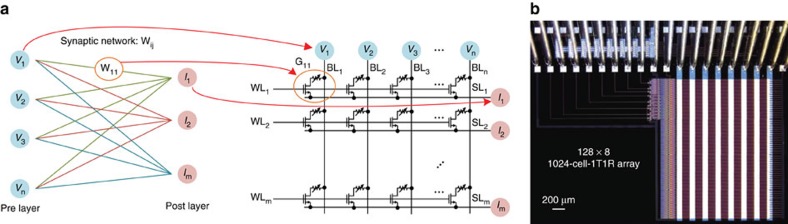
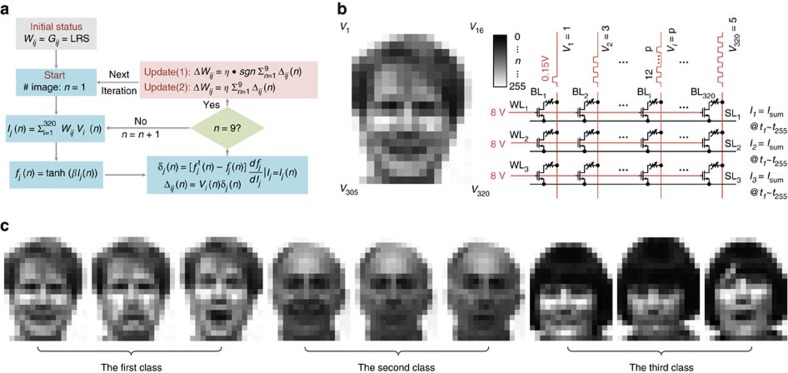
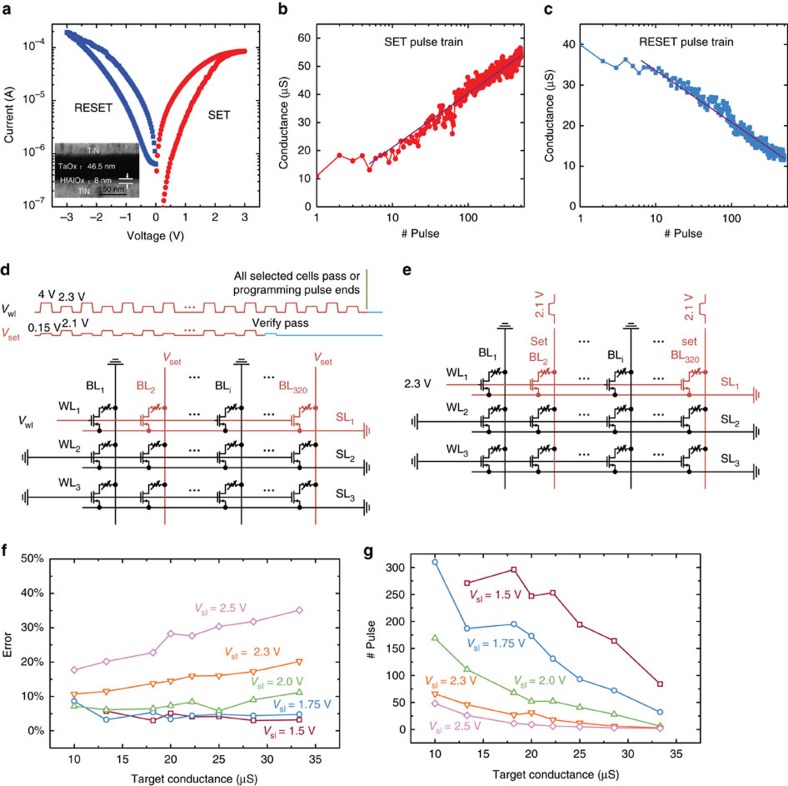
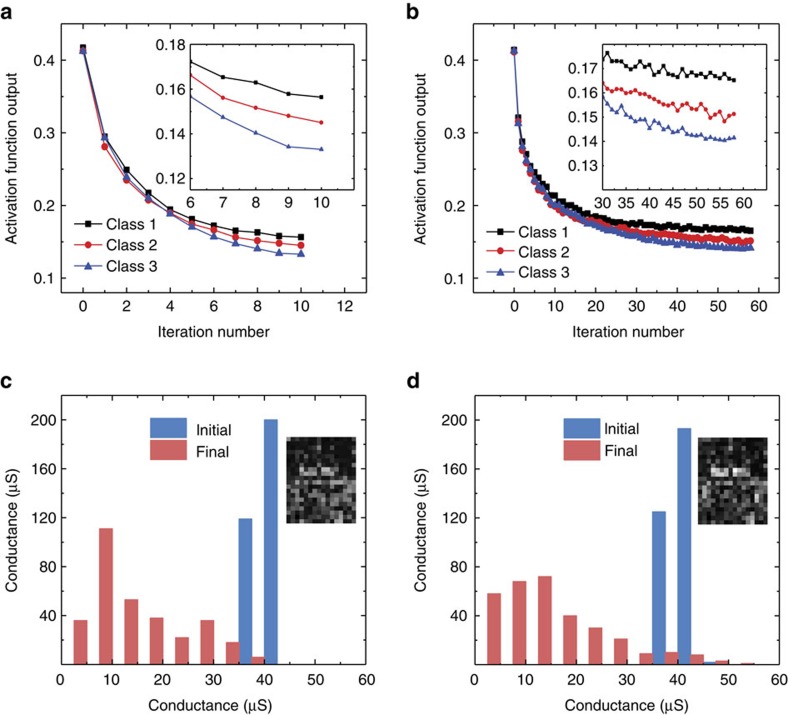
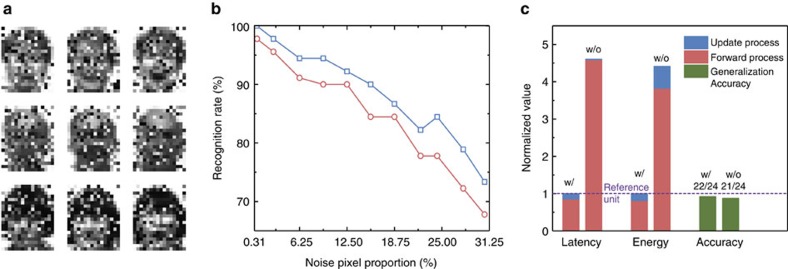
Conventional hardware platforms consume huge amount of energy for cognitive learning due to the data movement between the processor and the off-chip memory. Brain-inspired device technologies using analogue weight storage allow to complete cognitive tasks more efficiently. Here we present an analogue non-volatile resistive memory (an electronic synapse) with foundry friendly materials. The device shows bidirectional continuous weight modulation behaviour. Grey-scale face classification is experimentally demonstrated using an integrated 1024-cell array with parallel online training. The energy consumption within the analogue synapses for each iteration is 1,000 × (20 ×) lower compared to an implementation using Intel Xeon Phi processor with off-chip memory (with hypothetical on-chip digital resistive random access memory). The accuracy on test sets is close to the result using a central processing unit. These experimental results consolidate the feasibility of analogue synaptic array and pave the way toward building an energy efficient and large-scale neuromorphic system.
Overview
The claims and statistics of this paper haven’t been checked yet.
Free: it reads the open-access text and checks the first 5 claims that cite a source we can check. Create a free account to check every claim.
Integrity signals
Registry
Cites
Statistics
Figures
Verification
Claims the paper makes
The claims and statistics of this paper haven’t been checked yet.
Free: it reads the open-access text and checks the first 5 claims that cite a source we can check. Create a free account to check every claim.
Claims other papers make about this one
Each is checked against this paper’s own text: does it say what the citing paper says it does?
The cited source doesn’t support the claim as written.
In the citing paper
“the usual practice reported in the literature for this kind of training has been the use of the so-called Manhattan Update Rule105,194, or the Stochastic Gradient Descent54.”
From Hardware implementation of memristor-based artificial neural networks (2024) · cites this paper as [194]
Checked by a reasoning model — may be wrong.
Experimental — accuracy not yet measuredThe source backs part of the claim, not all of it — or backs it for a different population, condition or comparison.
In the citing paper
“leading to a variety of prototypes in which the circuitry needed for the backpropagation are implemented off-chip, an approach here labelled as partial-in situ. This is the case of refs. 54,105,194.”
From Hardware implementation of memristor-based artificial neural networks (2024) · cites this paper as [194]
Experimental — accuracy not yet measuredThe source backs part of the claim, not all of it — or backs it for a different population, condition or comparison.
In the citing paper
“In all these works the VMM operation required for the forward pass is performed by the memristor crossbar and the digitalized output vectors recorded by an acquisition printed circuit board. Then the output vector is processed by the training algorithm in software to determine how to update the synaptic weight after each training epoch.”
From Hardware implementation of memristor-based artificial neural networks (2024) · cites this paper as [194]
Experimental — accuracy not yet measuredThe source backs part of the claim, not all of it — or backs it for a different population, condition or comparison.
In the citing paper
“The most elementary approach is a sequential (row-by-row) analogue multiplication with binary inputs194, which does not perform an analogue VMM operation because, despite the multiplication operation is done in each memristor, the accumulation is performed by external circuitry.”
From Hardware implementation of memristor-based artificial neural networks (2024) · cites this paper as [194]
Experimental — accuracy not yet measuredThe cited source says what the claim attributes to it.
In the citing paper
“Some groups prefer to incorporate a transistor in series to each MIM cell to obtain a better control over the currents through the device (i.e., improve conductance controllability and minimize sneak path currents)53–55,60,61,102,113,167,194,218–222,).”
From Hardware implementation of memristor-based artificial neural networks (2024) · cites this paper as [194]
Self-check
Percentages, sums and reported differences re-computed from the paper’s own numbers.
The self-check needs the paper’s full text.
Citations
Cites
Gradient-based learning applied to document recognition
Lecun, Y., Bottou, L., Bengio, Y., & Haffner, P. (1998) · Proceedings of the IEEE · doi:10.1109/5.726791 · Cited by 58,805
ImageNet Large Scale Visual Recognition Challenge
Russakovsky, O., Deng, J., Su, H., Krause, J., Satheesh, S., Ma, S., Huang, Z., Karpathy, A., Khosla, A., Bernstein, M., et al. (2015) · International Journal of Computer Vision · doi:10.1007/s11263-015-0816-y · Cited by 39,380
Human-level control through deep reinforcement learning
Mnih, V., Kavukcuoglu, K., Silver, D., Rusu, A. A., Veness, J., Bellemare, M. G., Graves, A., Riedmiller, M., Fidjeland, A. K., Ostrovski, G., et al. (2015) · Nature · doi:10.1038/nature14236 · Cited by 30,357
Reducing the dimensionality of data with neural networks
Hinton, G. E., & Salakhutdinov, R. R. (2006) · Science · doi:10.1126/science.1127647 · Cited by 20,928
The perceptron: A probabilistic model for information storage and organization in the brain.
Rosenblatt, F. (1958) · Psychological Review · doi:10.1037/h0042519 · Cited by 12,280
Eigenfaces vs. Fisherfaces: recognition using class specific linear projection
Belhumeur, P. N., Hespanha, J. P., & Kriegman, D. J. (1997) · IEEE Transactions on Pattern Analysis and Machine Intelligence · doi:10.1109/34.598228 · Cited by 11,707
A million spiking-neuron integrated circuit with a scalable communication network and interface
Merolla, P. A., Arthur, J. V., Alvarez-Icaza, R., Cassidy, A. S., Sawada, J., Akopyan, F., Jackson, B. L., Imam, N., Guo, C., Nakamura, Y., et al. (2014) · Science · doi:10.1126/science.1254642 · Cited by 4,147
Training and operation of an integrated neuromorphic network based on metal-oxide memristors
Prezioso, M., Merrikh-Bayat, F., Hoskins, B. D., Adam, G. C., Likharev, K. K., & Strukov, D. B. (2015) · Nature · doi:10.1038/nature14441 · Cited by 3,001 · cited 3×
“Meanwhile, pattern recognition tasks based on analogue resistive random access memory (RRAM) have been demonstrated either through simulations or on a small crossbar array 13,14 .”
BackgroundMethodWong, H.-S. P., Lee, H.-Y., Yu, S., Chen, Y.-S., Wu, Y., Chen, P.-S., Lee, B., Chen, F. T., & Tsai, M.-J. (2012) · Proceedings of the IEEE · doi:10.1109/jproc.2012.2190369 · Cited by 2,757
Self-citationDeep learning applications and challenges in big data analytics
Najafabadi, M. M., Villanustre, F., Khoshgoftaar, T. M., Seliya, N., Wald, R., & Muharemagic, E. (2015) · Journal of Big Data · doi:10.1186/s40537-014-0007-7 · Cited by 2,594
Short-term plasticity and long-term potentiation mimicked in single inorganic synapses
Ohno, T., Hasegawa, T., Tsuruoka, T., Terabe, K., Gimzewski, J. K., & Aono, M. (2011) · Nature Materials · doi:10.1038/nmat3054 · Cited by 1,793
Neurogrid: A Mixed-Analog-Digital Multichip System for Large-Scale Neural Simulations
Benjamin, B. V., Gao, P., McQuinn, E., Choudhary, S., Chandrasekaran, A. R., Bussat, J.-M., Alvarez-Icaza, R., Arthur, J. V., Merolla, P. A., & Boahen, K. (2014) · Proceedings of the IEEE · doi:10.1109/jproc.2014.2313565 · Cited by 1,266
LeCun, Y. A., Bottou, L., Orr, G. B., & Müller, K.-R. (2012) · Lecture Notes in Computer Science · doi:10.1007/978-3-642-35289-8_3 · Cited by 1,264
Synaptic electronics: materials, devices and applications
Kuzum, D., Yu, S., & Philip Wong, H.-S. (2013) · Nanotechnology · doi:10.1088/0957-4484/24/38/382001 · Cited by 1,258
Self-citationEIE: Efficient Inference Engine on Compressed Deep Neural Network
Han, S., Liu, X., Mao, H., Pu, J., Pedram, A., Horowitz, M. A., & Dally, W. J. (2016) · 2016 ACM/IEEE 43rd Annual International Symposium on Computer Architecture (ISCA) · doi:10.1109/isca.2016.30 · Cited by 1,077
Memory leads the way to better computing
Wong, H.-S. P., & Salahuddin, S. (2015) · Nature Nanotechnology · doi:10.1038/nnano.2015.29 · Cited by 956
Self-citationBurr, G. W., Shelby, R. M., Sidler, S., di Nolfo, C., Jang, J., Boybat, I., Shenoy, R. S., Narayanan, P., Virwani, K., Giacometti, E. U., et al. (2015) · IEEE Transactions on Electron Devices · doi:10.1109/ted.2015.2439635 · Cited by 936 · cited 3×
“This is due to the nature of imperfection of the device 11,13,15 , such as abrupt switching during SET, the variation between each cell and the fluctuation during repeated cycles.”
BackgroundMethodKim, K.-H., Gaba, S., Wheeler, D., Cruz-Albrecht, J. M., Hussain, T., Srinivasa, N., & Lu, W. (2012) · Nano Letters · doi:10.1021/nl203687n · Cited by 924 · cited 2×
“Besides, they are compatible with CMOS fabrication process 30–32 and can be scaled down 33 remarkably to reach density as high as 10 11 synapses per cm 2 .”
BackgroundMethodPattern classification by memristive crossbar circuits using ex situ and in situ training
Alibart, F., Zamanidoost, E., & Strukov, D. B. (2013) · Nature Communications · doi:10.1038/ncomms3072 · Cited by 642
Integration of nanoscale memristor synapses in neuromorphic computing architectures
Indiveri, G., Linares-Barranco, B., Legenstein, R., Deligeorgis, G., & Prodromakis, T. (2013) · Nanotechnology · doi:10.1088/0957-4484/24/38/384010 · Cited by 613
Yu, S., Gao, B., Fang, Z., Yu, H., Kang, J., & Wong, H. ‐. P. (2013) · Advanced Materials · doi:10.1002/adma.201203680 · Cited by 527
Self-citationGokmen, T., & Vlasov, Y. (2016) · Frontiers in Neuroscience · doi:10.3389/fnins.2016.00333 · Cited by 491
Learning long‐range vision for autonomous off‐road driving
Hadsell, R., Sermanet, P., Ben, J., Erkan, A., Scoffier, M., Kavukcuoglu, K., Muller, U., & LeCun, Y. (2009) · Journal of Field Robotics · doi:10.1002/rob.20276 · Cited by 314
Wafer-scale integration of analog neural networks
Schemmel, J., Fieres, J., & Meier, K. (2008) · 2008 IEEE International Joint Conference on Neural Networks (IEEE World Congress on Computational Intelligence) · doi:10.1109/ijcnn.2008.4633828 · Cited by 275
SpiNNaker: Mapping neural networks onto a massively-parallel chip multiprocessor
Khan, M. M., Lester, D. R., Plana, L. A., Rast, A., Jin, X., Painkras, E., & Furber, S. B. (2008) · 2008 IEEE International Joint Conference on Neural Networks (IEEE World Congress on Computational Intelligence) · doi:10.1109/ijcnn.2008.4634199 · Cited by 270
Dynamically Reconfigurable Silicon Array of Spiking Neurons With Conductance-Based Synapses
Vogelstein, R. J., Mallik, U., Vogelstein, J. T., & Cauwenberghs, G. (2007) · IEEE Transactions on Neural Networks · doi:10.1109/tnn.2006.883007 · Cited by 220
Electronic system with memristive synapses for pattern recognition
Park, S., Chu, M., Kim, J., Noh, J., Jeon, M., Hun Lee, B., Hwang, H., Lee, B., & Lee, B.-G. (2015) · Scientific Reports · doi:10.1038/srep10123 · Cited by 181 · cited 2×
“Meanwhile, pattern recognition tasks based on analogue resistive random access memory (RRAM) have been demonstrated either through simulations or on a small crossbar array 13,14 .”
BackgroundMethodOptimization of the Backpropagation Algorithm for Training Multilayer Perceptrons
Schiffmann, W. H., Joost, M., & Werner, R. (1994) · Cited by 137
Eryilmaz, S. B., Kuzum, D., Yu, S., & Wong, H. ‐. P. (2015) · Technical digest - International Electron Devices Meeting/Technical digest · doi:10.1109/iedm.2015.7409622 · Cited by 102
Self-citationProgramming Protocol Optimization for Analog Weight Tuning in Resistive Memories
Gao, L., Chen, P.-Y., & Yu, S. (2015) · IEEE Electron Device Letters · doi:10.1109/led.2015.2481819 · Cited by 101
Energy characterization and instruction-level energy model of Intel's Xeon Phi processor
Shao, Y. S., & Brooks, D. M. (2013) · International Symposium on Low Power Electronics and Design (ISLPED) · doi:10.1109/islped.2013.6629328 · Cited by 81
A comprehensive study of energy efficiency and performance of flash-based SSD
Park, S., Kim, Y., Urgaonkar, B., Lee, J., & Seo, E. (2011) · Journal of Systems Architecture · doi:10.1016/j.sysarc.2011.01.005 · Cited by 51
Hertz, J., Krogh, A., & Palmer, R. G. (2018) · CRC Press eBooks · doi:10.1201/9780429499661-1 · Cited by 50
Research works printed but not linked: 6
- Le, Q. V. in Acoustics, Speech and Signal Processing (ICASSP), 2013 IEEE International Conference 8595–8598 (IEEE, 2013).
- Krizhevsky, A., Sutskever, I. & Hinton, G. E. in Advances in Neural Information Processing Systems 1097–1105 (Curran Associates, Inc., 2012).
- Fackenthal, R. et al. in Solid-State Circuits Conference Digest of Technical Papers (ISSCC), 2014 IEEE International, 338–339 (IEEE, 2014).
- Govoreanu, B. et al. in Electron Devices Meeting (IEDM), 2011 IEEE International, 31.36. 31–31.36. 34 (IEEE, 2011).
- Sekar, D. et al. in 2014 IEEE International Electron Devices Meeting, 28.23. 21–28.23. 24 (IEEE, 2014).
- Burr, G. et al. in 2015 IEEE International Electron Devices Meeting (IEDM), 4.4. 1–4.4. 4 (IEEE, 2015).
Cited by
Memory devices and applications for in-memory computing
Sebastian, A., Le Gallo, M., Khaddam-Aljameh, R., & Eleftheriou, E. (2020) · Nature Nanotechnology · doi:10.1038/s41565-020-0655-z · Cited by 2,289
Fully hardware-implemented memristor convolutional neural network
Yao, P., Wu, H., Gao, B., Tang, J., Zhang, Q., Zhang, W., Yang, J. J., & Qian, H. (2020) · Nature · doi:10.1038/s41586-020-1942-4 · Cited by 2,179
Self-citationMemristive crossbar arrays for brain-inspired computing
Xia, Q., & Yang, J. J. (2019) · Nature Materials · doi:10.1038/s41563-019-0291-x · Cited by 1,800
Optoelectronic resistive random access memory for neuromorphic vision sensors
Zhou, F., Zhou, Z., Chen, J., Choy, T. H., Wang, J., Zhang, N., Lin, Z., Yu, S., Kang, J., Wong, H.-S. P., et al. (2019) · Nature Nanotechnology · doi:10.1038/s41565-019-0501-3 · Cited by 1,322
Self-citationAnalogue signal and image processing with large memristor crossbars
Li, C., Hu, M., Li, Y., Jiang, H., Ge, N., Montgomery, E., Zhang, J., Song, W., Dávila, N., Graves, C. E., et al. (2017) · Nature Electronics · doi:10.1038/s41928-017-0002-z · Cited by 1,292
Metadata
- Authors
- Yao, P., Wu, H., Gao, B., Eryilmaz, S. B., Huang, X., Zhang, W., Zhang, Q., Deng, N., Shi, L., Wong, H.-S. P., & Qian, H.
- Affiliations
- Tsinghua University (CN)
- Stanford SystemX Alliance (US)
- Corresponding author
- Wu, Huaqiang
- ORCID
- Venue
- Nature Communications
- Published
- 2017-05-12
- Volume
- 8
- Issue
- 1
- Pages
- 15199-15199
- ISSN
- 2041-1723 (ISSN-L)
- PMC
- PMC5437298
- OpenAlex
- W2613205562
- Cited by
- 909
- References
- 34
- Citations by year
- 2026: 41 · 2025: 73 · 2024: 91 · 2023: 106 · 2022: 120 · 2021: 127 · 2020: 132 · 2019: 113 · 2018: 91 · 2017: 14
- FWCI
- 39.80
- Type
- journal article
- Language
- en
- Open access
- gold
- doi.org
- Licence
- cc-by
- creativecommons.org/licenses/by/4.0 (tdm)
- creativecommons.org/licenses/by/4.0 (vor)
- Locations
- Nature Communications (publishedVersion, cc-by)
- Europe PMC (PubMed Central) (publishedVersion, cc-by)
- PubMed Central (publishedVersion, cc-by)
- PubMed (publishedVersion)
- RePEc: Research Papers in Economics (submittedVersion)
- DOAJ (DOAJ: Directory of Open Access Journals) (submittedVersion, cc-by-sa)
- Funders
- National Science Foundation (1317470)
- Yale University
- Arizona State University
- Stanford SystemX Alliance
- National Natural Science Foundation of China (61674089)
- Beijing Innovation Center for Future Chip
- National Key Research and Development Program of China
- Topics
- Physical Sciences › Engineering › Electrical and Electronic Engineering › Advanced Memory and Neural Computing
- Physical Sciences › Computer Science › Artificial Intelligence › Neural Networks and Reservoir Computing
- Physical Sciences › Engineering › Electrical and Electronic Engineering › Ferroelectric and Negative Capacitance Devices
- Keywords
- electronic synapses, resistive random access memory, neuromorphic hardware, face classification, synaptic arrays, energy efficiency, neuromorphic computing
About these checks
Registry, retraction, Cites and statistics results are computed, not judged, with one exception: a printed reference that no index lists is read once by a model before it counts as a citation error. Claims are extracted by a model and kept only when their quote appears verbatim in the text; each cited source is then checked, with a model’s help, for whether it says what the claim relies on. Those verdicts can be wrong — read the claim’s quote and the cited source before relying on one.
Statistics and arithmetic are recomputed, not judged.
Confidence bands are shown only for fields calibrated on our annotated test set. None is calibrated yet, so no band is shown.
What counts as a claim ›How we measure confidence ›How we check this ›
Are you an author, or do you see a problem with this page? Request a review
Data sources
Bibliographic data: Semantic Scholar, OpenAlex, Crossref.
Contains information from the Semantic Scholar Academic Graph Datasets, made available under the ODC Attribution License (ODC-BY 1.0).
Semantic Scholar’s data is described in: Kinney, R., et al. (2023). The Semantic Scholar Open Data Platform. arXiv:2301.10140.
