

Face classification using electronic synapses
Open accessThe DOI matches its Crossref record; 33 of the 34 references it cites were found in a registry or an index.
Abstract
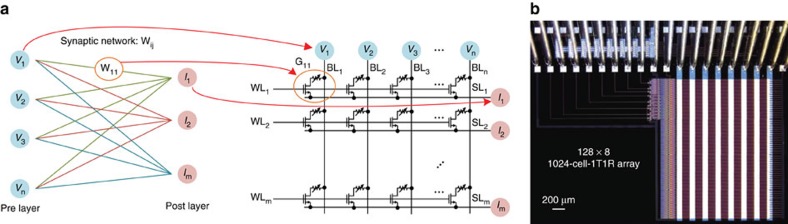
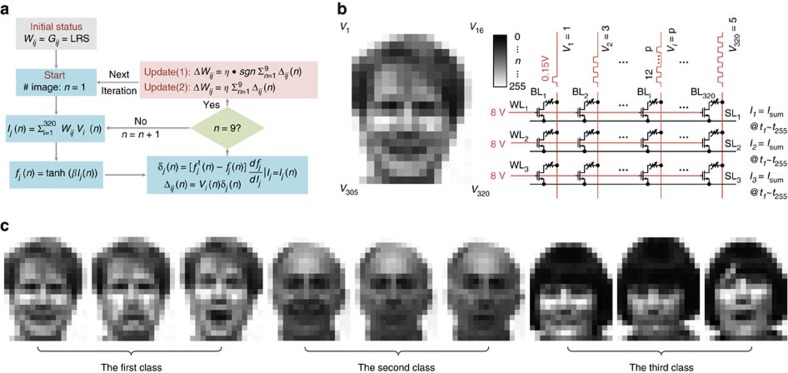
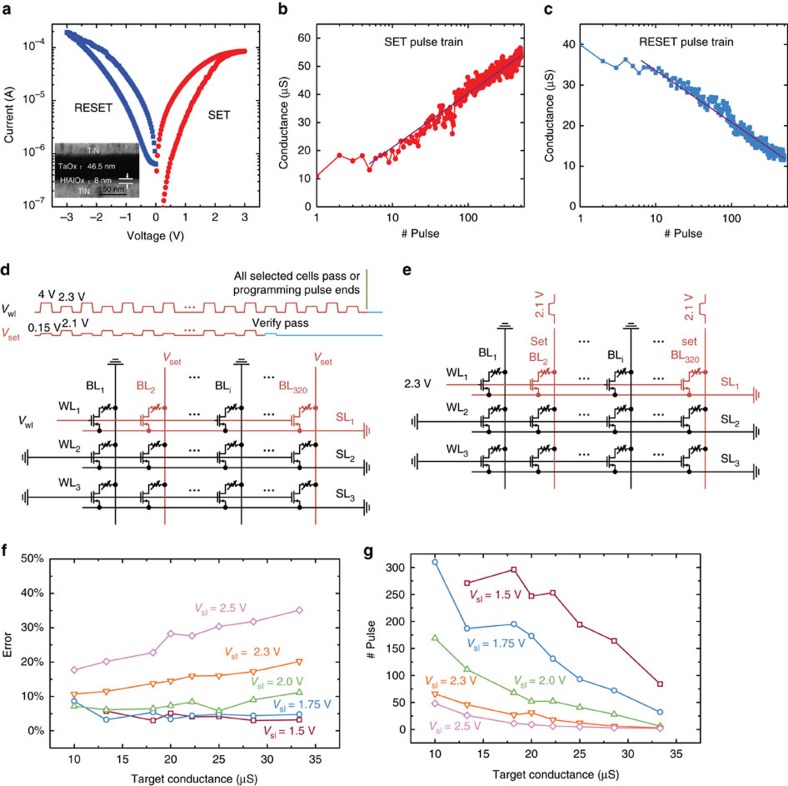
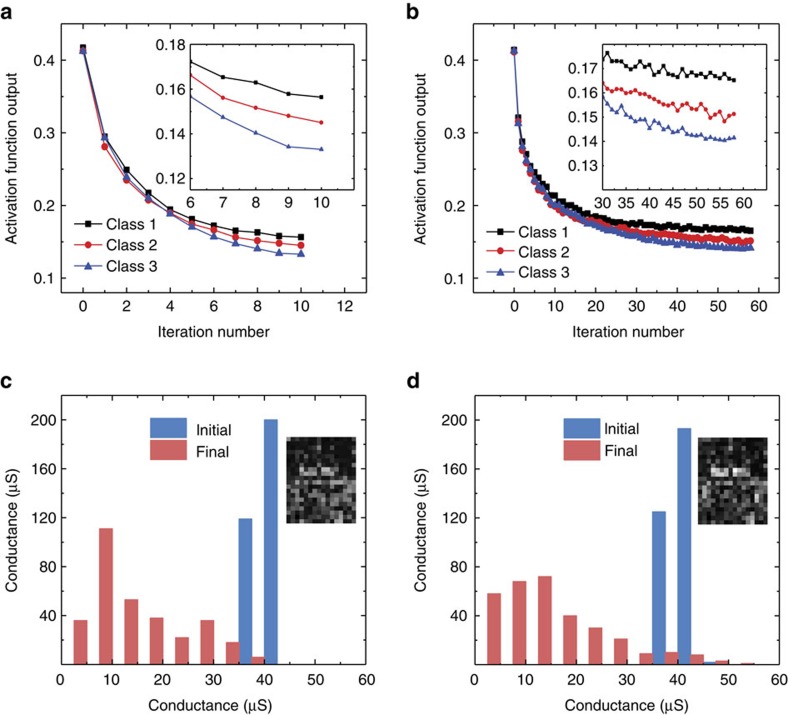
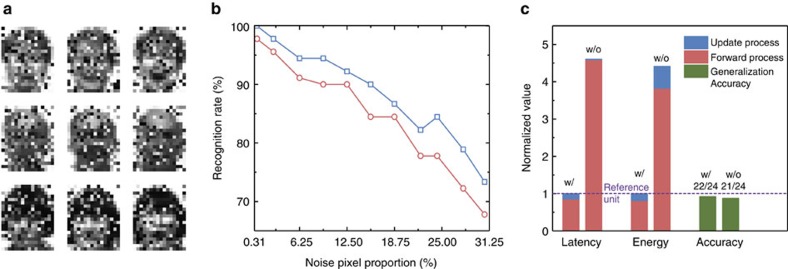
Conventional hardware platforms consume huge amount of energy for cognitive learning due to the data movement between the processor and the off-chip memory. Brain-inspired device technologies using analogue weight storage allow to complete cognitive tasks more efficiently. Here we present an analogue non-volatile resistive memory (an electronic synapse) with foundry friendly materials. The device shows bidirectional continuous weight modulation behaviour. Grey-scale face classification is experimentally demonstrated using an integrated 1024-cell array with parallel online training. The energy consumption within the analogue synapses for each iteration is 1,000 × (20 ×) lower compared to an implementation using Intel Xeon Phi processor with off-chip memory (with hypothetical on-chip digital resistive random access memory). The accuracy on test sets is close to the result using a central processing unit. These experimental results consolidate the feasibility of analogue synaptic array and pave the way toward building an energy efficient and large-scale neuromorphic system.
Overview
The claims and statistics of this paper haven’t been checked yet.
Free: it reads the open-access text and checks the first 5 claims that cite a source we can check. Create a free account to check every claim.
Integrity signals
Registry
Cites
Statistics
Figures
Verification
Claims the paper makes
The claims and statistics of this paper haven’t been checked yet.
Free: it reads the open-access text and checks the first 5 claims that cite a source we can check. Create a free account to check every claim.
Claims other papers make about this one
Each is checked against this paper’s own text: does it say what the citing paper says it does?
The cited source doesn’t support the claim as written.
In the citing paper
“the usual practice reported in the literature for this kind of training has been the use of the so-called Manhattan Update Rule105,194, or the Stochastic Gradient Descent54.”
From Hardware implementation of memristor-based artificial neural networks (2024) · cites this paper as [194]
Checked by a reasoning model — may be wrong.
Experimental — accuracy not yet measuredThe source backs part of the claim, not all of it — or backs it for a different population, condition or comparison.
In the citing paper
“leading to a variety of prototypes in which the circuitry needed for the backpropagation are implemented off-chip, an approach here labelled as partial-in situ. This is the case of refs. 54,105,194.”
From Hardware implementation of memristor-based artificial neural networks (2024) · cites this paper as [194]
Experimental — accuracy not yet measuredThe source backs part of the claim, not all of it — or backs it for a different population, condition or comparison.
In the citing paper
“In all these works the VMM operation required for the forward pass is performed by the memristor crossbar and the digitalized output vectors recorded by an acquisition printed circuit board. Then the output vector is processed by the training algorithm in software to determine how to update the synaptic weight after each training epoch.”
From Hardware implementation of memristor-based artificial neural networks (2024) · cites this paper as [194]
Experimental — accuracy not yet measuredThe source backs part of the claim, not all of it — or backs it for a different population, condition or comparison.
In the citing paper
“The most elementary approach is a sequential (row-by-row) analogue multiplication with binary inputs194, which does not perform an analogue VMM operation because, despite the multiplication operation is done in each memristor, the accumulation is performed by external circuitry.”
From Hardware implementation of memristor-based artificial neural networks (2024) · cites this paper as [194]
Experimental — accuracy not yet measuredThe cited source says what the claim attributes to it.
In the citing paper
“Some groups prefer to incorporate a transistor in series to each MIM cell to obtain a better control over the currents through the device (i.e., improve conductance controllability and minimize sneak path currents)53–55,60,61,102,113,167,194,218–222,).”
From Hardware implementation of memristor-based artificial neural networks (2024) · cites this paper as [194]
Self-check
Percentages, sums and reported differences re-computed from the paper’s own numbers.
The self-check needs the paper’s full text.
Citations
Cites
Gradient-based learning applied to document recognition
Lecun, Y., Bottou, L., Bengio, Y., & Haffner, P. (1998) · Proceedings of the IEEE · doi:10.1109/5.726791 · Cited by 58,805
ImageNet Large Scale Visual Recognition Challenge
Russakovsky, O., Deng, J., Su, H., Krause, J., Satheesh, S., Ma, S., Huang, Z., Karpathy, A., Khosla, A., Bernstein, M., et al. (2015) · International Journal of Computer Vision · doi:10.1007/s11263-015-0816-y · Cited by 39,380
Human-level control through deep reinforcement learning
Mnih, V., Kavukcuoglu, K., Silver, D., Rusu, A. A., Veness, J., Bellemare, M. G., Graves, A., Riedmiller, M., Fidjeland, A. K., Ostrovski, G., et al. (2015) · Nature · doi:10.1038/nature14236 · Cited by 30,357
Reducing the dimensionality of data with neural networks
Hinton, G. E., & Salakhutdinov, R. R. (2006) · Science · doi:10.1126/science.1127647 · Cited by 20,928
The perceptron: A probabilistic model for information storage and organization in the brain.
Rosenblatt, F. (1958) · Psychological Review · doi:10.1037/h0042519 · Cited by 12,280
Eigenfaces vs. Fisherfaces: recognition using class specific linear projection
Belhumeur, P. N., Hespanha, J. P., & Kriegman, D. J. (1997) · IEEE Transactions on Pattern Analysis and Machine Intelligence · doi:10.1109/34.598228 · Cited by 11,707
A million spiking-neuron integrated circuit with a scalable communication network and interface
Merolla, P. A., Arthur, J. V., Alvarez-Icaza, R., Cassidy, A. S., Sawada, J., Akopyan, F., Jackson, B. L., Imam, N., Guo, C., Nakamura, Y., et al. (2014) · Science · doi:10.1126/science.1254642 · Cited by 4,147
Training and operation of an integrated neuromorphic network based on metal-oxide memristors
Prezioso, M., Merrikh-Bayat, F., Hoskins, B. D., Adam, G. C., Likharev, K. K., & Strukov, D. B. (2015) · Nature · doi:10.1038/nature14441 · Cited by 3,001 · cited 3×
“Meanwhile, pattern recognition tasks based on analogue resistive random access memory (RRAM) have been demonstrated either through simulations or on a small crossbar array 13,14 .”
BackgroundMethodWong, H.-S. P., Lee, H.-Y., Yu, S., Chen, Y.-S., Wu, Y., Chen, P.-S., Lee, B., Chen, F. T., & Tsai, M.-J. (2012) · Proceedings of the IEEE · doi:10.1109/jproc.2012.2190369 · Cited by 2,757
Self-citationDeep learning applications and challenges in big data analytics
Najafabadi, M. M., Villanustre, F., Khoshgoftaar, T. M., Seliya, N., Wald, R., & Muharemagic, E. (2015) · Journal of Big Data · doi:10.1186/s40537-014-0007-7 · Cited by 2,594
Research works printed but not linked: 6
- Le, Q. V. in Acoustics, Speech and Signal Processing (ICASSP), 2013 IEEE International Conference 8595–8598 (IEEE, 2013).
- Krizhevsky, A., Sutskever, I. & Hinton, G. E. in Advances in Neural Information Processing Systems 1097–1105 (Curran Associates, Inc., 2012).
- Fackenthal, R. et al. in Solid-State Circuits Conference Digest of Technical Papers (ISSCC), 2014 IEEE International, 338–339 (IEEE, 2014).
- Govoreanu, B. et al. in Electron Devices Meeting (IEDM), 2011 IEEE International, 31.36. 31–31.36. 34 (IEEE, 2011).
- Sekar, D. et al. in 2014 IEEE International Electron Devices Meeting, 28.23. 21–28.23. 24 (IEEE, 2014).
- Burr, G. et al. in 2015 IEEE International Electron Devices Meeting (IEDM), 4.4. 1–4.4. 4 (IEEE, 2015).
Cited by
Items 701–800 of 918
Shen, Y., Shih, Y., Wang, Y., Wang, K., Yang, T., Cyu, R., Yu, Y., & Chueh, Y. (2021) · ACS Materials Letters · doi:10.1021/acsmaterialslett.1c00513 · Cited by 6
Solving Least-Squares Fitting in $O(1)$ Using RRAM-based Computing-in-Memory Technique
Chen, X., & Han, Y. (2022) · Asia and South Pacific Design Automation Conference (ASP-DAC) · doi:10.1109/asp-dac52403.2022.9712568 · Cited by 6
The Image Identification Application with HfO2-Based Replaceable 1T1R Neural Networks
Lin, J., Liu, H., Wang, S., Wang, D., & Wu, L. (2022) · Nanomaterials · doi:10.3390/nano12071075 · Cited by 6
Aziz, I., Ciou, J., Kongcharoen, H., & Lee, P. S. (2022) · Journal of Applied Physics · doi:10.1063/5.0096620 · Cited by 6
Zhang, Y., Chen, B., Deng, X., Guan, Z., Chen, B., Chen, Y., Zhong, N., Xiang, P., & Duan, C. (2022) · Journal of Materials Chemistry C · doi:10.1039/d2tc01592g · Cited by 6
A Wide Dynamic Range Read-out System For Resistive Switching Technology
Xie, L., Shen, J., Mifsud, A., Wang, C., Alshaya, A., & Papavassiliou, C. (2022) · IEEE International Symposium on Circuits and Systems proceedings · doi:10.1109/iscas48785.2022.9937616 · Cited by 6
Study on Memristor-Based 3-D Convolutional Neural Network Adapting to Non-Ideal Effects
Dong, B., Li, P., Fu, Y., Chang, T., Li, Y., Miao, X., & He, Y. (2023) · IEEE Transactions on Electron Devices · doi:10.1109/ted.2022.3233552 · Cited by 6
Oxide Memristors for Brain-inspired Computing
Zhuge, X., Renxiang, Z. H. U., Jianmin, W. A. N. G., Wang, J., & Zhuge, F. (2023) · Journal of Inorganic Materials · doi:10.15541/jim20230066 · Cited by 6
Percolation theory based statistical resistance model for resistive random access memory
Wang, L., Thean, A., & Liang, G. (2018) · Applied Physics Letters · doi:10.1063/1.5023196 · Cited by 6
Midya, R., Wang, Z., Rao, M., Upadhyay, N. K., & Yang, J. J. (2019) · Elsevier eBooks · doi:10.1016/b978-0-08-102584-0.00015-2 · Cited by 7
Berco, D., & Ang, D. S. (2019) · Journal of Vacuum Science & Technology B Nanotechnology and Microelectronics Materials Processing Measurement and Phenomena · doi:10.1116/1.5123665 · Cited by 6
Terasa, M.-I., Holtz, P., Carstens, N., Kaps, S., Faupel, F., Vahl, A., & Adelung, R. (2022) · PLoS ONE · doi:10.1371/journal.pone.0264846 · Cited by 6
XBarNet: Computationally Efficient Memristor Crossbar Model Using Convolutional Autoencoder
Zhang, Y., He, G., Wang, G., & Li, Y. (2022) · IEEE Transactions on Computer-Aided Design of Integrated Circuits and Systems · doi:10.1109/tcad.2022.3163895 · Cited by 6
Photomemristor Structures Based on 2D Crystals for Biocompatible Information Sensor Systems
Panin, G. N., & Kapitanova, O. O. (2021) · Nanobiotechnology Reports · doi:10.1134/s2635167621060173 · Cited by 5
Zhang, H., Huang, B., Zhang, Z., Cheng, C., Zhang, Z., Chen, R., Bao, L., & Xie, Y. (2023) · Optics Communications · doi:10.1016/j.optcom.2023.130017 · Cited by 5
Reliability-Enhanced Reverse Forming Operation Scheme for Analog Resistive Random-Access Memory
Jiang, Z., Xi, Y., Lu, Y., Tang, J., Hu, R., Du, Y., Gao, B., Qian, H., & Wu, H. (2024) · IEEE Electron Device Letters · doi:10.1109/led.2024.3521924 · Cited by 5
Self-citationJang, J., Song, Y., & Park, S. (2024) · Advanced Intelligent Systems · doi:10.1002/aisy.202400710 · Cited by 5
Multilevel Nanoarray Spin–Orbit Torque Device for Process-in-Memory Applications
Koh, D., Kim, D., Kim, T.-H., Kang, M., Viet, D. D., Hong, H., Jeong, J., Park, J., & Park, B. (2025) · Nano Letters · doi:10.1021/acs.nanolett.5c02634 · Cited by 5
Shao, K., Liao, Z., Yu, J., Zhao, L., Li, Q., Huang, X., He, J., Tian, F., Zou, Y., Wang, X., et al. (2025) · International Symposium on Low Power Electronics and Design (ISLPED) · doi:10.1109/islped65674.2025.11261807 · Cited by 6
Self-citationArtificial Synaptic Behavior of Lead-Free Cu 3 Sb 2 I 9 Perovskite Memristors
Li, H., Meng, L., Sun, J., & Zhang, X. G. (2025) · The Journal of Physical Chemistry Letters · doi:10.1021/acs.jpclett.5c03606 · Cited by 5
Wang, Y., Xiong, W., Yan, J., Zhou, Y., Zhu, C., Miao, X., He, Y., & Chai, Y. (2026) · Nature Communications · doi:10.1038/s41467-026-69898-9 · Cited by 5
Wu, Q., Xie, C., Li, X., Chen, H., Xie, L., Wang, Q., Sui, Z., Song, S., & Song, Z. (2023) · IEEE Transactions on Electron Devices · doi:10.1109/ted.2023.3288514 · Cited by 5
Programming Techniques of Resistive Random-Access Memory Devices for Neuromorphic Computing
Machado, P., Manich, S., Gómez‐Pau, Á., Rodriguez-Montanes, R., González, M. B., Campabadal, F., & Arumí, D. (2023) · Electronics · doi:10.3390/electronics12234803 · Cited by 5
Physics-Informed Learning for Versatile RRAM Reset and Retention Simulation
Hou, T., Ren, Y., Zhou, W., Li, C., Wang, Z., Chen, H., & Wong, N. (2024) · Asia and South Pacific Design Automation Conference (ASP-DAC) · doi:10.1109/asp-dac58780.2024.10473856 · Cited by 5
Effect of Programming Schemes on Short-Term Instability in 1T1R Configuration
Liu, X., Chen, Y., Kopperberg, N., Solfronk, O., Hoffmann‐Eifert, S., Menzel, S., Waser, R. M., & Wiefels, S. (2025) · IEEE Access · doi:10.1109/access.2025.3547818 · Cited by 5
Bi, J.-H., Yang, S., Zhang, P., & Chen, S. (2024) · Globecom · doi:10.1109/globecom52923.2024.10901048 · Cited by 5
Nikiruy, K. E., Emelyanov, A. V., Rylkov, V. V., Ситников, А. В., Presnyakov, M. Y., Kukueva, E. V., Grishchenko, Y. V., Minnekhanov, A. A., Chernoglazov, K. Y., Nikolaev, S. N., et al. (2019) · Journal of Communications Technology and Electronics · doi:10.1134/s1064226919100103 · Cited by 5
Vector multiplications using memristive devices and applications thereof
Zidan, M. A., & Lu, W. D. (2020) · Elsevier eBooks · doi:10.1016/b978-0-08-102782-0.00009-5 · Cited by 6
Transfer modeling of 1T1R crossbar arrays with line resistances based on matrix algebra method
Zhang, X., Zeng, Y., Yuan, L., & Zhou, L. P. (2021) · Solid-State Electronics · doi:10.1016/j.sse.2021.108220 · Cited by 5
Application of neuromorphic resistive random access memory in image processing
Jiang, B., Zhou, F., & Chai, Y. (2022) · Acta Physica Sinica · doi:10.7498/aps.71.20220463 · Cited by 5
Computing with nonvolatile memories for artificial intelligence
Pedretti, G., & Ielmini, D. (2022) · Elsevier eBooks · doi:10.1016/b978-0-12-820758-1.00009-1 · Cited by 7
A Novel Structured Single Device Neuron for Low Standby Power and Compact System Application
Lee, G., Oh, J., Shin, E. J., Kim, S., Park, Y., Kim, M. J., Choi, S., & Cho, B. J. (2023) · IEEE Electron Device Letters · doi:10.1109/led.2023.3240419 · Cited by 5
Device-circuit co-design of memristor-based on niobium oxide for large-scale crossbar memory
Gupta, A. K., Yadav, M. S., & Rawat, B. (2023) · Memories - Materials Devices Circuits and Systems · doi:10.1016/j.memori.2023.100080 · Cited by 5
Full-system-integrated neuro-inspired memristor chips for edge intelligence
Hua, Q., & Shen, G. (2023) · 中国科学通报:英文版 · doi:10.1016/j.scib.2023.11.042 · Cited by 5
Reconfigurable nanoionic and photoionic material and device platforms
Elfarash, A. H., & Gholipour, B. (2024) · Advances in Physics X · doi:10.1080/23746149.2024.2338285 · Cited by 6
Hang, C.-Z., Wang, C., Gao, B., Chen, H., Xu, M., Hao, L., & Lü, H.-L. (2019) · Applied Physics Letters · doi:10.1063/1.5078782 · Cited by 5
Self-citationA Reduced Architecture for ReRAM-Based Neural Network Accelerator and Its Software Stack
Ji, Y., Liu, Z., & Zhang, Y. (2020) · IEEE Transactions on Computers · doi:10.1109/tc.2020.2988248 · Cited by 9
RRAM-Based Neuromorphic Computing Systems
Dananjaya, P. A., Gopalakrishnan, R., & Lew, W. S. (2021) · Springer eBooks · doi:10.1007/978-981-15-6912-8_12 · Cited by 6
Song, H., An, J., Son, S., Kim, Y. S., Park, J., Jeon, J. B., Kim, G., & Kim, K. M. (2020) · Advanced Intelligent Systems · doi:10.1002/aisy.202000014 · Cited by 4
Dong, W., Wang, S., Zhao, B., Xu, C., Liu, Y., An, C., Zhang, X., Qi, M., Han, Y., & Geng, Y. (2025) · Small · doi:10.1002/smll.202502740 · Cited by 4
Pan, S., Li, X., Bai, J. G., Jia, G., Ying, X., Xiong, Z., & Yan, X. (2025) · Applied Physics Letters · doi:10.1063/5.0280404 · Cited by 4
Oxide-based Resistive RAM Analog Synaptic Behavior Assessment for Neuromemristive systems
Aziza, H. (2023) · IntechOpen eBooks · doi:10.5772/intechopen.1002782 · Cited by 4
Hasler, J., & Basu, A. (2024) · Neuromorphic Computing and Engineering · doi:10.1088/2634-4386/ad9b4a · Cited by 4
Self-compliance characteristics and switching degradation in TaO x -based memristors
Jiang, M., Wang, B., Xue, K., Liu, N., Sun, H., Lu, H., & Miao, X. (2019) · Applied Physics Express · doi:10.7567/1882-0786/ab42d0 · Cited by 4
Memristor, mem-systems and neuromorphic applications: a review
Pham, V., VOLOS, C. K., & Kapitaniak, T. (2021) · Elsevier eBooks · doi:10.1016/b978-0-12-821184-7.00022-0 · Cited by 5
Elsonbaty, A., Elsadany, A. A., & Adel, W. (2023) · Fractal and Fractional · doi:10.3390/fractalfract7040282 · Cited by 5
TOSA: Tolerating Stuck-At-Faults in Edge-based RRAM Inference Accelerators
Zhao, S., Liu, B., Wang, F., Feng, D., & Chen, X. (2023) · IEEE International Conference on Parallel and Distributed Systems (ICPADS) · doi:10.1109/icpads60453.2023.00172 · Cited by 5
Structurally simplified GCMO crossbar design for artificial synaptic networks
Antola, A., Angervo, I., Huhtinen, H., Miettinen, M., Schulman, A., & Paturi, P. (2024) · Applied Physics Letters · doi:10.1063/5.0210544 · Cited by 4
Cheng, Z., Wang, H., Guan, Z., Zhu, Z., Shen, S., Yin, Y., & Li, X. (2025) · ACS Applied Materials & Interfaces · doi:10.1021/acsami.5c00740 · Cited by 4
Two modes of bipolar resistive switching characteristics in asymmetric TaOx-based ReRAM cells
Miyatani, T., Nishi, Y., & Kimoto, T. (2019) · MRS Advances · doi:10.1557/adv.2019.316 · Cited by 4
Graphene synaptic transistor based on Ion-Gel dielectric
Chen, L., Gong, C., Zhang, G., Han, C., Li, X., & Liu, W. (2019) · IEEE International Conference on Electron Devices and Solid-State Circuits (EDSSC) · doi:10.1109/edssc.2019.8754160 · Cited by 4
A Serial Access Scheme Design on Memristor-CMOS Hybrid Memory
Guo, Y., Wang, X., Hong, Q., & Zhang, Y. (2020) · IEEE Access · doi:10.1109/access.2020.2974015 · Cited by 4
Accurate Weight Mapping in a Multi-Memristive Synaptic Unit
Martemucci, M., Kersting, B., Khaddam-Aljameh, R., Boybat, I., Nandakumar, S. R., Egger, U., BrightSky, M. J., Bruce, R. L., Gallo, M. L., & Sebastian, A. (2021) · IEEE International Symposium on Circuits and Systems proceedings · doi:10.1109/iscas51556.2021.9401558 · Cited by 4
Zhang, B., Wu, Y., Zeng, X., Guo, Y., Wang, B., & Cao, J. (2021) · Journal of Applied Physics · doi:10.1063/5.0049928 · Cited by 4
Ta/HfO2 memristors: from device physics to neural networks
Jiang, H., Li, C., & Xia, Q. (2022) · Japanese Journal of Applied Physics · doi:10.35848/1347-4065/ac665d · Cited by 4
Memristor’s characteristics: From non-ideal to ideal
Sun, F., Su, J., Li, J., Duan, S., & Hu, X. (2022) · Chinese Physics B · doi:10.1088/1674-1056/ac7548 · Cited by 4
Feng, Y., Huang, P. C., Chen, Y., Zhang, Y., Li, R., Zhou, Z., Liu, L., Liu, X., & Kang, J. (2023) · IEEE Electron Device Letters · doi:10.1109/led.2023.3239608 · Cited by 4
Pure-Attention-Based Multifunction Memristive Neuromorphic Circuit and System
Xiao, H., Sun, H., Zhao, T., Zhou, Y., & Hu, X. (2023) · International Journal of Bifurcation and Chaos · doi:10.1142/s0218127423300239 · Cited by 4
Competitive conductive mechanism of interstitial Ag and oxygen vacancies in Ag/Ta2O5/Pt stack
Hu, Q., Fan, Z.-Q., Huang, A., Zhang, X., Zhao, R., Gao, Q., Ji, Y., Dou, W., Wang, M., Shi, H., et al. (2019) · Journal of Applied Physics · doi:10.1063/1.5109267 · Cited by 4
A Circuit Implementation of Random Number Generator Utilizing Memristor Stochasticity
Guo, Y., Wu, Q., & Wang, X. (2021) · International Conference on Advanced Computational Intelligence (ICACI) · doi:10.1109/icaci52617.2021.9435904 · Cited by 4
Energy-Efficient Brain Floating Point Convolutional Neural Network Using Memristors
Tong, S.-Q., Bao, H., Li, J.-C., Yang, L., Zhou, H.-J., Li, Y., & Miao, X.-S. (2024) · IEEE Transactions on Electron Devices · doi:10.1109/ted.2024.3379953 · Cited by 3
Transforming edge hardware with in situ learning features
Yao, P., Gao, B., & Wu, H. (2024) · Nature Reviews Electrical Engineering · doi:10.1038/s44287-024-00031-y · Cited by 3
Self-citationZhang, B., Zhang, Y., Luo, K., Guo, Y., Yan, Z., Lv, W., Wang, B., Li, Z., Hu, Z., Wang, Q., et al. (2024) · physica status solidi (RRL) - Rapid Research Letters · doi:10.1002/pssr.202400166 · Cited by 3
Shingaya, Y., Nishioka, D., Terabe, K., & Tsuchiya, T. (2025) · Applied Physics Letters · doi:10.1063/5.0266816 · Cited by 3
Biomimetic halide perovskite synapses for neuromorphic computing
Sun, Z., Zhao, X., Si, H., Liao, Q., & Zhang, Y. (2026) · eScience · doi:10.1016/j.esci.2026.100558 · Cited by 3
Bai, Y., Kong, Y., Liu, S., Liu, M., Chen, S., Ma, H., Duan, X., Yang, W., Yang, J., Jiang, X., et al. (2026) · ACS Applied Materials & Interfaces · doi:10.1021/acsami.6c01554 · Cited by 3
Memristive Neural Network with Efficient In-Situ Supervised Training
Prajaprati, S., Mondal, M. N., & Sur‐Kolay, S. (2022) · IEEE International System-on-Chip Conference (SOCC) · doi:10.1109/socc56010.2022.9908131 · Cited by 3
Analysis of Conductance Variability in RRAM for Accurate Neuromorphic Computing
Aziza, H., Postel-Pellerin, J., Fieback, M., Hamdioui, S., Xun, H., Taouil, M., Castellani-Coulié, K., & Rahajandraibe, W. (2024) · IEEE Latin American Test Symposium (LATS) · doi:10.1109/lats62223.2024.10534620 · Cited by 3
Artificial neuromorphic devices based on magnetic tunnel junctions
Wang, Y., Zhang, L., Luo, R., Lu, Y., Fang, B., & Zeng, Z. (2025) · Chinese Science Bulletin (Chinese Version) · doi:10.1360/tb-2024-0931 · Cited by 3
Lahkar, S., Bragaglia, V., Bagheri, B., Falcone, D. F., Galetta, M., Sousa, M., & Todri‐Sanial, A. (2026) · ACS Applied Materials & Interfaces · doi:10.1021/acsami.5c16414 · Cited by 3
Intelligent Computing with RRAM
Yao, P., Zhang, W., Zhao, M., Lin, Y., Wu, W., Gao, B., Qian, H., & Wu, H. (2019) · IEEE International Memory Workshop (IMW) · doi:10.1109/imw.2019.8739764 · Cited by 3
Self-citationWu, L., Wang, Z., Yu, Z., Qin, Y., Chen, Q., Cai, Y., & Huang, R. (2021) · IEEE Electron Devices Technology & Manufacturing Conference (EDTM) · doi:10.1109/edtm50988.2021.9421034 · Cited by 3
Analogue In-Memory Computing with Resistive Switching Memories
Pedretti, G., & Ielmini, D. (2022) · Springer eBooks · doi:10.1007/978-3-031-03841-9_4 · Cited by 3
Review on data-centric brain-inspired computing paradigms exploiting emerging memory devices
Wang, W. J., Kvatinsky, S., Schmidt, H., & Du, N. (2022) · Frontiers in Electronic Materials · doi:10.3389/femat.2022.1020076 · Cited by 3
Ferroelectric memristor based on Li-doped BiFeO3 for information processing
Wang, L., Sun, J., Zhang, Y., Niu, J., Zhao, Z., Guo, Z., Zhang, Z., Shao, Y., Sun, S., Jia, X., et al. (2022) · Applied Physics Letters · doi:10.1063/5.0131063 · Cited by 3
Nonuniform magnetic domain-wall synapses enabled by population coding
Qiao, Y., Zhang, Y., & Yuan, Z. (2023) · New Journal of Physics · doi:10.1088/1367-2630/acc5a7 · Cited by 3
Lee, S., Hour, L., Kim, Y., & Han, Y. (2024) · Physica Scripta · doi:10.1088/1402-4896/ad2752 · Cited by 3
Synaptic behavior of a composite multiferroic heterostructure FeBSiC – PZT at resonant excitation
Fedulov, F. A., Savelev, D. V., & Fetisov, Y. K. (2024) · Modern Electronic Materials · doi:10.3897/j.moem.10.2.124089 · Cited by 3
DTGA: an in-situ training scheme for memristor neural networks with high performance
Shen, S., Guo, M., Wang, L., & Duan, S. (2024) · Applied Intelligence · doi:10.1007/s10489-024-06091-9 · Cited by 3
Choi, W. C., Yun, Y., Lee, S., Kang, Y., Jung, H. S., Cho, I. S., & Lee, S. (2025) · Journal of Alloys and Compounds · doi:10.1016/j.jallcom.2025.178787 · Cited by 3
Wang, X., He, J., Shao, K., Zheng, J., Tian, F., Cheng, K.-T. T., & Tsui, C.-Y. (2024) · doi:10.1145/3676536.3676751 · Cited by 3
Scalable 3D Ta:SiOx Memristive Devices
Jiang, H., Li, C., Lin, P., Pi, S., Yang, J. J., & Xia, Q. (2019) · Advanced Electronic Materials · doi:10.1002/aelm.201800958 · Cited by 3
IPlock: An Effective Hybrid Encryption for Neuromorphic Systems IP Core Protection
He, G., Dong, C., Liu, Y., & Fan, X. (2020) · IEEE Information Technology, Networking, Electronic and Automation Control Conference (ITNEC) · doi:10.1109/itnec48623.2020.9085144 · Cited by 3
Xu, H., Sun, Y., Zhu, Y., Wang, X., & Qin, G. (2021) · Journal of Physics D Applied Physics · doi:10.1088/1361-6463/ac296d · Cited by 3
Shchanikov, S., Zuev, A. D., Bordanov, I., Danilin, S. N., Korolev, D. S., Belov, A. I., Pigareva, Y., Pimashkin, A. S., Mikhaylov, A. N., & Kazantsev, V. (2020) · arXiv (Cornell University) · doi:10.48550/arxiv.2004.00154 · Cited by 3
Tunable magnetic synapse for reliable neuromorphic computing
Mou, H., Luo, Z., & Zhang, X. (2024) · Applied Physics Letters · doi:10.1063/5.0210317 · Cited by 2
Two-terminal photovoltaic neuromorphic device with temporal dynamics for reservoir computing
Fang, H., Wang, J., Ma, S., Zhao, L., Liu, Z., Nie, F., Lü, W., & Zheng, L. (2025) · Applied Physics Letters · doi:10.1063/5.0255395 · Cited by 2
Park, M., Chien, H.-T., Chen, W.-C., Mimi, A. A., Wan, W., Woo, K. S., Yi, S., & Kumar, S. (2025) · npj Unconventional Computing · doi:10.1038/s44335-025-00035-3 · Cited by 4
Jiao, Y., Zhao, H., Tang, J., Zhou, Y., Hu, R., Jiang, H., Li, X. Z., Huang, J., Sun, B., Sun, W. B., et al. (2025) · National Science Review · doi:10.1093/nsr/nwaf499 · Cited by 2
Self-citationEvolution of Neural Network Models and Computing-in-Memory Architectures
Kumar, A., Devi, M., Singh, S. K., Singh, K., & Mishra, D. (2025) · Archives of Computational Methods in Engineering · doi:10.1007/s11831-025-10481-8 · Cited by 3
Memristive Reservoir Computing Circuit for Real-Time Prediction of Epilepsy
Lu, L., Xu, A., Wu, Y., Deng, M., Sun, Y., Li, Z., Wang, Y., & Li, Q. (2026) · IEEE Transactions on Biomedical Circuits and Systems · doi:10.1109/tbcas.2026.3662427 · Cited by 2
Robust memristive neural networks with efficient in-situ training
Prajapati, S., Mondal, M. N., & Sur‐Kolay, S. (2026) · Integration · doi:10.1016/j.vlsi.2026.102897 · Cited by 2
Efficient Weight Mapping Scheme without Verification for RRAM Based Neuromorphic Computing
Zhang, S., Wu, H., Gao, B., & Qian, H. (2019) · China Semiconductor Technology International Conference (CSTIC) · doi:10.1109/cstic.2019.8755721 · Cited by 2
Self-citationPark, S., Lee, G., Kwon, Y., Suh, D. I., Lee, H., Je, S., Kim, D., Lee, D., Ryu, S., Kim, S., et al. (2022) · IEEE International Memory Workshop (IMW) · doi:10.1109/imw52921.2022.9779296 · Cited by 2
Experimental Analysis of Oxide-Based RAM Analog Synaptic Behavior
Aziza, H., Postel-Pellerin, J., & Moreau, M. (2022) · Electronics · doi:10.3390/electronics12010049 · Cited by 2
A Memristive Cell with Long Retention Time in 65 nm CMOS Technology
Assaf, H., Savaria, Y., Ali, M., Nabavi, M., & Sawan, M. (2023) · Advanced Electronic Materials · doi:10.1002/aelm.202300010 · Cited by 2
Jin, H., Zhu, H., Zhu, K., Leonard, T., Kwon, J., Alamdar, M., Kim, K.-S., Park, J., Hase, N., Pan, D. Z., et al. (2023) · IEEE Transactions on Nanotechnology · doi:10.1109/tnano.2023.3343667 · Cited by 2
Wei, W., Wang, C., Pan, C., Yangdong, X.-J., Yang, Z.-Z., Yang, Y., Cheng, B., Liang, S., & Miao, F. (2024) · APL Machine Learning · doi:10.1063/5.0195190 · Cited by 2
Petrov, M. O., Ryndin, E. A., & Andreeva, N. V. (2024) · The European Physical Journal Special Topics · doi:10.1140/epjs/s11734-024-01369-y · Cited by 2
Myoung, S. J., Lee, H., Shin, D. H., Seo, Y., Kim, W. S., Cho, J. R., Kim, C., Bae, J., Choi, S., Kim, D. M., et al. (2025) · IEEE Transactions on Electron Devices · doi:10.1109/ted.2025.3550465 · Cited by 2
Metadata
- Authors
- Yao, P., Wu, H., Gao, B., Eryilmaz, S. B., Huang, X., Zhang, W., Zhang, Q., Deng, N., Shi, L., Wong, H.-S. P., & Qian, H.
- Affiliations
- Tsinghua University (CN)
- Stanford SystemX Alliance (US)
- Corresponding author
- Wu, Huaqiang
- ORCID
- Venue
- Nature Communications
- Published
- 2017-05-12
- Volume
- 8
- Issue
- 1
- Pages
- 15199-15199
- ISSN
- 2041-1723 (ISSN-L)
- PMC
- PMC5437298
- OpenAlex
- W2613205562
- Cited by
- 909
- References
- 34
- Citations by year
- 2026: 41 · 2025: 73 · 2024: 91 · 2023: 106 · 2022: 120 · 2021: 127 · 2020: 132 · 2019: 113 · 2018: 91 · 2017: 14
- FWCI
- 39.80
- Type
- journal article
- Language
- en
- Open access
- gold
- doi.org
- Licence
- cc-by
- creativecommons.org/licenses/by/4.0 (tdm)
- creativecommons.org/licenses/by/4.0 (vor)
- Locations
- Nature Communications (publishedVersion, cc-by)
- Europe PMC (PubMed Central) (publishedVersion, cc-by)
- PubMed Central (publishedVersion, cc-by)
- PubMed (publishedVersion)
- RePEc: Research Papers in Economics (submittedVersion)
- DOAJ (DOAJ: Directory of Open Access Journals) (submittedVersion, cc-by-sa)
- Funders
- National Science Foundation (1317470)
- Yale University
- Arizona State University
- Stanford SystemX Alliance
- National Natural Science Foundation of China (61674089)
- Beijing Innovation Center for Future Chip
- National Key Research and Development Program of China
- Topics
- Physical Sciences › Engineering › Electrical and Electronic Engineering › Advanced Memory and Neural Computing
- Physical Sciences › Computer Science › Artificial Intelligence › Neural Networks and Reservoir Computing
- Physical Sciences › Engineering › Electrical and Electronic Engineering › Ferroelectric and Negative Capacitance Devices
- Keywords
- electronic synapses, resistive random access memory, neuromorphic hardware, face classification, synaptic arrays, energy efficiency, neuromorphic computing
About these checks
Registry, retraction, Cites and statistics results are computed, not judged, with one exception: a printed reference that no index lists is read once by a model before it counts as a citation error. Claims are extracted by a model and kept only when their quote appears verbatim in the text; each cited source is then checked, with a model’s help, for whether it says what the claim relies on. Those verdicts can be wrong — read the claim’s quote and the cited source before relying on one.
Statistics and arithmetic are recomputed, not judged.
Confidence bands are shown only for fields calibrated on our annotated test set. None is calibrated yet, so no band is shown.
What counts as a claim ›How we measure confidence ›How we check this ›
Are you an author, or do you see a problem with this page? Request a review
Data sources
Bibliographic data: Semantic Scholar, OpenAlex, Crossref.
Contains information from the Semantic Scholar Academic Graph Datasets, made available under the ODC Attribution License (ODC-BY 1.0).
Semantic Scholar’s data is described in: Kinney, R., et al. (2023). The Semantic Scholar Open Data Platform. arXiv:2301.10140.
