

Tau association with synaptic vesicles causes presynaptic dysfunction
Open accessThe DOI matches its Crossref record; 72 of the 72 references it cites were found in a registry or an index.
Abstract
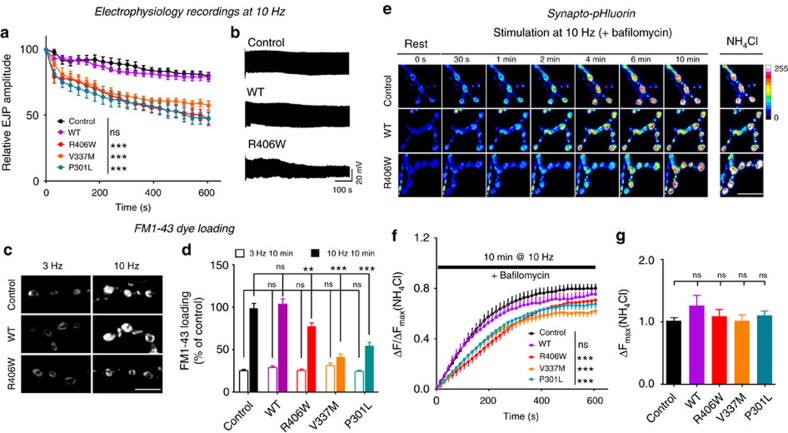
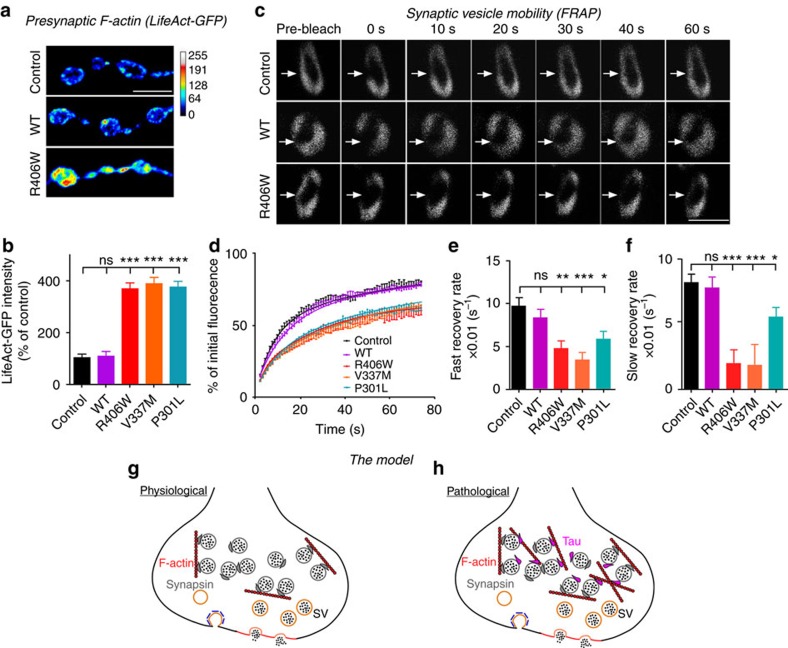
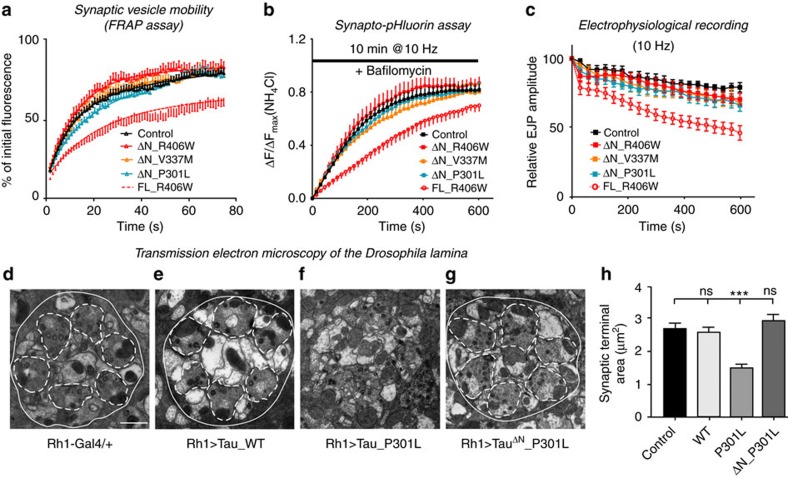
Tau is implicated in more than 20 neurodegenerative diseases, including Alzheimer’s disease. Under pathological conditions, Tau dissociates from axonal microtubules and missorts to pre- and postsynaptic terminals. Patients suffer from early synaptic dysfunction prior to Tau aggregate formation, but the underlying mechanism is unclear. Here we show that pathogenic Tau binds to synaptic vesicles via its N-terminal domain and interferes with presynaptic functions, including synaptic vesicle mobility and release rate, lowering neurotransmission in fly and rat neurons. Pathological Tau mutants lacking the vesicle binding domain still localize to the presynaptic compartment but do not impair synaptic function in fly neurons. Moreover, an exogenously applied membrane-permeable peptide that competes for Tau-vesicle binding suppresses Tau-induced synaptic toxicity in rat neurons. Our work uncovers a presynaptic role of Tau that may be part of the early pathology in various Tauopathies and could be exploited therapeutically.
Overview
The claims and statistics of this paper haven’t been checked yet.
Free: it reads the open-access text and checks the first 5 claims that cite a source we can check. Create a free account to check every claim.
Integrity signals
Registry
Cites
Statistics
Figures


Verification
Claims the paper makes
The claims and statistics of this paper haven’t been checked yet.
Free: it reads the open-access text and checks the first 5 claims that cite a source we can check. Create a free account to check every claim.
Claims other papers make about this one
Each is checked against this paper’s own text: does it say what the citing paper says it does?
The source backs part of the claim, not all of it — or backs it for a different population, condition or comparison.
In the citing paper
“The movement of vesicles and endo-lysosomal compartments along axons is a key part of amyloid fibril formation and vesicle-mediated aggregation of Tau proteins [7, 87].”
From Abnormal accumulation of extracellular vesicles in hippocampal dystrophic axons and regulation by the primary cilia in Alzheimer's disease (2023) · cites this paper as [87]
Experimental — accuracy not yet measured
Self-check
Percentages, sums and reported differences re-computed from the paper’s own numbers.
The self-check needs the paper’s full text.
Citations
Cites
Amyloid oligomers exacerbate tau pathology in a mouse model of tauopathy
Selenica, M.-L. B., Brownlow, M., Jimenez, J. P., Lee, D. C., Pena, G., Dickey, C. A., Gordon, M. N., & Morgan, D. (2013) · Neurodegenerative Diseases · doi:10.1159/000337230 · Cited by 10,359
Visualizing secretion and synaptic transmission with pH-sensitive green fluorescent proteins
Miesenböck, G., De Angelis, D. A., & Rothman, J. E. (1998) · Nature · doi:10.1038/28190 · Cited by 2,563
Tau in physiology and pathology
Wang, Y., & Mandelkow, E. (2016) · Nature Reviews Neuroscience · doi:10.1038/nrn.2015.1 · Cited by 2,251
Self-citationSynapse Loss and Microglial Activation Precede Tangles in a P301S Tauopathy Mouse Model
Yoshiyama, Y., Higuchi, M., Zhang, B., Huang, S.-M., Iwata, N., Saido, T. C., Maeda, J., Suhara, T., Trojanowski, J. Q., & Lee, V. M.-Y. (2007) · Neuron · doi:10.1016/j.neuron.2007.01.010 · Cited by 2,208
Tau-mediated neurodegeneration in Alzheimer’s disease and related disorders
Ballatore, C., Lee, V. M.-Y., & Trojanowski, J. Q. (2007) · Nature Reviews Neuroscience · doi:10.1038/nrn2194 · Cited by 2,174
Tau Suppression in a Neurodegenerative Mouse Model Improves Memory Function
SantaCruz, K., Lewis, J., Spires, T., Paulson, J., Kotilinek, L., Ingelsson, M., Guimaraes, A., DeTure, M., Ramsden, M., McGowan, E., et al. (2005) · Science · doi:10.1126/science.1113694 · Cited by 2,014
Self-citationReducing Endogenous Tau Ameliorates Amyloid ß-Induced Deficits in an Alzheimer's Disease Mouse Model
Roberson, E. D., Scearce-Levie, K., Palop, J. J., Yan, F., Cheng, I. H., Wu, T., Gerstein, H., Yu, G.-Q., & Mucke, L. (2007) · Science · doi:10.1126/science.1141736 · Cited by 1,892
Dendritic Function of Tau Mediates Amyloid-β Toxicity in Alzheimer's Disease Mouse Models
Ittner, L. M., Ke, Y. D., Delerue, F., Bi, M., Gladbach, A., van Eersel, J., Wölfing, H., Chieng, B. C., Christie, M. J., Napier, I. A., et al. (2010) · Cell · doi:10.1016/j.cell.2010.06.036 · Cited by 1,821
Hoover, B. R., Reed, M. N., Su, J., Penrod, R. D., Kotilinek, L. A., Grant, M. K., Pitstick, R., Carlson, G. A., Lanier, L. M., Yuan, L.-L., et al. (2010) · Neuron · doi:10.1016/j.neuron.2010.11.030 · Cited by 1,118
Hippocampal synaptic loss in early Alzheimer's disease and mild cognitive impairment
Scheff, S. W., Price, D. A., Schmitt, F. A., & Mufson, E. J. (2006) · Neurobiology of Aging · doi:10.1016/j.neurobiolaging.2005.09.012 · Cited by 1,017
Mutation-Specific Functional Impairments in Distinct Tau Isoforms of Hereditary FTDP-17
Hong, M. (1998) · Science · doi:10.1126/science.282.5395.1914 · Cited by 1,003
Tauopathy in Drosophila : Neurodegeneration Without Neurofibrillary Tangles
Wittmann, C. W., Wszolek, M. F., Shulman, J. M., Salvaterra, P. M., Lewis, J., Hutton, M., & Feany, M. B. (2001) · Science · doi:10.1126/science.1062382 · Cited by 939
Morris, M., Maeda, S., Vossel, K., & Mucke, L. (2011) · Neuron · doi:10.1016/j.neuron.2011.04.009 · Cited by 899
Verstreken, P., Ly, C. V., Venken, K. J. T., Koh, T.-W., Zhou, Y., & Bellen, H. J. (2005) · Neuron · doi:10.1016/j.neuron.2005.06.018 · Cited by 841
Self-citationTau is essential to β-amyloid-induced neurotoxicity
Rapoport, M., Dawson, H. N., Binder, L. I., Vitek, M. P., & Ferreira, A. (2002) · Proceedings of the National Academy of Sciences · doi:10.1073/pnas.092136199 · Cited by 807
Cognitive functions of gamma-band activity: memory match and utilization
Herrmann, C. S., Munk, M. H. J., & Engel, A. K. (2004) · Trends in Cognitive Sciences · doi:10.1016/j.tics.2004.06.006 · Cited by 761
Altered expression of synaptic proteins occurs early during progression of Alzheimer's disease
Masliah, E., Mallory, M., Alford, M., DeTeresa, R., Hansen, L. A., McKeel, D. W., & Morris, J. C. (2001) · Neurology · doi:10.1212/wnl.56.1.127 · Cited by 720
Bekkers, J. M., & Stevens, C. F. (1991) · Proceedings of the National Academy of Sciences · doi:10.1073/pnas.88.17.7834 · Cited by 579
Lachaux, J.-P., Axmacher, N., Mormann, F., Halgren, E., & Crone, N. E. (2012) · Progress in Neurobiology · doi:10.1016/j.pneurobio.2012.06.008 · Cited by 506
Tau promotes neurodegeneration through global chromatin relaxation
Frost, B., Hemberg, M., Lewis, J., & Feany, M. B. (2014) · Nature Neuroscience · doi:10.1038/nn.3639 · Cited by 495
Penzes, P., Beeser, A., Chernoff, J., Schiller, M. R., Eipper, B. A., Mains, R. E., & Huganir, R. L. (2003) · Neuron · doi:10.1016/s0896-6273(02)01168-6 · Cited by 466
Saheki, Y., & De Camilli, P. (2012) · Cold Spring Harbor Perspectives in Biology · doi:10.1101/cshperspect.a005645 · Cited by 457
Abnormal bundling and accumulation of F-actin mediates tau-induced neuronal degeneration in vivo
Fulga, T. A., Elson-Schwab, I., Khurana, V., Steinhilb, M. L., Spires, T. L., Hyman, B. T., & Feany, M. B. (2007) · Nature Cell Biology · doi:10.1038/ncb1528 · Cited by 452
Self-citationTai, H.-C., Serrano-Pozo, A., Hashimoto, T., Frosch, M. P., Spires-Jones, T. L., & Hyman, B. T. (2012) · The American Journal of Pathology · doi:10.1016/j.ajpath.2012.06.033 · Cited by 443
Self-citationPrion-like behaviour and tau-dependent cytotoxicity of pyroglutamylated amyloid-β
Nussbaum, J. M., Schilling, S., Cynis, H., Silva, A., Swanson, E., Wangsanut, T., Tayler, K., Wiltgen, B., Hatami, A., Rönicke, R., et al. (2012) · Nature · doi:10.1038/nature11060 · Cited by 427
Diao, J., Burré, J., Vivona, S., Cipriano, D. J., Sharma, M., Kyoung, M., Südhof, T. C., & Brunger, A. T. (2013) · eLife · doi:10.7554/elife.00592 · Cited by 350
Endophilin Mutations Block Clathrin-Mediated Endocytosis but Not Neurotransmitter Release
Verstreken, P., Kjaerulff, O., Lloyd, T. E., Atkinson, R., Zhou, Y., Meinertzhagen, I. A., & Bellen, H. J. (2002) · Cell · doi:10.1016/s0092-8674(02)00688-8 · Cited by 333
Self-citationOxidative stress mediates tau-induced neurodegeneration in Drosophila
Dias-Santagata, D., Fulga, T. A., Duttaroy, A., & Feany, M. B. (2007) · Journal of Clinical Investigation · doi:10.1172/jci28769 · Cited by 318
Early synaptic pathophysiology in neurodegeneration: insights from Huntington's disease
Milnerwood, A. J., & Raymond, L. A. (2010) · Trends in Neurosciences · doi:10.1016/j.tins.2010.08.002 · Cited by 312
Antisense Reduction of Tau in Adult Mice Protects against Seizures
DeVos, S. L., Goncharoff, D. K., Chen, G., Kebodeaux, C. S., Yamada, K., Stewart, F. R., Schuler, D. R., Maloney, S. E., Wozniak, D. F., Rigo, F., et al. (2013) · Journal of Neuroscience · doi:10.1523/jneurosci.2107-13.2013 · Cited by 311
Sydow, A., Van der Jeugd, A., Zheng, F., Ahmed, T., Balschun, D., Petrova, O., Drexler, D., Zhou, L., Rune, G., Mandelkow, E., et al. (2011) · The Journal of Neuroscience · doi:10.1523/jneurosci.5245-10.2011 · Cited by 302
Self-citationSynaptic Vesicle Pools and Dynamics
Alabi, A. A., & Tsien, R. W. (2012) · Cold Spring Harbor Perspectives in Biology · doi:10.1101/cshperspect.a013680 · Cited by 284
α-Synuclein Multimers Cluster Synaptic Vesicles and Attenuate Recycling
Wang, L., Das, U., Scott, D. A., Tang, Y., McLean, P. J., & Roy, S. (2014) · Current Biology · doi:10.1016/j.cub.2014.08.027 · Cited by 272
TOR-Mediated Cell-Cycle Activation Causes Neurodegeneration in a Drosophila Tauopathy Model
Khurana, V., Lu, Y., Steinhilb, M. L., Oldham, S., Shulman, J. M., & Feany, M. B. (2006) · Current Biology · doi:10.1016/j.cub.2005.12.042 · Cited by 266
Specification of synaptic connectivity by cell surface interactions
de Wit, J., & Ghosh, A. (2016) · Nature Reviews Neuroscience · doi:10.1038/nrn.2015.3 · Cited by 242
Holth, J. K., Bomben, V. C., Reed, J. G., Inoue, T., Younkin, L., Younkin, S. G., Pautler, R. G., Botas, J., & Noebels, J. L. (2013) · The Journal of Neuroscience · doi:10.1523/jneurosci.3191-12.2013 · Cited by 238
Loss of Skywalker Reveals Synaptic Endosomes as Sorting Stations for Synaptic Vesicle Proteins
Uytterhoeven, V., Kuenen, S., Kasprowicz, J., Miskiewicz, K., & Verstreken, P. (2011) · Cell · doi:10.1016/j.cell.2011.02.039 · Cited by 226
Self-citationThe Kinetics of Synaptic Vesicle Pool Depletion at CNS Synaptic Terminals
Fernández-Alfonso, T., & Ryan, T. A. (2004) · Neuron · doi:10.1016/s0896-6273(04)00113-8 · Cited by 225
Co-Localization of Amyloid Beta and Tau Pathology in Alzheimer's Disease Synaptosomes
Fein, J. A., Sokolow, S., Miller, C. A., Vinters, H. V., Yang, F., Cole, G. M., & Gylys, K. H. (2008) · The American Journal of Pathology · doi:10.2353/ajpath.2008.070829 · Cited by 204
Cortical gamma responses: Searching high and low
Crone, N. E., Korzeniewska, A., & Franaszczuk, P. J. (2011) · International Journal of Psychophysiology · doi:10.1016/j.ijpsycho.2010.10.013 · Cited by 201
Structural and functional changes in tau mutant mice neurons are not linked to the presence of NFTs
Rocher, A. B., Crimins, J. L., Amatrudo, J. M., Kinson, M. S., Todd-Brown, M. A., Lewis, J., & Luebke, J. I. (2010) · Experimental Neurology · doi:10.1016/j.expneurol.2009.07.029 · Cited by 187
Tau Phosphorylation Sites Work in Concert to Promote Neurotoxicity In Vivo
Steinhilb, M. L., Dias-Santagata, D., Fulga, T. A., Felch, D. L., & Feany, M. B. (2007) · Molecular Biology of the Cell · doi:10.1091/mbc.e07-04-0327 · Cited by 187
Caspase-2 cleavage of tau reversibly impairs memory
Zhao, X., Kotilinek, L. A., Smith, B., Hlynialuk, C., Zahs, K., Ramsden, M., Cleary, J., & Ashe, K. H. (2016) · Nature Medicine · doi:10.1038/nm.4199 · Cited by 187
Pathological Tau Disrupts Ongoing Network Activity
Menkes-Caspi, N., Yamin, H. G., Kellner, V., Spires-Jones, T. L., Cohen, D., & Stern, E. A. (2015) · Neuron · doi:10.1016/j.neuron.2015.01.025 · Cited by 184
Self-citationAssociation of MAPT haplotypes with Alzheimer’s disease risk and MAPT brain gene expression levels
Allen, M., Kachadoorian, M., Quicksall, Z., Zou, F., Chai, H. S., Younkin, C. S., Crook, J. E., Pankratz, V. S., Carrasquillo, M. M., Krishnan, S., et al. (2014) · Alzheimer s Research & Therapy · doi:10.1186/alzrt268 · Cited by 172
Tau haplotypes regulate transcription and are associated with Parkinson's disease
Kwok, J. B. J., Teber, E. T., Loy, C., Hallupp, M., Nicholson, G., Mellick, G. D., Buchanan, D. D., Silburn, P. A., & Schofield, P. R. (2004) · Annals of Neurology · doi:10.1002/ana.10826 · Cited by 159
Mismatched Appositions of Presynaptic and Postsynaptic Components in Isolated Hippocampal Neurons
Rao, A., Cha, E. M., & Craig, A. M. (2000) · Journal of Neuroscience · doi:10.1523/jneurosci.20-22-08344.2000 · Cited by 154
Crimins, J. L., Rocher, A. B., & Luebke, J. I. (2012) · Acta Neuropathologica · doi:10.1007/s00401-012-1038-9 · Cited by 153
Harris, J. A., Koyama, A., Maeda, S., Ho, K., Devidze, N., Dubal, D. B., Yu, G.-Q., Masliah, E., & Mucke, L. (2012) · PLoS ONE · doi:10.1371/journal.pone.0045881 · Cited by 148
The proline-rich domain of tau plays a role in interactions with actin
He, H. J., Wang, X. S., Pan, R., Wang, D. L., Liu, M. N., & He, R. Q. (2009) · BMC Cell Biology · doi:10.1186/1471-2121-10-81 · Cited by 142
Sara, Y., Mozhayeva, M. G., Liu, X., & Kavalali, E. T. (2002) · Journal of Neuroscience · doi:10.1523/jneurosci.22-05-01608.2002 · Cited by 141
Pre‐synaptic C‐terminal truncated tau is released from cortical synapses in Alzheimer's disease
Sokolow, S., Henkins, K. M., Bilousova, T., Gonzalez, B., Vinters, H. V., Miller, C. A., Cornwell, L., Poon, W. W., & Gylys, K. H. (2015) · Journal of Neurochemistry · doi:10.1111/jnc.12991 · Cited by 133
Kawasaki, F., Hazen, M., & Ordway, R. W. (2000) · Nature Neuroscience · doi:10.1038/78753 · Cited by 117
Polydoro, M., Dzhala, V. I., Pooler, A. M., Nicholls, S. B., McKinney, A. P., Sanchez, L., Pitstick, R., Carlson, G. A., Staley, K. J., Spires-Jones, T. L., et al. (2014) · Acta Neuropathologica · doi:10.1007/s00401-013-1215-5 · Cited by 117
Self-citationHow synapsin I may cluster synaptic vesicles
Shupliakov, O., Haucke, V., & Pechstein, A. (2011) · Seminars in Cell and Developmental Biology · doi:10.1016/j.semcdb.2011.07.006 · Cited by 115
A Genome-Wide Search for Synaptic Vesicle Cycle Proteins in Drosophila
Lloyd, T. E., Verstreken, P., Ostrin, E. J., Phillippi, A., Lichtarge, O., & Bellen, H. J. (2000) · Neuron · doi:10.1016/s0896-6273(00)81136-8 · Cited by 113
Self-citationFerreira, A., & Bigio, E. H. (2011) · Molecular Medicine · doi:10.2119/molmed.2010.00220 · Cited by 112
Gaffield, M. A., Rizzoli, S. O., & Betz, W. J. (2006) · Neuron · doi:10.1016/j.neuron.2006.06.031 · Cited by 111
Pro-aggregant Tau impairs mossy fiber plasticity due to structural changes and Ca++ dysregulation
Decker, J. M., Krüger, L., Sydow, A., Zhao, S., Frotscher, M., Mandelkow�, E., & Mandelkow, E. (2015) · Acta Neuropathologica Communications · doi:10.1186/s40478-015-0193-3 · Cited by 103
Liu, T., Perry, G. L., Chan, H. W., Verdile, G., Martins, R. N., Smith, M. A., & Atwood, C. (2003) · Journal of Neurochemistry · doi:10.1046/j.1471-4159.2003.02196.x · Cited by 96
Uncoupling neuronal death and dysfunction in Drosophila models of neurodegenerative disease
Chouhan, A. K., Guo, C., Hsieh, Y., Ye, H., Şentürk, M., Zuo, Z., Li, Y., Chatterjee, S., Botas, J., Jackson, G. R., et al. (2016) · Acta Neuropathologica Communications · doi:10.1186/s40478-016-0333-4 · Cited by 94
Synaptic Vesicles Are Constitutively Active Fusion Machines that Function Independently of Ca2+
Holt, M. G., Riedel, D., Stein, A., Schuette, C. G., & Jahn, R. (2008) · Current Biology · doi:10.1016/j.cub.2008.04.069 · Cited by 80
Self-citationExtensive p‐Tau Pathology and SDS‐Stable p‐Tau Oligomers in Alzheimer's Cortical Synapses
Henkins, K. M., Sokolow, S., Miller, C. A., Vinters, H. V., Poon, W. W., Cornwell, L. B., Saing, T., & Gylys, K. H. (2012) · Brain Pathology · doi:10.1111/j.1750-3639.2012.00598.x · Cited by 72
Homeostatic responses by surviving cortical pyramidal cells in neurodegenerative tauopathy
Crimins, J. L., Rocher, A. B., Peters, A., Shultz, P. L., Lewis, J. M., & Luebke, J. I. (2011) · Acta Neuropathologica · doi:10.1007/s00401-011-0877-0 · Cited by 72
Bellucci, A., Navarria, L., Zaltieri, M., Missale, C., & Spano, P. (2011) · Brain Research · doi:10.1016/j.brainres.2011.11.031 · Cited by 59
Sahara, N., Murayama, M., Higuchi, M., Suhara, T., & Takashima, A. (2014) · Frontiers in Neurology · doi:10.3389/fneur.2014.00026 · Cited by 47
Fioravante, D., Liu, R., Netek, A. K., Cleary, L. J., & Byrne, J. H. (2007) · Journal of Neurophysiology · doi:10.1152/jn.00604.2007 · Cited by 27
Patterns of sequence conservation in presynaptic neural genes
Hadley, D., Murphy, T., Valladares, O., Hannenhalli, S. S., Ungar, L., Kim, J., & Bućan, M. (2006) · Genome biology · doi:10.1186/gb-2006-7-11-r105 · Cited by 26
Rescue of tau-induced synaptic transmission pathology by paclitaxel
Erez, H., Shemesh, O. A., & Spira, M. E. (2014) · Frontiers in Cellular Neuroscience · doi:10.3389/fncel.2014.00034 · Cited by 22
Fast and EfficientDrosophila melanogasterGene Knock-Ins Using MiMIC Transposons
Vilain, S., Vanhauwaert, R., Maes, I., Schoovaerts, N., Zhou, L., Soukup, S., da Cunha, R., Lauwers, E., Fiers, M. W. E. J., & Verstreken, P. (2014) · G3 Genes Genomes Genetics · doi:10.1534/g3.114.014803 · Cited by 21
Self-citationRefenes, N., Bolbrinker, J., Tagaris, G. L., Orlacchio, A., Drakoulis, N., & Kreutz, R. H. (2009) · BMC Neurology · doi:10.1186/1471-2377-9-26 · Cited by 18
Vasileva, M., Renden, R., Horstmann, H., Gitler, D., & Kuner, T. (2013) · Frontiers in Cellular Neuroscience · doi:10.3389/fncel.2013.00270 · Cited by 10
Cited by
Knopman, D. S., Amieva, H., Petersen, R. C., Chételat, G., Holtzman, D. M., Hyman, B. T., Nixon, R. A., & Jones, D. T. (2021) · Nature Reviews Disease Primers · doi:10.1038/s41572-021-00269-y · Cited by 2,606
Molecular and cellular mechanisms underlying the pathogenesis of Alzheimer’s disease
Guo, T., Zhang, D., Zeng, Y., Huang, T. Y., Xu, H., & Zhao, Y. (2020) · Molecular Neurodegeneration · doi:10.1186/s13024-020-00391-7 · Cited by 994
Amyloid β-based therapy for Alzheimer’s disease: Challenges, successes and future
Zhang, Y., Chen, H., Li, R., Sterling, K., & Song, W. (2023) · Signal Transduction and Targeted Therapy · doi:10.1038/s41392-023-01484-7 · Cited by 988
Reconsideration of Amyloid Hypothesis and Tau Hypothesis in Alzheimer's Disease
Kametani, F., & Hasegawa, M. (2018) · Frontiers in Neuroscience · doi:10.3389/fnins.2018.00025 · Cited by 836
“Aberrant interaction of stabilized tau with filamentous actin induces mis-stabilization of actin (Fulga et al., 2007), synaptic impairment (Cabrales Fontela et al., 2017; Zhou et al., 2017; Bardai et al., 2018), and defects in mitochondrial integrity (DuBoff et al., 2012).”
BackgroundPhosphorylated Tau in Alzheimer’s Disease and Other Tauopathies
Rawat, P., Sehar, U., Bisht, J., Selman, A., Culberson, J., & Reddy, P. H. (2022) · International Journal of Molecular Sciences · doi:10.3390/ijms232112841 · Cited by 509
“Under pathological conditions, tau detached from an axonal compartment of the microtubule abnormally localizes into a presynaptic and postsynaptic compartment of the neuron and induces synaptic dysfunction in various ways, such as reduced mobility, the release of a presynaptic vesicle [187,188].”
Background
Metadata
- Authors
- Zhou, L., McInnes, J., Wierda, K., Holt, M., Herrmann, A. G., Jackson, R. J., Wang, Y.-C., Swerts, J., Beyens, J., Miskiewicz, K., Vilain, S., Dewachter, I., Moechars, D., De Strooper, B., Spires-Jones, T. L., De Wit, J., & Verstreken, P.
- Affiliations
- VIB-KU Leuven Center for Brain & Disease Research (BE)
- Euan MacDonald Centre for Motor Neuron Disease Research (GB)
- Hasselt University (BE)
- Janssen (Belgium) (BE)
- Corresponding author
- Verstreken, Patrik
- ORCID
- Venue
- Nature Communications
- Published
- 2017-05-11
- Volume
- 8
- Issue
- 1
- Pages
- 15295-15295
- ISSN
- 2041-1723 (ISSN-L)
- PMC
- PMC5437271
- OpenAlex
- W2613492737
- Cited by
- 434
- References
- 72
- Citations by year
- 2026: 40 · 2025: 47 · 2024: 61 · 2023: 54 · 2022: 35 · 2021: 68 · 2020: 49 · 2019: 31 · 2018: 40 · 2017: 8
- FWCI
- 25.89
- Type
- journal article
- Language
- en
- Open access
- gold
- doi.org
- Licence
- cc-by
- creativecommons.org/licenses/by/4.0 (tdm)
- creativecommons.org/licenses/by/4.0 (vor)
- Locations
- Nature Communications (publishedVersion, cc-by)
- Europe PMC (PubMed Central) (publishedVersion, cc-by)
- PubMed Central (publishedVersion, cc-by)
- PubMed (publishedVersion)
- Discovery Research Portal (University of Dundee) (publishedVersion, other-oa)
- Edinburgh Research Explorer (University of Edinburgh) (publishedVersion, cc-by)
- Lirias (submittedVersion, cc-by)
- RePEc: Research Papers in Economics (submittedVersion)
- DOAJ (DOAJ: Directory of Open Access Journals) (submittedVersion, cc-by-sa)
- Document Server@UHasselt (UHasselt) (submittedVersion, cc-by)
- UCL Discovery (University College London) (submittedVersion)
- Funders
- Belgian American Educational Foundation
- Belgian Federal Science Policy Office
- KU Leuven
- Vlaamse regering
- Medical Research Council (MC_PC_17116)
- National Institute on Aging (P50AG005134)
- H2020 European Research Council (646671)
- FP7 Ideas: European Research Council (260678)
- Topics
- Life Sciences › Neuroscience › Cellular and Molecular Neuroscience › Alzheimer's disease research and treatments
- Life Sciences › Neuroscience › Cellular and Molecular Neuroscience › Neuroscience and Neuropharmacology Research
- Life Sciences › Neuroscience › Neurology › Neuroinflammation and Neurodegeneration Mechanisms
- Keywords
- tau protein, synaptic vesicles, presynaptic dysfunction, tauopathy, Alzheimer's disease, neurotransmission, peptide competition, synaptic toxicity, Drosophila neurons, rat neurons
- MeSH terms
- Protein Domains, Actins, Animals, Drosophila melanogaster, Hippocampus, Humans, Mutation, Synaptic Transmission, Neurons, Synaptic Vesicles, tau Proteins, Presynaptic Terminals, Protein Transport, Rats
About these checks
Registry, retraction, Cites and statistics results are computed, not judged, with one exception: a printed reference that no index lists is read once by a model before it counts as a citation error. Claims are extracted by a model and kept only when their quote appears verbatim in the text; each cited source is then checked, with a model’s help, for whether it says what the claim relies on. Those verdicts can be wrong — read the claim’s quote and the cited source before relying on one.
Statistics and arithmetic are recomputed, not judged.
Confidence bands are shown only for fields calibrated on our annotated test set. None is calibrated yet, so no band is shown.
What counts as a claim ›How we measure confidence ›How we check this ›
Are you an author, or do you see a problem with this page? Request a review
Data sources
Bibliographic data: Semantic Scholar, OpenAlex, Crossref.
Contains information from the Semantic Scholar Academic Graph Datasets, made available under the ODC Attribution License (ODC-BY 1.0).
Semantic Scholar’s data is described in: Kinney, R., et al. (2023). The Semantic Scholar Open Data Platform. arXiv:2301.10140.
