

Estimating and reporting treatment effects in clinical trials for weight management: using estimands to interpret effects of intercurrent events and missing data.
Open accessThe DOI matches its Crossref record; 21 of the 21 references it cites were found in a registry or an index.
Abstract
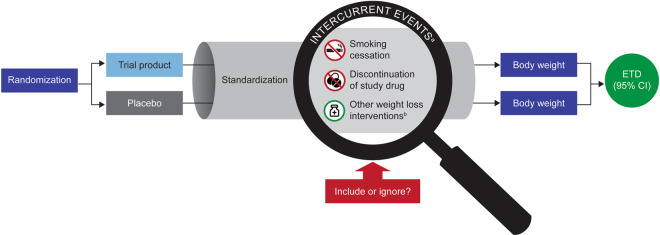
In the approval process for new weight management therapies, regulators typically require estimates of effect size. Usually, as with other drug evaluations, the placebo-adjusted treatment effect (i.e., the difference between weight losses with pharmacotherapy and placebo, when given as an adjunct to lifestyle intervention) is provided from data in randomized clinical trials (RCTs). At first glance, this may seem appropriate and straightforward. However, weight loss is not a simple direct drug effect, but is also mediated by other factors such as changes in diet and physical activity. Interpreting observed differences between treatment arms in weight management RCTs can be challenging; intercurrent events that occur after treatment initiation may affect the interpretation of results at the end of treatment. Utilizing estimands helps to address these uncertainties and improve transparency in clinical trial reporting by better matching the treatment-effect estimates to the scientific and/or clinical questions of interest. Estimands aim to provide an indication of trial outcomes that might be expected in the same patients under different conditions. This article reviews how intercurrent events during weight management trials can influence placebo-adjusted treatment effects, depending on how they are accounted for and how missing data are handled. The most appropriate method for statistical analysis is also discussed, including assessment of the last observation carried forward approach, and more recent methods, such as multiple imputation and mixed models for repeated measures. The use of each of these approaches, and that of estimands, is discussed in the context of the SCALE phase 3a and 3b RCTs evaluating the effect of liraglutide 3.0 mg for the treatment of obesity.
Overview
The claims and statistics of this paper haven’t been checked yet.
Free: it reads the open-access text and checks the first 5 claims that cite a source we can check. Create a free account to check every claim.
Integrity signals
Registry
Cites
Statistics
Figures
Verification
Claims the paper makes
The claims and statistics of this paper haven’t been checked yet.
Free: it reads the open-access text and checks the first 5 claims that cite a source we can check. Create a free account to check every claim.
Claims other papers make about this one
Each is checked against this paper’s own text: does it say what the citing paper says it does?
The cited source says what the claim attributes to it.
In the citing paper
“Two estimands were used to address different scientific questions, as described elsewhere.17,18”
In the citing paper
“In answering this, it is important to consider that these GLP-1RAs have only been in use for obesity treatment in real-world settings for a limited time, with most available efficacy data currently derived from clinical trials, which tend to overestimate weight loss effects (84).”
From GLP-1 and the Neurobiology of Eating Control: Recent Advances (2025) · cites this paper as [84]
Self-check
Percentages, sums and reported differences re-computed from the paper’s own numbers.
The self-check needs the paper’s full text.
Citations
Cites
A Randomized, Controlled Trial of 3.0 mg of Liraglutide in Weight Management
Pi-Sunyer, X., Astrup, A., Fujioka, K., Greenway, F., Halpern, A., Krempf, M., Lau, D. C. W., le Roux, C. W., Violante Ortiz, R., Jensen, C. B., et al. (2015) · New England Journal of Medicine · doi:10.1056/nejmoa1411892 · Cited by 2,724
Self-citationThe prevention and treatment of missing data in clinical trials
Little, R. J., D'Agostino, R., Cohen, M. L., Dickersin, K., Emerson, S. S., Farrar, J. T., Frangakis, C., Hogan, J. W., Molenberghs, G., Murphy, S. A., et al. (2012) · New England Journal of Medicine · doi:10.1056/nejmsr1203730 · Cited by 1,884
Davies, M. J., Bergenstal, R., Bode, B., Kushner, R. F., Lewin, A., Skjøth, T. V., Andreasen, A. H., Jensen, C. B., DeFronzo, R. A., & for the NN8022-1922 Study Group (2015) · JAMA · doi:10.1001/jama.2015.9676 · Cited by 1,198
Multicenter, placebo-controlled trial of lorcaserin for weight management.
Smith, S. R., Weissman, N. J., Anderson, C. M., Sanchez, M., Chuang, E., Stubbe, S., Bays, H., & Shanahan, W. R. (2010) · New England Journal of Medicine · doi:10.1056/nejmoa0909809 · Cited by 911
on behalf of the NN8022-1923 Investigators, Wadden, T. A., Hollander, P., Klein, S., Niswender, K., Woo, V, Hale, P. M., & Aronne, L. (2013) · International Journal of Obesity · doi:10.1038/ijo.2013.120 · Cited by 842
Self-citationon behalf of the NN8022-1807 Investigators, Astrup, A., Carraro, R., Finer, N., Harper, A., Kunesova, M., Lean, M. E. J., Niskanen, L., Rasmussen, M. F., Rissanen, A., et al. (2012) · International Journal of Obesity · doi:10.1038/ijo.2011.158 · Cited by 757
Self-citationThe effect of tobacco cessation on weight gain, obesity, and diabetes risk
Bush, T., Lovejoy, J. C., Deprey, M., & Carpenter, K. M. (2016) · Obesity · doi:10.1002/oby.21582 · Cited by 223
Wadden, T. A., Tronieri, J. S., Sugimoto, D., Lund, M. T., Auerbach, P., Jensen, C., & Rubino, D. (2020) · Obesity · doi:10.1002/oby.22726 · Cited by 200
Self-citationGarvey, W. T., Birkenfeld, A. L., Dicker, D., Mingrone, G., Pedersen, S. D., Satylganova, A., Skovgaard, D., Sugimoto, D., Jensen, C., & Mosenzon, O. (2020) · Diabetes Care · doi:10.2337/dc19-1745 · Cited by 186
Self-citationElobeid, M. A., Padilla, M. A., McVie, T., Thomas, O., Brock, D. W., Musser, B., Lu, K., Coffey, C. S., Desmond, R. A., St-Onge, M.-P., et al. (2009) · PLoS ONE · doi:10.1371/journal.pone.0006624 · Cited by 158
Research works printed but not linked: 1
- National Research Council. The prevention and treatment of missing data in clinical trials. Panel on handling missing data in clinical trials. Washington DC, USA: Committee on National Statistics, Division of Behavioral and Social Sciences and Education, The National Academies Press; 2010.
Cited by
Davies, M., Færch, L., Jeppesen, O. K., Pakseresht, A., Pedersen, S. D., Perreault, L., Rosenstock, J., Shimomura, I., Viljoen, A., Wadden, T. A., et al. (2021) · The Lancet · doi:10.1016/s0140-6736(21)00213-0 · Cited by 1,419
Self-citationRubino, D., Abrahamsson, N., Davies, M., Hesse, D., Greenway, F. L., Jensen, C., Lingvay, I., Mosenzon, O., Rosenstock, J., Rubio, M. A., et al. (2021) · JAMA · doi:10.1001/jama.2021.3224 · Cited by 1,444
Self-citationWadden, T. A., Bailey, T. S., Billings, L. K., Davies, M., Frias, J. P., Koroleva, A., Lingvay, I., O’Neil, P. M., Rubino, D. M., Skovgaard, D., et al. (2021) · JAMA · doi:10.1001/jama.2021.1831 · Cited by 1,114
Self-citationRubino, D. M., Greenway, F. L., Khalid, U., O’Neil, P. M., Rosenstock, J., Sørrig, R., Wadden, T. A., Wizert, A., Garvey, W. T., STEP 8 Investigators, et al. (2022) · JAMA · doi:10.1001/jama.2021.23619 · Cited by 995
“Statistical Analysis Two estimands evaluated treatment efficacy from different perspectives and accounted for intercurrent events andmissingdatadifferently (eAppendix 3 in Supplement 3).(13-15)Analyses in the statistical testing hierarchy addressed the treatment policy estimand (primary estimand) using data from all r…”
Self-citationTwo-year effects of semaglutide in adults with overweight or obesity: the STEP 5 trial
Garvey, W. T., Batterham, R. L., Bhatta, M., Buscemi, S., Christensen, L. N., Frias, J. P., Jódar, E., Kandler, K., Rigas, G., Wadden, T. A., et al. (2022) · Nature Medicine · doi:10.1038/s41591-022-02026-4 · Cited by 868
Self-citationOnce-weekly semaglutide in adolescents with obesity
Weghuber, D., Barrett, T., Barrientos-Pérez, M., Gies, I., Hesse, D., Jeppesen, O. K., Kelly, A. S., Mastrandrea, L. D., Sørrig, R., & Arslanian, S. (2022) · New England Journal of Medicine · doi:10.1056/nejmoa2208601 · Cited by 730
Once-Weekly Semaglutide in Persons with Obesity and Knee Osteoarthritis
Bliddal, H., Bays, H., Czernichow, S., Uddén Hemmingsson, J., Hjelmesæth, J., Hoffmann Morville, T., Koroleva, A., Skov Neergaard, J., Vélez Sánchez, P., Wharton, S., et al. (2024) · New England Journal of Medicine · doi:10.1056/nejmoa2403664 · Cited by 440
Self-citationKnop, F. K., Aroda, V. R., do Vale, R. D., Holst-Hansen, T., Laursen, P. N., Rosenstock, J., Rubino, D. M., & Garvey, W. T. (2023) · The Lancet · doi:10.1016/s0140-6736(23)01185-6 · Cited by 431
Semaglutide vs Tirzepatide for Weight Loss in Adults With Overweight or Obesity
Rodriguez, P. J., Goodwin Cartwright, B. M., Gratzl, S., Brar, R., Baker, C., Gluckman, T. J., & Stucky, N. L. (2024) · JAMA Internal Medicine · doi:10.1001/jamainternmed.2024.2525 · Cited by 334
Rodriguez, P. J., Goodwin Cartwright, B. M., Gratzl, S., Brar, R., Baker, C., Gluckman, T. J., & Stucky, N. L. (2023) · doi:10.1101/2023.11.21.23298775 · Cited by 334
“Unlike many clinical endpoints, weight loss is directly observable to patients, which may result in informative censoring [35, 36].”
Kadowaki, T., Isendahl, J., Khalid, U., Lee, S. Y., Nishida, T., Ogawa, W., Tobe, K., Yamauchi, T., & Lim, S. (2022) · The Lancet Diabetes & Endocrinology · doi:10.1016/s2213-8587(22)00008-0 · Cited by 330
Lau, D. C. W., Erichsen, L., Francisco, A. M., Satylganova, A., le Roux, C. W., McGowan, B., Pedersen, S. D., Pietiläinen, K. H., Rubino, D., & Batterham, R. L. (2021) · The Lancet · doi:10.1016/s0140-6736(21)01751-7 · Cited by 278
Self-citationSemaglutide for the treatment of overweight and obesity: A review
Bergmann, N. C., Davies, M. J., Lingvay, I., & Knop, F. K. (2023) · Diabetes, Obesity and Metabolism · doi:10.1111/dom.14863 · Cited by 265
“1 | Estimands used to assess treatment efficacy In line with regulatory guidance, the STEP trials were designed to report results using two estimands.(45) The treatment policy (primary) estimand assessed effects regardless of treatment discontinuation or rescue medication, while the secondary trial product estimand mo…”
Coadministered Cagrilintide and Semaglutide in Adults with Overweight or Obesity.
Garvey, W. T., Blüher, M., Osorto Contreras, C. K., Davies, M. J., Winning Lehmann, E., Pietiläinen, K. H., Rubino, D., Sbraccia, P., Wadden, T., Zeuthen, N., et al. (2025) · New England Journal of Medicine · doi:10.1056/nejmoa2502081 · Cited by 238
Self-citationWharton, S., Calanna, S., Davies, M., Dicker, D., Goldman, B., Lingvay, I., Mosenzon, O., Rubino, D. M., Thomsen, M., Wadden, T. A., et al. (2022) · Diabetes, Obesity and Metabolism · doi:10.1111/dom.14551 · Cited by 200
“Changes in body weight were analysed addressing the effect of treatment (if taken as intended) using a mixed model for repeated measurements.(20)”
Self-citationMcGowan, B. M., Bruun, J. M., Capehorn, M., Pedersen, S. D., Pietiläinen, K. H., Muniraju, H. A. K., Quiroga, M., Varbo, A., & Lau, D. C. W. (2024) · The Lancet Diabetes & Endocrinology · doi:10.1016/s2213-8587(24)00182-7 · Cited by 176
Oral Semaglutide at a Dose of 25 mg in Adults with Overweight or Obesity
Wharton, S., Lingvay, I., Bogdanski, P., Duque do Vale, R., Jacob, S., Karlsson, T., Shaji, C., Rubino, D., & Garvey, W. T. (2025) · New England Journal of Medicine · doi:10.1056/nejmoa2500969 · Cited by 142
Self-citationMu, Y., Bao, X., Eliaschewitz, F. G., Hansen, M. R., Kim, B. T., Koroleva, A., Ma, R. C. W., Yang, T., Zu, N., & Liu, M. (2024) · The Lancet Diabetes & Endocrinology · doi:10.1016/s2213-8587(23)00388-1 · Cited by 133
Cagrilintide–Semaglutide in Adults with Overweight or Obesity and Type 2 Diabetes
Davies, M. J., Bajaj, H. S., Broholm, C., Eliasen, A., Garvey, W. T., le Roux, C. W., Lingvay, I., Lyndgaard, C. B., Rosenstock, J., & Pedersen, S. D. (2025) · New England Journal of Medicine · doi:10.1056/nejmoa2502082 · Cited by 143
Kosiborod, M. N., Bhatta, M., Davies, M., Deanfield, J. E., Garvey, W. T., Khalid, U., Kushner, R., Rubino, D. M., Zeuthen, N., & Verma, S. (2023) · Diabetes, Obesity and Metabolism · doi:10.1111/dom.14890 · Cited by 127
“Data were analysed for each trial separately based on the treatment policy estimand (the primary estimand in the STEP programme, which reflects the intention-to-treat principle).(31) This assesses the trial-population-average treatment effect of semaglutide or placebo and includes all randomized participants regardles…”
Two‐year effect of semaglutide 2.4 mg on control of eating in adults with overweight/obesity: STEP 5
Wharton, S., Batterham, R. L., Bhatta, M., Buscemi, S., Christensen, L. N., Frias, J. P., Jódar, E., Kandler, K., Rigas, G., Wadden, T. A., et al. (2023) · Obesity · doi:10.1002/oby.23673 · Cited by 124
“All reported results are for the treatment policy estimand (treatment effect regardless of treatment discontinuation or rescue intervention), unless stated otherwise [11].”
Self-citationVerma, S., Bhatta, M., Davies, M., Deanfield, J. E., Garvey, W. T., Jensen, C., Kandler, K., Kushner, R. F., Rubino, D. M., & Kosiborod, M. N. (2023) · eClinicalMedicine · doi:10.1016/j.eclinm.2022.101737 · Cited by 106
“…on the treatment policy estimand, which assessed the treatment effect in all participants, regardless of trial product discontinuation or use of other anti-obesity therapies, 20 using data from the full analysis set (all randomised participants, regardless of whether they initiated treatment).”
Perreault, L., Davies, M., Frias, J. P., Laursen, P. N., Lingvay, I., Machineni, S., Varbo, A., Wilding, J. P. H., Wallenstein, S. O. R., & le Roux, C. W. (2022) · Diabetes Care · doi:10.2337/dc21-1785 · Cited by 87
Self-citationKrajnc, N., Itariu, B. K., Macher, S., Marik, W., Harreiter, J., Michl, M., Novak, K., Wöber, C., Pemp, B., & Bsteh, G. (2023) · The Journal of Headache and Pain · doi:10.1186/s10194-023-01631-z · Cited by 97
Efficacy and safety of semaglutide for weight management: evidence from the STEP program
Amaro, A., Sugimoto, D., & Wharton, S. (2022) · Postgraduate Medicine · doi:10.1080/00325481.2022.2147326 · Cited by 60
Self-citationKelly, A. S., Arslanian, S. A., Hesse, D., Iversen, A. T., Körner, A., Schmidt, S., Sørrig, R., Weghuber, D., & Jastreboff, A. M. (2023) · Obesity · doi:10.1002/oby.23808 · Cited by 66
“Treatment effects in STEP TEENS were assessed using two different estimands [17]: the treatment policy estimand (primary estimand: randomized participants regardless of adherence to treatment or initiation of rescue interventions using data from the in-trial observation period) and the trial product estimand (secondar…”
Lingvay, I., Bergenheim, S. J., Buse, J. B., Freitas, P., Garvey, W. T., Harder-Lauridsen, N. M., Rosenstock, J., Sahu, K., & Wharton, S. (2025) · The Lancet Diabetes & Endocrinology · doi:10.1016/s2213-8587(25)00225-6 · Cited by 64
Self-citationGLP-1 and the Neurobiology of Eating Control: Recent Advances
Jones, L. A., & Brierley, D. I. (2025) · Endocrinology · doi:10.1210/endocr/bqae167 · Cited by 43
“In answering this, it is important to consider that these GLP-1RAs have only been in use for obesity treatment in real-world settings for a limited time, with most available efficacy data currently derived from clinical trials, which tend to over-estimate weight loss effects (84).”
Incorporating estimands into clinical trial statistical analysis plans
Kang, M., Kendall, M. A., Ribaudo, H. J., Tierney, C., Zheng, L., Smeaton, L. M., & Lindsey, J. C. (2022) · Clinical Trials · doi:10.1177/17407745221080463 · Cited by 43
Addressing missing outcome data in randomised controlled trials: A methodological scoping review
Medcalf, E., Turner, R. M., Espinoza, D., He, V., & Bell, K. (2024) · Contemporary Clinical Trials · doi:10.1016/j.cct.2024.107602 · Cited by 30
Cost-effectiveness of weight-management pharmacotherapies in Canada: a societal perspective
Olivieri, A., Muratov, S., Larsen, S., Luckevich, M., Chan, K., Lamotte, M., & Lau, D. C. W. (2024) · International Journal of Obesity · doi:10.1038/s41366-024-01467-w · Cited by 38
“…the ICUR for semaglutide 2.4 may be expected to fall in between the base-case and this scenario, thus making semaglutide 2.4 mg the preferred intervention, given, most patients may be expected to discontinue treatment in case of non-response, in alignment with Canadian clinical practice guidelines.”
InfluentialSmith, I., Hardy, E., Mitchell, S., & Batson, S. (2022) · Diabetes Metabolic Syndrome and Obesity · doi:10.2147/dmso.s392952 · Cited by 39
“Whilst LOCF was the most commonly used method to address missing data across the trials included in the NMA, LOCF-based statistical approaches are no longer recommended due to concerns regarding the plausibility of the assumptions (ie, body weight would be unaffected by discontinuations for trial participants lost to…”
Hankosky, E. R., He, X., Malik, R., Brumm, J. F., Wang, F., Niemeyer, A., Zhang, X. M., & Garvey, W. T. (2025) · Diabetes Obesity and Metabolism · doi:10.1111/dom.16401 · Cited by 24
Kushner, R. F., Fink‐Jensen, A., Frenkel, O., McGowan, B. M., Goldman, B., Overvad, M., & Wadden, T. A. (2023) · Obesity · doi:10.1002/oby.23946 · Cited by 17
“…discontinuation or initiation of other antiobesity therapies, in all randomized participants according to the intention-to-treat principle [21 Safety assessments included AEs and were based on the safety analysis set (including all patients who were exposed to at least one dose of the…”
Self-citationBuse, J. B., BAJAJ, H. S., Dalskov, S., Donaldson, L., Duus, H. H. H., Fabricius, T. W., Haluzík, M., Lingvay, I., Pedersen, S. D., Pratley, R. E., et al. (2026) · The Lancet Diabetes & Endocrinology · doi:10.1016/s2213-8587(26)00125-7 · Cited by 22
Kolotkin, R. L., Jeppesen, O. K., Baker‐Knight, J., Lee, S. Y., Tokita, A., & Kadowaki, T. (2023) · Clinical Obesity · doi:10.1111/cob.12589 · Cited by 17
“All results are based on the treatment policy estimand (assesses treatment effect regardless of treatment discontinuation or rescue intervention).(24)”
Baek, H.-I., Ha, K.-C., Park, Y. K., Lee, J. H., Kim, E. J., Ko, H.-J., & Joo, J. C. (2023) · BMC Complementary Medicine and Therapies · doi:10.1186/s12906-023-04206-2 · Cited by 17
“Therefore, NAOs have a bene�cial effect on obesity prevention, suggesting that they could be developed as an anti-obesity supplement without side effects.”
Naude, J., Zentner, A., Suresh, P., Bittman, J., & Khan, N. A. (2024) · International Journal of Obesity · doi:10.1038/s41366-024-01526-2 · Cited by 13
RetractedRosenstock, J., Billings, L. K., Gajria, R., Giorgino, F., Johansen, N. B., Klein, K. R., Thamattoor, U. K., Buse, J. B., & Jain, A. B. (2026) · The Lancet · doi:10.1016/s0140-6736(26)01022-6 · Cited by 15
Kadowaki, T., Nishida, T., Ogawa, W., Overvad, M., Tobe, K., & Yamauchi, T. (2025) · Obesity Research & Clinical Practice · doi:10.1016/j.orcp.2025.03.003 · Cited by 15
Pohl, M., Baumann, L., Behnisch, R., Kirchner, M., Krisam, J., & Sander, A. (2021) · Deutsches Ärzteblatt international · doi:10.3238/arztebl.m2021.0373 · Cited by 24
Gu, W., Lu, Y., Ye, X., Yuan, G., Liu, D., Shen, Z., Zu, N., & Mu, Y. (2025) · Diabetes Obesity and Metabolism · doi:10.1111/dom.16253 · Cited by 14
Application of the Estimand Framework to Anesthesia Trials
Silva, A. P. D., Leslie, K., Braat, S., & Grobler, A. C. (2024) · Anesthesiology · doi:10.1097/aln.0000000000004966 · Cited by 11
Aroda, V. R., Buzzetti, R., Dalskov, S., Jain, A. B., Larsen, J. S., Mathieu, C., Pratley, R. E., Videmark, A. N., Watt, T., & Buse, J. B. (2026) · The Lancet Diabetes & Endocrinology · doi:10.1016/s2213-8587(26)00126-9 · Cited by 11
Kadowaki, T., Lee, S. Y., Ogawa, W., Nishida, T., Overvad, M., Tobe, K., Yamauchi, T., & Lim, S. K. (2024) · Obesity Research & Clinical Practice · doi:10.1016/j.orcp.2025.01.002 · Cited by 11
Diagnostic tests should be used for sexually transmitted chlamydia.
Lh, C. (1990) · PubMed Central · Cited by 5
Young, C. B., Rives, E., Gudzune, K. A., Jaeger, B. C., Simmons, C., White, B. N., Hooker, S. A., Horn, D. B., Young, D. R., Vesely, J. M., et al. (2026) · Contemporary Clinical Trials · doi:10.1016/j.cct.2026.108219 · Cited by 4
Yuan, C., Yang, Z., Liu, J., Li, X., Chen, B., Han, T., Yu, Q., & Li, Z. (2025) · Contemporary Clinical Trials · doi:10.1016/j.cct.2025.107886 · Cited by 3
Pagoto, S., Xu, R., Bannor, R., Idiong, C. I., Goetz, J. M., & Fernandes, D. (2024) · JMIR Research Protocols · doi:10.2196/65323 · Cited by 2
“We will have quality checks to make sure our missing data is minimal but if we have more than 5% data missing, we will use multiple imputations [37,38].”
Endpoints and estimands: understanding trials of weight-loss drugs
Adler, A. I. (2022) · Nature Medicine · doi:10.1038/s41591-022-02032-6 · Cited by 1
Patel, D. (2026) · Cureus · doi:10.7759/cureus.107202 · Cited by 2
“Patient education on titration, dietary strategies (smaller meals and lower fat), and symptom management are critical for both oral and injectable therapies [20,59].”
InfluentialEvidence-informed guidance for the clinical use of oral semaglutide in obesity management
Rubino, D., Wharton, S., Knight, M. G., & Aroda, V. R. (2026) · Postgraduate Medicine · doi:10.1080/00325481.2026.2686467 · Cited by 1
“This estimand assesses treatment effect regardless of adherence or use of other weight reduction medications [22,23].”
Self-citationPlanning of clinical trial programmes for medicines for the treatment of obesity
Анатольевна, П. И., Gorskaya, T. E., & Goryachev, D. V. (2023) · The Bulletin of the Scientific Centre for Expert Evaluation of Medicinal Products Regulatory Research and Medicine Evaluation · doi:10.30895/1991-2919-2023-452 · Cited by 1
Indeterminate Data and Handling for Assessing Diagnostic Performance in Imaging Drug Developments
Wang, S. (2023) · The New England Journal of Statistics in Data Science · doi:10.51387/23-nejsds46 · Cited by 1
Ulrich, F. S., Bailer, G. S., Yebyo, H. G., la Torre, A. M.-D., Puhan, M. A., & Burden, A. M. (2024) · SSRN Electronic Journal · doi:10.2139/ssrn.4785364
Krajnc, N., Itariu, B. K., Macher, S., Marik, W., Harreiter, J., Michl, M., Novak, K., Wöber, C., Pemp, B., & Bsteh, G. (2023) · Figshare · doi:10.6084/m9.figshare.23700431
Yan, J., Humphries, B., Che, M., Pullenayegum, E., Lee, S. F., & Xie, F. (2026) · Value in Health · doi:10.1016/j.jval.2026.04.009 · Cited by 1
Ulrich, F. S., Nielsen, M. F., Napoli, N., & Burden, A. M. (2026) · The Lancet Regional Health - Europe · doi:10.1016/j.lanepe.2026.101738
“16,17,19,20 Our findings are further supported by several methodological strengths.”
Rasool, Z. K., Shah, R., Batool, A. E. Z., Shah, R., Khachatryan, M., Bhardwaj, S., Ali, A., Atta, M., Bakthavatchalam, P., Khawar, M. M. H., et al. (2026) · Frontiers in Endocrinology · doi:10.3389/fendo.2026.1903335 · Cited by 1
“The treatment-policy estimand assesses the effect of assignment to treatment regardless of discontinuation or rescue intervention, and the trial-product estimand assesses the effect of treatment taken as intended, without discontinuation or rescue intervention (18).”
Metadata
- Authors
- Wharton, S., Astrup, A., Endahl, L., Lean, M. E. J., Satylganova, A., Skovgaard, D., Wadden, T. A., & Wilding, J. P. H.
- Affiliations
- York University (CA)
- University of Copenhagen (DK)
- Novo Nordisk (Denmark) (DK)
- Glasgow Royal Infirmary (GB)
- University of Pennsylvania (US)
- University of Liverpool (GB)
- Corresponding author
- Wharton, Sean
- Venue
- International Journal of Obesity
- Published
- 2021-01-18
- Volume
- 45
- Issue
- 5
- Pages
- 923-933
- ISSN
- 0307-0565 (ISSN-L)
- 1476-5497
- PMC
- PMC8081661
- OpenAlex
- W3121599370
- Cited by
- 58
- References
- 21
- Citations by year
- 2026: 9 · 2025: 8 · 2024: 12 · 2023: 10 · 2022: 12 · 2021: 6
- FWCI
- 1.85
- Type
- journal article
- Language
- en
- Open access
- hybrid
- doi.org
- Licence
- cc-by
- creativecommons.org/licenses/by/4.0 (tdm)
- creativecommons.org/licenses/by/4.0 (vor)
- Locations
- International Journal of Obesity (publishedVersion, cc-by)
- PubMed Central (publishedVersion, cc-by)
- PubMed (publishedVersion)
- Research at the University of Copenhagen (University of Copenhagen) (publishedVersion, cc-by)
- ENLIGHTEN (Jurnal Bimbingan dan Konseling Islam) (acceptedVersion, cc-by-sa)
- Funders
- Novo Nordisk
- Topics
- Physical Sciences › Mathematics › Statistics and Probability › Statistical Methods in Clinical Trials
- Physical Sciences › Mathematics › Statistics and Probability › Statistical Methods and Bayesian Inference
- Health Sciences › Medicine › Pharmacology (medical) › Pharmacology and Obesity Treatment
- Keywords
- estimands, intercurrent events, missing data, weight management, obesity pharmacotherapy, liraglutide, last observation carried forward, multiple imputation, clinical trial reporting, weight loss
- MeSH terms
- Body Weight, Data Interpretation, Statistical, Humans, Obesity, Randomized Controlled Trials as Topic, Clinical Trials, Phase III as Topic
About these checks
Registry, retraction, Cites and statistics results are computed, not judged, with one exception: a printed reference that no index lists is read once by a model before it counts as a citation error. Claims are extracted by a model and kept only when their quote appears verbatim in the text; each cited source is then checked, with a model’s help, for whether it says what the claim relies on. Those verdicts can be wrong — read the claim’s quote and the cited source before relying on one.
Statistics and arithmetic are recomputed, not judged.
Confidence bands are shown only for fields calibrated on our annotated test set. None is calibrated yet, so no band is shown.
What counts as a claim ›How we measure confidence ›How we check this ›
Are you an author, or do you see a problem with this page? Request a review
Data sources
Bibliographic data: Semantic Scholar, OpenAlex, Crossref.
Contains information from the Semantic Scholar Academic Graph Datasets, made available under the ODC Attribution License (ODC-BY 1.0).
Semantic Scholar’s data is described in: Kinney, R., et al. (2023). The Semantic Scholar Open Data Platform. arXiv:2301.10140.
