

Big data approaches to decomposing heterogeneity across the autism spectrum
Open accessPublished version of a preprint
The DOI matches its Crossref record; 111 of the 111 references it cites were found in a registry or an index.
Abstract
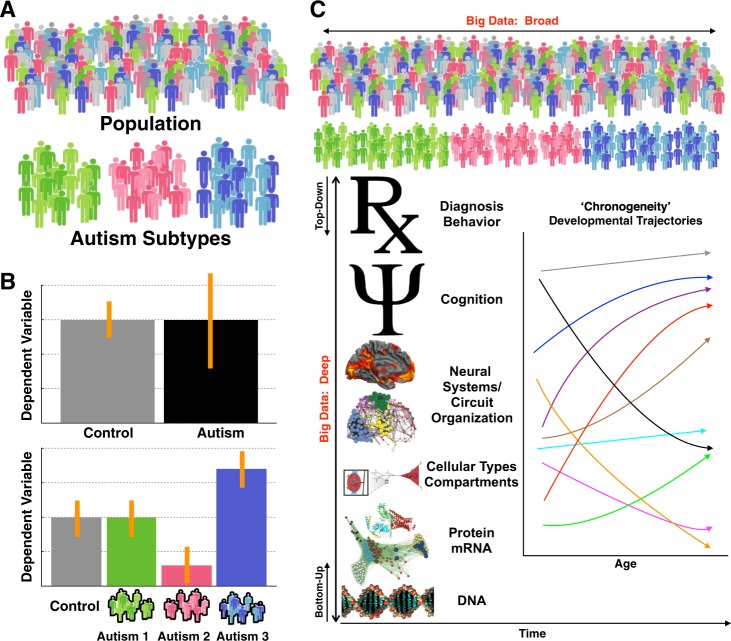
Autism is a diagnostic label based on behavior. While the diagnostic criteria attempt to maximize clinical consensus, it also masks a wide degree of heterogeneity between and within individuals at multiple levels of analysis. Understanding this multi-level heterogeneity is of high clinical and translational importance. Here we present organizing principles to frame research examining multi-level heterogeneity in autism. Theoretical concepts such as 'spectrum' or 'autisms' reflect non-mutually exclusive explanations regarding continuous/dimensional or categorical/qualitative variation between and within individuals. However, common practices of small sample size studies and case-control models are suboptimal for tackling heterogeneity. Big data are an important ingredient for furthering our understanding of heterogeneity in autism. In addition to being 'feature-rich', big data should be both 'broad' (i.e., large sample size) and 'deep' (i.e., multiple levels of data collected on the same individuals). These characteristics increase the likelihood that the study results are more generalizable and facilitate evaluation of the utility of different models of heterogeneity. A model's utility can be measured by its ability to explain clinically or mechanistically important phenomena, and also by explaining how variability manifests across different levels of analysis. The directionality for explaining variability across levels can be bottom-up or top-down, and should include the importance of development for characterizing changes within individuals. While progress can be made with 'supervised' models built upon a priori or theoretically predicted distinctions or dimensions of importance, it will become increasingly important to complement such work with unsupervised data-driven discoveries that leverage unknown and multivariate distinctions within big data. A better understanding of how to model heterogeneity between autistic people will facilitate progress towards precision medicine for symptoms that cause suffering, and person-centered support.
Overview
The claims and statistics of this paper haven’t been checked yet.
Free: it reads the open-access text and checks the first 5 claims that cite a source we can check. Create a free account to check every claim.
Integrity signals
Registry
Cites
Statistics
Figures
Verification
Claims the paper makes
The claims and statistics of this paper haven’t been checked yet.
Free: it reads the open-access text and checks the first 5 claims that cite a source we can check. Create a free account to check every claim.
Claims other papers make about this one
Each is checked against this paper’s own text: does it say what the citing paper says it does?
The source backs part of the claim, not all of it — or backs it for a different population, condition or comparison.
In the citing paper
“The scattered findings reported in studies about predictive coding and ASD may be related to a wide variety of factors, such as the dif ferences in tasks, the presence of co-occurring conditions, variations in medication use, potential cultural influences that shape responses and behaviors, as well as the intrinsic heterogeneity of ASD itself, which may manifest uniquely in each individual (Lomb”
From Predictive coding in neuropsychiatric disorders: a systematic transdiagnostic review. (2025) · cites this paper as Lombardo et al., 2019
Experimental — accuracy not yet measuredThe cited source says what the claim attributes to it.
In the citing paper
“Alongside the changes in classification systems, by now heterogeneity has already increased with regard to the expression and severity of the core and associated symptoms of ASD [4–6].”
From Autism spectrum disorder in ICD-11—a critical reflection of its possible impact on clinical practice and research (2024) · cites this paper as [4]
Self-check
Percentages, sums and reported differences re-computed from the paper’s own numbers.
The self-check needs the paper’s full text.
Citations
Cites
The Elements of Statistical Learning
Hastie, T., Tibshirani, R., & Friedman, J. (2009) · Springer Series in Statistics · doi:10.1007/978-0-387-84858-7 · Cited by 25,970
The Elements of Statistical Learning: Data Mining, Inference, and Prediction
John Lu, Z. Q. (2010) · Journal of the Royal Statistical Society Series A: Statistics in Society · doi:10.1111/j.1467-985x.2010.00646_6.x · Cited by 12,390
(1943) · The Nervous child · Cited by 8,870
Power failure: why small sample size undermines the reliability of neuroscience
Button, K. S., Ioannidis, J. P. A., Mokrysz, C., Nosek, B. A., Flint, J., Robinson, E. S. J., & Munafò, M. R. (2013) · Nature Reviews Neuroscience · doi:10.1038/nrn3475 · Cited by 7,641 · cited 2×
“Such inflated effects present an over-optimistic view on the identified effects and are prone to the winner’s curse [70].”
BackgroundInsel, T., Cuthbert, B., Garvey, M., Heinssen, R., Pine, D. S., Quinn, K., Sanislow, C., & Wang, P. (2010) · American Journal of Psychiatry · doi:10.1176/appi.ajp.2010.09091379 · Cited by 7,067
Baron-Cohen, S., Wheelwright, S., Skinner, R., Martin, J., & Clubley, E. (2001) · Journal of Autism and Developmental Disorders · doi:10.1023/a:1005653411471 · Cited by 6,450
Self-citationA New Initiative on Precision Medicine
Collins, F. S., & Varmus, H. (2015) · New England Journal of Medicine · doi:10.1056/nejmp1500523 · Cited by 5,202
Wing, L., & Gould, J. (1979) · Journal of Autism and Developmental Disorders · doi:10.1007/bf01531288 · Cited by 2,587 · cited 1×
“In the 1980s, Wing [56] and colleagues not only introduced the work of Hans Asperger into the English speaking world, but also conducted epidemiological studies that demonstrated the heterogeneity in social, language, motor, and cognitive abilities in the autistic and developmentally delayed population [57, 58].”
BackgroundLai, M.-C., Lombardo, M. V., & Baron-Cohen, S. (2014) · The Lancet · doi:10.1016/s0140-6736(13)61539-1 · Cited by 2,371
Self-citationDie „Autistischen Psychopathen” im Kindesalter
Asperger, H. (1944) · Archiv für Psychiatrie und Nervenkrankheiten · doi:10.1007/bf01837709 · Cited by 2,163 · cited 3×
“Moreover, both Leo Kanner and Hans Asperger recognized good cognitive potential in their child patients50, 52 and therefore autism was not necessarily tied to intellectual disability.”
Background
Research works printed but not linked: 1
- Loth E Ahmad J Mason L Crawley DV Hayward HL San Jose Caceres A Identifying cross-domain cognitive subtypes among children, adolescents, and adults with autism spectrum disorders 2017 San Francisco International Society for Autism Research
Cited by
Items 101–200 of 546
Genesis, modelling and methodological remedies to autism heterogeneity
Rabot, J., Rødgaard, E.-M., Joober, R., Dumas, G., Bzdok, D., Bernhardt, B., Jacquemont, S., & Mottron, L. (2023) · Neuroscience & Biobehavioral Reviews · doi:10.1016/j.neubiorev.2023.105201 · Cited by 31
Grammatical Comprehension in Italian Children with Autism Spectrum Disorder
Barsotti, J., Mangani, G., Nencioli, R., Pfanner, L., Tancredi, R., Cosenza, A., Sesso, G., Narzisi, A., Muratori, F., Cipriani, P., et al. (2020) · Brain Sciences · doi:10.3390/brainsci10080510 · Cited by 34
Pelton, M., Crawford, H., Bul, K., Robertson, A., Adams, J., Beurs, D. P. D., Rodgers, J., Baron‐Cohen, S., & Cassidy, S. (2023) · Suicide and Life-Threatening Behavior · doi:10.1111/sltb.12954 · Cited by 39
Self-citationPrognostic early snapshot stratification of autism based on adaptive functioning
Mandelli, V., Landi, I., Busuoli, E. M., Courchesne, E., Pierce, K., & Lombardo, M. V. (2023) · Nature Mental Health · doi:10.1038/s44220-023-00056-6 · Cited by 36
Self-citationCircuit-level theories for sensory dysfunction in autism: convergence across mouse models
Monday, H. R., Wang, H. C., & Feldman, D. E. (2023) · Frontiers in Neurology · doi:10.3389/fneur.2023.1254297 · Cited by 33
“Such approaches leverage the massive amounts of data available and newly developed machine learning tools but rely heavily on being able to compare and normalize data across studies (215).”
BackgroundVargason, T., Grivas, G., Hollowood-Jones, K., & Hahn, J. (2020) · Seminars in Pediatric Neurology · doi:10.1016/j.spen.2020.100803 · Cited by 38
Mapping Progressive Gray Matter Alterations in Early Childhood Autistic Brain
Guo, X., Duan, X., Suckling, J., Wang, J., Kang, X., Chen, H., Biswal, B. B., Cao, J., He, C., Xiao, J., et al. (2020) · Cerebral Cortex · doi:10.1093/cercor/bhaa304 · Cited by 34
“Small sample studies could reduce the statistical power and increase failures to find true effects, resulting in low reliability and reproducibility of results (Button et al. 2013; Lombardo et al. 2019).”
BackgroundMotor signature of autism spectrum disorder in adults without intellectual impairment
Cho, A. B., Otte, K., Baskow, I., Ehlen, F., Maslahati, T., Mansow‐Model, S., Schmitz‐Hübsch, T., Behnia, B., & Roepke, S. (2022) · Scientific Reports · doi:10.1038/s41598-022-10760-5 · Cited by 35
Morrow, E. L., Duff, M. C., & Mayberry, L. S. (2022) · Journal of Speech Language and Hearing Research · doi:10.1044/2022_jslhr-21-00551 · Cited by 40
Tasnim, A., Alkislar, I., Hakim, R., Turecek, J., Abdelaziz, A., Orefice, L. L., & Ginty, D. D. (2024) · Nature Neuroscience · doi:10.1038/s41593-023-01552-9 · Cited by 39
“However, autism diagnoses are elusive during infancy, in part due to high variability in ASD phenotypic presentation across individuals 16 .”
Medial prefrontal cortex circuitry and social behaviour in autism
Mediane, D. H., Basu, S., Cahill, E., & Anastasiades, P. G. (2024) · Neuropharmacology · doi:10.1016/j.neuropharm.2024.110101 · Cited by 45
Hawco, C. S., Yoganathan, L., Voineskos, A. N., Lyon, R. E., Tan, T., Daskalakis, Z. J., Blumberger, D. M., Croarkin, P. E., Lai, M., Szatmári, P., et al. (2020) · NeuroImage Clinical · doi:10.1016/j.nicl.2020.102260 · Cited by 34
“In line with the considerable phenotypic and genetic heterogeneity that is inherent to the current clinical classification of autism (Lombardo et al., 2019), fMRI studies indicate that individualized alterations in the functional organization of neural networks are increased in ASD compared to…”
BackgroundSelf-citationImmunogenetics of autism spectrum disorder: A systematic literature review
Arenella, M., Matulevičiūtė, R., Tamouza, R., Leboyer, M., McAlonan, G. M., Bralten, J., & Murphy, D. (2023) · Brain Behavior and Immunity · doi:10.1016/j.bbi.2023.09.010 · Cited by 38
Level of Attention to Motherese Speech as an Early Marker of Autism Spectrum Disorder
Pierce, K., Wen, T. H., Zahiri, J., Andreason, C., Courchesne, E., Barnes, C. C., Lopez, L., Arias, S. J., Esquivel, A., & Cheng, A. (2023) · JAMA Network Open · doi:10.1001/jamanetworkopen.2022.55125 · Cited by 36
Heterogeneity thwarts autism explanatory power: A proposal for endophenotypes
Waterhouse, L. (2022) · Frontiers in Psychiatry · doi:10.3389/fpsyt.2022.947653 · Cited by 29
“(59) asserted that, “Small samples cannot adequately cover heterogeneity in the autism population in a highly generalizable fashion, and hence there is a need for ‘big data’ when studying heterogeneity.”
BackgroundGeurts, H. M., van Rentergem, J. A. A., Radhoe, T. A., Torenvliet, C., van der Putten, W., & Groenman, A. P. (2021) · BMJ Open · doi:10.1136/bmjopen-2020-040943 · Cited by 31
Asif, M., Martiniano, H., Marques, A. R., Santos, J. X., Vilela, J. E. R., Rasga, C., Oliveira, G., Couto, F. M., & Vicente, A. M. (2020) · Translational Psychiatry · doi:10.1038/s41398-020-0721-1 · Cited by 33
Zhao, X., Zhu, S., Cao, Y., Cheng, P., Lin, Y., Sun, Z., Jiang, W., & Du, Y. (2022) · Neuropsychiatric Disease and Treatment · doi:10.2147/ndt.s349247 · Cited by 29
“As ASD is a heterogeneous developmental disorder,(30) there is an inherent variability between affected individuals, with diverse clinical manifestations and different levels of intelligence, which is most likely associated with variations in neuroanatomical abnormalities.(31,32) Therefore, the picture emerging is tha…”
BackgroundDuff, M. C., Morrow, E. L., Edwards, M., McCurdy, R. A., Clough, S., Patel, N. N., Walsh, K., & Covington, N. V. (2022) · Frontiers in Behavioral Neuroscience · doi:10.3389/fnbeh.2022.846919 · Cited by 33
“In the context of a high degree of heterogeneity and small sample sizes, contradictory group-level findings are inevitable (see Lombardo et al., 2019 and Covington and Duff, 2021 for discussion).”
Imoh, P. O., & Idoko, I. P. (2022) · International Journal of Scientific Research and Modern Technology. · doi:10.38124/ijsrmt.v1i8.463 · Cited by 47
Loss, C. M., Teodoro, L., Rodrigues, G. D., Moreira, L. R., Peres, F. F., Zuardi, A. W., Crippa, J. A. S., Hallak, J. E. C., & Abílio, V. C. (2021) · Frontiers in Pharmacology · doi:10.3389/fphar.2020.635763 · Cited by 34
Imputing cognitive impairment in SPARK , a large autism cohort
Shu, C., Snyder, L. G., Shen, Y., & Chung, W. K. (2021) · Autism Research · doi:10.1002/aur.2622 · Cited by 29
Positron Emission Tomography in the Neuroimaging of Autism Spectrum Disorder: A Review
Tan, Z., Wei, H., Song, X., Mai, W., Yan, J., Ye, W., Ling, X., Hou, L., Zhang, S., Yan, S., et al. (2022) · Frontiers in Neuroscience · doi:10.3389/fnins.2022.806876 · Cited by 29
Li, Q., Zhao, W., Palaniyappan, L. K., & Guo, S. (2023) · Psychological Medicine · doi:10.1017/s0033291723000181 · Cited by 30
Characterizing the ASD–ADHD phenotype: measurement structure and invariance in a clinical sample
Krakowski, A. D., Cost, K. T., Szatmari, P., Anagnostou, E., Crosbie, J., Schachar, R., Duku, E., Georgiades, S., Ayub, M., Kelley, E., et al. (2022) · Journal of Child Psychology and Psychiatry · doi:10.1111/jcpp.13609 · Cited by 26
Lombardo, M. V., Busuoli, E. M., Schreibman, L., Stahmer, A. C., Pramparo, T., Landi, I., Mandelli, V., Bertelsen, N., Barnes, C. C., Gazestani, V., et al. (2021) · Molecular Psychiatry · doi:10.1038/s41380-021-01239-2 · Cited by 33
Self-citationHooft, P. V. T., Moeijes, J., Hartman, C. A., van Busschbach, J. T., & Hartman, E. (2024) · Review Journal of Autism and Developmental Disorders · doi:10.1007/s40489-024-00464-z · Cited by 41
“Although very common in clinical studies in ASD (Lombardo et al., 2019), this can be a significant source of bias and can make it difficult to extrapolate the results to the overall population of children with ASD (Faber & Fonseca, 2014).”
Rethinking Our Concepts and Assumptions About Autism
Lombardo, M. V., & Mandelli, V. (2022) · Frontiers in Psychiatry · doi:10.3389/fpsyt.2022.903489 · Cited by 31
Self-citationAutism and Down syndrome: early identification and diagnosis
Diniz, N. L. F., Parlato-Oliveira, É., Pimenta, P. G. A., de Araújo, L. A., & Valadares, E. R. (2022) · Arquivos de Neuro-Psiquiatria · doi:10.1590/0004-282x-anp-2021-0156 · Cited by 42
Guo, X., Zhang, X., Chen, H., Zhai, G., Cao, Y., Zhang, T., & Gao, L. (2023) · Cerebral Cortex · doi:10.1093/cercor/bhad040 · Cited by 30
Eill, A., Jahedi, A., Gao, Y., Kohli, J. S., Fong, C., Solders, S. K., Carper, R. A., Valafar, F., Bailey, B., & Müller, R. (2019) · Brain Connectivity · doi:10.1089/brain.2019.0689 · Cited by 27
“A growing number of studies have applied ML techniques for diagnostic classification of ASDs, using different functional and anatomical types of imaging data with varying level of success.”
BackgroundInfluentialTsirgiotis, J. M., Young, R. L., & Weber, N. (2023) · Autism · doi:10.1177/13623613231190682 · Cited by 30
“This enabled movement beyond existing psychometric instruments, which may perpetuate traditional views of ASD presentation and lack sensitivity to the difficulties of females (see Hiller et al., 2014; Lombardo et al., 2019).”
BackgroundRios, P. C., & Benson, S. M. S. (2020) · Frontiers in Psychology · doi:10.3389/fpsyg.2020.01260 · Cited by 31
Kelleher, B., Halligan, T., Witthuhn, N., Neo, W. S., Hamrick, L. R., & Abbeduto, L. (2020) · Frontiers in Psychology · doi:10.3389/fpsyg.2020.01634 · Cited by 27
Choi, E. J., Vandewouw, M. M., Taylor, M. J., Arnold, P. D., Brian, J. A., Crosbie, J., Kelley, E. A., Lai, M., Liu, X., Schachar, R. J., et al. (2020) · NeuroImage Clinical · doi:10.1016/j.nicl.2020.102476 · Cited by 33
“A deep-and-big data approach by the combination of different types of biological information in a single large cohort (Lombardo et al., 2019), such as genomics, imaging and other –omics, combined with information on cognition and behaviour will be necessary to understand the complexity of shared biology from genes to…”
BackgroundMethodSelf-citationPredictive coding in neuropsychiatric disorders: a systematic transdiagnostic review.
Qela, B., Damiani, S., De Santis, S., Groppi, F., Pichiecchio, A., Asteggiano, C., Brondino, N., Monteleone, A. M., Grassi, L., Politi, P., et al. (2025) · Neuroscience & Biobehavioral Reviews · doi:10.1016/j.neubiorev.2025.106020 · Cited by 26
“…such as the differences in tasks, the presence of co-occurring conditions, variations in medication use, potential cultural influences that shape responses and behaviors, as well as the intrinsic heterogeneity of ASD itself, which may manifest uniquely in each individual (Lombardo et al., 2019).”
Age-atypical brain functional networks in autism spectrum disorder: a normative modeling approach
Jiang, A., Ma, X., Li, S., Wang, L., Yang, B., Wang, S., Li, M., & Dong, G. (2024) · Psychological Medicine · doi:10.1017/s0033291724000138 · Cited by 28
Autism spectrum disorder research: knowledge mapping of progress and focus between 2011 and 2022
Jiang, M., Lu, T., Yang, K., Li, X., Zhao, L., Zhang, D., Li, J., & Wang, L. (2023) · Frontiers in Psychiatry · doi:10.3389/fpsyt.2023.1096769 · Cited by 33
“Professor Baron-Cohen noted that increasing the sample size and collecting data from the same individual multiple times could reduce heterogeneity (58).”
BackgroundDevelopmental Trajectories of Autism
Fountain, C., Winter, A. S., Cheslack‐Postava, K., & Bearman, P. (2023) · PEDIATRICS · doi:10.1542/peds.2022-058674 · Cited by 31
The Future of Disentangling the Heterogeneity of Autism With Neuroimaging Studies
Duan, X., Shan, X., Uddin, L. Q., & Chen, H. (2024) · Biological Psychiatry · doi:10.1016/j.biopsych.2024.08.008 · Cited by 31
Harrison, L., Kats, A., Kilroy, E., Butera, C. D., Jayashankar, A., Keleş, Ü., & Aziz‐Zadeh, L. (2021) · Scientific Reports · doi:10.1038/s41598-021-87455-w · Cited by 33
Thomas, T., Koomar, T., Casten, L. G., Tener, A. J., Bahl, E., & Michaelson, J. J. (2022) · Translational Psychiatry · doi:10.1038/s41398-022-01982-2 · Cited by 29
“More detailed phenotypic characterization and new methods for integrating these granular phenotypes [72] into robust, interpretable traits are critical goals as the field strives to develop a more actionable, mechanistic understanding of autism that is based on genetics.”
MethodBao, X., Chen, B., Liu, J., Tan, Y., Chen, S., Zhang, F., Lu, H., & Li, J. (2023) · Frontiers in Molecular Neuroscience · doi:10.3389/fnmol.2023.1185021 · Cited by 27
Malihi, M., Nguyen, J. L., Cardy, R. E., Eldon, S., Petta, C., & Kushki, A. (2020) · Frontiers in Psychiatry · doi:10.3389/fpsyt.2020.00669 · Cited by 31
“As such, these approaches hold signi fi cant potential as analytical tools for characterizing the heterogeneity in samples of children with ASD (35).”
MethodTrastornos del neurodesarrollo: dónde estamos hoy y hacia dónde nos dirigimos
López, I., & Förster, J. (2022) · Revista Médica Clínica Las Condes · doi:10.1016/j.rmclc.2022.06.004 · Cited by 72
Rosario, C. D., Nixon, E., Quigley, J., Whitehouse, A., & Maybery, M. T. (2023) · Infant Behavior and Development · doi:10.1016/j.infbeh.2023.101830 · Cited by 30
Nakua, H., Yu, J., Abdi, H., Hawco, C. S., Voineskos, A. N., Hill, S., Lai, M., Wheeler, A. L., McIntosh, A. R., & Ameis, S. H. (2024) · Network Neuroscience · doi:10.1162/netn_a_00363 · Cited by 29
“Use of small sample sizes, between-study methodological variation, and underpow-ered statistical approaches have contributed to the lack of consistent results between studies (Button et al., 2013; Grady et al., 2021; Lombardo et al., 2019; Poldrack et al., 2017).”
BackgroundResultSelf-citationZhang, M., Tang, E., Ding, H., & Zhang, Y. (2024) · Journal of Speech, Language, and Hearing Research · doi:10.1044/2024_jslhr-24-00157 · Cited by 22
Normative age modelling of cortical thickness in autistic malesPreprint
Bethlehem, R. A. I., Seidlitz, J., Romero-García, R., Dumas, G., & Lombardo, M. V. (2018) · bioRxiv (Cold Spring Harbor Laboratory) · doi:10.1101/252593 · Cited by 29
“Beyond the single label of ASD, patients are in fact widely heterogeneous in phenotype, but also with regard to the diversity of different aetiologies (Lombardo et al., 2019).”
BackgroundSelf-citationResponse to Commentaries on bilingual language development in autism
Prévost, P., & Tuller, L. (2021) · Linguistic Approaches to Bilingualism · doi:10.1075/lab.00034.pre · Cited by 21
Greater interpersonal distance in adults with autism
Fusaro, M., Fanti, V., & Chakrabarti, B. (2023) · Autism Research · doi:10.1002/aur.3013 · Cited by 35
Understanding heterogeneity within autism spectrum disorder: a scoping review
Puerto, M. S. C., & Vázquez, M. S. (2024) · Advances in Autism · doi:10.1108/aia-12-2023-0072 · Cited by 31
Schmidt, M., & Glaser, N. J. (2021) · Journal of Enabling Technologies · doi:10.1108/jet-09-2020-0037 · Cited by 25
Yeh, C., Tseng, R.-Y., Ni, H., Cocchi, L., Chang, J.-C., Hsu, M.-Y., Tu, E., Wu, Y., Chou, T., Gau, S. S., et al. (2022) · Molecular Autism · doi:10.1186/s13229-022-00499-1 · Cited by 24
Heterogeneity of social cognitive performance in autism and schizophrenia
Hajdúk, M., Pinkham, A. E., Penn, D. L., Harvey, P. D., & Sasson, N. J. (2022) · Autism Research · doi:10.1002/aur.2730 · Cited by 23
“Reduced performance at the group level is consistent with prior studies (Velikonja et al., 2019), as is the substantial heterogeneity in performance (Klopper et al., 2017; Lombardo et al., 2019; Waddington et al., 2018; Zheng et al., 2020).”
BackgroundMethodResultAlateyat, H., Cruz, S., Cernadas, E., Tubío-Fungueiriño, M., Sampaio, A., González-Villar, A. J., Carracedo, Á., Fernández-Delgado, M., & Fernández‐Prieto, M. (2022) · Frontiers in Molecular Neuroscience · doi:10.3389/fnmol.2022.889641 · Cited by 28
“Some works in the literature showed the interest of using ML in the study of ASD to analyze continuous/dimensional or categorical/qualitative variation between and within individuals (Lombardo et al., 2019).”
BackgroundRosenblau, G., Frolichs, K., & Korn, C. W. (2023) · Neuroscience & Biobehavioral Reviews · doi:10.1016/j.neubiorev.2023.105181 · Cited by 21
Stott, J., WRIGHT, T. E., Holmes, J., Wilson, J. C., Griffiths‐Jones, S., Foster, D., & Wright, B. (2023) · PLoS ONE · doi:10.1371/journal.pone.0287131 · Cited by 24
Halvorsen, M. B., Kildahl, A. N., Kaiser, S., Axelsdottir, B., Aman, M. G., & Helverschou, S. B. (2024) · Journal of Autism and Developmental Disorders · doi:10.1007/s10803-024-06324-3 · Cited by 27
“Autistic people are a heterogeneous group, with considerable interindividual variation in autism symptoms and among co-occurring difficulties (APA, 2013; Lombardo et al., 2019).”
Meijer, J., Vieira, B. H., Elleaume, C., Baranczuk‐Turska, Z., Langer, N., & Floris, D. L. (2024) · Journal of Psychopathology and Clinical Science · doi:10.1037/abn0000914 · Cited by 27
Exploring EEG resting state differences in autism: sparse findings from a large cohort
Dede, A. J. O., Xiao, W., Vaci, N., Cohen, M. X., & Milne, E. (2025) · Molecular Autism · doi:10.1186/s13229-025-00647-3 · Cited by 24
“A common refrain in the literature is that autism is highly heterogeneous [25, 44] and that the diagnostic label of autism may represent a constellation of unique genetic and neurological conditions [45].”
Alvari, G., Coviello, L., & Furlanello, C. (2021) · Brain Sciences · doi:10.3390/brainsci11121555 · Cited by 25
Weitlauf, A. S., Broderick, N. A., Stainbrook, J. A., Slaughter, J. C., Taylor, J. L., Herrington, C. G., Nicholson, A. G., Santulli, M., Dorris, K., Garrett, L. J., et al. (2022) · Journal of Autism and Developmental Disorders · doi:10.1007/s10803-021-05399-6 · Cited by 21
Wong, N. M. L., Dipasquale, O., Turkheimer, F., Findon, J. L., Wichers, R., Dimitrov, M., Murphy, C. M., Stoencheva, V., Robertson, D., Murphy, D., et al. (2022) · Journal of Psychopharmacology · doi:10.1177/02698811221092509 · Cited by 20
Lefebvre, A., Tillmann, J., Cliquet, F., Amsellem, F., Maruani, A., Leblond, C. S., Beggiato, A., Germanaud, D., Amestoy, A., Moal, M. L., et al. (2022) · Autism Research · doi:10.1002/aur.2861 · Cited by 25
“The dSSP score may offer a relevant setting to explore the heterogeneity in autism spectrum (Lombardo et al., 2019).”
BackgroundLebeña, A., Faresjö, Å., Jones, M. P., Bengtsson, F., Faresjö, T., & Ludvigsson, J. (2024) · Scientific Reports · doi:10.1038/s41598-024-65067-4 · Cited by 24
Transparent deep learning to identify autism spectrum disorders (ASD) in EHR using clinical notes
Leroy, G., Andrews, J., Preece, M., Jaswani, A., Song, H., Galindo, M. K., Rice, S. A., & Rice, S. A. (2024) · Journal of the American Medical Informatics Association · doi:10.1093/jamia/ocae080 · Cited by 26
A convergent structure–function substrate of cognitive imbalances in autism
Hong, S., Mottron, L., Park, B., Benkarim, O. M., Valk, S. L., Paquola, C., Larivière, S., de Wael, R. V., Degré‐Pelletier, J., Soulières, I., et al. (2022) · Cerebral Cortex · doi:10.1093/cercor/bhac156 · Cited by 21
Miot, S., Chancel, R., Périés, M., Crepiat, S., Couderc, S., Pernon, É., Picot, M., Gonnier, V., Jeandel, C., Blain, H., et al. (2022) · Autism · doi:10.1177/13623613221121623 · Cited by 19
“autistic individuals potentially related to endophenotypes that can be used to understand the underlying physiopathology and propose personalized treatment (Lombardo et al., 2019).”
BackgroundMapping cerebellar anatomical heterogeneity in mental and neurological illnesses
Kim, M., Leonardsen, E. H., Rutherford, S. E., Selbæk, G., Persson, K., Steen, N. E., Smeland, O. B., Ueland, T., Richard, G., Beckmann, C. F., et al. (2024) · Nature Mental Health · doi:10.1038/s44220-024-00297-z · Cited by 18
“Participants who had withdrawn from the studies or had missing demographic information and T1-weighted MRI data were excluded from the analyses.”
Kolodny, T., Schallmo, M., Gerdts, J. A., Bernier, R., & Murray, S. O. (2020) · Journal of Neuroscience · doi:10.1523/jneurosci.2376-19.2020 · Cited by 20
“Given the general heterogeneity of ASD, in clinical presentation, behavior, and genetics (Jeste and Geschwind, 2014; Chaste et al., 2015; Bedford et al., 2019; Lombardo et al., 2019), such individual differences in neural response pattern are unsurprising.”
BackgroundEarly Intervention in Severe Autism: Positive Outcome Using Exchange and Development Therapy
Blanc, R., Latinus, M., Guidotti, M., Adrien, J., Roux, S., Dansart, P., Barthélémy, C., Rambault, A., Bonnet‐Brilhault, F., & Malvy, J. (2021) · Frontiers in Pediatrics · doi:10.3389/fped.2021.785762 · Cited by 33
Using human pluripotent stem cell models to study autism in the era of big data
Nehme, R., & Barrett, L. E. (2020) · Molecular Autism · doi:10.1186/s13229-020-00322-9 · Cited by 18
Tsai, C., Lin, H., Tseng, I. W.-Y., & Gau, S. S. (2020) · Brain Imaging and Behavior · doi:10.1007/s11682-020-00338-y · Cited by 19
Meta-modulation Network for Domain Generalization in Multi-site fMRI Classification
Lee, J.-I., Kang, E., Jeon, E., & Suk, H. (2021) · Lecture notes in computer science · doi:10.1007/978-3-030-87240-3_48 · Cited by 19
Enhancement of indirect functional connections with shortest path length in the adult autistic brain
Guo, X., Simas, T., Lai, M., Lombardo, M. V., Chakrabarti, B., Ruigrok, A. N. V., Bullmore, E. T., Baron‐Cohen, S., Chen, H., & Suckling, J. (2019) · Human Brain Mapping · doi:10.1002/hbm.24777 · Cited by 17
Self-citationMachine Learning for Neurodevelopmental Disorders
Moreau, C. A., Deruelle, C., & Auzias, G. (2023) · Neuromethods · doi:10.1007/978-1-0716-3195-9_31 · Cited by 19
Morris, P. O., Hope, E., Foulsham, T., & Mills, J. P. (2022) · Journal of Bodywork and Movement Therapies · doi:10.1016/j.jbmt.2022.09.016 · Cited by 24
Nakua, H., Hawco, C. S., Forde, N. J., Joseph, M. J. E., Grillet, M., Johnson, D., Jacobs, G. R., Hill, S., Voineskos, A. N., Wheeler, A. L., et al. (2023) · NeuroImage · doi:10.1016/j.neuroimage.2023.120119 · Cited by 17
“Inclusion of poor-quality scans into data analyses may contribute to challenges in replication and reproducibility in brain imaging research as suggested by prior reports (Esteban et al., 2017; Lombardo et al., 2019; Masouleh et al., 2019; Poldrack et al., 2017).”
Self-citationDifferently different?: A commentary on the emerging social cognitive neuroscience of female autism
Rippon, G. (2024) · Biology of Sex Differences · doi:10.1186/s13293-024-00621-3 · Cited by 25
“Increasing the size of available samples and/or data by combining information from international, multidisciplinary centres was proposed as a way of increasing the scale of autism studies, as well as improving issues of cross-laboratory robustness and reproducibility of findings [54].”
A 3D approach to understanding heterogeneity in early developing autisms
Mandelli, V., Severino, I., Eyler, L. T., Pierce, K., Courchesne, E., & Lombardo, M. V. (2024) · Molecular Autism · doi:10.1186/s13229-024-00613-5 · Cited by 22
“As a likely result of these changes over time, we have seen phenomena such as increasing heterogeneity [3], prevalence [4], decreasing effect sizes [5], and a change in views about autism, particularly from the neurodi-versity perspective.”
BackgroundSelf-citationSex/gender differences in neurology and psychiatry: Autism
Ruigrok, A. N. V., & Lai, M. (2020) · Handbook of clinical neurology · doi:10.1016/b978-0-444-64123-6.00020-5 · Cited by 21
Self-citationQuantitative and Qualitative Sex Modulations in the Brain Anatomy of Autism
Hammill, C. F., Lerch, J. P., Taylor, M. J., Ameis, S. H., Chakravarty, M. M., Szatmári, P., Anagnostou, E. A., & Lai, M. (2021) · Biological Psychiatry Cognitive Neuroscience and Neuroimaging · doi:10.1016/j.bpsc.2021.03.001 · Cited by 19
Self-citationAdrien, J., Taupiac, E., Thiébaut, É., Paulais, M.-A. B., Van‐Gils, J., Kaye, K., Blanc, R., Gattegno, M. P., Contejean, Y., Michel, G., et al. (2021) · Research in Developmental Disabilities · doi:10.1016/j.ridd.2021.104029 · Cited by 22
Beijers, L., van Loo, H. M., Romeijn, J., Lamers, F., Schoevers, R. A., & Wardenaar, K. J. (2020) · Psychological Medicine · doi:10.1017/s0033291720002846 · Cited by 19
“…Baker, McCarthy, Norris, & Öngür, 2018; Reser, Allott, Killackey, Farhall, & Cotton, 2015), bipolar disorder (Librenza-Garcia et al., 2017) and developmental disorders (e.g. attention deficit hyperactivity disorder (Mostert et al., 2018), autism spectrum disorder (Lombardo et al., 2019)).”
Riva, V., Riboldi, E. M., Dondena, C., Piazza, C., Molteni, M., & Cantiani, C. (2022) · Infancy · doi:10.1111/infa.12456 · Cited by 18
The challenges raised by comorbidity in psychiatric research: The case of autism
Petrolini, V., & Vicente, A. (2022) · Philosophical Psychology · doi:10.1080/09515089.2022.2052829 · Cited by 22
“…these approaches require a certain degree of breadth (i.e., large sample sizes) and depth (i.e., multiple levels of data available for each individual), to which we may add precision (i.e., data have to be precise as opposed to vague) – see, (Lombardo et al., 2019; Tuller, 2021) for some examples.”
BackgroundMethodInfluentialLandi, I., Mandelli, V., & Lombardo, M. V. (2021) · Patterns · doi:10.1016/j.patter.2021.100228 · Cited by 15
Self-citationLiu, Q., Lai, H., Le, J., Lan, C., Zhang, X., Huang, L., Xu, D., Jiang, X., Li, F. R., Kendrick, K. M., et al. (2025) · Molecular Psychiatry · doi:10.1038/s41380-025-03086-x · Cited by 22
Autism subtypes identified using cross-species functional connectivity analyses
Pagani, M., Zerbi, V., Gini, S., Alvino, F. G., Banerjee, A., Barberis, A., Basson, M. A., Bozzi, Y., Galbusera, A., Ellegood, J., et al. (2026) · Nature Neuroscience · doi:10.1038/s41593-026-02287-z · Cited by 44
“Autism spectrum disorder (ASD, hereafter referred to as autism) is characterized by highly heterogeneous phenotypic presentation, encompassing variable expression of core diagnostic symptoms and associated features, such as language, intellectual, motor and adaptive functioning 1–3 .”
Self-citationOlafson, E. R., Bedford, S. A., Devenyi, G. A., Patel, R., Tullo, S., Park, M. T. M., Parent, O., Anagnostou, E. A., Baron‐Cohen, S., Bullmore, E. T., et al. (2021) · Cerebral Cortex · doi:10.1093/cercor/bhab015 · Cited by 18
Self-citationGuo, X., Cao, Y., Liu, J., Zhang, X., Zhai, G., Chen, H., & Gao, L. (2022) · Cerebral Cortex · doi:10.1093/cercor/bhac454 · Cited by 15
Developmental Profiles in Autism Spectrum Disorder: Theoretical and methodological implications
Silleresi, S. (2023) · Language acquisition & language disorders · doi:10.1075/lald.68 · Cited by 17
Jain, V., Rakshe, C. T., Sengar, S. S., Murugappan, M., & Ronickom, J. F. A. (2023) · Arabian Journal for Science and Engineering · doi:10.1007/s13369-023-08560-8 · Cited by 19
Heterogeneity in strategy use during arbitration between experiential and observational learning
Charpentier, C. J., Wu, Q., Min, S., Ding, W., Cockburn, J., & O’Doherty, J. P. (2024) · Nature Communications · doi:10.1038/s41467-024-48548-y · Cited by 20
“Large datasets combined with compu-tationalmethods, suchasthe approachproposed in the current study, are gaining importance to help characterize individual differences 66 and pave the way towards individualized diagnoses and treatment plans.”
Ramanan, S., Akarca, D., Henderson, S. K., Rouse, M. A., Allinson, K. S. J., Patterson, K. E., Rowe, J. B., & Ralph, M. A. L. (2024) · Brain · doi:10.1093/brain/awae233 · Cited by 14
A Hybrid Machine Learning Model for Accurate Autism Diagnosis
Kavadi, D. P., Chirra, V. R. R., Kumar, P. R., Veesam, S. B., Yeruva, S., & Pappala, L. K. (2024) · IEEE Access · doi:10.1109/access.2024.3520009 · Cited by 14
“In contrast, other sectors have progressively mitigated inefficiencies by leveraging AI technology [2].”
Rethinking Autism Intervention Science: A Dynamic Perspective
Chen, Y., Duku, E., & Georgiades, S. (2022) · Frontiers in Psychiatry · doi:10.3389/fpsyt.2022.827406 · Cited by 22
“, chronogeneity (17, 18)—how treatment outcomes are approached in Autism intervention research remains limited in addressing individual-level variability with respect to time.”
BackgroundGuo, X., Zhang, X., Liu, J., Zhai, G., Zhang, T., Zhou, R., Lu, H., & Gao, L. (2024) · Progress in Neuro-Psychopharmacology and Biological Psychiatry · doi:10.1016/j.pnpbp.2024.110956 · Cited by 15
Systematic Review and Meta-Analysis: Phenotypic Correlates of the Autism Polygenic Score
de Wit, M. M., MORGAN, M., Libedinsky, I., Austerberry, C., Begeer, S., Abdellaoui, A., Ronald, A., & Polderman, T. J. C. (2025) · JAACAP Open · doi:10.1016/j.jaacop.2025.04.001 · Cited by 17
“102 105 It has been argued that heterogeneity within the autism population could be tempering scienti fi c progress, 102 and studying autism subtypes 106 or endophenotypes 107 would be helpful.”
Metadata
- Authors
- Lombardo, M. V., Lai, M.-C., & Baron-Cohen, S.
- Affiliations
- University of Cambridge (GB)
- Centre for Addiction and Mental Health (CA)
- Corresponding author
- Lombardo, Michael V.
- Venue
- Molecular Psychiatry
- Published
- 2019-01-07
- Volume
- 24
- Issue
- 10
- Pages
- 1435-1450
- ISSN
- 1359-4184 (ISSN-L)
- 1476-5578
- PMC
- PMC6754748
- OpenAlex
- W2951588804
- Cited by
- 537
- References
- 111
- Citations by year
- 2026: 75 · 2025: 65 · 2024: 84 · 2023: 77 · 2022: 75 · 2021: 74 · 2020: 64 · 2019: 20
- FWCI
- 7.38
- Type
- journal article
- Language
- en
- Open access
- hybrid
- doi.org
- Licence
- cc-by
- creativecommons.org/licenses/by/4.0 (tdm)
- Locations
- Molecular Psychiatry (publishedVersion, cc-by)
- bioRxiv (Cold Spring Harbor Laboratory) (acceptedVersion, cc-by-nc-nd)
- Europe PMC (PubMed Central) (publishedVersion, cc-by)
- PubMed Central (publishedVersion, cc-by)
- PubMed (publishedVersion)
- Apollo (University of Cambridge) (submittedVersion, cc-by)
- Apollo (cc-by)
- Funders
- EC | European Research Council (755816)
- Topics
- Life Sciences › Neuroscience › Cognitive Neuroscience › Autism Spectrum Disorder Research
- Life Sciences › Biochemistry, Genetics and Molecular Biology › Genetics › Genetics and Neurodevelopmental Disorders
- Social Sciences › Psychology › Experimental and Cognitive Psychology › Mental Health Research Topics
- Keywords
- autism spectrum disorder, autism heterogeneity, big data, dimensional versus categorical models, longitudinal development, precision medicine, person-centred support, sample size
- MeSH terms
- Autism Spectrum Disorder, Big Data, Humans, Longitudinal Studies, Case-Control Studies, Genetic Heterogeneity
About these checks
Registry, retraction, Cites and statistics results are computed, not judged, with one exception: a printed reference that no index lists is read once by a model before it counts as a citation error. Claims are extracted by a model and kept only when their quote appears verbatim in the text; each cited source is then checked, with a model’s help, for whether it says what the claim relies on. Those verdicts can be wrong — read the claim’s quote and the cited source before relying on one.
Statistics and arithmetic are recomputed, not judged.
Confidence bands are shown only for fields calibrated on our annotated test set. None is calibrated yet, so no band is shown.
What counts as a claim ›How we measure confidence ›How we check this ›
Are you an author, or do you see a problem with this page? Request a review
Data sources
Bibliographic data: Semantic Scholar, OpenAlex, Crossref.
Contains information from the Semantic Scholar Academic Graph Datasets, made available under the ODC Attribution License (ODC-BY 1.0).
Semantic Scholar’s data is described in: Kinney, R., et al. (2023). The Semantic Scholar Open Data Platform. arXiv:2301.10140.
