

Big data approaches to decomposing heterogeneity across the autism spectrum
Open accessPublished version of a preprint
The DOI matches its Crossref record; 111 of the 111 references it cites were found in a registry or an index.
Abstract
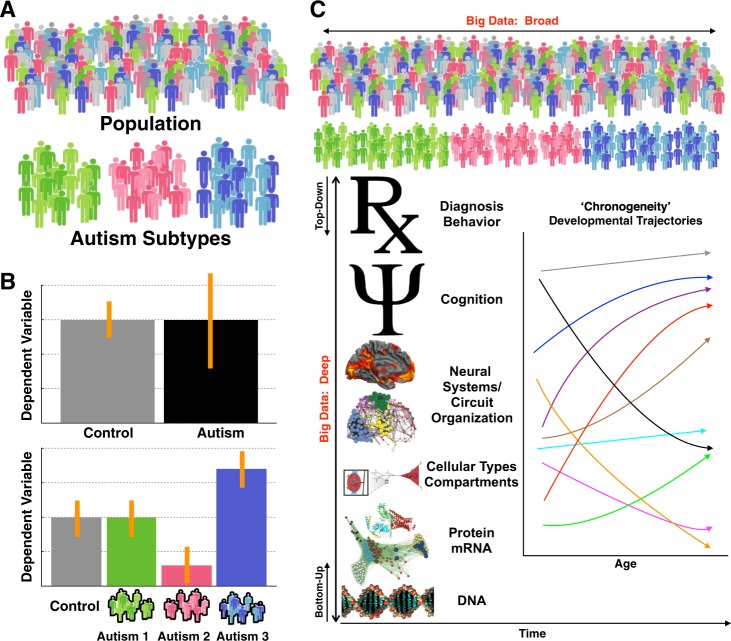
Autism is a diagnostic label based on behavior. While the diagnostic criteria attempt to maximize clinical consensus, it also masks a wide degree of heterogeneity between and within individuals at multiple levels of analysis. Understanding this multi-level heterogeneity is of high clinical and translational importance. Here we present organizing principles to frame research examining multi-level heterogeneity in autism. Theoretical concepts such as 'spectrum' or 'autisms' reflect non-mutually exclusive explanations regarding continuous/dimensional or categorical/qualitative variation between and within individuals. However, common practices of small sample size studies and case-control models are suboptimal for tackling heterogeneity. Big data are an important ingredient for furthering our understanding of heterogeneity in autism. In addition to being 'feature-rich', big data should be both 'broad' (i.e., large sample size) and 'deep' (i.e., multiple levels of data collected on the same individuals). These characteristics increase the likelihood that the study results are more generalizable and facilitate evaluation of the utility of different models of heterogeneity. A model's utility can be measured by its ability to explain clinically or mechanistically important phenomena, and also by explaining how variability manifests across different levels of analysis. The directionality for explaining variability across levels can be bottom-up or top-down, and should include the importance of development for characterizing changes within individuals. While progress can be made with 'supervised' models built upon a priori or theoretically predicted distinctions or dimensions of importance, it will become increasingly important to complement such work with unsupervised data-driven discoveries that leverage unknown and multivariate distinctions within big data. A better understanding of how to model heterogeneity between autistic people will facilitate progress towards precision medicine for symptoms that cause suffering, and person-centered support.
Overview
The claims and statistics of this paper haven’t been checked yet.
Free: it reads the open-access text and checks the first 5 claims that cite a source we can check. Create a free account to check every claim.
Integrity signals
Registry
Cites
Statistics
Figures
Verification
Claims the paper makes
The claims and statistics of this paper haven’t been checked yet.
Free: it reads the open-access text and checks the first 5 claims that cite a source we can check. Create a free account to check every claim.
Claims other papers make about this one
Each is checked against this paper’s own text: does it say what the citing paper says it does?
The source backs part of the claim, not all of it — or backs it for a different population, condition or comparison.
In the citing paper
“The scattered findings reported in studies about predictive coding and ASD may be related to a wide variety of factors, such as the dif ferences in tasks, the presence of co-occurring conditions, variations in medication use, potential cultural influences that shape responses and behaviors, as well as the intrinsic heterogeneity of ASD itself, which may manifest uniquely in each individual (Lomb”
From Predictive coding in neuropsychiatric disorders: a systematic transdiagnostic review. (2025) · cites this paper as Lombardo et al., 2019
Experimental — accuracy not yet measuredThe cited source says what the claim attributes to it.
In the citing paper
“Alongside the changes in classification systems, by now heterogeneity has already increased with regard to the expression and severity of the core and associated symptoms of ASD [4–6].”
From Autism spectrum disorder in ICD-11—a critical reflection of its possible impact on clinical practice and research (2024) · cites this paper as [4]
Self-check
Percentages, sums and reported differences re-computed from the paper’s own numbers.
The self-check needs the paper’s full text.
Citations
Cites
The Elements of Statistical Learning
Hastie, T., Tibshirani, R., & Friedman, J. (2009) · Springer Series in Statistics · doi:10.1007/978-0-387-84858-7 · Cited by 25,970
The Elements of Statistical Learning: Data Mining, Inference, and Prediction
John Lu, Z. Q. (2010) · Journal of the Royal Statistical Society Series A: Statistics in Society · doi:10.1111/j.1467-985x.2010.00646_6.x · Cited by 12,390
(1943) · The Nervous child · Cited by 8,870
Power failure: why small sample size undermines the reliability of neuroscience
Button, K. S., Ioannidis, J. P. A., Mokrysz, C., Nosek, B. A., Flint, J., Robinson, E. S. J., & Munafò, M. R. (2013) · Nature Reviews Neuroscience · doi:10.1038/nrn3475 · Cited by 7,641 · cited 2×
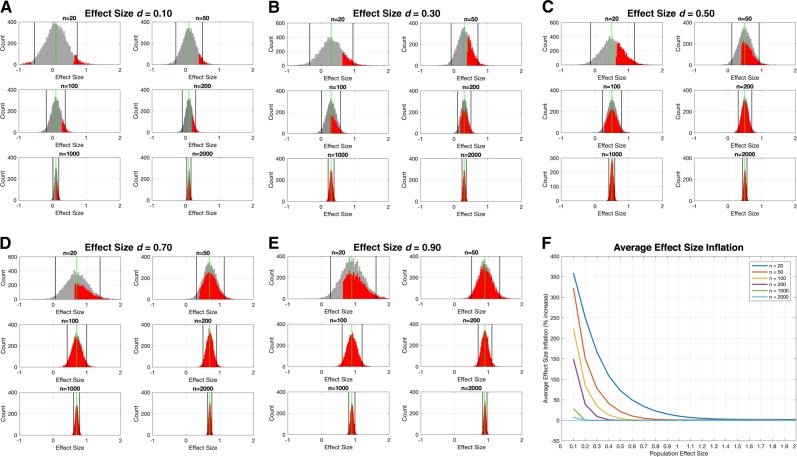
“Such inflated effects present an over-optimistic view on the identified effects and are prone to the winner’s curse [70].”
BackgroundInsel, T., Cuthbert, B., Garvey, M., Heinssen, R., Pine, D. S., Quinn, K., Sanislow, C., & Wang, P. (2010) · American Journal of Psychiatry · doi:10.1176/appi.ajp.2010.09091379 · Cited by 7,067
Baron-Cohen, S., Wheelwright, S., Skinner, R., Martin, J., & Clubley, E. (2001) · Journal of Autism and Developmental Disorders · doi:10.1023/a:1005653411471 · Cited by 6,450
Self-citationA New Initiative on Precision Medicine
Collins, F. S., & Varmus, H. (2015) · New England Journal of Medicine · doi:10.1056/nejmp1500523 · Cited by 5,202
Wing, L., & Gould, J. (1979) · Journal of Autism and Developmental Disorders · doi:10.1007/bf01531288 · Cited by 2,587 · cited 1×
“In the 1980s, Wing [56] and colleagues not only introduced the work of Hans Asperger into the English speaking world, but also conducted epidemiological studies that demonstrated the heterogeneity in social, language, motor, and cognitive abilities in the autistic and developmentally delayed population [57, 58].”
BackgroundLai, M.-C., Lombardo, M. V., & Baron-Cohen, S. (2014) · The Lancet · doi:10.1016/s0140-6736(13)61539-1 · Cited by 2,371
Self-citationDie „Autistischen Psychopathen” im Kindesalter
Asperger, H. (1944) · Archiv für Psychiatrie und Nervenkrankheiten · doi:10.1007/bf01837709 · Cited by 2,163 · cited 3×
“Moreover, both Leo Kanner and Hans Asperger recognized good cognitive potential in their child patients50, 52 and therefore autism was not necessarily tied to intellectual disability.”
Background
Research works printed but not linked: 1
- Loth E Ahmad J Mason L Crawley DV Hayward HL San Jose Caceres A Identifying cross-domain cognitive subtypes among children, adolescents, and adults with autism spectrum disorders 2017 San Francisco International Society for Autism Research
Cited by
Items 401–500 of 546
Morris, P. O., Hope, E., Foulsham, T., & Mills, J. P. (2020) · doi:10.31236/osf.io/u2rvk · Cited by 1
Pelton, M., Crawford, H., Bul, K., Robertson, A. E., Adams, J., Beurs, D. P. D., Rodgers, J., Baron‐Cohen, S., & Cassidy, S. (2022) · doi:10.31234/osf.io/3yhf9 · Cited by 1
Self-citationIncreased extra-axial cerebrospinal fluid and benign external hydrocephalus in early autismPreprint
Ben‐Arie, G., Shelef, I., Meiri, G., Menashe, I., Dinstein, I., & Arazi, A. (2024) · bioRxiv (Cold Spring Harbor Laboratory) · doi:10.1101/2024.01.04.574160 · Cited by 1
“Instead, it may be more useful to search for stratification biomarkers with the potential of identifying ASD subgroups with distinct physiology and etiologies 10 .”
BackgroundMultiscale heterogeneity of functional connectivity in autismPreprint
Ilioska, I., Oldehinkel, M., Llera, A., Rovný, M., Mei, T., Kia, S. M., Floris, D. L., Tillmann, J., Holt, R., Loth, E., et al. (2024) · medRxiv · doi:10.1101/2024.10.20.24315248 · Cited by 1
Computational Primitives for Cost-Benefit Decision-MakingPreprint
Rakocevic, L. I., Davila, L. D., Heaton, C. N., Beck, D. W., Alcalá, R. J. I., Hossain, S., Reyes, N. F., Macias, A. Y., Salcido, A. A., Tyulmankov, D., et al. (2024) · bioRxiv (Cold Spring Harbor Laboratory) · doi:10.1101/2024.12.09.627657 · Cited by 1
Editorial: New insights into neurodevelopmental biology and autistic spectrum disorders
Candini, M. (2025) · Frontiers in Neuroscience · doi:10.3389/fnins.2024.1514075 · Cited by 1
A Clinical Theory-Driven Deep Learning Model for Interpretable Autism Severity PredictionPreprint
Hu, X. (2026) · medRxiv · doi:10.64898/2026.01.25.26344792 · Cited by 2
Di, X., Xu, T., Castellanos, F. X., & Biswal, B. B. (2026) · bioRxiv (Cold Spring Harbor Laboratory) · doi:10.64898/2026.02.26.708280 · Cited by 1
Autism Sensory Profiles Predict Stimulus-Evoked Insula ConnectivityPreprint
Jacokes, Z., Beeler-Duden, S., Lawson, S., Eilbott, J. A., Dapretto, M., Kleinhans, N. M., McPartland, J. C., Jack, A., Wallace, G., Sukhodolsky, D. G., et al. (2026) · medRxiv · doi:10.64898/2026.04.29.26352062 · Cited by 1
Cross-species machine learning improves diagnostic classification of human psychiatric disordersPreprint
Zhan, Y., Wei, J., Liang, J., Xu, X., He, R., Robbins, T. W., & Wang, Z. (2019) · bioRxiv (Cold Spring Harbor Laboratory) · doi:10.1101/812693
Santos, A., Caramelo, F. J., Melo, J. B., & Castelo-Branco, M. S. (2020) · bioRxiv (Cold Spring Harbor Laboratory) · doi:10.1101/2020.04.28.065987
Bertelsen, N., Landi, I., Bethlehem, R. A. I., Seidlitz, J., Busuoli, E. M., Mandelli, V., Satta, E., Trakoshis, S., Auyeung, B., Kundu, P., et al. (2020) · bioRxiv (Cold Spring Harbor Laboratory) · doi:10.1101/2020.05.08.083758
Self-citationInvestigation of Genetic and Clinical Heterogeneity in Subtypes of Autism Spectrum Disorder
Chan, A. J. S. (2020) · TSpace (University of Toronto)
Bos, D. J., Dobos, D., Oranje, B., & Durston, S. (2020) · PsyArXiv (OSF Preprints) · doi:10.31234/osf.io/7xspg
Protocol paper Aging & Autism Geurts eaPreprint
Geurts, H. M., van Rentergem, J. A. A., Radhoe, T. A., Torenvliet, C., van der Putten, W., & Groenman, A. P. (2021) · PsyArXiv (OSF Preprints) · doi:10.31234/osf.io/cfkzw
A Highly Accurate Ensemble Classifier for the Molecular Diagnosis of ASD at Ages 1 to 4 YearsPreprint
Bao, B., Gazestani, V., Xiao, Y., Kim, R., Chiang, A. W. T., Nalabolu, S. R., Pierce, K., Robasky, K., Lewis, N. E., & Courchesne, E. (2021) · medRxiv · doi:10.1101/2021.07.08.21260225
Autisme in het licht van het biopsychosociaal model
Buitelaar, J. K., Velders, F. P., & de Jonge, M. V. (2021) · Bohn Stafleu van Loghum eBooks · doi:10.1007/978-90-368-2665-5_3
Screening and Diagnosis of Autism Spectrum Disorder via Assistive Tools: Classification Algorithms
Tuna, G., & Tuna, A. (2021) · Advances in early childhood and K-12 education · doi:10.4018/978-1-7998-7732-5.ch001
Howlin, P. (2021) · Faculty Opinions – Post-Publication Peer Review of the Biomedical Literature · doi:10.3410/f.739863163.793585597
Alvares, G. A., Mekertichian, K., Rose, F., Vidler, S., & Whitehouse, A. (2021) · doi:10.31219/osf.io/zg5tr
Neurodevelopmental, neurocognitive, and behavioral disorders
Smith, M. (2021) · Elsevier eBooks · doi:10.1016/b978-0-12-821913-3.00007-x
Early intervention in severe Autism : positive outcome using EDTPreprint
Blanc, R., Latinus, M., Guidotti, M., Adrien, J., Roux, S., Dansart, P., Barthélémy, C., Rambault, A., Bonnet‐Brilhault, F., & Malvy, J. (2021) · PsyArXiv (OSF Preprints) · doi:10.31234/osf.io/7yfmt · Cited by 1
Budimirovic, D. B. (2019) · Faculty Opinions – Post-Publication Peer Review of the Biomedical Literature · doi:10.3410/f.735846837.793561048
Using Connectivity to Explain AutismPreprint
Ewen, J. B. (2019) · PsyArXiv (OSF Preprints) · doi:10.31234/osf.io/vjd69
Positron Emission Tomography in the Neuroimaging of Autism Spectrum Disorder
Tan, Z., Ye, W., Xu, H., & Wang, L. (2023) · IntechOpen eBooks · doi:10.5772/intechopen.106825
Autism Affects Recognition Memory of VoicesPreprint
Lee, C., & Feinberg, D. R. (2022) · PsyArXiv (OSF Preprints) · doi:10.31234/osf.io/dynak
Geng, S., Dai, Y., Rolls, E. T., Liu, Y., Zhang, Y., Deng, L., Chen, Z., Feng, J., Li, F. R., & Cao, M. (2023) · bioRxiv (Cold Spring Harbor Laboratory) · doi:10.1101/2023.12.10.571041
McDonald, T. A. M. (2023) · Springer eBooks · doi:10.1007/978-3-031-42383-3_15 · Cited by 2
The many faces of control: brain-behavior interactions in development
Gooskens, B. (2024) · Utrecht University Repository (Utrecht University) · doi:10.33540/1183
Differentiated approach to the pharmacotherapy of autism spectrum disorders: biochemical aspects
Бокша, И. С., Prokhorova, T. A., Savushkina, O. K., Терешкина, Е. Б., & Burbaeva, G. S. (2023) · Biochemistry (Moscow) · doi:10.31857/s0320972523030028
Drug discovery and development and precision medicine for Autism Spectrum Disorder – current state
Stojanovska, I. (2024) · Journal of Health and Rehabilitation Sciences · doi:10.33700/jhrs.3.1.109 · Cited by 1
Genetic neurocognitive profile of autism unveiled with gene transcriptionPreprint
Hu, S., Zhang, Y., Li, F., Wu, H., Du, W. D., Shu, J., Wang, A., Xu, C., Li, C., & Wang, Y. (2024) · Research Square · doi:10.21203/rs.3.rs-5425486/v1
Bullen, J. C., Birkeneder, S., Zajic, M. C., Lerro, L., McIntyre, N. S., Sparapani, N., & Mundy, P. C. (2024) · Autism · doi:10.1177/13623613241304208
“…for efficient applications in large sample developmental, treat-ment outcome, and bio-behavioral studies (Fountain et al., 2012; Georgiades et al., 2013; Interagency Autism Coordinating Committee [IACC], 2019; Lombardo et al., 2019; Lord et al., 2015; Robinson et al., 2015; Scahill & Lord, 2004).”
Intelligence profiles in autism spectrum disorder
Silleresi, S. (2023) · Language acquisition & language disorders · doi:10.1075/lald.68.c4
Interactive technologies for training language skills in children on the autism spectrum
Silleresi, S. (2023) · Language acquisition & language disorders · doi:10.1075/lald.68.c7
Structural language and Autism Spectrum Disorder
Silleresi, S. (2023) · Language acquisition & language disorders · doi:10.1075/lald.68.c2
Silleresi, S. (2023) · Language acquisition & language disorders · doi:10.1075/lald.68.c3
Silleresi, S. (2023) · Language acquisition & language disorders · doi:10.1075/lald.68.c1
Silleresi, S. (2023) · Language acquisition & language disorders · doi:10.1075/lald.68.ack
List of most frequent acronyms and abbreviations
Silleresi, S. (2023) · Language acquisition & language disorders · doi:10.1075/lald.68.abb
Silleresi, S. (2023) · Language acquisition & language disorders · doi:10.1075/lald.68.refs
Silleresi, S. (2023) · Language acquisition & language disorders · doi:10.1075/lald.68.lot
Profiles in children on the autism spectrum: Insights from research
Silleresi, S. (2023) · Language acquisition & language disorders · doi:10.1075/lald.68.c6
Silleresi, S. (2023) · Language acquisition & language disorders · doi:10.1075/lald.68.li
Autism severity and developmental factors
Silleresi, S. (2023) · Language acquisition & language disorders · doi:10.1075/lald.68.c5
Silleresi, S. (2023) · Language acquisition & language disorders · doi:10.1075/lald.68.pre
Silleresi, S. (2023) · Language acquisition & language disorders · doi:10.1075/lald.68.lof
Silleresi, S. (2023) · Language acquisition & language disorders · doi:10.1075/lald.68.si
Silleresi, S. (2023) · Language acquisition & language disorders · doi:10.1075/lald.68.toc
Silleresi, S. (2023) · Language acquisition & language disorders · doi:10.1075/lald.68.prelim
Silleresi, S. (2023) · Language acquisition & language disorders · doi:10.1075/lald.68.c8
Lin, P., Khin, K. S., John, J. R., Walker, A. K., Chen, Y.-C., Nayeem, N., & Messias, E. (2024) · Children · doi:10.3390/children11121558
“However, the manifestation of neurodevelopmental symptoms, such as hyperactivity and emotional regulation difficulties, is characterized by significant heterogeneity across individuals with NDDs [10].”
Wall, C. A., Hudac, C. M., Dommer, K. J., Li, B., Atyabi, A., Foster, C. E., Wang, Q., Barney, E. C., Ahn, Y. A., Kim, M., et al. (2025) · Journal of Autism and Developmental Disorders · doi:10.1007/s10803-024-06691-x
Paramita, P. P. (2025) · KnE Social Sciences · doi:10.18502/kss.v10i7.18300
“Although there are several core symptoms of ASD, not every case of autism follows the same path (2,4).”
Computational Primitives for Cost-Benefit Decision-MakingPreprint
Friedman, A., Rakocevic, L. I., Davila, L. D., Heaton, C. N., Beck, D. W., Alcalá, R. J. I., Hossain, S., Reyes, N. F., Macias, A. Y., Salcido, A. A., et al. (2025) · SSRN Electronic Journal · doi:10.2139/ssrn.5205592
IVCA (Integrated Voice and Chat Assistant) for Visually Impaired
Chaudhari, A. K., Pathak, I., & Munde, S. (2025) · IGI Global eBooks · doi:10.4018/979-8-3693-7560-0.ch018
Guo, X., Xing, Y., Cui, D., Zhou, R., & Gao, L. (2025) · Brain Connectivity · doi:10.1089/brain.2024.0033 · Cited by 1
“Although the etiology of ASD is poorly understood, accumulating evidence generally suggests that the clinical presentation of individuals with ASD is highly heterogeneous (Lombardo et al., 2018, 2019).”
Factors Influencing Spoken Language in Autistic Cochlear Implant Users: A Mixed Methods StudyPreprint
Cardon, G. J., & Marks, C. (2025) · SSRN Electronic Journal · doi:10.2139/ssrn.5349296
Interventions for neurocognitive disorders—From clinical trials to practical implementation
Wang, H. (2025) · International Psychogeriatrics · doi:10.1016/j.inpsyc.2025.100131
Language impairment in autistic adolescents and young adults: Variability by definitionPreprint
Girolamo, T. M., Butler, L. K., & Parish‐Morris, J. (2025) · medRxiv · doi:10.1101/2025.09.05.25335184
“To test hypotheses about language in autism during the transition to adulthood, such as to what extent language and cognitive profiles vary (WHO, 2022), robust sampling and big data analysis to support gold-standard practices (e.g., a hold-out sample) are needed (Lombardo et al., 2019).”
Al-Zaabi, A., & Yousif, J. H. (2025) · Studies in systems, decision and control · doi:10.1007/978-3-031-96641-5_73
Raymond, K. E., Butler, B. E., Tremblay, P. F., Bodell, L. P., & Stevenson, R. A. (2025) · Research Square · doi:10.21203/rs.3.rs-7768960/v1
de Wit, M. M., Ferriera, P. S. B., Begeer, S., Abdellaoui, A., Wagtendonk, A., Bartels, M., van de Weijer, M. P., & Polderman, T. J. C. (2025) · Journal of Autism and Developmental Disorders · doi:10.1007/s10803-025-07127-w
Morphometric Latent Factors in Autism and Their Association with Receptor Profiles and BehaviorPreprint
Al-Naji, A., Abdolalizadeh, A., & Kristanto, D. (2025) · bioRxiv (Cold Spring Harbor Laboratory) · doi:10.64898/2025.12.08.692851
Fuhr, B. P., Perl, Y. S., Severino, I., Kringelbach, M. L., Deco, G., Ruhé, H. G., & Lombardo, M. V. (2026) · Biological Psychiatry Global Open Science · doi:10.1016/j.bpsgos.2026.100787 · Cited by 1
Self-citationYeh, C.-H., Tseng, R.-Y., Ni, H.-C., Cocchi, L., Chang, J.-C., Hsu, M.-Y., Tu, E.-N., Wu, Y.-Y., Chou, T., Gau, S., et al. (2022) · Figshare · doi:10.6084/m9.figshare.19793463
Yan, X., Qi, Y., Yao, X., Zhou, N., Ye, X., & Chen, X. (2024) · Figshare · doi:10.6084/m9.figshare.26676302
Yan, X., Qi, Y., Yao, X., Zhou, N., Ye, X., & Chen, X. (2024) · Figshare · doi:10.6084/m9.figshare.26676317
Yan, X., Qi, Y., Yao, X., Zhou, N., Ye, X., & Chen, X. (2024) · Figshare · doi:10.6084/m9.figshare.26676344
Yan, X., Qi, Y., Yao, X., Zhou, N., Ye, X., & Chen, X. (2024) · Figshare · doi:10.6084/m9.figshare.26676347
Floris, D. L., Filho, J. O. A., Lai, M., Giavasis, S., Oldehinkel, M., Mennes, M., Charman, T., Tillmann, J., Dumas, G., Ecker, C., et al. (2021) · Figshare · doi:10.6084/m9.figshare.14140167
Self-citationFloris, D. L., Filho, J. O. A., Lai, M., Giavasis, S., Oldehinkel, M., Mennes, M., Charman, T., Tillmann, J., Dumas, G., Ecker, C., et al. (2021) · Figshare · doi:10.6084/m9.figshare.14140161
Self-citationFloris, D. L., Filho, J. O. A., Lai, M., Giavasis, S., Oldehinkel, M., Mennes, M., Charman, T., Tillmann, J., Dumas, G., Ecker, C., et al. (2021) · Figshare · doi:10.6084/m9.figshare.14140164
Self-citationAdditional file 1 of Enhanced motor noise in an autism subtype with poor motor skills
Mandelli, V., Landi, I., Ceccarelli, S. B., Molteni, M., Nobile, M., D’Ausilio, A., Fadiga, L., Crippa, A., & Lombardo, M. V. (2024) · Figshare · doi:10.6084/m9.figshare.26945532
Self-citationYan, X., Qi, Y., Yao, X., Zhou, N., Ye, X., & Chen, X. (2024) · Figshare · doi:10.6084/m9.figshare.26676329
Yan, X., Qi, Y., Yao, X., Zhou, N., Ye, X., & Chen, X. (2024) · Figshare · doi:10.6084/m9.figshare.25137980
Yan, X., Qi, Y., Yao, X., Zhou, N., Ye, X., & Chen, X. (2024) · Figshare · doi:10.6084/m9.figshare.26676305
Yan, X., Qi, Y., Yao, X., Zhou, N., Ye, X., & Chen, X. (2024) · Figshare · doi:10.6084/m9.figshare.26676323
Yan, X., Qi, Y., Yao, X., Zhou, N., Ye, X., & Chen, X. (2024) · Figshare · doi:10.6084/m9.figshare.26676296
Li, G., Zarei, M. A., Alibakhshi, G., & Labbafi, A. (2024) · Figshare · doi:10.6084/m9.figshare.26705298
Additional file 1 of Physical health of autistic girls and women: a scoping review
Kassee, C., Babinski, S., Tint, A., Lunsky, Y., Brown, H. K., Ameis, S. H., Szatmári, P., Lai, M., & Einstein, G. (2020) · Figshare · doi:10.6084/m9.figshare.13151886
Self-citationYan, X., Qi, Y., Yao, X., Zhou, N., Ye, X., & Chen, X. (2024) · Figshare · doi:10.6084/m9.figshare.26676326
Yan, X., Qi, Y., Yao, X., Zhou, N., Ye, X., & Chen, X. (2024) · Figshare · doi:10.6084/m9.figshare.26676299
Yan, X., Qi, Y., Yao, X., Zhou, N., Ye, X., & Chen, X. (2024) · Figshare · doi:10.6084/m9.figshare.26676314
Mei, T., Llera, A., Forde, N. J., van Rooij, D., Floris, D. L., Beckmann, C. F., & Buitelaar, J. K. (2024) · Figshare · doi:10.6084/m9.figshare.25010365
Guo, X., Zhai, G., Liu, J., Cao, Y., Zhang, X., Cui, D., & Gao, L. (2024) · Figshare · doi:10.6084/m9.figshare.26557583
Ko, C., Kang, S., Hong, S.-B., & Park, Y. R. (2024) · Figshare · doi:10.6084/m9.figshare.26610522
Yan, X., Qi, Y., Yao, X., Zhou, N., Ye, X., & Chen, X. (2024) · Figshare · doi:10.6084/m9.figshare.26676332
Yan, X., Qi, Y., Yao, X., Zhou, N., Ye, X., & Chen, X. (2024) · Figshare · doi:10.6084/m9.figshare.26676320
Yan, X., Qi, Y., Yao, X., Zhou, N., Ye, X., & Chen, X. (2024) · Figshare · doi:10.6084/m9.figshare.25138069
Yan, X., Qi, Y., Yao, X., Zhou, N., Ye, X., & Chen, X. (2024) · Figshare · doi:10.6084/m9.figshare.26676335
Yan, X., Qi, Y., Yao, X., Zhou, N., Ye, X., & Chen, X. (2024) · Figshare · doi:10.6084/m9.figshare.26676341
Yan, X., Qi, Y., Yao, X., Zhou, N., Ye, X., & Chen, X. (2024) · Figshare · doi:10.6084/m9.figshare.26676293
Qi, S., Morris, R., Turner, J. A., Fu, Z., Jiang, R., DeRamus, T. P., Zhi, D., Calhoun, V. D., & Sui, J. (2020) · Figshare · doi:10.6084/m9.figshare.13257777
Newell, V., Phillips, L., Jones, C. A., Townsend, E., Richards, C., & Cassidy, S. (2023) · Figshare · doi:10.6084/m9.figshare.22625015
Yan, X., Qi, Y., Yao, X., Zhou, N., Ye, X., & Chen, X. (2024) · Figshare · doi:10.6084/m9.figshare.26676338
Ko, C., Kang, S., Hong, S.-B., & Park, Y. R. (2024) · Figshare · doi:10.6084/m9.figshare.26610519
Yan, X., Qi, Y., Yao, X., Zhou, N., Ye, X., & Chen, X. (2024) · Figshare · doi:10.6084/m9.figshare.26676311
Yan, X., Qi, Y., Yao, X., Zhou, N., Ye, X., & Chen, X. (2024) · Figshare · doi:10.6084/m9.figshare.26676308
Geng, G., Xu, G., Li, S., Zhu, Z., Liu, Z., Liu, Y., Wang, X. C., & Li, X. (2026) · Journal of Autism and Developmental Disorders · doi:10.1007/s10803-026-07217-3
Metadata
- Authors
- Lombardo, M. V., Lai, M.-C., & Baron-Cohen, S.
- Affiliations
- University of Cambridge (GB)
- Centre for Addiction and Mental Health (CA)
- Corresponding author
- Lombardo, Michael V.
- Venue
- Molecular Psychiatry
- Published
- 2019-01-07
- Volume
- 24
- Issue
- 10
- Pages
- 1435-1450
- ISSN
- 1359-4184 (ISSN-L)
- 1476-5578
- PMC
- PMC6754748
- OpenAlex
- W2951588804
- Cited by
- 537
- References
- 111
- Citations by year
- 2026: 75 · 2025: 65 · 2024: 84 · 2023: 77 · 2022: 75 · 2021: 74 · 2020: 64 · 2019: 20
- FWCI
- 7.38
- Type
- journal article
- Language
- en
- Open access
- hybrid
- doi.org
- Licence
- cc-by
- creativecommons.org/licenses/by/4.0 (tdm)
- Locations
- Molecular Psychiatry (publishedVersion, cc-by)
- bioRxiv (Cold Spring Harbor Laboratory) (acceptedVersion, cc-by-nc-nd)
- Europe PMC (PubMed Central) (publishedVersion, cc-by)
- PubMed Central (publishedVersion, cc-by)
- PubMed (publishedVersion)
- Apollo (University of Cambridge) (submittedVersion, cc-by)
- Apollo (cc-by)
- Funders
- EC | European Research Council (755816)
- Topics
- Life Sciences › Neuroscience › Cognitive Neuroscience › Autism Spectrum Disorder Research
- Life Sciences › Biochemistry, Genetics and Molecular Biology › Genetics › Genetics and Neurodevelopmental Disorders
- Social Sciences › Psychology › Experimental and Cognitive Psychology › Mental Health Research Topics
- Keywords
- autism spectrum disorder, autism heterogeneity, big data, dimensional versus categorical models, longitudinal development, precision medicine, person-centred support, sample size
- MeSH terms
- Autism Spectrum Disorder, Big Data, Humans, Longitudinal Studies, Case-Control Studies, Genetic Heterogeneity
About these checks
Registry, retraction, Cites and statistics results are computed, not judged, with one exception: a printed reference that no index lists is read once by a model before it counts as a citation error. Claims are extracted by a model and kept only when their quote appears verbatim in the text; each cited source is then checked, with a model’s help, for whether it says what the claim relies on. Those verdicts can be wrong — read the claim’s quote and the cited source before relying on one.
Statistics and arithmetic are recomputed, not judged.
Confidence bands are shown only for fields calibrated on our annotated test set. None is calibrated yet, so no band is shown.
What counts as a claim ›How we measure confidence ›How we check this ›
Are you an author, or do you see a problem with this page? Request a review
Data sources
Bibliographic data: Semantic Scholar, OpenAlex, Crossref.
Contains information from the Semantic Scholar Academic Graph Datasets, made available under the ODC Attribution License (ODC-BY 1.0).
Semantic Scholar’s data is described in: Kinney, R., et al. (2023). The Semantic Scholar Open Data Platform. arXiv:2301.10140.
